Question 14 Marks
Read the passage given below and answer the following questions from 1 to 5.
Kinetic Energy The energy possessed by a body by virtue of its motion is called kinetic energy. In other words, the amount of work done, a moving object can do before coming to rest is equal to its kinetic energy. $\therefore\text{Kinetic energy}, \text{KE}=\frac{1}{2}\text{mv}^2$ where, m is a mass andv is the velocity of a body. The units and dimensions of KE are Joule (inSI) and $[ML^2 T ^{-2} ],$ respectively. Kinetic energy of a body is always positive. It can never be negative.
Kinetic Energy The energy possessed by a body by virtue of its motion is called kinetic energy. In other words, the amount of work done, a moving object can do before coming to rest is equal to its kinetic energy. $\therefore\text{Kinetic energy}, \text{KE}=\frac{1}{2}\text{mv}^2$ where, m is a mass andv is the velocity of a body. The units and dimensions of KE are Joule (inSI) and $[ML^2 T ^{-2} ],$ respectively. Kinetic energy of a body is always positive. It can never be negative.
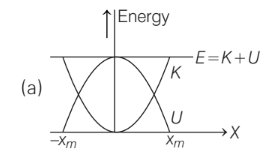
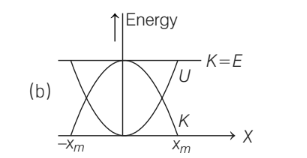
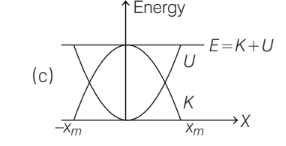
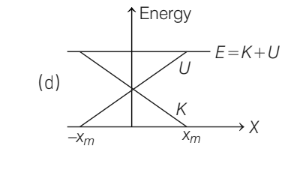
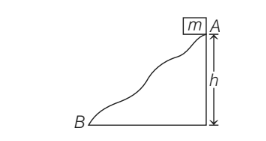
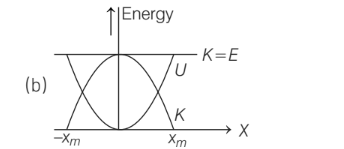
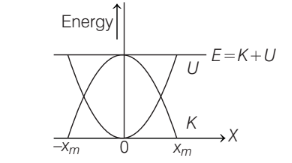
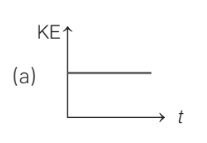
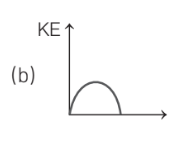
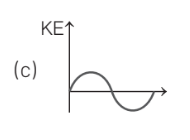
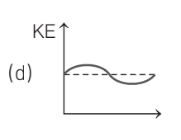
- Which of the diagrams shown in figure most closely shows the variation in kinetic energy of the earth as it moves once around the sun in its elliptical orbit?
- A force which is inversely proportional to the speed is acting on a body. The kinetic energy of the body starting from rest is:
- a constant
- inversely proportional to time
- directly proportional to time
- directly proportional to square of time
- The kinetic energy of an air molecule $(10 ^{-21} J)$ in eV is:
- 6.2 meV
- 4.2 meV
- 10.4 meV
- 9.7 meV
- Two masses of 1 g and 4 g are moving with equal kinetic energy. The ratio of the magnitudes of their momentum is:
- $4 : 1$
- $\sqrt{2}:1$
- $1 : 2$
- $1 : 16$
- An object of mass 10 kg is moving with velocity of $10\ ms ^{-1}.$ Due to a force, its velocity become $20\ ms^{-1}$ Percentage increase in its KE is:
- 25%
- 50%
- 75%
- 300%
Answer
When the earth is closest to the sun, speed of the earth is maximum, hence KE is maximum. When the earth is farthest from the sun, speed is minimum, hence KE is minimum but never zero and negative.
$\text{F}=\frac{\text{k}}{\text{v}}$
$\text{m}\frac{\text{dv}}{\text{dt}}=\frac{\text{K}}{\text{v}}$
$\Rightarrow\int\text{mv dv}=\int\text{K}\text{ dt}$
$\Rightarrow\text{m}\frac{\text{v}^2}{2}=\text{Kt}$
$\Rightarrow\text{Ke } \infty\text{ t}$
The kinetic energy of an air molecule is
$\frac{10^{-21}\text{J}}{1.6\times10^{-19}\frac{\text{J}}{\text{eV}}}=0.0062\text{ eV}$
This is the same as 6.2 meV.
As we know that, linear momentum, p
$=\sqrt{2\text{mK}}$
$\bigg(\because\text{K}=\frac{\text{p}^2}{2\text{m}}\bigg)$
For same kinetic energy, $\text{P}\infty\sqrt{\text{m}}$
$\frac{\text{P}_1}{\text{P}_2}=\sqrt\frac{\text{m}_1}{\text{m}_2}=\sqrt\frac{1}{4}=\frac{1}{2}=1:2$
Initial velocity $= 10\ ms^{-1}$
Final velocity $= 20\ ms^{-1}$
Final KE $=\frac{1}{2}\times10\times20\times20=20\times10^2\text{J}$
% incrase $=\frac{(20-5)\times10^2}{5\times10^2}\times100=300\%$
View full question & answer→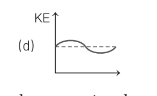
When the earth is closest to the sun, speed of the earth is maximum, hence KE is maximum. When the earth is farthest from the sun, speed is minimum, hence KE is minimum but never zero and negative.
- (c) directly proportional to time
$\text{F}=\frac{\text{k}}{\text{v}}$
$\text{m}\frac{\text{dv}}{\text{dt}}=\frac{\text{K}}{\text{v}}$
$\Rightarrow\int\text{mv dv}=\int\text{K}\text{ dt}$
$\Rightarrow\text{m}\frac{\text{v}^2}{2}=\text{Kt}$
$\Rightarrow\text{Ke } \infty\text{ t}$
- (a) 6.2 meV
The kinetic energy of an air molecule is
$\frac{10^{-21}\text{J}}{1.6\times10^{-19}\frac{\text{J}}{\text{eV}}}=0.0062\text{ eV}$
This is the same as 6.2 meV.
- (c) 1 : 2
As we know that, linear momentum, p
$=\sqrt{2\text{mK}}$
$\bigg(\because\text{K}=\frac{\text{p}^2}{2\text{m}}\bigg)$
For same kinetic energy, $\text{P}\infty\sqrt{\text{m}}$
$\frac{\text{P}_1}{\text{P}_2}=\sqrt\frac{\text{m}_1}{\text{m}_2}=\sqrt\frac{1}{4}=\frac{1}{2}=1:2$
- (d) 300%
Initial velocity $= 10\ ms^{-1}$
Final velocity $= 20\ ms^{-1}$
Final KE $=\frac{1}{2}\times10\times20\times20=20\times10^2\text{J}$
% incrase $=\frac{(20-5)\times10^2}{5\times10^2}\times100=300\%$