Questions · Page 2 of 2

3 Marks Question

Question 513 Marks
  1. When and where did Neanderthal man live?
  2. What was his brain capacity?
  3. Mention the advancements he showed over Homo erectus.
Answer
  1. Neanderthal man lived in near east and Central Asia, between 1,00,000-40,000 years before.
  2. His brain capacity was 1400cc.
  3. He used hides to protect the body. He buried the dead. His brain size was more (1400cc) than that of Homo erectus which was 900cc.
View full question & answer
Question 523 Marks
Define analogous organ. Give one example of analogous organ.
Answer
The organs, which have similar functions but are different in their structural details and origin are called analogous organs. The analogous structures are the result of convergent evolution. Fins of fishes and flippers of whales are analogous organs.
View full question & answer
Question 533 Marks
According to Darwinian theory, the rate of appearance of new forms is linked to their life cycles. Explain.
Answer
  1. The rate of appearance of new forms is linked to the lifespan of the species.
  2. Microbes have the ability to divide and multiply to produce millions of individuals within hours.
  3. A colony of bacteria (say A) growing on a given medium, has built-in variation in terms of ability to utilise a food component.
  4. A change in the composition of the medium will allow only those individuals who can survive in the changed condition.
  5. In due course of time, the variant population (say B) would outgrow the population A and appear as a new species; this would happen within a few days.
  6. This is also true for microbes to develop antibioticresistant varieties.
  7. Use of pesticides like DDT against mosquitoes has resulted in mosquito populations with DDT resistance within a few years.
  8. For a change to occur in a fish or fowl would take million years, as their lifespans are in years.
View full question & answer
Question 543 Marks
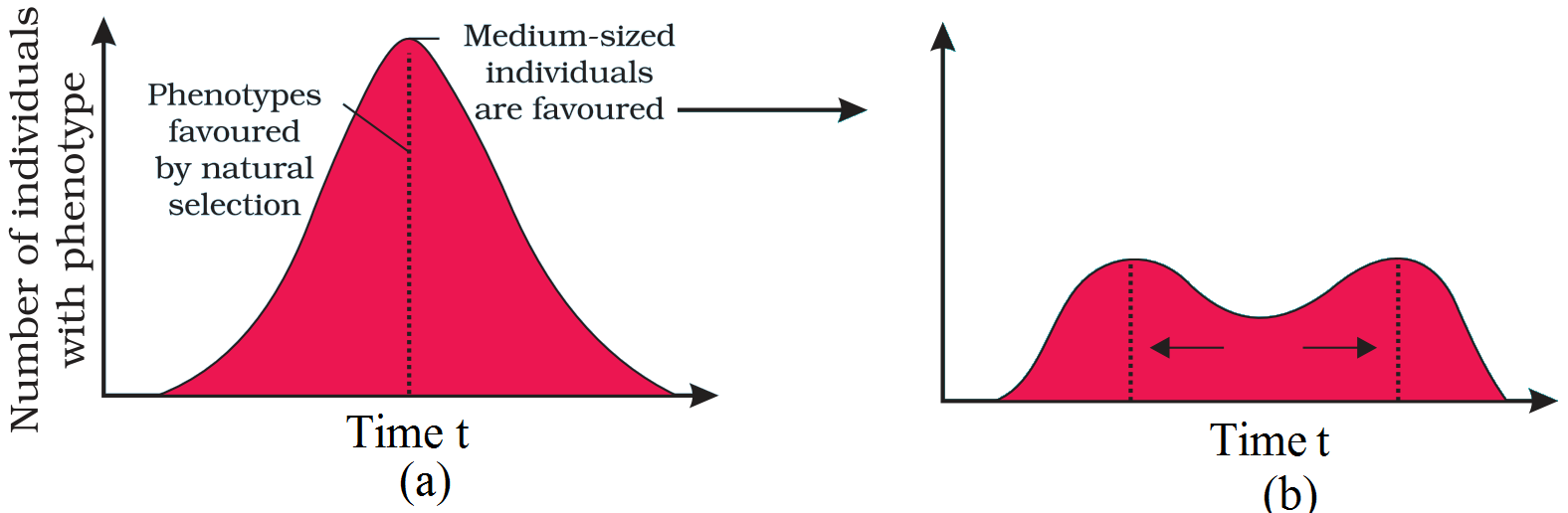
Study the figure (a) and (b) given below and answer the questions given after the graphs.
  1. Under the influence of which type of Natural Selection would graph (a) become like graph.
  2. What could be the likely reasons of new variations arising in the population?
  3. Who suggested Natural Selection as a mechanism of evolution?
Answer
  1. When disruptive natural selection operates.
  2. Mutation, gene flow genetic drift, recombination.
  3. Charles Darwin.
View full question & answer
Question 553 Marks
Classify the following as examples of homology and analogy:
  1. Mouth parts of cockroach and butterfly.
  2. Hearts of rabbits and human beings.
  3. Eyes of octopus and mammals.
  4. Sweet potato and potato.
  5. Stings of honeybee and scorpion.
  6. Tendrils of Lathyrus and tendrils of Gloriosa.
Answer
  1. Homology.
  2. Analogy.
  3. Analogy.
  4. Analogy.
  5. Analogy.
  6. Analogy.
View full question & answer
Question 563 Marks
  1. Name the ancestors of progymnosperm.
  2. Name the ancestors of herbaceous and arborescent lycopod.
  3. Name the ancestors of cycads.
Answer
  1. Psilophyton.
  2. Zosterophyllum.
  3. Progymnosperm.
View full question & answer
Question 573 Marks
What is molecular homology? Cite one example.
Answer
Molecular homology is the similarity among organisms at the molecular level. The amino acid sequence for the protein cytochromic-C is the same in humans and chimpanzee. Molecular homology shows phyllogenetic relationships.
View full question & answer
Question 583 Marks
When did the following appear on the geological history?
  1. Invertebrates.
  2. Jawless fish.
  3. Sea weeds.
Answer
  1. Invertebrates-500 mya
  2. Jawless fish-350 mya
  3. Sea weeds-320 mya
View full question & answer
Question 593 Marks
Excessive and continuous use of pesticides has resulted in evolution of some new species of pests. Explain what must have led to this. What is this type of evolution called?
OR
Anthropogenic action can hasten evolution. Explain with the help of a suitable example.
Answer
  1. Anthropogenic actions, i.e. human activities have been found to enhance evolution.
Example:
  1. Use of DDT has resulted in evolution of DDT-resistant mosquitoes.
  2. Evolution of antibiotic or drug-resistant microbes.
  1. When DDT was used for the first time, many mosquitoes died, but a few survived.
  2. These few mosquitoes showed resistance to DDT and reproduced in the presence of DDT.
  3. Most of the offspring were also resistant to DDT.
  4. Hence, the mosquito populations of today consist mainly of DDT-resistant mosquitoes and hence, DDT is not effective.
  5. In the absence of DDT, these DDT-resistant mosquitoes had no advantage over those mosquitoes, which were sensitive to DDT.
  6. This is an example of evolution due to anthropogenic activities, i.e., anthropogenic evolution.
View full question & answer
Question 603 Marks
Give a brief account of origin of earth.
Answer
The origin of life on the earth took place million of years ago and the study of history of life forms on earth is called evolutionary biology. The history of life actually comprises of two events, i.e. firstly origin of life and secondly the mechanism involved in the changes of living organisms through time or evolution of life. The origin of life is considered a unique went in the history of universe.
View full question & answer
Question 613 Marks
What are fossils? Mention any two ways in which the study of fossils support biological evolution of an organism.
Answer
Fossils are the remains or impressions of pre-historic organisms preserved in sedimentary rocks or other media.Two ways in which study of fossils support biological evolution:
  1. The study of Archaeopteryx reveals that birds have evolved from reptiles. This shows fossils provide evidence for evolution.
  2. Phylogeny can be constructed from fossils.
  3. The habitat and behaviour of extinct organisms can be inferred from well-preserved fossils.
View full question & answer
Question 623 Marks
How can Hardy-Weinberg equilibrium be affected? Explain giving three reasons.
Answer
Any disturbance in Hardy-Weinberg's genetic equilibrium indicates an evolutionary change.It is caused by one or more of the following:
  1. Gene migration/ Gene flow:
  • When a section of a population migrates to another population in another place, the gene frequencies change in both the populations.
  • When gene migration occurs a number of times, there is gene flow.
  1. Genetic drift: Due to some chance events, the allele frequency becomes so different that they become new species.
  2. Natural selection: It is a process in which heritable variations enabling better survival are made to reproduce and leave more progeny; hence, there is a change in the allele frequency.
  3. Genetic recombination: In sexually reproducing organisms, recombination of maternal and paternal alleles occurs during gametogenesis, it is a major cause of variation in the allele frequency
View full question & answer
Question 633 Marks
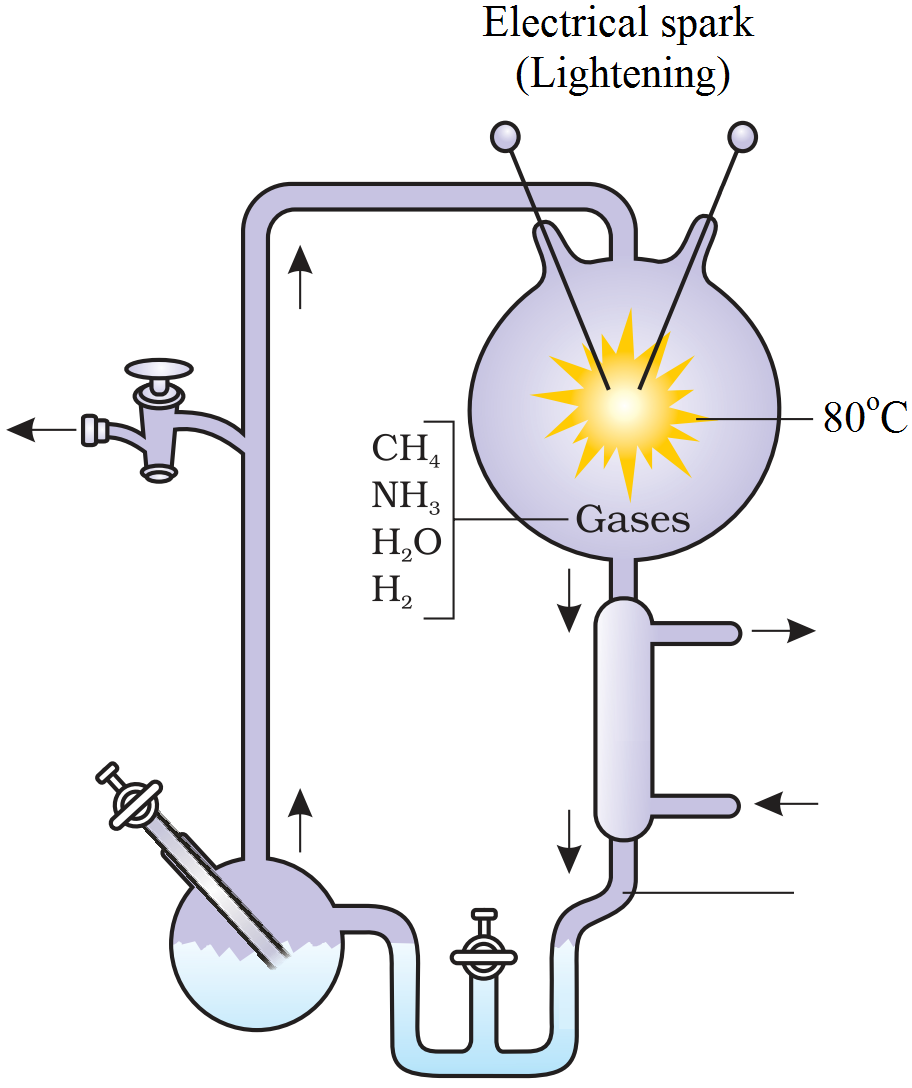
A student was simulating Urey and Millers experiment to prove the origin of life. The set up used by the student is given.
  1. Find out the reasons why he could not get desired results.
  2. What conclusion was drawn by Urey and Miller through this experiment?
  3. Compare the conclusion drawn with the theory of spontaneous generation.
Answer
  1. He could not get desired results because:
  • $\mathrm{O}_2$ was used instead of $\mathrm{H}_2$.
  • Temperature maintained was $80^{\circ} \mathrm{C}$ instead of $800^{\circ} \mathrm{C}$.
  1. It was concluded that life could have come from pre-existing non-living organic molecules and their formation was preceded by chemical evolution.
  2. Urey and Miller observed formation of amino acids when in a closed flask $\mathrm{CH}_4, \mathrm{H}_2, \mathrm{NH}_3$ and water vapour were heated at $800^{\circ} \mathrm{C}$ in presence of electric discharge. Analysis of meteorite content also reveals similar compounds indicating that similar process are occurring elsewhere in space (Chemical evolution). Urey and Miller proved that life originated abiogenetically whereas theory of spontaneous generation emphasised that units of life called spores were transferred to different planets including Earth.
View full question & answer
Question 643 Marks
What is natural selection? How is artificial selection different from natural selection? Give one example each from plants and animals where artificial selection has operated.
Answer
The nature builds some pressure on the population of a species and as a result few individuals are eliminated and few adapt to adjust with changes and become fit. This biological phenomenon is called natural selection.
S. No Natural selection Artificial selection
(i) It is a natural phenomenon. It is the practice done by man.
(ii) As a result only fit individual increases in a population. As a result commercially high yielding and disease resistance varieties increase.
Artificial selection have been operated in the followings cases:
Plants: Cabbage, wheat. Animals: High milk yielding varieties of cows.
View full question & answer
Question 653 Marks
"A population has been exhibiting genetic equilibrium."
Answer the following with regard to the above statement.
  1. Explain the above statement.
  2. Name the underlying principle.
  3. List any two factors which would upset the genetic equilibrium of the population.
  4. Take up any one such factor and explain how the gene pool will change due to factor.
Answer
  1. When the allele frequencies in a population remain stable and is constant from generation to generation, it is said to be in genetic equilibrium; it means the gene pool of the population remains constant.
  2. Hardy-Weinberg principle
  3. Two factors are:
  • Genetic drift.
  • Gene flow.
  1. Gene flow/ Migration: When the individuals of a population migrate to another population, gene frequencies change in both the populations.
  • New genes/ alleles are added to the second population while they are lost from the first population. If this migration happens a number of times, there will be gene flow.
View full question & answer
Question 663 Marks
Louis Pasteur’s experiments, if you recall, proved that life can arise from only pre-existing life. Can we correct this as life evolves from pre-existent life or otherwise we will never answer the question as to how the first forms of life arose? Comment.
Answer
For this experiment, Louis Pasteur used a sterilized flask and another flask which was open to air. Killed yeast did not produce new organism in sterilized flask, while yeast new organisms could come into origin in the second flask. This experiment helped in rejecting the theory of spontaneous generation. But lager experiments by Miller showed that organic molecules could develop from inorganic molecules; subsequently leading to origin of life. So, Pasteur’s observation could be corrected to some degree by Miller’s experiment.
View full question & answer
Question 673 Marks
If origin of life is in progress in any other planet, what would be the condition there?
Answer
The conditions which favour origin of life are:
  1. Reducing atmosphere, i.e. the presence of hydrogen.
  2. The absence of free oxygen.
  3. High temperature and storms to provide energy.
View full question & answer
Question 683 Marks
In the 1950s, there were hardly any mosquitoes in Delhi. The use of pesticide DDT on standing water killed their larvae. It is believed that now there are mosquitoes because they evolved DDT resistance through the interaction of mutation and Natural selection. Pointwise, state in a sequence how that could have happened.
Answer
  1. When DDT was first used, most of the mosquitoes were sensitive to it and were therefore killed.
  2. In the original population of mosquitoes, some individuals were resistant to DDT.
  3. They did not have any advantage over the DDT-sensitive mosquitoes, in the absence of DDT.
  4. They survived in the presence of DDT and reproduced; the offspring were also mostly DDT-resistant.
  5. As a result, over a period of time almost the entire population came to consist of the resistant type.
View full question & answer
Question 693 Marks
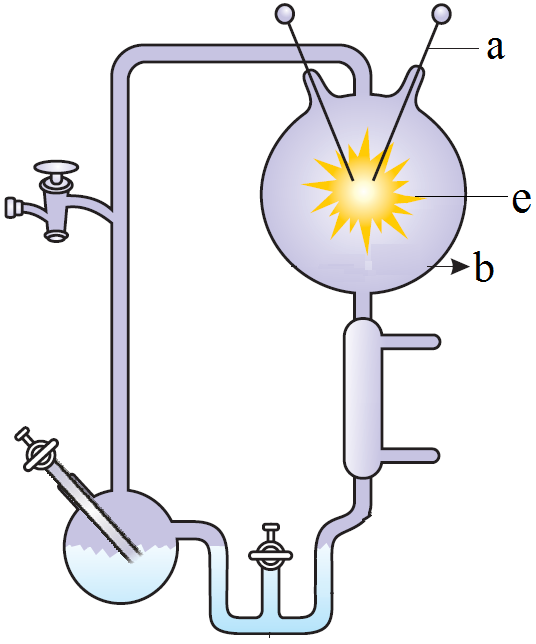
Name the scientist who had used the set-up shown below. Write the purpose of 'a' in the set-up and the conclusion the scientist arrived at.
Answer
  1. S.L. Miller used this set up.
  2. In the diagram, 'a' refers to electrode through which electric discharge was created
  3. Miller observed a large number of simple organic compounds and some amino acids. He proved that organic compounds were basis of life.
View full question & answer
Question 703 Marks
How does industrial melanism in Biston betularia illustrate the action of natural selection? Explain briefly.
Answer
Industrial Melanism is an adaptation, where the moths living in the industrial area developed melanin pigments to match their body to the tree trunk that were covered with black soot.
Before industrialisation, in Great Britain, it was observed that there were more white winged moths. However, after industrialisation the white coloured lichen covered the tree trunks. In that background the white winged moths survived but the dark coloured moths were eaten by predators. During the post industrialisation periods the tree trunks became dark due to industrial smoke and soots. Under such conditions, the white winged moths did not survive due to predators and dark winged moths survived.
In areas where industrialisation did not occur, the count of moths were low.
Thus, industrial melanism supports evolution by natural selection.
View full question & answer
Question 713 Marks
A population is exhibiting genetic equilibrium answer the following with regard to this statement.
  1. Explain the above statement.
  2. Name the underlying principle.
  3. Name any two factors which could upset the genetic equilibrium (i.e. allele frequency) of the population.
Answer
  1. The relative frequency of alleles of sexually reproducing organisms in a given population remains constant from generation to generation.
  2. Hardy-Weinberg equilibrium.
  3. Gene mutation, recombination, gene flow, genetic drift and natural selection.
View full question & answer
Question 723 Marks
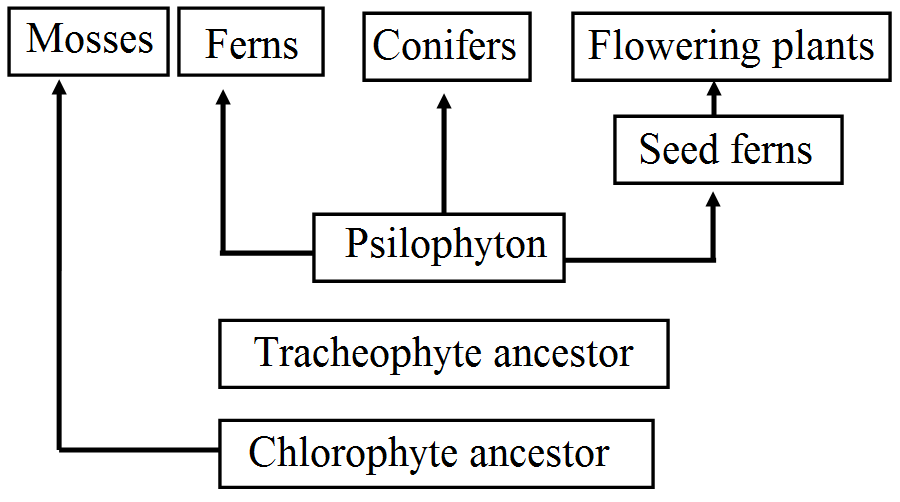
Study the schematic representation of evolutionary history of plant forms given below and mention:
  1. The plant form Ferns and Conifers are most related to.
  2. The nearest ancestors of flowering plants.
  3. The most primitive group of plants
  4. Common ancestry Psilophyton provides to.
  5. The common ancestors of Psilophyton and seed ferns.
  6. The common ancestors of mosses and tracheophytes.
Answer
  1. Psilophyton.
  2. Seed ferns.
  3. Chlorophyte ancestors.
  4. Ferns, Conifers, Seed ferns.
  5. Tracheophyte ancestors.
  6. Chlorophyte ancestors.
View full question & answer
Question 733 Marks
Mention the three connotations of the theory of special creation.
Answer
Theory of special creation:
  1. All living organisms (different species or types of plants and animals) that we see today were created as such.
  2. The diversity of life forms was always the same, since the time of creation and will remain the same in future too.
  3. Earth is about 4000 years old.
View full question & answer
Question 743 Marks
Amongst pea tendrils, Opuntia spines, lemon thorns, and Cucurbita tendrils, which are homologous structures? Why do you call them homologous?
Answer
Opuntia spines and pea tendrils are homologous because both are leaf modifications. Lemon thorns and Cucurbita tendrils are homologous because both are modified stems having same basic design and developmental origin but different functions.
View full question & answer
Question 753 Marks
Mention the charateristics of the first ape man Australopithecus africanus.
Answer
Australopithecus africanus was about 1.5 metres tall and had human as well as ape characters. It was with bipedal locomotion, omnivorous diet and had erect posture. It had human like teeth but it had more of an ape brain than a human brain. Its brain capacity was about 500cc, similar to that of an ape Australopithecus africanus existed about million year ago and gave rise to Homo habits about two million years ago.
View full question & answer
Question 763 Marks
Name and explain the principle, the given equation represents: $p^2+2 p g+q^2=1$.
Answer
  1. The given equation represents Hardy-Weinberg (genetic) equilibrium.
  2. This principle stated that allele frequences in a population are stable and remain constant from generation to generation, i.e., the gene pool remains a constant; this is called genetic equilibrium.
  3. The sum total of all the allele frequencies is one.
  4. Individual frequencies are named as p and q, which represent the frequencies of alleles A and a respectively, in a population of diploid organisms.
  5. The frequency of $A A$ individuals is $p^2$, while that of aa is $q^2$ and $A a$ is $2 p q$; hence $p^2+2 p g+q^2=1$, which is the binomial expansion of $(p+q)^2$.
  6. Any deviation in the frequency of alleles represents an evolutionary change.
View full question & answer
Question 773 Marks
Write in what context did Darwin use the terms 'fitness', 'survival' and 'selection' while elaborating on the mechanism of evolution.
Answer
According to Darwin, fitness refers to reproductive fitness. A fit species will leave more progenies. This will result in greater chances of survival. Greater the number of progenies which will survive, more they will be selected by nature to continue the species. This is called natural selection.
View full question & answer
Question 783 Marks
Palaeontological evidence support the theory of organic evolution. Explain with an example.
Answer
The study of fossils, i.e. palaeontological evidences support theory of organic evolution, i.e. evolution in plants and animals. The transitional fossil organisms show evolutionary relationship between two groups and are called connecting links, e.g. Archaeopteryx is a connecting link between reptiles and birds.
The study of fossil in different sedimentary layers indicates the geological period in which they existed, the life forms varied over time and life forms that are restricted to certain geological time scale. Hence, new forms of life have evolved at different times in the history of earth. All this forms palaeontological evidence. The ages of these fossils are estimated by using methods like radiocarbon and ting.
View full question & answer
Question 793 Marks
What are the periods in Palaeozoic era and name the plant group that appeared in each of them?
Answer
The periods in Palaeozoic era are:
  1. Silurian Zosterophyllum. (Psilophyton, Rhynia type plants).
  2. Devonian Progymnosperms.
  3. Carboniferous seed ferns.
  4. Permian Arborescent lycopods.
View full question & answer
Question 803 Marks
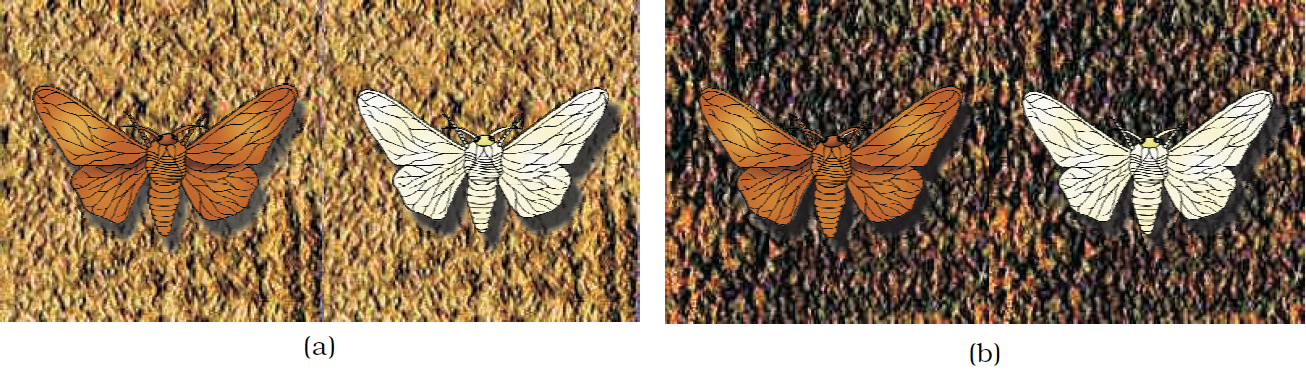
Taking the example of white-winged moths and dark-winged moths of England in pre and postindustrialised era, explain evolution by natural selection.OR
How can evolution by natural selection be explained by melanised moths before and after industrialisation in England?OR
How did industrialisation play a role in Natural Selection of light and dark-coloured moth in England?OR

What do these pictures (a) and (b) illustrate with reference to evolution? Explain.
Answer
Industrial Melanism:
  1. In England, before industrial revolution, there were more white-winged or dull-grey moths on the tree trunks, than the dark-winged or melanic moths.
  2. In the collection of moths, carried out in the same area after industrial revolution, there were more dark-winged moths.
  3. The explanation given for this observation was that predators will spot a moth against a contrasting background.
  4. During the post-industrialisation period, the trunks became dark with the industrial smoke and soot.
  5. Under this condition, white-winged moths did not survive as predators could easily spot these, while dark-winged or melanic moths survived better.
  6. Before industrialisation, there used to be a thick growth of the almost white-coloured lichens on the tree trunks and in that background, the white-winged moths survived better, the dark-coloured moths were easily spotted and picked up by their predators.
  7. In this case, the moths which were able to camouflage and hide in the background survived and increased their population size through reproduction.
View full question & answer
Question 813 Marks
What type of organs eye of an Octopus and that of a human called? Give another example from the animal group and one from the plants of such organs. Name and explain the evolutionary process they exhibit.
Answer
flippers of penguins and dolphins or eye of octopus and mammals In plants, these organs can be seen in sweet potato (root modification) and potato (stem modification). They are anatomically dissimilar structure though they perform similar function. This type of evolution is called convergent evolution.
View full question & answer
Question 823 Marks
State Hardy-Weinberg Principle and give the algebraic equation for the distribution of genotypes.
Answer
This principle states that allele frequencies in a population are static and is constant from generation to generation. Thus the gene pool remains a constant which is also called as genetic equilibrium. The distribution of genes is described by the relationship $A^2+2 A a+a^2=1$ where $A^2$ represents the frequency of the homozygous dominant genotype. 2Aa represents the frequency of the heterozygous genotype and $a^2$ represents the frequency of the homozygous recessive genotype.
View full question & answer
3 Marks Question - Page 2 - BIOLOGY STD 12 Science Questions - Vidyadip