Questions

5 Marks Questions

🎯

Test yourself on this topic

22 questions · timed · auto-graded

Question 15 Marks
The rate constant for the first order decomposition of $H_2O_2$​​​​​​​ is given by the following equation:
log $k = 14.34 – 1.25 \times 10^4K/T$
Calculate $E_a​​​​​​​$​​​​​​​ for this reaction and at what temperature will its half-period be $256$ minutes?
Answer
Arrhenius equation is given by,
$k = Ae^{-E_a/RT}$
$\text{In k}=\text{In A}-\frac{\text{E}_\text{a}}{\text{RT}}$
$\text{In k}=\text{log A}-\frac{\text{E}_\text{a}}{\text{RT}}$
$\text{log k}=\text{log A}-\frac{\text{E}_\text{a}}{\text{2.303 RT}}\ ....(\text{i})$
The given equation is
$\log k = 14.34 - 1.25 \times 10^4 K/T .....(ii)$
From equation (i) and (ii), we obtain
$\frac{\text{E}_\text{a}}{\text{2.303 RT}}=\frac{1.25\times10^4\text{K}}{\text{T}}$
$Ea = 1.25 \times 10^4 K \times 2.303 \times R$
$= 1.25 \times 10^4 K \times 2.303 \times 8.314 JK^{-1} mol$
$= 239339.3 J mol^{-1}​​​​​​​$​​​​​​​ (approximately)
Also, when $k_{1/2} = 256$ min utes
$\text{k}=\frac{0.693}{\text{t}_{1/2}}$
$=\frac{0.693}{256}$
$= 2.707 \times 10^{-5} s^{-1}$
It is also given that, log k = 14.34 - 1.25 × 10⁴ K/T
$\text{log}(4.51\times10^{-5})=14.34-\frac{1.25\times10^4\text{K}}{\text{T}}$
$\text{log}(0.654-05)=14.34-\frac{1.25\times10^4\text{K}}{\text{T}}$
$\frac{1.25\times10^4\text{K}}{\text{T}}=18.686$
$\text{T}=\frac{1.25\times10^4\text{K}}{18.686}$
$= 668.95\ K$
$= 669\ K$ (approximately)
View full question & answer
Question 25 Marks
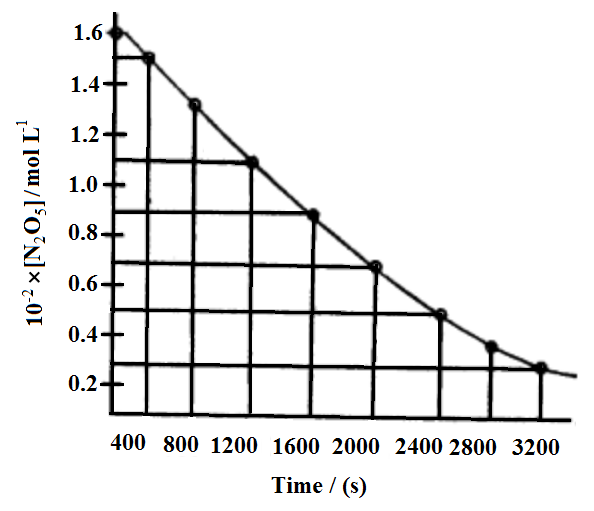
The experimental data for decomposition of $N_2O_5 [2N_2O_5 \rightarrow 4NO_2 + O_2]$ in gas phase at $318K$ are given below:
$t/s$ $0$ $400$ $800$ $1200$ $1600$ $2000$ $2400$ $2800$ $3200$
$10^2 \times [N_2O_5]/mol L^{-1}$ $1.63$ $1.36$ $1.14$ $0.93$ $0.78$ $0.64$ $0.53$ $0.43$ $0.35$
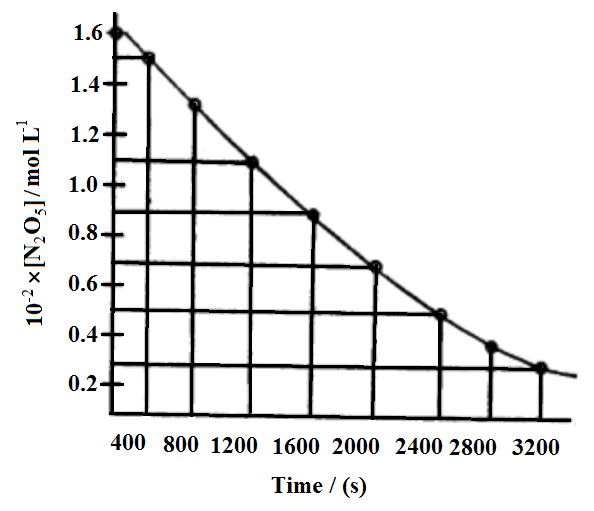
  1. Plot $[N_2O_5]$ against t.
  2. Find the half-life period for the reaction.
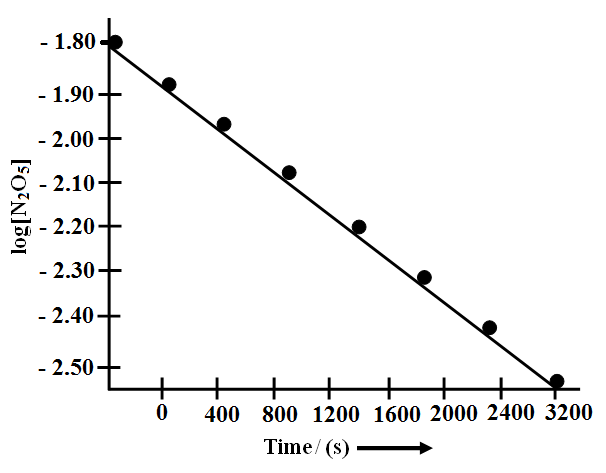
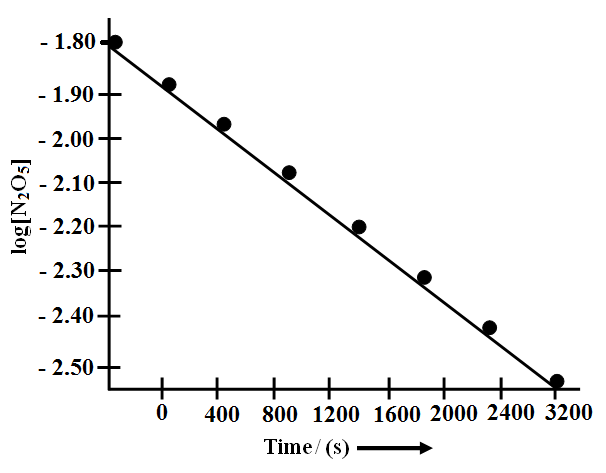
  3. Draw a graph between $\log[N_2O_5]$ and $t.$
  4. What is the rate law?
  5. Calculate the rate constant.
  6. Calculate the half-life period from k and compare it with $(ii).$
Answer
  1.  
  1. Time corresponding to the concentration, $\frac{1.630\times10^2}{2}\text{mol L}^{-1}$ = 81.5 mol L^{-1} is the half life. From the graph, the half life is obtained as $1450$ s.
  2.  
$t(s)$ $102 \times [N_2O_5]/mol L^{-1}$ $\log[N_2O_5]$
$0$ $1.63$ $-1.79$
$400$ $1.36$ $-1.87$
$800$ $1.14$ $-1.94$
$1200$ $0.93$ $-2.03$
$1600$ $0.78$ $-2.11$
$2000$ $0.64$ $-219$
$2400$ $0.53$ $-2.28$
$2800$ $0.43$ $-2.37$
$3200$ $0.35$ $-2.46$
  1. The given reaction is of the first order as the plot, $\log[N_2O_5]\ v/s\ t,$ is a straight line. Therefore, the rate law of the reaction is Rate $= k[N_2O_5]s$
  1. From the plot, $\log[N_2O_5] v/s\ t,$ we obtain
$\text{Slope}=\frac{-2.46-(-1.79)}{3200-0}$
$=\frac{-0.67}{3200}$
Again, slope of the line of the plot $\log[N2O5]$ v/s t is given by $-\frac{\text{k}}{2.303}$ Therefore, we obtain,
$-\frac{\text{k}}{2.303}=-\frac{0.67}{3200}$
View full question & answer
Question 35 Marks
The rate constant for the decomposition of $N_2O_5$ at various temperatures is given below:
$T/^\circ C$ $0$ $20$ $40$ $60$ $80$
$105 \times k/s-1$ $0.0787$ $1.70$ $25.7$ $178$ $2140$
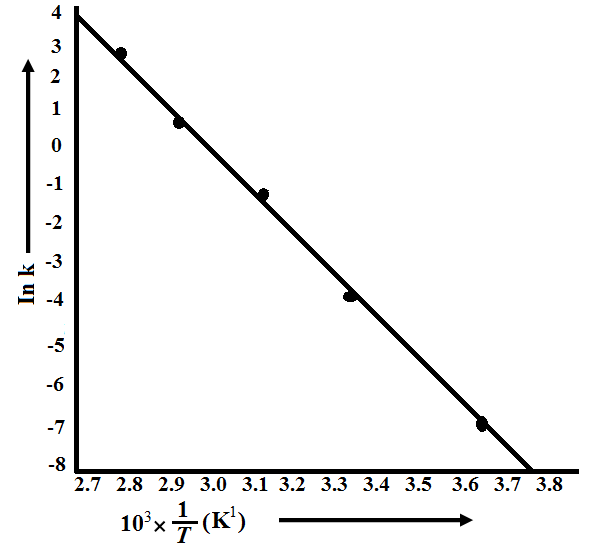
Draw a graph between ln $k$ and $1/T$ and calculate the values of $A$ and $E_a$. Predict the rate constant at $30^\circ$ and $50^\circ C.$
Answer

From the given data, we obtain
$\text{T}/^\circ\text{C}$
$0$
$20$
$40$
$60$
$80$
$\text{T/K}$
$273$
$293$
$313$
$333$
$353$
$\frac{1}{\text{T}}/\text{K}^{-1}$
$3.66\times10^{-3}$
$3.41\times10^{-3}$
$3.19\times10^{-3}$
$3.0\times10^{-3}$
$2.83\times10^{-3}$
$10^5\times\text{k/s}^{-1}$
$0.0787$
$1.70$
$25.7$
$178$
$2140$
$\text{In K}$
$-7.147$
$-4.075$
$-1.359$
$-0.577$
$3.063$

Slope of the line,
$\frac{\text{y}_2-\text{y}_1}{\text{x}_2-\text{x}_1}=-12.301\text{K}$
According to Arrhenius equation,
$\text{Slope}=-\frac{\text{E}_\text{a}}{\text{R}}$
$\text{E}_\text{a}=-\text{Slope}\times\text{R}$
$= -(-12.301\ K) \times (8.134JK^{-1}\ mol^{-1})$
$= 102.27\ KJ\ mol^{-1}$
Again,
$\text{In k}=\text{In A}-\frac{\text{E}_\text{a}}{\text{RT}}$
$\text{In A}=\text{In k}+\frac{\text{E}_\text{a}}{\text{RT}}$
When $T = 273\ K$
In $k = –7.147$
$\text{Then, In A}=-7.147+\frac{102.27\times10^3}{8.314\times273}$
$= 37.911$
Therefore, $A = 2.91 \times 10^6$​​​​​​​
When, $T = 30 + 273K = 303\ K$
$\frac{1}{\text{T}}=0.0033\text{K}=3.3\times10^{-3}\text{K}$
$\text{Then, at}\frac{1}{\text{T}}=3.3\times10^{-3}\text{K},$
In $k = –2.8$
Therefore, $k = 6.08 \times 10^{-2} s^{-1}$
Again, when $T = 50 + 273K = 323K,$
View full question & answer
Question 45 Marks
The time required for $10 \%$ completion of a first order reaction at $298 K$ is equal to that required for its $25 \%$ completion at $308 K $. If the value of A is $4 \times 10^{10} S^{-1}$. Calculate k at $318 K $ and $E _{ a }$.
Answer
For a first order reaction, $\text{t}=\frac{2.303}{\text{k}}\text{log}\frac{\text{a}}{\text{a - x}}$
$\text{At}\ 298\ \text{K, t}=\frac{2.303}{\text{k}}\text{log}\frac{100}{90}$
$\frac{0.1054}{\text{k}}$
At 308 K,
$\text{t'}=\frac{2.303}{\text{k'}}\text{log}\frac{100}{75}$
$=\frac{2.2877}{\text{k'}}$
According to the question, t = t’
$\frac{0.1054}{\text{k}}=\frac{0.2877}{\text{k'}}$
$\frac{\text{k'}}{\text{k}}=2.7296$
From Arrhenius equation, we obtain
$\text{log}\frac{\text{k'}}{\text{k}}=\frac{\text{E}_\text{a}}{2.303\text{R}}\bigg(\frac{\text{T' - T}}{\text{TT'}}\bigg)$
$\text{log}(2.7296)=\frac{\text{E}_\text{a}}{2.303\times8.314}\bigg(\frac{308-298}{298\times308}\bigg)$
$\text{E}_\text{a}=\frac{2.303\times8.314\times298\times308\times\text{log}(2.7296)}{308-298}$
$= 76640.096 J mol^{-1}$
$= 76.64 kJ mol^{-1}$​​​​​​​
To calculate k at 318 K,
It is given that, $A = 4 \times 10^{10} s^{-1}, T = 318K$
Again, from Arrhenius equation, we obtain
$\text{log k}=\text{log A}-\frac{\text{E}_\text{a}}{2.303\ \text{RT}}$
$=\text{log}(4\times10^{10})-\frac{76.64\times10^3}{2.303\times8.314\times318}$
$= (06021 + 10) - 12.5876$
$= -1.9855$
Therefore, k = Antilog (–1.9855)
$= 1.034 \times 10^{-2} s^{-1}​​​​​​​$​​​​​​​
View full question & answer
Question 55 Marks
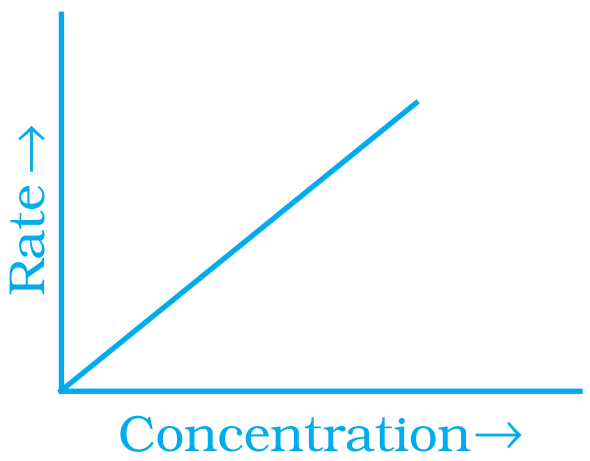
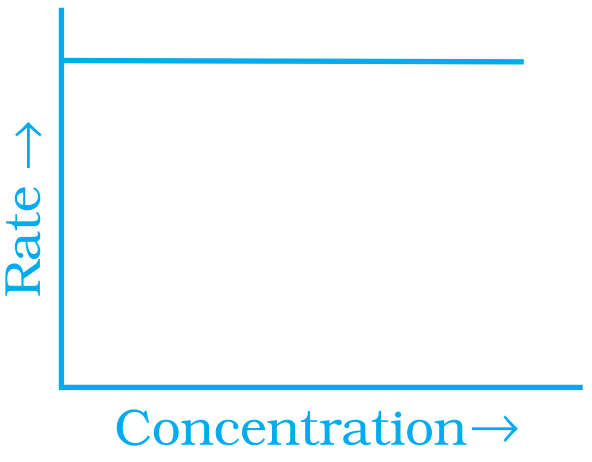
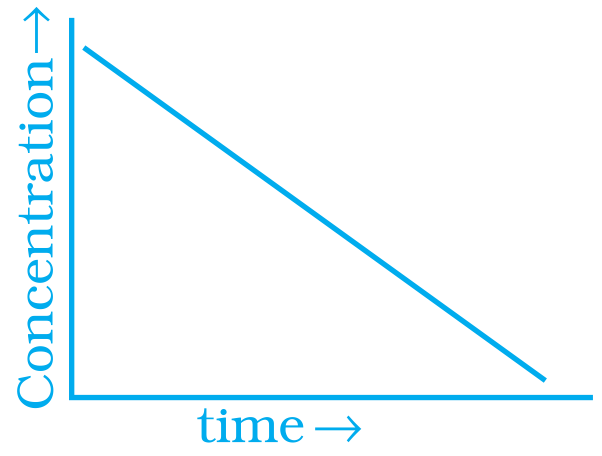
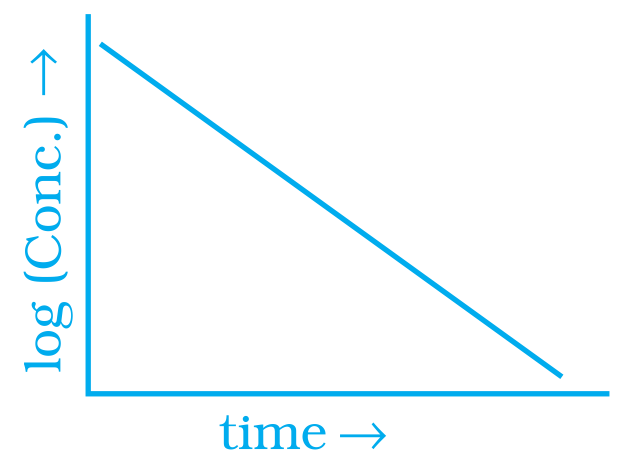
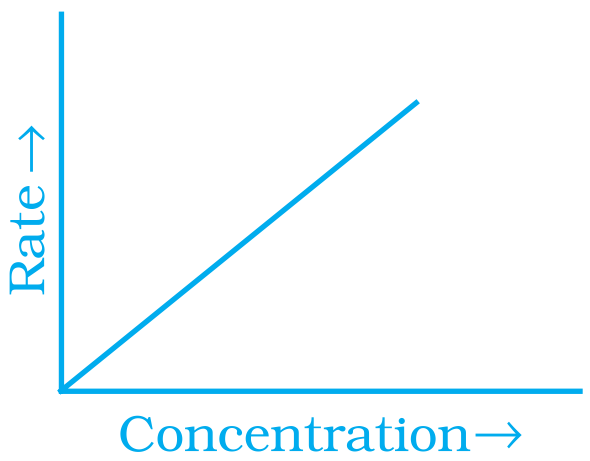
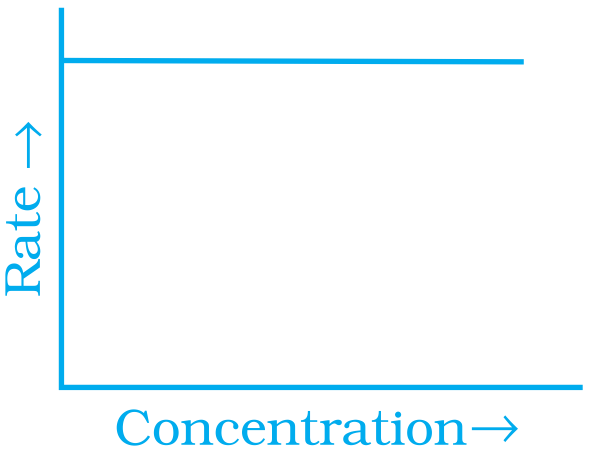
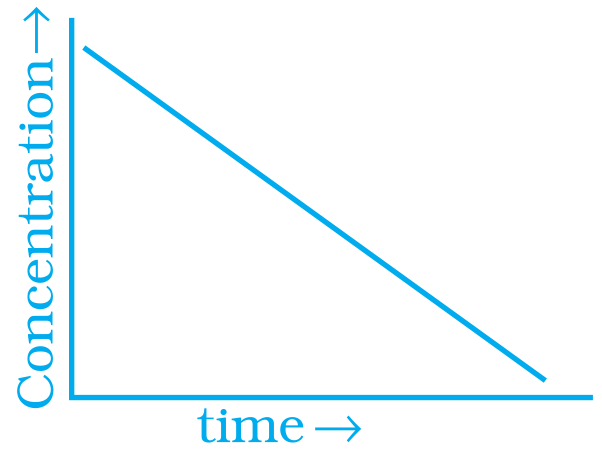
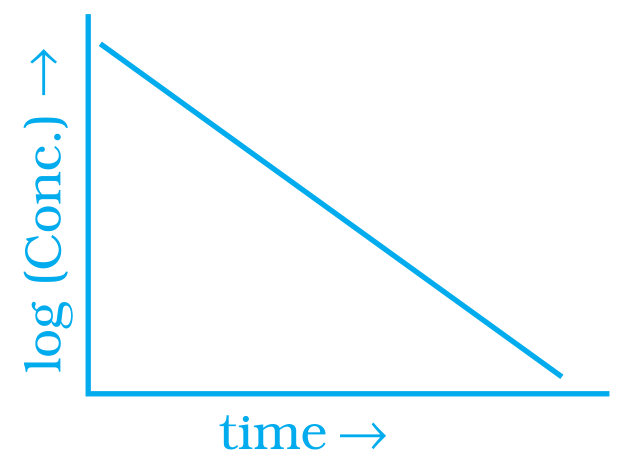
Match the graph given in Column I with the order of reaction given in Column II. More than one item in Column I may link to the same item of Column II.
 
Column I
 
Column II
(i)
 
 
(ii)
(a)
$I^{st}$ order
(iii)
(b)
Zero order
(iv)
   
Answer
 
Column I
 
Column II
(i)
(a)
$I^{st}$ order
(ii)
(b)
Zero order
(iii)
(b)
Zero order
(iv)
(a) $I^{st}$ order
Explanation:
For the first order reaction rate of reaction is directly proportional to the concentration of the reactant.
$\frac{\text{D[R]}}{\text{dt}}\propto[\text{R}]$
Hence the graph (i) will be a straight line.
Modifying the integrated rate equation for first order reaction.
$\text{K}=\frac{2.303}{\text{t}}\log\Big[\frac{\text{R}^0}{\text{R}}\Big]$
graph (iv) is of first order reaction.
For zero order reaction rate $= k[R]_0. $Therefore, rate is independent of the concentration of reactant.
Therefore graph (ii) is of zero order reaction.
From integrated rate equation of zero order reaction $k = [R_0] -[R]$ thus graph (iii) of zero order reaction.
View full question & answer
Question 65 Marks
In the reaction
$Q + R \rightarrow $ Products
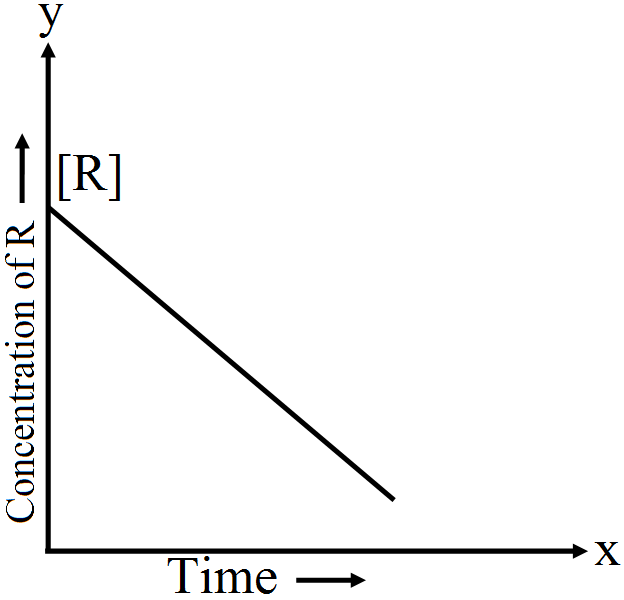
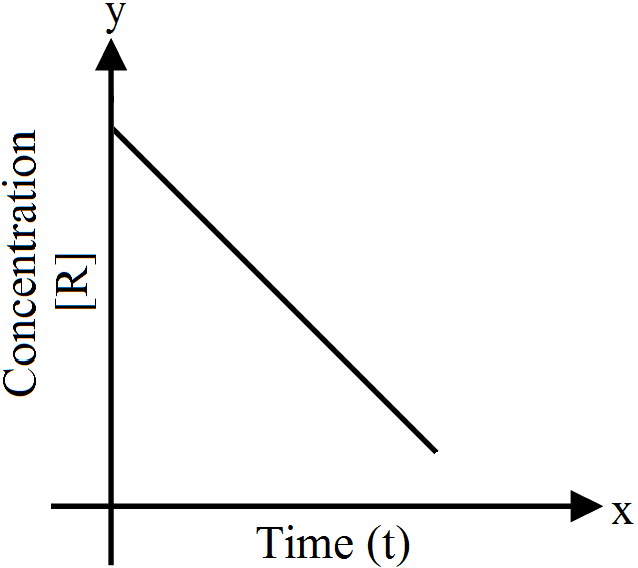
The time taken for $99\%$ reaction of $Q$ is twice the time taken for $90\%$ reaction of $R.$ The concentration of $R$ varies with time as shown in the figure given alongside.

What is the overall order of the reaction? Give the units of the rate constant for the same. Write the rate expression for the above reaction.
Answer
For reactant $Q, t_{99\%} = 2 \times t_{90\%}$ Therefore, order of reaction w.r.t. reactant $Q = 1.$
From the graph, order of reaction w.r.t. reactant, $R = 0.$
So, overall order of reaction $= 1 + 0 = 1$
Unit of rate constant, $k =$ time$-1$
Rate $= k[Q][R]^0$
Rate $= k[Q].$
View full question & answer
Question 75 Marks
The experimental data for decomposition of $N_2O_5$
$[2N_2O_5 \rightarrow 4NO_2 + O_2]$
in gas phase at 318K are given below:
$t/s$ $0$ $400$ $800$ $1200$ $1600$ $2000$ $2400$ $2800$ $3200$
$10^2 \times [N_2O_5]/mol L^{-1}$ $1.63$ $1.36$ $1.14$ $0.93$ $0.78$ $0.64$ $0.53$ $0.43$ $0.35$
  1. Plot $[N_2O_5]$ against $t.$
  2. Find the half-life period for the reaction.
  3. Draw a graph between $ \log[N_2O_5]$ and $t.$
  4. What is the rate law?
  5. Calculate the rate constant.
  6. Calculate the half-life period from k and compare it with $(ii).$
Answer
  1.  
  1. Time corresponding to the concentration, $\frac{1.630\times10^2}{2}\text{mol L}^{-1} = 81.5\ mol \ L^{-1}$ is the half life. From the graph, the half life is obtained as $1450 $ s.
  2.  
$t(s)$ $102 \times [N_2O_5]/mol L^{-1}$ $\log[N_2O_5]$
$0$ $1.63$ $-1.79$
$400$ $1.36$ $-1.87$
$800$ $1.14$ $-1.94$
$1200$ $0.93$ $-2.03$
$1600$ $0.78$ $-2.11$
$2000$ $0.64$ $-219$
$2400$ $0.53$ $-2.28$
$2800$ $0.43$ $-2.37$
$3200$ $0.35$ $-2.46$
  1. The given reaction is of the first order as the plot, $\log[N_2O_5]$ v/s t, is a straight line. Therefore, the rate law of the reaction is Rate $= k[N_2O_5]s$
  1. From the plot, $\log[N_2O_5]$ v/s t, we obtain
$\text{Slope}=\frac{-2.46-(-1.79)}{3200-0}$
$=\frac{-0.67}{3200}$
Again, slope of the line of the plot $\log[N2O5]$ v/s t is given by $-\frac{\text{k}}{2.303}$ Therefore, we obtain,
$-\frac{\text{k}}{2.303}=-\frac{0.67}{3200}$
View full question & answer
Question 85 Marks
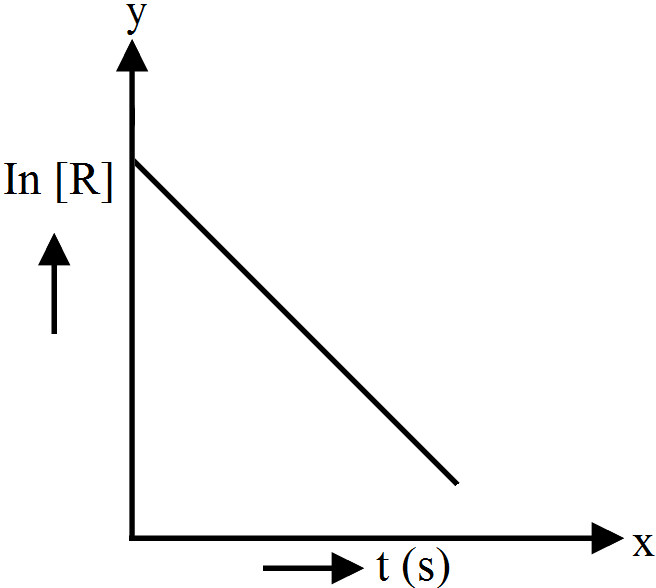
For a certain chemical reaction variation in the concentration ln $[R]$ vs. time plot is given alongside.For this reaction:
  1. What is the order of the reaction?
  2. What are the units of rate constant $k$?
  3. Give the relationship between $k$ and $t1/2$ (half-life period).
  4. What is the slope of the curve?
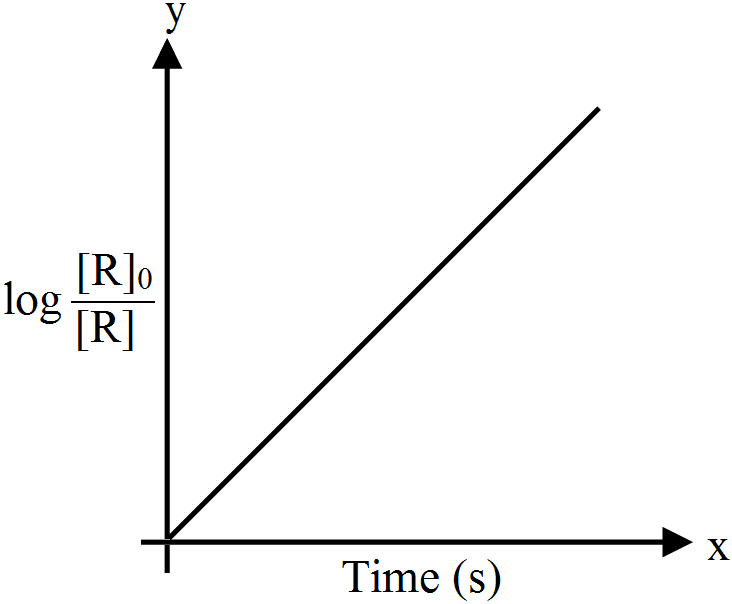
  5. Draw the plot log $[R]0 /[R]$ vs time $t(s)$.
Answer
  1. First order.
  2. $Time^{-1} (s^{-1})$
  3. $\text{k}=\frac{0.693}{\text{t}_{1/2}}$
  4. Slope = - k (rate constant).
  5.  
View full question & answer
Question 95 Marks
Rate constant for a first order reaction has been found to be $2.54 \times 10^{-3} \mathrm{~s}^{-1}$. Calculate its three-fourth life.
Answer
$\text{|R|}=\text{|R|}_0-\frac{3}{4}\text{|R}|_0=\frac{\text{|R|}_0}{4}$
Substituting $\text{|R|}=\frac{\text{|R|}_0}{4},\text{k}=2.54\times10^{-3}8^{-1}$ in the expression $\text{t}=\frac{2.303}{\text{k}}\log \frac{\text{|R|}_0}{\text{|R|}},$ we get
$\text{t=}\frac{2.303}{2.54\times10^{-3}}\log\frac{\text{|R|}_0}{\text{|R|}4}=\frac{2.303\times10^3}{2.54}\log4$
$\text{t}=\frac{2.303\times10^3}{2.54}\times06021=545.92\text{ s}$
Alternative methode:
For a first order reaction, $\text{t}_{3/4}=2\times\text{t}_{1/2}$
$\therefore \text{t}_{3/4}=2\times\frac{0.693}{\text{k}}$
$\text{t}_{3/4}=\frac{2\times.963}{2.54\times10^{-3}\text{s}}=545.67\text{s}$
View full question & answer
Question 105 Marks
The decomposition of $\mathrm{N}_2 \mathrm{O}_5(\mathrm{~g})$ is a first order reaction with a rate constant of $5 \times 10^{-4} \mathrm{~s}^{-1}$ at $45^{\circ} \mathrm{C}$, i.e., $2 \mathrm{~N}_2 \mathrm{O}_5(\mathrm{~g}) \rightarrow$ $4 \mathrm{NO}_2(\mathrm{~g})+\mathrm{O}_2(\mathrm{~g})$. If initial concentration of $\mathrm{N}_2 \mathrm{O}_5$ is $0.25\ M$ , calculate its concentration after $2$ min . Also, calculate halflife for decomposition of $\mathrm{N}_2 \mathrm{O}_5(\mathrm{~g})$.
Answer
$[R]_0 = 0.25\ M,\ t = 2 \min = 2 \times 60\ s = 120\ s,\ k = 5.0 \times 10^{-4}s-^1 $ For a first order reaction, $\text{k}=\frac{2.303}{\text{t}}\log\frac{\text{|R|}_0}{\text{|R|}}$$5.0\times10^{-4}=\frac{2.303}{120}\log\frac{0.25}{\text{}|R|}\text{ or }\log \frac{0.25}{\text{|R|}}=0.026$
$\log \frac{\text{|R|}}{0.25}=-0.026 \text{ or}\log \frac{0.25}{\text{|R|}}=\text{Antilog}(\overline{1}.974)$ $\frac{\text{|R|}}{0.25}=0.9419\text{ or }\text{[R]}=0.235\text{ m}$ $\text{t}_{\frac{1}{2}}=\frac{0.693}{\text{k}}=\frac{0.693}{5\times10^{-4}\text{s}^{-1}}=1386\text{ s}.$
View full question & answer
Question 115 Marks
The activation energy of a reaction is $75.2 kJ mol ^{-1}$ in the absence of a catalyst and it lowers to $50.14 kJ mol ^{-1}$ with a catalyst. How many times will the rate of reaction grow in the presence of a catalyst if the reaction proceeds at $25^{\circ} C$ ?
Answer
According to Arrhenius equation,
$\log \text{k}=\log\text{A}-\frac{\text{E}_\text{a}}{2.303\text{ RT}}$
For uncatalysed reaction,
$\log\text{k}_1=\log\text{A}-\frac{\text{E}_\text{a}}{2.303\text{ RT}}\dots(\text{i )}$
For catalaysed reaction,
$\log\text{k}_2=\log{\text{A}}-\frac{\text{E}_{\text{a}}}{2.303\text{ RT}}\dots(\text{ii})$
A is equal for both (i) from equation (ii),
$\log\frac{\text{k}_1}{\text{k}_2}-=\frac{\text{E}_\text{a1}-\text{E}_\text{}a2}{2.303\text{ RT}}=\frac{(75.2-50.14)\text{ kJ mol}^{-1}}{2.303\times8.314\text{ JK}^{-1}\text{mol}^{-1}\times298\text{ K}}=4.39$
$\log\frac{\text{k}_1}{\text{k}_2}=\text{antilog}(4.39)=2.45\times10^4$
Rate of reaction increas by $2.45\times10^4$ times.
View full question & answer
Question 125 Marks
The decomposition of a hydrocarbon follows the equation.$\text{k}=(4.5\times10^{11}\text{s}^{-1})\text{e}^{-28000}\text{ K/T}$
Calculate Ea.
Answer
Comparing with Arrhenius equation$ k = Ae^{-Ea/RT}, $we get$-\frac{\text{E}_\text{a}}{\text{RT}}=-\frac{28000\text{ k}}{\text{T}}\text{ or} \text{ E}_\text{a}=28000 \text{ k}\times\text{R}$
$\text{E}_\text{a}=28000\text{ k}\times8.314\text{ J K}^{-1}\text{ mol }^{-1}=232792\text{ J mol}^{-1}$
$\text{E}_\text{a}=232.79\text{ kJ mol}^{-1}$
View full question & answer
Question 135 Marks
With the help of an example explain what is meant by pseudo first order reaction.
Answer
Pseudo first order reaction: Reaction which appears to be a second order reaction, but actually is first order reaction is called pseudo first order reaction. This condition occurs in a chemical reaction between two substances when one reactant is present in large amount. The concentration of reactant present in excess does not get altered much during the course of the reaction. Due to this reaction behaves as first order reaction.
E.g., hydrolysis of esters.
$\text{CH}_3\text{COOHC}_2\text{H}_5+\text{H}_2\text{O}\xrightarrow{\ \ \ \ \ \ \ \ \ }\text{CH}_3\text{COOH}+\text{C}_2\text{H}_5\text{OH}$
Rate law for this reaction is; rate $=\text{K}[\text{CH}_3\text{COOC}_2\text{H}_5][\text{H}_2\text{O}]$
But the concentration of water does not change during the course of the reaction. So; $[\text{H}_2\text{O}]$ is constant.
Therefore rate $=\text{K}_1[\text{CH}_3\text{COOC}_2\text{H}_5].$ Where $\text{K = K}\text{[H}_2\text{O}]$
The reaction behaves as a first order reaction.
View full question & answer
Question 145 Marks
For an elementary reaction:
$2 A+B \rightarrow 3 C$
the rate of appearance of $C$ at time ' t ' is $1.3 \times 10-4 mol L ^{-1} s^{-1}$. Calculate at this time:
a. Rate of the reaction.
b. Rate of disappearance of $A.$
Answer
  1. $\text{Rate}= \frac{1}{3}\frac{\text{d|C|}}{\text{dt}}=\frac{1}{3}\times1.3\times10^{-4}\text{mol L}^{-1}\text{s}^{-1}=0.43\times10^{-4}\text{mol L}^{-1}\text{s}^{-1}$$$
  2. $\text{Rate}= \frac{-\text{d}|A|}{\text{dt}}=\frac{2}{3}\times\frac{\text{d|C|}}{\text{dt}} $
$= \frac{2}{3}\times1.3\times10^{-4}\text{mol L}^{-1}\text{s}^{-1}=0.86\times10^{-4}\text{mol L}^{-1}\text{s}^{-1}$
View full question & answer
Question 155 Marks
All energetically effective collisions do not result in a chemical change. Explain with the help of an example.
Answer

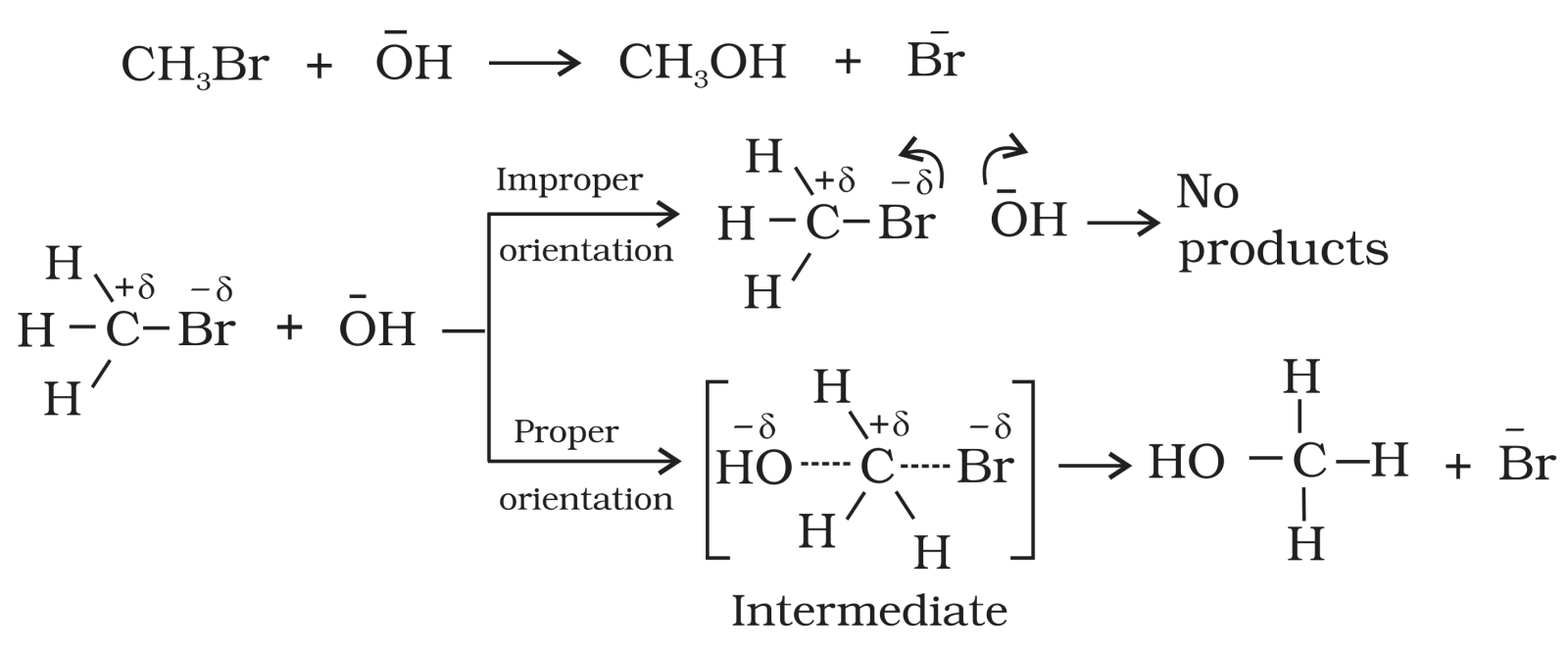
Only effective collision leads to the formation of products. It means that collisions in which molecules collide with sufficient kinetic energy (called threshold energy = activation energy + energy possessed by reacting species). And proper orientation lead to a chemical change because it facilitates the breaking of old bonds between (reactant) molecules and formation of the new ones, i.e., in products.
e.g., formation of methanol from bromomethane depends upon the orientation of the reactant molecules.

The proper orientation of reactant molecules lead to bond formation whereas improper orientation makes them simply back and no products are formed. To account to effective collisions, another factor P (probability or steric factor) is introduced $\text{K}=\text{Ae}^{\frac{-\text{Ea}}{\text{RT}}}.$
View full question & answer
Question 165 Marks
Describe how does the enthalpy of reaction remain unchanged when a catalyst is used in the reaction.
Answer
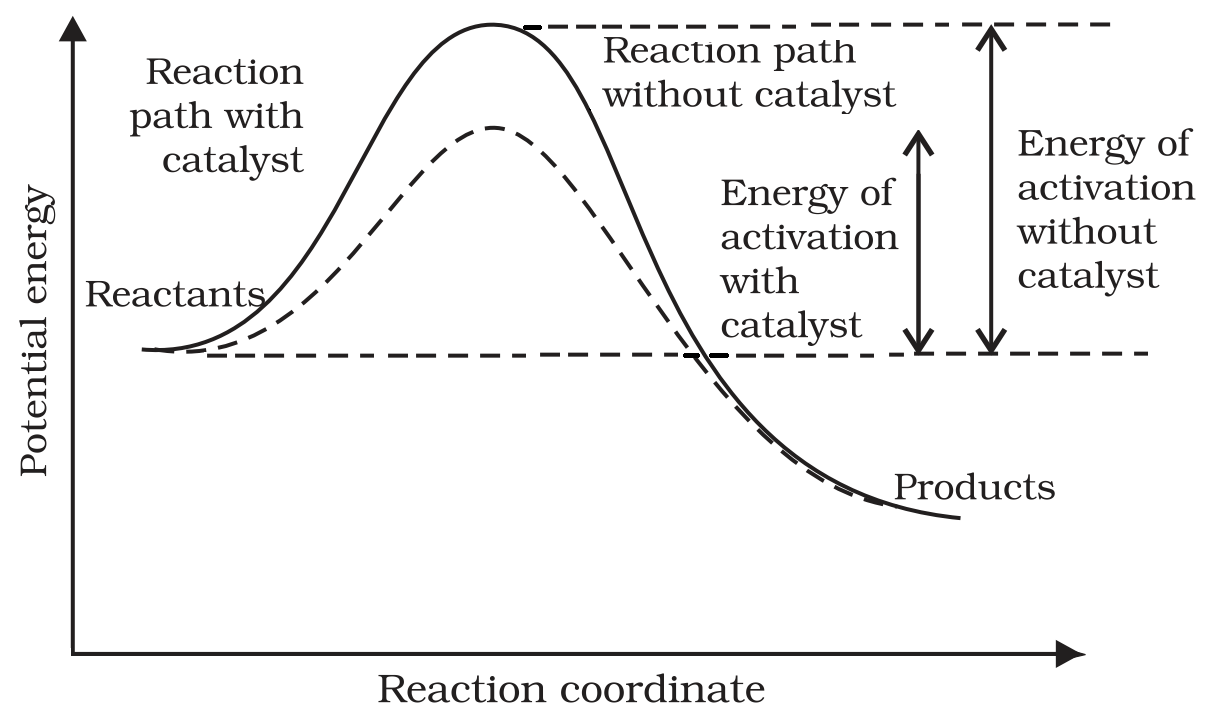
A catalyst is substance which increases the rate of a reaction without itself undergoing any permanent chemical change. The action of the catalyst can be explained by intermediate complex theory. According to this theory, a catalyst participates in a chemical reaction by forming temporary bonds with the reactants resulting in an intermediate complex. This has transitory existence and decomposes to yield products and the catalyst.
A small amount of the catalyst can catalyst a large amount of reactants. A catalyst does not alter Gibbs energy, $\Delta\text{G}$ of a reaction. Difference in energy between reactants and product is constant.
It is also found that a catalyst does not change the equilibrium constant of a reaction rather, it helps in attaining the equilibrium faster, that is, it catalyses the forward as well as the backward reactions to the same extent so that the equilibrium state remains same enthalpy of reaction means difference in energy between reactant and product it will also remain unchanged. It can be shown by:
View full question & answer
Question 175 Marks
Match the items of Column I and Column II.
  Column I   Column II
(i) Mathematical expression for rate of reaction. (a) Rate constant.
(ii) Rate of reaction for zero order reaction is equal to. (b) Rate law.
(iii) Units of rate constant for zero order reaction is same as that of. (c) Oder of slowest step.
(iv) Order of a complex reaction is determined by. (d) Rate of a reaction.
Answer
  Column I   Column II
(i) Mathematical expression for rate of reaction. (b) Rate law.
(ii) Rate of reaction for zero order reaction is equal to. (a) Rate constant.
(iii) Units of rate constant for zero order reaction is same as that of. (d) Rate of a reaction.
(iv) Order of a complex reaction is determined by. (c) Oder of slowest step.
Explanation:
  1. Mathematical expression for rate of reaction is known as rate law.
  2. Rate of reaction for zero order reaction is equal to rate constant r = k[A].
  3. Unit of rate of reaction is same as that or rate of reaction.
  4. Order of complex reaction is determined by rate of a reaction, which is slowest.
View full question & answer
Question 185 Marks
Graphically explain the effect of temperature on the rate constant of reaction. How can this temperature effect on rate constant be represented quantitatively?
Answer
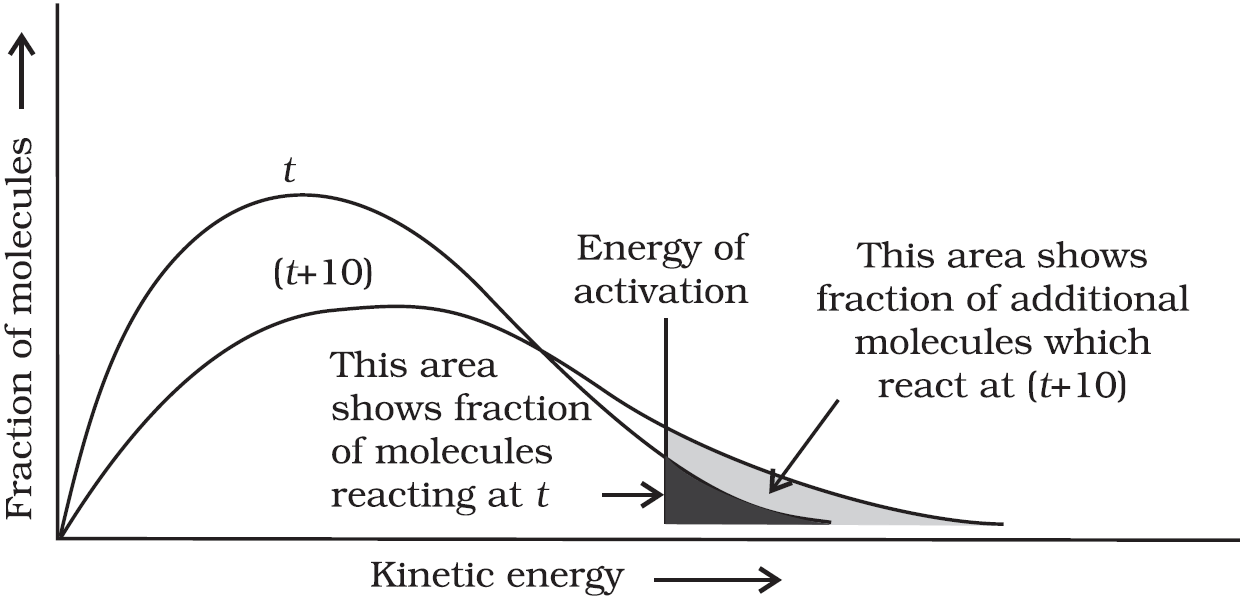
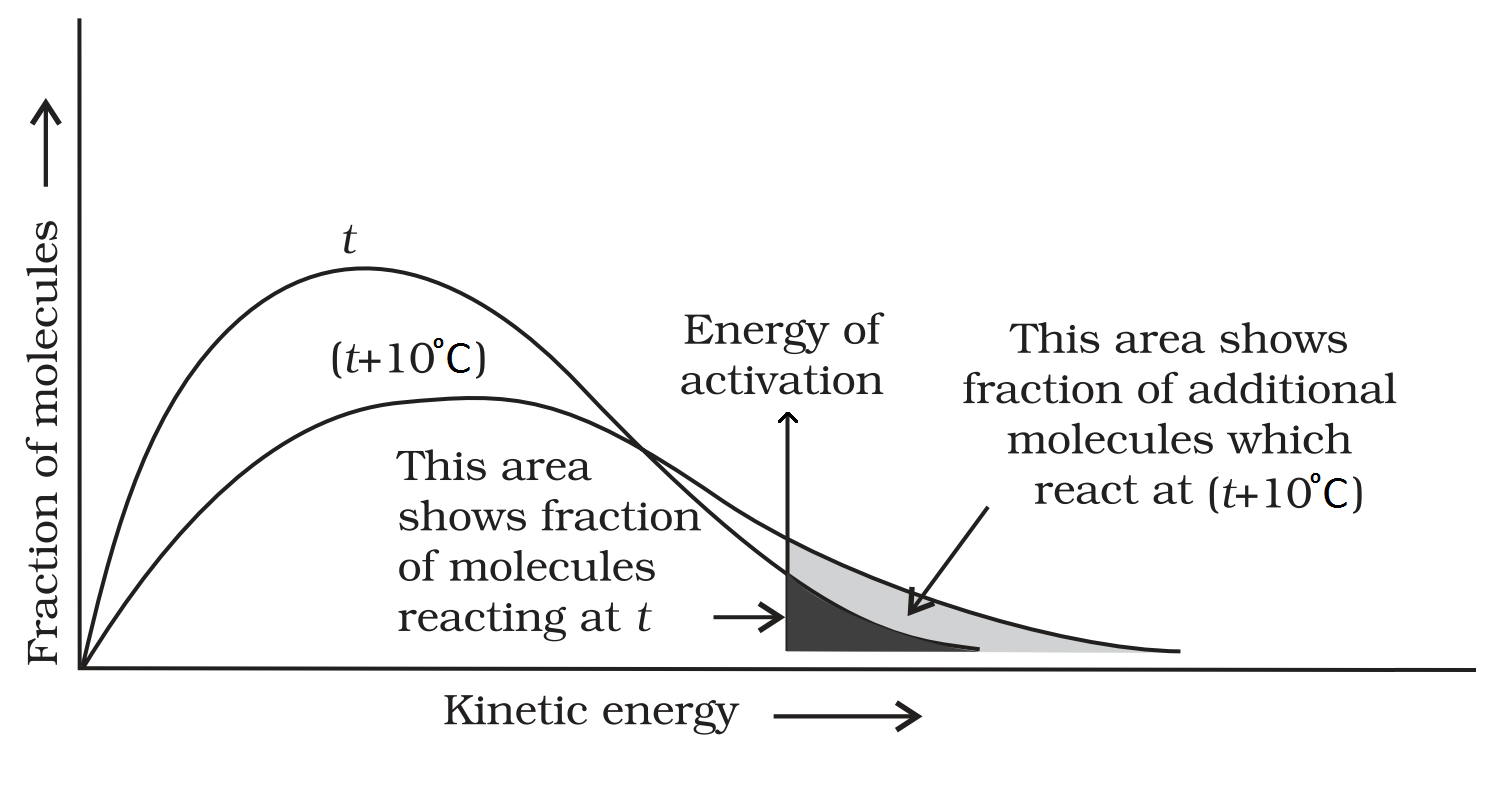
Increasing the temperature of a reaction mixture increased the fraction of molecules which colloide with energies greater than $E_a$​​​​​​​. It is clear from the graph below that with $10^\circ C$ rise in temperature the area showing the fraction of molecules having energy equal to or greater than activation energy gets almost double leading to almost to doubling the rate constant. Quantitatively the effect of temperature on rate constant (k) is given by Arrhenius equation. $\text{k}=\text{A e}^{-\text{E}_a/\text{RT}}\text{ or}\text{ k}= \text{A}\frac{1}{\text{e}^{\text{E}_a/\text{RT}}}$Where A is the frequency factor, R is the gas constant and Ea is the activation energy.

Thus, from Arrhenius equation we find that increasing the temperature or decreasing the activation energy will result in an exponential increase in rate constant.
View full question & answer
Question 195 Marks
What happens to most probable kinetic energy and the energy of activation with increase in temperature?
Answer


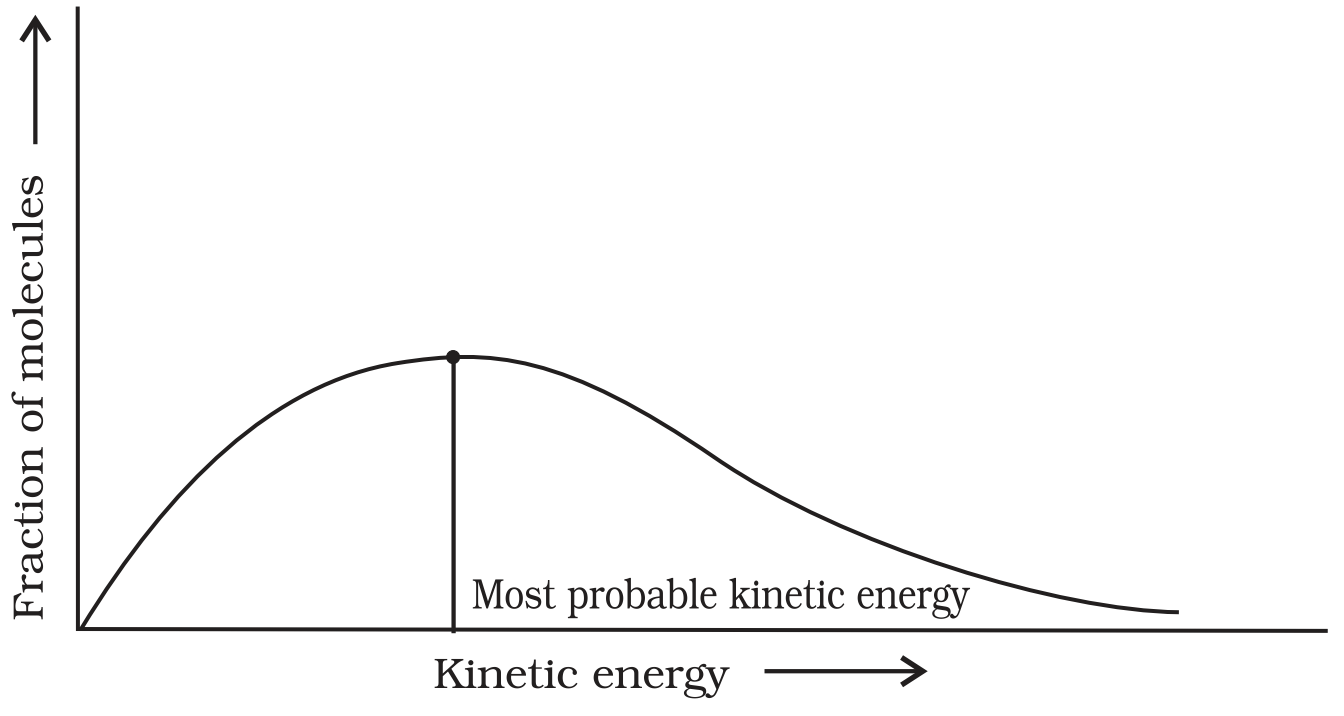
When the temperature is raised’ the maxima of the curve move to the higher energy value and the curve broadens out so that there is a greater proportion of the molecules with much higher energies. Most probable kinetic energy increases with increase in temperature. As the temperature increases, activation energy decreases which will result in the increase in the rate of reaction.
View full question & answer
Question 205 Marks
Write the rate law for a first order reaction. Justify the statement that half life for a first order reaction is independent of the initial concentration of the reactant.
Answer
Consider the first order reaction, R → P For this reaction, rate law which relates the rate of reaction to the concentration of reactants can be given as: $\text{Rate}=\frac{\text{d|R|}}{\text{dt}}=\text{k|R|}$
For a first order reaction,
$\text{t}=\frac{2.303}{\text{k}} \log\frac{\text{|R|}_0}{\text{|R|}}$,
Where [R]0 = initial concentration,[R] = concentration at time t. $At t_{1/2}, [R] = [R]_0/2$
So, the above equation becomes: $\text{t}_{1/2}=\frac{2.303}{\text{k}}\log\frac{\text{|R|}_0}{\text{|R|}_0/2}$
$\text{t}_{1/2}=\frac{2.303}{\text{k}}\log2 \text{ or}\text{ t}_{1/2}=\frac{2.303}{\text{k}}\times0.3010$
$\text{t}_{1/2}=\frac{0.693}{\text{k}}$
View full question & answer
Question 215 Marks
Consider the reaction $\text{R}\xrightarrow{\ \ \text{k}\ \ } \text{P}.$ The change in concentration of $R$ with time is shown in the following plot:
  1. Predict the order of the reaction.
  2. Derive the expression for the time required for the completion of the reaction.
  3. What does the slope of the above line indicate?
Answer
  1. The reaction $R \rightarrow P$ is a zero order reaction.
  2. For the reaction $R \rightarrow P.$
Rate$= \frac{-\text{d|R|}}{\text{dt}}=\text{k}$
d[R] = -k dt
Integrating both sides,
$[R] = - kt + C$, where $C =$ constant of integration$ .... (i)$
$At t = O, [R] = [R]_0$_
substituing this in equation $(i)$
$C = [R]_0$​​​​​​​_
Substituing the value of C in equation $(i)$
$[R] = - kt + [R]_0 ...(ii)$
$kt = [R]_0 - [R]$
$\Rightarrow\text{t}=\frac{|\text{R|}_0-|\text{R|}}{\text{k}}$
On completion of reactions, $[R] = 0$
$\therefore\text{t}=\frac{|\text{R|}_0-|\text{R|}}{\text{k}}$
  1. From equation (ii), we have slope of curve
Slope $= \frac{\text{d|R|}}{\text{dt}}=-\text{k}$.
 
View full question & answer
Question 225 Marks
Match the statements given in Column I and Column II.
 
Column I
 
Column II
(i)
Catalyst alters the rate of reaction.
(a)
Cannot be fraction or zero.
(ii)
Molecularity
(b)
Proper orientation is not there always.
(iii)
Second half life of first order reaction
(c)
By lowering the activation energy.
(iv)
$\text{e}^{\frac{-\text{Ea}}{\text{RT}}}$
(d)
Is same as the first.
(v)
Energetically favourable reactions are sometimes slow.
(e)
Total probability is one.
(vi)
Area under the Maxwell Boltzman curve is constant.
(f)
Refers to the fraction of molecules with energy equal to or greater than activation energy.
Answer
 
Column I
 
Column II
(i)
Catalyst alters the rate of reaction.
(c)
By lowering the activation energy.
(ii)
Molecularity
(a)
Cannot be fraction or zero.
(iii)
Second half life of first order reaction
(d)
Is same as the first.
(iv)
$\text{e}^{\frac{-\text{Ea}}{\text{RT}}}$
(f)
Refers to the fraction of molecules with energy equal to or greater than activation energy.
(v)
Energetically favourable reactions are sometimes slow.
(b)
Proper orientation is not there always.
(vi)
Area under the Maxwell Boltzman curve is constant.
(e)
Total probability is one.
Explanation:
  1. Catalyst alters the rate of reaction by lowering activation energy.
  2. Molecularity cannot be fraction or zero. If molecularity is zero, reaction is not possible.
  3. Second half-life of first order reaction is same as first because half-life time is temperature independent.
  4. $\text{e}^{\frac{-\text{Ea}}{\text{RT}}}$ refers to the fraction of molecules with kinetic energy equal to greater than activation energy.
  5. Energetically favourble reactions are sometimes slow due to improper orientation of molecule cause some ineffective collision of molecules.
  6. Area under the Maxwell-Boltzmann curve is constant because total probability of molecule taking part in a chemical reaction is equal to one.
View full question & answer