Question
All energetically effective collisions do not result in a chemical change. Explain with the help of an example.

Answer


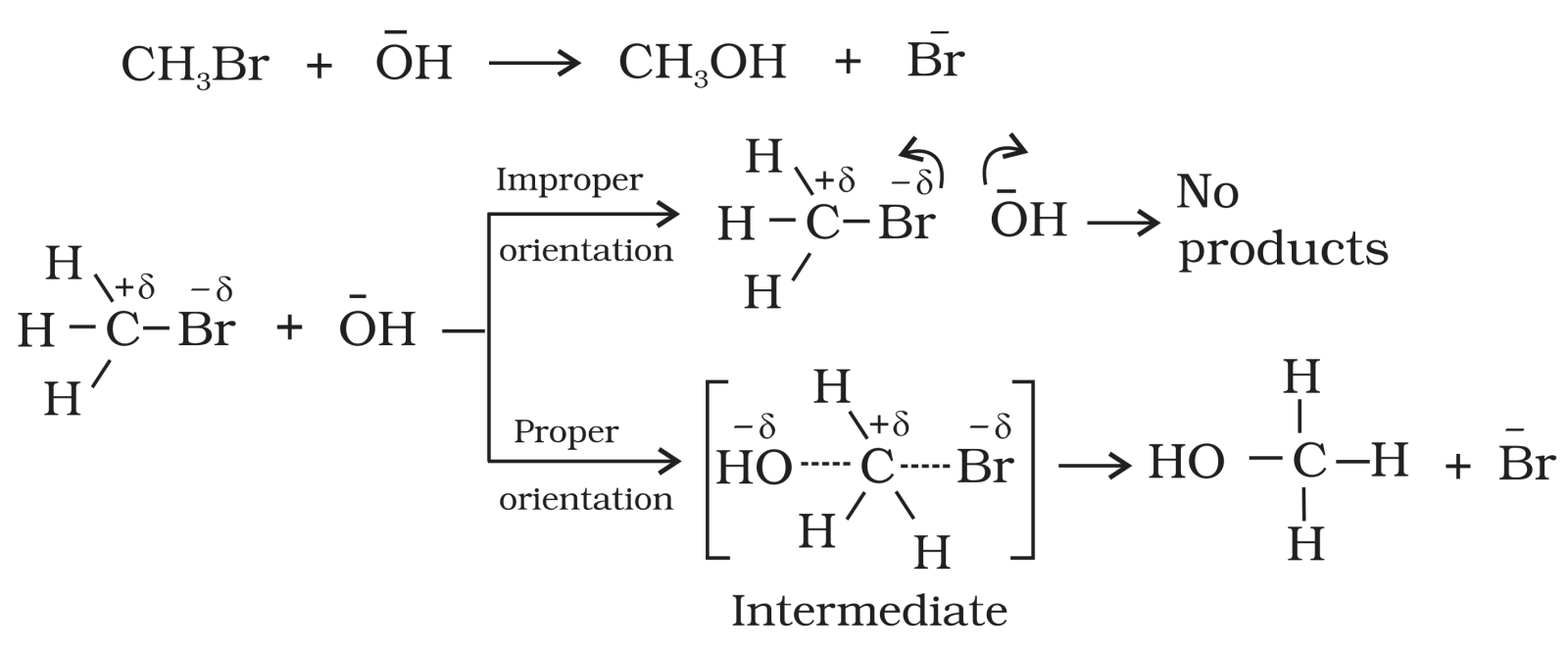
Only effective collision leads to the formation of products. It means that collisions in which molecules collide with sufficient kinetic energy (called threshold energy = activation energy + energy possessed by reacting species). And proper orientation lead to a chemical change because it facilitates the breaking of old bonds between (reactant) molecules and formation of the new ones, i.e., in products.
e.g., formation of methanol from bromomethane depends upon the orientation of the reactant molecules.

The proper orientation of reactant molecules lead to bond formation whereas improper orientation makes them simply back and no products are formed. To account to effective collisions, another factor P (probability or steric factor) is introduced $\text{K}=\text{Ae}^{\frac{-\text{Ea}}{\text{RT}}}.$

Need a full question paper?

Generate a complete, print-ready paper with questions like this in minutes — across 16+ boards, with answer keys.
Start Generating Free

Similar questions

Using crystal field theory, draw energy level diagram, write electronic configuration of the central metal atom/ion and determine the magnetic moment value in the following:
  1. $[\text{CoF}_6]^{3-}, [\text{Co(H}_2\text{O})_6]^{2+}, [\text{Co(CN)}_6]^{3-}$
  2. $[\text{FeF}_6]^{3-}, [\text{Fe(H}_2\text{O})_6]^{2+}, [\text{Fe(CN})_6]^{4-}$
A colourless substance 'A' $(C_6H_7N)$ is sparingly soluble in water and gives a water soluble compound 'B' on treating with mineral acid. On reacting with $CHCl_3$ and alcoholic potash 'A' produces an obnoxious smell due to the formation of compound 'C'. Reaction of 'A' with benzenesulphonyl chloride gives compound 'D' which is soluble in alkali. With $NaNO_2$ and HCl, 'A' forms compound 'E' which reacts with phenol in alkaline medium to give an orange dye 'F'. Identify compounds 'A' to 'F'.
  1. What may be the possible oxidation states of the transition metals with the following d electronic configurations in the ground state of their atoms:
$3d^34s^2, 3d^54s^2 $and $3d^6 4s^3$^. Indicate relative stability of oxidation states in each case.
  1. Write steps involved in the preparation of (i) $Na_2CrO_4 $from chromite ore and (ii) K_2MnO_4 from pyrolusite ore.
  1. Define the following terms:
  1. Co-enzymes.
  2. Mutation in biomolecules.
  3. Nucleotides.
  1. List four main functions of carbohydrates in organisms.
How are different aromatic compounds synthesized by benzene diazonium chloride? Explain with examples.
Discuss biological and industrial importance of osmosis.
Describe the mechanism of replication of DNA.
  1. Account for the following:
  1. Thermal stability of water is much higher than that of $H_2S$.
  2. Anhydrous aluminium chloride acts as a catalyst.
  3. White phosphorus is more reactive than red phosphorus.
  1. Draw the structures of (i) $H_3PO_3$​​​​​​​ and (ii) $XeOF_4$​​​​​​​.
For an elementary reaction:
$2 A+B \rightarrow 3 C$
the rate of appearance of $C$ at time ' t ' is $1.3 \times 10-4 mol L ^{-1} s^{-1}$. Calculate at this time:
a. Rate of the reaction.
b. Rate of disappearance of $A.$
i. How will you convert:
a. Nitrobenzene to phenol,
b. Aniline to chlorobenzene