MCQ 11 Mark
Which of the following metal ion is present in Ziegler$-$Natta catalyst?
- A
$ \mathrm{Fe}^{2+} $
- B
$ \mathrm{Zr}^{4+} $
- C
$ \mathrm{Rh}^{+} $
- ✓
$ \mathrm{Ti}^{4+} $
AnswerCorrect option: D. $ \mathrm{Ti}^{4+} $
Ziegler$-$Natta catalyst is triethylaluminium $\mathrm{Al}\left(\mathrm{C}_2 \mathrm{H}_5\right)_3$ along with $\mathrm{TiCl}_4$.

View full question & answer→MCQ 21 Mark
The correct order of ligands for writing the formula of complex compounds is $.......$
- ✓
Neutral, anionic, cationic
- B
Anionic, neutral, cationic
- C
Anionic, cationic, neutral
- D
Cationic, neutral, anionic
AnswerCorrect option: A. Neutral, anionic, cationic
The formula of a coordination complex is written in a different order than its name. The chemical symbol of the metal center is written first.
The ligands are written next, with neutral ligands coming before anionic ligands. If there is more than one anion or neutral ligand, they are written in alphabetical order according to the first letter in their chemical formula.
View full question & answer→MCQ 31 Mark
The two compounds $\left[\mathrm{Co}\left(\mathrm{SO}_4\right)\left(\mathrm{NH}_3\right)_5\right] \mathrm{Br}$ and $\left[\mathrm{Co}\left(\mathrm{SO}_4\right)\left(\mathrm{NH}_3\right)_5\right] \mathrm{Cl}$ represent.
AnswerEven formula of compounds is not same so no isomerism.
View full question & answer→MCQ 41 Mark
The co$-$ordination number of a metal in co$-$ordination compound is:
- A
- B
Sum of primary and secondary valences.
- ✓
Same as secondary valency.
- D
AnswerCorrect option: C. Same as secondary valency.
The secondary valency is equal to the coordination number the secondary valency are non ionizable valencies. These are satisfied by neutral molecules or negative ions.
For example in $\left[\mathrm{Ni}(\mathrm{CO})_4\right]$ the coordination number of $Ni$ metal is four and its secondary valency is also four.
View full question & answer→MCQ 51 Mark
$\text{IUPAC}$ name of $\left[\mathrm{Pt}\left(\mathrm{NH}_3\right)_2 \mathrm{Cl}\left(\mathrm{NO}_2\right)\right]$ is:
- A
Platinum diaminechloronitrite.
- B
Chloronitrito$-N-$ammineplatinum $(II).$
- ✓
Diamminechloridonitrito$-N-$platinum $(II).$
- D
Diamminechloronitrito$-N-$platinate $(II).$
AnswerCorrect option: C. Diamminechloridonitrito$-N-$platinum $(II).$
In this case both the central atom as well as ligands are present in the coordination sphere. The legands are named first in alphabetical order before the name of central atom or ion. Names of the anionic ligands end with suffix $'-o\ '.$ The name of the central metal atom is written at the end along with its oxidation state in Roman numeral, which is $(II)$ for the central metal atom "platinum". Note the "chlorido" is preferred term/ name over chloro for chloride ion as a ligand as per modern trend.
View full question & answer→MCQ 61 Mark
An ion $\mathrm{M}^{2+}$, forms the complexes $\left[\mathrm{M}\left(\mathrm{H}_2 \mathrm{O}\right)_6\right]^{2+},\left[\mathrm{M}(\mathrm{en})_3\right]^{2+}$ and $\left[\mathrm{MBr}_6\right]^{4-}$. The colour of the complexes will be $........$ respectively.
AnswerCrystal Field Stabilization Energy$(\text{CFSE})$ is proportional to the frequency of the absorbed light. The emitted colors are red, green and blue. The corresponding absorbed colors are green, red and orange.
So the first complex will be blue, second is red and third is green.
View full question & answer→MCQ 71 Mark
$\text{IUPAC}$ name for the complex $\left[\mathrm{Cu}\left(\mathrm{NH}_3\right)_4\right] \mathrm{SO}_4$ is:
AnswerCorrect option: C. Tetrammine copper $(II)$ sulphate.
Since $4$ amino groups are present, it will be called as tetrammine.
Since copper$(II)$ is the central metal, it will be tetrammine copper$(II).$ Note that we can determine the oxidation number of copper by charge balance.
Now finally since sulphate is the counter ion, it's full name will be tetrammine copper$(II)$ sulphate.
View full question & answer→MCQ 81 Mark
In which one of the following the central atom is $sp^3$ hydridised?
- ✓
$\text{NH}_4^+$
- B
$BF_3$
- C
$SF_6$
- D
$\ce{XeF_4}$
AnswerCorrect option: A. $\text{NH}_4^+$
View full question & answer→MCQ 91 Mark
A violet colour compound is formed in detection of S in a compound:
- ✓
$\mathrm{Na}_4\left[\mathrm{Fe}(\mathrm{CN})_5 \mathrm{NOS}\right]$
- B
$\mathrm{Na}_3\left[\mathrm{Fe}(\mathrm{CN})_5 \mathrm{NOS}\right]$
- C
$\mathrm{Na}_2\left[\mathrm{Fe}(\mathrm{CN})_5 \mathrm{NOS}\right]$
- D
$\mathrm{Na}\left[\mathrm{Fe}(\mathrm{CN})_5 \mathrm{NOS}\right]$
AnswerCorrect option: A. $\mathrm{Na}_4\left[\mathrm{Fe}(\mathrm{CN})_5 \mathrm{NOS}\right]$
$\mathrm{Na}_2 \mathrm{S}+\mathrm{Na}_2\left[\mathrm{Fe}(\mathrm{CN})_5 \mathrm{NO}\right] \rightarrow \mathrm{Na}_4\left[\mathrm{Fe}(\mathrm{CN})_5 \mathrm{NOS}\right]($ Violet Color Compond $)$.
View full question & answer→MCQ 101 Mark
True structure is predicted by:
- A
Valence$-$bond approach
- B
- ✓
- D
AnswerHybridisation helps to explain molecular shape, since the angles between bonds are $($approximately$)$ equal to the angles between hybrid orbitals.
View full question & answer→MCQ 111 Mark
Which compound is formed when excess of $\text{KCN}$ is added to an aqueous solution of copper sulphate?
- A
$\mathrm{Cu}(\mathrm{CN})_2$
- B
$\mathrm{K}_2\left[\mathrm{Cu}(\mathrm{CN})_2\right]$
- C
$\mathrm{K}\left[\mathrm{Cu}(\mathrm{CN})_2\right]$
- ✓
$\mathrm{K}_3\left[\mathrm{Cu}(\mathrm{CN})_4\right]$
AnswerCorrect option: D. $\mathrm{K}_3\left[\mathrm{Cu}(\mathrm{CN})_4\right]$
When excess of $\text{KCN}$ is added to an aqueous solution of $\mathrm{CuSO}_4$ then$-$
Initially, cupric cyanide is formed, $\mathrm{Cu}(\mathrm{CN})_2$.
$\mathrm{CuSO}_4+2 \mathrm{KCN} \rightarrow \mathrm{K}_2 \mathrm{CO}_4+\mathrm{Cu}(\mathrm{CN})_2$
Cupric Cyanide will decompose to produce cuprous cyanide, $\mathrm{Cu}_2(\mathrm{CN})_2$.
$2 \mathrm{Cu}(\mathrm{CN})_2 \rightarrow 2 \mathrm{Cu}_2(\mathrm{CN})_2+2(\mathrm{CN})$
Cuprous cyanide reacts with an excess of $\text{KCN}$ to form a complex, $\mathrm{K}_3\left[\mathrm{Cu}(\mathrm{CN})_4\right]$, which is a stable complex.
$\mathrm{CuCN}+3 \mathrm{Ka} \rightarrow \mathrm{K}_3\left[\mathrm{Cu}(\mathrm{CN})_4\right]$
View full question & answer→MCQ 121 Mark
Which one of the following molecular geometries $($i.e. shapes$)$ is not possible for the $\ce{sp^3d^2}$ hybridization?
View full question & answer→MCQ 131 Mark
The brown complex obtained in the detection of nitrate radical is formulated as $\left[\mathrm{Fe}\left(\mathrm{H}_2 \mathrm{O}\right)_5 \mathrm{NO}\right] \mathrm{SO}_4$. What is the oxidation number of Fe in this complex?
AnswerThe brown colour complex obtained in the detection of nitrate radical is formulated as $\left[\mathrm{Fe}\left(\mathrm{H}_2 \mathrm{O}\right)_5 \mathrm{NO}\right] \mathrm{SO}_4$. In this complex, oxidation state of iron is $+1.$ The univalent character of iron in the complex is justified by the presence of a coordinated $\mathrm{NO}^{+}$ group.
View full question & answer→MCQ 141 Mark
Co$-$ordination compounds are mostly formed by:
- A
$s-$block elements
- B
$p-$block elements
- ✓
$d-$block elements
- D
$f-$block elements
AnswerCorrect option: C. $d-$block elements
Since $'d\ '$ block elements have higher oxidation states and variable oxidation states and their tendency to form co$-$ordinate bonds due to presence of unpaired electrons, they form co$-$ordination complexes.
View full question & answer→MCQ 151 Mark
According to Werner’s theory of valency, transition metals possess:
AnswerAccording to Werner’s theory of valence, transition metals has two valencies are primary valencies and secondary valency.
The primary valency relates to the oxidation state and the secondary valency relates to the coordination number or it is the number of ligands attached to metal ions.
View full question & answer→MCQ 161 Mark
The isomerism exhibited by following compounds $\left[\mathrm{Co}\left(\mathrm{NH}_3\right)_6\right][\mathrm{Cr}(\mathrm{CN}) 6]$ and $\left[\mathrm{Cr}\left(\mathrm{NH}_3\right)_6\right]\left[\mathrm{Co}(\mathrm{CN})_6\right]$ is:
AnswerCoordination isomerism occurs in those complexes in which the total ratio of ligand to metal remains the same but the ligands attached to the specific metal ion varies.
View full question & answer→MCQ 171 Mark
The complex used as an anticancer agent is:
- A
trans$-[ \left.\mathrm{Co}\left(\mathrm{NH}_3\right)_3 \mathrm{Cl}_3\right]$
- ✓
cis$- \left[\mathrm{PtCl}_2\left(\mathrm{NH}_3\right)_2\right]$
- C
cis$- \mathrm{K}_2\left[\mathrm{PtCl}_2 \mathrm{Br}_2\right]$
- D
$\mathrm{Na}_2 \mathrm{CO}_3$
AnswerCorrect option: B. cis$- \left[\mathrm{PtCl}_2\left(\mathrm{NH}_3\right)_2\right]$
Cisplatin, or cis$-$diamminedichloroplatinum$\text{(II)[2] (CDDP)}$ is a chemotherapy drug. It was the first member of a class of platinum$-$containing anti$-$cancer drugs, which now also includes carboplatin and oxaliplatin.
These platinum complexes react in vivo, binding to and causing crosslinking of $\text{DNA},$ which ultimately triggers apoptosis $($programmed cell death$).$
View full question & answer→MCQ 181 Mark
The coordination of $Pt$ in the complex ion $\left[\mathrm{Pt}(\mathrm{en})_2 \mathrm{Cl}_2\right]^{2+}$ is:
AnswerThe coordination of $Pt$ in the complex ion $\left[\mathrm{Pt}(\mathrm{en})_2 \mathrm{Cl}_2\right]^{2+}$ is $6.$
$\text{en}\ ($ethylene diamine$)$ is bidentate ligand.
So$\text{, 2 en}$ ligands and $2Cl^-$ ligands corresponds to six donor atoms.
View full question & answer→MCQ 191 Mark
The stabilisation of coordination compounds due to chelation is called the chelate effect. Which of the following is the most stable complex species?
- A
$ {\left[\mathrm{Fe}(\mathrm{CO})_5\right]} $
- B
$ {\left[\mathrm{Fe}(\mathrm{CN})_6\right]^{3-}} $
- ✓
$ {\left[\mathrm{Fe}\left(\mathrm{C}_2 \mathrm{O}_4\right)_3\right]^{3-}} $
- D
$ {\left[\mathrm{Fe}\left(\mathrm{H}_2 \mathrm{O}\right)_6\right]^{3+}} $
AnswerCorrect option: C. $ {\left[\mathrm{Fe}\left(\mathrm{C}_2 \mathrm{O}_4\right)_3\right]^{3-}} $
Chelation $($formation of cycle by linkage between metal ion and ligand$)$ stabilizes the coordination compound. The ligand which chelates the metal ion are known as chelating ligand.
Here, only $ {\left[\mathrm{Fe}\left(\mathrm{C}_2 \mathrm{O}_4\right)_3\right]^{3-}} $ is a coordination compound which contains oxalate ion as a chelating ligand. Hence, it stabilizes coordination compound by chelating $\mathrm{Fe}^{3+}$ ion.
View full question & answer→MCQ 201 Mark
The compounds $\left[\mathrm{Co}\left(\mathrm{SO}_4\right)\left(\mathrm{NH}_3\right)_5\right] \mathrm{Br}$ and $\left[\mathrm{Co}\left(\mathrm{SO}_4\right)\left(\mathrm{NH}_3\right)_5\right] \mathrm{Cl}$ represents:
AnswerThe compounds $\left[\mathrm{Co}\left(\mathrm{SO}_4\right)\left(\mathrm{NH}_3\right)_5\right] \mathrm{Br}$ and $\left[\mathrm{Co}\left(\mathrm{SO}_4\right)\left(\mathrm{NH}_3\right)_5\right] \mathrm{Cl}$ represent no isomerism as they have different molecular formulae.
View full question & answer→MCQ 211 Mark
The correct labeling of different terms used in coordination compounds is:
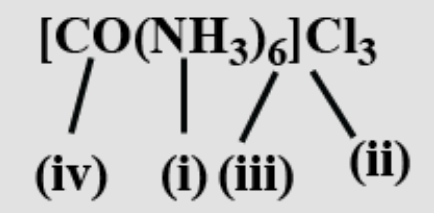
- A
$(i)$ Central atom$, (ii)$ Ionisation sphere$, (iii)$ Coordination number$, (iv)$ Ligands
- B
$(i)$ Ligands$, (ii)$ Coordination number$, (iii)$ Valency$, (iv)$ Ionisation sphere
- C
$(i)$ Ionisation sphere$, (ii)$ Ligands$, (iii)$ Coordination number$, (iv)$ Central atom
- ✓
$(i)$ Ligands$, (ii)$ Ionisation sphere$, (iii)$ Coordination number$, (iv)$ Central atom
AnswerCorrect option: D. $(i)$ Ligands$, (ii)$ Ionisation sphere$, (iii)$ Coordination number$, (iv)$ Central atom
Ammonia is a ligand. It donates lone pair of electrons to Cobalt $($central metal atom$)$ and forms co$-$ordinate bond. Co$-$ordination number is $6$ as $6$ ammonia ligand coordinate to central metal.
$(ii)$ represents ionisation sphere$, \left[\mathrm{Co}\left(\mathrm{NH}_3\right)_6\right]$ has $+3$ charge.
View full question & answer→MCQ 221 Mark
Pair of compounds which is planar:
- A
$ {\left[\mathrm{Ni}(\mathrm{CN})_4\right]^{-4},\left[\mathrm{PtCl}_4\right]^{-2}} $
- B
$ {\left[\mathrm{NiCl}_4\right]^{-2},\left[\mathrm{Ni}(\mathrm{CN})_4\right]^{-4}} $
- ✓
$ {\left[\mathrm{Ni}(\mathrm{CN})_4\right]^{-4},\left[\mathrm{Rh}(\mathrm{CO})_2\left(\mathrm{PPh}_3\right)_2\right]^{+}} $
- D
$ {\left[\mathrm{PtCl}_4\right]^{-2},\left[\mathrm{Ni}(\mathrm{CN})_4\right]^{-4}}$
AnswerCorrect option: C. $ {\left[\mathrm{Ni}(\mathrm{CN})_4\right]^{-4},\left[\mathrm{Rh}(\mathrm{CO})_2\left(\mathrm{PPh}_3\right)_2\right]^{+}} $
View full question & answer→MCQ 231 Mark
Chrome green is $.......$
AnswerCorrect option: A. $ \mathrm{PbCrO}_4+\mathrm{Fe}^{\mathrm{III}}\left[\mathrm{Fe}^{\mathrm{II}}(\mathrm{CN})_6\right]^{-}$
Chrome green is $ \mathrm{PbCrO}_4+\mathrm{Fe}^{\mathrm{III}}\left[\mathrm{Fe}^{\mathrm{II}}(\mathrm{CN})_6\right]^{-}$
It is a composite pigment consisting of a combination of chrome yellow and prussian blue.
View full question & answer→MCQ 241 Mark
Which element is not present in chlorophyll?
AnswerIn chlorophyll the central ion is magnesium, and the large organic molecule is a porphyrin. The porphyrin contains four nitrogen atoms that form bonds to magnesium in a square planar arrangement. There are several forms of chlorophyll.
So, an element not present in chlorophyll is calcium.
View full question & answer→MCQ 251 Mark
A chelating agent has two or more than two donor atoms to bind to a single metal ion. Which of the following is not a chelating agent?
- ✓
- B
- C
- D
Ethane$-1, 2^-$diamine.
AnswerThiosulphato or $\mathrm{S}_2 \mathrm{O}_3^-$ is not a chelating agent since it is a monodentate ligand.
View full question & answer→MCQ 261 Mark
Transition metal compounds are usually colored. This is due to the electronic transition:
- A
From $p-$orbital to $s-$orbital.
- B
From $d-$orbital to $s-$orbital.
- C
From $p-$orbital to $p-$orbital.
- ✓
Within the $d-$orbitals.
AnswerCorrect option: D. Within the $d-$orbitals.
Coloured compound of transition elements is assosiated with partially filled $(n-1)d$ orbitals. the transition metal ions containing unpaired $d-$electrons undergoes electronic transition from one $d-$orbital to another.
During this $d-d$ transition process the electrons absorb certain energy from the radiation and emit the remainder of energy as colored light. the color of ion is complementary of the color absorbed by it.
Hence, colored ion is formed due to $d-d$ transition which falls in visible region for all transition elements.
View full question & answer→MCQ 271 Mark
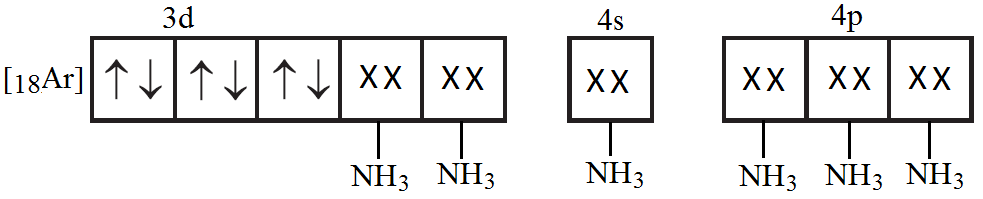
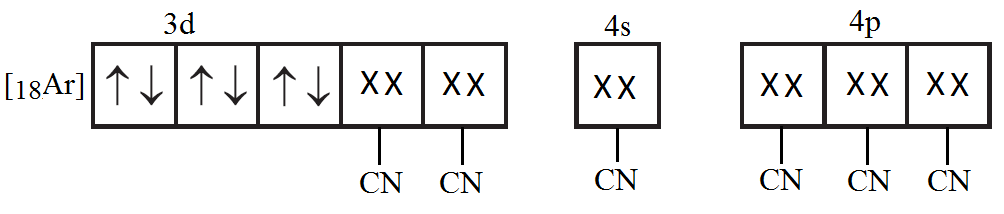
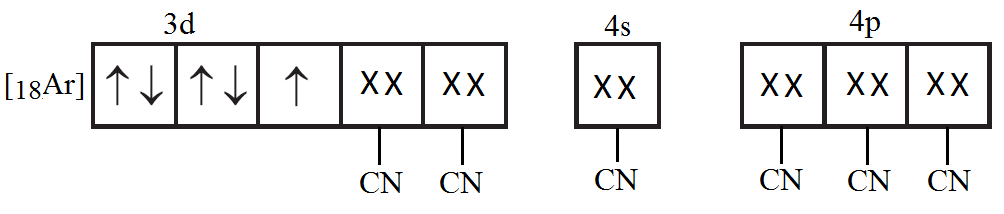
Atomic number of $\text{Mn, Fe}$ and $Co$ are $25, 2$6 and $27$ respectively. Which of the following inner orbital octahedral complex ions are diamagnetic?
$a. {\left[\mathrm{Co}\left(\mathrm{NH}_3\right)_6\right]^{3+}} $
$b. {\left[\mathrm{Mn}(\mathrm{CN})_6\right]^{3-}} $
$c. {\left[\mathrm{Fe}(\mathrm{CN})_6\right]^{4-}} $
$d. {\left[\mathrm{Fe}(\mathrm{CN})_6\right]^{3-}} $
- A
$a$ and $b$
- ✓
$a$ and $c$
- C
$b$ and $c$
- D
$a$ and $d$
View full question & answer→MCQ 281 Mark
Copper sulphate dissolves in ammonia due to the formation of:
- A
$ \mathrm{Cu}_2 \mathrm{O} $
- ✓
$ {\left[\mathrm{Cu}\left(\mathrm{NH}_3\right)_4\right] \mathrm{SO}_4} $
- C
$ {\left[\mathrm{Cu}\left(\mathrm{NH}_3\right)_4\right] \mathrm{OH}} $
- D
$ {\left[\mathrm{Cu}\left(\mathrm{H}_2 \mathrm{O}\right)_4\right] \mathrm{SO}_4}$
AnswerCorrect option: B. $ {\left[\mathrm{Cu}\left(\mathrm{NH}_3\right)_4\right] \mathrm{SO}_4} $
Copper sulphate dissolves in ammonia due to the formation of $\left[\mathrm{Cu}\left(\mathrm{NH}_3\right)_4\right] \mathrm{SO}_4.$
$\mathrm{CuSO}_4+4 \mathrm{NH}_3 \rightarrow\left[\mathrm{Cu}\left(\mathrm{NH}_3\right)_4\right] \mathrm{SO}_4$
$\left[\mathrm{Cu}\left(\mathrm{NH}_3\right)_4\right] \mathrm{SO}_4$ contains complex cation $\left[\mathrm{Cu}\left(\mathrm{NH}_3\right)_4\right]^{2+}$.
View full question & answer→MCQ 291 Mark
Which of the following statements is true about hybridisation?
- A
The hybridised orbitals have different energies for each orbital.
- ✓
The number of hybrid orbitals is equal to the number of atomic orbitals that are hybridised.
- C
Hybrid orbitals form multiple bonds.
- D
The orbitals with different energies undergo hybridisation.
AnswerCorrect option: B. The number of hybrid orbitals is equal to the number of atomic orbitals that are hybridised.
In hybridization, the number of hybrid orbitals is equal to the number of atomic orbitals that are hybridized.
Let's take an example$:\ {CH}_4$
Carbon electronic configuration is $\ce{2 S^2 2 P^2}$ in ground state, in excited state one electron of $s$ orbital move into $p$ orbital and thus we get $4$ unpaired electrons in atomic orbital which will take part in bonding,
The hybridisation of carbon in $ {CH}_4$ is $sp^3 ,$ means $4$ hybrid orbitals$. ($one $s$ orbital and three $p$ orbitals$).$
View full question & answer→MCQ 301 Mark
Which of the following compounds would exhibit co$-$ordination isomerism?
- A
$ {\left[\mathrm{Cr}\left(\mathrm{H}_2 \mathrm{O}\right)_5\right] \mathrm{Cl}_2}$
- ✓
${\left[\mathrm{Cr}\left(\mathrm{NH}_3\right)_5\right]\left[\mathrm{Co}(\mathrm{CN})_5\right]}$
- C
${\left[\mathrm{Cr}(\mathrm{en})_2\right] \mathrm{NO}_2}$
- D
${\left[\mathrm{Ni}\left(\mathrm{NH}_3\right)_5\right]\left[\mathrm{BF}_4\right]_3}$
AnswerCorrect option: B. ${\left[\mathrm{Cr}\left(\mathrm{NH}_3\right)_5\right]\left[\mathrm{Co}(\mathrm{CN})_5\right]}$
Co$-$ordination isomerism is a form of structural isomerism in which the composition of the complexion varies. In a coordination isomer, the total ratio ligand to metal remains the same, but the ligand attached to specific metal ion change. In $B$ option ratio of metal to the ligand is the same and they can exchange their ligands $\left(\mathrm{NH}_3, \mathrm{CN}\right).$
View full question & answer→MCQ 311 Mark
According to Werner's theory of coordination compounds:
- ✓
Primary valency is ionisable.
- B
Secondary valency is ionisable.
- C
Primary and secondary valencies are ionisable.
- D
Neither primary nor secondary valency is ionisable.
AnswerCorrect option: A. Primary valency is ionisable.
Primary valency is ionisable according to Werner's theory of coordination compounds.
According to Werner's coordination theory, there are two kinds of valency, primary and secondary. The primary valency of a central metal ion is satisfied with anions.
For example, in $\left[\mathrm{Cu}\left(\mathrm{NH}_3\right)_4\right] \mathrm{SO}_4$ primary valency is $2$ and secondary valency is $4.$
Secondary valence refers to coordination number. Since copper is coordinated to $4$ ammonia ligands, secondary valence is $4.$ Primary valence is satisfied by anions. Since sulphate ion has $−2$ charge, primary valence is $2.$
View full question & answer→MCQ 321 Mark
Which of the following complexes exists in facial and meridional forms?
- A
$ \mathrm{K}\left[\mathrm{Cr}\left(\mathrm{H}_2 \mathrm{O}\right)_2\left(\mathrm{C}_2 \mathrm{O}_4\right)_2\right] $
- ✓
$ {\left[\mathrm{Co}(\mathrm{NH})_3\left(\mathrm{NO}_2\right)_3\right]} $
- C
$ {\left[\mathrm{Co}\left(\mathrm{NH}_3\right)_5\left(\mathrm{NO}_2\right)\right]\left(\mathrm{NO}_3\right)_2}$
- D
$ {\left[\mathrm{Pt}\left(\mathrm{NH}_3\right)\left(\mathrm{H}_2 \mathrm{O}\right) \mathrm{Cl}_2\right]} $
AnswerCorrect option: B. $ {\left[\mathrm{Co}(\mathrm{NH})_3\left(\mathrm{NO}_2\right)_3\right]} $
View full question & answer→MCQ 331 Mark
$\text{IUPAC}$ name of $\mathrm{Na}_3\left[\mathrm{Co}(\mathrm{ONO})_6\right]$ is:
- A
- ✓
Sodium hexanitritocobaltate $(\text{III})$
- C
Sodium hexanitrocobalt $(\text{III})$
- D
Sodium hexanitritocobaltate $(II)$
AnswerCorrect option: B. Sodium hexanitritocobaltate $(\text{III})$
The above complex $\mathrm{Na}_3\left[\mathrm{Co}(\mathrm{ONO})_6\right]$ has two ions$:\ Na^+$ and a complex ion which is negatively charged $\left[\mathrm{Co}(\mathrm{ONO})_6\right]^{3-}$
According to the rules, name of the positive ion comes first $($i.e., sodium$),$ do not mention the number of sodium as it is not present in a square bracket.
After naming the positive ion, next will be the negative ion, Now in this example, the negative ion is a complex compound, which contain's 'metal' and 'ligand'.
While naming a complex, name of ligand comes first, also mention the number of ligand by using prefix $($di, tri, tetra. etc..$)$ and if a bidentate ligand is present then mention the atom which is attached to central metal $($i.e., hexanitrito $−O−)$ followed by name of metal with the ending 'ate' $($i.e., cobaltate, always use the word 'ate' if the complex is negatively charge$)$ and than oxidation number of metal.
To show the oxidation state, we use Roman numerals inside parenthesis.
View full question & answer→MCQ 341 Mark
Consider the coordination compound, $\mathrm{K}_2\left[\mathrm{Cu}(\mathrm{CN})_4\right]$. A coordinate covalent bond exists between:
AnswerCorrect option: B. $Cu^{2+}$ and $CN^-$
The coordinate covalent bond exists between the central metal and ligand. In $\mathrm{K}_2\left[\mathrm{Cu}(\mathrm{CN})_4\right]$ ex the coordinate bond exists between $Cu^{2+}$ and $CN^-$.
View full question & answer→MCQ 351 Mark
The neutral complex, diamine dibromo dichloro platinum $(IV)$ is best represented as:
- ✓
$ {\left[\mathrm{Pt}\left(\mathrm{NH}_3\right)_2 \mathrm{Br}_2 \mathrm{Cl}_2\right]} $
- B
$ {\left[\mathrm{PtCl}_2 \mathrm{Br}_2\left(\mathrm{NH}_3\right)_2\right]} $
- C
$ {\left[\mathrm{PtBr}_2 \mathrm{Cl}_2\left(\mathrm{NH}_3\right)_2\right]} $
- D
$ {\left[\mathrm{Pt}\left(\mathrm{NH}_3\right)_2 \mathrm{Cl}_2 \mathrm{Br}_2\right]}$
AnswerCorrect option: A. $ {\left[\mathrm{Pt}\left(\mathrm{NH}_3\right)_2 \mathrm{Br}_2 \mathrm{Cl}_2\right]} $
In a complex compound, the neutral ligand is written first followed by an anionic ligand. But if there are more than one anionic ligand then their name is written in alphabetical order thus bromo is written first then chloro.
View full question & answer→MCQ 361 Mark
The $\text{IUPAC}$ name of $\left[\mathrm{Ni}(\mathrm{CO})_4\right]$ is:
- A
Tetracarbonyl nickelete $(0)$
- B
Tetracarbonyl nickelete $(II)$
- ✓
Tetracarbonyl nickel $(0)$
- D
Tetracarbonyl nickel $(II)$
AnswerCorrect option: C. Tetracarbonyl nickel $(0)$
The $\text{IUPAC}$ name of $\left[\mathrm{Ni}(\mathrm{CO})_4\right]$ is Tetracarbonyl nickel $(0)$ since the oxidation state of carbonyl ligand is $0,$ so $Ni$ will also be $0$ and four ligand are bonded to central metal atom.
View full question & answer→MCQ 371 Mark
Silver halides are used in photography because they are$-$
AnswerSilver halides are used in photography because they are photosensitive as they react with light to form the image, silver halides being reduced to silver.
They are also soluble in hyposolution.
View full question & answer→MCQ 381 Mark
Which of the following will give $Fe^{3+}$ ions in the solution?
- A
$ {\left[\mathrm{Fe}(\mathrm{CN})_6\right]^{3-}} $
- B
$ {\left[\mathrm{Fe}(\mathrm{CN})_6\right]^{4-}} $
- C
$ \mathrm{NH}_4\left(\mathrm{SO}_4\right)_2 \cdot \mathrm{FeSO}_4 \cdot 6 \mathrm{H}_2 \mathrm{O} $
- ✓
$ \mathrm{Fe}_2\left(\mathrm{SO}_4\right)_3 $
AnswerCorrect option: D. $ \mathrm{Fe}_2\left(\mathrm{SO}_4\right)_3 $
$\left[\mathrm{Fe}(\mathrm{CN})_6\right]^{3-}$ and $\left[\mathrm{Fe}(\mathrm{CN})_6\right]^{4-}$ are complex ions.
They retain their identity in the solution.
Hence, they will not give $\mathrm{Fe}^{3+}$ ions in the solution.
$\mathrm{NH}_4\left(\mathrm{SO}_4\right)_2 \cdot \mathrm{FeSO}_4 \cdot 6 \mathrm{H}_2 \mathrm{O}$ is a double salt.
In the solution, it breaks into individual ions, but it will give $\mathrm{Fe}^{2+}$ ions in the solution.
Similarly$, \mathrm{Fe}_2\left(\mathrm{SO}_4\right)_3$ also breaks into individual ions.
Hence, they will give $\mathrm{Fe}^{3+}$ ions in the solution.
View full question & answer→MCQ 391 Mark
The properties of a compound are:
- A
Similar to the properties of its constituents.
- B
Similar to the properties of one of the constituents.
- ✓
Different from the properties of its constituents.
- D
AnswerCorrect option: C. Different from the properties of its constituents.
A compound is a substance formed when two or more chemical elements are chemically bonded together. The elements in any compound are always present in fixed ratios.
Example: Pure methane is a compound made from two elements - carbon and hydrogen. The ration of hydrogen to carbon in methane is always $4:1.$ The properties of a compound are different from the properties of its constituents.
View full question & answer→MCQ 401 Mark
Hexa ammine nickel $(II)$ hexa nitro cobaltate $(III)$ can be written as:
- A
$ {\left[\mathrm{Ni}\left(\mathrm{NH}_3\right)_6 \mathrm{Co}\left(\mathrm{NO}_2\right)_6\right]} $
- ✓
${\left[\mathrm{Ni}\left(\mathrm{NH}_3\right)_6\right]_3\left[\mathrm{Co}\left(\mathrm{NO}_2\right)_6\right]_2} $
- C
$ {\left[\mathrm{Ni}\left(\mathrm{NH}_3\right)_6\right]\left[\mathrm{Co}\left(\mathrm{NO}_2\right)_6\right]_2} $
- D
$ {\left[\mathrm{Ni}\left(\mathrm{NH}_3\right)_6\left(\mathrm{NO}_2\right)_6\right] \mathrm{Co}} $
AnswerCorrect option: B. ${\left[\mathrm{Ni}\left(\mathrm{NH}_3\right)_6\right]_3\left[\mathrm{Co}\left(\mathrm{NO}_2\right)_6\right]_2} $
$\left[\mathrm{Ni}\left(\mathrm{NH}_3\right)_6\right]_3\left[\mathrm{CO}\left(\mathrm{NO}_2\right)_6\right]_2 \equiv 3\left[\mathrm{Ni}\left(\mathrm{NH}_3\right)_6\right]^{2+} \mid 2\left[\mathrm{CO}\left(\mathrm{NO}_2\right)_6\right]^{3-}$
Since $3 \mathrm{Ni}(2+)$ balance with $2 \mathrm{Co}(3+)$
View full question & answer→MCQ 411 Mark
In octahedral complexes for which of the following configuration of central metal atom magnitude of crystal field stabilization energy $(\text{CFSE})$ is maximum in presence of ligand $\mathrm{CN}^{-}\ ?$
- A
$d^5$
- ✓
$d^6$
- C
$d^{10}$
- D
$d^9$
AnswerIn the presence of strong field ligand the maximum energy occurs when all elements are in $\mathrm{t}_{2 \mathrm{g}}$ level.
S$o, d^6$ has all the electrons in $\mathrm{t}_{2 \mathrm{g}}$ level.
View full question & answer→MCQ 421 Mark
The correct representation of $\mathrm{CuSO}_4 \cdot 5 \mathrm{H}_2 \mathrm{O}$ is:
- A
$ {\left[\mathrm{Cu}\left(\mathrm{H}_2 \mathrm{O}\right)_5\right] \mathrm{SO}_4} $
- B
$ {\left[\mathrm{Cu}\left(\mathrm{H}_2 \mathrm{O}\right)_3 \mathrm{SO}_4\right] \cdot 2 \mathrm{H}_2 \mathrm{O}} $
- C
$ {\left[\mathrm{CuSO}_4 \cdot \mathrm{H}_2 \mathrm{O}\right] \cdot 4 \mathrm{H}_2 \mathrm{O}} $
- ✓
$ {\left[\mathrm{Cu}\left(\mathrm{H}_2 \mathrm{O}\right)_4\right] \mathrm{SO}_4 \cdot \mathrm{H}_2 \mathrm{O}} $
AnswerCorrect option: D. $ {\left[\mathrm{Cu}\left(\mathrm{H}_2 \mathrm{O}\right)_4\right] \mathrm{SO}_4 \cdot \mathrm{H}_2 \mathrm{O}} $
For,
$\mathrm{CuSO}_4 \cdot 5 \mathrm{H}_2 \mathrm{O}$ in this $4 \mathrm{H}_2 \mathrm{O}$ are bonded by co$-$ordinate bond and $1 \mathrm{H}_2 \mathrm{O}$ by covalent bonding.
Therefore,
Its formula of the compound is $\left[\mathrm{Cu}\left(\mathrm{H}_2 \mathrm{O}\right)_4\right] \mathrm{SO}_4 \cdot \mathrm{H}_2 \mathrm{O}$.
View full question & answer→MCQ 431 Mark
Which of the following will give maximum number of isomer?
- A
$ {\left[\mathrm{Co}(\mathrm{py})_3\left(\mathrm{NH}_3\right)_3\right]^{3+}} $
- B
$ {\left[\mathrm{Ni}(\mathrm{en})\left(\mathrm{NH}_3\right)_4\right]^{2+}} $
- C
$ {\left[\mathrm{Fe}\left(\mathrm{C}_2 \mathrm{O}_4\right)(\mathrm{en})_2\right]^{2-}} $
- ✓
$ {\left[\mathrm{Co}\left(\mathrm{NO}_2\right)_2\left(\mathrm{NH}_3\right)_4\right]^{+}}$
AnswerCorrect option: D. $ {\left[\mathrm{Co}\left(\mathrm{NO}_2\right)_2\left(\mathrm{NH}_3\right)_4\right]^{+}}$
$ {\left[\mathrm{Co}\left(\mathrm{NO}_2\right)_2\left(\mathrm{NH}_3\right)_4\right]^{+}}$ shows the following isomerism:
Linkage isomerism through oxygen $[−\text{ONO}]$ and nitrogen $[−NO_2].$
Geometrical isomerism$: 2$ cis isomers and $1$ trans isomer.
$[\mathrm{Ni}(\mathrm{en})\left(\mathrm{NH}_3\right)_4]{ }^{2+}$ and $\left[\mathrm{Fe}\left(\mathrm{C}_2 \mathrm{O}_4\right)(\mathrm{en})_2\right]^{2-}$ will show optical isomerism. But total isomers are $4.$ But it has $5$ isomerism.
View full question & answer→MCQ 441 Mark
$\ce{CuSO_4}$ when reacts with $\text{KCN}$ forms $\text{CuCN}$ which is insoluble in water. It is soluble in excess of $\text{KCN},$ due to formation of the following complex:
- A
$ \mathrm{K}_2\left[\mathrm{Cu}(\mathrm{CN})_4\right] $
- ✓
$ \mathrm{K}_3\left[\mathrm{Cu}(\mathrm{CN})_4\right] $
- C
$ \mathrm{CuCN}_2$
- D
$\mathrm{Cu}\left[\mathrm{KCu}(\mathrm{CN})_4\right]$
AnswerCorrect option: B. $ \mathrm{K}_3\left[\mathrm{Cu}(\mathrm{CN})_4\right] $
Here$, \text{CuCN}$ is insoluble in water. This means $Cu$ in $\text{CuCN}$ is in $+1$ state. Because Cu is unstable in water only when it is in $+1$ state.
Co-ordination sphere exactly contains $4\ CN^-$ ions. So, its structure would be $\ce{[Cu(CN)_4]^x}$
Calculating $\text{x, Cu}$ is $+1$ state
$1 + 4(−1) = x$
$1 − 4 = x$
$x = −3$
So$, \ce{[Cu(CN)4]^{-3}}$
It combines with $3 \mathrm{\sim K}^{+}$ ions to form $\mathrm{K}_3\left[\mathrm{Cu}(\mathrm{CN})_4\right] \text.$
View full question & answer→MCQ 451 Mark
The chemical formula of iron$(\text{III})$ hexacyanoferrate$(II)$ is:
- A
$ \mathrm{Fe}\left[\mathrm{Fe}(\mathrm{CN})_6\right] $
- B
$ \mathrm{Fe}_3\left[\mathrm{Fe}(\mathrm{CN})_6\right] $
- C
$ \mathrm{Fe}_3\left[\mathrm{Fe}(\mathrm{CN})_6\right]_4 $
- ✓
$ \mathrm{Fe}_4\left[\mathrm{Fe}(\mathrm{CN})_6\right]_3 $
AnswerCorrect option: D. $ \mathrm{Fe}_4\left[\mathrm{Fe}(\mathrm{CN})_6\right]_3 $
We proceed from left to right, iron $(\text{III})$ means $Fe^{3+},$ hexacyano means $6CN^-$ ions are present and ferrate $(II)$ means $Fe^{2+}$ is the central metal atom.
So, the complex ion is $\left[\mathrm{Fe}(\mathrm{CN})_6\right]^{4-}$ and the counter ion is $Fe^{3+}$. So, after balancing the charge, the formula becomes $ \mathrm{Fe}_4\left[\mathrm{Fe}(\mathrm{CN})_6\right]_3 .$
View full question & answer→MCQ 461 Mark
Which one of the following platinum complexes is used in cancer chemotherapy?
- ✓
$ \mathrm{Cis}-\left[\mathrm{PtCl}_2\left(\mathrm{NH}_3\right)_2\right] $
- B
$ \text {Trans}-\left[\mathrm{PtCl}_2\left(\mathrm{NH}_3\right)\right] $
- C
$ {\left[\mathrm{Pt}\left(\mathrm{NH}_3\right)_4\right]^{2+}} $
- D
$ {\left[\mathrm{PtCl}_4\right]^{2-}} $
AnswerCorrect option: A. $ \mathrm{Cis}-\left[\mathrm{PtCl}_2\left(\mathrm{NH}_3\right)_2\right] $
$ \mathrm{Cis}-\left[\mathrm{PtCl}_2\left(\mathrm{NH}_3\right)_2\right] $ known as cis$-$platin.
Cisplatin is a chemotherapy medication used to treat several cancers. These include testicular cancer, ovarian cancer, cervical cancer, breast cancer, bladder cancer, head and neck cancer, oesophagal cancer, lung cancer, mesothelioma, brain tumours and neuroblastoma. It is given by injection into a vein.
View full question & answer→MCQ 471 Mark
What is the electronic configuration of elements of $\ce{III^{rd}}$ group:
- A
$\ce{1s^2, 2s^22ps^3}$
- ✓
$\ce{1s^2, 2s^22p^6, 3s^23p^1}$
- C
$\ce{1s^2, 2s^22p^6}$
- D
$\ce{1s^2, 2s^22p^6, 3s^1}$
AnswerCorrect option: B. $\ce{1s^2, 2s^22p^6, 3s^23p^1}$
$\ce{1s^2, 2s^22p^6, 3s^23p^1}$
As it is p block element therefore the group is $12 + 1 = 13 \text{ (III A}$ group$).$
View full question & answer→MCQ 481 Mark
How many ions are produced from the complex $\mathrm{Co}\left(\mathrm{NH}_3\right)_6 \mathrm{Cl}_2$ in solution?
AnswerThe given complex can be written as $\mathrm{Co}\left(\mathrm{NH}_3\right)_6 \mathrm{Cl}_2.$
Thus, $\left[\mathrm{Co}\left(\mathrm{NH}_3\right)_6\right]^{+}$ along with two $Cl^-$ ions are produced.
View full question & answer→MCQ 491 Mark
Which of the following order is correct for the $IR$ vibrational frequency of $CO\ ?$
- ✓
$ { [\mathrm{Fe}(\mathrm{CO})_4]^{2-} < [\mathrm{Co}(\mathrm{CO})_4]^{-} < [\mathrm{Ni}(\mathrm{CO})_4]}$
- B
$ { [\mathrm{Fe}(\mathrm{CO})_4 ]^{2-} > [\mathrm{Co}(\mathrm{CO})_4 ]^{-} > [\mathrm{Ni}(\mathrm{CO})_4 ]}$
- C
$ { [\mathrm{Fe}(\mathrm{CO})_4 ]^{2-} > [\mathrm{Co}(\mathrm{CO})_4 ]^{-} < [\mathrm{Ni}(\mathrm{CO})_4]} $
- D
$ { [\mathrm{Fe}(\mathrm{CO})_4 ]^{2-} < [\mathrm{Co}(\mathrm{CO})_4 ]^{-} > [\mathrm{Ni}(\mathrm{CO})_4 ]} $
AnswerCorrect option: A. $ { [\mathrm{Fe}(\mathrm{CO})_4]^{2-} < [\mathrm{Co}(\mathrm{CO})_4]^{-} < [\mathrm{Ni}(\mathrm{CO})_4]}$
The $IR$ vibrational frequency depends on the strength of $CO$ bond, More is the bond strength more will be the $IR$ vibrational frequency.
Since$, CO$ is a $pi$ acceptor ligand and accepts electron in antibonding $pi$ orbital.
More electrons in antibonding orbital implies less bond strength of $CO.$ In the given complexes the oxidation state of metals is $\ce{Fe(2^-), Co(1^-), Ni(0)}.$
Therefore more electrons on metal implies more will be the pi backbonding more stronger will be the Metal$-C$ bond weaker will be the $C-O$ bond hence, the $IR$ vibrational frequency order will be $ { [\mathrm{Fe}(\mathrm{CO})_4]^{2-} < [\mathrm{Co}(\mathrm{CO})_4]^{-} < [\mathrm{Ni}(\mathrm{CO})_4]}.$
View full question & answer→MCQ 501 Mark
Hypo is used in photography because it is:
- A
- B
- ✓
A strong Complexing agent
- D
AnswerCorrect option: C. A strong Complexing agent
Hypo forms the complex $\left[\mathrm{Ag}\left(\mathrm{S}_2 \mathrm{O}_3\right)_2\right]^{3-}$ from insoluble $Ag.$
$\left[\mathrm{Ag}\left(\mathrm{S}_2 \mathrm{O}_3\right)_2\right]^{3-}$ is formed by treatment of $\mathrm{Na}_2 \mathrm{S}_2 \mathrm{O}_3 \cdot 5 \mathrm{H}_2 \mathrm{O}$ with $\text{AgBr}.$
Therefore, Hypo is used in photography because it is a strong Complexing agent.
View full question & answer→