Questions · Page 2 of 4

M.C.Q (1 Marks)

MCQ 511 Mark
Intermediate compound formation theory explains:
  • Homogeneous catalysis.
  • B
    Heterogeneous catalysis.
  • C
    Both of the above.
  • D
    None of the above.
Answer
Correct option: A.
Homogeneous catalysis.
View full question & answer
MCQ 521 Mark
What is the function of germ pore ?
  • A
    Absorption of water for seed germination.
  • Initiation of pollen tube.
  • C
    Release of male gametes.
  • D
    Release of female gametes.
Answer
Correct option: B.
Initiation of pollen tube.
A germ pore is a small pore in the outer wall of fungal pore which is used for initiation of pollen tube.
View full question & answer
MCQ 531 Mark
Sulphur sol contains:
  • A
    Discrete $S−$atoms.
  • B
    Discrete $S−$molecules.
  • Large aggregates of $S−$molecules.
  • D
    Water dispersed in solid sulphur.
Answer
Correct option: C.
Large aggregates of $S−$molecules.
Sulphur sols are highly dispersed sols containing nearly $0.08\%$ of sulphur and are prepared by reduction of sulphur dioxide.
It can also be prepared by passing a very hot sulphur vapour into water that is air free.
A large aggregate of sulphur would be formed.
View full question & answer
MCQ 541 Mark
Peptisation is a process in which:
  • A
    Precipitation becomes true solution.
  • B
    True solution becomes a suspension.
  • C
    A colloid gets coagulation.
  • A suspension gets converted into a colloid.
Answer
Correct option: D.
A suspension gets converted into a colloid.
Peptisation is a method of preparation of colloids in which a freshly formed precipitate is stirred with a peptizing agent $($suitable electrolyte$).$ The adsorption of the ions of the electrolyte by the particles of the precipitate leads to peptisation.
View full question & answer
MCQ 551 Mark
The metal used as a catalyst in the hydrogenation of oil is:
  • A
    Sodium.
  • Nickel.
  • C
    Mercury.
  • D
    Manganese.
Answer
Correct option: B.
Nickel.
It is a well known fact that the metal used as a catalyst in the hydrogenation of oil is nickel.
View full question & answer
MCQ 561 Mark
On adding dilute $\text{HCl}$ to chalk piece$, \mathrm{CO}_2$ is evolved. This is an example of:
  • A hetrogeneous reaction.
  • B
    An acid-base reaction.
  • C
    An oxidation$-$reduction reaction.
  • D
    Catalysed reaction.
Answer
Correct option: A.
A hetrogeneous reaction.
Heterogeneous reactions are chemical reactions in which the reactants and products are in a different phase.
Dilute $\text{HCl}$ is a liquid, chalk piece is solid. Both react with each other to form $\mathrm{CO}_2$ gas. So this reaction is a heterogeneous reaction.
$2 \mathrm{HCl}(\mathrm{l})+\mathrm{CaCO}_3(\mathrm{s}) \rightarrow \mathrm{CaOCl}_2(\mathrm{s})+\mathrm{CO}_2(\mathrm{g})$
View full question & answer
MCQ 571 Mark
Which of the following process is responsible for the formation of delta at a place where rivers meet the sea?
  • A
    Emulsification.
  • B
    Colloid formation.
  • Coagulation.
  • D
    Peptisation.
Answer
Correct option: C.
Coagulation.
River water is a colloidal solution of clay. Sea water contains a number of electrolytes. When river water meets the sea water, the electrolytes present in sea water coagulate the colloidal solution of clay resulting in its deposition with the formation of delta.
View full question & answer
MCQ 581 Mark
Which of the following explains the increase of the reaction rate by catalyst ?
  • A
    Catalyst decreases the rate of backward reaction so that the rate of forward reaction increases.
  • B
    Catalyst provides extra energy to reacting molecules so that they may produce effective collisions.
  • Catalyst provides an alternative path o lower activation energy to the reactants.
  • D
    Catalyst increases the number of collisions between the reacting molecules.
Answer
Correct option: C.
Catalyst provides an alternative path o lower activation energy to the reactants.
A catalyst is a substance, which increases the rate of reaction without itself being consumed at the end of the reaction, and the phenomenon is called catalysis. There are some catalysts which decrease the rate of reaction and such catalysts are called negative catalyst. Obviously, the catalyst accelerating the rate will be positive catalyst. However, the term positive is seldom used and catalyst itself implies positive catalyst.
Characteristics of catalyst are as follows:
$(i)$ A catalyst remains unchanged chemically at the end of reaction, however its physical state may change.
$(ii)$ A catalyst never initiate a chemical reaction. It simply influences the rate of reaction.
$(iii)$ A small quantity of catalyst is sufficient to influence the rate of reaction.
$(iv)$ A catalyst does not influence the equilibrium constant of reaction. It simply helps in attaining equilibrium earlier. It alters the rate of forward $\ \&\ $ backward reactions equally.
$(v)$ Catalyst’s activity is more or less specific.
A catalyst for one reaction is not necessary to catalyse the another reaction.
View full question & answer
MCQ 591 Mark
Soap action is due to:
  • A
    Micelle formation.
  • B
    Colloidal dispersion of micelles in water.
  • C
    Oil drop dispersal.
  • All of these.
Answer
Correct option: D.
All of these.
When soap is dissolved in water, its hydrophobic ends attach themselves to dirt and remove it from the cloth.
First, the molecules of soap arrange themselves in micelle formation and trap the dirt at the center of the cluster.
These micelles remain suspended in water like particles in colloidal solution.
The various micelle present in water does not come together to form a precipitate as each micelle repels the other because of the ion$-$ion repulsion.
Thus, the dust particle remains trapped in micelles$($which remains suspended$)$ and are easily rinsed away with water.
View full question & answer
MCQ 601 Mark
From the following which is not an emulsifer?
  • A
    Agar
  • Milk
  • C
    Gum
  • D
    Soap
Answer
Correct option: B.
Milk
The substances that stabilise emulsions are called emulsifiers. Agar, gum and soap all are emulsifier while milk is an emulsion, not an emulsifier.
View full question & answer
MCQ 611 Mark
Which phenomenon occurs when an electric field is applied to a colloidal solution and electrophoresis is prevented?
Reverse osmosis takes place.
Electroosmosis takes place.
Dispersion medium begins to move.
Dispersion medium becomes stationary.
  • A
    $c$ and $d$
  • B
    $a$ and $b$
  • C
    $a$ and $d$
  • $b$ and $c$
Answer
Correct option: D.
$b$ and $c$
When electrophoresis, i.e., movement of particles is prevented by some suitable means, it is observed that the dispersion medium begins to move in an electric field. This phenomenon is termed electro osmosis.
View full question & answer
MCQ 621 Mark
Soap lather is an example of:
  • Foam.
  • B
    Sol.
  • C
    Emulsion.
  • D
    Gel.
Answer
Correct option: A.
Foam.
Soap lather is an example of foam. Dispersion medium is liquid and dispersed phase is gas.
View full question & answer
MCQ 631 Mark
A colloidal system having a solid substance as a dispersed phase and a liquid as a dispersion medium is classified as $......$
  • A
    Solid sol.
  • B
    Gel.
  • C
    Emulsion.
  • Sol.
Answer
Correct option: D.
Sol.
Solid $+$ liquid $=$ sol $($here solid is the dispersed phase and liquid is the dispersion medium$.)$
View full question & answer
MCQ 641 Mark
The pollutants released by jet aeroplanes in the atmosphere as chlorofluorocarbons are called:
  • Photochemical oxidants.
  • B
    Photochemical reductants.
  • C
    Aerosols.
  • D
    Physical pollutants.
Answer
Correct option: A.
Photochemical oxidants.
Aerosols are emitted into the air in the form of vapour or fine mist. Jet airplanes emit aerosols containing chlorofluorocarbons $\left(\mathrm{CCl}_2 \mathrm{F}_2\right)$ and $\left(\mathrm{CCl}_3 \mathrm{F}\right)$.
The aerosols deplete ozone layer in the atmosphere.
View full question & answer
MCQ 651 Mark
Example of an intrinsic colloid is:
  • A
    $\mathrm{As}_2 \mathrm{~S}_3 \mathrm{sol}$
  • B
    $S$ sol
  • Egg albumin
  • D
    $\mathrm{Fe}(\mathrm{OH})_2 \mathrm{sol}$
Answer
Correct option: C.
Egg albumin
Based on the nature of the interaction between the dispersed phase and the dispersion medium:
Colloids are classified into two categories$-$lyophilic and lyophobic.
$(a)$ Colloidal solutions in which the dispersed phase has a great affinity or love for the dispersion medium are termed lyophilic colloids. Such substances have a tendency to pass directly into colloidal solution when brought in contact with the dispersion medium. The lyophilic colloids are also called intrinsic colloids. Egg$-$albumin is an inherent or essential sol.
$(b)$ Lyophobic colloids: Substances which when mixed with the dispersion medium do not form the colloidal sol but their sols can be prepared by special methods.
They are also called extrinsic colloids. Example: Sols of metal sulfides, sols of metallic hydroxides, etc.
View full question & answer
MCQ 661 Mark
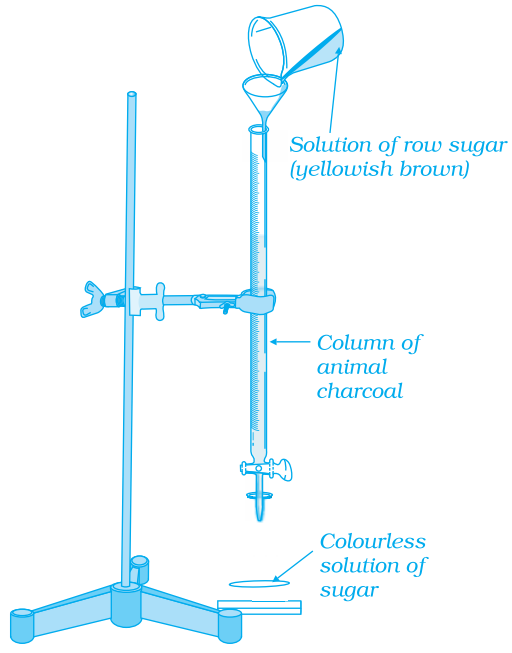
Which of the following phenomenon is applicable to the process shown in the?
  • A
    Absorption.
  • Adsorption.
  • C
    Coagulation.
  • D
    Emulsification.
Answer
Correct option: B.
Adsorption.
In the figure adsorption of coloured particle from charcoal is shown. Solution of raw sugar is filtered by animal charcoal and yellowish brown colour of raw sugar is adsorbed and filterate is colourless which gives white colour on crystallization.
View full question & answer
MCQ 671 Mark
The colloidal system in which the disperse phase and dispersion medium are both liquids is known as:
  • An emulsion.
  • B
    An aerosol.
  • C
    A gel.
  • D
    A foam.
Answer
Correct option: A.
An emulsion.
Emulsions are the colloidal solutions of two immiscible liquids in which one liquid acts as the dispersed phase and the other as the dispersion medium. In emulsion, the suspended droplets $($dispersed phase$)$ are larger than the particles of dispersion medium.
View full question & answer
MCQ 681 Mark
Detergents are better than soaps because:
  • A
    They wash clothes better.
  • B
    They absorb the hardness of water.
  • They are less affected by hard water.
  • D
    They are less soapy.
Answer
Correct option: C.
They are less affected by hard water.
Detergents are better than soaps because they are less affected by hard water, as the hydrocarbon chains in detergents do not precipitate with calcium, magnesium and other metal ions.
View full question & answer
MCQ 691 Mark
Butter is an emulsion of type:
  • Water in oil.
  • B
    Oil in water.
  • C
    Oil and oil.
  • D
    None of the above.
Answer
Correct option: A.
Water in oil.
Oil in water $(o/ w)$ type : In these emulsions, oil forms the dispersed phase and water, the dispersion medium. For example, milk, vanishing cream, etc. These are also called aqueous emulsions.
Water in oil $(w/ o)$ type : In these emulsions, water is in the dispersed phase and oil in the dispersion medium. For example, butter, cold cream etc. are also called oil emulsions.
View full question & answer
MCQ 701 Mark
Cod liver oil is:
  • An emulsion.
  • B
    Solution.
  • C
    Colloidal solution.
  • D
    Suspension.
Answer
Correct option: A.
An emulsion.
Cod liver oil is extracted from the liver of the codfish and is enriched with omega$-3$ fatty acids.
Cod liver oil is an emulsion i.e. liquid in liquid type solution. In Cod liver oil, water acts as a dispersed phase while oil acts as a dispersion medium. we use acacia gum as an emulsifying agent.
View full question & answer
MCQ 711 Mark
The process of passing of a precipitate into colloidal solution on adding an electrolyte is called:
  • A
    Dialysis.
  • Peptization.
  • C
    Electophoresis.
  • D
    Electro$-$osmosis.
Answer
Correct option: B.
Peptization.
View full question & answer
MCQ 721 Mark
A catalyst:
  • A
    Changes $\triangle \text{G}\triangle \text{G}$ for an equation.
  • B
    Acts by increasing the rate of the forward reaction more than the reverse reaction.
  • C
    Raises the equilibrium constant of a system.
  • May have a molecular weight as low as $1$ or higher than $200, 000.$
Answer
Correct option: D.
May have a molecular weight as low as $1$ or higher than $200, 000.$
A catalyst :
Does not change $\triangle \text{G}$ for a reaction.
Acts by increasing the rate of forward reaction and backward reaction by equal amounts.
Does not affect the value of equilibrium constant.
May have a molecular weight as low as $1$ or higher than $200, 000.$
$\therefore$ The only correct choice is that a catalyst may have a molecular weight as low as $1$ or higher than $200, 000.$
View full question & answer
MCQ 731 Mark
Smoke precipitator works on the principle of:
  • A
    Distribution law.
  • Neutralization of charge on colloids.
  • C
    Le$-$Chaterlier's principle.
  • D
    Addition of electrolytes.
Answer
Correct option: B.
Neutralization of charge on colloids.
Smoke precipitator works on the principle of neutralization of charge on colloids.
Smoke coming out of the chimneys contain a lot of unburnt carbon particle.
Smoke is the colloidal solution of the solid particles such as carbon, arsenic, dust particles etc. These particles are injurious to health and have to be precipitated.
Carbon particle is charged particles and can not be precipitated. Thus, a metal plate of an oppositely charged particle is used for their precipitation.
This is done by the Cottrell smoke precipitator which neutralizes the charge on the carbon particles and neutralizes them.
In this way, smoke coming out of the chimneys gets free from the charged particles.
View full question & answer
MCQ 741 Mark
Which of the following pairs of colloidal solutions have dispersed phase as liquid and dispersed medium as gas?
  • Fog, mist.
  • B
    Butter, milk.
  • C
    Fog, smoke.
  • D
    Smoke, foam.
Answer
Correct option: A.
Fog, mist.
Fog: Dispersed phase $-$ Liquid and Dispersed medium $-$ Gas
Mist: Dispersed phase $-$ Liquid and Dispersed medium $-$ Gas
Butter: Dispersed phase $-$ Liquid and Dispersed medium $-$ Solid
Milk: Dispersed phase $-$ Liquid and Dispersed medium $-$ Liquid
Smoke: Dispersed phase $-$ Solid and Dispersed medium $-$ Gas
View full question & answer
MCQ 751 Mark
What happens when a lyophilic sol is added to a lyophobic sol?
$A.$ Lyophobic sol is protected.
$B.$ Lyophilic sol is protected.
$C.$ Film of lyophilic sol is formed over lyophobic sol.
$D.$ Film of lyophobic sol is formed over lyophilic sol.
  • A
    $A$ and $B$
  • $A$ and $C$
  • C
    $B$ and $C$
  • D
    $B$ and $D$
Answer
Correct option: B.
$A$ and $C$
Lyophobic sols are protected due to formation of film of lyophobic sol.
View full question & answer
MCQ 761 Mark
Which of the following is homogeneous?
  • Milk.
  • B
    Paint.
  • C
    Shampoo.
  • D
    All of the above.
Answer
Correct option: A.
Milk.
The emulsion is a colloidal system consisting of immiscible liquids. Milk is an example of emulsion in which particles of liquid fat are dispersed in water. In common occurrence, however, one of the liquids is water and the other, and oily substance insoluble in it. The suspended droplets are larger than the particles of the sols. It is because of the density differences between the phases being small.
View full question & answer
MCQ 771 Mark
Hard soaps are:
  • A
    Calcium salts of higher fatty acids.
  • B
    Magnesium salts of higher fatty acids.
  • C
    Potassium salts of higher fatty acids.
  • Sodium salts of higher fatty acids.
Answer
Correct option: D.
Sodium salts of higher fatty acids.
Sodium salts of higher fatty acids are called hard soaps. A good example is sodium stearate$(\mathrm{C}_{12} \mathrm{H}_{35} \mathrm{COONa}).$
View full question & answer
MCQ 781 Mark
Milk is an example for:
  • A
    Inelastic gel.
  • B
    Foam.
  • C
    Elastic gel.
  • Emulsion.
Answer
Correct option: D.
Emulsion.
An emulsion is a colloid of two or more immiscible liquids where one liquid contains a dispersion of the other liquids. In other words, an emulsion is a special type of mixture made by combining two liquids that normally don't mix. The word emulsion comes from the Latin word meaning "to milk" $($milk is one example of an emulsion of fat and water$).$ The process of turning a liquid mixture into an emulsion is called emulsification.
View full question & answer
MCQ 791 Mark
Which of the following process does not occur at the interface of phases?
  • A
    Crystallisation.
  • B
    Heterogenous catalysis.
  • Homogeneous catalysis.
  • D
    Corrosion.
Answer
Correct option: C.
Homogeneous catalysis.
In homogeneous catalysis, only, the reactant and product are in same phase and composition is uniform throughout.
View full question & answer
MCQ 801 Mark
Method by which lyophobic sol can be protected.
  • A
    By addition of oppositely charged sol.
  • B
    By addition of an electrolyte.
  • By addition of lyophilic sol.
  • D
    By boiling.
Answer
Correct option: C.
By addition of lyophilic sol.
Lyophilic colloids have a unique property of protecting lyophobic colloids. When a lyophilic sol is added to the lyophobic sol, the lyophilic particles form a layer around lyophobic particles and thus protect the latter from electrolytes. Lyophilic colloids used for this purpose are called protective colloids.
View full question & answer
MCQ 811 Mark
Which of the following catalyst is used in contact process for manufacture of $\mathrm{H}_2 \mathrm{SO}_4?$
  • A
    Oxides of nitrogen
  • $ \mathrm{V}_2 \mathrm{O}_5 $
  • C
    $ \mathrm{Fe}_2 \mathrm{O}_3 $
  • D
    ​Platinised asbestos
Answer
Correct option: B.
$ \mathrm{V}_2 \mathrm{O}_5 $
Vanadium $(V)$ Oxide$, \mathrm{Fe}_2 \mathrm{O}_3 $​ is used as catalyst in this reaction. It increases the rate of the reaction, thus reducing the need for a high temperature.
View full question & answer
MCQ 821 Mark
At high concentration of soap in water, soap behaves as $.......$
  • A
    Molecular colloid
  • Associated colloid
  • C
    Macromolecular colloid
  • D
    Lyophilic colloid
Answer
Correct option: B.
Associated colloid
Aqueous solution of soap above critical micelle concentration leads to the formation of colloidal solution. Tyndall effect is a characteristic of colloidal solution in which colloidal particles show a coloured appearance when sunlight is passes through it and seen perpendicularly.
View full question & answer
MCQ 831 Mark
Colloidal sols are more effective for medical purposes because:
  • A
    They have smaller surface area.
  • They have larger surface area.
  • C
    Their assimilation is difficult.
  • D
    They can be easily prepared.
Answer
Correct option: B.
They have larger surface area.
Colloidal sols have larger surface area which provides larger sites for reactions.So,they are more effective for medical purposes.
View full question & answer
MCQ 841 Mark
Decomposition of $\ce{H_2​O_2}$ is prevented in presence of :
  • Acetanilide.
  • B
    Glycol.
  • C
    Oxygen.
  • D
    None of the above.
Answer
Correct option: A.
Acetanilide.
Decomposition of $\ce{H_2​O_2}$ is prevented in the presence of acetanilide. Acetanilide acts as a stabilizer which when added to the solutions retards the decomposition.
View full question & answer
MCQ 851 Mark
Which of the following statements are correct?
$a.$ Mixing two oppositely charged sols neutralises their charges and stabilises the colloid.
$b.$ Presence of equal and similar charges on colloidal particles provides stability to the colloids.
$c.$ Any amount of dispersed liquid can be added to emulsion without destabilising it.
$d.$ Brownian movement stabilises sols.
  • A
    $a$ and $b$
  • B
    $b$ and $c$
  • C
    $a$ and $c$
  • $b$ and $d$
Answer
Correct option: D.
$b$ and $d$
Presence of equal and similar charges on colloidal particles provides stability to colloids as repulsive forces between charge particles having same charge prevent them from colliding when they come closer to each other.
View full question & answer
MCQ 861 Mark
Collodion is a:
  • A
    Colloidal sol of cellulose nitrate in water.
  • B
    Colloidal sol of cellulose acetate in ethyl alcohol.
  • Colloidal sol of cellulose nitrate in ethyl alcohol.
  • D
    Colloidal sol of cellulose acetate in water.
Answer
Correct option: C.
Colloidal sol of cellulose nitrate in ethyl alcohol.
Collodion is a colloidal sol of cellulose nitrate in ethyl alcohol.
View full question & answer
MCQ 871 Mark
The $........$ colloidal dispersions are called emulsions.
  • Liquid$-$liquid.
  • B
    Solid$-$solid.
  • C
    Gas$-$gas.
  • D
    $A$ and $C.$
Answer
Correct option: A.
Liquid$-$liquid.
The liquid$-$liquid colloidal dispersions are called emulsions.
In these systems, one liquid is dispersed in another liquid immiscible with it.
For example, milk is an emulsion of oil in water.
The particles of liquid fat are dispersed in water.
Cod liver oil is an emulsion of water in oil. It consists of particles of water dispersed in oil.
View full question & answer
MCQ 881 Mark
A catalyst promoter $......$ the efficiency of a catalyst while a poison $......$ the efficiency of the catalyst.
  • A
    Decreases, increases
  • B
    Decreases, decreases
  • C
    Increases, increases
  • Increases, decreases
Answer
Correct option: D.
Increases, decreases
A catalyst promoter increases the efficiency of a catalyst while a poison decreases the efficiency of the catalyst. Substances which themselves are not catalysts but when mixed in small quantities with the catalysts increase their efficiency are called as promoters or activators. For example, in the Haber process for the synthesis of ammonia, traces of molybdenum increase the activity of finely divided iron which acts as a catalyst. Substances that destroy the activity of the catalyst by their presence are known as catalytic poisons. For example, the platinum catalyst used in the oxidation of hydrogen is poisoned by $CO.$
View full question & answer
MCQ 891 Mark
$\mathrm{Fe}(\mathrm{OH})_3$​ sol is:
  • A
    Macro molecular colloid.
  • Multi molecular colloid.
  • C
    Micelles.
  • D
    Negative colloid.
Answer
Correct option: B.
Multi molecular colloid.
When a large number of atoms of a substance combine in a dispersion medium having size in the colloidal, the filmed solutions are called multimolecular colloids.
Sulphur solution consists of particles containing about a thousands of $S_8$ molecules$. \ce{Fe(OH)_3}$​ is a multimolecular colloids.
View full question & answer
MCQ 901 Mark
Soaking of water by a sponge is an example of:
  • A
    Simple adsorption.
  • Physical adsorption.
  • C
    Chemisorption.
  • D
    Absorption.
Answer
Correct option: B.
Physical adsorption.
Soaking of water by a sponge is an example of physical adsorption.
Water molecules are held to the surface of the sponge by weak van der Waals forces.
View full question & answer
MCQ 911 Mark
An example of colloidal sol in which the affinity of the sol particles for the medium is due to hydrogen bonding is:
  • A
    Sulphur in water.
  • B
    Gold in water.
  • C
    $\mathrm{Fe}(\mathrm{OH})_3$ in water.
  • Protein water.
Answer
Correct option: D.
Protein water.
Protein water is an example of colloidal sol in which the affinity of the sol particles for the medium is due to hydrogen bonding.
View full question & answer
MCQ 921 Mark
The polar end in soap is called:
  • Hydrophilic.
  • B
    Hydrophobic.
  • C
    Lipophilic.
  • D
    None of these.
Answer
Correct option: A.
Hydrophilic.
When used for cleaning, soap allows insoluble particles to become soluble in water and rinsed away. The insoluble fat molecules become associated inside micelles tiny spheres formed from soap molecules with polar hydrophilic groups on outside and lipophilic pocket which shields the fat molecule from the water making it soluble.
View full question & answer
MCQ 931 Mark
Which of the following options are correct?
$a.$ Micelle formation by soap in aqueous solution is possible at all temperatures.
$b.$ Micelle formation by soap in aqueous solution occurs above a particular concentration.
$c.$ On dilution of soap solution micelles may revert to individual ions.
$d.$ Soap solution behaves as a normal strong electrolyte at all concentrations.
  • A
    $a$ and $b$
  • $b$ and $c$
  • C
    $a$ and $c$
  • D
    $a$ and $d$
Answer
Correct option: B.
$b$ and $c$
Micelle formation is possible only above critical micelle concentration and on dilution the micelles may form electrolytes.
View full question & answer
MCQ 941 Mark
At the equilibrium position in the process of adsorption $.......$
  • A
    $\triangle\text{H}>0$
  • $\triangle\text{H}=\text{T}\triangle\text{S}$
  • C
    $\triangle\text{H}>\text{T}\triangle\text{S}$
  • D
    $\triangle\text{H}<\text{T}\triangle\text{S}$
Answer
Correct option: B.
$\triangle\text{H}=\text{T}\triangle\text{S}$
At equilibrium position adsorption$, \triangle\text{G}=\triangle\text{H}-\text{T}\triangle\text{S}=0$ so that $\triangle\text{H}=\text{T}\triangle\text{H}.$
View full question & answer
MCQ 951 Mark
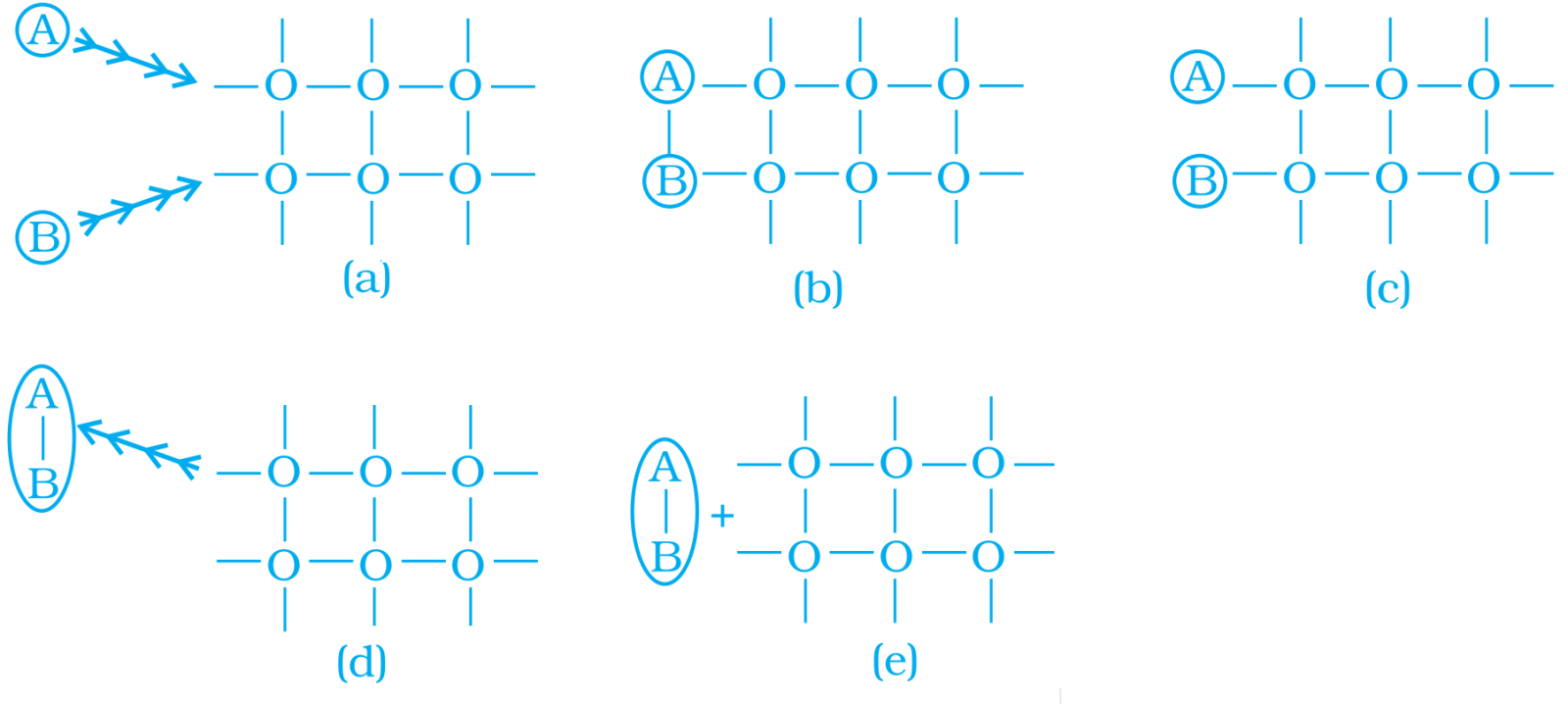
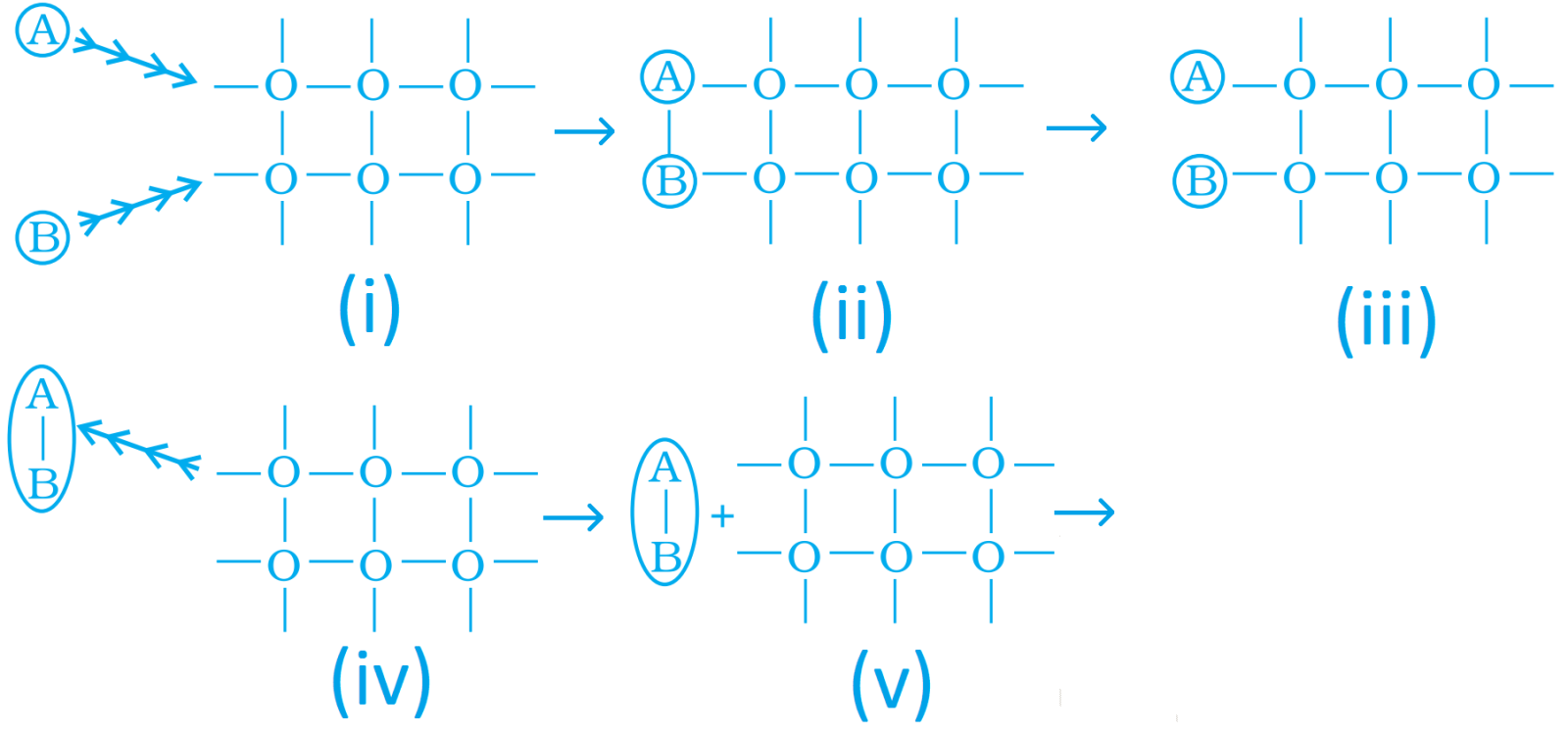
Arrange the following diagrams in correct sequence of steps involved in the mechanism of catalysis, in accordance with modern adsorption theory.
  • A
    $a ⎯\rightarrow b ⎯\rightarrow c ⎯\rightarrow d ⎯\rightarrow e$
  • $a ⎯\rightarrow c ⎯\rightarrow b ⎯\rightarrow d ⎯\rightarrow e$
  • C
    $a ⎯\rightarrow c ⎯\rightarrow b ⎯\rightarrow e ⎯\rightarrow d$
  • D
    $a ⎯\rightarrow b ⎯\rightarrow c ⎯\rightarrow e ⎯\rightarrow d$
Answer
Correct option: B.
$a ⎯\rightarrow c ⎯\rightarrow b ⎯\rightarrow d ⎯\rightarrow e$
Each transformation denotes a meaningful process as follows
  1. Adsorption of $A$ and $B$ on surface.
  2. Interaction between $A$ and $B$ to form intermediate.
  3. Starting desorption of $A-B.$
  4. Complete desorption.
View full question & answer
MCQ 961 Mark
Which one of the following systems has the smallest sized domains in its dispersed phase?
  • A
    Nanoemulsion.
  • B
    Coarse suspension.
  • C
    Coarse emulsion.
  • Microemulsion.
Answer
Correct option: D.
Microemulsion.
The average diameter of droplets in macro-emulsion is close to one millimeter $($i.e., $10^{-3} \mathrm{\sim m}).$ Therefore, since micromeans $10^{-6}$ and emulsion implies that droplets of the dispersed phase have diameters close to $10^{-3} \mathrm{\sim m},$ the microemulsion denotes a system with the size range of the dispersed phase in the $10^{-6} \times 10^{-3} \mathrm{\sim m}=10^{-9} \mathrm{\sim m}$ range.
View full question & answer
MCQ 971 Mark
Which of the following statements are correct about solid catalyst?
$a.$ Same reactants may give different product by using different catalysts.
$b.$ Catalyst does not change $\triangle\text{H}$ of reaction.
$c.$ Catalyst is required in large quantities to catalyse reactions.
$d.$ Catalytic activity of a solid catalyst does not depend upon the strength of chemisorption.
  • $a$ and $b$
  • B
    $a$ and $c$
  • C
    $b$ and $c$
  • D
    $a$ and $d$
Answer
Correct option: A.
$a$ and $b$
Action of a catalyst is highly selective in nature, i.e., a given substance can act as a catalyst only in a particular reaction and not for all the reactions. It means that a substance which acts as a catalyst in one reaction may fail to catalyse another reaction. Catalyst does not change the enthalpy of reaction.
View full question & answer
MCQ 981 Mark
The adhering of the molecules of gas on the surface of a solid is called $......?$
  • A
    Mixture.
  • Adsorption.
  • C
    Reduction.
  • D
    None of these.
Answer
Correct option: B.
Adsorption.
The adhering of the molecules of gas on the surface of a solid is called adsorption. It is a surface phenomenon. It is defined as the phenomenon of accumulation of higher concentration of one substance on the surface of another than in the bulk.
View full question & answer
MCQ 991 Mark
Delta formation at the mouth of river takes place by:
  • A
    Coagulation of negative salt ions and positive river particles.
  • Coagulation of positive salt ions and negative river particles.
  • C
    Coagulation of positive salt ions and positive river particles.
  • D
    Coagulation of negative salt ions and negative river particles.
Answer
Correct option: B.
Coagulation of positive salt ions and negative river particles.
River water contains charged colloidal particles of clay, sand and many other materials. Sea water is very big store house of a variety of electrolytes dissolved in it. As soon as river water comes in contact with sea water coagulate the suspended colloidal particles which ultimately settle down at the point of contact. Thus the level of the river bed rises. As a result, water adopts a different course and delta is formed in due course of time.
View full question & answer
MCQ 1001 Mark
The term ‘sorption’ stands for $......$
  • A
    Absorption
  • B
    Adsorption
  • Both absorption and adsorption
  • D
    Desorption
Answer
Correct option: C.
Both absorption and adsorption
Adsorption and absorption when take place together, it is known as sorption.
View full question & answer
M.C.Q (1 Marks) - Page 2 - Chemistry STD 12 Science Questions - Vidyadip