MCQ 1011 Mark
Choose the correct answer from the given four options:Area of the region bounded by the curve $\text{y}\cos\text{x}$ between $x = 0$ and $\text{x}=\pi$ is:
- ✓
$2\text{ sq. units}$
- B
$4\text{ sq. units}$
- C
$3\text{ sq. units}$
- D
$1\text{ sq. units}$
AnswerCorrect option: A. $2\text{ sq. units}$
Required area enclosed by the curve $\text{y}\cos\text{x},$ and $x = 0$ and $\text{x}=\pi$
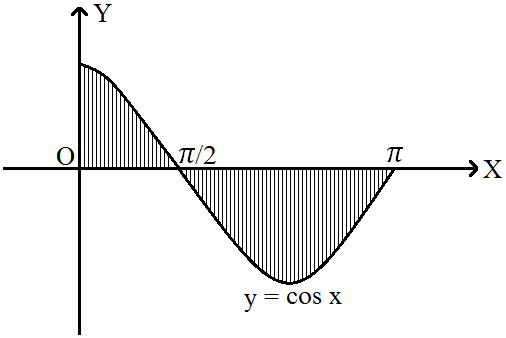
$\text{A}=\int\limits^{\frac{\pi}{2}}_0\cos\text{x dx}\Bigg|\int\limits^\pi_{\frac{\pi}{2}}\cos\text{x dx}\Bigg|$
$=\Big[\sin\frac{\pi}{2}-\sin0\Big]+\Big|\sin\frac{\pi}{2}-\sin\pi\Big|$
$=1+1=2\text{ sq. units}$ View full question & answer→MCQ 1021 Mark
If the area above the $x-$axis, bounded by the curve $y = 2kx$ and $x = 0,$ and $x = 2$ is $\frac{3}{\log_{\text{e}}2},$ then the value of $k$ is:
- A
$\frac{1}{2}$
- ✓
$1$
- C
$-1$
- D
$2$
AnswerThe area bounded by the curves $y=2^{k x}, x=0,$ and $x=2$ is given by $\int\limits^2_02^\text{kx}\text{dx}.$ It is given that $\int\limits^2_02^{\text{kx}}\text{dx} = \frac{3}{\log_{\text{e}}(2)} $
$\Rightarrow\frac{1}{\text{k}}\bigg[\frac{2^\text{kx}}{\log_e(2)}\bigg]^2_0=\frac{3}{\log_{e}(2)}$
$\Rightarrow\frac{1}{\text{k}}\bigg[\frac{2^\text{k(2)}}{\log_e(2)}-\frac{2^{\text{k(0)}}}{\log_{e}(2)}\bigg]= \frac{3}{\log_{e}(2)}$
$\Rightarrow\frac{1}{\text{k}}\Big(\frac{2^{\text{2k}}}{\log_e(2)}-\frac{1}{\log_e(2)}\Big)= \frac{3}{\log_e(2)}$
$\Rightarrow\frac{1}{\text{k}}(2^{\text{2k}}-1)=3$
$\Rightarrow(2^{\text{2k}}-1)=3\text{k}$
$\Rightarrow2^{\text{2k}}-3\text{k}-1=0$
$\Rightarrow \text{k}= 1$
Clearly$, K = 1$ satisfies the equation.
Hence$, K = 1$
View full question & answer→MCQ 1031 Mark
The area bounded by the curve $x^2=4 y+4$ and line $3 x+4 y=0$ is:
- A
$\frac{25}{4}\text{sq}.\text{units}$
- B
$\frac{125}{8}\text{sq}.\text{units} $
- C
$\frac{125}{16}\text{sq}.\text{units}$
- ✓
$\frac{124}{4}\text{sq}.\text{units}$
AnswerCorrect option: D. $\frac{124}{4}\text{sq}.\text{units}$
View full question & answer→MCQ 1041 Mark
Area of the region bounded by the curve $\text{y}=\sqrt{49-\text{x}^2}$ and the $x -$ axis is:
- ✓
$\frac{49}{2}\pi\text{ sq}\text{ units}$
- B
$98\pi\text{ sq}\text{ units}$
- C
$49\pi\text{ sq}\text{ units}$
- D
$240\pi\text{ sq}\text{ units}$
AnswerCorrect option: A. $\frac{49}{2}\pi\text{ sq}\text{ units}$
$=$as area is above the $x-$axis
$\therefore$area$=2\int\limits^7_0\sqrt{49-\text{x}^2\text{dx}}$
$=2\Big[\frac{\text{x}}{2}\sqrt{49-\text{x}^2}+\frac{49}{2}\sin^{-1}\frac{\text{x}}{7}\Big]^7_0$
$=2\Big[\Big(\frac{7}{2}\times+\frac{49}{2}\sin^{-1}1\Big)-(0)\Big]$
$=\frac{49}{2}\pi\text{ sq}\text{ units}$
View full question & answer→MCQ 1051 Mark
The line $y = mx$ bisects the area enclosed by lines $\text{x}=0,\text{y}=0$ and $\text{x}=\frac{3}{2}$ and the curve $\text{y}=1+4\text{x}-\text{x}^2.$ Then the value of m is:
- ✓
$\frac{13}{6}$
- B
$\frac{13}{2}$
- C
$\frac{13}{5}$
- D
$\frac{13}{7}$
AnswerCorrect option: A. $\frac{13}{6}$
View full question & answer→MCQ 1061 Mark
The area of the region bounded by the parabola $y=x^2$ and $y=|x|$ is:
- A
$3$
- B
$\frac{1}{2}$
- ✓
$\frac{1}{3}$
- D
$2$
AnswerCorrect option: C. $\frac{1}{3}$
View full question & answer→MCQ 1071 Mark
He area bounded by $y=x^2, x=y^2$ is:
- ✓
$1$
- B
$\frac{1}{6}$
- C
$\frac{3}{4}$
- D
Answer$=\text{y}=\text{x}^2,\text{y}^2=\text{x}$
$\Rightarrow\text{y}=\sqrt{\text{x}}$
The curves intersect at $(0, 0)$ and $(1,1)$ Area between the curves is given by
$=\int\limits^1_0\sqrt{\text{x}}-\text{x}^2\text{dx}$
$=\frac{1}{2}\text{x}^\frac{3}{2}+\frac{\text{x}^3}{3}\Big|^1_0$
$=\frac{2}{3}+\frac{1}{3}=1$
View full question & answer→MCQ 1081 Mark
The area bounded by $y=2-x^2$ and $x+y=0$ is:
AnswerCorrect option: B. $\frac{9}{2}\text{ sq. units}$
$\text{(IMAGE)}$
To find the points of intersection of $x+y=0$ and $y=2-x^2$.
We put $x=-y$ in $y=2-x^2$,
We get $y=2-y^2$
$\Rightarrow y^2+y-2=0$
$\Rightarrow y-1, y+2=0$
$\Rightarrow y=1,-2$
$\Rightarrow x=-1,2$
Therefore, the points of intersection are $A(-1,1)$ and $C(2,-2)$. The area of the required region $\text{ABCD},$
$\text{A} = \int\limits^2_{-1}(\text{y}_1-\text{y}_{2})\text{dx}$ (Where, $\mathrm{y}_1=2-\mathrm{x}^2$ and $\mathrm{y}_2=-\mathrm{x}$ )
$=\int\limits^2_{-1}(2-\text{x}^{2}+\text{x})\text{dx}$
$ = \Big[2\text{x}-\frac{\text{x}^{3}}{3}+\frac{\text{x}^{2}}{2}\Big]^2_{-1}$
$= \bigg\{2(2)-\frac{(2)^{3}}{3}+\frac{(2)^{2}}{2}\bigg\}-\bigg\{2(-1)-\frac{(-1)^{3}}{3}+\frac{(-1)^{2}}{2}\bigg\}$
$= \Big(4-\frac{8}{3}+2\Big)-\Big(-2+\frac{1}{3}+\frac{1}{2}\Big)$
$=6-\frac{8}{3}+2-\frac{1}{3}-\frac{1}{2}$
$= 8 - \frac{9}{3}-\frac{1}{2}$
$= 5 -\frac{1}{2}$
$\frac{9}{2}\text{ sq. units}$
View full question & answer→MCQ 1091 Mark
The area between $x-$axis and curve $\text{y}=\cos\text{x}$ when $0\leq\text{x}\leq2\pi$ is:
Answer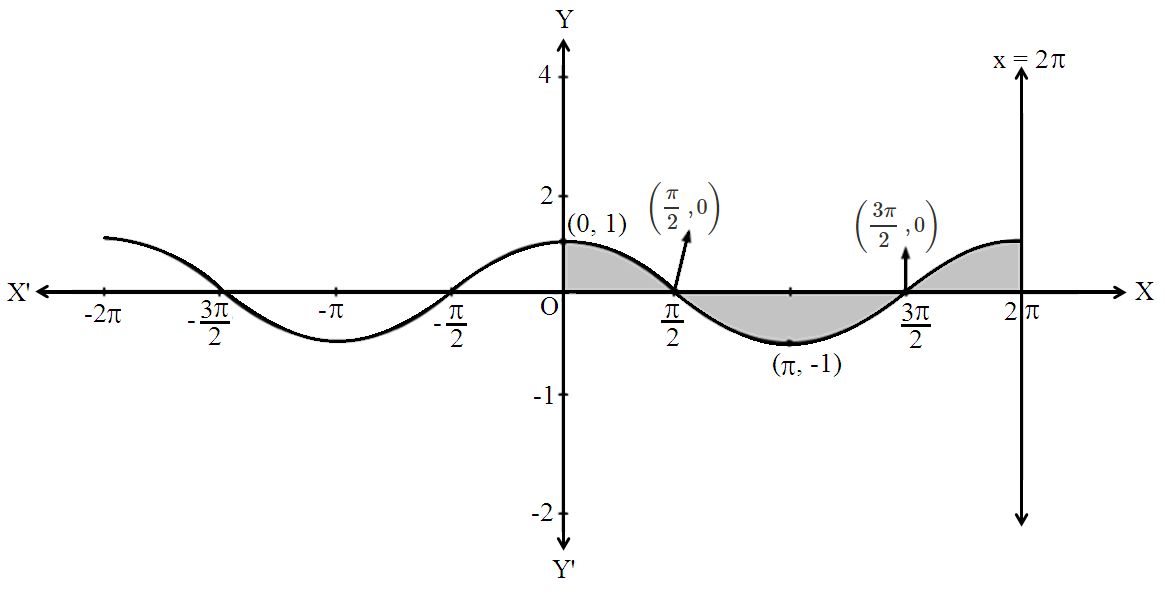
Required shaded area,
$\text{A} = \int\limits^\frac{\pi}{2}_0\cos\text{x}\text{ dx} + \int\limits^\frac{3\pi}{2}_\frac{\pi}{2}(-\cos\text{x})\text{dx} + \int\limits^{2\pi}_\frac{3\pi}{2}\cos\text{x}\text{ dx}$
$= \int\limits^\frac{\pi}{2}_0\cos\text{x}\text{ dx}-\int\limits^\frac{3\pi}{2}_\frac{\pi}{2}\cos\text{x}\text{ dx} + \int\limits^{2\pi}_\frac{3\pi}{2}\cos\text{x}\text{ dx}$
$=\Big[\sin\text{x}\Big]^{\frac{\pi}{2}}_0-\Big[\sin\text{x}\Big]^{\frac{3\pi}{2}}_\frac{\pi}{2}+\Big[\sin\text{x}\Big]^{2\pi}_\frac{3\pi}{2}$
$= \Big[\sin\text{x}\Big]^\frac{\pi}{2}_0-\Big[\sin\text{x}\Big]^\frac{3\pi}{2}_\frac{\pi}{2}+\Big[\sin\text{x}\Big]^{2\pi}_\frac{3\pi}{2}$
$=(1-0)-(-1-1)+\big[0-(-1)\big]$
$=1+2+1$
$=4\text{ sq. units}$ View full question & answer→MCQ 1101 Mark
Find the area above $x-$axis, bounded by the curves $y=2^{k x}, x = 0$ and $x = 2:$
- ✓
$\frac{4^\text{k}-1}{\text{k}\text{ log}_\text{e}2}$
- B
$\frac{2^\text{k}-1}{2\text{ log}_\text{e}2}$
- C
$\frac{3-\text{k}}{\text{k}\text{ log}_\text{e}2}$
- D
$\frac{-1+3^\text{k}}{2\text{ log}_\text{e}2}$
AnswerCorrect option: A. $\frac{4^\text{k}-1}{\text{k}\text{ log}_\text{e}2}$
View full question & answer→MCQ 1111 Mark
The area of the region bounded by the parabola $(y - 2)^2 = x - 1,$ the tangent to it at the point with the ordinate $3$ and the $x-$axis is:
Answer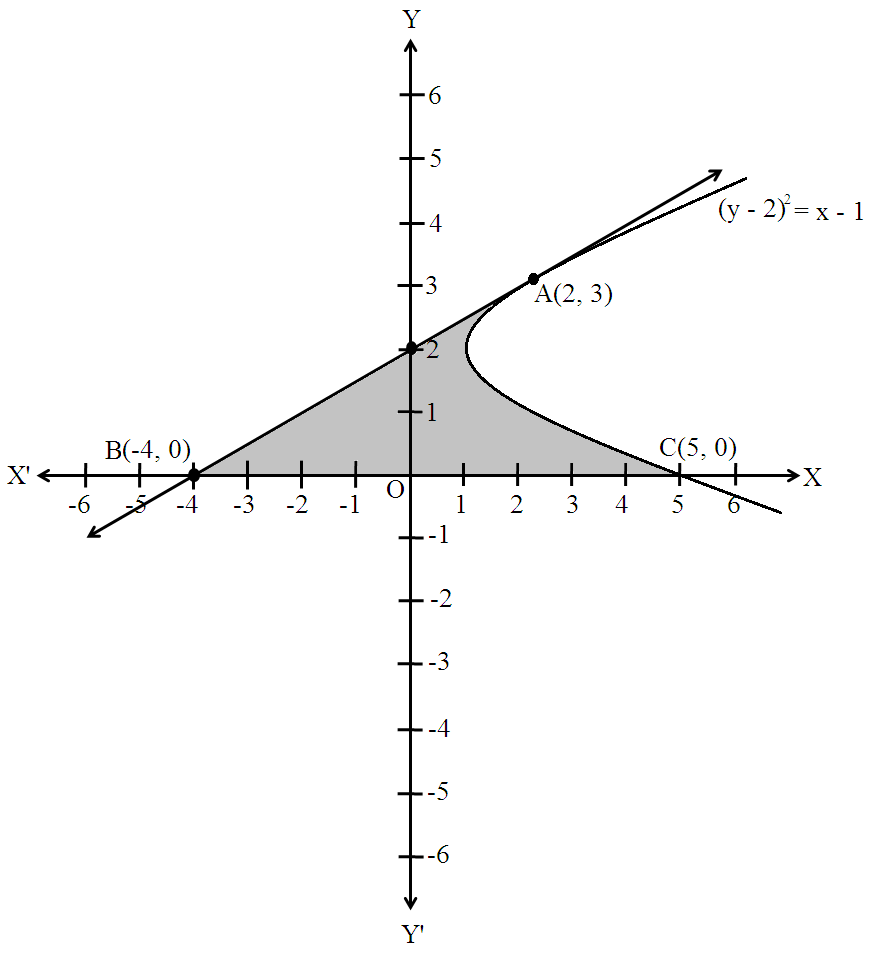
The tangent passes through the point with ordinate $3,$
so substituting $y = 3$ in equation of parabola $(y - 2)^2 = x - 1,$ we get $x = 2$
Therefore, the line touches the parabola at $(2, 3)$
We have,
$(\text{y}-2)^{2} = \text{x}-1$
$\Rightarrow \text{y}-2 = \sqrt{\text{x}-1}$
$\Rightarrow \text{y} = \sqrt{\text{x}-1}+2$
Slope of tangent of parabola at x = 2
$\Big[\frac{\text{dy}}{\text{dt}}\Big]_{\text{x}=2}=\Big[\frac{1}{2\sqrt{\text{x}-1}}\Big]_{\text{x}=2}=\frac{1}{2}$
Therefore the equation of the tangent is given as:
$\text{y}-\text{y}_0 = \text{m}(\text{x}-\text{x}_0)$
$\Rightarrow\text{y}-3=\frac{1}{2}(\text{x}-2)$
$\Rightarrow\text{y}=\frac{1}{2}\text{x}+2$
Therefore, area of the required region $\text{ABC},$
$\text{A} = \int\limits^3_0(\text{x}_1-\text{x}_2)\text{dy}$ $\big[$Where$, \text{x}_1=(\text{y}-2)^{2}+1$ and $\text{ x}_2=2(\text{y}-2)\big]$
$= \int\limits^3_0(\text{x}_1-\text{x}_2)\text{dy}$
$=\int\limits^3_0(\text{y}-2)^2+1-2(\text{y}-2)\text{dy}$
$= \int\limits^3_0\big[(\text{y}-2)-1\big]^2\text{dy}$
$= \int\limits^3_0\big[\text{y}-3\big]^2\text{dy} $
$= \bigg[\frac{(\text{y}-3)^3}{3}\bigg]^3_0$
$=\bigg[\frac{(3-3)^{3}}{3}\bigg]-\bigg[\frac{(0-3)^3}{3}\bigg]$
$=9$ View full question & answer→MCQ 1121 Mark
The area bounded by the curve $\text{y}^2=16\text{x}$ and line $\text{y}=\text{ mx}$ is $\frac{2}{3},$ then m is equal to:
View full question & answer→MCQ 1131 Mark
The area bounded by the lines $|x| + |y| = 1$ is:
AnswerCorrect option: B. $\text{2 sq. units}$
View full question & answer→MCQ 1141 Mark
Find the area enclosed by the parabola $y^2=x$ and the line $y + x = 2$ and the $x-$axis:
- A
$\frac{5}{6}\text{sq.}\text{units}$
- ✓
$\frac{7}{6}\text{sq.}\text{units}$
- C
$\frac{6}{7}\text{sq.}\text{units}$
- D
$\frac{4}{7}\text{sq.}\text{units}$
AnswerCorrect option: B. $\frac{7}{6}\text{sq.}\text{units}$
View full question & answer→MCQ 1151 Mark
For which of the following values of $mm,$ is the area of the region bounded by the curve $y=x-x^2,$ and the line $y = mx$ equals $\frac{9}{2}\text{ sq. unit?}$
AnswerThe two curves meet at $m x=x-x^2$ or $=x^2=x(1-m)$
$\Rightarrow x^2=x-m x$
$\therefore x = 0, 1 - m$
$=\int\limits^{1-\text{m}}_0(\text{y}_1-\text{y}_2)\text{dx}$
$=\Big[(1-\text{m)}\frac{\text{x}^2}{2}-\frac{\text{x}^2}{3}\Big]^{1-\text{m}}_0$
$=\frac{9}{2}($given$)$ If $\text{ m}<1$
$=$or$=(1-\text{m)}^3\Big[\frac{1}{2}-\frac{1}{3}\Big]=\frac{9}{2}$
$=$or$-(1-\text{m)}^3=-27$
$=$or $1-\text{m}=-3$
$\Rightarrow\text{m}=4$
View full question & answer→MCQ 1161 Mark
The area of ellipse $\frac{\text{x}^2}{4^2}+\frac{\text{y}^2}{9^2}=1$ is:
- A
$6\pi\text{ sq}.\text{units}$
- B
$\frac{\pi(\text{a}^2+\text{b}^2)}{4}\text{ sq}.\text{units}$
- C
$\pi(\text{a+b})\text{ sq}.\text{units}$
- ✓
View full question & answer→MCQ 1171 Mark
Area between the curve $\text{y}=\cos^2\text{x}, x-$axis and ordinates $x = 0$ and $x = p$ in the interval $(0, p)$ is:
- A
$2\pi3$
- B
$2\pi$
- C
$\pi$
- ✓
$\frac{\pi}{2}$
AnswerCorrect option: D. $\frac{\pi}{2}$
View full question & answer→MCQ 1181 Mark
The area included between the parabolas $y^2 = 4x$ and $x^2 = 4y$ is $($in square units$)$
- A
$\frac{4}{3}$
- B
$\frac{1}{3}$
- ✓
$\frac{16}{3}$
- D
$\frac{8}{3}$
AnswerCorrect option: C. $\frac{16}{3}$
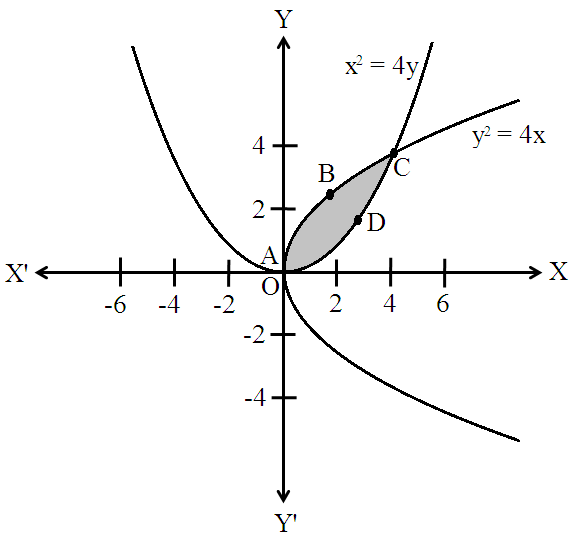
We have, $\text{x} = \frac{\text{y}^{2}}{4}\ ....(1)$
$\text{x}^{2} = 4\text{y}\ ....(2)$
points of intersection of two parabola is given by$, y^24^2 = 4y$
$\Big(\frac{\text{y}^{2}}{4}\Big)^{2} = 4\text{y}$
$\Rightarrow\text{y}^{4} -64\text{y} = 0$
$\Rightarrow\text{y}(\text{y}^{3}-64) = 0$
$\Rightarrow\text{y} = 0, 4$
$\Rightarrow\text{x} = 0, 4$
Therefore, the points of intersection are $A(0, 0)$ and $C(4, 4).$
Therefore, the area of the required region $\text{ABCD},$
$= \int\limits^4_0\Big(2\sqrt{\text{x}}-\frac{\text{x}^{2}}{4}\Big) \text{dx}$
$= \bigg[2\times\frac{2\text{x}^\frac{3}{2}}{3}-\frac{\text{x}^{3}}{12}\bigg]^4_0$
$=\bigg(2\times\frac{2(4)^\frac{3}{2}}{3}-\frac{(4)^{3}}{12}-\frac{(0)^{3}}{12}\bigg)$
$= \big(\frac{32}{3}-\frac{16}{3}\big)-0$
$= \frac{16}{3}$ square units View full question & answer→MCQ 1191 Mark
The area bounded by the curve $y = 4x - x^2$ and the $x-$axis is:
- A
$\frac{30}{7}\text{ sq. units}$
- B
$\frac{31}{7}\text{ sq. units}$
- ✓
$\frac{32}{3}\text{ sq. units}$
- D
$\frac{34}{3}\text{ sq. units}$
AnswerCorrect option: C. $\frac{32}{3}\text{ sq. units}$
Point of intersection of parabola
$y = 4x - x^2$ with $x-$axis is given by $y = 4x - x^2$ and $y = 0$
Equation of $x$ axis
$\Rightarrow 4x - x^2 = 0$
$\Rightarrow x = 0$ or $x = 4$
$\Rightarrow y = 0, y = 0$
Thus $0 (0, 0)$ and $B (4, 0)$ are points of intersection of parabola and $x -$ axis.
Required shaded area $= \int\limits^4_0(4\text{x}-\text{x}^2)\text{dx}$
$= \Big[2\text{ x}^2-\frac{\text{x}^3}{3}\Big]^4_0$
$= 2\times16-\frac{16}{3}-0$
$=\frac{96-64}{3}$
$=\frac{32}{3}\text{ sq. units}$
View full question & answer→MCQ 1201 Mark
The area of the circle $x^2+y^2=16$ enterior to the parabola $y^2=6 x$ is:
- A
$\frac{4}{3}\big(4\pi-\sqrt{3}\big)$
- B
$\frac{4}{3}\big(4\pi+\sqrt{3}\big)$
- ✓
$\frac{4}{3}\big(8\pi-\sqrt{3}\big)$
- D
$\frac{4}{3}\big(8\pi+\sqrt{3}\big)$
AnswerCorrect option: C. $\frac{4}{3}\big(8\pi-\sqrt{3}\big)$
Points of intersection of the parabola and the circle is obtained by solving the simultaneous equation
$x^2+y^2=16$ and $y^2=6 x$
$\Rightarrow x^2+6 x=16$
$\Rightarrow x^2=6 x-16=0$
$\Rightarrow(x+8)(x-2)=0$
$\Rightarrow x=2$ or $x=-8$
$\Rightarrow x=2$ or $x=-8, x$ can not be $-8$ as in this case it will be the point outside circle.
$\therefore \text{x} = 2$
$\therefore$ when $\text{x} = 2,\text{ y}=\pm\sqrt{6\times2}=\pm\sqrt{12}=\pm2\sqrt{3}$
$\therefore\text{B}(2, 2\sqrt{3})$ and $\text{ B}\ '(2,-2\sqrt{3})$ are points of intersection of the parabola and circle.
Required area
$=$ Area $OB\ 'C\ ' A\ 'CBO$
$=$ area of circle $-$ area $OBAB\ 'O$ Area of circle with radius $4$
$= \pi\times4^2$
$=16\pi$
Now,
Area $OBAB\ 'O$
$= 2$area $\text{OBAO}$
$= 2$ area $\text{OBDO} +$ area $\text{DBAD}$
$= 2\times\Bigg[\int\limits^2_0\sqrt{6\text{x}}\text{dx}+ \int\limits^4_2\sqrt{16-\text{x}^{2}}\Bigg]$
$= 2\times\Bigg\{\Bigg[\sqrt{6}\frac{\text{x}^\frac{3}{2}}{\frac{3}{2}}\Bigg]^2_0+ \Big[\frac{\text{x}}{2}\sqrt{16-\text{x}^2}+\frac{1}{2}\times16\sin^{-1}\Big(\frac{\text{x}}{4}\Big)\Big]^4_2\Bigg\}$
$= 2\times\Big\{\Big(\sqrt{6}\times\frac{2}{3}\times2^\frac{3}{2}-0\Big)+ \Big(\frac{1}{2}4\sqrt{16-(4)^2}\frac{1}{2}\times16\sin^{-1}\frac{4}{4}\\-\frac{2}{2}\sqrt{16-2^2}-\frac{1}{2}\times16\sin^{-1}\frac{2}{4}\Big)\Big\}$
$= 2\times\bigg[\Big(\sqrt{6}\times\frac{2}{3}\times2\sqrt{2}\Big)+0+8\sin^{-1}(1)-\sqrt{12}-8\sin^{-1}\Big(\frac{1}{2}\Big)\bigg]$
$= 2\times \bigg[\frac{8\sqrt{3}}{3}+8\times\frac{\pi}{2}-2\sqrt{3}-8\frac{\pi}{6}\bigg]$
$= 2\bigg\{\frac{8\sqrt{3}-6\sqrt{3}}{3}+8\big(\frac{\pi}{2}-\frac{\pi}{2}\big)\bigg\}$
$= 2\bigg\{\frac{2\sqrt{3}}{3}+8\Big(\frac{2\pi}{6}\Big)\bigg\}$
$= \frac{4\sqrt{3}}{3}+\frac{16\pi}{3}$
View full question & answer→MCQ 1211 Mark
If $A_n$ be the area bounded by the curve $y = (\tan x)^n$ and the lines $x = 0, y = 0$ and $\text{x}=\frac{\pi}{4},$ then for $x > 2$
- ✓
$\text{A}_{\text{n}}+\text{A}_{\text{n}-2}=\frac{1}{\text{n}-1}$
- B
$\text{A}_{\text{n}}+\text{A}_{\text{n}-2}<\frac{1}{\text{n}-1}$
- C
$\text{A}_{\text{n}}-\text{A}_{\text{n}-2}=\frac{1}{\text{n}-1}$
- D
AnswerCorrect option: A. $\text{A}_{\text{n}}+\text{A}_{\text{n}-2}=\frac{1}{\text{n}-1}$
$A_n =$ Area bounded by the curve $\text{y}=\big\{\tan(\text{x})\big\}^\text{n}=\tan^\text{n}\text{(x)}$ and the lines $x = 0, y = 0,$ and $\text{x}=\frac{\pi}{4}.$
Therefore,
$\text{A}_\text{n}=\int\limits_\text{0}^{\frac{\pi}{4}}\tan^\text{n}\text{(x)}\text{dx}$
$\Rightarrow \text{A}_{\text{n}-2}=\int\limits_\text{0}^{\frac{\pi}{4}}\tan^{\text{n}-2}\text{(x)}\text{dx}$
Comsider, $\text{A}_\text{n}=\int\limits_\text{0}^{\frac{\pi}{4}}\tan^\text{n}\text{(x)}\text{dx}$
$\Rightarrow\ \text{A}_\text{n}=\int\limits_0^{\frac{\pi}{4}}\big\{\tan^{\text{n}-2}(\text{x})\big\}\big\{\tan^2(\text{x})\big\}\text{dx}$
$\Rightarrow\text{A}_\text{n}=\int\limits_0^\frac{\pi}{4}\big\{\tan^{\text{n}-2}(\text{x})\big\}\big\{\sec^2\text{(x)}-1\big\}\text{dx}$
$\Rightarrow\text{A}_\text{n}=\int\limits_0^\frac{\pi}{4}\big\{\tan^{\text{n}-2}\text{(x)} \sec^2(\text{x})-\tan^{\text{n}-2}(\text{x})\big\}\text{dx}$
$\Rightarrow\text{A}_\text{n}=\int\limits_0^{\frac{\pi}{4}}\big\{\tan^{\text{n}-2}\text{(x)}\sec^2(\text{x})\big\}\text{dx}-\int_0^\frac{\pi}{4}\tan^{\text{n}-2}\text{(x)}\text{ dx}$
$\Rightarrow\text{A}_\text{n}+\text{A}_{\text{n}-2}=\int\limits_0^\frac{\pi}{4}\tan^{\text{n}-2}(\text{x})\sec^2\text{(x) dx}$
Now, $\text{A}_\text{n}+\text{A}_{\text{n}+2}=\int\limits_0^\frac{\pi}{4}\tan^{\text{n}-2}\text{(x)}\sec^2(\text{x})\text{dx}$
Let $\text{u}=\tan\text{(x)}$
$\Rightarrow\text{du}=\sec^2\text{x }\text{dx}$
Also, when $x = 0, u = 0$ and when $\text{x}=\frac{\pi}{4},\text{u}=1$
Therefore,
$\text{A}_\text{n}+\text{A}_{\text{n}-2}=\int\limits_0^{\frac{\pi}{4}}\tan^{\text{n}-2}\text{(x)}\sec^2\text{(x) dx}$
$=\int\limits_0^1(\text{u}^{\text{n}-2})\text{du}$
$=\Big[\frac{\text{u}^{\text{n}-1}}{\text{n}-1}\Big]_0^1$
$=\Big[\frac{1}{\text{n}-1}-0\Big]=\frac{1}{\text{n}-1}$
View full question & answer→MCQ 1221 Mark
Area bounded between the parabola $y^2=4 a x$ and its latus rectum is:
- A
$\frac{1}{3}\text{a }\text{sq}.\text{units}$
- B
$\frac{1}{3}\text{a}^2\text{ sq}.\text{units}$
- C
$\frac{8}{3}\text{a}\text{ sq}.\text{units}$
- ✓
$\frac{8}{3}\text{a}^2\text{ sq}.\text{units}$
AnswerCorrect option: D. $\frac{8}{3}\text{a}^2\text{ sq}.\text{units}$
View full question & answer→MCQ 1231 Mark
Area bounded by the ellipse $\frac{\text{x}^2}{4}+\frac{\text{y}^2}{9}=1$ is:
- ✓
$6\pi\text{ sq.}\text{units}$
- B
$3\pi\text{ sq.}\text{units}$
- C
$12\pi\text{ sq.}\text{units}$
- D
AnswerCorrect option: A. $6\pi\text{ sq.}\text{units}$
View full question & answer→MCQ 1241 Mark
The area $($sq. units$)$ bounded by the parabola $y^2 = 4ax$ and the line $x = a$ and $x = 4a$ is:
- A
$\frac{\text{35a}^2}{3}$
- B
$\frac{4\text{a}^2}{3}$
- C
$\frac{7\text{a}^2}{3}$
- ✓
$\frac{56\text{a}^2}{3}$
AnswerCorrect option: D. $\frac{56\text{a}^2}{3}$
View full question & answer→MCQ 1251 Mark
Area bounded by the curve $\text{y}=\cos\text{x}$ between $\text{x}=0$ and $\text{x}=\frac{3\pi}{2}$ is:
- A
$\text{1 sq. unit}$
- B
$\text{2 sq. units}$
- ✓
$\text{3 sq. units}$
- D
$\text{4 sq. units}$
AnswerCorrect option: C. $\text{3 sq. units}$
View full question & answer→MCQ 1261 Mark
Consider the curves $\text{y}=\sin\text{x}$ and $\text{y}=\cos\text{x}.$ What is the area of the region bounded by the above two curves and the lines $\text{x}=0$ and $\text{x}=\frac{\pi}{4}?$
- ✓
$\sqrt{2}-1$
- B
$\sqrt{2}+1$
- C
$\sqrt{2}$
- D
$2$
AnswerCorrect option: A. $\sqrt{2}-1$
The area enclosed by $\text{y}=\sin\text{x,}\text{ y}=\cos\text{x},\text{ x}=0,\text{x}=\frac{\pi}{4}$ is given by
$=\int\limits^\frac{\pi}{4}_0(\cos\text{x}-\sin\text{x})\text{dx}=\sin\text{x}+\cos\text{x}\Big|^\frac{\pi}{4}_0$
$=\frac{1}{\sqrt{2}}+\frac{1}{\sqrt{2}}-0-=\sqrt{2}-1$
View full question & answer→MCQ 1271 Mark
Find the area of bounded by $\text{y}=\sin\text{x}$ from $\text{x}=\frac{\pi}{4}$ to $\text{x}=\frac{\pi}{2}:$
AnswerCorrect option: A. $\frac{\sqrt{2-1}}{\sqrt2}$
The area bounded is given as
$=\int\limits^\frac{\pi}{2}_\frac{\pi}{4}\sin\text{ x}\text{dx}$
$=\cos\text{ x}\Big|^\frac{\pi}{2}_\frac{\pi}{4}$
$=\cos\frac{\pi}{2}+\cos\frac{\pi}{4}$
$=\frac{\sqrt{2}-1}{\sqrt{2}}$
View full question & answer→MCQ 1281 Mark
The area of the region bounded by the ellipse $\text{x}^\frac{2}{16}+\text{y}^\frac{2}{9}=1$ is:
- ✓
$12\pi$
- B
$3\pi$
- C
$24\pi$
- D
$\pi$
AnswerCorrect option: A. $12\pi$
View full question & answer→MCQ 1291 Mark
Smaller area enclosed by the circle $x^2 + y^2 = 4$ and the line $x + y = 2$ is:
- A
$2(\pi-2)$
- ✓
$\pi-2$
- C
$\pi-1$
- D
$2(\pi+2)$
AnswerCorrect option: B. $\pi-2$
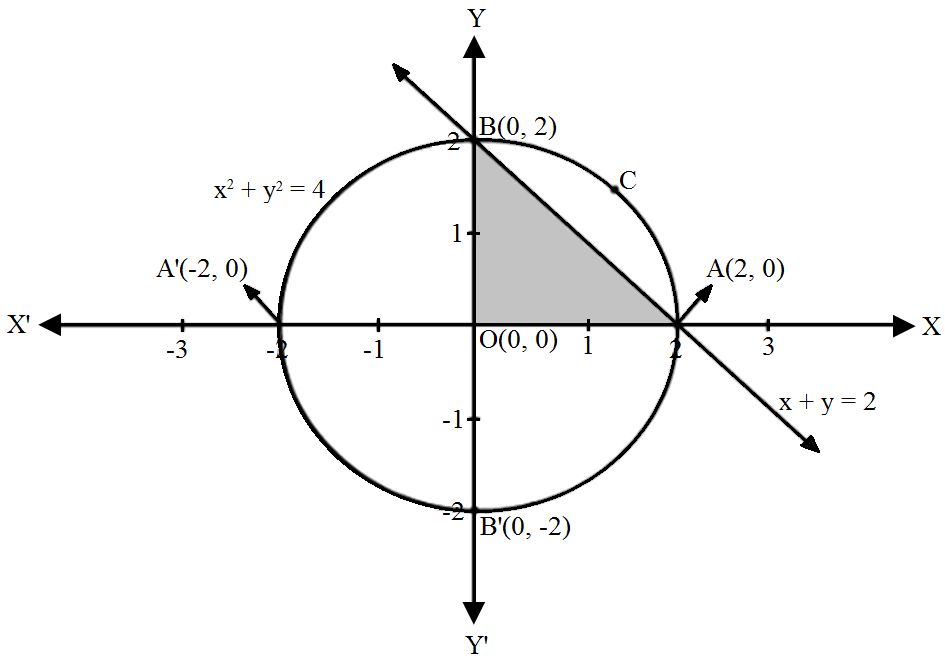
We have, $x^2 + y^2 = 4$ represents a circle with centre at $O(0, 0)$ and radius $2$
$x + y = 2$ represents a straight line cutting the $x-$axis at $A(2, 0)$ and $y$ axis at $B(0, 2)$
Thus, $A(2, 0)$ and $B(0, 2)$ are also the points of intersection of the straight line and the circle smaller area enclosed by the by the curve and straight line is the shaded area.
shaded area$\text{(ABCA)} =$ area$\text{(OBCA)} -$ area$\text{(OBAO)}$
$=\int\limits^2_0\sqrt{4-\text{x}^2}\text{dx}-\int\limits^2_0(2 - \text{x})\text{dx}$ $\big[\therefore\text{x}^2 + \text{y}^2=4\Rightarrow\text{y}=\sqrt{4-\text{x}^2}$ and $\text{x}+\text{y} = 2\Rightarrow\text{y} = 2-\text{x}\big]$
$=\int\limits^2_0\Big[\big(\sqrt{4-\text{x}^2}\big)+\text{x} - 2\Big]$
$= \bigg[\frac{1}{2}\text{x}\sqrt{4-\text{x}^2}+\frac{1}{2}\times4\times\sin^{-1}\Big(\frac{\pi}{2}\Big)+\Big(\frac{\text{x}^2}{2}-2\text{x}\Big)\bigg]^2_0$
$= \frac{1}{2}\times2\sqrt{4-2^2}+2\times\sin^{-1}\Big(\frac{2}{2}\Big)+\Big(\frac{2^2}{2}-2\times2\Big)-0$
$= 0 + 2 \times\frac{\pi}{2}+(2 - 4)$
$= (\pi-2) \text{sq. units}$ View full question & answer→MCQ 1301 Mark
A tangent having slope of $-\frac{4}{3}$ to the ellipse $\frac{\text{x}^2}{18}+\frac{\text{y}^2}{32}=1$ ntersects the major and minor axes at points $A$ and $B$ respectively. If $C$ is the center of the ellipse, then area of the $\triangle ABC$ is:
- A
$\text{12 sq. units}$
- ✓
$\text{24 sq. units}$
- C
$\text{36 sq. units}$
- D
AnswerCorrect option: B. $\text{24 sq. units}$
One of the tangents of slope m to the given ellipse is
$=\text{y}=\text{mx}+\sqrt{18\text{m}^2+32}$ for
$=\text{m}=-\frac{4}{3},$ we have
$=\text{y}=-\frac{4}{3}\text{x}+8.$
Then points on the axis where tangents meet are $A(6, 0)$ and $B(0, 8).$
Then area of $\triangle ABC$ is
$=\frac{1}{2}(6)(8)=24$ units.
View full question & answer→MCQ 1311 Mark
Choose the correct answer from the given four options: Area of the region in the first quadrant enclosed by the $x-$axis, the line $y = x$ and the circle $x^2 + y^2 = 32$ is:
- A
$16\pi\text{ sq. units}$
- ✓
$4\pi\text{ sq. units}$
- C
$32\pi\text{ sq. units}$
- D
$24\pi\text{ sq. units}$
AnswerCorrect option: B. $4\pi\text{ sq. units}$
We have$, y = 0, y = x$ and the circle $x^2 + y^2 - 3$ in the first quadrant
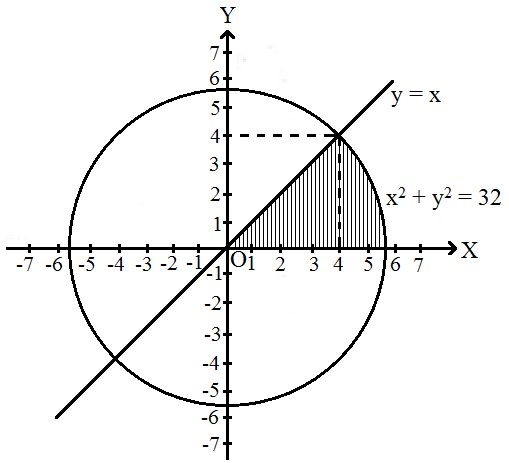
Solving $y = x$ with the circle
$x^2 + x^2 = 32$
$\Rightarrow x^2 = 16$
$\Rightarrow x = 4 ($In first quadrant$)$
When $x = 4, y = 4$
For point of intersection of circle with the $x-$axis,
Put $y = 0$
$\therefore\ \text{x}^2+0=32$
$\Rightarrow\ \text{x}=\pm4\sqrt{2}$
So, the circle intersects the $x-$axis at $\big(\pm4\sqrt{2},0\big)$
From the figure, area of shaded region
$\text{A}=\int\limits^4_0\text{x dx}+\int\limits^{4\sqrt{2}}_4\sqrt{(4\sqrt{2})^2-\text{x}^2}\text{ dx}$
$=\Big[\frac{\text{x}^2}{2}\Big]^4_0+\bigg[\frac{\text{x}}{2}\sqrt{(4\sqrt{2})^2-\text{x}^2}+\frac{\big(4\sqrt{2}\big)^2}{2}\sin^{-1}\frac{\text{x}}{4\sqrt{2}}\bigg]^{4\sqrt{2}}_0$
$=\frac{16}{2}+\bigg[0+16\sin^{-1}1-\frac{4}{2}\sqrt{\big(4\sqrt{2}\big)^2-16}-16\sin^{-1}\frac{4}{4\sqrt{2}}\bigg]$
$=8+\bigg[16\cdot\frac{\pi}{2}-2\cdot\sqrt{16}-16\cdot\frac{\pi}{4}\bigg]$
$=8+\big[8\pi-8-4\pi\big]=4\pi\text{ sq. units}$ View full question & answer→MCQ 1321 Mark
Area of triangle whose two vertices formed from the $x-$axis and line $y = 3 - |x|$ is:
View full question & answer→MCQ 1331 Mark
The area enclosed by the curve $\frac{\text{x}^2}{25}+\frac{\text{y}^2}{9}=1$ is:
- A
$10\pi\text{ sq.}\text{units}$
- ✓
$15\pi\text{ sq.}\text{units}$
- C
$5\pi\text{ sq.}\text{units}$
- D
$4\pi\text{ sq.}\text{units}$
AnswerCorrect option: B. $15\pi\text{ sq.}\text{units}$
View full question & answer→MCQ 1341 Mark
The area bounded by the $x -$ axis, the curve $y = f(x)$ and the lines $x = 1, x = b$ is equal to $\sqrt{\text{b}}^2+1-\sqrt{2}$ for all $b>,$then $\text{ f(x)}$ is:
AnswerCorrect option: D. $\text{x}\sqrt{\text{x}-1}$
View full question & answer→MCQ 1351 Mark
The area bounded by $= 4ax$ and $y = mx$ is $\frac{\text{a}^2}{3}\text{sq. units}$ then $m:$
AnswerThe two curves $y^2=4 a x$ and $y = mx$ intersect at
$=\Big(\frac{4\text{a}}{\text{m}^2},\frac{4\text{a}}{\text{m}}\Big)$ and the area enclosed by the two curves are given by
$=\int\limits^\frac{4\text{a}}{\text{m}2}_0\Big(\sqrt{4\text{ax}}-\text{mx}\Big)\text{dx}$
$\therefore\int\limits^\frac{4\text{a}}{\text{m}^2}\Big(\sqrt{4\text{ax}}-\text{mx}\Big)\text{dx}=\frac{\text{a}^2}{3}$
$\Rightarrow\frac{8}{3}.\frac{\text{a}^2}{\text{m}^3}=\frac{\text{a}^2}{3}$
$\Rightarrow\text{m}^3=8$
$\Rightarrow\text{m}=2$
View full question & answer→MCQ 1361 Mark
Area lying between the parabola $y^2=4 x$ and its latus rectum is:
- A
$\frac{1}{3}\text{ sq.}\text{units}$
- B
$\frac{2}{3}\text{ sq.}\text{units}$
- C
$\frac{5}{3}\text{ sq.}\text{units}$
- ✓
$\frac{8}{3}\text{ sq.}\text{units}$
AnswerCorrect option: D. $\frac{8}{3}\text{ sq.}\text{units}$
View full question & answer→MCQ 1371 Mark
If area bounded by the curves $x=a t^2$ and $y=a x^2$ is $1,$ then a $........$
- A
$\frac{1}{2}$
- B
$\frac{1}{3}$
- ✓
$\frac{1}{\sqrt{3}}$
- D
$1$
AnswerCorrect option: C. $\frac{1}{\sqrt{3}}$
$\text{x}=\text{ay}^2$ and $\text{ y}=\text{ax}^2$
$\Rightarrow\text{a}^3\text{ x}^3=1$
$\Rightarrow\text{(x},\text{y)}=\Big(\frac{1}{\text{a}},\frac{1}{\text{a}}\Big)$
The area bounded by the curves is computed by:
$=\int\limits^\frac{1}{\text{a}}_0\text{a}\text{x}^2-\sqrt{\frac{\text{x}}{\text{a}}}\text{ dx}=1$
$\Rightarrow\frac{1}{3\text{a}^2}=1$
$\Rightarrow\text{a}=\frac{1}{\sqrt{3}}$
View full question & answer→MCQ 1381 Mark
Area of curve explained in the passage from $0$ to $\frac{\pi}{2}$ is:
- A
$\frac{1}{3}\text{ sq.}\text{ unit}$
- B
$\frac{1}{2}\text{ sq.}\text{ unit}$
- ✓
$1\text{ sq.}\text{ unit}$
- D
$2\text{ sq.}\text{ units}$
AnswerCorrect option: C. $1\text{ sq.}\text{ unit}$
View full question & answer→MCQ 1391 Mark
The area bounded by the curve $\text{y}=\sec^2\text{x},\text{y}$ and $\text{x}=\frac{\pi}{3}$ is:
- A
$\sqrt{3}\text{ sq.}\text{ units}$
- B
$\sqrt{2}\text{ sq.}\text{ units}$
- ✓
$2\sqrt{3}\text{ sq.}\text{ units}$
- D
AnswerCorrect option: C. $2\sqrt{3}\text{ sq.}\text{ units}$
View full question & answer→MCQ 1401 Mark
The area bounded by the curves $x+2 y^2=0$ and $x+3 y^2=1$ is:
- A
$1\text{ sq.}\text{units}$
- B
$\frac{1}{3}\text{ sq.}\text{units}$
- C
$\frac{2}{3}\text{ sq.}\text{units}$
- ✓
$\frac{4}{3}\text{ sq.}\text{units}$
AnswerCorrect option: D. $\frac{4}{3}\text{ sq.}\text{units}$
View full question & answer→MCQ 1411 Mark
The area of the region $($in square units$)$ bounded by the curve $x^2=4 y$, line $x=2$ and $x-$axis is:
- A
$1$
- ✓
$\frac{2}{3}$
- C
$\frac{4}{3}$
- D
$\frac{8}{3}$
AnswerCorrect option: B. $\frac{2}{3}$
$x^2=4 y$ and $x=2$
$\Rightarrow 4 = 4y$
$\Rightarrow y = 1$
$A(2, 1)$ is the point of intersection of curve and straight the
Area of shaded region $\text{OAB} = \int\limits^2_0\text{y}\text{ dx}$
$=\int\limits^2_0\frac{\text{x}^2}{4}\text{ dx}$
$=\Big[\frac{\text{x}^3}{12}\Big]^2_0$
$= \frac{2^3}{12}-0$
$= \frac{2}{3}$ square units
View full question & answer→MCQ 1421 Mark
Choose the correct answer from the given four options : The area of the region bounded by the curve $\text{y}=\sqrt{16-\text{x}^2}$ and $x-$ axis is :
AnswerCorrect option: A. $8\text{ sq. units}$
Given equation of curve is $\text{y}=\sqrt{16-\text{x}^2}$ and the equation of line is
$X-$ axis i.e., $y = 0$
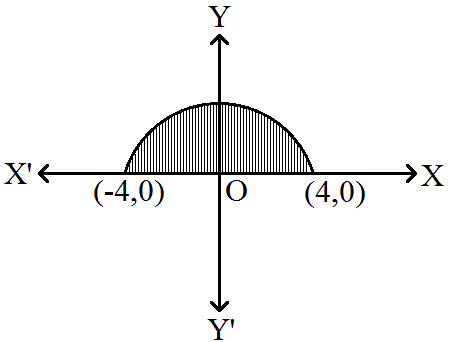
$\therefore\ \sqrt{16-\text{x}^2}=0\ \ \dots(\text{i})$
$\Rightarrow\ 16-\text{x}^2=0$
$\Rightarrow\ \text{x}^2=16$
$\Rightarrow\ \text{x}=\pm4$
So, the intersection points are $(4, 0)$ and $(-4, 0).$
$\therefore$ Area of curve, $\text{A}=\int\limits^4_{-4}(16-\text{x}^2)^{\frac{1}{2}}\text{dx}$
$=\int\limits^4_{-4}\sqrt{(4^2-\text{x}^2)}\text{dx}$
$=\bigg[\frac{\text{x}}{2}\sqrt{4^2-\text{x}^2}+\frac{4^2}{2}\sin^{-1}\frac{\text{x}}{4}\bigg]^4_{-1}$
$=\bigg[\frac{4}{2}\sqrt{4^2-4^2}+8\sin^{-1}\frac{4}{4}\bigg]-\bigg[-\frac{4}{2}\sqrt{4^2-(-4)^2}+8\sin^{-1}\Big(-\frac{4}{4}\Big)\bigg]$
$=\bigg[2\cdot0+8\cdot\frac{\pi}{2}-0+8\cdot\frac{\pi}{2}\bigg]=8\pi\text{ sq. units}$ View full question & answer→MCQ 1431 Mark
Area between the curves $y = x$ and $y=x^3$ is:
- ✓
$\sqrt{3}\sqrt{2}$
- B
$\frac{1}{2}$
- C
$\frac{2}{\sqrt{2}}$
- D
$\frac{1}{4}$
AnswerCorrect option: A. $\sqrt{3}\sqrt{2}$
View full question & answer→MCQ 1441 Mark
The area of region bounded by curve $\text{y}=\cos2\text{x},$ line $\text{x}=0$ $\text{x}=\frac{\pi}{3}$ is:
- A
$\frac{2-\sqrt{3}}{4}$
- ✓
$\frac{\sqrt{3}}{4}$
- C
$\frac{4-\sqrt{3}}{4}$
- D
$\frac{\sqrt{3}-4}{4}$
AnswerCorrect option: B. $\frac{\sqrt{3}}{4}$
$=\text{y}=\cos2\text{x}\int\limits^\frac{\pi}{3}_0\cos2\text{ xdx}$
$=\frac{1}{2}[\sin2\text{x}]^\frac{\pi}{3}_0$
$=\frac{\sqrt{3}}{4}\text{sq}\text{ units}$
View full question & answer→MCQ 1451 Mark
Area of the region bounded by the curve $\text{y}=\tan\text{x,}$ line $\text{x}=\frac{\pi}{4}$ and the $x-$axis is:
- A
$\log2\text{ sq.}\text{units}$
- ✓
$\frac{1}{2}\log2\text{ sq.}\text{units}$
- C
$\frac{1}{3}\log2\text{ sq.}\text{units}$
- D
$5\log2\text{ sq.}\text{units}$
AnswerCorrect option: B. $\frac{1}{2}\log2\text{ sq.}\text{units}$
View full question & answer→MCQ 1461 Mark
The area of the region bounded by the curve $x = 2y + 3$ and lines $y = 1$ and $y = –1$ is:
- A
$4\text{ sq.}\text{ units}$
- B
$\frac{2}{3}\text{ sq.}\text{ units}$
- ✓
$6\text{ sq.}\text{ units}$
- D
$8\text{ sq.}\text{ units}$
AnswerCorrect option: C. $6\text{ sq.}\text{ units}$
View full question & answer→MCQ 1471 Mark
The area bounded by the curve $y = f(x),$ above the $x - $ axis, between $ax = a$ and $x = b$ is :
- A
$\int\limits^{\text{b}}_{\text{f(a)}}\text{ydy}$
- B
$\int\limits^{\text{fb}}_{\text{(b)}}\text{xdx}$
- C
$\int\limits^{\text{b}}_{\text{a}}\text{xdy}$
- ✓
$\int\limits^{\text{b}}_{\text{a}}\text{ydx}$
AnswerCorrect option: D. $\int\limits^{\text{b}}_{\text{a}}\text{ydx}$
We need to calculate the area bounded by $y = f(x)$ between $x = a$ and $x = bx = b$
So, we need to find the area of the region inside the curve $y = f(x)$
having limit points aa to $\text{bb}$ and it is given by
$\int\limits^\text{b}_\text{a}=\text{f(x)}\text{ dx}=\int\limits^\text{b}_\text{a}$
View full question & answer→MCQ 1481 Mark
Area enclosed between the curve $y^2(2 a-x)=x^3$ and the line $x = 2a$ above $x-$ axis is :
AnswerCorrect option: B. $\frac{3}{2}\pi\text{a}^2$
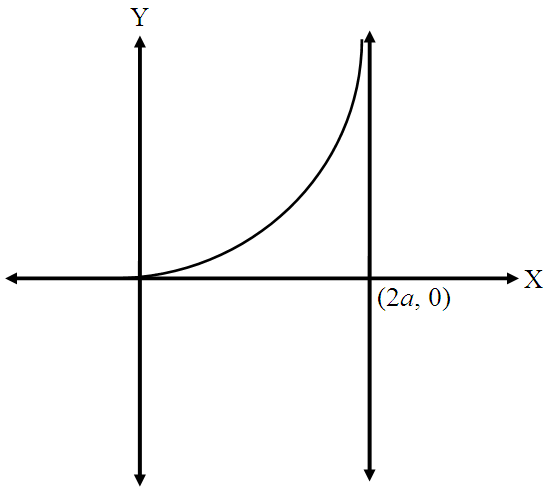
$\text{y}^2 (2\text{a}-\text{x})=\text{x}^3$
$\text{y}= \sqrt\frac{\text{x}^3}{2\text{a}-\text{x}}$
Let $\text{ x}= 2\text{a}\sin^2\theta$
$\text{dx}=4\text{a}\sin\theta\cos\theta\ \text{d}\theta$
$\text{Area}=\int\limits^\text{2a}_0\sqrt\frac{\text{x}^3}{2\text{a}-\text{x}}\text{dx}$
$=\int\limits^\frac{\pi}{2}_0\sqrt\frac{(8\text{a}^3)\sin^6\theta}{(2\text{a})\cos^2\theta}.(4\text{a})\sin\theta\cos\theta\ \text{d}\theta$
$= 8\text{a}^2\int^\frac{\pi}{2}_0\sqrt{\sin^6}\theta\sin\theta\ \text{d}\theta$
$=8\text{a}^2\Big[\int^\frac{\pi}{2}_0\sin^4\theta\ \text{d}\theta\Big]$
$= 8\text{a}^2\Big[\int^\frac{\pi}{2}_0\sin^2\theta(1-\cos^2\theta)\ \text{d}\theta\Big]$
$= 8\text{a}^2\Big[\int^\frac{\pi}{2}_0\frac{(1-\cos2\theta)}{2}\text{d}\theta-\frac{1}{4}\int^\frac{\pi}{2}_0\sin^2\theta\ \text{d}\theta\Big]$
$= 8\text{a}^2\bigg[\frac{1}{2}[\theta]^\frac{\pi}{2}_0-\Big[\frac{\sin2\theta}{4}\Big]^\frac{\pi}{2}_0\bigg]-\frac{1}{4}\bigg[\int^\frac{\pi}{2}_0\frac{1-\cos4\theta}{2}\text{d}\theta\bigg]$
$= 8\text{a}^2\Big[\Big(\frac{\pi}{4}\Big)-0\Big]-\frac{1}{4}\Big[\frac{\pi}{4}-0\Big]$
$= 8\text{a}^2\Big[\frac{\pi}{4}-\frac{\pi}{16}\Big]$
$=\frac{3}{2}\pi\text{a}^2$ View full question & answer→MCQ 1491 Mark
The area of the region bounded by the curves $y =| x – 2 |, x = 1, x = 3$ and the $x-$axis is:
View full question & answer→MCQ 1501 Mark
Area bounded by the ellipse $\frac{\text{x}^2}{4}+\frac{\text{y}^2}{9}=1$
- ✓
$6\pi\text{ sq}.\text{units}$
- B
$3\pi\text{ sq}.\text{units}$
- C
$12\pi\text{ sq}.\text{units}$
- D
AnswerCorrect option: A. $6\pi\text{ sq}.\text{units}$
View full question & answer→