MCQ 511 Mark
The area enclosed between the curve $\text{y}=\log_{\text{e}}(\text{x}+\text{e}),\text{x}=\log_\text{e}\Big(\frac{1}{\text{y}}\Big)$ and the $x-$axis is:
Answer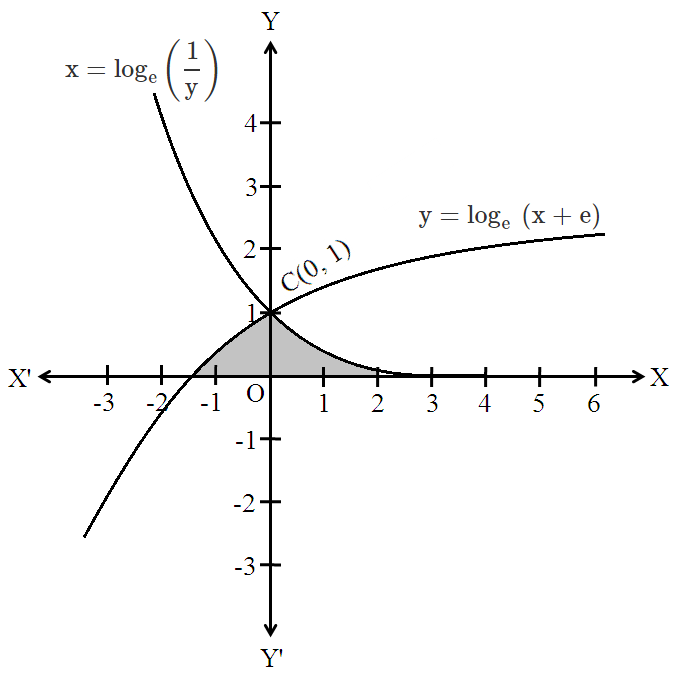
The point of intersection of the curves $\text{y}=\log_{\text{e}}(\text{x}+\text{e})$ and $\text{x}=\log_\text{e}\Big(\frac{1}{\text{y}}\Big) $
$\text{y}=\log_{\text{e}}(\text{x}+\text{e})$
$\Rightarrow\text{x}+\text{e}=\text{e}^{\text{y}}$
$\Rightarrow\text{x}=\text{e}^{\text{y}}-\text{e}$
and $\text{x}_{2} = \log_\text{e}\Big(\frac{1}{\text{y}}\Big)$
Therefore, area of the required region,
$\text{A} = \int\limits^1_0(\text{x}_2-\text{x}_1)\text{ dy} \Big[$where$, = \text{x}_1 = \text{e}^{\text{y}}-\text{e}$ and $\text{x}_2= \log_\text{e}\Big(\frac{1}{\text{y}}\Big)\Big]$
$\text{A} = \int\limits^1_0\log_\text{e}\Big(\frac{1}{\text{y}}\Big)\text{ dy}-\int\limits^1_0(\text{e}^\text{y}-\text{e})\text{ dy}$
$\text{A}=\int\limits^1_0\log_\text{e}\Big(\frac{1}{\text{y}}\Big)\text{ dy}-\big[\text{e}^{\text{y}}-\text{ey}\big]\ ...(\text{i})$
Let $\text{I} = \int\log_\text{e}\Big(\frac{1}{\text{y}}\Big)\text{dy}$
Putting $\frac{1}{\text{y}}=\text{t}$
Therefore, integral becomes
$\text{I} = \int-\frac{1}{\text{t}^{2}}\log_\text{e}\text{t}\text{ dt} $
$= -\log_\text{e}\text{t}\int\frac{1}{\text{t}^{2}}\text{ dt}-\int\frac{1}{\text{t}}\times\frac{1}{\text{t}}\text{ dt}$
$= \frac{1}{\text{t}}\log_\text{e}\text{t}+\frac{1}{\text{t}}$
$= \text{y}\log_\text{e}\frac{1}{\text{y}}+\text{y}$
Now$, (i)$ becomes
$\text{A} = \Big[\text{y}\log_\text{e}\frac{1}{\text{y}}+\text{y}\Big]^1_0-\big[\text{e}^\text{y}-\text{ey}\big]^1_0$
$=\Big[\text{y}\log_\text{e}\Big(\frac{1}{\text{y}}\Big)+\text{y}-\text{e}^{\text{y}}+\text{ey}\Big]^1_0$
$=\big[\log_\text{e}(1)+1-\text{e}^1+\text{e}(1)\big]-\big[0+0-\text{e}^{(0)}+\text{e}(0)\big]$
$= 2$ View full question & answer→MCQ 521 Mark
Compute the area of the figure bounded by straight lines $x = 0, x = 2$ and the curves $y=2^x$ and $y=2 x-x^2$
- ✓
$\frac{3}{\log 2}-\frac{4}{3}$
- B
$\frac{3}{\log 2}+\frac{4}{3}$
- C
$\frac{4}{\log 3}-\frac{4}{3}$
- D
$\frac{4}{\log 2}+\frac{1}{3}$
AnswerCorrect option: A. $\frac{3}{\log 2}-\frac{4}{3}$
$=\int\limits^2_02^\text{x}-2\text{x}+\text{x}^2\text{ dx}$
$=\Big[\frac{2^\text{x}}{\text{In(2)}}+\frac{(\text{x}-3)\text{x}^2}{3}\Big]^2_0$
$=\Big[\frac{4}{\text{In}2}-\frac{4}{3}\Big]-\Big[\frac{1}{\text{In}2}\Big]$
$=\frac{3}{\text{log}\ 2}-\frac{4}{3}$
View full question & answer→MCQ 531 Mark
The area bounded by the curve $y = f(x),$ the $x-$axis and $x = 1$ and $x = b$ is $(b – 1)$ sin $(3b + 4).$ Then$, f(x)$ is:
AnswerCorrect option: C. $\sin(\text{3x}-4)+3(\text{x}-1).\cos(3\text{x}+4)$
View full question & answer→MCQ 541 Mark
Choose the correct answer: Area of the region bounded by the curve $y^2=4 x, y-$axis and the line $y = 3$ is:
- A
$2$
- ✓
$\frac94$
- C
$\frac93$
- D
$\frac92.$
AnswerCorrect option: B. $\frac94$
The equation of curve is $y^2=4 x$
We are to find the area bounded by the curve $y^2=4 x, y-$axis and the line $y = 3.$
Required area $=\int\limits^3_0\text{x dy}=\int\limits^3_0\frac{\text{y}^2}{4}\text{dy}$
$=\frac14\int\limits^3_0\text{y}^2\text{dy}=\frac14\Big[\frac{\text{y}^3}{3}\Big]^3_0$
$=\frac{1}{12}\Big[\text{y}^3\Big]^3_0=\frac{1}{12}(27-0)$
$=\frac{27}{12}=\frac94$
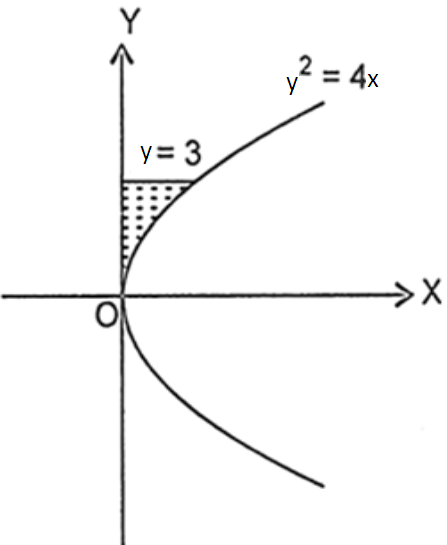
View full question & answer→MCQ 551 Mark
The area of the region bounded by the curve $=2 x-x^2$ and the line $y = x$ is $........$ square units:
- ✓
$\frac{1}{6}$
- B
$\frac{1}{2}$
- C
$\frac{1}{3}$
- D
$\frac{7}{6}$
AnswerCorrect option: A. $\frac{1}{6}$
We note that the region bounded by these curves is in the region $x \in [0, 1].$
In this region, the curve $y = x$ lies below the curve $=2 x-x^2$
So, to calculate the area of said region, we evaluatie the following integral:
$=\int\limits^1_02\text{x}-\text{x}^2-\text{x}\text{dx}$
$=\int\limits^1_0\text{x}-\text{x}^2\text{dx}$
$=\Big[\frac{\text{x}^2}{2}-\frac{\text{x}^3}{3}\Big]^\text{x=1}_{\text{x=0}}$
$=\frac{1}{2}-\frac{1}{3}=\frac{1}{6}.$
View full question & answer→MCQ 561 Mark
Area of the region bounded by the curve $y = |x + 1| + 1, x = –3, x = 3$ and $y = 0$ is:
- A
$8\ sq$ units
- ✓
$16\ sq$ units
- C
$32\ sq$ units
- D
AnswerCorrect option: B. $16\ sq$ units
View full question & answer→MCQ 571 Mark
The area $($in sq. units$)$ bounded by the curves $\text{y}=\sqrt{\text{x}},2\text{y}-\text{x}+3=0$ and $x-$axis lying in the first quadrant is:
- ✓
$9$
- B
$36$
- C
$18$
- D
$\frac{27}{4}$
View full question & answer→MCQ 581 Mark
The area common to the parabola $y=2 x^2$ and $y=x^2+4$ is:
- A
$\frac{2}{3}\text{ sq.}$ units
- B
$\frac{3}{2}\text{ sq.}$ units
- ✓
$\frac{32}{3}\text{ sq.}$ units
- D
$\frac{3}{32}\text{ sq.}$ units
AnswerCorrect option: C. $\frac{32}{3}\text{ sq.}$ units
Common region of two given parabola $y=2 x^2$ and $y=x^2+4$ is: is infinite as we see in the figure here.
Therefore, area common to these two parabola is infinity.
Disclaimer: In the question, instead of "The area common to the parabola $y=2 x^2$ and $y=x^2+4$ is: is" It should be "The closed area made by the parabola $y=2 x^2$ and $y=x^2+4$ is: is"
Solution of this question is as follow.
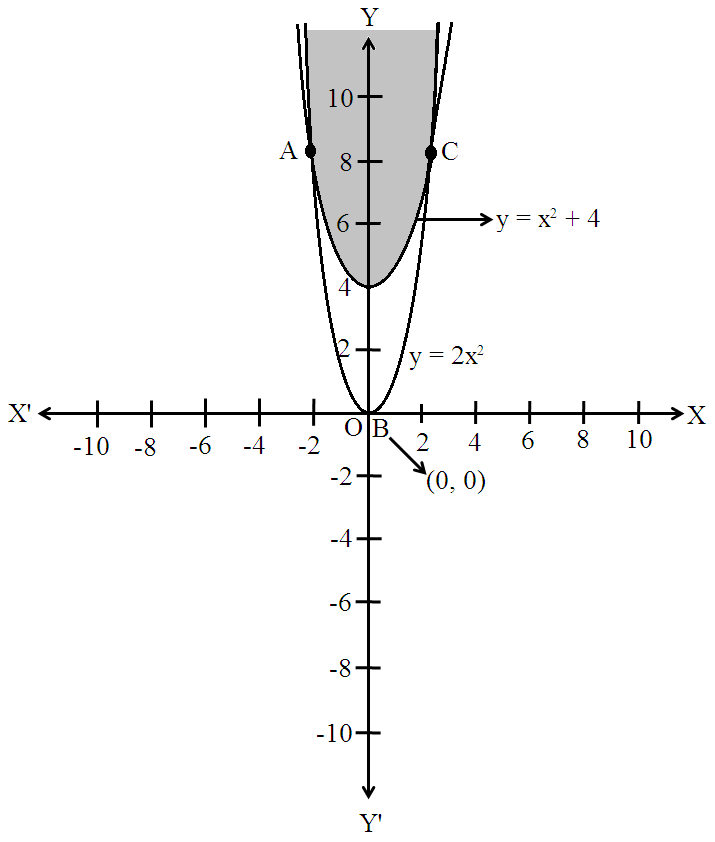
To find the point of intersection of the parabola equate the equations $y=2 x^2$ and $y=x^2+4$ is: we get
$2\text{x}^2 = \text{x} + 4$
$\Rightarrow \text{x}^2 = 4$
$\Rightarrow\text{x}= \pm2$
$\therefore \text{y}=8$
Therefore, the points of intersection are $A(-2, 8)$ and $C(2, 8).$
Therefore, the required area $\text{ABCD},$
$\text{A}= \int\limits^2_{-2}(\text{y}_1-\text{y}_2)\text{dx}$
$\big($where$, \text{y}_1=\text{x}^2+4\text{ and}\text{ y}_2=2\text{x}^2\big)$
$=\int\limits^2_{-2}(\text{x}^2+4-2\text{x}^2)\text{dx}$
$=\int\limits^2_{-2}(4-\text{x}^2)\text{dx}$
$=\Big[4\text{x}-\frac{\text{x}^3}{3}\Big]^2_{-2}$
$=\bigg[4(2)-\frac{(2)^3}{3}\bigg]-\bigg[4(-2)-\frac{(-2)}{3}^3\bigg]$
$=\Big[8-\frac{8}{3}\Big]-\Big[-8+\frac{8}{3}\Big]$
$=8-\frac{8}{3}+8-\frac{8}{3}$
$=16-\frac{16}{3}$
$=\frac{32}{3}$ square units View full question & answer→MCQ 591 Mark
The area of the region bounded by the curve $x^2=4 y$ and the straight line $x=4 y-2$ is:
- A
$\frac{3}{8}\text{sq}.$ units
- B
$\frac{5}{8}\text{sq}.$ units
- C
$\frac{7}{8}\text{sq}.$ units
- ✓
$\frac{9}{8}\text{sq}.$ units
AnswerCorrect option: D. $\frac{9}{8}\text{sq}.$ units
View full question & answer→MCQ 601 Mark
The value of aa for which the area between the curves $y^2=4 a x$ and $x^2=4 a y$ is $1\ sq$. unit, is:
- A
$\sqrt{3}$
- B
$4$
- C
$4\sqrt{3}$
- ✓
$\frac{\sqrt{3}}{4}$
AnswerCorrect option: D. $\frac{\sqrt{3}}{4}$
$=\text{y}^2=4\text{ ax}$
$=\text{y}=\sqrt{4\text{ ax}}$
$=\text{x}^2=4\text{ ax}$
$=\text{y}=\frac{\text{x}^2}{4\text{a}}$
$=$area$=\int\limits^{4\text{a}}_0\sqrt{4\text{a}\text{x}}\text {d}\text{x}-\int\limits^{4\text{a}}_0\frac{\text{x}^2}{4\text{a}}\text{dx}$
$=2\sqrt{\text{a}}\times\frac{2}{3}\text{(x})^\frac{3}{2}\Big]^{4\text{a}}_0-\frac{\text{x}^3}{3(4\text{a})}\Big]^{4\text{a}}_0$
$=\frac{32\text{a}^2}{3}-\frac{16\text{a}^2}{3}$
$=\frac{16\text{a}^2}{3}=1$
$=\text{a}=\frac{\sqrt{3}}{4}$
View full question & answer→MCQ 611 Mark
The area of the region bounded by the ellipse $\frac{\text{x}\ ^2}{25}+\frac{\text{y}^2}{16}=1\text{ is:}$
AnswerCorrect option: A. $25\pi\text{ sq.}$ units
View full question & answer→MCQ 621 Mark
The area under the curve $y=x^4$ and the lines $x=1, x=5$ and $x-$axis is:
- A
$\frac{3124}{3}\text{ sq.}$ units
- B
$\frac{3124}{7}\text{ sq.}$ units
- ✓
$\frac{3124}{5}\text{ sq.}$ units
- D
$\frac{3124}{9}\text{ sq.}$ units
AnswerCorrect option: C. $\frac{3124}{5}\text{ sq.}$ units
Concept:
The area under the function $y = f(x)$ from $x = a$ to $x = b$ and the $x-$axis is given by the definite integral
$\int\limits^\text{b}_\text{a}\text{f(x)}\text{dx}$
This is for curves that are entirely on the same side of the $x-$axis in the given range.
If the curves are on both sides of the $x-$axis, then we calculate the areas of both sides separately and add them.
Definite integral:
If $\int\text{f(x)}\text{dx}=\text{g(x)}+\text{c},$then
$\int\limits^\text{b}_\text{a}\text{f(x)}\text{dx}=[\text{g(x)}]^\text{b}_\text{a}=\text{g(b)}-\text{g(a)}$
$\int\text{x}^\text{n}\text{dx}=\frac{\text{x}^\text{n+1}}{\text{n+1}}+\text{c} $
Calculation:
$\int\text{x}^4\text{dx}=\frac{\text{x}^5}{5}+\text{c.}$
Using the above concept for area of a curve, we can say that the required area is:
$\text{I}=\int\limits^5_1\text{x}^4\text{dx}$
$=\Big[\frac{\text{x}^5}{5}\Big]^5_1$
$=\frac{5^5}{5}-\frac{1^5}{5}$
$=\frac{3125-1}{5}$
$=\frac{3124}{5}$
View full question & answer→MCQ 631 Mark
The area bounded by the curve $y^2=x,$ line $y=4$ and $y-$axis is:
- A
$\frac{16}{3}\text{sq.}$ units
- ✓
$\frac{64}{3}\text{sq.}$ units
- C
$7\sqrt{2}\text{sq.}$ units
- D
AnswerCorrect option: B. $\frac{64}{3}\text{sq.}$ units
View full question & answer→MCQ 641 Mark
The area common to the ellipse $\frac{\text{x}^2}{\text{a}^2}+\frac{\text{y}^2}{\text{b}^2}=1$ and $\frac{\text{x}^2}{\text{b}^2}+\frac{\text{y}^2}{\text{a}^2}=1,0<\text{b}<\text{a}$ is:
- A
$(\text{a}+\text{b})^2\tan^{-1}\frac{\text{b}}{\text{a}}$
- B
$(\text{a}+\text{b})^2\tan^{-1}\frac{\text{a}}{\text{b}}$
- ✓
$4\text{a}+\text{b}\tan^{-1}\frac{\text{b}}{\text{a}}$
- D
$4\text{a}+\text{b}\tan^{-1}\frac{\text{a}}{\text{b}}$
AnswerCorrect option: C. $4\text{a}+\text{b}\tan^{-1}\frac{\text{b}}{\text{a}}$
View full question & answer→MCQ 651 Mark
Area bounded by the curvey $\text{y}=\text{x}+\sin\text{x}$ and its inverse function between the ordinates $\text{x}=0$ and $\text{x}=2\pi$ is:
- A
$8\pi\text{ sqp}.$ units
- B
$4\pi\text{ sq}.$ units
- ✓
$8\pi\text{ sq}.$ units
- D
$3\pi\text{ sq}.$ units
AnswerCorrect option: C. $8\pi\text{ sq}.$ units
Inverse function is the mirror image with respect to $y = x$
Then area bounded by $\text{x}+\sin\text{x}$ and its inverse function is
$=4\int\limits^\pi_0(\text{x}+\sin\text{x}-\text{x})\text{ dx}=8$
View full question & answer→MCQ 661 Mark
The area enclosed between the graph of $y=x^3$ and the lines $x=0, y=1, y=8$ is:
- ✓
$\frac{45}{4}$
- B
$14$
- C
$7$
- D
AnswerCorrect option: A. $\frac{45}{4}$
View full question & answer→MCQ 671 Mark
Area bounded between the curve $x^2=y$ and the line $y=4 x$ is:
- ✓
$\frac{32}{3}\text{sq}$ unit
- B
$\frac{1}{3}\text{sq}$ unit
- C
$\frac{8}{3}\text{sq}$ unit
- D
$\frac{16}{3}\text{sq}$ unit
AnswerCorrect option: A. $\frac{32}{3}\text{sq}$ unit
Given curves are $x^2=y$ and $y=4 x$
Intersection points are $(0, 0)$ and $(4, 16)$
$\therefore$ Required area
$=\int\limits^4_0(4\text{x}-\text{x}^2)\text{dx}$
$=\Big[\frac{4\text{x}^2}{2}-\frac{\text{x}^3}{3}\Big]^4_0$
$=\Big[32-\frac{64}{3}\Big]$
$=\frac{32}{3}\text{sq}$ unit
View full question & answer→MCQ 681 Mark
Area enclosed by the circle $x^2+y^2=a^2$ is equal to:
- A
$2\pi\text{a}^2\text{sq.}\text{ units}$
- ✓
$\pi\text{a}^2\text{sq.}\text{ units}$
- C
$2\pi\text{a}\text{ sq.}\text{ units}$
- D
$\pi\text{a}\text{ sq.}\text{ units}$
AnswerCorrect option: B. $\pi\text{a}^2\text{sq.}\text{ units}$
View full question & answer→MCQ 691 Mark
The area of the region bounded by the curves $=x e^x, y=x e^{-x}$ and the line $x=1$ is:
- A
$\frac{4}{\text{e}}$
- B
$\frac{3}{\text{e}}$
- ✓
$\frac{2}{\text{e}}$
- D
$\frac{1}{\text{e}}$
AnswerCorrect option: C. $\frac{2}{\text{e}}$
$=\text{A}=\int\limits^1_0(\text{xe}^\text{x}-\text{x}^\text{-x})\text{dx}$
$=\int\limits^1_0\text{x}(\text{e}^\text{x}-\text{e}^\text{-x})\text{dx}$
$=\text{(e}^\text{x}+\text{x}^\text{-x})\int\limits^1_0$
$=\int\limits^1_0\text{x}(\text{e}^\text{x}-\text{e}^\text{-x})\text{dx}$
$=(\text{e}+\text{e}^{-1})-[\text{e}^\text{x}-\text{e}^\text{-x}]^1_0 $
$=(\text{e}+\text{e}^{-1})-(\text{e}-\text{e}^{-1})=2\text{e}^{-1}$
$=\text{A}=\frac{2}{\text{e}}$
View full question & answer→MCQ 701 Mark
The area of the region bounded by the parabola $y=x^2+1$ and the staight line $x+y=3$ is given by:
- A
$\frac{45}{7}$
- B
$\frac{25}{4}$
- C
$\frac{\pi}{18}$
- ✓
$\frac{9}{2}$
AnswerCorrect option: D. $\frac{9}{2}$
To find the point of intersection of the parabola
$y=x^2+1$ and the line $x+y=3$
substitute $y=3-x$ in $y=x^2+13-x=x^2+1$
$\Rightarrow x^2+x-2=0$
$\Rightarrow(x-1)(x+2)=0$
$\Rightarrow x=1$ or $x=-2$
$\therefore$ $y = 2$ or $y = 5$
So, we get the points of intersection $A (-2, 5)$ and $C (1, 2).$
Therefore, the required area $\text{ABC},$
$\text{A} = \int\limits^1_{-2}(\text{y}_1-\text{y}_2)\text{dx}$ $\big($Where$, \text{y}_1 = 3-\text{x }$ and $\text{ y}_2 = \text{x}^2+1\big)$
$=\int\limits^1_{-2}\big[(3-\text{x})-(\text{x}^2+1)\big]\text{dx}$
$=\int\limits^1_{-2}(3-\text{x}-\text{x}^2-1)\text{dx}$
$=\int\limits^1_{-2}\big(2-\text{x}-\text{x}^2\big)\text{dx}$
$= \Big[2\text{x}-\frac{\text{x}^2}{2}-\frac{\text{x}^3}{3}\Big]^1_{-2}$
$=\bigg[2(1)-\frac{(1)^2}{2}-\frac{(1)^3}{3}\bigg]-\bigg[2(-2)-\frac{(-2)^2}{2}-\frac{(-2)^3}{3}\bigg]$
$=\Big[2-\frac{1}{2}-\frac{1}{3}\Big]-\Big[-4-2+\frac{8}{3}\Big]$
$=2-\frac{1}{2}-\frac{1}{3}+4+2-\frac{8}{3}$
$=8-\frac{1}{2}-\frac{9}{3}$
$=5-\frac{1}{2}$
$=\frac{9}{2}$ square units
View full question & answer→MCQ 711 Mark
The area of the region $\{(\text{x},\text{y}):\text{y}^2\leq4\text{x},4\text{x}^2+4\text{y}^2\leq9\}$ is:
- ✓
$\frac{\sqrt2}{6}+\frac{9\pi}{8}-\frac{9}{4}\sin-1(\frac{1}{5})$
- B
$\frac{\sqrt2}{6}-\frac{9\pi}{8}$
- C
$\frac{9\pi}{8}-\frac{9}{4}\sin-1(\frac{1}{3})$
- D
AnswerCorrect option: A. $\frac{\sqrt2}{6}+\frac{9\pi}{8}-\frac{9}{4}\sin-1(\frac{1}{5})$
View full question & answer→MCQ 721 Mark
The area bounded by $y=x^2$ and $y=1-x^2$ is:
- ✓
$\frac{\sqrt{8}}{3}$
- B
$\frac{16}{3}$
- C
$\frac{32}{3}$
- D
$\frac{17}{3}$
AnswerCorrect option: A. $\frac{\sqrt{8}}{3}$
Required are
$=2\Bigg[\int\limits^\frac{1}{\sqrt{2}}_0(1+\text{x}^2)\text{dx}-\int\limits^\frac{1}{\sqrt{2}}_0\text{x}^2\text{dx}\Bigg]$
$=2\Bigg[\text{x}+\frac{\text{x}^3}{3}\Bigg]^\frac{1}{\sqrt{2}}_0-2\Bigg[\frac{\text{x}^3}{3}\Bigg]^\frac{1}{\sqrt{2}}_0=\frac{\sqrt{8}}{3}$
View full question & answer→MCQ 731 Mark
The area bounded by $y=x^2, y=[x+1], x \leq 1$ and the $y -$ axis is:
- A
$\frac{1}{3}$
- ✓
$\frac{2}{3}$
- C
$1$
- D
$\frac{7}{3}$
AnswerCorrect option: B. $\frac{2}{3}$
Required area
$=\int\limits^1_0\sqrt{\text{y}}\text{dx}=\frac{2}{3}$
View full question & answer→MCQ 741 Mark
Area between the parabola $x^2 = 4y$ and line $x = 4y –2$ is:
- A
$\frac{8}{9}$
- B
$\frac{9}{7}$
- C
$\frac{7}{9}$
- ✓
$\frac{9}{8}$
AnswerCorrect option: D. $\frac{9}{8}$
View full question & answer→MCQ 751 Mark
If the curves $y = x^3 + ax$ and $y = bx^2 + c $pass through the point $(-1, 0)$ and have common tangent line at this point, then the value of $a+b$ is?
AnswerAs the curve pass through the point $P(-1, 0) 0 = a = -1$
$\Longrightarrow a = -10 = b +$ Common tangent at this point
$=\frac{\text{dx}}{\text{dx}}=2\text{ bx}$ and $\frac{\text{dy}}{\text{dx}}=3\text{x}^2+\text{a}$
$= 3 - 1 = 2$
$2bx = 2 - 2b =2b = -1a + b = -2$
View full question & answer→MCQ 761 Mark
The area bounded by the curves $\text{y}=\sin\text{x},\text{y}=\cos\text{x}\ y −$ axes in first quadrant is:
- ✓
$\sqrt{2}-1$
- B
$\sqrt{2}$
- C
$\sqrt{2}+1$
- D
AnswerCorrect option: A. $\sqrt{2}-1$
The area bounded by the curves $\text{y}=\sin\text{x},\text{y}=\cos\text{x}\ y −$ axes in first quadrant is,
$\text{A}=\int\limits^\frac{\pi}{4}_0(\cos\text{x}-\sin\text{x})\text{dx}$
$=[\sin\text{x}+\cos\text{x}]^\frac{\pi}{4}_0$
$=\Big(\sin\frac{\pi}{4}+\cos\frac{\pi}{4}\Big)-(\sin0+\cos0)$
$=\sqrt{2}-1$
View full question & answer→MCQ 771 Mark
The area bounded by $y –1 = |x|, y = 0$ and $|x| \frac{1}{2}$ will be:
- A
$\frac{3}{4}$
- B
$\frac{3}{2}$
- ✓
$\frac{5}{4}$
- D
AnswerCorrect option: C. $\frac{5}{4}$
View full question & answer→MCQ 781 Mark
Choose the correct answer from the given four options:The area of the region bounded by the curve $x = 2y + 3$ and the $y$ lines$. y = 1$ and $y = -1$ is:
AnswerCorrect option: C. $6\text{ sq. units}$
Required area, $\text{A}=\int\limits^1_{-1}(2\text{y}+3)\text{dy}$
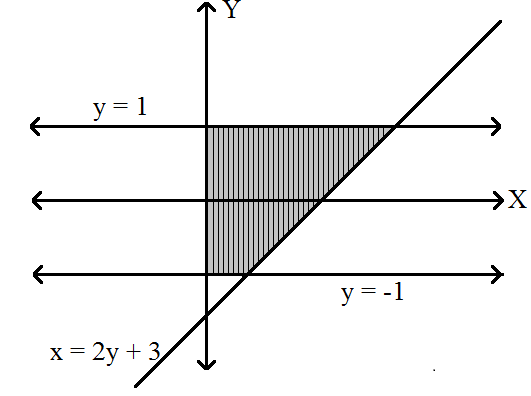
$=\Big[\frac{2\text{y}^2}{2}+3\text{y}\Big]^1_{-1}$
$\Big[\text{y}^2+3\text{y}\Big]^1_{-1}$
$=\big[1+3-1+3\big]$
$=6\text{ sq. units}$ View full question & answer→MCQ 791 Mark
The area bounded by the curve $x^2+ y^2 = 1$ in first quadrant is:
- ✓
$\frac{\pi}{4}\text{sq.}\text{units}$
- B
$\frac{\pi}{2}\text{sq.}\text{units}$
- C
$\frac{\pi}{3}\text{sq.}\text{units}$
- D
$\frac{\pi}{6}\text{sq.}\text{units}$
AnswerCorrect option: A. $\frac{\pi}{4}\text{sq.}\text{units}$
View full question & answer→MCQ 801 Mark
The area bounded by the curve $y = (x + 1)^2, y = (x - 1)^2$ and the line $y = 0$ is:
- A
$\frac{1}{6}$
- ✓
$\frac{2}{3}$
- C
$\frac{1}{4}$
- D
$\frac{1}{3}$
AnswerCorrect option: B. $\frac{2}{3}$
$\text{R.E.F}$ image $\rightarrow y = (x + 1)^2$ is obtained by shifting origin to $(-1, 0)$ in $x^2= y,$
for $y = (x - 1)^2$Similarly $(1, 0)$ As graph is symmetric about $y -$ axis, area $A$ would be,
$=\text{A}=2\int\limits^1_0(\text{x}-1)^2\text{dx}$
$=2\int\limits^1_0\text{x}^2-2\text{x}+1\text{dx}=2$
$\Big[\text{x}\frac{3}{3}-\text{x}^2+\text{x}\Big]^1_0$
$=2\Big(\frac{1}{3}-1+1\Big)=\frac{2}{3}$
View full question & answer→MCQ 811 Mark
The area bounded by the parabola $y^2= 4ax,$ latus rectum and $x-$axis is:
- A
$0$
- ✓
$\frac{4}{3}\text{a}^2$
- C
$\frac{2}{3}\text{a}^2$
- D
$\frac{\text{a}^2}{3}$
AnswerCorrect option: B. $\frac{4}{3}\text{a}^2$
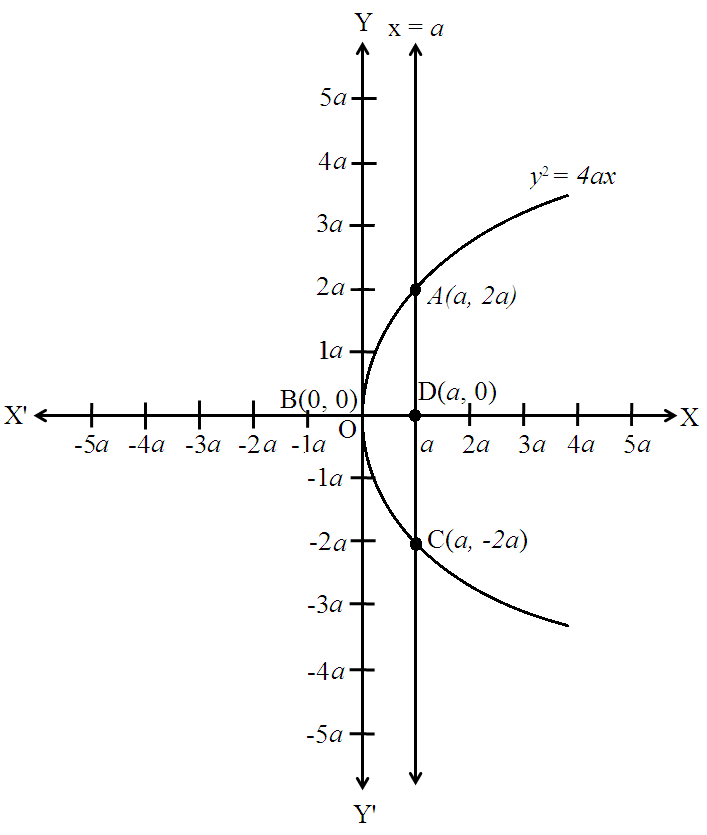
Clearly, the latus rectum passes $x-$axis through the point $D(a, 0).$
Therefore, the required area $\text{ABCD},$
$\text{A} = \int\limits^\text{a}_0\text{y}\text{ dx}$ $($where$, \text{y = 2}\sqrt{\text{ax}})$
$=\int\limits^\text{1}_02\sqrt{\text{ax}}\text{ dx}=\bigg[\frac{4\sqrt{\text{a}}}{3}(\text{x})^\frac{3}{2}\bigg]^\text{a}_0$
$\bigg[\frac{4\sqrt{\text{a}}}{3}(\text{a})^\frac{3}{2}\bigg]-\bigg[\frac{4\sqrt{\text{a}}}{3}(0)^\frac{3}{2}\bigg]$
$=\frac{4}{3}\text{a}^2$ square units View full question & answer→MCQ 821 Mark
Points of inflexion of the curve $y = x^4 - 6x^3+ 12x^2 + 5x + 7$ are:
- A
$(1, 19); (1, 12)$
- ✓
$(1, 19); (2, 33)$
- C
$(1, 2); (2, 1)$
- D
AnswerCorrect option: B. $(1, 19); (2, 33)$
$ y=x^4-6 x^3+12 x^2+5 x+7 y(x) $
$ =4 x^3-18 x^2+24 x+5 y(x) $
$ =12 x^2-36 x+24 y(x) $
$ =012 x^2-36 x+24=0 x^2-3 x+2 $
$ =0 x^2-2 x-x+2 $
$= 0x(x - 2) -1(x - 2) = 0(x - 1) -1(x - 2)$
$= 0(x - 1)(x - 2) = 0(x - 1)(x - 2) = 0x = 1, 2$
Inflection point of a function is where the function changes from concave up to concave down or vice$-$versax $ < 1, f(x) > 01 < x < 2, f(x) < 0x > 2, f(x) > 0$
$\because f(x)$ changes sign
$\therefore$ At $x = 1, 2y = f(x)$ has inflection point At $x = 1, y = f(1) = 19$
At $x = 2, x = f(2) = 33x = 2, y = f(2) = 33$
Point of inflection $(1,19); (2,33)$
View full question & answer→MCQ 831 Mark
Area between the parabolas $y^2=4 a x$ and $x^2=4 a y$ is:
- A
$\frac{2}{3}\text{a}^2-5$
- B
$\frac{15}{4}\text{a}^2+5$
- C
$\frac{16}{3}\text{a}^2+2$
- ✓
$\frac{16}{3}\text{a}^2$
AnswerCorrect option: D. $\frac{16}{3}\text{a}^2$
View full question & answer→MCQ 841 Mark
The area bounded by $y=x e^{|x|}$ and $|x|=1$ is:
Answer$=\text{I}=\int\limits^1_{-1}\text{y}\text{dx}$
$=\int\limits^1_{-1}\text{dx}^\text{x}\text{dx}$
$=\int\limits^1_{-1}\text{dx}^\text{-x}\text{dx}+\int\limits^1_0\text{xe}^\text{x}\text{dx}$
$=[-\text{xe}^\text{-x}+\int\text{e}^\text{-x}\text{ dx}]^0_{-1}+[\text{xe}^\text{x}-\int\text{e}^\text{x}\text{dx}]^1_0$
$=[-\text{xe}^\text{-x}-\text{e}^\text{-x}]^0_{-1}+[\text{xe}^\text{x}-\text{e}^\text{x}]^1_0$
$=-1-\text{(e}-\text{e})]+[\text{e}-\text{e}(-1)]=|-1|+|1|$
we take modulus because area can not be negative and this function is symmetry about $y$ axis.
we have to put modulus otherwise area will be zeroso,ans is $2$
View full question & answer→MCQ 851 Mark
Choose the correct answer in the following.
The area bounded by the curve y = x|x|, x-axis and the ordinates x = -1 and x = 1 is given by,
- A
- B
$\frac13$
- ✓
$\frac23$
- D
$\frac43.$
AnswerCorrect option: C. $\frac23$
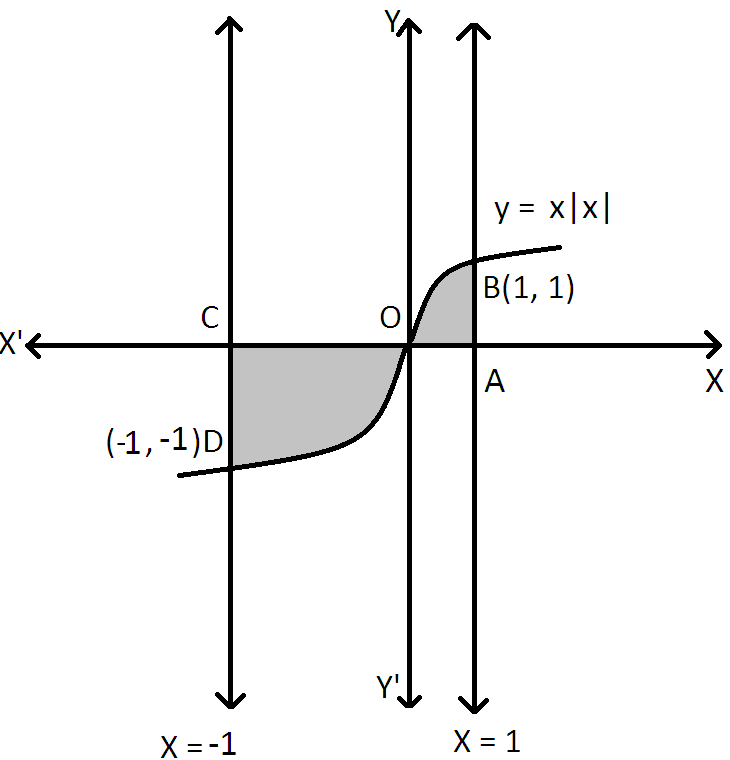
$\text{Required area}=\int\limits^1_0\text{y dx}$
$=\int\limits^1_{-1}\text{x}|\text{x}|\text{dx}$
$=\int\limits^{0}_{-1}\text{x}^2\text{dx}+\int\limits^1_0\text{x}^2\text{dx}$
$=\Big[\frac{\text{x}^3}{3}\Big]^0_{-1}+\Big[\frac{\text{x}^3}{3}\Big]^1_0$
$=-\Big(-\frac13\Big)+\frac13$
$=\frac23\text{ units}$
Thus, the correct answer is C. View full question & answer→MCQ 861 Mark
The area under the curve $y=2 x^3+4 x^2$ between $x = 2, x = 4$ is:
AnswerCorrect option: A. $192.6$
The area under the curve is given as
$=\int\limits^4_2\ 2\text{x}^3+4\text{x}^2\text{ dx}$
$=\int\limits^4_2\ 2\text{x}^3\text{ dx}+4\text{x}^2\text{ dx}$
$=2\frac{\text{x}^4}{4}\Big|^4_2+4\frac{\text{x}^3}{3}\Big|^\frac{2}{4}_2$
$=64\times2-8+\frac{4^4}{3}-\frac{32}{3}$
$=120-\frac{224}{3}=192.6$
View full question & answer→MCQ 871 Mark
The area of the plane region bounded by the curves $x+2 y^2=0$ and $x+3 y^2=1$ is equal to:
- A
$\frac{5}{3}$
- B
$\frac{1}{3}$
- C
$\frac{2}{3}$
- ✓
$\frac{4}{3}$
AnswerCorrect option: D. $\frac{4}{3}$
View full question & answer→MCQ 881 Mark
The area bounded by curve $y = x^2- 1$ and tangents to it at $(2, 3)$ and $y -$ axis is:
- A
$\frac{8}{3}$
- ✓
$\frac{2}{3}$
- C
$\frac{4}{3}$
- D
$\frac{1}{3}$
AnswerCorrect option: B. $\frac{2}{3}$
$=\text{x}-$axis$:(-1,0)$
$=$Area$=\int\limits^0_{-1}(\text{x}^2-1)\text{dx}$
$=\Big[\frac{\text{x}^3}{3}-\text{x}\Big]^0_{-1}$
$=\Big[\frac{-1}{3}-(-1)\Big]-[0]$
$=-\frac{1}{3}+1$
$=\frac{2}{3}\text{sq. units}$
View full question & answer→MCQ 891 Mark
The area of the region enclosed by the lines $y = x, x = e$ and curve $\text{y}=\frac{1}{\text{x}}$ and the positive $x -$ axis is:
- A
$1\text{ sq.}\text{ units}$
- ✓
$\frac{3}{2}\text{ sq.}\text{ units}$
- C
$\frac{5}{2}\text{ sq.}\text{ units}$
- D
$\frac{1}{2}\text{ sq.}\text{ units}$
AnswerCorrect option: B. $\frac{3}{2}\text{ sq.}\text{ units}$
View full question & answer→MCQ 901 Mark
A rea bounded by the circle $x^2+y^2=1$ and the curve $| x | + | y | = 1$ is:
- A
$2\pi$
- ✓
$\pi-2$
- C
$\pi$
- D
$\pi+3$
AnswerCorrect option: B. $\pi-2$
View full question & answer→MCQ 911 Mark
Choose the correct answer from the given four options: The area of the region bounded by the circle $x^2 + y^2 = 1$ is:
- A
$2\pi\text{ sq. units}$
- ✓
$\pi\text{ sq. units}$
- C
$3\pi\text{ sq. units}$
- D
$4\pi\text{ sq. units}$
AnswerCorrect option: B. $\pi\text{ sq. units}$
Here, $x^2 + y^2 = 1^2$ is a circle with centre at $(0, 0)$
$\Rightarrow\ \text{y}^2=1-\text{x}^2$
$\Rightarrow\ \text{y}=\sqrt{1=\text{x}^2}$
Graph for the circle $x^2 + y^2 = 1^2$ is shown below:
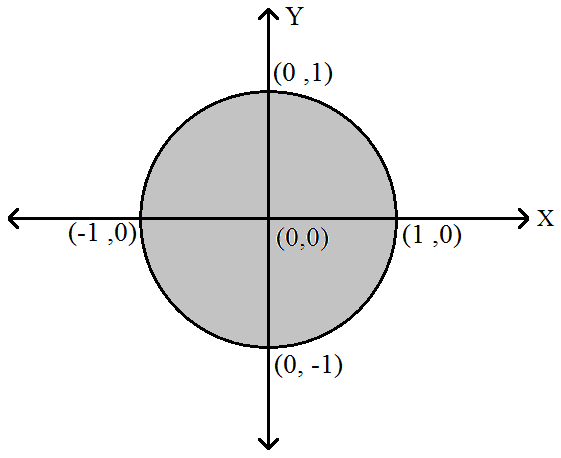
$\therefore$ Area enclosed by circle $=2\int\limits^{1}_{-1}\sqrt{1^2-\text{x}^2}\text{dx}=2.2\int\limits^{1}_{0}\sqrt{1^2-\text{x}^2}\text{dx}$
$=2\cdot2\bigg[\frac{\text{x}}{2}\sqrt{1^2-\text{x}^2}+\frac{1^2}{2}\sin^{-1}\frac{\text{x}}{1}\bigg]^{1}_{0} $
$=4\bigg[\frac{1}{2}\cdot0+\frac{1}{2}\cdot\frac{\pi}{2}-0-\frac{1}{2}\cdot0\bigg] $
$=4\cdot\frac{\pi}{4}=\pi\text{ sq. units} $ View full question & answer→MCQ 921 Mark
Find area bounded by curves $\{(\text{x},\text{y}):\text{y}\geq\text{x}^2$ andy$=\text{x}\} :$
- A
$\frac{5}{3}$
- B
$\frac{1}{2}$
- ✓
$\frac{1}{3}$
- D
$\frac{1}{9}$
AnswerCorrect option: C. $\frac{1}{3}$
$=\text{y}=\text{x}=\{\{\text{x};\text{x}\geq0-\text{x};\text{x}<0\}<0\}\text{p}$ and $Q$ arex $^2=x$
$= x2 - x = 0 x(x - 1) = 0 x = 0,1Q =1$ similarlyp
$=-\text{A}=\int\limits^1_0\text{x}-\text{x}^2\text{ dx}$
$=\text{A}=\Big[\frac{\text{x}^2}{2}-\frac{\text{x}^3}{3}\Big]^1_0$
$\text{A}=\frac{1}{2}-\frac{1}{3}$
$=\text{A}=\frac{1}{3}$
View full question & answer→MCQ 931 Mark
The area of the region enclosed by the parabola $x^2 = y,$ the line $y = x + 2$ and the $x -$ axis, is:
- A
$\frac{2}{9}$
- ✓
$\frac{9}{2}$
- C
$9$
- D
$2$
AnswerCorrect option: B. $\frac{9}{2}$
View full question & answer→MCQ 941 Mark
Choose the correct answer: Area lying between the curves $y^2=4 x$ and $y=2 x$ is:
- A
$\frac23$
- ✓
$\frac13$
- C
$\frac14$
- D
$\frac34.$
AnswerCorrect option: B. $\frac13$
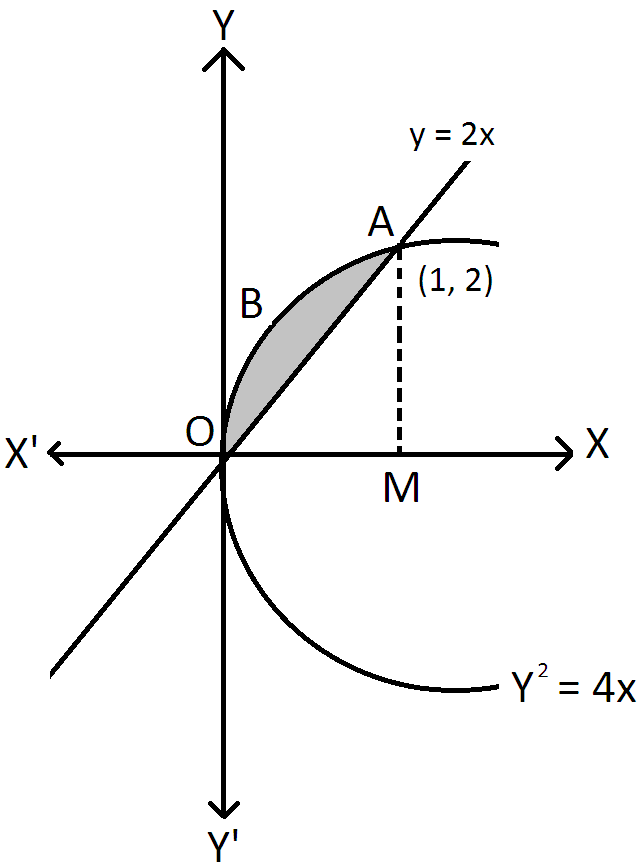
Equation of curve (parabola) is $y^2=4 x \ldots$ (i)
$\Rightarrow\text{y}=2\sqrt{\text{x}}=2\text{x}^{\frac12}...(\text{ii})$ Equation of another curve (line) is y = 2x ...(iii) Solving eq. (i) and (iii), we get x = 0 or x = 1 and y = 0 or y = 2 Therefore, Points of intersections of circle (i) and line (ii) are O(0, 0) and A(1, 2). Now Area OBAM = Area bounded by parabola (i) and x-axis $=\Bigg|\int\limits^1_0\text{y dx}\Bigg|=\Bigg|\int\limits^1_02\text{x}^{\frac12}\text{dx}\Bigg|=$ $2\frac{\Big(\text{x}^{\frac32}\Big)^1_0}{\frac32}$ $=\frac43(1-0)=\frac43\dots(\text{iv})$ Also, Area $\Delta\text{ OAM}=$ Area bounded by parabola (iii) and x-axis $=\Bigg|\int\limits^1_0\text{y dx}\Bigg|=\Bigg|\int\limits^1_02\text{x dx}\Bigg|=2\Big(\frac{\text{x}^2}{2}\Big)^1_0$ = (1 - 0) = 1 ...(v) Now Required shaded area OBA = Area OBAM - Area of $\Delta\text{ OAM}$ $=\frac43-1=\frac{4-3}{3}=\frac13\text{ sq. units}$ Therefore, option (B) is correct. View full question & answer→MCQ 951 Mark
Consider the following statements:Statement $I:\ $ The area bounded by the curve, $\text{y}=\sin\text{x}$ between $\text{x}=0$ and $x = 2p$ is $2\ sq.$ units.Statement $II:\ $ The area bounded by the curve, $\text{y}=2\cos\text{x}$ and the $x-$axis from $\text{x}=0$ to $x = 2p$ is $8\ sq.$ units.
- A
Statement $I$ is true
- ✓
Statement $II$ is true
- C
- D
Both statements are false
AnswerCorrect option: B. Statement $II$ is true
View full question & answer→MCQ 961 Mark
The area of the region bounded by the and the lines $x = 2$ and $x = 3.$
- ✓
$\frac{7}{2}\text{sq}.\text{units}$
- B
$\frac{9}{2}\text{sq}.\text{units}$
- C
$\frac{11}{2}\text{sq}.\text{units}$
- D
$\frac{13}{2}\text{sq}.\text{units}$
AnswerCorrect option: A. $\frac{7}{2}\text{sq}.\text{units}$
View full question & answer→MCQ 971 Mark
Choose the correct answer in the following: The area of the circle x$^2$ + y$^2$ = 16 exterior to the parabola y$^2$ = 6x is:
- A
$\frac43(4\pi-\sqrt3)$
- B
$\frac43(4\pi+\sqrt3)$
- ✓
$\frac43(8\pi-\sqrt3)$
- D
$\frac43(8\pi+\sqrt3).$
AnswerCorrect option: C. $\frac43(8\pi-\sqrt3)$
The given equations are x$^2$ + y$^2$ = 16 ...(1) y$^2$ = 6x ...(2) 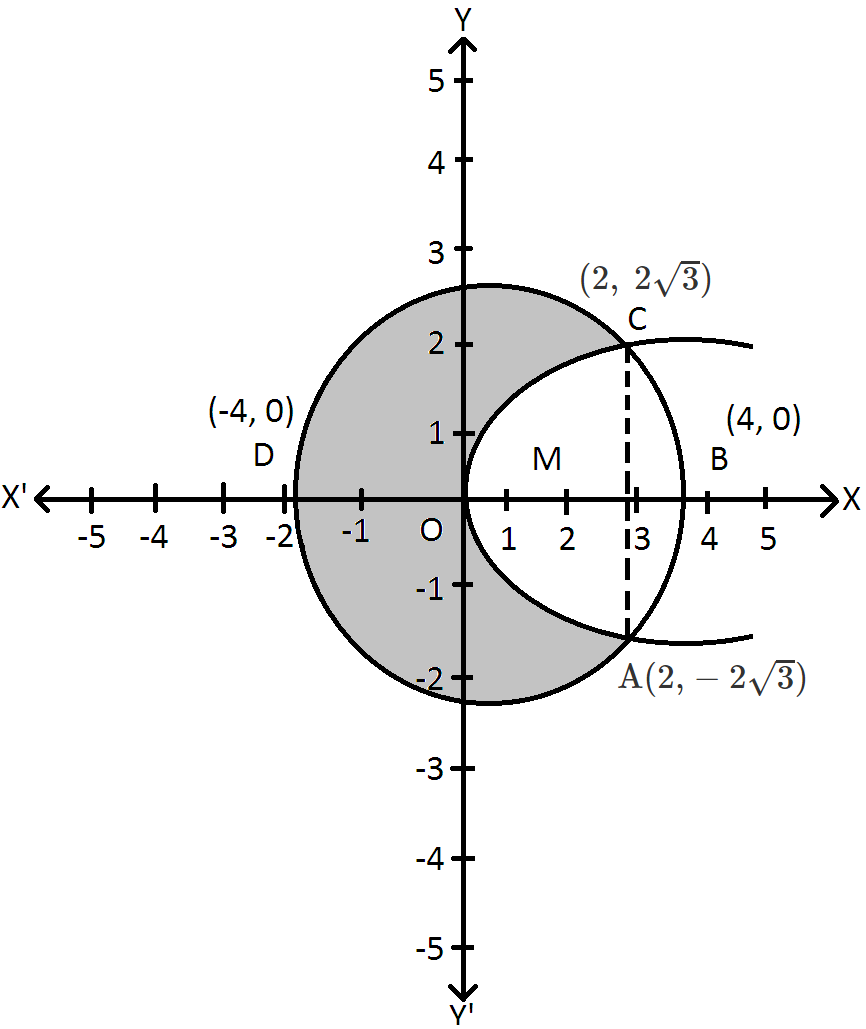 Area bounded by the circle and parabola = 2[Area(OADO) + Area(ADBA)] $=2\bigg[\int\limits^2_0\sqrt{6\text{x}}\text{ dx}+\int\limits^4_2\sqrt{16-\text{x}^2}\text{dx}\bigg]$ $=2\Bigg[\sqrt6\left\{\frac{\text{x}^{\frac32}}{\frac32}\right\}^2_0\Bigg]$ $+2\Big[\frac{\text{x}}{2}\sqrt{16-\text{x}^2}+\frac{16}{2}\sin^{-1}\frac{\text{x}}{4}\Big]^4_2$ $=2\sqrt6\times\frac23\Big[\text{x}^{\frac32}\Big]^2_0$ $+2\Big[8.\frac{\pi}{2}-\sqrt{16-4}-8\sin^{-1}\Big(\frac12\Big)\Big]$ $=\frac{4\sqrt6}{3}(2\sqrt2)+2\Big[4\pi-\sqrt{12}-8\frac{\pi}{6}\Big]$ $=\frac{16\sqrt3}{3}+8\pi-4\sqrt3-\frac83\pi$ $=\frac43\Big[4\sqrt3+6\pi-3\sqrt3-2\pi\Big]$ $=\frac43\Big[\sqrt3+4\pi\Big]$ $=\frac43\Big[4\pi+\sqrt3\Big]\text{ units}$ Area of circle = n(r)$^2$ = n(4)$^2$ = 16n units $\therefore\text{Required area}=16\pi-\frac43\Big[4\pi+\sqrt3\Big]$ $=\frac43\Big[4\times3\pi-4\pi-\sqrt3\Big]$ $=\frac43\big(8\pi-\sqrt3\big)\text{ units}$ Thus, the correct answer is C.
 View full question & answer→MCQ 981 Mark
If the area bounded by the $x -$ axis, curve $y = f (x)$ and the lines $x = 1, x = b$ is equal to $\sqrt{\text{b}^2+1}-\sqrt{2}$ for all $b > 1,$ then $f(x)$ is:
- A
$\sqrt{\text{x}-1}$
- B
$\sqrt{\text{x}+1}$
- C
$\sqrt{\text{x}^2+1}$
- ✓
$\frac{\text{x}}{\sqrt{1+\text{x}^2}}$
AnswerCorrect option: D. $\frac{\text{x}}{\sqrt{1+\text{x}^2}}$
$\text{Atp},\int\limits^\text{b}_1\text{f(x)}\text{ dx}=\sqrt{\text{b}^2+1}-\sqrt{2}\int\limits^\text{b}_1$
$\text{f(x)}\text{ dx}=\Big[\sqrt{\text{x}^2+1}\Big]^\text{b}_1$
$\text{f(x)}=\text{d}(\sqrt{\text{x}^2}+1)$
$\text{f(x)}=\frac{\text{x}}{\sqrt{1+\text{x}^2}}$
View full question & answer→MCQ 991 Mark
The area bounded by the parabola $x = 4 - y^2$ and $y-$axis, in square units, is:
- A
$\frac{3}{32}$
- ✓
$\frac{32}{3}$
- C
$\frac{33}{2}$
- D
$\frac{16}{3}$
AnswerCorrect option: B. $\frac{32}{3}$
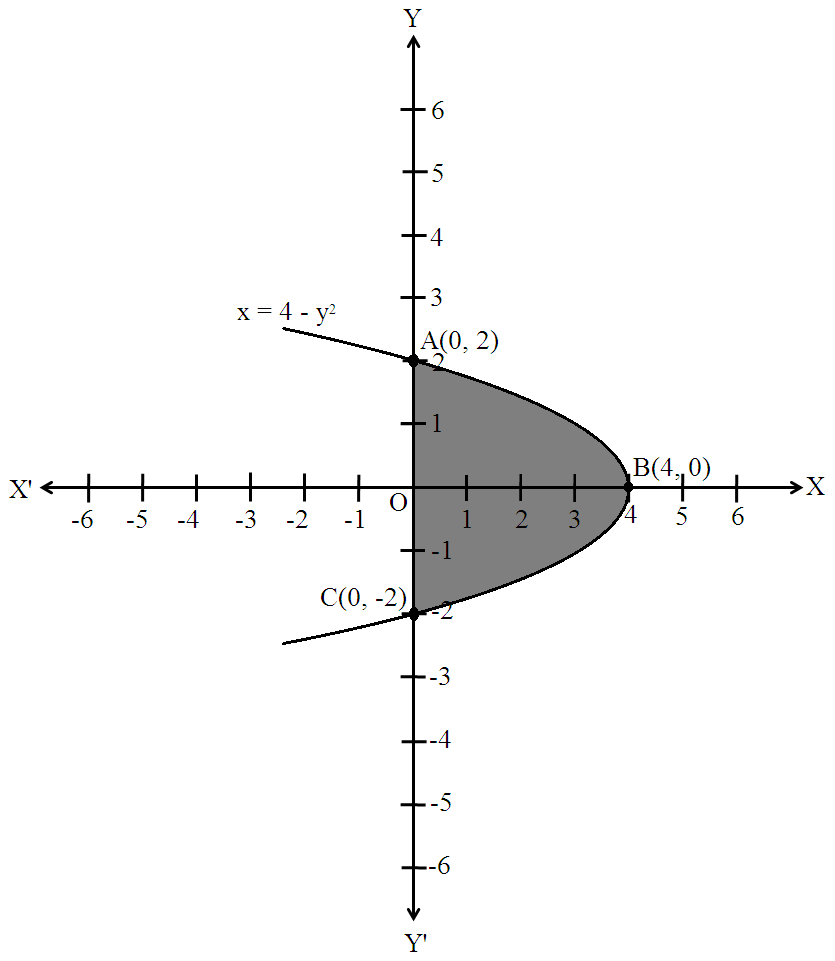
The points of intersection of the parabola and the $y-$ axis are $A(0, 2)$ and $C(0, -2).$
Therefore, the area of the required region $\text{ABCO},$
$\text{A} = \int\limits^2_{-2}\text{x }\text{dy}$
$= \int\limits^2_{-2}(4-\text{y}^{2})\text{dy}$
$= \Big[4\text{y}-\frac{\text{y}^{3}}{3}\Big]^2_{-2}$
$= \Big[4(2)-\frac{(2)^3}{3}\Big]-\Big[4(2)-\frac{(-2)^3}{3}\Big]$
$= \Big(8-\frac{8}{3}\Big)-\Big(-8+\frac{8}{3}\Big)$
$=8-\frac{8}{3}+8-\frac{8}{3}$
$= 16 -\frac{16}{3}$
$= \frac{32}{3}$ square units View full question & answer→MCQ 1001 Mark
Choose the correct answer: Area lying in the first quadrant and bounded by the circle $x^2 + y^2 = 4$ and the lines $x = 0$ and $x = 2$ is:
- ✓
$\pi$
- B
$\frac{\pi}{2}$
- C
$\frac{\pi}{3}$
- D
$\frac{\pi}{4}.$
AnswerThe equation of circle is $x^2 + y^2 = 4$
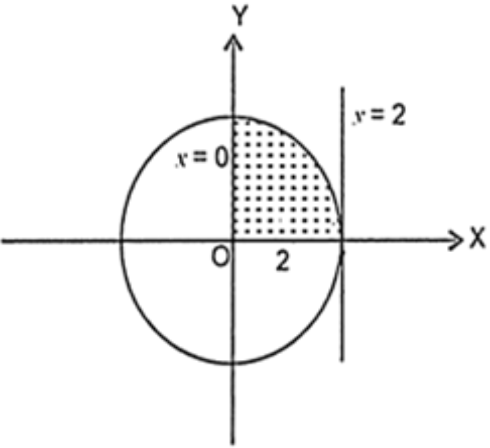
we are to find the area of the circle lying between the circle lying between the lines $x = 0$ and $x = 2$ in the first quadrant.
Required area $=\int\limits^2_0\text{y dx}$
$=\int\limits^2_0\sqrt{4-\text{x}^2}\text{dx}\ \ [\therefore$ of $(1)]$
$=\int\limits^2_0\sqrt{(2)^2-\text{x}^2}\text{ dx}$ $=\Big[\frac{\text{x}}{2}\sqrt{(2)^2-\text{x}^2}+\frac{(2)^2}{2}\sin^{-1}\Big(\frac{\text{x}}{2}\Big)\Big]^2_0$
$=\Big[\frac{\text{x}}{2}\sqrt{4-\text{x}^2}+2\sin^{-1}\Big(\frac{\text{x}}{2}\Big)\Big]^2_0$
$=\Big[\frac{\text{2}}{2}\sqrt{4-\text{4}}+2\sin^{-1}\Big(\frac{\text{2}}{2}\Big)\Big]-[0+2\sin^{-1}0]$
$=\Big[0+2\sin^{-1}(1)-[0+2\times0]\Big]$
$=2\sin^{-1}1=2\times\frac{\pi}{2}=\pi$ View full question & answer→