Question 1015 Marks
$\text{If}\ \ \vec{a},\ \vec{b},\vec{c}$ are unit vectors such that $\vec{a}+\vec{b}+\vec{c}=\vec{0},$ find the value of $\vec{a}\cdot\vec{b}+\vec{b}\cdot\vec{c}+\vec{c}\cdot\vec {a}.$
AnswerHere
$\vec{a}+\vec{b}+\vec{c}=\vec{0}$
$\therefore\ \ \vec{a}+\vec{b}=-\vec{c}\ \ \ \ .....(1)$
$\therefore\ \ \vec{a}.(\vec{a}+\vec{b})=-\vec{a}.\vec{c}$
$\Rightarrow\ \ \vec{a}.\vec{a}+\vec{a}.\vec{b}=-\vec{a}.\vec{c}$
$\Rightarrow\ \big|\vec{a}\big|^2 +\ \vec{a}.\vec{b}+\vec{a}.\vec{c}=0$
$\therefore \ \ 1+\vec{a}.\vec{b}+\vec{a}.\vec{c}=0 $ $\ [\because\ \vec{a}\ \text{is a unit vector}]$
$\text{From}(1),\ \vec{b}.(\vec{a}+\vec{b})=-\vec{b}.\vec{c}\ \Rightarrow\ \ \vec{b}.\vec{a}+\vec{b}.\vec{b}=-\vec{b}.\vec{c}$
$\Rightarrow\ \vec{b}.\vec{a}+\big|\vec{b}\big|^2+\vec{b}.\vec{c}=0$
$\Rightarrow\ \ \vec{b}.\vec{a}+1+\vec{b}.\vec{c}=0$ $\ [\because\ \vec{b}\ \text{is a unit vector}]$
$\therefore\ \ \vec{b}.\vec{a}+\vec{b}.\vec{c}=-1\ \ ....(3)$
$\text{Again form(1)},\ \vec{c}.(\vec{a}+\vec{b})=-\vec{c}.\vec{c}$
$\therefore\ \vec{c}.\vec{a}+\vec{c}.\vec{b}=-\big|\vec{c}\big|^2 \ $ $\Rightarrow\ \ \vec{c}.\vec{a}+\vec{c}.\vec{b}+\big|\vec{c}\big|^2=0$
$\Rightarrow\ \ \vec{c}.\vec{a}+\vec{c}.\vec{b}+1=0$ $\ \ \ \ \ \ [\because\ \vec{c}\ \text{is a unit vector}]$
$\Rightarrow\ \ \vec{c}.\vec{a}+\vec{c}.\vec{b}=-1$
Adding (2), (3) and (4), we get
$2(\vec{a}.\vec{b}+\vec{b}.\vec{c}+\vec{c}.\vec{a})=-3$ $\ \ \ \ \ [\because\ \vec{a}.\vec{b}=\vec{b}.\vec{a}\ \text{etc.}]$
$\therefore\ \vec{a}.\vec{b}+\vec{b}.\vec{c}+\vec{c}.\vec{a}=-\frac{3}{2}$
View full question & answer→Question 1025 Marks
Show that the points whose position vectors are as given below are collinear:
$2\hat{\text{i}}+\hat{\text{j}}-\hat{\text{k}},\ 3\hat{\text{i}}-2\hat{\text{j}}+\hat{\text{k}}$ and $\hat{\text{i}}+4\hat{\text{j}}-3\hat{\text{k}}$
AnswerLet the points be A, B and C with position vectors $2\hat{\text{i}}+\hat{\text{j}}-\hat{\text{k}},\ 3\hat{\text{i}}-2\hat{\text{j}}+\hat{\text{k}}$ and $\hat{\text{i}}+4\hat{\text{j}}-3\hat{\text{k}}$. Then, $\overrightarrow{\text{AB}}=$ Position vector of B - Position vector of A$=3\hat{\text{i}}-2\hat{\text{j}}+\hat{\text{k}}-2\hat{\text{i}}-\hat{\text{j}}+\hat{\text{k}}$
$=\hat{\text{i}}-3\hat{\text{j}}+2\hat{\text{k}}$
$\overrightarrow{\text{BC}}=$ Position vector of C - Position vector of B
$=\hat{\text{i}}+4\hat{\text{j}}-3\hat{\text{k}}-3\hat{\text{i}}+2\hat{\text{j}}-\hat{\text{k}}$
$=-2\hat{\text{i}}+6\hat{\text{j}}-4\hat{\text{k}}$
$=-2\big(\hat{\text{i}}-3\hat{\text{j}}+2\hat{\text{k}}\big)$$\therefore\ \overrightarrow{\text{AB}}=-2\overrightarrow{\text{BC}}$
So, $\overrightarrow{\text{AB}}$ and $\overrightarrow{\text{BC}}$ are parallel vectors. But B is a point common to them. Hence, A, B, and C are collinear.
View full question & answer→Question 1035 Marks
If $\vec{\text{a}}=\hat{\text{i}}+\hat{\text{j}}+2\hat{\text{k}}$ and $\vec{\text{b}}=2\hat{\text{i}}+\hat{\text{j}}-2\hat{\text{k}},$ find the unit vector in the direction of:
- $6\vec{\text{b}}$
- $2\vec{\text{a}}-\vec{\text{b}}$
AnswerHere, $\vec{\text{a}}=\hat{\text{i}}+\hat{\text{j}}+2\hat{\text{k}}$ and $\vec{\text{b}}=2\vec{\text{i}}+\vec{\text{j}}-2\vec{\text{k}}$
- $6\vec{\text{b}}=12\hat{\text{i}}+6\hat{\text{j}}-12\hat{\text{k}}$
$\therefore$ Unit vectors in the direction of $6\vec{\text{b}}=\frac{6\vec{\text{b}}}{|6\vec{\text{b}}|}$
$=\frac{12\hat{\text{i}}+6\hat{\text{j}}-12\hat{\text{k}}}{\sqrt{12^2+6^2+12^2}}$
$=\frac{6(12\hat{\text{i}}+\hat{\text{j}}-2\hat{\text{k}})}{\sqrt{324}}$
$=\frac{6(2\hat{\text{i}}+\hat{\text{j}}-2\hat{\text{k}})}{18}$
$=\frac{2\hat{\text{i}}+\hat{\text{j}}-2\hat{\text{k}}}{3}$
- $2\vec{\text{a}}-\vec{\text{b}}=2(\hat{\text{i}}+\hat{\text{j}}+2\hat{\text{k}})$
$=\hat{\text{j}}+6\hat{\text{k}}$
$\therefore$ Unit vectors in the direction of $2\vec{\text{a}}-\vec{\text{b}}$
$=\frac{2\vec{\text{a}}-\vec{\text{b}}}{|2\vec{\text{a}}-\vec{\text{b}}|}=\frac{\hat{\text{j}}+6\hat{\text{k}}}{\sqrt{1^2+6^2}}$
$=\frac{\hat{\text{j}}+6\hat{\text{k}}}{\sqrt{37}}$ View full question & answer→Question 1045 Marks
Show that the sum of three vectors determined by the medians of a triangle directed from the vertices is zero.
AnswerLet $\vec{\text{a}}, \vec{\text{b}}\text{ and }\vec{\text{c}}$ are the position vectors of the vertices A, B and C respectively.Then we know that the position vector of the centroid O of the triangle is $\frac{\vec{\text{a}}+\vec{\text{b}}+\vec{\text{c}}}{3}$.
Therefore sum of the three vectors $\overrightarrow{\text{OA}},\ \overrightarrow{\text{OB}}\text{ and }\overrightarrow{\text{OC}}$ is $\overrightarrow{\text{OA}}+\overrightarrow{\text{OB}}+\overrightarrow{\text{OC}}=\vec{\text{a}}-\bigg(\frac{\vec{\text{a}}+\vec{\text{b}}+\vec{\text{c}}}{3}\bigg)+\vec{\text{b}}-\bigg(\frac{\vec{\text{a}}+\vec{\text{b}}+\vec{\text{c}}}{3}\bigg)+\vec{\text{c}}-\bigg(\frac{\vec{\text{a}}+\vec{\text{b}}+\vec{\text{c}}}{3}\bigg)$ $=\big(\vec{\text{a}}+\vec{\text{b}}+\vec{\text{c}}\big)-3\Big(\frac{\vec{\text{a}}+\vec{\text{b}}+\vec{\text{c}}}3\Big)$$=\vec0$
Hence, Sum of the three vectors determined by the medians of a triangle directed from the vertices is zero.
View full question & answer→Question 1055 Marks
The two adjecent sides of a parallelogram are $2\hat{\text{i}}-4\hat{\text{j}}+5\hat{\text{k}}$ and $\hat{\text{i}}-2\hat{\text{j}}-3\hat{\text{k}}.$ Find the unit vector parallel to one of its diagonals. Also, find its area.
AnswerSuppose $\Box\text{ ABCD}$ is the given parallelogram and AC is its diagonal.
Let:
$\overrightarrow{\text{AB}}=2\hat{\text{i}}-4\hat{\text{j}}+5\hat{\text{k}}$
$\overrightarrow{\text{BC}}=\hat{\text{i}}-2\hat{\text{j}}-3\hat{\text{k}}$
$\therefore$ Diagonal $\overrightarrow{\text{AC}}=\overrightarrow{\text{AB}}+\overrightarrow{\text{BC}}$
$=3\hat{\text{i}}-6\hat{\text{j}}+2\hat{\text{k}}$
$\Rightarrow\big|\overrightarrow{\text{AC}}\big|=\sqrt{9+36+4}$
$=7$
Unit vector parallel to $\overrightarrow{\text{AC}}=\frac{\overrightarrow{\text{AC}}}{\big|\overrightarrow{\text{AC}}\big|}$
$=\frac{3\hat{\text{i}}-6\hat{\text{j}}+2\hat{\text{k}}}{7}$
Now,
$\Rightarrow\overrightarrow{\text{AB}}\times\overrightarrow{\text{BC}}=\begin{vmatrix}\hat{\text{i}}&\hat{\text{j}}&\hat{\text{k}}\\2&-4&5\\1&-2&-3 \end{vmatrix}$
$=22\hat{\text{i}}+11\hat{\text{j}}+0\hat{\text{k}}$
$\Rightarrow\big|\overrightarrow{\text{AB}}\times\overrightarrow{\text{AC}}\big|=\sqrt{484+121}$
$=\sqrt{605}$
$=11\sqrt{5}$
Area of triangle ABC $=\frac{1}{2}\big|\overrightarrow{\text{AB}}\times\overrightarrow{\text{AC}}\big|$
$=\frac{11\sqrt{5}}{2}\text{ sq. units}$
View full question & answer→Question 1065 Marks
Show that the vectors $2\hat{\text{i}}-3\hat{\text{j}}+4\hat{\text{k}}$ and $-4\hat{\text{i}}+6\hat{\text{j}}-8\hat{\text{k}}$ are collinear.
AnswerGiven the position vectors $2\hat{\text{i}}-3\hat{\text{j}}+4\hat{\text{k}}$ and $-4\hat{\text{i}}+6\hat{\text{j}}-8\hat{\text{k}}$Let $\vec{\text{a}}=2\hat{\text{i}}-3\hat{\text{j}}+4\hat{\text{k}}$ and $\vec{\text{b}}=-4\hat{\text{i}}+6\hat{\text{j}}-8\hat{\text{k}}$
Then,
$\vec{\text{b}}=-4\hat{\text{i}}+6\hat{\text{j}}-8\hat{\text{k}}$
$=-2\big(2\hat{\text{i}}-3\hat{\text{j}}+4\hat{\text{k}}\big)$
$=-2\vec{\text{a}}$
Hence, $\vec{\text{a}},\vec{\text{b}}$ are collinear.
View full question & answer→Question 1075 Marks
Prove by vector method that the internal bisectors of the angles of a triangle are concurrent.
Answer
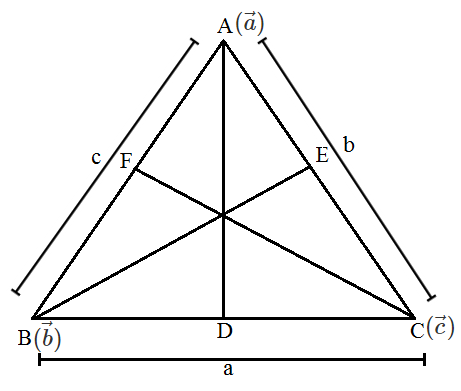 Let ABC be a triangle and $\vec\alpha,\ \vec\beta,\ \vec\gamma$ be the position vectors of the vertices A, B and C respectively. Let AD, BE and CF be the internal bisectors of $\angle\text{A},\angle\text{B}\text{ and } \angle\text{C}$ respectively.
We know that D divides BC in the ratio of AB : AC that is c : b.
Then,
P.V. of D is $\frac{\text{c}\vec\gamma+\text{b}\vec\beta}{\text{c}+\text{b}}$.
P.V. of E is $\frac{\text{c}\vec\gamma+\text{a}\vec\alpha}{\text{c}+\text{a}}$.
and P.V. of F is $\frac{\text{a}\vec\alpha+\text{b}\vec\beta}{\text{a}+\text{b}}$.
The point dividing AD in the ratio b + c : a is $\frac{\text{a}\vec\alpha+\text{b}\vec\beta+\text{c}\vec\gamma}{\text{a}+\text{b}+\text{c}}$.
The point dividing BE in the ratio of a + c : b is $\frac{\text{a}\vec\alpha+\text{b}\vec\beta+\text{c}\vec\gamma}{\text{a}+\text{b}+\text{c}}$.
The point dividing CF in the ratio of a + b : c is $\frac{\text{a}\vec\alpha+\text{b}\vec\beta+\text{c}\vec\gamma}{\text{a}+\text{b}+\text{c}}$.
Since the point $\frac{\text{a}\vec\alpha+\text{b}\vec\beta+\text{c}\vec\gamma}{\text{a}+\text{b}+\text{c}}$ lies on all the three internal bisectors AD, BE and CF.
Hence the internal bisectors are concurrent. View full question & answer→Question 1085 Marks
Show that the points (3, 4), (-5, 16) and (5, 1) are collinear.
AnswerHere, let A = (3, 4)
B = (-5, 16)
C = (5, 1)
$\overrightarrow{\text{AB}}=$ Position vector of B - Position vector of A
$=\big(-5\hat{\text{i}}+16\hat{\text{j}}\big)-\big(3\hat{\text{i}}+4\hat{\text{j}}\big)$
$=-5\hat{\text{i}}+16\hat{\text{j}}-3\hat{\text{i}}-4\hat{\text{j}}$
$\overrightarrow{\text{AB}}=-8\hat{\text{i}}+12\hat{\text{j}}$
$\overrightarrow{\text{BC}}=$ Position vector of C - Position vector of B
$=\big(5\hat{\text{i}}+\hat{\text{j}}\big)-\big(-5\hat{\text{i}}+16\hat{\text{j}}\big)$
$=5\hat{\text{i}}+\hat{\text{j}}+5\hat{\text{i}}-16\hat{\text{j}}$
$\overrightarrow{\text{BC}}=10\hat{\text{i}}-15\hat{\text{j}} $
So, $4\Big(\overrightarrow{\text{AB}}\Big)=-5\Big(\overrightarrow{\text{BC}}\Big)$
$\overrightarrow{\text{AB}}$ is parallel to $\overrightarrow{\text{BC}}$ but B is a common point.
Hence, A, B, C are collinear.
View full question & answer→Question 1095 Marks
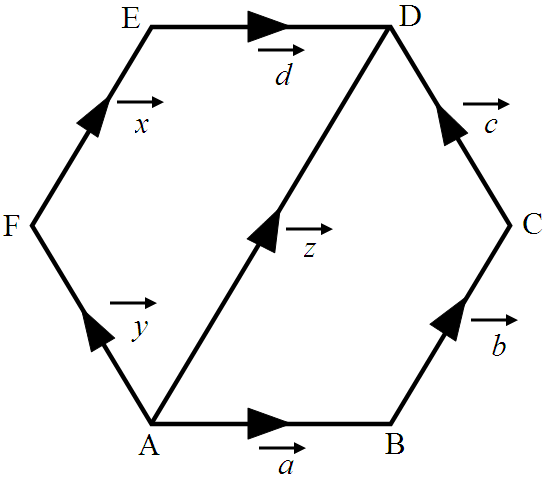
In Figure ABCD is a regular hexagon, which vectors are:
- Collinear.
- Equal.
- Co-initial.
- Collinear but not equal.
Answer
- Vectors having the same or parallel supports are called collinear vector. In the given figure the collinear vectors are,
$\vec{\text{a}},\ \vec{\text{d}};\ \vec{\text{x}},\ \vec{\text{z}},\ \vec{\text{b}};\ \vec{\text{c}},\ \vec{\text{y}}$
- vectors having the same magnitude and direction are called equal vector. In the given figure the equal vectors are,
$\vec{\text{b}},\ \vec{\text{x}};\ \vec{\text{c}},\ \vec{\text{y}};\ \vec{\text{a}},\ \vec{\text{d}}$
- Vectors having the same initial point are called co-initial vector. In the given figure the co-initial vectors are,
$\vec{\text{a}},\ \vec{\text{y}},\ \vec{\text{z}}$
- The vectors which are collinear but not equal are $\vec{\text{b}},\ \vec{\text{z}};\ \vec{\text{x}},\ \vec{\text{z}}$
View full question & answer→Question 1105 Marks
Find the value of $\lambda$ so that the following vectors are coplanar:
$\vec{\text{a}}=\hat{\text{i}}+3\hat{\text{j}},\vec{\text{b}}=5\hat{\text{k}},\vec{\text{c}}=\lambda\hat{\text{i}}-\hat{\text{j}}$
AnswerGiven:
$\vec{\text{a}}=\hat{\text{i}}+3\hat{\text{j}}$
$\vec{\text{b}}=5\hat{\text{k}}$
$\vec{\text{c}}=\lambda\hat{\text{i}}-\hat{\text{j}}$
We know that vectors $\vec{\text{a}},\vec{\text{b}},\vec{\text{c}}$ are coplanar iff $\Big[\vec{\text{a}}\ \vec{\text{b}}\ \vec{\text{c}}\Big]=0.$
It is given that $\vec{\text{a}},\vec{\text{b}},\vec{\text{c}}$ are coplanar.
$\therefore\Big[\vec{\text{a}}\ \vec{\text{b}}\ \vec{\text{c}}\Big]=0$
$\Rightarrow\begin{vmatrix}1&3&0\\0&0&5\\\lambda&-1&0 \end{vmatrix}=0$
$\Rightarrow1(0+5)-3(0-5\lambda)+0(0-0)=0$
$\Rightarrow5+15\lambda=0$
$\Rightarrow \lambda=-\frac{1}{3}$
View full question & answer→Question 1115 Marks
If the vectors $\vec{\text{a}}=2\hat{\text{i}}-3\hat{\text{j}}$ and $\vec{\text{b}}=-6\hat{\text{i}}+\text{m}\hat{\text{j}}$ are collinear, find tghe value of m.
AnswerHere, it is given that vectors $\vec{\text{a}}=2\hat{\text{i}}-3\hat{\text{j}}$ and $\vec{\text{b}}=-6\hat{\text{i}}+\text{m}\hat{\text{j}}$ are collinear. So, $\text{a}=\lambda\text{b}$, for a scalar $\lambda$$2\hat{\text{i}}-3\hat{\text{j}}=\lambda\big(-6\hat{\text{i}}+\text{m}\hat{\text{j}}\big)$
$2\hat{\text{i}}-3\hat{\text{j}}=-6\lambda\hat{\text{i}}+\text{m}\lambda\hat{\text{j}}\big)$ Comparing the coefficients of LHS and RHS, $2=-6\lambda$ $\lambda=\frac{2}{-6}$ $\lambda=\frac{-1}3\ \dots(\text{i})$ $-3=\lambda\text{m}$ $\lambda=\frac{-3}{\text{m}}\ \dots(\text{ii})$ From (i) and (ii), $\frac{-1}3=\frac{-3}{\text{m}}$ $\text{m}=3\times3$ $=9$ $\therefore\ \text{m}=9$
View full question & answer→Question 1125 Marks
Using vector method, prove that the point is collinear:
A(-3, -2, -5), B(1, 2, 3) and C(3, 4, 7)
AnswerGiven the points A(-3, -2, -5), B(1, 2, 3) and C(3, 4, 7). Then, $\overrightarrow{\text{AB}}=$ Position vector of B - Position vector of A$=\hat{\text{i}}+2\hat{\text{j}}+3\hat{\text{k}}+3\hat{\text{i}}+2\hat{\text{j}}+5\hat{\text{k}}$
$=4\hat{\text{i}}+4\hat{\text{j}}+8\hat{\text{k}}$
$=2\big(2\hat{\text{i}}+2\hat{\text{j}}+4\hat{\text{k}}\big)$$\overrightarrow{\text{BC}}=$ Position vector of C - Position vector of B
$=3\hat{\text{i}}+4\hat{\text{j}}+7\hat{\text{k}}-\hat{\text{i}}-2\hat{\text{j}}-3\hat{\text{k}}$
$=2\hat{\text{i}}+2\hat{\text{j}}+4\hat{\text{k}}$
$\therefore\ \overrightarrow{\text{AB}}=2\overrightarrow{\text{BC}}$
So, $\overrightarrow{\text{AB}}$ and $\overrightarrow{\text{BC}}$ are parallel vectors. But B is a point common to them. Hence, the given points A, B, and C are collinear.
View full question & answer→Question 1135 Marks
If the points with position vectors $10\hat{\text{i}}+3\hat{\text{j}},\ 12\hat{\text{i}}-5\hat{\text{j}}$ and $\text{a}\hat{\text{i}}+11\hat{\text{j}}$ are collinear, find the value of a.
AnswerLet A, B, C be the points with position vectors $10\hat{\text{i}}+3\hat{\text{j}},\ 12\hat{\text{i}}-5\hat{\text{j}}$ and $\text{a}\hat{\text{i}}+11\hat{\text{j}}$. Then, $\overrightarrow{\text{AB}}=$ Position vector of B - Position vector of A $=12\hat{\text{i}}-5\hat{\text{j}}-10\hat{\text{i}}-3\hat{\text{j}}$ $=2\hat{\text{i}}-8\hat{\text{j}}$ $\overrightarrow{\text{BC}}=$ Position vector of C - Position vector of B $=\text{a}\hat{\text{i}}+11\hat{\text{j}}-12\hat{\text{i}}+5\hat{\text{j}}$ $=(\text{a}-12)\hat{\text{i}}+16\hat{\text{j}}$ Since, A, B, and C are collinear. $\therefore\ \overrightarrow{\text{AB}}=\lambda\overrightarrow{\text{BC}}$ $\Rightarrow2\hat{\text{i}}-8\hat{\text{j}}=\lambda(\text{a}-12)\hat{\text{i}}+\lambda16\hat{\text{j}}$ $\Rightarrow2=\lambda(\text{a}-12),\ -8=\lambda16$ $\Rightarrow2=\lambda(\text{a}-12),\ \lambda=-\frac{1}2$ $\Rightarrow2=-\frac{1}2(\text{a}-12)$ $\Rightarrow-\text{a}+12=4$ $\Rightarrow\text{a}=8$
View full question & answer→Question 1145 Marks
Show that the following triads of vectors are coplanar:
$\vec{\text{a}}=\hat{\text{i}}-2\hat{\text{j}}+3\hat{\text{k}},\vec{\text{b}}=-2\hat{\text{i}}+3\hat{\text{j}}-4\hat{\text{k}},\vec{\text{c}}=\hat{\text{i}}-3\hat{\text{j}}+5\hat{\text{k}}$
AnswerWe know that three vectors $\vec{\text{a}}\ \vec{\text{b}}\ \vec{\text{c}}$ are coplanar iff their scalar triple product is zero i.e. $\Big[\vec{\text{a}}\ \vec{\text{b}}\ \vec{\text{c}}\Big]=0.$
Here,
$\Big[\vec{\text{a}}\ \vec{\text{b}}\ \vec{\text{c}}\Big]=\begin{vmatrix}1&-2&3\\-2&3&-4\\1&-3&5 \end{vmatrix}$
$=1(15-12)+2(-10+4)+3(6-3)$
$=3-12+9$
$=0$
Hence, the given vectors are coplanar.
View full question & answer→Question 1155 Marks
Prove that the given vectors are non-coplanar:
$\hat{\text{i}}+2\hat{\text{j}}+3\hat{\text{k}},\ 2\hat{\text{i}}+\hat{\text{j}}+3\hat{\text{k}}$ and $\hat{\text{i}}+\hat{\text{j}}+\hat{\text{k}}$
AnswerWe know that, Three vectors are coplanar if any one of them vector can be expressed as the linear combination of the other two. Let, $\hat{\text{i}}+2\hat{\text{j}}+3\hat{\text{k}}\\=\text{x}\big(2\hat{\text{i}}+\hat{\text{j}}+3\hat{\text{k}}\big)+\text{y}\big(\hat{\text{i}}+\hat{\text{j}}+\hat{\text{k}}\big)$ $=2\text{x}\hat{\text{i}}+\text{x}\hat{\text{j}}+3\text{x}\hat{\text{k}}+\text{y}\hat{\text{i}}+\text{y}\hat{\text{j}}+\text{y}\hat{\text{k}}$ $\therefore\ \hat{\text{i}}+2\hat{\text{j}}+3\hat{\text{k}}\big)\\=\big(2\text{x}+\text{y}\big)\hat{\text{i}}+\big(\text{x}+2\text{y}\big)\hat{\text{j}}+\big(3\text{x}+\text{y}\big)\hat{\text{k}}$ comparing the coefficient of LHS and RHS, 2x + y = 1 .....(i) x + 2y = 2 .....(ii) 3x + y = 3 .....(iii) subtracting 2 × (ii) from equation (i),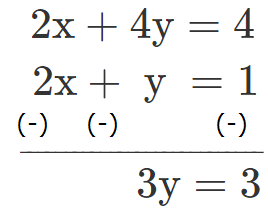
$\text{y}=\frac{3}3$ $\text{y}=1$ Put the value of y in equation (i), $2\text{x}+\text{y}=1$ $2\text{x}+1=1$ $2\text{x}=1-1$ $2\text{x}=0$ $\text{x}=\frac{0}2$ $\text{x}=0$ Put the value of x and y in equation (iii), $3\text{x}+\text{y}=3$ $3(0)+1=3$ $0+1=3$ $1=3$ $\text{LHS}\neq\text{RHS}$ The value of x and y do not satisfy the equation (iii), Hence, vectors are non-coplanar. View full question & answer→Question 1165 Marks
A girl walks 4 km towards west, then she walks 3 km in a direction 30° east of north and stops. Determine the girl's displacement from her initial point of departure.
AnswerLet O and B be the initial and final position of the girl respectively Then, the girl's position can be shown as: 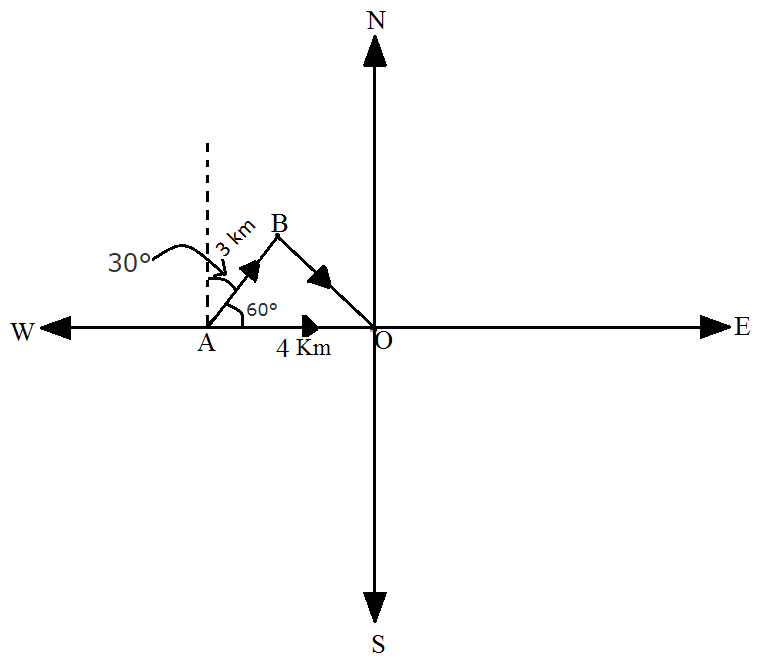 Now, we have: $\overrightarrow{\text{OA}}=-4\hat{\text{i}}$ $\overrightarrow{\text{AB}}=\hat{\text{i}}\bigg|\overrightarrow{\text{AB}}\bigg|\cos60^{\circ}+\hat{\text{j}}\bigg|\overrightarrow{\text{AB}}\bigg|\sin60^{\circ}$$=\hat{\text{i}}3\times\frac{1}{2}+\hat{\text{j}}3\times\frac{\sqrt{3}}{2} $
$=\frac{3}{2}\hat{\text{i}}+\frac{3\sqrt{3}}{2}\hat{\text{j}}$
By the triangle law vector addition, we have: $\overrightarrow{\text{OB}}=\overrightarrow{\text{OA}}+\overrightarrow{\text{AB}}$ $=(-4\hat{\text{i}})+\bigg(\frac{3}{2}\hat{\text{i}}+\frac{3\sqrt{3}}{2}\hat{\text{j}}\bigg)$ $=\bigg(-4+\frac{3}{2}\bigg)\hat{\text{i}}+\frac{3\sqrt{3}}{2}\hat{\text{j}}$ $=\bigg(\frac{-8+3}{2}\bigg)\hat{\text{i}}+\frac{3\sqrt{3}}{2}\hat{\text{j}}$ $=\frac{-5}{2}\hat{\text{i}}+\frac{3\sqrt{3}}{2}\hat{\text{j}}$Hence, the girl's displacement form her initial point of departure is
$\frac{-5}{2}\hat{\text{i}}+\frac{3\sqrt{3}}{2}\hat{\text{j}}$ View full question & answer→Question 1175 Marks
Prove that: If the diagonals of a quadrilateral bisect each other at right angles, then it is a rhombus.
Answer

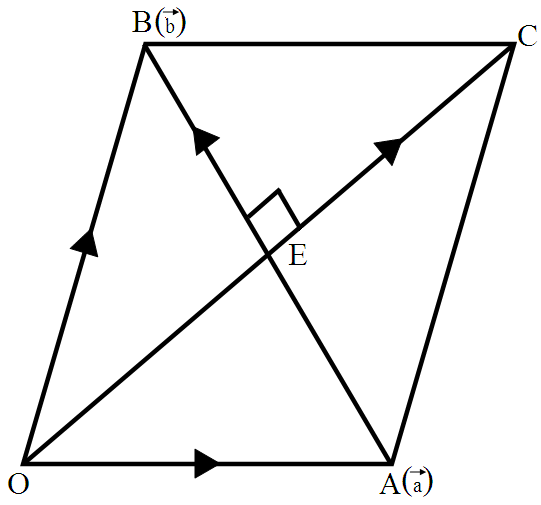 Let OACB be a quadrilateral such that diagonals OC and AB bisect each other at 90°.
Taking O as the origin, let the position vectors of A and B be $\vec{\text{a}}$ and $\vec{\text{b}},$respectively. Then,
$\vec{\text{OA}}=\vec{\text{a}}$ and $\vec{\text{OB}}=\vec{\text{b}}$
position vector of mid-point of AB, $\vec{\text{OE}}=\frac{\vec{\text{a}}+\vec{\text{b}}}{2}$
$\therefore$ position vector of c, $\vec{\text{OC}}=\vec{\text{a}}+\vec{\text{b}}$
By the triangle law of vector addition, we have
$\vec{\text{OA}}+\vec{\text{AB}}=\vec{\text{OB}}$
$\Rightarrow\vec{\text{AB}}=\vec{\text{OB}}-\vec{\text{OA}}=\vec{\text{b}}-\vec{\text{a}}$
Since $\vec{\text{AB}}\perp\vec{\text{OC}},$
$\Rightarrow \vec{\text{AB}}.\vec{\text{OC}}=0$
$\Rightarrow\big(\vec{\text{b}}-\vec{\text{a}}\big).\big(\vec{\text{a}}+\vec{\text{b}}\big)=0$
$\Rightarrow\big|\vec{\text{b}}\big|^{2}-|\vec{\text{a}}|^{2}=0$
$\Rightarrow|\vec{\text{a}}|^{2}=\big|\vec{\text{b}}\big|^{2}$
$\Rightarrow|\vec{\text{a}}|=\big|\vec{\text{b}}\big|$
$\Rightarrow \text{OA = OB}$
In a quadrilateral if diagonals bisects each other at right angle and adjacent sides are equal, then it is a rhombus. View full question & answer→Question 1185 Marks
Find the angles of a triangle whose vertices are A (0, -1 ,-2), B(3, 1 ,4) and C(5 ,7 ,1).
Answer$\vec{\text{A}}=0.\hat{\text{i}}-\hat{\text{j}}-2\hat{\text{k}}$
$\vec{\text{B}}=3\hat{\text{i}}+\hat{\text{j}}+4\hat{\text{k}}$
$\vec{\text{C}}=5\hat{\text{i}}+7\hat{\text{j}}+\hat{\text{k}}$
$\overrightarrow{\text{AB}}=\vec{\text{B}}-\vec{\text{A}}$
$=\big(3\hat{\text{i}}+\hat{\text{j}}+4\hat{\text{k}}\big)-\big(0.\hat{\text{i}}-\hat{\text{j}}-2\hat{\text{k}}\big)$
$=3\hat{\text{i}}+\hat{\text{j}}+4\hat{\text{k}}-0.\hat{\text{i}}+\hat{\text{j}}+2\hat{\text{k}}$
$\overrightarrow{\text{AB}}=3\hat{\text{i}}+2\hat{\text{j}}+6\hat{\text{k}}$
$\overrightarrow{\text{BC}}=\vec{\text{C}}-\vec{\text{B}}$
$=\big(5\hat{\text{i}}+7\hat{\text{j}}+\hat{\text{k}}\big)-\big(3\hat{\text{i}}+\hat{\text{j}}+4\hat{\text{k}}\big)$
$=5\hat{\text{i}}+7\hat{\text{j}}+\hat{\text{k}}-3\hat{\text{i}}-\hat{\text{j}}-4\hat{\text{k}}$
$\overrightarrow{\text{BC}}=2\hat{\text{i}}+6\hat{\text{j}}-3\hat{\text{k}}$
$\overrightarrow{\text{AC}}=\vec{\text{C}}-\vec{\text{A}}$
$=\big(5\hat{\text{i}}+7\hat{\text{j}}+\hat{\text{k}}\big)-\big(-\hat{\text{j}}-2\hat{\text{k}}\big)$
$=5\hat{\text{i}}+7\hat{\text{j}}+\hat{\text{k}}+\hat{\text{j}}+2\hat{\text{k}}$
$\overrightarrow{\text{AC}}=5\hat{\text{i}}+8\hat{\text{j}}+3\hat{\text{k}}$
Angle between $\overrightarrow{\text{AB}}$ and $\overrightarrow{\text{AC}},$
$\cos\text{A}=\frac{\overrightarrow{\text{AB}}.\overrightarrow{\text{AC}}}{\big|\overrightarrow{\text{AB}}\big|\big|\overrightarrow{\text{AC}}\big|}$
$=\frac{\big(3\hat{\text{i}}+2\hat{\text{j}}+6\hat{\text{k}}\big)\big(5\hat{\text{i}}+8\hat{\text{j}}+3\hat{\text{k}}\big)}{\sqrt{(3)^2+(2)^2+(6)^2}\sqrt{(5)^2+(8)^2+(3)^2}}$
$=\frac{(3)(5)+(2)(8)+(6)(3)}{\sqrt{9+4+36}\sqrt{25+64+9}}$
$=\frac{15+16+18}{\sqrt{49}\sqrt{98}}$
$=\frac{49}{\sqrt{49}\sqrt{49\times2}}$
$\cos\text{A}=\frac{49}{49\sqrt{2}}$
$\cos\text{A}=\frac{1}{\sqrt{2}}$
$\text{A}=\cos^{-1}\Big(\frac{1}{\sqrt{2}}\Big)$
$=\frac{\pi}{4}$
$\angle\text{A}=\frac{\pi}{4}$
Angle between $\overrightarrow{\text{BC}}$ and $\overrightarrow{\text{BA}}$
$\cos\text{B}=\frac{\overrightarrow{\text{BC}}.\overrightarrow{\text{BA}}}{\big|\overrightarrow{\text{BC}\big|}\big|\overrightarrow{\text{BA}\big|}}$
$=\frac{\big(2\hat{\text{i}}+6\hat{\text{j}}-3\hat{\text{k}}\big)\big(-3\hat{\text{i}}-2\hat{\text{j}}-6\hat{\text{k}}\big)}{\sqrt{(2)^2+(6)^2+(-3)^2\sqrt{(-3)^2+(-2)^2+(-6)^2}}}$
$=\frac{(2)(-3)+(6)(-2)+(-3)(-6)}{\sqrt{4+36+9}\sqrt{9+4+36}}$
$=\frac{-6-12+18}{\sqrt{49}\sqrt{98}}$
$\cos\text{B}=\frac{-18+18}{49}$
$=\frac{0}{49}$
$\cos\text{B}=0$
$\text{B}=\cos^{-1}(0)$
$\angle\text{B}=\frac{\pi}{2}$
We know that,
$\angle\text{A}+\angle\text{B}+\angle\text{C}=\pi$
$\frac{\pi}{4}+\frac{\pi}{2}+\angle\text{C}=\pi$
$\frac{3\pi}{4}+\angle\text{C}=\pi$
$\angle\text{C}=\frac{\pi}{1}-\frac{3\pi}{4}$
$\angle\text{C}=\frac{4\pi-3\pi}{4}$
$\angle\text{C}=\frac{\pi}{4}$
$\angle\text{A}=\frac{\pi}{4}$
$\angle\text{B}=\frac{\pi}{2}$
View full question & answer→Question 1195 Marks
Show that the points A(-1, 4, -3), B(3, 2, -5), C(-3, 8, -5) and D(-3, 2, 1) are coplanar.
AnswerThe points A, B, C and D will be coplanar off any one of the following triads of vectors are coplanar:
$\vec{\text{AB}},\vec{\text{AC}},\vec{\text{AD}};\vec{\text{AB}},\vec{\text{BC}},\vec{\text{CD}};\vec{\text{BC}},\vec{\text{BA}},\vec{\text{BD}},$ etc.
To show that $\vec{\text{AB}},\vec{\text{AC}},\vec{\text{AD}}$ are coplaner, we have to prove that their scaler triple product,
i.e., $\Big[\vec{\text{AB}}\vec{\text{ AC}}\vec{\text{ AD}}\Big]=0$
Now,
$\vec{\text{AB}}=\big[3-(-1)\big]\hat{\text{i}}+(2-4)\hat{\text{j}}+[-5-(-3)]\hat{\text{k}}\\=4\hat{\text{i}}-2\hat{\text{j}}-2\hat{\text{k}}$
$\vec{\text{AC}}=[-3-1)]\hat{\text{i}}+(8-4)\hat{\text{j}}+[-5-(3)]\hat{\text{k}}\\=-2\hat{\text{i}}+4\hat{\text{j}}-2\hat{\text{k}}$
$\vec{\text{AD}}=[-3-(-1)]\hat{\text{i}}+(2-4)\hat{\text{j}}+[1-(3)]\hat{\text{k}}\\=-2\hat{\text{i}}-2\hat{\text{j}}+4\hat{\text{k}}$
$\therefore\Big[\vec{\text{AC}}\vec{\text{ AC}}\vec{\text{ AD}}\Big]=\begin{vmatrix}4&-2&-2\\-2&4&-2\\-2&-2&4 \end{vmatrix}$
$=4(16-4)+2(-8-4)-2(4+8)=0$
Thus, the given points are coplanar.
View full question & answer→Question 1205 Marks
If $\vec{\text{p}}=5\hat{\text{i}}+\lambda\hat{\text{j}}-3\hat{\text{k}}$ and $\vec{\text{q}}=\hat{\text{i}}+3\hat{\text{j}}-5\hat{\text{k}},$ then find the value of $\lambda,$ so that $\vec{\text{p}}+\vec{\text{q}}$ and $\vec{\text{p}}-\vec{\text{q}}$ are perpendicular vectora.
AnswerGiven that
$\vec{\text{p}}=5\hat{\text{i}}+\lambda\hat{\text{j}}-3\hat{\text{k}}$
and $\vec{\text{q}}=\hat{\text{i}}+3\hat{\text{j}}-5\hat{\text{k}},$
$\vec{\text{p}}+\vec{\text{q}}=\big(5\hat{\text{i}}+\lambda\hat{\text{j}}-3\hat{\text{k}}\big)+(\hat{\text{i}}+3\hat{\text{j}}-5\hat{\text{k}})\\=6\hat{\text{i}}+(\lambda+3)\hat{\text{j}}-8\hat{\text{k}}$
$\vec{\text{p}}-\vec{\text{q}}=\big(5\hat{\text{i}}+\lambda\hat{\text{j}}-3\hat{\text{k}}\big)-(\hat{\text{i}}+3\vec{\text{j}}-5\hat{\text{k}})\\=4\hat{\text{i}}+(\lambda-3)\hat{\text{j}}+2\hat{\text{k}}$
Given that $\vec{\text{p}}+\vec{\text{q}}$ is orthogonal to $\vec{\text{p}}-\vec{\text{q}}.$
$\Rightarrow\big(\vec{\text{p}}+\vec{\text{q}}\big).\big(\vec{\text{p}}-\vec{\text{q}}\big)=0$
$\Rightarrow\Big[6\hat{\text{i}}+(\lambda+3)\hat{\text{j}}-8\hat{\text{k}}\Big].\Big[4\hat{\text{i}}+(\lambda-3)\hat{\text{j}}+2\hat{\text{k}}\Big]=0$
$\Rightarrow24+\lambda^2-9-16=0$
$\Rightarrow\lambda^2=1$
$\therefore\lambda=\pm1$
View full question & answer→Question 1215 Marks
Find a vector of magnitude 6, which is perpendicular to both the vectors $2\hat{\text{i}}-\hat{\text{j}}+2\hat{\text{k}}$ and $4\hat{\text{i}}-\hat{\text{j}}+3\hat{\text{k}}.$
AnswerLet $\vec{\text{a}}=2\hat{\text{i}}-\hat{\text{j}}+2\hat{\text{k}}$ and $\vec{\text{b}}=4\hat{\text{i}}-\hat{\text{j}}+3\hat{\text{k}}$
So, any vector perpendicular to both the vectors $\vec{\text{a}}$ and $\vec{\text{b}}$ is given by
$\vec{\text{a}}\times\vec{\text{b}}=\begin{vmatrix}\hat{\text{i}}&\hat{\text{j}}&\hat{\text{k}} \\2&-1&2\\4&-1&3 \end{vmatrix}$
$=\hat{\text{i}}(-3+2)-\hat{\text{j}}(6-8)+\hat{\text{k}(-2+4)}$
$=\hat{\text{i}}+2\hat{\text{j}}+2\hat{\text{k}}=\vec{\text{r}}$
A vector of magnitude 6 in the direction of $\vec{\text{r}}$
$=\frac{\vec{\text{r}}}{|\vec{\text{r}}|}.6\frac{-\hat{\text{i}}+2\hat{\text{j}}+2\hat{\text{k}}}{\sqrt{1^2+2^2+2^2}}.6$
$=-\frac{-6}{3}\hat{\text{i}}+\frac{12}{3}\hat{\text{j}}+\frac{12}{3}\hat{\text{k}}$
$=-2\hat{\text{i}}+4\hat{\text{j}}+4\hat{\text{k}}$
View full question & answer→Question 1225 Marks
If the points A(m, -1), B(2, 1) and C(4, 5) are collinear, find the value of m.
AnswerHere, A = (m, -1)
B = (2, 1)
C = (4, 5)
$\overrightarrow{\text{AB}}=$ Position vector of B - Position vector of A
$=\big(2\hat{\text{i}}+\hat{\text{j}}\big)-\big(\text{m}\hat{\text{i}}-\hat{\text{j}}\big)$
$=2\hat{\text{i}}+\hat{\text{j}}-\text{m}\hat{\text{i}}+\hat{\text{j}}$
$=(2-\text{m})\hat{\text{i}}+2\hat{\text{j}}$
$\overrightarrow{\text{BC}}=$ Position vector of C - Position vector of B
$=\big(4\hat{\text{i}}+5\hat{\text{j}}\big)-\big(2\hat{\text{i}}+\hat{\text{j}}\big)$
$=4\hat{\text{i}}+5\hat{\text{j}}-2\hat{\text{i}}-\hat{\text{j}}$
$\overrightarrow{\text{BC}}=2\hat{\text{i}}+4\hat{\text{j}} $
A, B, C are collinear. So, $\overrightarrow{\text{AB}}$ and $\overrightarrow{\text{BC}}$ are collinear.
So, $\overrightarrow{\text{AB}}=\lambda\Big(\overrightarrow{\text{BC}}\Big)$
$\big(2-\text{m})\hat{\text{i}}+2\hat{\text{j}}=\lambda\big(2\hat{\text{i}}+4\hat{\text{j}}\big)$, for $\lambda$ scalar
$\big(2-\text{m})\hat{\text{i}}+2\hat{\text{j}}=2\lambda\hat{\text{i}}+4\lambda\hat{\text{j}}$
Comparing the coefficient of LHS and RHS.
$2-\text{m}=2\lambda$
$\frac{2-\text{m}}2=\lambda\ \dots(\text{i})$
$2=4\lambda$
$\frac{2}4=\lambda$
$\frac{1}2=\lambda\ \dots(\text{ii})$
Using (i) and (ii)
$\frac{2-\text{m}}2=\frac{1}2$
$4-2\text{m}=2$
$-2\text{m}=2$
$-2\text{m}=2-4$
$-2\text{m}=-2$
$\text{m}=\frac{-2}{-2}$
$\text{m}=1$
View full question & answer→Question 1235 Marks
Find the position vector of a point R which divides the line joining two points P and Q whose position vectors are $\hat{i}+2\hat{j}-\hat{k}\ \text{and}\ -\hat{i}+\hat{j}+\hat{k}$ respectively, in the ratio 2 : 1
- Internally.
- Externally.
AnswerThe position vector of point R dividing the line segment joining two points P and Q in the ratio m : n is given by:
- Internally:
$\frac{\text{m}\vec{b}+\text{n}\vec{a}}{\text{m}+\text{n}}$
- Externally:
$\frac{\text{m}\vec{b}-\text{n}\vec{a}}{\text{m}-\text{n}}$
Position vectors of P and Q are given as:
$\overrightarrow{\text{OP}}=\hat{i}+2\hat{j}-\hat{k}\ \text{and}\ \overrightarrow{\text{OQ}}=-\hat{i}+\hat{j}+\hat{k}$
- The position vector of point R which divides the line joining two points P and Q internally in the ratio 2 : 1 is given by,
$\overrightarrow{\text{OR}}=\frac{2\big(-\hat{i}+\hat{j}+\hat{k}\big)+1\big(\hat{i}+2\hat{j}-\hat{k}\big)}{2+1}$ $=\frac{\big(-2\hat{i}+2\hat{j}+2\hat{k}\big)+\big(\hat{i}+2\hat{j}-\hat{k}\big)}{3}$
$=\frac{-\hat{i}+4\hat{j}+\hat{k}}{3}=-\frac{1}{3}\hat{i}+\frac{4}{3}\hat{j}+\frac{1}{3}\hat{k}$
- The position vector of point R which divides the line joining two points P and Q externally in the ratio 2 : 1 is given by,
$\overrightarrow{\text{OR}}=\frac{2\big(-\hat{i}+\hat{j}+\hat{k}\big)-1\big(\hat{i}+2\hat{j}-\hat{k}\big)}{2-1}$ $=\big(-2\hat{i}+2\hat{j}+2\hat{k}\big)-\big(\hat{i}+2\hat{j}-\hat{k}\big)$
$=-3\hat{i}+3\hat{k}$ View full question & answer→Question 1245 Marks
If a, b, c are the langths of sides, BC, CA and AB of a triangle ABC, prove that $\overrightarrow{\text{BC}}+\overrightarrow{\text{CA}}+\overrightarrow{\text{AB}}=\vec{\text{0}}$ and deduce that $\frac{\text{a}}{\sin\text{A}}=\frac{\text{b}}{\sin\text{B}}=\frac{\text{c}}{\sin\text{C}}.$
AnswerWe have
$\overrightarrow{\text{BC}}=\vec{\text{a}}$
$\overrightarrow{\text{CA}}=\vec{\text{b}}$
$\overrightarrow{\text{AB}}=\vec{\text{c}}$
$|\vec{\text{a}}|=\text{a}$
$\big|\vec{\text{b}}\big|=\text{b}$ ($\because$ Length is alwys positive)
$\vec{\text{c}}=\text{c}$
Now,
$\overrightarrow{\text{BC}}+\overrightarrow{\text{CA}}+\overrightarrow{\text{AB}}=\vec{0}$ (Given)
$\Rightarrow\vec{\text{a}}+\vec{\text{b}}+\vec{\text{c}}=\vec{0}$
$\Rightarrow\vec{\text{a}}\times\big(\vec{\text{a}}+\vec{\text{b}}+\vec{\text{c}}\big)=\vec{\text{a}}\times\vec{0}$
$\Rightarrow\vec{\text{a}}\times\vec{\text{a}}+\vec{\text{a}}\times\vec{\text{b}}+\vec{\text{a}}\times\vec{\text{c}}=\vec{\text{0}}$
$\Rightarrow\vec{0}+\vec{\text{a}}\times\vec{\text{b}}-\vec{\text{c}}\times\vec{\text{a}}=\vec{\text{0}}$
$\Rightarrow\vec{\text{a}}\times\vec{\text{b}}=\vec{\text{c}}\times\vec{\text{a}}$
$\Rightarrow|\vec{\text{a}}|\big|\vec{\text{b}}\big|\sin\text{C}=|\vec{\text{c}}||\vec{\text{a}}|\sin\text{B}$
$\Rightarrow\text{ab}\sin\text{C}=\text{ca}\sin\text{B}$
Dividing both sides by abc, we get
$\Rightarrow\frac{\sin\text{C}}{\text{c}}=\frac{\sin\text{B}}{\text{b}}\dots(1)$
Again,
$\overrightarrow{\text{BC}}+\overrightarrow{\text{CA}}+\overrightarrow{\text{AB}}=\vec{0}$
$\Rightarrow\vec{\text{a}}+\vec{\text{b}}+\vec{\text{c}}=\vec{0}$
$\Rightarrow\vec{\text{b}}\times\big(\vec{\text{a}}+\vec{\text{b}}+\vec{\text{c}}\big)=\vec{\text{b}}\times\vec{0}$
$\Rightarrow\vec{\text{b}}\times\vec{\text{a}}+\vec{\text{b}}\times\vec{\text{b}}+\vec{\text{b}}\times\vec{\text{c}}=\vec{0}$
$\Rightarrow-\vec{\text{a}}\times\vec{\text{b}}+\vec{0}+\vec{\text{b}}\times\vec{\text{c}}=\vec{0}$
$\Rightarrow\vec{\text{a}}\times\vec{\text{b}}=\vec{\text{b}}\times\vec{\text{c}}$
$\Rightarrow|\vec{\text{a}}|\big|\vec{\text{b}}\big|\sin\text{C}=\big|\vec{\text{b}}\big||\vec{\text{c}}|\sin\text{A}$
$\Rightarrow\text{ab}\sin\text{C}=\text{bc}\sin\text{A}$
Dividing both sides by abc, we get
$\Rightarrow\frac{\sin\text{C}}{\text{c}}=\frac{\sin\text{A}}{\text{a}}\dots(2)$
From (1) and (2), we get
$\frac{\sin\text{A}}{\text{a}}=\frac{\sin\text{B}}{\text{b}}=\frac{\sin\text{C}}{\text{c}}$
$\Rightarrow\frac{\text{a}}{\sin\text{A}}=\frac{\text{b}}{\sin\text{B}}=\frac{\text{c}}{\sin\text{C}}$
View full question & answer→Question 1255 Marks
Show that the points A, B, C with position vectors $\vec{\text{a}}-2\vec{\text{b}}+3\vec{\text{c}},\ 2\vec{\text{a}}+3\vec{\text{b}}-4\vec{\text{c}}$ and $-7\vec{\text{b}}+10\vec{\text{c}}$ are collinear.
AnswerWe have, A, B, C with position vectors $\vec{\text{a}}-2\vec{\text{b}}+3\vec{\text{c}},\ 2\vec{\text{a}}+3\vec{\text{b}}-4\vec{\text{c}}$ and $-7\vec{\text{b}}+10\vec{\text{c}}$ Then,
$\overrightarrow{\text{AB}}=$ Position vector of B - Position vector of A
$=2\vec{\text{a}}+3\vec{\text{b}}-4\vec{\text{c}}-\vec{\text{a}}+2\vec{\text{b}}-3\vec{\text{c}}$
$=\vec{\text{a}}+5\vec{\text{b}}-7\vec{\text{c}}$
$\overrightarrow{\text{BC}}=$ Position vector of C - Position vector of B
$=-7\vec{\text{b}}+10\vec{\text{c}}-2\vec{\text{a}}-3\vec{\text{b}}+4\vec{\text{c}}$
$=-2\vec{\text{a}}-10\vec{\text{b}}+14\vec{\text{c}}$
$=-2\big(\vec{\text{a}}+5\vec{\text{b}}-7\vec{\text{c}}\big)$
$\therefore\ \overrightarrow{\text{BC}}=-2\overrightarrow{\text{AB}}$
Hence, $\overrightarrow{\text{AB}}$ and $\overrightarrow{\text{BC}}$ are parallel vectors.
But B is a point common to them.
So, $\overrightarrow{\text{AB}}$ and $\overrightarrow{\text{BC}}$ are collinear.
Hence, points A, B and C are collinear.
View full question & answer→Question 1265 Marks
If $\vec{\text{a}},\vec{\text{b}}$ are two non-collinear vectors, prove that the points with position vectors $\vec{\text{a}}+\vec{\text{b}},\ \vec{\text{a}}-\vec{\text{b}}$ and $\vec{\text{a}}+\lambda\vec{\text{b}}$ are collinear for all real values of $\lambda$.
AnswerLet A, B, C be the points then, Position vector of $\text{A}=\vec{\text{a}}+\vec{\text{b}}$ Position vector of $\text{B}=\vec{\text{a}}-\vec{\text{b}}$ Position vector of $\text{C}=\vec{\text{a}}+\lambda\vec{\text{b}}$ $\overrightarrow{\text{AB}}=$ Position vector of B - Position vector of A $=\big(\vec{\text{a}}-\vec{\text{b}}\big)-\big(\vec{\text{a}}+\vec{\text{b}}\big)$ $=\vec{\text{a}}-\vec{\text{b}}-\vec{\text{a}}-\vec{\text{b}}$ $\overrightarrow{\text{AB}}=-2\vec{\text{b}}$ $\overrightarrow{\text{BC}}=$ Position vector of C - Position vector of B $=\big(\vec{\text{a}}+\lambda\vec{\text{b}}\big)-\big(\vec{\text{a}}-\vec{\text{b}}\big)$ $=\vec{\text{a}}+\lambda\vec{\text{b}}-\vec{\text{a}}+\vec{\text{b}}$ $\overrightarrow{\text{BC}}=(\lambda+1)\vec{\text{b}}$ Using $\overrightarrow{\text{AB}}$ and $\overrightarrow{\text{BC}}$, we get $\overrightarrow{\text{AB}}=\Big[\frac{(\lambda+1)}{2}\Big]\Big(\overrightarrow{\text{BC}}\Big)$ Let $\Big(\frac{\lambda+1}{2}\Big)=\mu$Since $\lambda$ is a real number. So,
$\mu$ is also a real number. So, $\overrightarrow{\text{AB}}$ is parallel to $\overrightarrow{\text{BC}}$, but $\vec{\text{B}}$ is a common vector. Hence, A, B, C are collinear.
View full question & answer→Question 1275 Marks
Show that the points A(1, -2, -8), B(5, 0, -2) and C(11, 3, 7) are collinear, and find the ratio in which B divides AC.
AnswerGiven points A(1, -2, -8), B(5, 0, -2), C(11, 3, 7).
Therefore, $\overrightarrow{\text{AB}}=5\hat{\text{i}}+0\hat{\text{j}}-2\hat{\text{k}}-\hat{\text{i}}+2\hat{\text{j}}+8\hat{\text{k}}=4\hat{\text{i}}+2\hat{\text{j}}+6\hat{\text{k}}$
$\overrightarrow{\text{BC}}=11\hat{\text{i}}+3\hat{\text{j}}+7\hat{\text{k}}-5\hat{\text{i}}+2\hat{\text{k}}=6\hat{\text{i}}+3\hat{\text{j}}+9\hat{\text{k}}$
and, $\overrightarrow{\text{AC}}=11\hat{\text{i}}+3\hat{\text{j}}+7\hat{\text{k}}-\hat{\text{i}}+2\hat{\text{j}}+8\hat{\text{k}}=10\hat{\text{i}}+5\hat{\text{j}}+15\hat{\text{k}}$
Clearly, $\overrightarrow{\text{AB}}+\overrightarrow{\text{BC}}=\overrightarrow{\text{AC}}$
Hence A, B, C are collinear.
Suppose B divides AC in the ratio $\lambda:1$. Then the position vector B is
$\Big(\frac{11\lambda+1}{\lambda+1}\Big)\hat{\text{i}}+\Big(\frac{3\lambda-2}{\lambda+1}\Big)\hat{\text{j}}+\Big(\frac{7\lambda-8}{\lambda+1}\Big)\hat{\text{k}}$
But the position vector of B is $5\hat{\text{i}}+0\hat{\text{j}}-2\hat{\text{k}}$.
$\Big(\frac{11\lambda+1}{\lambda+1}\Big)=5,\Big(\frac{3\lambda-2}{\lambda+1}\Big)=0,\Big(\frac{7\lambda-8}{\lambda+1}\Big)=-2$
$\Rightarrow11\lambda+1=5\lambda+5,\ 3\lambda-2=0,\ 7\lambda-8=-2\lambda-2$
$\Rightarrow6\lambda=4,\ 3\lambda=2,\ 9\lambda=6$
$\Rightarrow\lambda=\frac{2}3,\ \lambda=\frac{2}3,\ \lambda=\frac{2}3$
View full question & answer→Question 1285 Marks
The scalar product of the vector $\hat{\text{l}}+\hat{\text{j}}+\hat{\text{k}}$ with a unit a vector along the sum of vectors $2\hat{\text{l}}+4\hat{\text{j}}-5\hat{\text{k}}\ \text{and}\ \lambda\hat{\text{l}}+2\hat{\text{j}}+3\hat{\text{k}}$ is equal to one. Find the value of $\lambda.$
Answer$\Big(2\hat{\text{i}}+4\hat{\text{j}}-5\hat{\text{k}}\Big)+\Big(\lambda\hat{\text{i}}+2\hat{\text{j}}+3\hat{\text{k}}\Big) $
$=(2+\lambda)\hat{\text{i}}+6\hat{\text{j}}-2\hat{\text{k}}$
Therefore, unit vector along $\Big(2\hat{\text{i}}+4\hat{\text{j}}-5\hat{\text{k}}\Big)+\Big(\lambda\hat{\text{i}}+2\hat{\text{j}}+3\hat{\text{k}}\Big) $ is given as:
$\frac{(2+\lambda)\hat{\text{i}}+6\hat{\text{j}}-2\hat{\text{k}}}{\sqrt{(2+\lambda)^{2}+6^{2}+(-2)^{2}}}=\frac{(2+\lambda)\hat{\text{i}}+6\hat{\text{j}}-2\hat{\text{k}}}{\sqrt{4+4\lambda+\lambda^{2}+36+4}}$ $=\frac{(2+\lambda)\hat{\text{i}}+6\hat{\text{j}}-2\hat{\text{k}}}{\sqrt{\lambda^{2}+4\lambda+44}}$
Scalar product of $\Big(\hat{\text{l}}+\hat{\text{j}}+\hat{\text{k}}\Big)$ with this unit vector is 1.
$\Rightarrow\Big(\hat{\text{l}}+\hat{\text{j}}+\hat{\text{k}}\Big) \cdot\frac{(2+\lambda)\hat{\text{i}}+6\hat{\text{j}}-2\hat{\text{k}}}{\sqrt{\lambda^{2}+4\lambda+44}}=1$
$\Rightarrow\frac{(2+\lambda)+6-2}{\sqrt{\lambda^{2}+4\lambda+44}}=1$
$\Rightarrow {\sqrt{\lambda^{2}+4\lambda+44}}=\lambda+6$
$\Rightarrow{\lambda^{2}+4\lambda+44}=\big(\lambda+6\big)^{2}$
$\Rightarrow{\lambda^{2}+4\lambda+44}=\lambda^{2}+12\lambda+36$
$\Rightarrow{8\lambda=8}$
$\Rightarrow{\lambda=1}$
Hence, the value of $\lambda$ is 1.
View full question & answer→Question 1295 Marks
Show that the points $2\hat{\text{i}},-\hat{\text{i}}-4\hat{\text{j}}\text{ and }-\hat{\text{i}}+4\hat{\text{j}}$ form an isosceles triangle.
AnswerGiven:- The points A, B, C with position vectors $\vec{\text{a}},\ \vec{\text{b}},\ \vec{\text{c}}$ respectively.
Also, $\vec{\text{a}}=2\hat{\text{i}}$
$\vec{\text{b}}=-\hat{\text{i}}-4\hat{\text{j}}$
$\vec{\text{c}}=-\hat{\text{i}}+4\hat{\text{j}}$
Then,
$\overrightarrow{\text{AB}}=\vec{\text{b}}-\vec{\text{a}}$
$\Rightarrow\overrightarrow{\text{AB}}=\big(-\hat{\text{i}}-4\hat{\text{j}}\big)-2\hat{\text{i}}$
$\Rightarrow\overrightarrow{\text{AB}}=-3\hat{\text{i}}-4\hat{\text{j}}$
Now, $\Big|\overrightarrow{\text{AB}}\Big|=\sqrt{(-3)^2+(-4)^2}$
$=\sqrt{9+16}$
$=\sqrt{25}$
$=5$
$\overrightarrow{\text{BC}}=\vec{\text{c}}-\vec{\text{b}}$
$\Rightarrow\overrightarrow{\text{BC}}=\big(-\hat{\text{i}}+4\hat{\text{j}}\big)-\big(-\hat{\text{i}}-4\hat{\text{j}}\big)$
$\Rightarrow\overrightarrow{\text{BC}}=-\hat{\text{i}}+4\hat{\text{j}}+\hat{\text{i}}+4\hat{\text{j}}$
$\Rightarrow\overrightarrow{\text{BC}}=8\hat{\text{j}}$
View full question & answer→Question 1305 Marks
Using vector method, prove that the point is collinear:
A(6, -7, -1), B(2, -3, 1) and C(4, -5, 0)
AnswerGiven the points A(6, -7, -1), B(2, -3, 1) and C(4, -5, 0). Then, $\overrightarrow{\text{AB}}=$ Position vector of B - Position vector of A$=2\hat{\text{i}}-3\hat{\text{j}}+\hat{\text{k}}-6\hat{\text{i}}+7\hat{\text{j}}+\hat{\text{k}}$
$=-4\hat{\text{i}}+4\hat{\text{j}}+2\hat{\text{k}}$
$=-2\big(2\hat{\text{i}}-2\hat{\text{j}}-\hat{\text{k}}\big)$$\overrightarrow{\text{BC}}=$ Position vector of C - Position vector of B
$=4\hat{\text{i}}-5\hat{\text{j}}-2\hat{\text{k}}+3\hat{\text{j}}-\hat{\text{k}}$
$=2\hat{\text{i}}-2\hat{\text{j}}-\hat{\text{k}}$
$\therefore\ \overrightarrow{\text{AB}}=-2\overrightarrow{\text{BC}}$
So, $\overrightarrow{\text{AB}}$ and $\overrightarrow{\text{BC}}$ are parallel vectors. But B is a point common to them. Hence, the given points A, B, and C are collinear.
View full question & answer→Question 1315 Marks
Let $\vec{\text{a}}=\hat{\text{i}}+4\hat{\text{j}}+2\hat{\text{k}},\vec{\text{b}}=3\hat{\text{i}}-2\hat{\text{j}}+7\hat{\text{k}}$ and $\vec{\text{c}}=2\hat{\text{i}}-\hat{\text{j}}+4\hat{\text{k}}.$Find a vector $\vec{\text{d}}$ which is perpendicular to both $\vec{\text{a}}$ and $\vec{\text{d}}$ and $\vec{\text{c}}.\vec{\text{d}}=15.$
AnswerGiven
$\vec{\text{a}}=\hat{\text{i}}+4\hat{\text{j}}+2\hat{\text{k}}$
$\vec{\text{b}}=3\hat{\text{i}}-2\hat{\text{j}}+7\hat{\text{k}}$
$\vec{\text{c}}=2\hat{\text{i}}-\hat{\text{j}}+4\hat{\text{k}}$
Since d is perpendicular to both a and b, it is parallel to $\vec{\text{a}}\times\vec{\text{b}}.$
Suppose $\text{d}=\lambda\big(\vec{\text{a}}\times\vec{\text{b}}\big)$ for some scalar $\lambda.$
$\text{d}=\lambda\begin{vmatrix}\hat{\text{i}}&\hat{\text{j}}&\hat{\text{k}}\\1&4&2\\3&-2&7 \end{vmatrix}$
$=\lambda\big[(28+4)\hat{\text{i}}-(7-6)\hat{\text{j}}+(-2-12)\hat{\text{k}}\big]$
$\vec{\text{c}}.\vec{\text{d}}=15$ (Given)
$\Rightarrow\big(2\hat{\text{i}}-\hat{\text{j}}+4\hat{\text{k}}\big).\lambda\big(32\hat{\text{i}}-\hat{\text{j}}-14\hat{\text{k}}\big)=15$
$\Rightarrow\lambda(64+1-56)=15$
$\Rightarrow\lambda=\frac{5}{3}$
$\therefore\vec{\text{d}}=\frac{5}{3}\big(32\hat{\text{i}}-\hat{\text{j}}-14\hat{\text{k}}\big)$
$\Rightarrow\vec{\text{d}}=\frac{1}{3}\big(160\hat{\text{i}}-5\hat{\text{j}}-70\hat{\text{k}}\big)$
Disclaimer: The question should contain "Which is perpendicular to both $\vec{\text{a}}$ and $\vec{\text{b}}$ " instead of "Which is perpendicular to both $\vec{\text{a}}$ and $\vec{\text{d}}$ "
View full question & answer→Question 1325 Marks
If $\vec{\text{a}}=2\hat{\text{i}}-3\hat{\text{j}}+\hat{\text{k}},\vec{\text{b}}=-\hat{\text{i}}+\hat{\text{k}},\vec{\text{c}}=2\hat{\text{j}}-\hat{\text{k}}$are three vectors, find the aera of the parallelogram having diagonals $\big(\vec{\text{a}}+\vec{\text{b}}\big)$ and $\big(\vec{\text{b}}+\vec{\text{c}}\big).$
AnswerIt is given that $\vec{\text{a}}=2\hat{\text{i}}-3\hat{\text{j}}+\hat{\text{k}},\vec{\text{b}}=-\hat{\text{i}}+\hat{\text{k}},\vec{\text{c}}=2\hat{\text{j}}-\hat{\text{k}}$
$\vec{\text{a}}+\vec{\text{b}}=\big(2\hat{\text{i}}-3\hat{\text{j}}+\hat{\text{k}}\big)+\big(-\hat{\text{i}}+\hat{\text{k}}\big)=\hat{\text{i}}-3\hat{\text{j}}+2\hat{\text{k}}$
$\vec{\text{b}}+\vec{\text{c}}=\big(-\hat{\text{i}}+\hat{\text{k}}\big)+\big(2\hat{\text{j}}-\hat{\text{k}}\big)=-\hat{\text{i}}+2\hat{\text{j}}$
WE know that the area of parallelogram $\frac{1}{2}\big|\vec{\text{d}}_1\times\vec{\text{d}}_2\big|$ where $\vec{\text{d}}_1$ and $\vec{\text{d}}_2$ are the diagonal vectors.
Now,
$\big(\vec{\text{a}}+\vec{\text{b}}\big)\times\big(\vec{\text{b}}+\vec{\text{c}}\big)=\begin{vmatrix}\hat{\text{i}}&\hat{\text{j}}&\hat{\text{k}}\\1&-3&2\\-1&2&0 \end{vmatrix}=-4\hat{\text{i}}-2\hat{\text{j}}-\hat {\text{k}}$
$\therefore$ Area of the parallelogram having diagonals $\big(\vec{\text{a}}+\vec{\text{b}}\big)$ and $\big(\vec{\text{b}}+\vec{\text{c}}\big)$
$=\frac{1}{2}\big|\big(\vec{\text{a}}+\vec{\text{b}}\big)\times\big(\vec{\text{b}}+\vec{\text{c}}\big)\big|=\frac{1}{2}\big|-4\hat{\text{i}}-2\hat{\text{j}}-\hat{\text{k}}\big|$
$=\frac{1}{2}\sqrt{(-4)^2+(-2)^2+(-1)^2}$
$=\frac{\sqrt{21}}{2}\text{square units}$
View full question & answer→Question 1335 Marks
If $\hat{\text{a}}$ and $\hat{\text{b}}$ are unit vectors inclined at an angle $\theta$, prove that$\cos\frac{\theta}{2}=\frac{1}{2}\big|\hat{\text{a}}+\hat{\text{b}}\big|$
AnswerHere, $\hat{\text{a}}$ and $\hat{\text{b}}$ are unit vectors, then
$\big|\hat{\text{a}}\big|=\big|\hat{\text{b}}\big|=1$
$\big|\hat{\text{a}}+\hat{\text{b}}\big|^2=\big(\hat{\text{a}}+\hat{\text{b}}\big)^2$
$=(\hat{\text{a}})^2+(\hat{\text{b}})^2+2\hat{\text{a}}.\hat{\text{b}}$
$=\big|\hat{\text{a}}\big|^2+\big|\hat{\text{b}}\big|^2+2\hat{\text{a}}.\hat{\text{b}}$
$=(1)^2+(1)^2+2\hat{\text{a}}.\hat{\text{b}}$
$\big|\hat{\text{a}}+\hat{\text{b}}\big|^2=2+2\hat{\text{a}}\times\hat{\text{b}}$
$\big|\hat{\text{a}}+\hat{\text{b}}\big|^2=2+2\times\big|\hat{\text{a}}\big|\big|\hat{\text{b}}\big|\cos\theta$ $\big[\text{since }\vec{\text{a}} .\vec{\text{b}}=\big|\hat{\text{a}}\big|\big|\hat{\text{b}}\big|\cos\theta\big]$
$\big|\hat{\text{a}}+\hat{\text{b}}\big|^2=2+2\times1\times1\times\cos\theta$
$=2+2\cos\theta$
$\big|\hat{\text{a}}+\hat{\text{b}}\big|^2=2(1+\cos\theta)$
$\big|\hat{\text{a}}+\hat{\text{b}}\big|^2=2\big(2\cos^2\frac{\theta}{2}\big)$ $\Big[\text{since}1+\cos\theta=2\cos^2\frac{\theta}{2}\Big]$
$\big|\hat{\text{a}}+\hat{\text{b}}\big|^2=4\cos^2\frac{\theta}{2}$
$\big|\hat{\text{a}}+\hat{\text{b}}\big|=\sqrt{4\cos^2\frac{\theta}{2}}$
$\big|\hat{\text{a}}+\hat{\text{b}}\big|=2\cos\frac{\theta}{2}$
$\cos\frac{\theta}{2}=\frac{1}{2}\big|\hat{\text{a}}+\hat{\text{b}}\big|$
View full question & answer→Question 1345 Marks
Let $\vec{\text{a}}=\text{x}^2\hat{\text{i}}+2\hat{\text{j}}-2\hat{\text{k}},\vec{\text{b}}=\hat{\text{i}}-\hat{\text{j}}+\hat{\text{k}}$ and $\vec{\text{c}}=\text{x}^2\hat{\text{i}}+5\hat{\text{j}}-4\hat{\text{k}}$ be three vectors. Find the valuse of x for which the angle between $\vec{\text{a}}$ and $\vec{\text{b}}$ is acute and the angle between $\vec{\text{b}}$ and $\vec{\text{c}}$ is obtuse.
AnswerWe have
$\vec{\text{a}}=\text{x}^2\hat{\text{i}}+2\hat{\text{j}}-2\hat{\text{k}},\vec{\text{b}}=\hat{\text{i}}-\hat{\text{j}}+\hat{\text{k}}$ and $\vec{\text{c}}=\text{x}^2\hat{\text{i}}+5\hat{\text{j}}-4\hat{\text{k}}$
Let $\theta_1$ be the angle between $\vec{\text{a}}$ and $\vec{\text{b}}$ and $\theta_2$ be the angle between $\vec{\text{b}}$ and $\vec{\text{c}}.$
Given that $\theta_1$ is acute and $\theta_2$ is obtuse.
$\Rightarrow\cos\theta_1>0$ and $\cos\theta_2<0$
$\Rightarrow\frac{\vec{\text{a}}.\vec{\text{b}}}{|\vec{\text{a}}|.\big|\vec{\text{b}}\big|}>0$ and $\frac{\vec{\text{b}}.\vec{\text{c}}}{\big|\vec{\text{b}}\big|.|\vec{\text{c}}|}<0$
$\Rightarrow\frac{\text{x}^2-4}{\sqrt{\text{x}^2+4+4}\sqrt{\text{1+1+1}}}>0$ and $\frac{\text{x}^2-9}{\sqrt{\text{1+1+1}}\sqrt{\text{x}^4}+25+16}<0$
$\Rightarrow\text{x}^2-4>0$ and $\text{x}^2-9<0$
$\Rightarrow\text{x}\in(-\infty,-2)\cup(2,\infty)$ and $\text{x}\in(-3,3)$
$\Rightarrow\text{x}\in(-3,-2)\cup(2,3)$
View full question & answer→Question 1355 Marks
If $\vec{\text{a}},\ \vec{\text{b}},\ \vec{\text{c}}$ are non-coplanar vectors, prove that the point having the following position vectors is collinear:$\vec{\text{a}},\ \vec{\text{b}},\ 3\vec{\text{a}}-2\vec{\text{b}}$
AnswerLet the points be A, B, C
Position vector of $\text{A}=\vec{\text{a}}$
Position vector of $\text{B}=\vec{\text{b}}$
Position vector of $\text{C}=3\vec{\text{a}}-2\vec{\text{b}}$
$\overrightarrow{\text{AB}}=$Position vector of B - Postion vector of A
$=\vec{\text{b}}+\vec{\text{a}}$
$\overrightarrow{\text{BC}}=$Position vector of C - Postion vector of B
$=3\vec{\text{a}}-2\vec{\text{b}}-\vec{\text{b}}$
$=3\vec{\text{a}}-3\vec{\text{b}}$
Using $\overrightarrow{\text{AB}}$ and $\overrightarrow{\text{BC}}$
Let $\overrightarrow{\text{BC}}=\lambda\Big(\overrightarrow{\text{AB}}\Big)$ [where $\lambda$ is and scalar]
$3\vec{\text{a}}-3\vec{\text{b}}=\lambda\big(\vec{\text{b}}-\vec{\text{a}}\big)$
$3\vec{\text{a}}-3\vec{\text{b}}=\lambda\vec{\text{b}}-\lambda\vec{\text{a}}$
$3\vec{\text{a}}-3\vec{\text{b}}=\lambda\vec{\text{a}}+\lambda\vec{\text{b}}$
Comparing the coefficients of LHS and RHS, we get,
$-\lambda=3$
$\lambda=3$
$\lambda=-3$
Since the value of $\lambda$ are different.
Therefore,
A, B, C are not collinear.
View full question & answer→Question 1365 Marks
Find a unit vector perpendicular to each of the vectors $\vec{\text{a}}+\vec{\text{b}}$ and $\vec{\text{a}}-\vec{\text{b}},$ where $\vec{\text{a}}=3\hat{\text{i}}+2\hat{\text{j}}+2\hat{\text{k}}$ and $\vec{\text{b}}=\hat{\text{i}}+2\hat{\text{j}}-2\hat{\text{k}}.$
AnswerGiven, $\vec{\text{a}}=3\hat{\text{i}}+2\hat{\text{j}}+2\hat{\text{k}}$
$\vec{\text{b}}=\hat{\text{i}}+2\hat{\text{j}}-2\hat{\text{k}}$
Let, $\vec{\text{d}}=\vec{\text{a}}+\vec{\text{b}}$
$=\big(3\hat{\text{i}}+2\hat{\text{j}}+2\hat{\text{k}}\big)+\big(\hat{\text{i}}+2\hat{\text{j}}-2\hat{\text{k}}\big)$
$\vec{\text{d}}=4\hat{\text{i}}+4\hat{\text{j}}-0\hat{\text{k}}$
And, $\vec{\text{e}}=\vec{\text{a}}-\vec{\text{b}}$
$=\big(3\hat{\text{i}}+2\hat{\text{j}}+2\hat{\text{k}}\big)-\big(\hat{\text{i}}+2\hat{\text{j}}-2\hat{\text{k}}\big)$
$\vec{\text{e}}=2\hat{\text{i}}+4\hat{\text{k}}$
Let, $\vec{\text{f}}$ be any vector perpendicular to both $\vec{\text{d}}$ and $\vec{\text{e}}$
$\vec{\text{f}}=\begin{vmatrix}\hat{\text{i}}&\hat{\text{j}}&\hat{\text{k}}\\4&4&0\\2&0&4 \end{vmatrix}$
$=\hat{\text{i}}(16-0)-\hat{\text{j}}(16-0)+\hat{\text{k}}(0-8)$
$\vec{\text{f}}=16\hat{\text{i}}-16\hat{\text{j}}-8\hat{\text{k}}$
$=8(2\hat{\text{i}}-2\hat{\text{j}}-\hat{\text{k}})$
Let $\vec{\text{g}}$ be the required vector, then
$\vec{\text{g}}=\lambda\vec{\text{f}}$ and $|\vec{\text{g}}|=1$
$\vec{\text{g}}=8\lambda\big(2\hat{\text{i}}-2\hat{\text{j}}-\hat{\text{k}}\big)\dots(1)$
$|\vec{\text{g}}|=1$
$8\lambda\sqrt{(2)^2+(-2)^2+(-1)^2}=1$
$8\lambda\sqrt{4+4+1}=1$
$8\lambda\sqrt{9}=1$
$24\lambda=1$
$\lambda=\frac{1}{24}$
put $\lambda$ in (1)
$\vec{\text{g}}=8\Big(\frac{1}{24}\Big)\big(2\hat{\text{i}}-2\hat{\text{j}}-\hat{\text{k}}\big)$
$\vec{\text{g}}=\frac{1}{2}\big(2\hat{\text{i}}-2\hat{\text{j}}-\hat{\text{k}}\big)$
Thus,
Unit vector perpendicular to $\big(\vec{\text{a}}+\vec{\text{b}}\big)$ and $\big(\vec{\text{a}}-\vec{\text{b}}\big)=\frac{1}{3}\big(2\hat{\text{i}}-2\hat{\text{j}}-\hat{\text{k}}\big)$
View full question & answer→Question 1375 Marks
A vector $\vec{\text{r}}$ has magnitude 14 and direction ratios 2, 3, -6. Find the direction cosines and components of $\vec{\text{r}},$ given that $\vec{\text{r}}$ makes an acute angle with x-axis.
AnswerLet vector $\vec{\text{r}}=\text{a}\hat{\text{i}}+\text{b}\hat{\text{j}}+\text{c}\hat{\text{k}}$
Given $|\vec{\text{r}}|=14$
and $\frac{\text{a}}{2}=\frac{\text{b}}{3}=\frac{\text{c}}{-6}=\lambda\ (\text{say})$
$\therefore\vec{\text{r}}=\lambda(2\hat{\text{i}}+3\hat{\text{j}}-6\hat{\text{k}})$
$|\vec{\text{r}}|=14$
$\therefore\ 4\lambda^2+9\lambda^2+36\lambda^2=196$
$\Rightarrow49\lambda^2=196$
$\Rightarrow\lambda^2=4$
$\Rightarrow\lambda=2$ (as it is given taht $\vec{\text{r}}$ makes an acutw angle withj x-axis)
$\Rightarrow\vec{\text{r}}=4\hat{\text{i}}+6\hat{\text{j}}-12\hat{\text{k}}$
$\Rightarrow\hat{\text{r}}=\frac{\vec{\text{r}}}{|\vec{\text{r}}|}$
$=\frac{4\hat{\text{i}}+6\hat{\text{j}}-12\hat{\text{k}}}{14}$
$=\frac{2\hat{\text{i}}+3\hat{\text{j}}-6\hat{\text{k}}}{7}$
$\therefore$ direction cosines are $\frac{2}{7},\frac{3}{7},\frac{-6}{7}.$
View full question & answer→Question 1385 Marks
If P is a point and ABCD is a quadrilateral and $\overrightarrow{\text{AP}}+\overrightarrow{\text{PB}}+\overrightarrow{\text{PD}}=\overrightarrow{\text{PC}}$, show that ABCD is a parallelogram.
AnswerGiven: ABCD is a quadrilateral such that $\overrightarrow{\text{AP}}+\overrightarrow{\text{PB}}+\overrightarrow{\text{PD}}=\overrightarrow{\text{PC}}$.To show: ABCD is a parallelogram.
Proof: Consider,
$\overrightarrow{\text{AP}}+\overrightarrow{\text{PB}}+\overrightarrow{\text{PD}}=\overrightarrow{\text{PC}}$
$\Rightarrow\overrightarrow{\text{AP}}+\overrightarrow{\text{PB}}=\overrightarrow{\text{PC}}-\overrightarrow{\text{PD}}$
$\Rightarrow\overrightarrow{\text{AB}}=\overrightarrow{\text{DC}}$ $\Big[\because\ \overrightarrow{\text{AP}}+\overrightarrow{\text{PB}}=\overrightarrow{\text{AB}}\text{ and }\overrightarrow{\text{PD}}+\overrightarrow{\text{DC}}=\overrightarrow{\text{PC}}\Big]$
Again,
$\overrightarrow{\text{AP}}+\overrightarrow{\text{PB}}+\overrightarrow{\text{PD}}=\overrightarrow{\text{PC}}$
$\Rightarrow\overrightarrow{\text{AP}}+\overrightarrow{\text{PD}}=\overrightarrow{\text{PC}}-\overrightarrow{\text{PB}}$
$\Rightarrow\overrightarrow{\text{AD}}=\overrightarrow{\text{BC}}$ $\Big[\because\ \overrightarrow{\text{AP}}+\overrightarrow{\text{PD}}=\overrightarrow{\text{AD}}\text{ and }\overrightarrow{\text{PB}}+\overrightarrow{\text{BC}}=\overrightarrow{\text{PC}}\Big]$
Since, opposite sides of the quadrilateral are equal and parallel.
Hence, ABCD is a parallelogram.
View full question & answer→Question 1395 Marks
Show that the points whose position vectors are$\vec{\text{a}}=4\hat{\text{i}}-3\hat{\text{j}}+\hat{\text{k}}, \vec{\text{b}}=2\hat{\text{i}}-4\hat{\text{j}}+5\hat{\text{k}},\vec{\text{c}}=\hat{\text{i}}-\hat{\text{j}}$ from a right triangle.
AnswerGiven
$\vec{\text{a}}=4\hat{\text{i}}-3\hat{\text{j}}+\hat{\text{k}}$
$\vec{\text{b}}=2\hat{\text{i}}-4\hat{\text{j}}+5\hat{\text{k}}$
$\vec{\text{c}}=\hat{\text{i}}-\hat{\text{j}}$
$\overrightarrow{\text{AB}}$ = position vector of B - position vector of A
$=\big(2\hat{\text{i}}-4\hat{\text{j}}+5\hat{\text{k}}\big)-\big(4\hat{\text{i}}-3\hat{\text{j}}+\hat{\text{k}}\big)$
$=2\hat{\text{i}}-4\hat{\text{j}}+5\hat{\text{k}}-4\hat{\text{i}}+3\hat{\text{j}}-\hat{\text{k}}$
$\overrightarrow{\text{AB}}=-2\hat{\text{i}}-\hat{\text{j}}+4\hat{\text{k}}$
$\overrightarrow{\text{BC}}$ = position vector of C - position vector of B
$=\big(\hat{\text{i}}-\hat{\text{j}}\big)-\big(2\hat{\text{i}}-4\hat{\text{j}}+5\hat{\text{k}}\big)$
$=\hat{\text{i}}-\hat{\text{j}}-2\hat{\text{i}}+4\hat{\text{j}}-5\hat{\text{k}}$
$=-\hat{\text{i}}+3\hat{\text{j}}-5\hat{\text{k}}$
$\overrightarrow{\text{CA}}$ = position vector of A - position vector of C
$=\big(4\hat{\text{i}}-3\hat{\text{j}}+\hat{\text{k}}\big)-\big(\hat{\text{i}}-\hat{\text{j}}\big)$
$=4\hat{\text{i}}-3\hat{\text{j}}+\hat{\text{k}}-\hat{\text{i}}+\hat{\text{j}}$
$=3\hat{\text{i}}-2\hat{\text{j}}+\hat{\text{k}}$
View full question & answer→Question 1405 Marks
Prove that the points $\hat{\text{i}}-\hat{\text{j}},\ 4\hat{\text{i}}+3\hat{\text{j}}+\hat{\text{k}}$ and $2\hat{\text{i}}-4\hat{\text{j}}+5\hat{\text{k}}$ are the vertices of a right-angled triangle.
AnswerLet $\vec{\text{A}}=\hat{\text{i}}-\hat{\text{j}}$
$\vec{\text{B}}=4\hat{\text{i}}+3\hat{\text{j}}+\hat{\text{k}}$
$\vec{\text{C}}=2\hat{\text{i}}-4\hat{\text{j}}+5\hat{\text{k}}$
$\overrightarrow{\text{AB}}=\vec{\text{B}}-\vec{\text{A}}$
$=\big(4\hat{\text{i}}+3\hat{\text{j}}+\hat{\text{k}}\big)-\big(\hat{\text{i}}-\hat{\text{j}}\big)$
$=4\hat{\text{i}}+3\hat{\text{j}}+\hat{\text{k}}-\hat{\text{i}}-\hat{\text{j}}$
$=3\hat{\text{i}}+4\hat{\text{j}}+\hat{\text{k}}$
$\Big|\overrightarrow{\text{AB}}\Big|=\sqrt{(3^2)+(4)^2+(1)^2}$
$=\sqrt{9+16+1}$
$=\sqrt{26}$
$\overrightarrow{\text{BC}}=\vec{\text{C}}-\vec{\text{B}}$
$=\big(\hat{2\text{i}}-4\hat{\text{j}}+5\hat{\text{k}}\big)-\big(4\hat{\text{i}}+3\hat{\text{j}}+\hat{\text{k}}\big)$
$=2\hat{\text{i}}-4\hat{\text{j}}+5\hat{\text{k}}-4\hat{\text{i}}-3\hat{\text{j}}-\hat{\text{k}}$
$=-2\hat{\text{i}}-7\hat{\text{j}}+4\hat{\text{k}}$
$\Big|\overrightarrow{\text{BC}}\Big|=\sqrt{(2)^2+(-7)^2+(4)^2}$
$=\sqrt{4+49+16}$
$=\sqrt{69}$
$\overrightarrow{\text{CA}}=\vec{\text{A}}-\vec{\text{C}}$
$=\hat{\text{i}}-\hat{\text{j}}-\big(2\hat{\text{i}}-4\hat{\text{j}}+5\hat{\text{k}}\big)$
$=\hat{\text{i}}-\hat{\text{j}}-2\hat{\text{i}}+4\hat{\text{j}}-5\hat{\text{k}}$
$=-\hat{\text{i}}+3\hat{\text{j}}-5\hat{\text{k}}$
$\Big|\overrightarrow{\text{CA}}\Big|=\sqrt{(-1)^2+(3)^2+(-5)^2}$
$=\sqrt{1+9+25}$
$=\sqrt{35}$
Here, $\Big|\overrightarrow{\text{AB}}\Big|^2+\Big|\overrightarrow{\text{CA}}\Big|^2=\Big|\overrightarrow{\text{BC}}\Big|^2$
$26+35=69$
$61\neq69$
$\text{LHS}\neq\text{RHS}$
Since sum of square of two sides is not equal to the square of third sides. So, $\triangle\text{ABC}$ is not a right triangle.
View full question & answer→Question 1415 Marks
Find a unit vector perpendicular to the plane A B C, where the coordinates of A, B and C are A (3, -1, 2), B (1, -1, -3) and C (4, -3, 1).
AnswerHere, position vector of $\text{A}=\big(3\hat{\text{i}}-\hat{\text{j}}+2\hat{\text{k}}\big)$
position vector of $\text{B}=\big(\hat{\text{i}}-\hat{\text{j}}-3\hat{\text{k}}\big)$
position vector of $\text{C}=\big(4\hat{\text{i}}-3\hat{\text{j}}+\hat{\text{k}}\big)$
$\overrightarrow{\text{AB}}=\vec{\text{B}}-\vec{\text{A}}$
$=\big(\hat{\text{i}}-\hat{\text{j}}-3\hat{\text{k}}\big)-\big(3\hat{\text{i}}-\hat{\text{j}}+2\hat{\text{k}}\big)$
$=\hat{\text{i}}-\hat{\text{j}}-3\hat{\text{k}}-3\hat{\text{i}}+\hat{\text{j}}-2\hat{\text{k}}$
$=-2\hat{\text{i}}-5\hat{\text{k}}$
$\overrightarrow{\text{AC}}=\vec{\text{C}}-\vec{\text{A}}$
$=\big(4\hat{\text{i}}-3\hat{\text{j}}+\hat{\text{k}}\big)-\big(3\hat{\text{i}}-\hat{\text{j}}+2\hat{\text{k}}\big)$
$=4\hat{\text{i}}-3\hat{\text{j}}+\hat{\text{k}}-3\hat{\text{i}}+\hat{\text{j}}-2\hat{\text{k}}$
$=\hat{\text{i}}-2\hat{\text{j}}-\hat{\text{k}}$
vector perpendicular to the plane ABC
$=\overrightarrow{\text{AC}}\times\overrightarrow{\text{AB}}=\begin{vmatrix}\hat{\text{i}}&\hat{\text{j}}&\hat{\text{k}}\\1&-2&-1\\-2&0&-5 \end{vmatrix}$
$\overrightarrow{\text{AC}}\times\overrightarrow{\text{AB}}=\hat{\text{i}}(10-0)-\hat{\text{j}}(-5-2)+\hat{\text{k}}(0-4)$
$=10\hat{\text{i}}+7\hat{\text{j}}-4\hat{\text{k}}$
$\overrightarrow{\text{AC}}\times\overrightarrow{\text{AB}}=\sqrt{(10)^2+(7)^2+(-4)^2}$
$=\sqrt{100+49+16}$
$=\sqrt{165}$
Therefore, unit vector perpendicular to the plane ABC $=\frac{\overrightarrow{\text{AC}}\times\overrightarrow{\text{AB}}}{\big|\overrightarrow{\text{AC}}\times\overrightarrow{\text{AB}}\big|}$
$=\frac{1}{\sqrt{165}}\big(10\hat{\text{i}}+7\hat{\text{j}}-4\hat{\text{k}}\big)$
unit vectore perpendicular to the plane ABC $=\frac{1}{\sqrt{165}}\big(10\hat{\text{i}}+7\hat{\text{j}}-4\hat{\text{k}}\big)$
View full question & answer→Question 1425 Marks
Find the angles which the vector $\vec{\text{a}}=\hat{\text{i}}-\hat{\text{j}}+\sqrt{2}\hat{\text{k}}$ makes with the coordinate axes.
AnswerLet $\theta_{1}$ be the angle between $\vec{\text{a}}$ and x-axis.
$\big|\vec{\text{a}}\big|=\sqrt{(1)^2+(-1)^2+(\sqrt{2})^2}=\sqrt{4}=2$
$\vec{\text{b}}=\hat{\text{i}}$ (Because $\hat{\text{i}}$ is the unit vector along x-axis)
$\big|\vec{\text{b}}\big|=\sqrt{(1)^2}=\sqrt{1}=1$
$\vec{\text{a}}.\vec{\text{b}}=1+0+0=1$
$\cos\theta_{1}=\frac{\vec{\text{a}} .\vec{\text{b}}}{\big|\vec{a}\big|\big|\vec{b}\big|}=\frac{1}{(2)(1)}=\frac{1}{2}$
$\Rightarrow\theta_{1}=\cos^{-1}\big(\frac{1}{2}\big)=\frac{\pi}{3}$
Let $\theta_{2}$ be the angle between $\vec{\text{a}}$ and y-axis.
$\big|\vec{\text{a}}\big|=\sqrt{(1)^2+(-1)^2+(\sqrt{2})^2}=\sqrt{4}=2$
$\vec{\text{b}}=\hat{\text{j}}$(Because $\hat{\text{j}}$ is the unit vector along y-axis)
$\big|\vec{\text{b}}\big|=\sqrt{(1)^2}=\sqrt{1}=1$
$\vec{\text{a}}.\vec{\text{b}}=0-1+0=-1$
$\cos\theta_{2}=\frac{\vec{\text{a}} .\vec{\text{b}}}{\big|\vec{a}\big|\big|\vec{b}\big|}=\frac{-1}{(2)(1)}=\frac{-1}{2}$
$\Rightarrow\theta_{2}=\cos^{-1}\big(\frac{-1}{2}\big)=\frac{2\pi}{3}$
Let $\theta_{3}$ be the angle between $\vec{\text{a}}$ and z-axis.
$\big|\vec{\text{a}}\big|=\sqrt{(1)^2+(-1)^2+(\sqrt{2})^2}=\sqrt{4}=2$
$\vec{\text{b}}=\hat{\text{k}}$ (Because $\hat{\text{k}}$ is the unit vector along z-axis)
$\big|\vec{\text{b}}\big|=\sqrt{(1)^2}=\sqrt{1}=1$
$\vec{\text{a}}.\vec{\text{b}}=0+0+\sqrt{2}=\sqrt{2}$
$\cos\theta=\frac{\vec{\text{a}} .\vec{\text{b}}}{\big|\vec{a}\big|\big|\vec{b}\big|}=\frac{\sqrt{2}}{(2)(1)}=\frac{1}{\sqrt2}$
$\Rightarrow\theta=\cos^{-1}\big(\frac{1}{\sqrt2}\big)=\frac{\pi}{4}$
View full question & answer→Question 1435 Marks
Prove that the diagonals of a rhombus are perpendicular bisectors of each other.
Answer
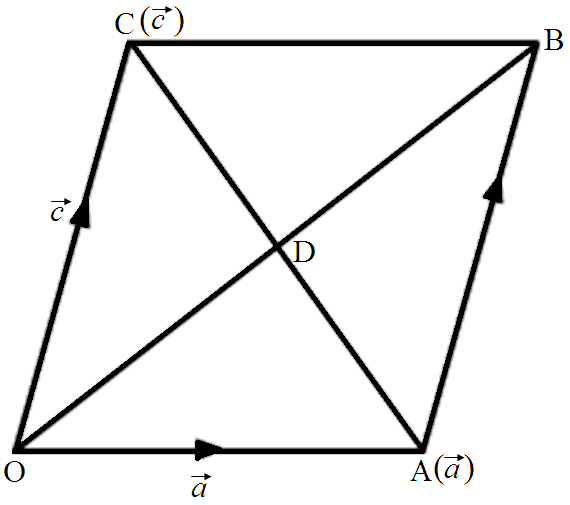 Let OABC be a rhombus, whose diagonals OB and AC intersect at D. suppose O is origin.Let the position vector of A and C be $\vec{\text{a}}$ and $\vec{\text{c}},$ respectively. Then,
$\vec{\text{OA}} = \vec{\text{a}}$ and $\vec{\text{OC}} =\vec { \text{c}}$
In $\triangle \text{OAB,}$
$\vec{\text{OB}} = \vec{\text{OA}} + \vec{\text{AB}} = \vec{\text{OA}} + \vec{\text{OC}} = \vec{\text{a}} + \vec{\text{c}}$ $\big(\vec{\text{AB}} = \vec{\text{OC}}\big)$
Position vector of mid-point of $\vec{\text{OB}} = \frac{1}{2}\big(\vec{\text{a}} + \vec{\text{c}}\big)$
position vector of mid-point of $\vec{\text{AC}} = \frac{1}{2}\big(\vec{\text{a}} + \vec{\text{c}}\big)$ (mid-point formula)
So, the mid-points of OB and AC coincide. Thus, the diagonals OB and AC bisect each other.
Now,
$\vec{\text{OB}}.\vec{\text{AC}} = \big(\vec{\text{a}} + \vec{\text{c}}\big).\big(\vec{\text{c}}-\vec{\text{a}}\big)$
$= \big(\vec{\text{c}} + \vec{\text{a}}\big).\big(\vec{\text{c}} - \vec{\text{a}}\big)$
$= \big|\vec{\text{c}}\big|^{2} - \big|\vec{\text{a}}\big|^{2}$
$= \big|\vec{\text{OC}}\big|^{2} - \big|\vec{\text{OA}}\big|^{2}$
$= 0 $ $\big(\big|\vec{\text{OC}}\big| = \big|\vec{\text{OA}}\big|\big)$
$\Rightarrow \vec{\text{OB}} \perp \vec{\text{AC}}$
Hence, the diagonals OB and AC are perpendicular to each other.
Thus, the diagonals of a rhombus are perpendicular bisectors of each other. View full question & answer→Question 1445 Marks
If $\vec{\text{a}}=\hat{\text{i}}+\hat{\text{j}}+\hat{\text{k}}$ and $=\vec{\text{b}}=\hat{\text{j}}-\hat{\text{k}},$ then find a vector $\vec{\text{c}}$ such that $\vec{\text{a}}\times\vec{\text{c}}=\vec{\text{b}}$ and $\vec{\text{a}}\cdot\vec{\text{c}}=3.$
AnswerLet $\vec{\text{c}}=\text{x}\hat{\text{i}}+\text{y}\hat{\text{j}}+\text{z}\hat{\text{k}}$
Also, $\vec{\text{a}}=\hat{\text{i}}+\hat{\text{j}}+\hat{\text{k}}$ and $=\vec{\text{b}}=\hat{\text{j}}-\hat{\text{k}}$
For $\vec{\text{a}}\times\vec{\text{c}}=\vec{\text{b}},$
$\begin{vmatrix}\hat{\text{i}}&\hat{\text{j}}&\hat{\text{k}} \\1&1&1\\\text{x}&\text{y}&\text{z} \end{vmatrix}=\hat{\text{j}}-\hat{\text{k}}$
$\Rightarrow\hat{\text{i}}(\text{z}-\text{y})-\hat{\text{j}}(\text{z}-\text{z})+\hat{\text{k}}(\text{y}-\text{x})=\hat{\text{j}}-\hat{\text{k}}$
$\therefore\text{z}-\text{y}=0\ ...(\text{i})$
$\text{x}-\text{z}=1\ .....(\text{ii})$
$\text{x}-\text{y}=1\ ....(\text{iii})$
Also, $\vec{\text{a}}\cdot\vec{\text{c}}=3$
$\Rightarrow(\hat{\text{i}}+\hat{\text{j}}+\hat{\text{k}})\cdot(\text{x}\hat{\text{i}}+\text{y}\hat{\text{j}}+\text{z}\hat{\text{k}})=3$
$\Rightarrow\text{x}+\text{y}+\text{z}=3\ .....(\text{iv})$
On solving equations (ii) and (iii), we get
$\Rightarrow2\text{x}-\text{y}-\text{z}=2\ .....(\text{v})$
On solving equations (iv) and (v), we get
$\text{x}=\frac{5}{3}$
$\therefore\text{y}=\frac{5}{3}-1=\frac{2}{3}$ and $\text{z}=\frac{2}{3}$
Now, $\vec{\text{c}}=\frac{5}{3}\hat{\text{i}}+\frac{2}{3}\hat{\text{j}}+\frac{2}{3}\hat{\text{k}}$
$=\frac{1}{3}(5\hat{\text{i}}+2\hat{\text{j}}+2\hat{\text{k}})$
View full question & answer→Question 1455 Marks
If $\vec{\text{a}},\vec{\text{ b}}$ and $\vec{\text{c}}$ determine the vertices of a triangle, show that $\frac{1}{2}[\vec{\text{b}}\times\vec{\text{c}}+\vec{\text{c}}\times\vec{\text{a}}+\vec{\text{a}}\times\vec{\text{b}}]$ gives the vector area of the triangle. Hence, deduce the condition that the three points $\vec{\text{a}},\vec{\text{ b}}$ and $\vec{\text{c}}$ are collinear. Also, find the unit vector normal to the plane of the triangle.
AnswerLet $\vec{\text{a}},\vec{\text{ b}}$ and $\vec{\text{c}}$ be the vertices of a $\triangle\text{ABC}.$
Now, area $\triangle\text{ABC}=\frac{1}{2}|\overrightarrow{\text{AB}}\times\overrightarrow{\text{AC}}|$
Here, $\overrightarrow{\text{AB}}=\vec{\text{b}}-\vec{\text{a}}$ and $\overrightarrow{\text{AC}}=\vec{\text{c}}-\vec{\text{a}}$
$\therefore$ Area of $\triangle\text{ABC}=\frac{1}{2}|\vec{\text{b}}-\vec{\text{a}}\times\vec{\text{c}}-\vec{\text{a}}|$
$=\frac{1}{2}|\vec{\text{b}}\times\vec{\text{c}}-\vec{\text{b}}\times\vec{\text{a}}-\vec{\text{a}}\times\vec{\text{c}}+\vec{\text{a}}\times\vec{\text{a}}|$
$=\frac{1}{2}|\vec{\text{b}}\times\vec{\text{c}}+\vec{\text{a}}\times\vec{\text{b}}+\vec{\text{c}}\times\vec{\text{a}}+\vec{0}|$
$=\frac{1}{2}|\vec{\text{b}}\times\vec{\text{c}}+\vec{\text{a}}\times\vec{\text{b}}+\vec{\text{c}}\times\vec{\text{a}}|\ .....(\text{i})$
For $\vec{\text{a}},\vec{\text{ b}}$ and $\vec{\text{c}}$ to be collinear, area of the $\triangle\text{ABC}$ should be equal to zero.
$\Rightarrow\frac{1}{2}|\vec{\text{b}}\times\vec{\text{c}}+\vec{\text{c}}\times\vec{\text{a}}+\vec{\text{a}}\times\vec{\text{b}}|=0$
$\Rightarrow\vec{\text{b}}\times\vec{\text{c}}+\vec{\text{c}}\times\vec{\text{a}}+\vec{\text{a}}\times\vec{\text{b}}=0\ .....(\text{ii})$
This is the required condition for collinearity of three points $\vec{\text{a}},\vec{\text{ b}}$ and $\vec{\text{c}}$
Let $\hat{\text{n}}$ be the unit vector normal to the plane of the $\triangle\text{ABC}.$
$\hat{\text{n}}=\frac{\overrightarrow{\text{AB}}\times\overrightarrow{\text{AC}}}{|\overrightarrow{\text{AB}}\times\overrightarrow{\text{AC}}|}$
$\hat{\text{n}}=\frac{\vec{\text{a}}\times\vec{\text{b}}+\vec{\text{b}}\times\vec{\text{c}}+\vec{\text{c}}\times\vec{\text{a}}}{|\vec{\text{a}}\times\vec{\text{b}}+\vec{\text{b}}\times\vec{\text{c}}+\vec{\text{c}}\times\vec{\text{a}}|}$
View full question & answer→Question 1465 Marks
Prove by vector method that the sum of the squares of the diagonals of a parallelogram is equal to the sum squares of its sides.
Answer
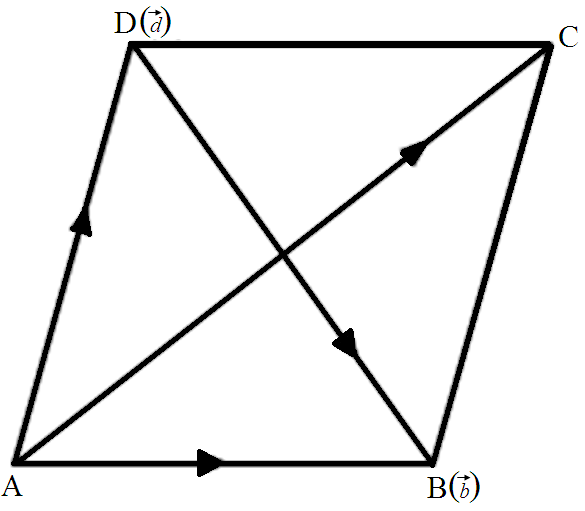 Let ABCD be a parallelogram such that AC and BD are its two diagonals.Taking A as the origin, let the position vectors of B and D be $\vec{\text{b}}$ and $\vec{\text{d}},$ respectively.Then,$\vec{\text{AB}} = \vec{\text{b}}$ and $\vec{\text{AD}} = \vec{\text{d}}$
Using triangle law of vector addition, we have
$\vec{\text{AD}} + \vec{\text{DB}} = \vec{\text{AB}}$
$\Rightarrow \vec{\text{DB}} = \vec{\text{b}} - \vec{\text{d}}$
In $\triangle\text{ ABC,}$
$\vec{\text{AC}} = \vec{\text{AB}} + \vec{\text{BC}} = \vec{\text{AB}} + \vec{\text{AD}} = \vec{\text{b}} + \vec{\text{d}}$
Now,
$\big|\vec{\text{AB}}\big|^{2} + \big|\vec{\text{BC}}\big|^{2}+\big|\vec{\text{CD}}\big|^2+ \big|\vec{\text{DA}}\big|^{2}$
$=\big|\vec{\text{AB}}\big|^{2} + \big|\vec{\text{AD}}\big|^{2} + \big|-\vec{\text{AB}}\big|^{2} + \big|-\vec{\text{AD}}\big|^{2}$
$=2\big|\vec{\text{AB}}\big|^{2} + 2\big|\vec{\text{AD}}\big|^{2}$
$=2\big|\vec{\text{b}}\big|^{2} + 2\big|\vec{\text{d}}\big|^{2}\dots(1)$
Also,
$\big|\vec{\text{DB}}\big|^{2} + \big|\vec{\text{AC}}\big|^{2}$
$=\big|\vec{\text{b}}-\vec{\text{d}}\big|^{2} + \big|\vec{\text{b}} + \vec{\text{d}}\big|^{2}$
$=\big(\vec{\text{b}} - \vec{\text{d}}\big).\big(\vec{\text{b}} - \vec{\text{d}}\big) + \big(\vec{\text{b}} + \vec{\text{d}}\big).\big(\vec{\text{b}} + \vec{\text{d}}\big)$
$=\big|\vec{\text{b}}\big| ^ 2 - 2\vec{\text{b}}.\vec{\text{d}} + \big|\vec{\text{d}}\big|^{2} + \big|\vec{\text{b}}\big|^{2}+2\vec{\text{b}}.\vec{\text{d}} + \big|\vec{\text{d}}\big|^{2}$
$=2\big|\vec{\text{b}}\big|^{2} + 2\big|\vec{\text{d}}\big|^{2}\dots(2)$
From (1) and (2), we have
$\big|\vec{\text{AB}}\big|^{2} + \big|\vec{\text{BC}}\big|^{2} + \big|\vec{\text{CD}}\big|^{2} + \big|\vec{\text{DA}}\big|^{2}=\big|\vec{\text{DB}}\big|^{2} = \big|\vec{\text{AC}}\big|^{2}$ View full question & answer→Question 1475 Marks
The adjacent sides of a parallelogram are represented by the vectors $\vec{\text{a}}=\hat{\text{i}}+\hat{\text{j}}-\hat{\text{k}}$ and $\vec{\text{b}}=-2\hat{\text{i}}+\hat{\text{j}}+2\hat{\text{k}}$. Find the unit vectors parallel to the diagonals of the parallelogram.
AnswerLet PQRS be a parallelogram such that $\text{PQ}=\vec{\text{a}}=\hat{\text{i}}+\hat{\text{j}}-\hat{\text{k}}$and $\text{QR}=\vec{\text{b}}=-2\hat{\text{i}}+\hat{\text{j}}+2\hat{\text{k}}$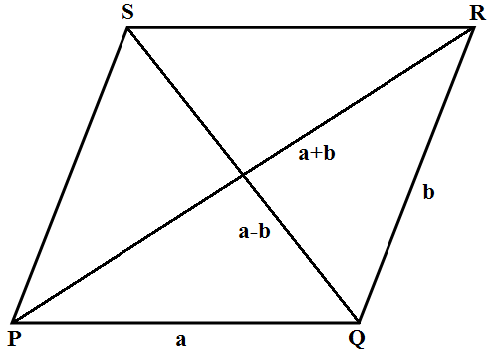
In $\triangle\text{PQR}$ $\overrightarrow{\text{PQ}}+\overrightarrow{\text{QR}}=\overrightarrow{\text{PR}}$ $\overrightarrow{\text{PR}}=\vec{\text{a}}+\vec{\text{b}}=\hat{\text{i}}+\hat{\text{j}}-\hat{\text{k}}+\big(-2\hat{\text{i}}+\hat{\text{j}}+2\hat{\text{k}}\big)$ $\overrightarrow{\text{PR}}=-\hat{\text{i}}+2\hat{\text{j}}+\hat{\text{k}}$ In $\triangle{\text{PQS}}$ $\overrightarrow{\text{PS}}+\overrightarrow{\text{SQ}}=\overrightarrow{\text{PQ}}$ $\overrightarrow{\text{SQ}}=\vec{\text{a}}-\vec{\text{b}}=\hat{\text{i}}+\hat{\text{j}}-\hat{\text{k}}-\big(-2\hat{\text{i}}+\hat{\text{j}}+2\hat{\text{k}}\big)$ $\overrightarrow{\text{SQ}}=3\hat{\text{i}}+0\hat{\text{j}}-3\hat{\text{k}}$ The unit vector along $\overrightarrow{\text{PR}}=\frac{\overrightarrow{\text{PR}}}{\big|\overrightarrow{\text{PR}}\big|}=\frac{-\hat{\text{i}}+2\hat{\text{j}}+\hat{\text{k}}}{\sqrt{1+4+1}}$ $=\frac{1}{\sqrt6}\big(-\hat{\text{i}}+2\hat{\text{j}}+\hat{\text{k}}\big)$ The unit vector along $\overrightarrow{\text{SQ}}=\frac{\overrightarrow{\text{SQ}}}{\big|\overrightarrow{\text{SQ}}\big|}=\frac{3\hat{\text{i}}+0\hat{\text{j}}-3\hat{\text{k}}}{\sqrt{9+0+9}}$ $=\frac{1}{\sqrt2}\big(\hat{\text{i}}-\hat{\text{k}}\big)$ View full question & answer→Question 1485 Marks
If $\vec{\text{a}},\vec{\text{b}},\vec{\text{c}}$ are non-zero, non-coplanar vectors, prove that the vector is coplanar:
$5\vec{\text{a}}+6\vec{\text{b}}+7\vec{\text{c}},\ 7\vec{\text{a}}-8\vec{\text{b}}+9\vec{\text{c}}$ and $3\vec{\text{a}}+20\vec{\text{b}}+5\vec{\text{c}}$
AnswerWe know that, Three vectors are coplanar if one of the vector can be expressed as the linear combination of other two. Let, $5\vec{\text{a}}+6\vec{\text{b}}+7\vec{\text{c}}\\=\text{x}\big(7\vec{\text{a}}-8\vec{\text{b}}+9\vec{\text{c}}\big)+\text{y}\big(3\vec{\text{a}}+20\vec{\text{b}}+5\vec{\text{c}}\big)$ $5\vec{\text{a}}+6\vec{\text{b}}+7\vec{\text{c}}\\=7\vec{\text{a}}\text{x}-8\vec{\text{b}}\text{x}+9\vec{\text{c}}\text{x}+3\vec{\text{a}}\text{y}+20\vec{\text{b}}\text{y}+5\vec{\text{c}}\text{y}$ $5\vec{\text{a}}+6\vec{\text{b}}+7\vec{\text{c}}\\=\big(7\text{x}+3\text{y}\big)\vec{\text{a}}+\big(-8\text{x}+20\text{y}\big)\vec{\text{b}}+\big(9\text{x}+5\text{y}\big)\vec{\text{c}}$ Comparing the LHS and RHS, 7x + 3y = 5 .....(i) -8x + 20y = 6 .....(ii) 9x + 5y = 7 .....(iii) For solving (i) and (ii), Subtract -8 × (i) from 7 × (ii),
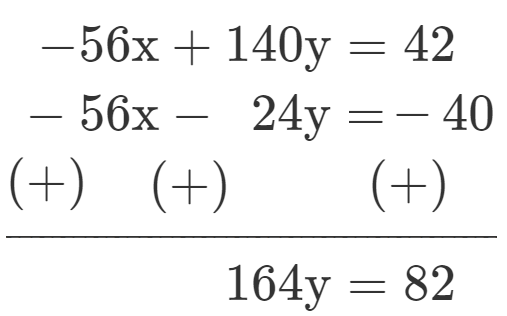
$\text{y}=\frac{82}{164}$ $\text{y}=\frac{1}2$ Put $\text{y}=\frac{1}2$ in equation (i), $7\text{x}+3\text{y}=5$ $7\text{x}+3\Big(\frac{1}2\Big)=5$ $7\text{x}+\frac{3}2=5$ $7\text{x}=\frac{5}1-\frac{3}2$ $7\text{x}=\frac{10-3}2$ $7\text{x}=\frac{7}2$ $\text{x}=\frac{7}{14}$ $\text{x}=\frac{1}{2}$ Now, put $\text{x}=\frac{1}{2}$ and $\text{y}=\frac{1}2$ in equation (iii), $9\text{x}+5\text{y}=7$ $9\Big(\frac{1}2\Big)+5\Big(\frac{1}2\Big)=7$ $\frac{9}2+\frac{5}2=7$ $\frac{14}2=7$ $7=7$LHS = RHS
$\therefore$ The value of x, y satisfy equation (iii).
So, $5\vec{\text{a}}+6\vec{\text{b}}+7\vec{\text{c}},\ 7\vec{\text{a}}-8\vec{\text{b}}+9\vec{\text{c}},\ 3\vec{\text{a}}+20\vec{\text{b}}+5\vec{\text{c}}$ are coplanar. View full question & answer→Question 1495 Marks
Find the values of x and y if the vectors $\vec{\text{a}}=3\hat{\text{i}}+\text{x}\hat{\text{j}}-\hat{\text{k}}$ and $\vec{\text{b}}=2\hat{\text{i}}+\hat{\text{j}}+\text{y}\hat{\text{k}}$ are mutually perpendicular vectors of equal magnitude.
AnswerWe have
$\vec{\text{a}}=3\hat{\text{i}}+\text{x}\hat{\text{j}}-\hat{\text{k}}$ and $\vec{\text{b}}=2\hat{\text{i}}+\hat{\text{j}}+\text{y}\hat{\text{k}}$
It is given that the vectors are perpendicular.
$\Rightarrow\vec{\text{a}}.\vec{\text{b}}=0$
$\Rightarrow6+\text{x}-\text{y}=0$
$\Rightarrow\text{x}-\text{y}=-6\dots(1)$
Also, it is given that
$|\vec{\text{a}}|=\big|\vec{\text{b}}\big|$
$\Rightarrow\sqrt{9+\text{x}^2+1}=\sqrt{4+1+\text{y}^2}$
$\Rightarrow\sqrt{10+\text{x}^2}=\sqrt{5+\text{y}^2}$
$\Rightarrow10+\text{x}^2=5+\text{y}^2$
$\Rightarrow\text{x}^2-\text{y}^2=-5$
View full question & answer→Question 1505 Marks
If the vectors $\big(\sec^2\text{A}\big)\hat{\text{i}}+\hat{\text{j}}+\hat{\text{k}},\hat{\text{i}}+\big(\sec^2\text{B}\big)+\hat{\text{k}},\hat{\text{i}}+\hat{\text{j}}+\big(\sec^2\text{C}\big)\hat{\text{k}}$ are coplanar, then find the value of $\text{cosec}^2\text{A}+\text{cosec}^2\text{B}+\text{cosec}^2\text{C}.$
AnswerLet: $\vec{\text{a}}=\big(\sec^2\text{A}\big)\hat{\text{i}}+\hat{\text{j}},\vec{\text{b}}=\hat{\text{i}}+(\sec^2\text{B})\hat{\text{j}}+\hat{\text{k}}$ and $\vec{\text{c}}=\hat{\text{i}}+\hat{\text{j}}+(\sec^2\text{C})\hat{\text{k}}$
We know that three vectors are coplanar if their scaler triple product is zero i.e., $\big[\vec{\text{a}}\vec{\text{b}}\vec{\text{c}}\big]=0$
Here, $\big[\vec{\text{a}}\vec{\text{b}}\vec{\text{c}}\big]=0$
$\begin{vmatrix}\sec^2\text{A}&1&1\\1&\sec^2\text{B}&1\\1&1&\sec^2\text{C} \end{vmatrix}=0$
$\Rightarrow\sec^2\text{A}\big[\big(\sec^2\text{B}\times\sec^2\text{C}\big)\\-1\big]-1\big(\sec^2\text{C}-1\big)+1\big(1-\sec^2\text{B}\big)=0$
$\Rightarrow\sec^2\text{A}\sec^2\text{B}\sec^2\text{C}-\sec^2\text{A}-\sec^2\text{C}+1+1-\sec^2\text{B}=0$
$\Rightarrow\big(1+\tan^2\text{A}\big)\big(1+\tan^2\text{B}\big)\big(1+\tan^2\text{C}\big)\\-\big(1+\tan^2\text{A}\big)-\big(1+\tan^2\text{C}\big)+1=1-\big(1+\tan^2\text{B}\big)=0$
$\Rightarrow1+\tan^2\text{A}+\tan^2\text{B}+\tan^2\text{C}+\tan^2\text{A}\tan^2\text{B}\\+\tan^\text{B}\tan^2\text{C}+\tan^2\text{C}\tan^2\text{A}+\tan^2\text{A}\tan^2\text{B}\tan^\text{C}1\\-\tan^2\text{A}-1-\tan^2\text{C}$
$\tan^2\text{A}\tan^2\text{B}+\tan^2\text{B}\tan^2\text{C}+\tan^2\text{C}\tan^2\text{A}\\+\tan^2\text{A}\tan^2\text{B}\tan^2\text{C}=0$
$\Rightarrow\tan^2\text{A}\tan^2\text{B}+\tan^2\text{B}\tan^2\text{C}+\tan^2\text{C}\tan^2\text{A}\\=-\tan^2\text{A}\tan^2\text{B}\tan^2\text{C}$
$\Rightarrow\frac{\tan^2\text{A}\tan^2\text{B}\tan^2\text{C}+\tan^2\text{C}\tan^2\text{A}}{\tan^2\text{A}\tan^2\text{B}\tan^2\text{C}}=-1$
$\Rightarrow\cot^2\text{C}+\cot^2\text{A}+\cot^2\text{B}=-1$
$\Rightarrow\text{cosec}^2\text{C}-1+\text{cosec}^2\text{A}-1+\text{cosec}^2\text{B}-1=-1$
$\therefore\text{cosec}^2\text{A}+\text{cosec}^2\text{B}+\text{cosec}^2\text{C}=2$
View full question & answer→