- AOnly $R$
- BOnly $C$
- C$R$ and $C$
- ✓Only $L$
Current and voltage are in same phase in resistor whereas current leads the voltage by $\frac{\pi}{2}$in a capacitor.
So, the circuit must contain an inductor only.
In pure inductive circuit,
voltage leads by $\frac{\pi}{2}$
The inductive reactance $\text{Xl}=\omega\text{L}$
Hence, $\text{X}_1\propto\omega$
As frequency increases $\rightarrow\omega$
Therefore, inductive reactance increases with frequency.

Key concept: It decreases voltage and increases current
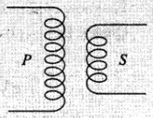
$V _{ S } < V _{ p }$
$N _{ S } > N _{ p }$
$E _{ S } < E _{ p }$
$i _{ S } > i _{ P }$
$R _{ S } < R _{ p }$
$t _{ S } > t _{ p }$
$k < l$

According to the problem output/secondary voltage $V _{ S }=24 V$
Power associated with secondary $P_S=12 W$
$\text{I}_\text{S}=\frac{\text{P}_\text{S}}{\text{V}_\text{S}}=\frac{12}{24}=0.5\text{A}$
Amplitude of the current in the secondary winding
$\text{I}_0=\text{I}_\text{S}\sqrt{2}$
$=(0.5)(1.414)=0.707=\frac{1}{\sqrt{2}}\text{A}$

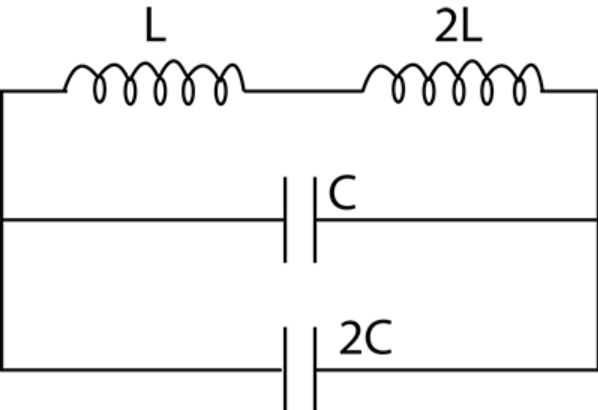
Equivalent inductance Leq $= L + 2L = 3L$
Ceq $= C + 2C = 3C$
$\therefore$ Frequency of oscillation $\text{f}=\frac{1}{2\pi\sqrt{\text{L}_\text{eq}\text{C}_\text{eq}}}=\frac{1}{6\pi\sqrt{\text{LC}}}$
Total impedance $= R + j \left( X _{ L }- X _{ C }\right)$
$=100+\text{j}100$
$=100\sqrt{2}\measuredangle45$
$=141\measuredangle45$
$\text{I}=\frac{\text{V}}{\text{Z}}=\frac{\text{V}}{\sqrt{\text{R}^2\Big(\omega\text{L }\sim}\frac{1}{\omega\text{C}}\Big)^2}$
By increasing $R$, current will definitely decrease by change in $L$ or $C$, current may increase or decrease.
$\text{i}=\frac{\text{V}_\text{rms}}{\sqrt{\text{R}^2+\Big(\frac{1}{\omega\text{C}}-\omega\text{L}\Big)^2}}$
$\Rightarrow\text{i}=\frac{200\sqrt{2}\frac{1}{\sqrt{2}}}{\sqrt{10000^2+\Big(\frac{1}{100\times10^{-6}}-100\times0\Big)^2}}=\frac{200}{\sqrt{2\times10000^2}}$
$10\sqrt{\text{2}}\text{mA}$
Answer: $A$ an inductor and a capacitor, $B$ neither an inductor nor a capacitor
Reactance in electrical and electronic systems is the opposition of a circuit element to a change of electric current or voltage.Ideally a resistor has zero reactance.
Therefore in a circuit, reactance can be zero either if there are no inductors and capacitors in the circuit, or the individual reactance of inductors and capacitors cancel each other, making net reactance zero.
Capacitive reactance is given as $\text{X}_\text{C}=\frac{1}{\omega\text{C}}$
From this relation we can see that the value of capacitive reactance and therefore its overall impedance $($in Ohms$)$ decreases to zero as the frequency increases acting like a short
circuit. Likewise, as the frequency approaches zero or $DC$, the capacitors reactance increases to infinity, acting like an open circuit which is why capacitors block $DC.$
$\text{X}_\text{C}=\frac{1}{\text{C}\omega}=10000\Omega$
ammeater reading $=\text{I}_\text{rms}=\frac{\text{V}_\text{rms}}{\mid\text{jX}_\text{c}\mid}=\frac{50}{10000}=5\text{mA}$
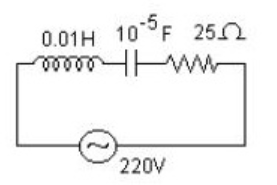
Wattless current $=\text{I}_\text{max}\sin(\tan^{-1}[\frac{\text{L}\omega}{\text{R}}])=\frac{220}{\sqrt{\text{R}^2+\text{L}^2\omega^2}}\sin(\tan^{-1}[\frac{\text{L}\omega}{\text{R}})=0.5\text{A}$
Capacitive reactance in an $A.C$ circuit is: $\text{X}_\text{C}=\frac{1}{\omega\text{C}}\text{ohm}$
where, $C$ is the capacitance of capacitor and $\omega=2\pi\text{rn} (n$ is the frequency of $A.C$ source$)$
In a series $\text{LCR}$ circuit, the voltage across the inductor $(L)$ and the capacitor $(C)$ are in opposite phase.
So the voltage across $\text{LC}$ combination will be $(50 - 50) = 0V$
$\text{f}=\frac{1}{2\pi\sqrt{(\text{LC})}}$
when $C$ is doubled, $L$ should be halved so that resonant frequency remains unchanged.