Question types

Dual Nature of Radiation and Matter question types

509 questions across 7 question groups — pick any mix to generate a Physics paper with step-by-step answer keys.

509
Questions
7
Question groups
5
Question types
Sample Questions

Dual Nature of Radiation and Matter questions

One sample from each question group in this chapter. Select any group above to see the full set with answer keys.

When the electron in a $H-$atom jumps from 6th excited state to $2^{nd}$ excited state, the maximum number of emission lines will be.
  • A
    $20$
  • $18$
  • C
    $10$
  • D
    $5$

Answer: B.

View full solution
A proton, a neutron, an electron and an particle have same energy. Then their de Broglie wavelengths compare as:
  • A
    $\lambda_\text{p}=\lambda_\text{n}>\lambda_\text{e}>\lambda_{\alpha}$
  • $\lambda_{\alpha}<\lambda_\text{p}=\lambda_\text{n}>\lambda_\text{e}$
  • C
    $\lambda_\text{e}<\lambda_\text{p}=\lambda_\text{n}>\lambda_{\alpha}$
  • D
    $\lambda_\text{e}=\lambda_\text{p}=\lambda_\text{n}=\lambda_{\alpha}.$

Answer: B.

View full solution
In photoelectric effect, electrons are ejected from metals,if the incident light has a certain minimum?
  • A
    Wavelength.
  • Frequency.
  • C
    Amplitude.
  • D
    Angle of incidence.

Answer: B.

View full solution
For the same speed, de Broglie wavelength.
  • A
    Of electron is larger than proton
  • B
    Of proton is larger than $\alpha−$particle
  • C
    Of electron is larger than $\alpha−$particle
  • All of the above

Answer: D.

View full solution
The collector plate in an experiment on photoelectric effect is kept vertically above the emitter plate. Light source is put on and a saturation photocurrent is recorded. An electric field is switched on which has a vertically downward direction.
  • A
    The photocurrent will increase.
  • The kinetic energy of the electrons will increase.
  • C
    The stopping potential will decrease.
  • D
    The threshold wavelength will increase.

Answer: B.

View full solution
For question two statements are given-one labelled Assertion (A) and the other labelled Reason (R). Select the correct answer to these questions front the codes (a), (b), (c) and (d) as given below.
  1. Both A and R are true and R is the correct explanation of A.
  2. Both A and R are true but R is NOT the correct explanation of A.
  3. A is true but R is false.
  4. A is false and R is also false.
Assertion (A): The de-Broglie wavelength of a neutron when its kinetic energy is K is $\lambda$. Its wavelength is $2\lambda$, when its kinetic energy is 4K.
Reason (R): The de-Broglie wavelength $\lambda$ is directly proportional to square root of the kinetic energy.
View full solution
For question two statements are given-one labelled Assertion (A) and the other labelled Reason (R). Select the correct answer to these questions front the codes (a), (b), (c) and (d) as given below.
  1. Both A and R are true and R is the correct explanation of A.
  2. Both A and R are true but R is NOT the correct explanation of A.
  3. A is true but R is false.
  4. A is false and R is also false.
Assertion (A): There is a physical significance of matter waves.
Reason (R): Both interference and diffraction occurs in it.
View full solution
For question two statements are given-one labelled Assertion (A) and the other labelled Reason (R). Select the correct answer to these questions front the codes (a), (b), (c) and (d) as given below.
  1. Both A and R are true and R is the correct explanation of A.
  2. Both A and R are true but R is NOT the correct explanation of A.
  3. A is true but R is false.
  4. A is false and R is also false.
Assertion (A): Some photographic plates are not affected by red light but are immediately blackened by white light.
Reason (R): The wavelength of red light is less than the wavelength of many components of white light.
View full solution
For question two statements are given-one labelled Assertion (A) and the other labelled Reason (R). Select the correct answer to these questions front the codes (a), (b), (c) and (d) as given below.
  1. Both A and R are true and R is the correct explanation of A.
  2. Both A and R are true but R is NOT the correct explanation of A.
  3. A is true but R is false.
  4. A is false and R is also false.
Assertion (A): The threshold frequency of photoelectric effect supports the particle nature of light.
Reason (R): If frequency of incident light is less than the threshold frequency, electrons are not emitted from metal surface.
View full solution
For question two statements are given-one labelled Assertion $(A)$ and the other labelled Reason $(R).$ Select the correct answer to these questions front the codes $(a), (b), (c)$ and $(d)$ as given below.
Assertion $(A):$ Mass of moving photon varies inversely to the wavelength.
Reason $(R):$ Energy of the particle $=$ Mass $\times ($Speed of light$)^2$
  • A
    Both $A$ and $R$ are true and $R$ is the correct explanation of $A.$
  • Both $A$ and $R$ are true but $R$ is not the correct explanation of $A.$
  • C
    $A$ is true but $R$ is false.
  • D
    $A$ is false and $R$ is also false.

Answer: B.

View full solution
A sphere of radius 1.00 cm is placed in the path of a parallel beam of light of large aperture. The intensity of the light is $0.5 \mathrm{~W} / \mathrm{cm}^{-2}$. If the sphere completely absorbs the radiation falling on it, find the force exerted by the light beam on the sphere.
View full solution
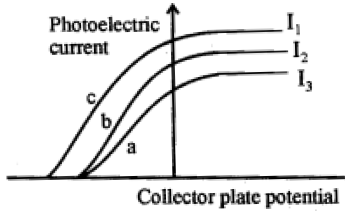
The figure shows a plot of three curves a, b, c showing the variation of photocurrent vs collector plate potential for three different intensities $\mathrm{I}_1, \mathrm{I}_2$ and $\mathrm{I}_3$ having frequencies $\sqrt{1}, \sqrt{2}$ and $\sqrt{3}$, respectively incident on a photosensitive surface.
Point out the two curves for which the incident radiations have same frequency but different intensities.
View full solution
Answer the following question:
The energy and momentum of an electron are related to the frequency and wavelength of the associated matter wave by the relations:
$\text{E}=\text{h v, p}=\frac{\text{h}}{\lambda}$
But while the value of λ is physically significant, the value of ν (and therefore, the value of the phase speed ν λ) has no physical significance. Why?
View full solution
Answer the following question:
Every metal has a definite work function. Why do all photoelectrons not come out with the same energy if incident radiation is monochromatic? Why is there an energy distribution of photoelectrons?
View full solution
Q 213 Marks Question3 Marks
Light of frequency $7.21 \times 10^{14} Hz$ is incident on a metal surface. Electrons with a maximum speed of $6.0 \times 10^5 m/s$ are ejected from the surface. What is the threshold frequency for photoemission of electrons?
View full solution
Q 223 Marks Question3 Marks
Compute the typical de Broglie wavelength of an electron in a metal at 27ºC and compare it with the mean separation between two electrons in a metal which is given to be about $2 \times 10^{–10} m.$
View full solution
Q 233 Marks Question3 Marks
An electron microscope uses electrons accelerated by a voltage of 50 kV. Determine the de Broglie wavelength associated with the electrons. If other factors (such as numerical aperture, etc.) are taken to be roughly the same, how does the resolving power of an electron microscope compare with that of an optical microscope which uses yellow light?
View full solution
Q 243 Marks Question3 Marks
Light of wavelength 488 nm is produced by an argon laser which is used in the photoelectric effect. When light from this spectral line is incident on the emitter, the stopping (cut-off) potential of photoelectrons is 0.38 V. Find the work function of the material from which the emitter is made.
View full solution
Q 253 Marks Question3 Marks
An electron and a photon each have a wavelength of 1.00 nm. Find:
  1. Their momenta,
  2. The energy of the photon, and
  3. The kinetic energy of electron.
View full solution
  1. For what kinetic energy of a neutron will the associated de Broglie wavelength be $1.40 \times 10^{–10} m?$
  2. Also find the de Broglie wavelength of a neutron, in thermal equilibrium with matter, having an average kinetic energy of (3/2) kT at 300 K.
View full solution
Crystal diffraction experiments can be performed using X-rays, or electrons accelerated through appropriate voltage. Which probe has greater energy? (For quantitative comparison, take the wavelength of the probe equal to 1 Å, which is of the order of inter-atomic spacing in the lattice) $(m^e = 9.11 \times 10^{–31} kg).$
View full solution
The work function of caesium metal is 2.14 eV. When light of frequency $6 \times 10^{14}$Hz is incident on the metal surface, photoemission of electrons occurs. What is the
  1. Maximum kinetic energy of the emitted electrons,
  2. Stopping potential, and
  3. Maximum speed of the emitted photoelectrons?
View full solution
There are materials which absorb photons of shorter wavelength and emit photons of longer wavelength. Can there be stable substances which absorb photons of larger wavelength and emit light of shorter wavelength.
View full solution
A silver ball of radius 4.8cm is suspended by a thread in a vacuum chamber. Ultraviolet light of wavelength 200 run is incident on the ball for some time during which a total light energy of $1.0 \times 10^{-7}J$ falls on the surface. Assuming that on the average one photon out of every ten thousand is able to eject a photoelectron, find the electric potential et the surface of the bell assuming zero potential at infinity. What is the potential at the centre of the bell?
View full solution
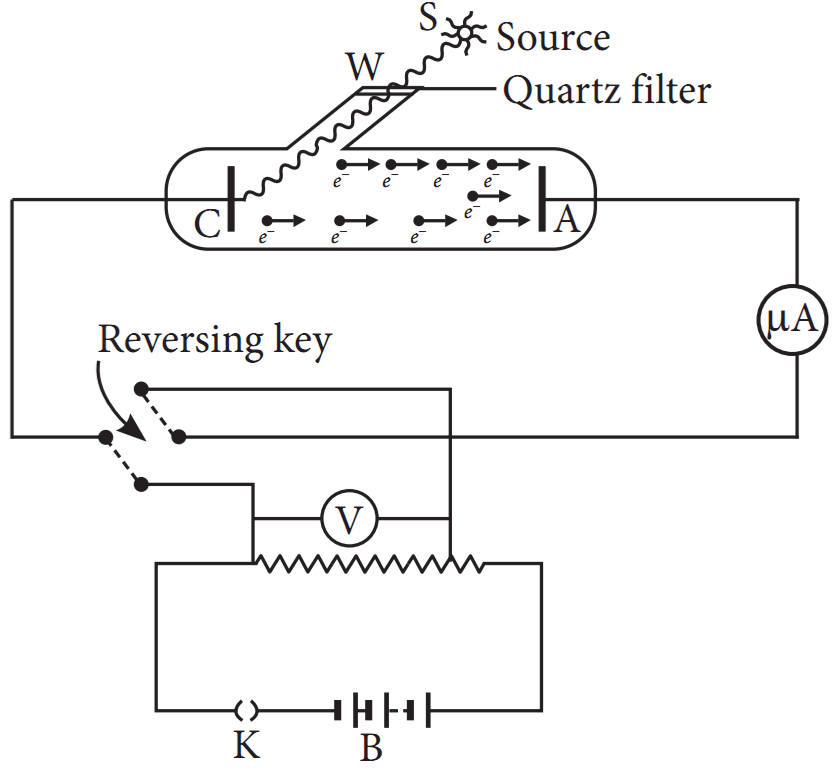
When a monochromatic radiations of suitable frequency obtained from source S, after being filtered by a filter attached on the window W, fall on the photosensitive place C, the photo electrons are emitted from C, which get accelerated towards the plate A if it is kept at positive potential. These electrons flow in the outer circuit resulting in photoelectric current. Due to it, the microammeter shows a deflection. The reading of micrommeter measures the photoelectric current.

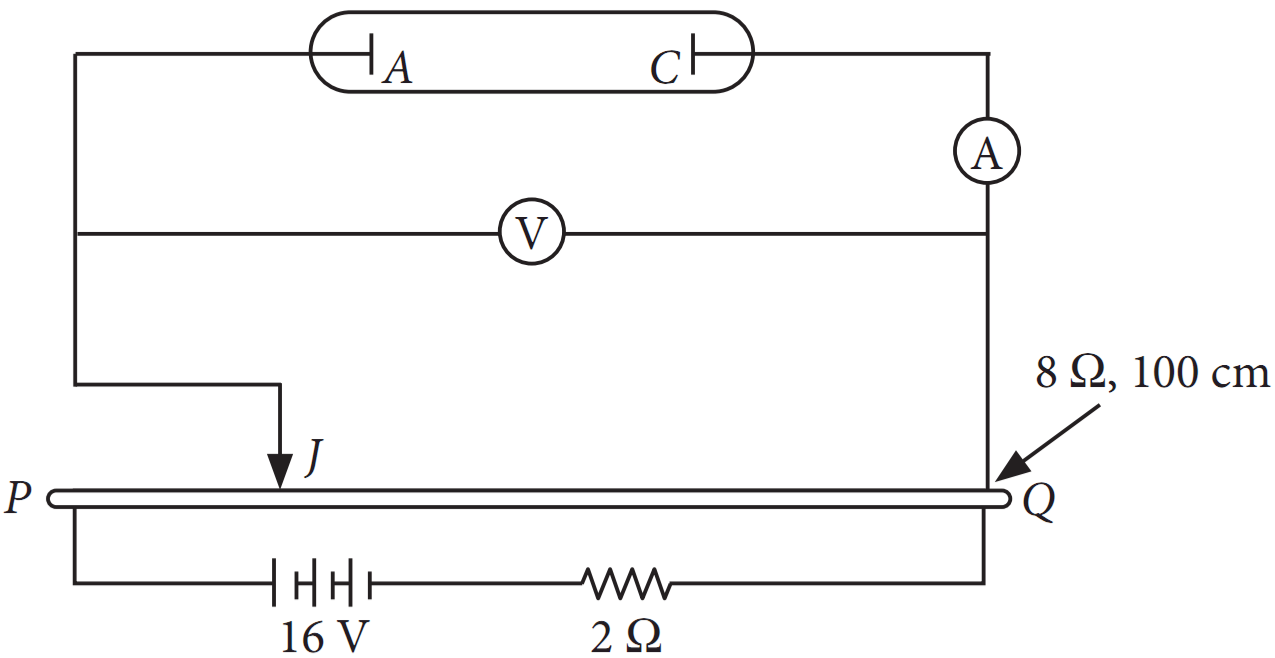
An experimental setup of verification of photoelectric effect is shown in figure. The voltage across the electrodes is measured with the help ofan ideal voltmeter, and which can be varied by moving jockey Jon the potentiometer wire. The battery used in potentiometer circuit is of 16 V and its internal resistance is $2\Omega$. The resistance of 100cm long potentiometer wire is $8\Omega$.

The photocurrent is measured with the help of an ideal ammeter. Two plates of potassium oxide of area $50cm^2$ at separation 0.5mm are used in the vacuum tube. Photocurrent in the circuit is very small, so we can treat the potentiometer circuit as an independent circuit.
Light
1 Violet
2 Blue
3 Green
4 Yellow
5 Orange
6 Red
$\lambda(\text{in } \mathring{\text{A}})$
4000-500
4500-5000
5000-5500
5500-6000
6000-6500
6500-7000
  1. When radiation falls on the cathode plate, a current of $2\mu\text{A}$ is recorded in the ammeter. Assuming that the vacuum tube setup follows Ohm's law, the equivalent resistance of vacuum tube operating in the case when jockey is at end P is:
  1. $8\times10^8\Omega$
  2. $16\times10^6\Omega$
  3. $8\times10^6\Omega$
  4. $10\times10^6\Omega$
  1. It is found that ammeter current remains unchanged $(2\mu\text{A})$ even when the jockey is moved from the end P to the middle point of the potentiometer wire. Assuming that all the incident photons eject electrons and the power of the light incident is $4\times10^{-6}\Omega$. Then, the color of the incident light is:
  1. Green
  2. Violet
  3. Red
  4. Orange
  1. Which of the following colors may not give photoelectric effect for this cathode?
  1. Green
  2. Violet
  3. Red
  4. Orange
  1. When other light falls on the anode plate, the anuneter reading zero till jockey is moved from the end P to the middle point of the wire PQ. Therefore, the deflection is recorded in the anuneter. The maximum kinetic energy of the emitted electron is:
  1. 16eV
  2. 8eV
  3. 4eV
  4. 10eV
  1. If the intensity of incident radiation is increased twice, the number of photoelectrons emitted per second will be:
  1. Halves
  2. Double
  3. Remain same
  4. Four times
View full solution

Generate a Dual Nature of Radiation and Matter paper free

Pick question groups from the list above, set marks and difficulty, and export a branded PDF with step-by-step answer keys. First 3 chapters free — no signup.

Download App