Questions · Page 2 of 2

5 Marks Questions

Question 515 Marks
In 1959 Lyttleton and Bondi suggested that the expansion of the Universe could be explained if matter carried a net charge. Suppose that the Universe is made up of hydrogen atoms with a number density N, which is maintained a constant. Let the charge on the proton be: $e_p = -(1 + y)e$ where e is the electronic charge.
Find the critical value of y such that expansion may start.
Answer
Let the Universe have a radius R. Assume that the hydrogen atoms are uniformly distributed. The Expansion starts if the Coulumb repulsion on a hydrogen atom, at R, is larger than the gravitational attraction.
The hydrogen atom contains one proton and one electron, charge on each hydrogen atom.
$e_H = e_P + e = -(1 + y)e + e = -ye = |ye|$
Let E be elecrtric field intensity at distance R, on the surface of the sphere, the according to Gauss' theorem,
$\oint\overrightarrow{\text{E}}.\text{d}\overrightarrow{\text{S}}=\frac{\text{q}_\text{enclosed}}{\in_0}$
$\Rightarrow\ \text{E}(4\pi\text{R}^2)=\frac{4}{3}\frac{\pi\text{R}^3\text{N}|\text{ye}|}{\in_0}$
$\Rightarrow\ \text{E}=\frac{1}{3}\frac{\text{N}|\text{ye}|\text{R}}{\in_0}\ .....(\text{i})$
Let us suppose the mass of each nydrogen atom $= m_p =$ Mass of a proton and $G_R =$ gravitational rield at distance R on the sphere.
Then $-4\pi\text{R}^2\text{G}_\text{R}=4\pi\text{Gm}_\text{p}\Big(\frac{4}{3}\pi\text{R}^3\Big)\text{N}$
$\Rightarrow\ \text{G}_\text{R}=\frac{-4}{3}\pi\text{Gm}_\text{p}\text{NR}\ .....(\text{ii})$
$\therefore$ Gravitational force on this atom is
$\text{F}_\text{G}=\text{m}_\text{p}\times\text{G}_\text{p}=\frac{-4\pi}{3}\text{Gm}_\text{p}^2\text{NR}\ .....(\text{iii})$
Coulomb force on hydrogen atom at R is
$\text{F}_\text{C}=(\text{ye})\text{E}=\frac{1}{3}\frac{\text{Ny}^2\text{e}^2\text{R}}{\in_0}\ \ [\text{from Eq. (i)}]$
Now, to start expansion $F_C > F_G$ and aritical value of y to start expansion wolud be when,
$F_C = F_G$​​​​​​​
$\Rightarrow\ \frac{1}{3}\frac{\text{Ny}^2\text{e}^2\text{R}}{\in_0}=\frac{4\pi}{3}\text{Gm}_\text{p}^2\text{NR}$
$\Rightarrow\ \text{y}^2=(4\pi\in_0)\text{G}\Big(\frac{\text{m}_\text{p}}{\text{e}}\Big)^2$
$=\frac{1}{9\times10^9}\times(6.67\times10^{-11})$
$=\frac{1}{9\times10^9}\times(6.67\times10^{-11})\Big(\frac{(1.66\times10^{-27})^2}{(1.6\times10^{-19})^2}\Big)$
$\Rightarrow\ \text{y}=\sqrt{79.8\times10^{-38}}=8.9\times10^{-19}\simeq10^{-18}$
Hence $10^{-18}$ is the required critical value of y corresponding to which expansion of universe would start.
View full question & answer
Question 525 Marks
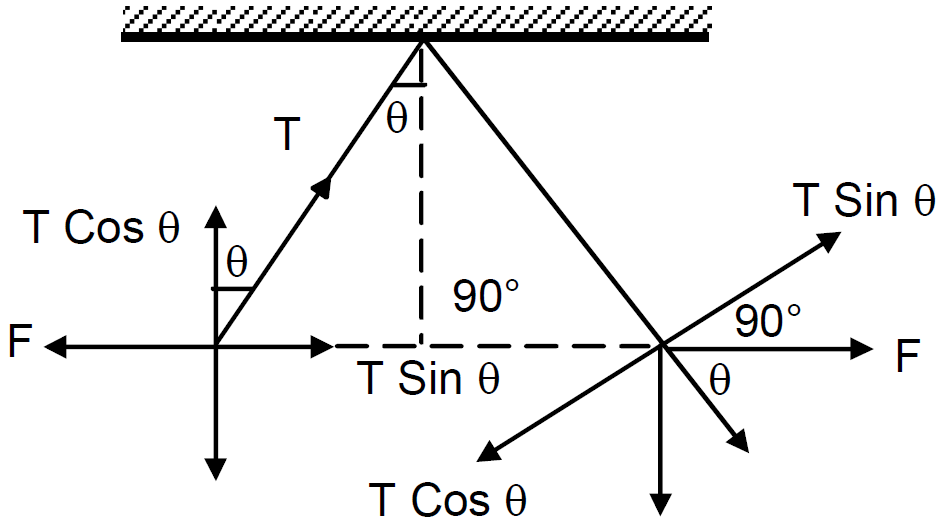
Two identical balls, each having a charge of $2.00 \times 10^{-7}C$ and a mass of 100g, are suspended from a common point by two insulating strings each 50cm long. The balls are held at a separation 5.0cm apart and then released. Find,
  1. The electric force on one of the charged balls.
  2. The components of the resultant force on it along and perpendicular to the string.
  3. The tension in the string.
  4. The acceleration of one of the balls. Answers are to be obtained only for the instant just after the release.
Answer


$\text{q}_1=\text{q}_2=2\times10^{-7}\text{c},\ \text{m}=100\text{g}$
$\text{l}=50\text{cm}=5\times10^{-2}\text{m},\ \text{d}=5\times10^{-2}\text{m}$
  1. Now Electric force
$\text{F}=\text{K}\frac{\text{q}^2}{\text{r}^2}$
$=\frac{9\times10^9\times4\times10^{-14}}{25\times10^{-4}}\text{N}$
$=14.4\times10^{-2}\text{N}$
$=0.144\text{N}$
  1. The components of Resultant force along it is zero, because mg balances $\text{T}\cos\theta$ and so also.
$\text{F}=\text{mg}=\text{T}\sin\theta$
  1. Tension on the string
$\text{T}\sin\theta=\text{F},\ \text{T}\cos\theta=\text{mg}$
$\text{Tan}\theta=\frac{\text{F}}{\text{mg}}$
$=\frac{0.144}{100\times10^{-3}\times9.8}$
$=0.14693$
  1. But $\text{T}\cos\theta=10^2\times10^{-3}\times10=1\text{N}$
$\Rightarrow\text{T}=\frac{1}{\cos\theta}=\sec\theta$
$\Rightarrow\text{T}=\frac{\text{F}}{\sin\theta},$
$\sin\theta=0.145369$
$\cos\theta=0.989378$
View full question & answer
Question 535 Marks
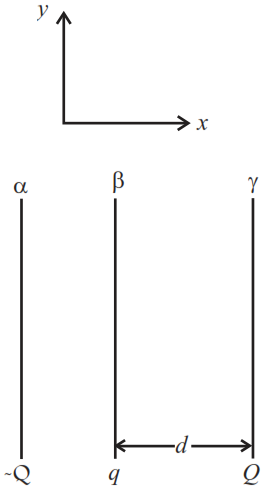
Two fixed, identical conducting plates $(\alpha\ \&\ \beta)$, each of surface area S are charged to -Q and q, respectively, where Q > q > 0. A third identical plate $(\gamma)$, free to move is located on the other side of the plate with charge q at a distance d (Fig.). The third plate is released and collides with the plate $\beta$. Assume the collision is elastic and the time of collision is sufficient to redistribute charge amongst $\beta\ \&\ \gamma$.

Find the electric field acting on the plate $\gamma$ before collision.
Answer
Net electric field at plate $\gamma$ before collision is vector sum of electric field at plate $\gamma$ due to plate $\alpha$ and $\beta$.
The electric field at plate $\gamma$ due to plate $\alpha$ is $\vec{\text{E}_1}=\frac{\text{Q}}{\text{S}(2\in_0)}(-\hat{\text{i}})$,
The electric field at palte $\gamma$ due to plate $\beta$ is $\vec{\text{E}_2}=\frac{\text{q}}{\text{S}(2\in_0)}(\hat{\text{i}}),$
Hence, the net electric field at plate $\gamma$ before collision is
$\vec{\text{E}}=\vec{\text{E}_1}+\vec{\text{E}_2}=\frac{\text{q}-\text{Q}}{\text{S}(2\in_0)}\hat{\text{(i)}}$
$\vec{\text{E}}=\vec{\text{E}_1}+\vec{\text{E}_2}=\frac{\text{Q}-\text{q}}{\text{S}(2\in_0)}(-\hat{\text{i}})$
$\frac{\text{Q}-\text{q}}{\text{S}(2\in_0)}$ to the left, if Q > q.
View full question & answer
Question 545 Marks
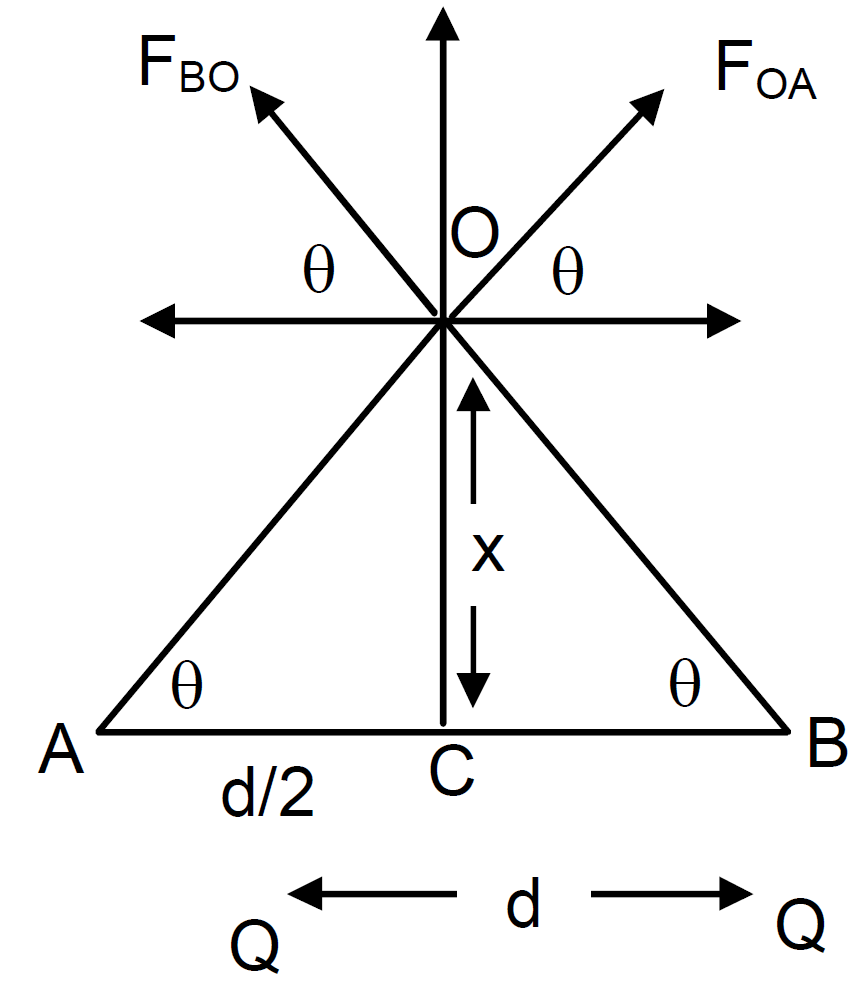
Two particles A and B, each carrying a charge Q, are held fixed with a separation d between them. A particle C having mass m and charge q is kept at the middle point of the line AB.
  1. If it is displaced through a distance x perpendicular to AB, what would be the electric force experienced by it.
  2. Assuming x << d, show that this force is proportional to x.
  3. Under what conditions will the particle C execute simple harmonic motion if it is released after such a small displacement?
Find the time period of the oscillations if these conditions are satisfied.
Answer

  1. Let Q = charge on A & B Separated by distance d
q = charge on c displaced $\bot$ to -AB

So, force on $0=\overline{\text{F}}_\text{AB}+\overline{\text{F}}_\text{BO}$

But $\text{F}_\text{AO}\cos\theta=\text{F}_\text{BO}\cos\theta$

So, force on ‘0’ in due to vertical component.

$\overline{\text{F}}=\text{F}_\text{AO}\sin\theta+\text{F}_\text{BO}\sin\theta$ $|\text{F}_\text{AO}|=|\text{F}_\text{BO}|$

$=2\frac{\text{KQq}}{\Big(\frac{\text{d}}{2^2+\text{x}^2}\big)}\sin\theta$

$\text{F}=\frac{2\text{KQq}}{\Big(\frac{\text{d}}{2}\Big)^2+\text{x}^2}\sin\theta$

$=\frac{4\times2\times2\text{KQq}}{(\text{d}^2+4\text{x}^2)}\times\frac{\text{x}}{\Big[\big(\frac{\text{d}}{2}\big)^2+\text{x}^2\Big]^{\frac{1}{2}}}$

$=\frac{2\text{kQq}}{\Big[\big(\frac{\text{d}}{2}\big)^2+\text{x}^2\Big]^{\frac{3}{2}}}\text{x}$ = Electric force $\Rightarrow\text{F}\propto\text{x}$
  1. When x << d
$\text{F}=\frac{2\text{kQq}}{\Big[\big(\frac{\text{d}}{2}\big)^2+\text{x}^2\Big]^{\frac{3}{2}}}\text{x}$ x << d

$\Rightarrow\text{F}=\frac{2\text{kQq}}{\Big(\frac{\text{d}^2}{4}\Big)^{\frac{3}{2}}}\text{x}\Rightarrow\text{F}\propto\text{x}$

$\text{a}=\frac{\text{F}}{\text{m}}=\frac{1}{\text{m}}\Bigg[\frac{2\text{kQqx}}{\Big[\big(\frac{\text{d}^2}{4}\big)+\ell^2}\Bigg]$

So time period $\text{T}=2\pi\sqrt{\frac{\ell}{\text{g}}}$

$=2\pi\sqrt{\frac{\ell}{\text{a}}}$
View full question & answer
Question 555 Marks
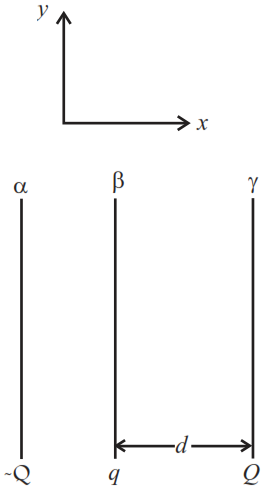
Two fixed, identical conducting plates $(\alpha\ \&\ \beta)$, each of surface area S are charged to -Q and q, respectively, where Q > q > 0. A third identical plate $(\gamma)$, free to move is located on the other side of the plate with charge q at a distance d (Fig.). The third plate is released and collides with the plate $\beta$. Assume the collision is elastic and the time of collision is sufficient to redistribute charge amongst $\beta\ \&\ \gamma$.

Find the charges on $\beta$ and $\gamma$ after the collision.
Answer

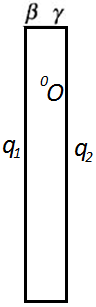
During collision, plates $\beta$ and $\gamma$ are in contact with each other, hence their potentials become same.
Suppose charge on plate $\beta$ is $q_1$ and charge on plate $\gamma$ is $q_2$. At any point O, in between the two plates, the electric field must be zero.

Electric field at o due to plate $\alpha,\vec{\text{E}_\alpha}=\frac{\text{Q}}{\text{S}(2\in_0)}(-\hat{\text{i}})$
Electric field at O due to plate $\beta,\vec{\text{E}_2}=\frac{\text{q}_1}{\text{S}(2\in_0)}(\hat{\text{i}})$
Electric field at O due to plate $\gamma,\vec{\text{E}_\gamma}=\frac{\text{q}_2}{\text{S}(2\in_0)}(-\hat{\text{i}})$
As the electric field at O is zero, therefore
$\frac{\text{Q}+\text{q}_2}{\text{S}(2\in_0)}=\frac{\text{q}_1}{\text{S}(2\in_0)}$
$\because\ \text{Q}+\text{q}_2=\text{q}_1$
As there is no loss of charge on collision,
$Q + q = q_1 + q_2$​​​​​​​
On solving Eqs. (i) and (ii), we get
$\text{q}_1=\Big(\text{Q}+\frac{\text{q}}{2}\Big)=\text{Charge on plate }\beta$
$\text{q}_1=\Big(\frac{\text{q}}{2}\Big)=\text{Charge on plate }\gamma$
View full question & answer
Question 565 Marks
Consider a system of n charges $q_1, q_2, ... q_n$ with position vectors $\vec{\text{r}}_1,\vec{\text{r}}_2,\vec{\text{r}}_3,...\vec{\text{r}}_\text{n}$ relative to some origin ‘O’. Deduce the expression for the net electric field $\vec{\text{E}}$ at a point P with position vector $\vec{\text{r}}_\text{p},$ due to this system of charges.
Answer


Electric field due to a system of point charges.
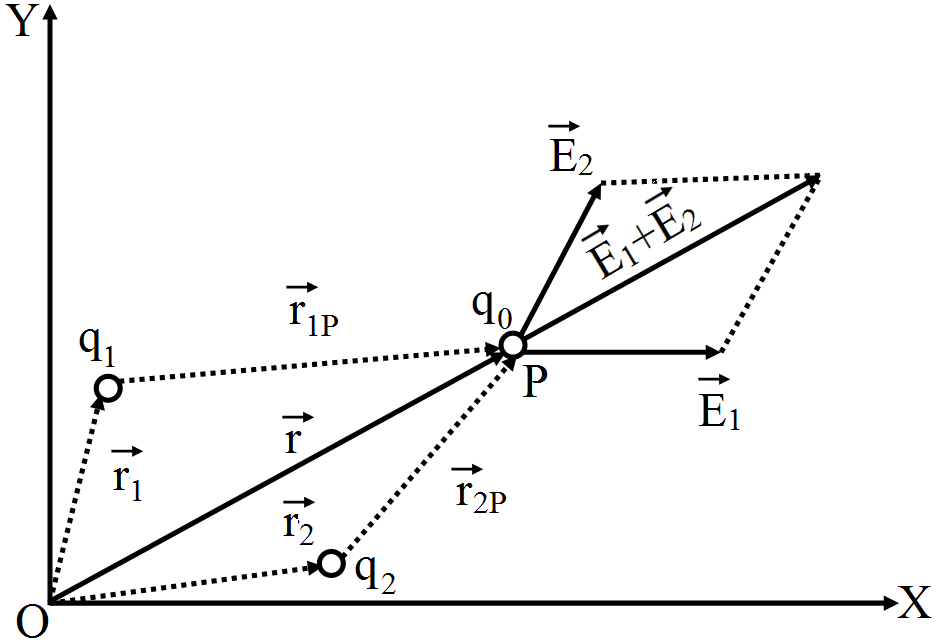
Consider a system of N point charges $q_1,q_2,.....q_n,$ having position vectors $\vec{\text{r}}_1,\vec{\text{r}}_2,\vec{\text{r}}_3,...\vec{\text{r}}_\text{n},$ with respect to origin O. We wish to determine the electric field at point P whose position vector is $\vec{\text{r}}.$
According to Coulomb’s law, the force on charge $q_0$ due to charge $q_1$ is,
$\vec{\text{F}}_1=\frac{1}{4\pi\in_0}.\frac{\text{q}_1\text{q}_0}{\text{r}^2_{2}\text{p}}\hat{\text{r}}_{1}\text{p}$
Where $\hat{\text{r}}_1\text{p}$ is a unit vector in the direction from $q_1$ to P and $r_1p$ is the distance between $q_1$ and P.
Hence the electric field at point P due to charge $q_1$ is,
$\vec{\text{E}}_1=\frac{\vec{\text{F}}_1}{\text{q}_0}=\frac{1}{4\pi\in_0}.\frac{\text{q}_1}{\text{r}^2_{1}\text{p}}\hat{\text{r}}_{1}\text{p}$
Similarly, electric field at P due to charge $q_2$ is,
$\vec{\text{E}}_2=\frac{1}{4\pi\in_0}.\frac{\text{q}_2}{\text{r}^2_{2}\text{p}}\hat{\text{r}}_{2}\text{p}$
According to the principle of superposition of electric fields, the electric field at any point due to a group of point charges is equal to the vector sum of the electric fields produced by each charge individually at that point, when all other charges are assumed to be absent.
Hence, the electric field at point P due to the system of N charges is
$\vec{\text{E}}=\vec{\text{E}}_1+\vec{\text{E}}_2+\dots+\vec{\text{E}}_\text{n}$
$=\frac{1}{4\pi\in_0}\Big[\frac{\text{q}_1}{\text{r}^2_{1}\text{p}}\hat{\text{r}}_{1}\text{p}+\frac{\text{q}_2}{\text{r}^2_{2}\text{p}}\hat{\text{r}}_{2}\text{p}+\dots+\frac{\text{q}_\text{n}}{\text{r}^2_{\text{n}}\text{p}}\hat{\text{r}}_{\text{n}}\text{p}\Big]$
$=\frac{1}{4\pi\in_0}\Sigma^{\text{n}}_\text{i=1}\frac{\text{q}_\text{i}}{\text{r}^2_{\text{i}}\text{p}}\hat{\text{r}}_\text{i}\text{p}$
View full question & answer
Question 575 Marks
Apply Gauss’s Theorem to find the electric field near a charged conductor.
OR
Show that the electric field at the surface of a charged conductor is $\vec{\text{E}}=\frac{\text{p}}{\in_0}\hat{\text{n}}$ where $\sigma$ is surface charge density and $\hat{\text{n}}$ is a unit vector normal to the surface in the outward direction.
Answer


Let a charge Q be given to a conductor, this charge under electrostatic equilibrium will redistribute and the electric field inside the conductor is zero $(i.e., E_{in} = 0).$
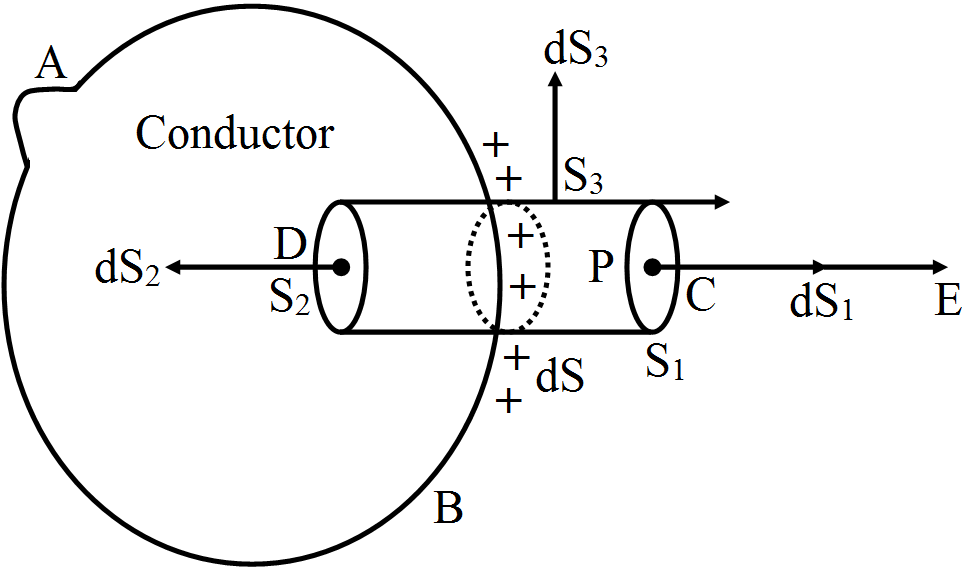
Let us consider a point P at which electric field strength is to be calculated, just outside the surface of the conductor. Let the surface charge density on the surface of the conductor in the neighbourhood of P be $\sigma$ coulomb/ metre$^2$ . Now consider a small cylindrical box CD having one base C passing through P; the other base D lying inside the conductor and the curved surface being perpendicular to the surface of the conductor.
Let the area of each flat base be a. As the surface of the conductor is equipotential surface, the electric field strength E at P, just outside the surface of the conductor is perpendicular to the surface of the conductor in the neighbourhood of P.
The flux of electric field through the curved surface of the box is zero, since there is no component of electric field E normal to curved surface. Also the flux of electric field through the base D is zero, as electric field strength inside the conductor is zero. Therefore the resultant flux of electric field through the entire surface of the box is same as the flux through the face C. This may be analytically seen as:
If $S_1$ and $S_2$ are flat surfaces at C and D and S3 is curved surface, then
Total electric flux,
$\oint\limits_{\text{S}}\vec{\text{E}}.\vec{\text{dS}}=\oint\limits_{\text{S}_1}\vec{\text{E}}.\vec{\text{dS}_1}+\oint\limits_{\text{S}_2}\vec{\text{E}}.\vec{\text{dS}_2}+\oint\limits_{\text{S}_3}\vec{\text{E}}.\vec{\text{dS}_3}$
$=\oint\limits_{\text{S}_1}{\text{E}}.{\text{dS}_1}\cos0+\oint\limits_{\text{S}_2}{\vec0}.{\text{dS}_2}+\oint\limits_{\text{S}_3}{\text{E}}.{\text{dS}_3}\cos90^\circ$
$\oint\limits_{\text{S}}\text{E dS}_1=\text{Ea}$
As the charge enclosed by the cylinder is $(\sigma\text{a})$ coulomb, we have, using Gauss’s theorem, $=\frac{1}{\in_0}\times\text{charge enclosed}$
$\text{Ea}=\frac{1}{\in_0}(\sigma\text{a})$
or $\text{E}=\frac{\text{p}}{\in_0}\dots(\text{i})$
Thus the electric field strength at any point close to the surface of a charged conductor of any shape is equal to $\frac{1}{\in_0}$ times the surface charge density $\sigma.$ This is known as Coulomb’s law. The electric field strength is directed radially away from the conductor if $\sigma$ is positive and towards the conductor if $\sigma$ is negative.
If $\hat{\text{n}}$ is unit vector normal to surface in outward direction, then
$\vec{\text{E}}=\frac{\text{p}}{\in_0}\hat{\text{n}}$
Obviously electric field strength near a plane conductor is twice of the electric field strength near a non-conducting thin sheet of charge.
View full question & answer
Question 585 Marks
Find an expression for the electric field strength at a distant point situated (i) on the axis and (ii) along the equatorial line of an electric dipole.
OR
Derive an expression for the electric field intensity at a point on the equatorial line of an electric dipole of dipole moment $\vec{\text{p}}$ and length 2a. What is the direction of this field?
Answer
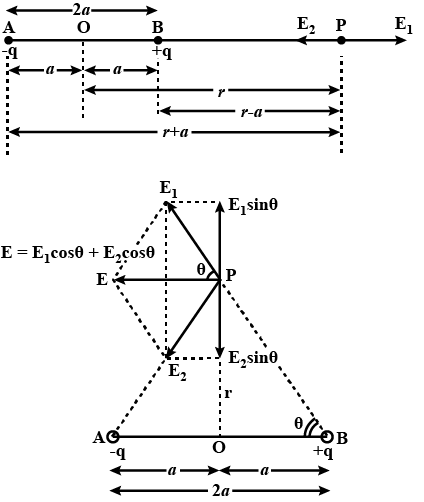
Consider an electric dipole AB. The charges -q and +q of dipole are situated at A and B respectively as shown in the figure. The separation between the charges is 2a. Electric dipole moment, p = q.2a The direction of dipole moment is from -q to +q.Image
  1. At axial or end-on position: Consider a point P on the axis of dipole at a distance r from mid-point O of electric dipole.
The distance of point P from charge +q at B is BP = r - a.
And distance of point P from charge -q at A is, AP = r + a.
Let $E_1$ and $E_2$ be the electric field strengths at point P due to charges +q and -q respectively.
We know that the direction of electric field due to a point charge is away from positive charge and towards the negative charge. Therefore,
$\text{E}_1=\frac{1}{4\pi\in_0}\frac{\text{q}}{(\text{r}-\text{a})^2}$ (from B to P)
and $\text{E}_2=\frac{1}{4\pi\in_0}\frac{\text{q}}{(\text{r}+\text{a})^2}$ (from P to A)
Clearly the directions of electric field strengths $\vec{\text{E}}_1$ and $\vec{\text{E}}_2$ along the same line but opposite to each other and $E_1 > E_2$ because positive charge is nearer.
$\therefore$ The resultant electric field due to electric dipole has magnitude equal to the difference of $E_1$ and $E_2$ direction from B to P i.e.,
$E = E_1 - E_2$
$=\frac{1}{4\pi\in_0}\frac{\text{q}}{(\text{r}-\text{a})^2}-​​\frac{1}{4\pi\in_0}\frac{\text{q}}{(\text{r}+\text{a})^2}$
$=\frac{\text{q}}{4\pi\in_0}=\Big[\frac{1}{(\text{r}-\text{a})^2}-\frac{1}{(\text{r}+\text{a})^2}\Big]=\frac{\text{q}}{4\pi\in_0}\bigg[\frac{(\text{r}+\text{a})^2-(\text{r}-\text{a})^2}{(\text{r}^2-\text{a}^2)^2}\bigg]$
$=\frac{\text{q}}{4\pi\in_0}\frac{4\text{ra}}{(\text{r}^2-\text{a}^2)^2}=\frac{1}{4\pi\in_0}\frac{2(\text{q}2\text{a})\text{r}}{(\text{r}^2-\text{a}^2)^2}$
But q.21 = p (electric dipole moment)
$\therefore\ \text{E}=\frac{1}{4\pi\in_0}\frac{2\text{pr}}{(\text{r}^2-\text{a}^2)^2}\dots(\text{i})$
If the dipole is infinitely small and point P is far away from the dipole, then r >> l, therefore equation (i) may be expressed as,
$\text{E}=\frac{1}{4\pi\in_0}\frac{2\text{pr}}{\text{r}^4}$ or $\text{E}=\frac{1}{4\pi\in_0}\frac{2\text{p}}{\text{r}^3}\dots(\text{ii})$
This is the expression for the electric field strength at axial position due to a short electric dipole.
  1. At a point of equatorial line: Consider a point P on broad side on the position of dipole formed of charges +q and -q at separation 2a. The distance of point P from mid-point (O) of electric dipole is r. Let $\vec{\text{E}}_1$ and $\vec{\text{E}}_2$ be the electric field strengths due to charges +q and -q of electric dipole.
From fig. $\text{AP}=\text{BP}=\sqrt{\text{r}^2+\text{a}^2}$
$\therefore\ \vec{\text{E}}=\frac{1}{4\pi\in_0}\frac{\text{q}}{\text{r}^2+\text{a}^2}$ along B to P
$\vec{\text{E}}_2=\frac{1}{4\pi\in_0}\frac{\text{q}}{\text{r}^2+\text{a}^2}$ along P to A
Clearly $\vec{\text{E}}_1$ and $\vec{\text{E}}_2$ are equal in magnitude i.e., $|\vec{\text{E}}_1|=|\vec{\text{E}}_2|$ or $E_1 = E_2$​​​​​​​
To find the resultant of $\vec{\text{E}}_1$ and $\vec{\text{E}}_2,$ we reslove them into rectangular components.
Component of $\vec{\text{E}}_1$ Parallel to $​​\text{AB}=\text{E}_1\cos\theta,$ in the direction to $\vec{\text{BA}}$
Component of $\vec{\text{E}}_1$ perpendicular to $​​\text{AB}=\text{E}_1\sin\theta,$ along OP
Component of $\vec{\text{E}}_2$ Parallel to $​​\text{AB}=\text{E}_2\cos\theta,$ in the direction to $\vec{\text{BA}}$
Component of $\vec{\text{E}}_2$ perpendicular to $​​\text{AB}=\text{E}_2\sin\theta,$ along PO
Clearly, comoponents of $\vec{\text{E}}_1$ and $\vec{\text{E}}_2$ perpendicular to $​​\text{AB}=\text{E}_1\sin\theta$ and $\text{E}_2\sin\theta$ being equal and opposite cancel each other, while the components of $\vec{\text{E}}_1$ and $\vec{\text{E}}_2$ parallel to $​​\text{AB}=\text{E}_1\cos\theta$ and $\text{E}_2\cos\theta,$ being in the same direction add up and give the resultant electric field whose direction is parallel to $\vec{\text{BA}}.$
$\therefore$ Resultant electric field at P is $​​\text{E}=\text{E}_1\cos\theta+\text{E}_2\cos\theta$
But $\text{E}_1=\text{E}_2=\frac{1}{4\pi\in_0}\frac{\text{q}}{(\text{r}^2+\text{a}^2)}$
From the figure, $\cos\theta=\frac{\text{OB}}{\text{PB}}=\frac{\text{l}}{\sqrt{\text{r}^2+\text{a}^2}}=\frac{\text{l}}{(\text{r}^2+\text{a}^2)^{1/2}}$
$\text{E}=2\text{E}_1\cos\theta=2\times\frac{1}{4\pi\in_0}\frac{\text{q}}{(\text{r}^2+\text{a}^2)}.\frac{\text{l}}{(\text{r}^2+\text{a}^2)^{1/2}}$
$=\frac{1}{4\pi\in_0}\frac{2\text{ql}}{(\text{r}^2+\text{a}^2)^{3/2}}$
But q.2l = p = electric dipole moment ...(iii)
$\therefore\ \text{E}=\frac{1}{4\pi\in_0}\frac{\text{p}}{(\text{r}^2+\text{a}^2)^{3/2}}$
If dipole is infinitesimal and point P is far away, we have a << r, so $l^2$ may be neglected as compared to $r^2$ and so equation (iii) gives,
$\text{E}=\frac{1}{4\pi\in_0}\frac{\text{p}}{(\text{r}^2)^{3/2}}=\frac{1}{4\pi\in_0}\frac{\text{p}}{\text{r}^3}$
i.e., electric field strength due to a short dipole at broadside on position.
$\text{E}=\frac{1}{4\pi\in_0}\frac{\text{p}}{\text{r}^3}$ in the direction parallel to $\vec{\text{BA}}\dots(\text{iv})$
Its direction is parallel to the axis of dipole from positive to negative charge. It may be noted clearly from equations (ii) and (iv) that electric field strength due to a short dipole at any point is inversely proportional to the cube of its distance from the dipole and the electric field strength at axial position is twice that at broad-side on position for the same distance.
Important: Note the important point that the electric field due to a dipole at large distances falls off as $\frac{1}{\text{r}^3}$ and not as $\frac{1}{\text{r}^2}$ as in the case of a point charge.
View full question & answer
Question 595 Marks
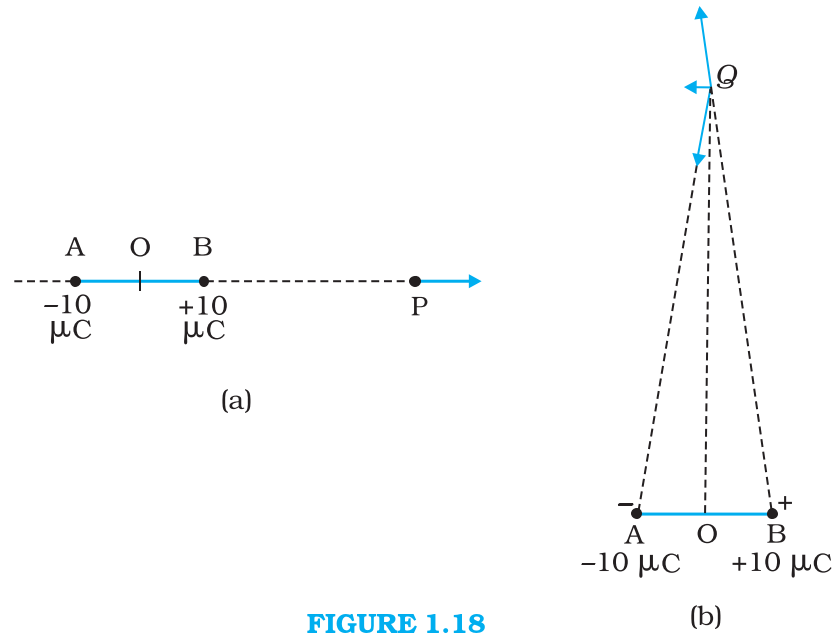
Two charges $\pm 10 \mu C$ are placed $5.0 mm$ apart. Determine the electric field at $(a)$ a point $P$ on the axis of the dipole $15 \ cm$ away from its centre $O$ on the side of the positive charge, as shown in Fig. $1.18( a ),$ and $(b)$ a point $Q , 15 \ cm$ away from $O$ on a line passing through $O$ and normal to the axis of the dipole, as shown in Fig. $1.18(b)$.
Image
Answer
Field at $P$ due to charge $+10 \mu C$
$=\frac{10^{-5} C }{4 \pi\left(8.854 \times 10^{-12} C ^2 N ^{-1} m ^{-2}\right)} \times \frac{1}{(15-0.25)^2 \times 10^{-4} m ^2}$
$=4.13 \times 10^6 N C ^{-1}\ \text{along} \ BP$
Field at $P$ due to charge $-10 \mu C$
$=\frac{10^{-5} C }{4 \pi\left(8.854 \times 10^{-12} C ^2 N ^{-1} m ^{-2}\right)} \times \frac{1}{(15+0.25)^2 \times 10^{-4} m ^2}$
$=3.86 \times 10^6 N C ^{-1} \text { along PA }$
The resultant electric field at $P$ due to the two charges at $A$ and $B$ is $=2.7 \times 10^5 N C ^{-1}\ \text{along } \ BP$.
In this example, the ratio $OP/OB$ is quite large $(=60)$.
Thus, we can expect to get approximately the same result as above by directly using the formula for electric field at a far $-$ away point on the axis of a dipole.
For a dipole consisting of charges $\pm q, 2 a$ distance apart, the electric field at a distance $r$ from the centre on the axis of the dipole has a magnitude
$E=\frac{2 p}{4 \pi \varepsilon_0 r^3} \quad(r / a>>1)$
where $p=2 a q$ is the magnitude of the dipole moment.
The direction of electric field on the dipole axis is always along the direction of the dipole moment vector $($i.e., from $-q$ to $q ).$
Here, $p=10^{-5} C \times 5 \times 10^{-3} m =5 \times 10^{-8} C m$
Therefore,
$E=\frac{2 \times 5 \times 10^{-8} Cm }{4 \pi\left(8.854 \times 10^{-12} C ^2 N ^{-1} m ^{-2}\right)} \times \frac{1}{(15)^3 \times 10^{-6} m ^3}=2.6 \times 10^5 N C ^{-1}$
along the dipole moment direction $AB$, which is close to the result obtained earlier.
$(b)$ Field at $O$ due to charge $+10 \mu C$ at $B$
$=\frac{10^{-5} C }{4 \pi\left(8.854 \times 10^{-12} C ^2 N ^{-1} m ^{-2}\right)} \times \frac{1}{\left[15^2+(0.25)^2\right] \times 10^{-4} m ^2}$
$=3.99 \times 10^6 N C ^{-1} \text { along BQ }$
Field at $Q$ due to charge $-10 \mu C$ at $A$
$=\frac{10^{-5} C }{4 \pi\left(8.854 \times 10^{-12} C ^2 N ^{-1} m ^{-2}\right)} \times \frac{1}{\left[15^2+(0.25)^2\right] \times 10^{-4} m ^2}$
$=3.99 \times 10^6 N C ^{-1} \text { along } QA .$
Clearly, the components of these two forces with equal magnitudes cancel along the direction $OQ$ but add up along the direction parallel to $BA$.
Therefore, the resultant electric field at $Q$ due to the two charges at $A$ and $B$ is
$=2 \times \frac{0.25}{\sqrt{15^2+(0.25)^2}} \times 3.99 \times 10^6 N C ^{-1} \text { along } BA$
$=1.33 \times 10^5 N C ^{-1} \ \text{along} \ BA$.
As in $(a),$ we can expect to get approximately the same result by directly using the formula for dipole field at a point on the normal to the axis of the dipole:
$E=\frac{p}{4 \pi \varepsilon_0 r^3} \quad(r / a \gg 1)$
$= \frac{5 \times 10^{-8} Cm }{4 \pi\left(8.854 \times 10^{-12} C ^2 N ^{-1} m ^{-2}\right)} \times \frac{1}{(15)^3 \times 10^{-6} m ^3}$
$= 1.33 \times 10^5 N C ^{-1} .$
The direction of electric field in this case is opposite to the direction of the dipole moment vector.
Again, the result agrees with that obtained before.
View full question & answer
Question 605 Marks
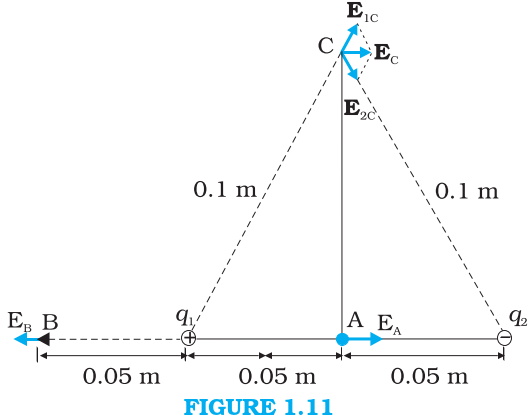
Two point charges $q_1$ and $q_2$, of magnitude $+10^{-8} C$ and $-10^{-8} C$, respectively, are placed $0.1 m$ apart. Calculate the electric fields at points A, B and C shown in Fig. 1.11.
Image
Answer
The electric field vector $E _{1 A }$ at A due to the positive charge $q_1$ points towards the right and has a magnitude
$
E_{1 A }=\frac{\left(9 \times 10^9 Nm ^2 C ^{-2}\right) \times\left(10^{-8} C \right)}{(0.05 m )^2}=3.6 \times 10^4 N C ^{-1}
$
The electric field vector $E _{2 A }$ at A due to the negative charge $q_2$ points towards the right and has the same magnitude. Hence the magnitude of the total electric field $E_{ A }$ at $A$ is
$
E_{ A }=E_{1 A }+E_{2 A }=7.2 \times 10^4 N C ^{-1}
$
$E _{ A }$ is directed toward the right.

The electric field vector $E _{1 B }$ at $B$ due to the positive charge $q_1$ points towards the left and has a magnitude
$
E_{1 B }=\frac{\left(9 \times 10^9 Nm ^2 C ^{-2}\right) \times\left(10^{-8} C \right)}{(0.05 m )^2}=3.6 \times 10^4 N C ^{-1}
$

The electric field vector $E _{2 B }$ at B due to the negative charge $q_2$ points towards the right and has a magnitude
$
E_{2 B }=\frac{\left(9 \times 10^9 Nm ^2 C ^{-2}\right) \times\left(10^{-8} C \right)}{(0.15 m )^2}=4 \times 10^3 N C ^{-1}
$

The magnitude of the total electric field at $B$ is $E_{ B }=E_{1 B }-E_{2 B }=3.2 \times 10^4 N C ^{-1}$
$E _{ B }$ is directed towards the left.
The magnitude of each electric field vector at point $C$, due to charge $q_1$ and $q_2$ is
$
E_{1 C }=E_{2 C }=\frac{\left(9 \times 10^9 Nm ^2 C ^{-2}\right) \times\left(10^{-8} C \right)}{(0.10 m )^2}=9 \times 10^3 N C ^{-1}
$

The directions in which these two vectors point are indicated in Fig. 1.11. The resultant of these two vectors is
$
E_C=E_{1 c} \cos \frac{\pi}{3}+E_{2 c} \cos \frac{\pi}{3}=9 \times 10^3 N C ^{-1}
$
$E _{ C }$ points towards the right.
View full question & answer
Question 615 Marks
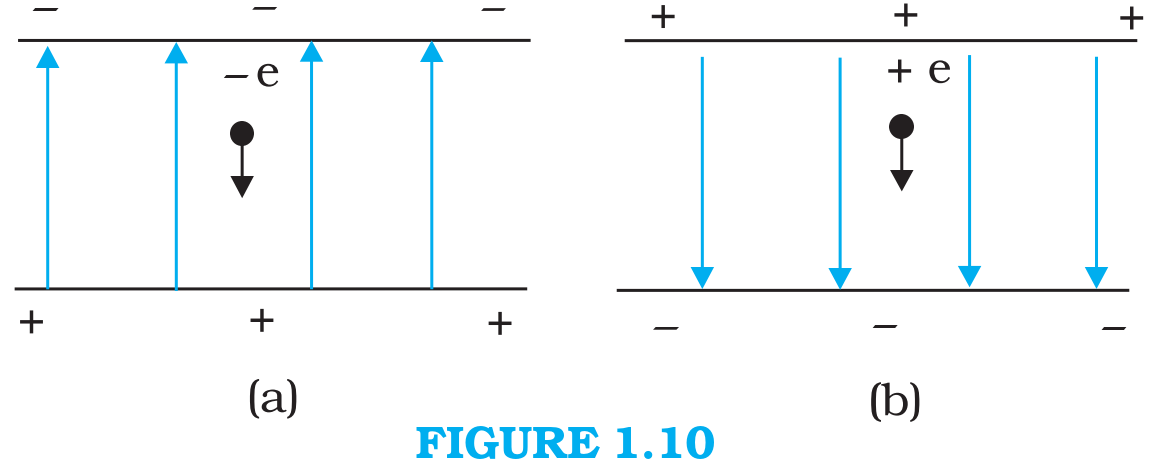
An electron falls through a distance of $1.5 \ cm$ in a uniform electric field of magnitude $2.0 \times 10^4 N C ^{-1} \ [$Fig. $1.10(a)]$. The direction of the field is reversed keeping its magnitude unchanged and a proton falls through the same distance $[$Fig. $1.10(b)]$. Compute the time of fall in each case. Contrast the situation with that of 'free fall under gravity'.
Image
Answer
In Fig. $1.10 (a)$ the field is upward, so the negatively charged electron experiences a downward force of magnitude $e E$ where $E$ is the magnitude of the electric field.
The acceleration of the electron is
$a_e=e E / m_e $
where $m_e$ is the mass of the electron.
Starting from rest, the time required by the electron to fall through a distance $h$ is given by $t_e=\sqrt{\frac{2 h}{a_e}}=\sqrt{\frac{2 h m_e}{e E}}$
For $e=1.6 \times 10^{-19} C , m_{ e }=9.11 \times 10^{-31} \ kg$,
$E=2.0 \times 10^4 N C ^{-1}, h=1.5 \times 10^{-2} m ,$
$t_{ e }=2.9 \times 10^{-9} s$
In Fig. $1.10 (b),$ the field is downward, and the positively charged proton experiences a downward force of magnitude $e E$.
The acceleration of the proton is
$a_p=e E / m_p$
where $m_p$ is the mass of the proton; $m_p=1.67 \times 10^{-27} \ kg$. The time of fall for the proton is
$t_p=\sqrt{\frac{2 h}{a_p}}=\sqrt{\frac{2 h m_p}{e E}}=1.3 \times 10^{-7} s$
Thus, the heavier particle $($proton$)$ takes a greater time to fall through the same distance.
This is in basic contrast to the situation of 'free fall under gravity' where the time of fall is independent of the mass of the body.
Note that in this example we have ignored the acceleration due to gravity in calculating the time of fall.
To see if this is justified, let us calculate the acceleration of the proton in the given electric field:
$a_p =\frac{e E}{m_p}$
$ =\frac{\left(1.6 \times 10^{-19} C \right) \times\left(2.0 \times 10^4 N C ^{-1}\right)}{1.67 \times 10^{-27} \ kg }$
$ =1.9 \times 10^{12} m s ^{-2}$
which is enormous compared to the value of $g\left(9.8 m s ^{-2}\right),$ the acceleration due to gravity.
The acceleration of the electron is even greater.
Thus, the effect of acceleration due to gravity can be ignored in this example.
View full question & answer
Question 625 Marks
Coulomb's law for electrostatic force between two point charges and Newton's law for gravitational force between two stationary point masses, both have inverse-square dependence on the distance between the charges and masses respectively. (a) Compare the strength of these forces by determining the ratio of their magnitudes (i) for an electron and a proton and (ii) for two protons. (b) Estimate the accelerations of electron and proton due to the electrical force of their mutual attraction when they are $1 \mathring A\left(=10^{-10} m \right)$ apart? $\left(m_p=1.67 \times\right.$ $\left.10^{-27} kg , m_e=9.11 \times 10^{-31} kg \right)$
Answer
(a) (i) The electric force between an electron and a proton at a distance $r$ apart is:
$
F_e=-\frac{1}{4 \pi \varepsilon_0} \frac{e^2}{r^2}
$
where the negative sign indicates that the force is attractive. The corresponding gravitational force (always attractive) is:
$
F_G=-G \frac{m_p m_e}{r^2}
$
where $m_p$ and $m_e$ are the masses of a proton and an electron respectively.
$
\left|\frac{F_e}{F_G}\right|=\frac{e^2}{4 \pi \varepsilon_0 G m_p m_e}=2.4 \times 10^{39}
$

(ii) On similar lines, the ratio of the magnitudes of electric force to the gravitational force between two protons at a distance $r$ apart is:
$
\left|\frac{F_e}{F_G}\right|=\frac{e^2}{4 \pi \varepsilon_0 G m_p m_p}=1.3 \times 10^{36}
$
However, it may be mentioned here that the signs of the two forces are different. For two protons, the gravitational force is attractive in nature and the Coulomb force is repulsive. The actual values of these forces between two protons inside a nucleus (distance between two protons is $\sim 10^{-15} m$ inside a nucleus) are $F_{ e } \sim 230 N$, whereas, $F_{ G } \sim 1.9 \times 10^{-34} N$.
The (dimensionless) ratio of the two forces shows that electrical forces are enormously stronger than the gravitational forces.

(b) The electric force $F$ exerted by a proton on an electron is same in magnitude to the force exerted by an electron on a proton; however, the masses of an electron and a proton are different. Thus, the magnitude of force is
$
\begin{aligned}
| F | & =\frac{1}{4 \pi \varepsilon_0} \frac{e^2}{r^2}=8.987 \times 10^9 Nm ^2 / C ^2 \times\left(1.6 \times 10^{-19} C \right)^2 /\left(10^{-10} m \right)^2 \\
& =2.3 \times 10^{-8} N
\end{aligned}
$
Using Newton's second law of motion, $F=m a$, the acceleration that an electron will undergo is
$
a=2.3 \times 10^{-8} N / 9.11 \times 10^{-31} kg =2.5 \times 10^{22} m / s ^2
$

Comparing this with the value of acceleration due to gravity, we can conclude that the effect of gravitational field is negligible on the motion of electron and it undergoes very large accelerations under the action of Coulomb force due to a proton.
The value for acceleration of the proton is
$
2.3 \times 10^{-8} N / 1.67 \times 10^{-27} kg =1.4 \times 10^{19} m / s ^2
$
View full question & answer
Question 635 Marks
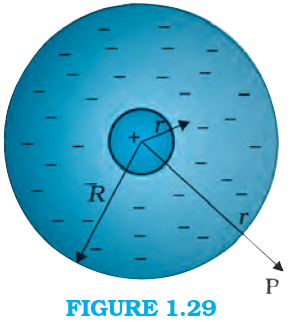
An early model for an atom considered it to have a positively charged point nucleus of charge $Z e$, surrounded by a uniform density of negative charge up to a radius $R$. The atom as a whole is neutral. For this model, what is the electric field at a distance $r$ from the nucleus?
Image
Answer
The charge distribution for this model of the atom is as shown in Fig. 1.29. The total negative charge in the uniform spherical charge distribution of radius $R$ must be $-Z e$, since the atom (nucleus of charge $Z e+$ negative charge) is neutral. This immediately gives us the negative charge density $\rho$, since we must have
$
\frac{4 \pi R^3}{3} \rho=0-Z e
$
or $\quad \rho=-\frac{3 Z e}{4 \pi R^3}$
To find the electric field $E ( r )$ at a point $P$ which is a distance $r$ away from the nucleus, we use Gauss's law. Because of the spherical symmetry of the charge distribution, the magnitude of the electric field $E ( r )$ depends only on the radial distance, no matter what the direction of $r$. Its direction is along (or opposite to) the radius vector $r$ from the origin to the point $P$. The obvious Gaussian surface is a spherical surface centred at the nucleus. We consider two situations, namely, $r<R$ and $r > R$.
(i) $r < R$ : The electric flux $\phi$ enclosed by the spherical surface is $\phi=E(r) \times 4 \pi r^2$
where $E(r)$ is the magnitude of the electric field at $r$. This is because the field at any point on the spherical Gaussian surface has the same direction as the normal to the surface there, and has the same magnitude at all points on the surface. The charge $q$ enclosed by the Gaussian surface is the positive nuclear charge and the negative charge within the sphere of radius $r$, $ \text { i.e., } q=Z e+\frac{4 \pi r^3}{3} \rho $ Substituting for the charge density $\rho$ obtained earlier, we have $ q=Z e-Z e \frac{r^3}{R^3} $ Gauss's law then gives, $ E(r)=\frac{Z e}{4 \pi \varepsilon_0} \quad \frac{1}{r^2}-\frac{r}{R^3} ; \quad rR$ : In this case, the total charge enclosed by the Gaussian spherical surface is zero since the atom is neutral. Thus, from Gauss's law, $ E(r) \times 4 \pi r^2=0 \text { or } E(r)=0 ; \quad r>R $ At $r=R$, both cases give the same result: $E=0$.
View full question & answer
Question 645 Marks
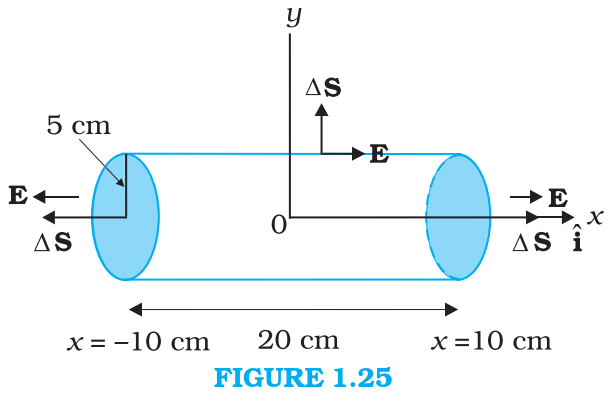
An electric field is uniform, and in the positive $x$ direction for positive $x$, and uniform with the same magnitude but in the negative $x$ direction for negative $x$. It is given that $E =200 \hat{ i } N / C$ for $x>0$ and $E =-200 \hat{ i } N / C$ for $x<0$. A right circular cylinder of length $20 \ cm$ and radius $5 \ cm$ has its centre at the origin and its axis along the $x-$ axis so that one face is at $x=+10 \ cm$ and the other is at $x=-10 \ cm\  ($Fig. $1.25).\ (a)$ What is the net outward flux through each flat face? $(b)$ What is the flux through the side of the cylinder? $(c)$ What is the net outward flux through the cylinder? $(d)$ What is the net charge inside the cylinder?
Answer
$(a$) We can see from the figure that on the left face $E$ and $\Delta S$ are parallel.
Therefore, the outward flux is
$\phi_L= E \cdot \Delta S =-200 \hat{ i } \cdot \Delta S$
$=+200 \Delta S , \text { since } \hat{ i } \cdot \Delta S =-\Delta S$
$=+200 \times \pi(0.05)^2=+1.57 N m ^2 C ^{-1}$
On the right face, $E$ and $\Delta S$ are parallel and therefore
$\phi_R= E \cdot \Delta S =+1.57 N m ^2 C ^{-1} \text {. }$
$(b)$  For any point on the side of the cylinder $E$ is perpendicular to $\Delta S$ and hence $E \cdot \Delta S =0$.
Therefore, the flux out of the side of the cylinder is zero.
$(c)$ Net outward flux through the cylinder
$\phi=1.57+1.57+0=3.14 N m ^2 C ^{-1}$
Image
$(d)$ The net charge within the cylinder can be found by using Gauss's law which gives
$q =\varepsilon_0 \phi$
$ =3.14 \times 8.854 \times 10^{-12} C$
$ =2.78 \times 10^{-11} C$
View full question & answer
5 Marks Questions - Page 2 - Physics STD 12 Science Questions - Vidyadip