Questions · Page 6 of 9

M.C.Q (1 Marks)

MCQ 2511 Mark
The potential barrier, in the depletion layer, is due to
  •  Ions
  • B
     Holes
  • C
     Electrons
  • D
     Both (b) and (c)
Answer
Correct option: A.
 Ions
Ions
View full question & answer
MCQ 2521 Mark
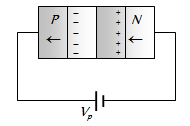
When forward bias is applied to a $P - N$ junction, then what happens to the potential barrier $V _{ B }$, and the width of charge depleted region $x$
  • A
    $V_B$ increases, $x$ decreases
  • B
     $V _{ B }$ decreases, x increases
  • C
    $V_B$ increases, $x$ increases
  •  $V_B$ decreases, $x$ decreases
Answer
Correct option: D.
 $V_B$ decreases, $x$ decreases
$V_B$ decreases, $x$ decreases
View full question & answer
MCQ 2531 Mark
Zener breakdown in a semi-conductor diode occurs when
  • A
    Forward current exceeds certain value
  • Reverse bias exceeds certain value
  • C
    Forward bias exceeds certain value
  • D
    Potential barrier is reduced to zero
Answer
Correct option: B.
Reverse bias exceeds certain value
 Reverse bias exceeds certain value
View full question & answer
MCQ 2551 Mark
Avalanche breakdown is due to
  • Collision of minority charge carrier
  • B
    Increase in depletion layer thickness
  • C
    Decrease in depletion layer thickness
  • D
    None of these
Answer
Correct option: A.
Collision of minority charge carrier
View full question & answer
MCQ 2561 Mark
In comparison to a half wave rectifier, the full wave rectifier gives lower
  • A
    Efficiency
  • B
    Average dc
  • C
    Average output voltage
  • None of these
Answer
Correct option: D.
None of these
None of these
View full question & answer
MCQ 2571 Mark
Consider the following statements A and B and identify the correct choice of the given answers
A : The width of the depletion layer in a P-N junction diode increases in forwards bias
B : In an intrinsic semiconductor the fermi energy level is exactly in the middle of the forbidden gap
  • A
    A is true and B is false
  • B
    Both A and B are false
  • A is false and B is true
  • D
    Both A and B are true
Answer
Correct option: C.
A is false and B is true
View full question & answer
MCQ 2581 Mark
Which of the following statements is not true
  • A
    The resistance of intrinsic semiconductors decrease with increase of temperature
  • B
    Doping pure Si with trivalent impurities give P-type semiconductors
  • The majority carriers in N-type semiconductors are holes
  • D
    A PN-junction can act as a semiconductor diode
Answer
Correct option: C.
The majority carriers in N-type semiconductors are holes
 The majority carriers in N-type semiconductors are holes
View full question & answer
MCQ 2591 Mark
The resistance of a reverse biased P-N junction diode is about
  • A
    $1$ ohm
  • B
    $10^2 ohm$
  • C
    $10^3 ohm$
  • $10^6 ohm$
Answer
Correct option: D.
$10^6 ohm$
 $10^6 ohm$
View full question & answer
MCQ 2601 Mark
In a PN-junction diode not connected to any circuit
  • A
    The potential is the same everywhere
  • B
    The P-type is a higher potential than the N-type side
  • There is an electric field at the junction directed from the N- type side to the P- type side
  • D
    There is an electric field at the junction directed from the P-type side to the N-type side
Answer
Correct option: C.
There is an electric field at the junction directed from the N- type side to the P- type side
View full question & answer
MCQ 2611 Mark
The cause of the potential barrier in a P-N diode is
  • A
    Depletion of positive charges near the junction
  • B
     Concentration of positive charges near the junction
  • C
    Depletion of negative charges near the junction
  • Concentration of positive and negative charges near the junction
Answer
Correct option: D.
Concentration of positive and negative charges near the junction
 Concentration of positive and negative charges near the junction
View full question & answer
MCQ 2621 Mark
In forward bias, the width of potential barrier in a P-N junction diode
  • A
    Increases
  • Decreases
  • C
    Remains constant
  • D
    First increases then decreases
Answer
Correct option: B.
Decreases
Decreases
View full question & answer
MCQ 2631 Mark
The reason of current flow in P-N junction in forward bias is
  • A
    Drifting of charge carriers
  • B
    Minority charge carriers
  • Diffusion of charge carriers
  • D
    All of these
Answer
Correct option: C.
Diffusion of charge carriers
 Diffusion of charge carriers
View full question & answer
MCQ 2651 Mark
In a P-N junction diode if P region is heavily doped than n region then the depletion layer is
  • A
    Greater in P region
  • Greater in N region
  • C
    Equal in both region
  • D
    No depletion layer is formed in this case
Answer
Correct option: B.
Greater in N region
Greater in N region
View full question & answer
MCQ 2661 Mark
On adjusting the P-N junction diode in forward biased
  • A
    Depletion layer increases
  • B
    Resistance increases
  • Both decreases
  • D
    None of these
Answer
Correct option: C.
Both decreases
 Both decreases
View full question & answer
MCQ 2681 Mark
The depletion layer in the P-N junction region is caused by
  • A
    Drift of holes
  • Diffusion of charge carriers
  • C
    Migration of impurity ions
  • D
    Drift of electrons
Answer
Correct option: B.
Diffusion of charge carriers
 Diffusion of charge carriers
View full question & answer
MCQ 2691 Mark
In P-N junction, avalanche current flows in circuit when biasing is
  • A
    Forward
  • Reverse
  • C
    Zero
  • D
    Excess
Answer
Correct option: B.
Reverse
Reverse
View full question & answer
MCQ 2701 Mark
In the depletion region of an unbiased P-N junction diode there are
  • A
    Only electrons
  • B
    Only holes
  • C
    Both electrons and holes
  • Only fixed ions
Answer
Correct option: D.
Only fixed ions
Only fixed ions
View full question & answer
MCQ 2711 Mark
A PN- junction has a thickness of the order of
  • A
     $1$ cm
  • B
     $1$ mm
  • $10^{-6} m$
  • D
     $10^{-12} cm$
Answer
Correct option: C.
$10^{-6} m$
$10^{-6} m$
View full question & answer
MCQ 2721 Mark
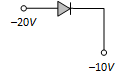
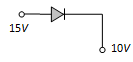
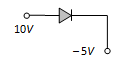
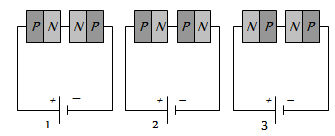
Two PN-junctions can be connected in series by three different methods as shown in the figure. If the potential difference in the junctions is the same, then the correct connections will be
  • A
    In the circuit (1) and (2)
  •  In the circuit (2) and (3)
  • C
     In the circuit (1) and (3)
  • D
     Only in the circuit (1)
Answer
Correct option: B.
 In the circuit (2) and (3)
 In the circuit (2) and (3)
View full question & answer
MCQ 2731 Mark
When a PN junction diode is reverse biased
  • A
    Electrons and holes are attracted towards each other and move towards the depletion region
  • Electrons and holes move away from the junction depletion region
  • C
    Height of the potential barrier decreases
  • D
    No change in the current takes place
Answer
Correct option: B.
Electrons and holes move away from the junction depletion region
View full question & answer
MCQ 2741 Mark
The PN junction diode is used as
  • A
    An amplifier
  • A rectifier
  • C
    An oscillator
  • D
    A modulator
Answer
Correct option: B.
A rectifier
 A rectifier
View full question & answer
MCQ 2751 Mark
If the forward voltage in a semiconductor diode is doubled, the width of the depletion layer will
  • Become half
  • B
    Become one-fourth
  • C
    Remain unchanged
  • D
    Become double
Answer
Correct option: A.
Become half
 Become half
View full question & answer
MCQ 2761 Mark
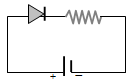
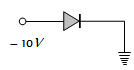
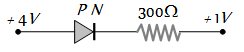
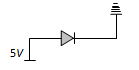
What is the current in the circuit shown below
  • 0 amp
  • B
     $10^{-2} amp$
  • C
    1 amp
  • D
    0.10 amp
Answer
Correct option: A.
0 amp
0 amp
View full question & answer
MCQ 2771 Mark
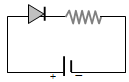
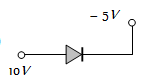
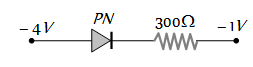
In the circuit given below, the value of the current is
  • A
    $0$ amp
  • $10^{-2} amp$
  • C
    $10^2 amp$
  • D
    $10^{-3} amp$
Answer
Correct option: B.
$10^{-2} amp$
(b) $10^{-2} amp$
View full question & answer
MCQ 2781 Mark
The electrical resistance of depletion layer is large because
  • It has no charge carriers
  • B
    It has a large number of charge carriers
  • C
    It contains electrons as charge carriers
  • D
    It has holes as charge carriers
Answer
Correct option: A.
It has no charge carriers
 It has no charge carriers
View full question & answer
MCQ 2791 Mark
The reverse biasing in a PN junction diode
  • A
    Decreases the potential barrier
  • Increases the potential barrier
  • C
    Increases the number of minority charge carriers
  • D
    Increases the number of majority charge carriers
Answer
Correct option: B.
Increases the potential barrier
View full question & answer
MCQ 2801 Mark
PN-junction diode works as a insulator, if connected
  • A
    To A.C.
  • B
    In forward bias
  • In reverse bias
  • D
    None of these
Answer
Correct option: C.
In reverse bias
In reverse bias
View full question & answer
MCQ 2811 Mark
The electrical circuit used to get smooth dc output from a rectifier circuit is called
  • A
    Oscillator
  • Filter
  • C
     Amplifier
  • D
    Logic gates
Answer
Correct option: B.
Filter
Filter
View full question & answer
MCQ 2821 Mark
The cut-in voltage for silicon diode is approximately
  • A
    0.2 V
  • 0.6 V
  • C
    1.1 V
  • D
    1.4 V
Answer
Correct option: B.
0.6 V
0.6 V
View full question & answer
MCQ 2831 Mark
In the forward bias arrangement of a PN-junction diode
  • A
     The N-end is connected to the positive terminal of the battery
  •  The P-end is connected to the positive terminal of the battery
  • C
     The direction of current is from N-end to P-end in the diode
  • D
     The P-end is connected to the negative terminal of battery
Answer
Correct option: B.
 The P-end is connected to the positive terminal of the battery
 The P-end is connected to the positive terminal of the battery
View full question & answer
MCQ 2841 Mark
In a junction diode, the holes are due to
  • A
    Protons
  • B
    Neutrons
  • C
    Extra electrons
  • Missing of electrons
Answer
Correct option: D.
Missing of electrons
View full question & answer
MCQ 2851 Mark
The approximate ratio of resistances in the forward and reverse bias of the PN-junction diode is
  • A
    $10^2: 1$
  • B
    $10^{-2}: 1$
  • C
    $1: 10^{-4}$
  • $1: 10^4$
Answer
Correct option: D.
$1: 10^4$
(d) $1: 10^4$
View full question & answer
MCQ 2861 Mark
A semiconductor device is connected in a series circuit with a battery and a resistance. A current is found to pass through the circuit. If the polarity of the battery is reversed, the current drops almost to zero. The device may be
  • A
    A P-type semiconductor
  • B
    An N-type semiconductor
  • A PN-junction
  • D
    An intrinsic semiconductor
Answer
Correct option: C.
A PN-junction
A PN-junction
View full question & answer
MCQ 2871 Mark
Which of the following statements concerning the depletion zone of an unbiased PN junction is (are) true
  • A
    The width of the zone is independent of the densities of the dopants (impurities)
  • B
    The width of the zone is dependent on the densities of the dopants
  • C
    The electric field in the zone is produced by the ionized dopant atoms
  • b, c
Answer
Correct option: D.
b, c
 b, c
View full question & answer
MCQ 2881 Mark
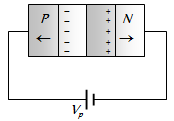
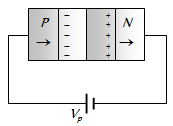
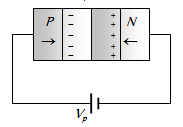
In the case of forward biasing of PN-junction, which one of the following figures correctly depicts the direction of flow of carriers
 
  • A
  • B
  • D
Answer
Correct option: C.
View full question & answer
MCQ 2891 Mark
On increasing the reverse bias to a large value in a PN-junction diode, current
  • A
    Increases slowly
  • B
    Remains fixed
  • Suddenly increases
  • D
    Decreases slowly
Answer
Correct option: C.
Suddenly increases
Suddenly increases
View full question & answer
MCQ 2901 Mark
The energy gap of silicon is $1.14  eV. $The maximum wavelength at which silicon will begin absorbing energy is
  • $10888 \mathring A$
  • B
    $1088.8 \mathring A$
  • C
    $108.88 \mathring A$
  • D
    $10.888 \mathring A$
Answer
Correct option: A.
$10888 \mathring A$
$10888 \mathring A$
View full question & answer
MCQ 2911 Mark
In a PN-junction diode
  •  The current in the reverse biased condition is generally very small
  • B
     The current in the reverse biased condition is small but the forward biased current is independent of the bias voltage
  • C
    The reverse biased current is strongly dependent on the applied bias voltage
  • D
     The forward biased current is very small in comparison to reverse biased current
Answer
Correct option: A.
 The current in the reverse biased condition is generally very small
 The current in the reverse biased condition is generally very small
View full question & answer
MCQ 2921 Mark
Doping of intrinsic semiconductor is done
  • A
    To neutralize charge carriers
  • To increase the concentration of majority charge carriers
  • C
    To make it neutral before disposal
  • D
    To carry out further purification
Answer
Correct option: B.
To increase the concentration of majority charge carriers
View full question & answer
MCQ 2931 Mark
A semiconductor dopped with a donor impurity is
  • A
     P-type
  • N-type
  • C
    NPN type
  • D
    PNP type
Answer
Correct option: B.
N-type
 N-type
View full question & answer
MCQ 2941 Mark
Carbon, silicon and Germanium atoms have four valence electrons each. Their valence and conduction band are separated by energy band gaps represented by $\left(E_g\right)_C \cdot\left(E_g\right)_{s i}$ and $\left(E_g\right)_{G e}$ respectively. Which one of the following relationship is true in their case
  •  $\left(E_g\right) C>\left(E_g\right) Si$
  • B
     $\left(E_g\right) C=\left(E_g\right) Si$
  • C
    $\left( E _{ g }\right) C <\left( E _{ g }\right) Ge$
  • D
     $\left( E _{ g }\right) C <\left( E _{ g }\right) Si$
Answer
Correct option: A.
 $\left(E_g\right) C>\left(E_g\right) Si$
$\left(E_g\right) C>\left(E_g\right) Si$
View full question & answer
MCQ 2951 Mark
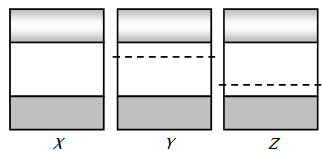
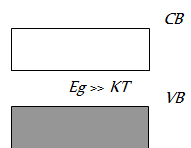
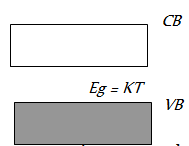
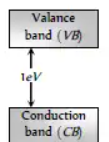
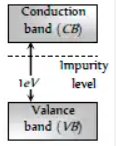
The energy band diagrams for three semiconductor samples of silicon are as shown. We can then assert that
  • Sample X is undoped while samples Y and Z have been doped with a third group and a fifth group impurity respectively
  • B
    Sample X is undoped while both samples Y and Z have been doped with a fifth group impurity
  • C
    Sample X has been doped with equal amounts of third and fifth group impurities while samples Y and Z are undoped
  • D
    Sample X is undoped while samples Y and Z have been doped with a fifth group and a third group impurity respectively
Answer
Correct option: A.
Sample X is undoped while samples Y and Z have been doped with a third group and a fifth group impurity respectively
(a) Sample X is undoped while samples Y and Z have been doped with a third group and a fifth group impurity respectively
View full question & answer
MCQ 2961 Mark
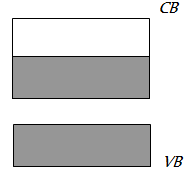
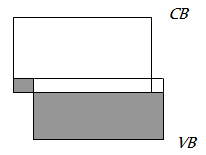
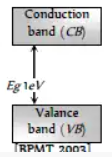
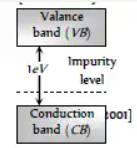
Which of the energy band diagrams shown in the figure corresponds to that of a semiconductor
  • A
  • B
  • C
Answer
Correct option: D.
View full question & answer
MCQ 2971 Mark
The electron mobility in $N-$type germanium is $3900 \mathrm{~cm}^2 / \mathrm{v}-s$ and its conductivity is $6.24 \ \mathrm{mho} / \mathrm{cm}$, then impurity concentration will be if the effect of cotters is negligible
  • A
    $ 10^{15} \mathrm{~cm}^3$
  • B
    $ 10^{13} / \mathrm{cm}^3$
  • C
    $ 10^{12} / \mathrm{cm}^3$
  • $ 10^{16} / \mathrm{cm}^3$
Answer
Correct option: D.
$ 10^{16} / \mathrm{cm}^3$
View full question & answer
MCQ 2981 Mark
The relation between the number of free electrons in semiconductors (n) and its temperature (T) is
  • A
    $n \propto T^2$
  • B
    $n \propto T$
  • C
    $n \propto \sqrt{ T }$
  • $n \propto T^{3 / 2}$
Answer
Correct option: D.
$n \propto T^{3 / 2}$
(d) $n \propto T^{3 / 2}$
View full question & answer
MCQ 2991 Mark
The mobility of free electron is greater than that of free holes because
  • A
    The carry negative charge
  • B
    They are light
  • C
    They mutually collide less
  • They require low energy to continue their motion
Answer
Correct option: D.
They require low energy to continue their motion
 They require low energy to continue their motion
View full question & answer
M.C.Q (1 Marks) - Page 6 - Physics STD 12 Science Questions - Vidyadip