Questions · Page 5 of 9

M.C.Q (1 Marks)

MCQ 2011 Mark
The transistors provide good power amplification when they are used in
  • A
    Common collector configuration
  • Common emitter configuration
  • C
    Common base configuration
  • D
    None of these
Answer
Correct option: B.
Common emitter configuration
View full question & answer
MCQ 2021 Mark
Least doped region in a transistor
  • A
    Either emitter or collector
  • Base
  • C
    Emitter
  • D
    Collector
Answer
Correct option: B.
Base
Base
View full question & answer
MCQ 2031 Mark
In a common emitter transistor, the current gain is 80. What is the change in collector current, when the change in base current is 250 mA
  • 80 × 250 mA
  • B
    (250 – 80) mA
  • C
    (250 + 80) mA
  • D
    250/80 mA
Answer
Correct option: A.
80 × 250 mA
80 × 250 mA
View full question & answer
MCQ 2051 Mark
In P-N junction, the barrier potential offers resistance to
  • Free electrons in N region and holes in P region
  • B
    Free electrons in P region and holes in N region
  • C
    Only free electrons in N region
  • D
    Only holes in P region
Answer
Correct option: A.
Free electrons in N region and holes in P region
View full question & answer
MCQ 2061 Mark
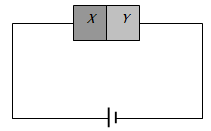
A semiconductor X is made by doping a germanium crystal with arsenic (Z = 33). A second semiconductor Y is made by doping germanium with indium (Z = 49). The two are joined end to end and connected to a battery as shown. Which of the following statements is correct
  • A
    X is P-type, Y is N-type and the junction is forward biased
  • B
     X is N-type, Y is P-type and the junction is forward biased
  • C
     X is P-type, Y is N-type and the junction is reverse biased
  •  X is N-type, Y is P-type and the junction is reverse biased
Answer
Correct option: D.
 X is N-type, Y is P-type and the junction is reverse biased
X is N-type, Y is P-type and the junction is reverse biased
View full question & answer
MCQ 2071 Mark
The width of forbidden gap in silicon crystal is 1.1 eV. When the crystal is converted in to a N-type semiconductor the distance of Fermi level from conduction band is
  • A
    Greater than 0.55 eV
  • B
    Equal to 0.55 eV
  • Lesser than 0.55 eV
  • D
    Equal to 1.1 eV
Answer
Correct option: C.
Lesser than 0.55 eV
Lesser than 0.55 eV
View full question & answer
MCQ 2081 Mark
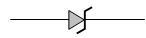
Zener diode is used as
  • A
    Half wave rectifier
  • B
    Full wave rectifier
  • ac voltage stabilizer
  • D
    dc voltage stabilizer
Answer
Correct option: C.
ac voltage stabilizer
View full question & answer
MCQ 2091 Mark
In a PNP transistor working as a common-base amplifier, current gain is 0.96 and emitter current is 7.2 mA. The base current is
  • A
     0.4 mA
  • B
     0.2 mA
  •  0.29 mA
  • D
    0.35 mA
Answer
Correct option: C.
 0.29 mA
0.29 mA
View full question & answer
MCQ 2101 Mark
For a common base configuration of PNP transistor $\frac{1_{ C }}{1_{ E }}=0.98$ then maximum current gain in common emitter configuration will be
  • A
     12
  •  24
  • C
     6
  • D
     5
Answer
Correct option: B.
 24
24
View full question & answer
MCQ 2111 Mark
If $a = 0.98$ and current through emitter $i_e= 20 \ mA$, the value of $b$ is
  • A
    $4.9$
  • $49$
  • C
    $96$
  • D
    $9.6$
Answer
Correct option: B.
$49$
$49$
View full question & answer
MCQ 2121 Mark
Which of the following is true
  • A
    Common base transistor is commonly used because current gain is maximum
  • Common emitter is commonly used because current gain is maximum
  • C
    Common collector is commonly used because current gain is maximum
  • D
    Common emitter is the least used transistor
Answer
Correct option: B.
Common emitter is commonly used because current gain is maximum

Common emitter is commonly used because current gain is maximum
View full question & answer
MCQ 2131 Mark
In the case of constants a and b of a transistor
  • A
    a = b
  • B
    b < 1 a > 1
  • C
    ab = 1
  • b > 1 a < 1
Answer
Correct option: D.
b > 1 a < 1
 b > 1 a < 1
View full question & answer
MCQ 2141 Mark
A NPN transistor conducts when
  • A
    Both collector and emitter are positive with respect to the base
  • Collector is positive and emitter is negative with respect to the base
  • C
    + Collector is positive and emitter is at same potential as the base
  • D
     Both collector and emitter are negative with respect to the base
Answer
Correct option: B.
Collector is positive and emitter is negative with respect to the base
View full question & answer
MCQ 2151 Mark
In an NPN transistor the collector current is 24 mA. If 80% of electrons reach collector its base current in mA is
  • A
    36
  • B
    26
  • C
    16
  •  6
Answer
Correct option: D.
 6
 6
View full question & answer
MCQ 2161 Mark
The emitter-base junction of a transistor is …… biased while the collector-base junction is ……. biased
  • A
     Reverse, forward
  • B
     Reverse, reverse
  • C
    Forward, forward
  • Forward, reverse
Answer
Correct option: D.
Forward, reverse
 Forward, reverse
View full question & answer
MCQ 2171 Mark
An oscillator is nothing but an amplifier with
  •  Positive feed back
  • B
    Large gain
  • C
    No feedback
  • D
    Negative feedback
Answer
Correct option: A.
 Positive feed back
Positive feed back
View full question & answer
MCQ 2181 Mark
The phase difference between input and output voltages of a $\ce{CE}$ circuit is
  • A
    $ 0^{\circ} $
  • B
    $ 90^{\circ} $
  • $ 180^{\circ} $
  • D
    $ 270^{\circ}$
Answer
Correct option: C.
$ 180^{\circ} $
$ 180^{\circ}$
View full question & answer
MCQ 2191 Mark
When NPN transistor is used as an amplifier
  •  Electrons move from base to collector
  • B
    Holes move from emitter to base
  • C
    Electrons move from collector to base
  • D
    Holes move from base to emitter
Answer
Correct option: A.
 Electrons move from base to collector
Electrons move from base to collector
View full question & answer
MCQ 2201 Mark
In a full wave rectifiers, input ac current has a frequency ‘n’. The output frequency of current is
  • A
    n/2
  • B
    n
  • 2n
  • D
    None of these
Answer
Correct option: C.
2n
2n
View full question & answer
MCQ 2211 Mark
If a full wave rectifier circuit is operating from 50 Hz mains, the fundamental frequency in the ripple will be
  • A
    50 Hz
  • B
    70.7 Hz
  • 100 Hz
  • D
    25 Hz
Answer
Correct option: C.
100 Hz
 100 Hz
View full question & answer
MCQ 2221 Mark
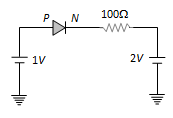
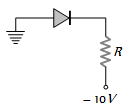
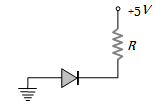
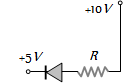
The current through an ideal PN-junction shown in the following circuit diagram will be
  •  Zero
  • B
     1 mA
  • C
     10 mA
  • D
     30 mA
Answer
Correct option: A.
 Zero
 Zero
View full question & answer
MCQ 2231 Mark
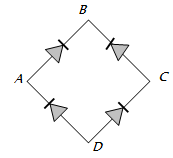
In the diagram, the input is across the terminals A and C and the output is across the terminals B and D, then the output is
  • A
    Zero
  • B
    Same as input
  • Full wave rectifier
  • D
    Half wave rectifier
Answer
Correct option: C.
Full wave rectifier
Full wave rectifier
View full question & answer
MCQ 2241 Mark
The depletion layer in silicon diode is $1 \ mm$ wide and the knee potential is $0.6 V,$ then the electric field in the depletion layer will be
  • A
    Zero
  • B
    $ 0.6\  \mathrm{Vm}^{-1} $
  • $ 6 \times 10^4 \mathrm{~V} / \mathrm{m} $
  • D
    $ 6 \times 10^5 \mathrm{~V} / \mathrm{m}$
Answer
Correct option: C.
$ 6 \times 10^4 \mathrm{~V} / \mathrm{m} $
$ 6 \times 10^5 \mathrm{~V} / \mathrm{m}$
View full question & answer
MCQ 2251 Mark
Which is the wrong statement in following sentences? A device in which P and N-type semiconductors are used is more useful then a vacuum type because
  • A
    Power is not necessary to heat the filament
  • B
    It is more stable
  • C
    Very less heat is produced in it
  • Its efficiency is high due to a high voltage across the junction
Answer
Correct option: D.
Its efficiency is high due to a high voltage across the junction
 Its efficiency is high due to a high voltage across the junction
View full question & answer
MCQ 2261 Mark
To make a PN junction conducting
  • The value of forward bias should be more than the barrier potential
  • B
    The value of forward bias should be less than the barrier potential
  • C
    The value of reverse bias should be more than the barrier potential
  • D
    The value of reverse bias should be less than the barrier potential
Answer
Correct option: A.
The value of forward bias should be more than the barrier potential
View full question & answer
MCQ 2271 Mark
If no external voltage is applied across P-N junction, there would be
  • A
    No electric field across the junction
  •  An electric field pointing from N-type to P-type side across the junction
  • C
    An electric field pointing from P-type to N-type side across the junction
  • D
    A temporary electric field during formation of P-N junction that would subsequently disappear
Answer
Correct option: B.
 An electric field pointing from N-type to P-type side across the junction
An electric field pointing from N-type to P-type side across the junction
View full question & answer
MCQ 2281 Mark
A potential barrier of 0.50 V exists across a P-N junction. If the depletion region is $5.0 \times 10^{-7} V / m$  wide, the intensity of the electric field in this region is
  •  $1.0 \times 10^6 V / m$
  • B
     $1.0 \times 10^5 V / m$
  • C
     $2.0 \times 10^5 V / m$
  • D
     $2.0 \times 10^6 V / m$
Answer
Correct option: A.
 $1.0 \times 10^6 V / m$
$1.0 \times 10^6 V / m$
View full question & answer
MCQ 2291 Mark
No bias is applied to a P-N junction, then the current
  • A
    Is zero because the number of charge carriers flowing on both sides is same
  • Is zero because the charge carriers do not move
  • C
    Is non-zero
  • D
    None of these
Answer
Correct option: B.
Is zero because the charge carriers do not move
View full question & answer
MCQ 2301 Mark
Which one of the following statements is not correct
  • A
    A diode does not obey Ohm's law
  • B
    A PN junction diode symbol shows an arrow identifying the direction of current (forward) flow
  • An ideal diode is an open switch
  • D
    An ideal diode is an ideal one way conductor
Answer
Correct option: C.
An ideal diode is an open switch
View full question & answer
MCQ 2321 Mark
Consider the following statements A and B and identify the correct choice of the given answers
(A) A zener diode is always connected in reverse bias
(B) The potential barrier of a PN junction lies between 0.1 to 0.3 V approximately
  • A
    A and B are correct
  • B
    A and B are wrong
  • A is correct but B is wrong
  • D
    A is wrong but B is correct
Answer
Correct option: C.
A is correct but B is wrong
 A is correct but B is wrong
View full question & answer
MCQ 2331 Mark
Zener breakdown takes place if
  • A
    Doped impurity is low
  • Doped impurity is high
  • C
    Less impurity in N-part
  • D
    Less impurity in P-type
Answer
Correct option: B.
Doped impurity is high
View full question & answer
MCQ 2341 Mark
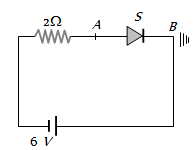
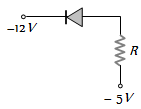
The diode shown in the circuit is a silicon diode. The potential difference between the points A and B will be
  • 6 V
  • B
    0.6 V
  • C
    0.7 V
  • D
    0 V
Answer
Correct option: A.
6 V
6 V
View full question & answer
MCQ 2351 Mark
In order to forward bias a PN junction, the negative terminal of battery is connected to
  • A
    P–side
  • B
    Either P–side or N–side
  • N–side
  • D
    None of these
Answer
Correct option: C.
N–side
N–side
View full question & answer
MCQ 2361 Mark
Select the correct statement
  • In a full wave rectifier, two diodes work alternately
  • B
    In a full wave rectifier, two diodes work simultaneously
  • C
    The efficiency of full wave and half wave rectifiers is same
  • D
    The full wave rectifier is bi-directional.
Answer
Correct option: A.
In a full wave rectifier, two diodes work alternately
 In a full wave rectifier, two diodes work alternately
View full question & answer
MCQ 2371 Mark
Serious draw back of the semiconductor device is
  • They cannot be used with high voltage
  • B
    They pollute the environment
  • C
    They are costly
  • D
    They do not last for long time
Answer
Correct option: A.
They cannot be used with high voltage
 They cannot be used with high voltage
View full question & answer
MCQ 2381 Mark
The maximum efficiency of full wave rectifier is
  • A
    100%
  • B
    25.20%
  • C
    40.2%
  • 81.2%
Answer
Correct option: D.
81.2%
 81.2%
View full question & answer
MCQ 2401 Mark
In a PN junction photo cell, the value of photo-electromotive force produced by monochromatic light is proportional to
  • A
     The voltage applied at the PN junction
  • B
     The barrier voltage at the PN junction
  •  The intensity of the light falling on the cell
  • D
     The frequency of the light falling on the cell
Answer
Correct option: C.
 The intensity of the light falling on the cell
The intensity of the light falling on the cell
View full question & answer
MCQ 2421 Mark
A crystal diode is a
  •  Non-linear device
  • B
     Amplifying device
  • C
    Linear device
  • D
    Fluctuating device
Answer
Correct option: A.
 Non-linear device
Non-linear device
View full question & answer
MCQ 2431 Mark
Barrier potential of a P-N junction diode does not depend on
  • A
    Temperature
  • B
    Forward bias
  • C
    Doping density
  • Diode design
Answer
Correct option: D.
Diode design
 Diode design
View full question & answer
MCQ 2441 Mark
In the middle of the depletion layer of a reverse-biased PN junction, the
  • A
    Potential is zero
  • B
    Electric field is zero
  • C
    Potential is maximum
  • Electric field is maximum
Answer
Correct option: D.
Electric field is maximum
View full question & answer
MCQ 2451 Mark
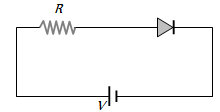
For the given circuit of PN-junction diode, which of the following statement is correct
  • In forward biasing the voltage across R is V
  • B
    In forward biasing the voltage across R is 2V
  • C
    In reverse biasing the voltage across R is V
  • D
    In reverse biasing the voltage across R is 2V
Answer
Correct option: A.
In forward biasing the voltage across R is V
View full question & answer
MCQ 2461 Mark
In a PN-junction
  • A
     P and N both are at same potential
  •  High potential at N side and low potential at P side
  • C
     High potential at P side and low potential at N side
  • D
    Low potential at N side and zero potential at P side
Answer
Correct option: B.
 High potential at N side and low potential at P side
High potential at N side and low potential at P side
View full question & answer
MCQ 2471 Mark
The dominant mechanisms for motion of charge carriers in forward and reverse biased silicon P-N junctions are
  • A
    Drift in forward bias, diffusion in reverse bias
  • Diffusion in forward bias, drift in reverse bias
  • C
    Diffusion in both forward and reverse bias
  • D
    Drift in both forward and reverse bias
Answer
Correct option: B.
Diffusion in forward bias, drift in reverse bias
View full question & answer
MCQ 2481 Mark
If the two ends P and N of a P-N diode junction are joined by a wire
  •  There will not be a steady current in the circuit
  • B
     There will be a steady current from N side to P side
  • C
     There will be a steady current from P side to N side
  • D
     There may not be a current depending upon the resistance of the connecting wire
Answer
Correct option: A.
 There will not be a steady current in the circuit
There will not be a steady current in the circuit
View full question & answer
MCQ 2491 Mark
When the P end of P-N junction is connected to the negative terminal of the battery and the N end to the positive terminal of the battery, then the P-N junction behaves like
  • A
     A conductor
  • An insulator
  • C
    A super-conductor
  • D
    A semi-conductor
Answer
Correct option: B.
An insulator
An insulator
View full question & answer
MCQ 2501 Mark
Function of rectifier is
  •  To convert ac into dc
  • B
     To convert dc into ac
  • C
    Both (a) and (b)
  • D
    None of these
Answer
Correct option: A.
 To convert ac into dc
To convert ac into dc
View full question & answer
M.C.Q (1 Marks) - Page 5 - Physics STD 12 Science Questions - Vidyadip