Question 13 Marks
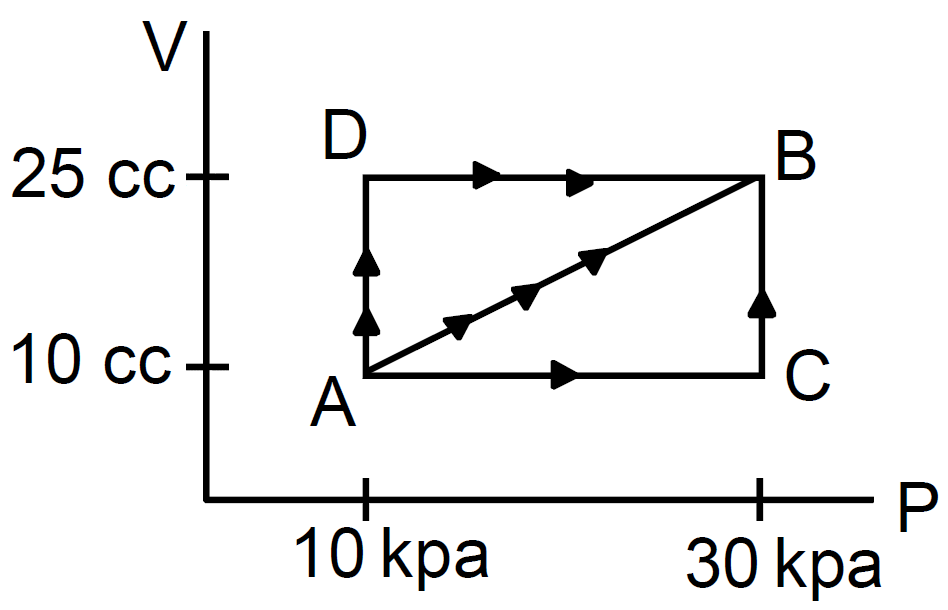
Figure. shows three paths through which a gas can be taken from the state A to the state B. Calculate the work done by the gas in each of the three paths.
Answer
View full question & answer→In path ACB,
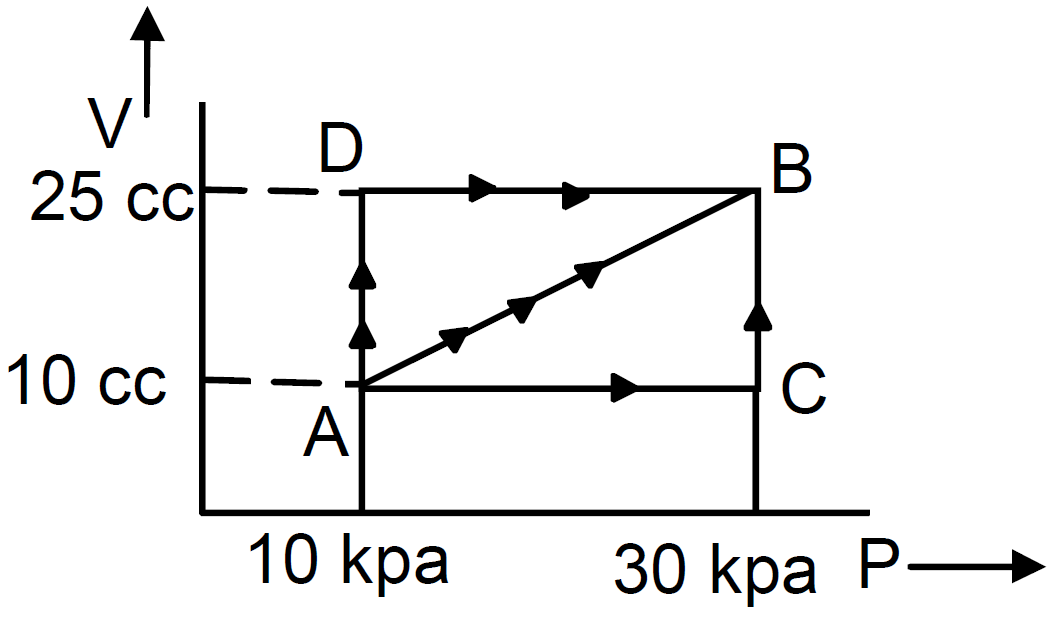
$W_{AC} + W_{BC} = 0 + pdv = 30 \times 10^3(25 - 10) \times 10^{-6} = 0.45J$
In path AB, $W_{AB} =\frac{1}{2} \times (10 + 30) \times 10^3\times 15 × 10^{-6} = 0.30\text{J}$
In path ADB,$ W = W_{AD} + W_{DB} = 10 \times 10^3(25 - 10) \times 10^{-6} + 0 = 0.15J$
$W_{AC} + W_{BC} = 0 + pdv = 30 \times 10^3(25 - 10) \times 10^{-6} = 0.45J$
In path AB, $W_{AB} =\frac{1}{2} \times (10 + 30) \times 10^3\times 15 × 10^{-6} = 0.30\text{J}$
In path ADB,$ W = W_{AD} + W_{DB} = 10 \times 10^3(25 - 10) \times 10^{-6} + 0 = 0.15J$
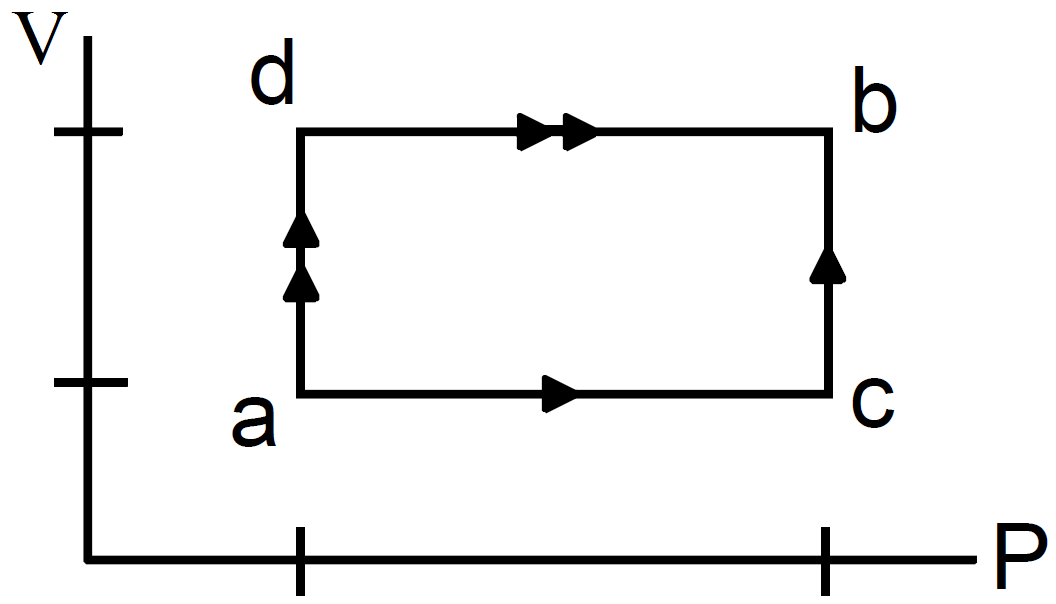
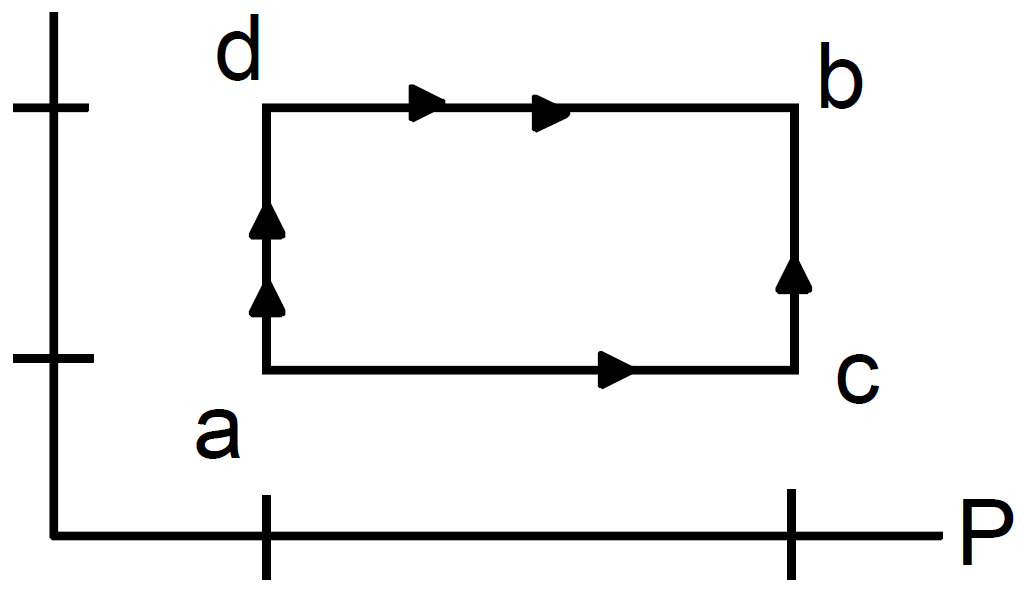 $\Delta\text{Q}=\Delta\text{U}+\Delta\text{W}$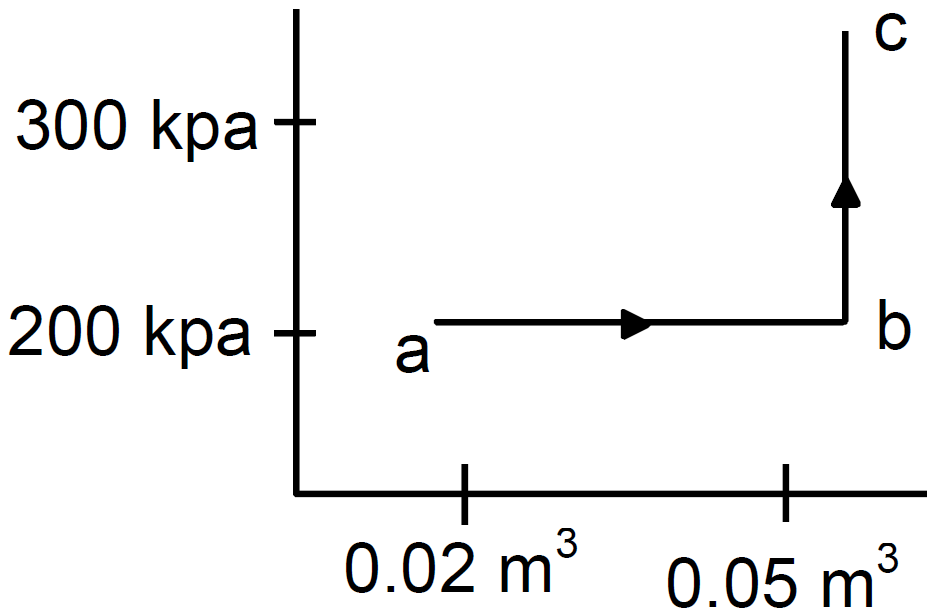
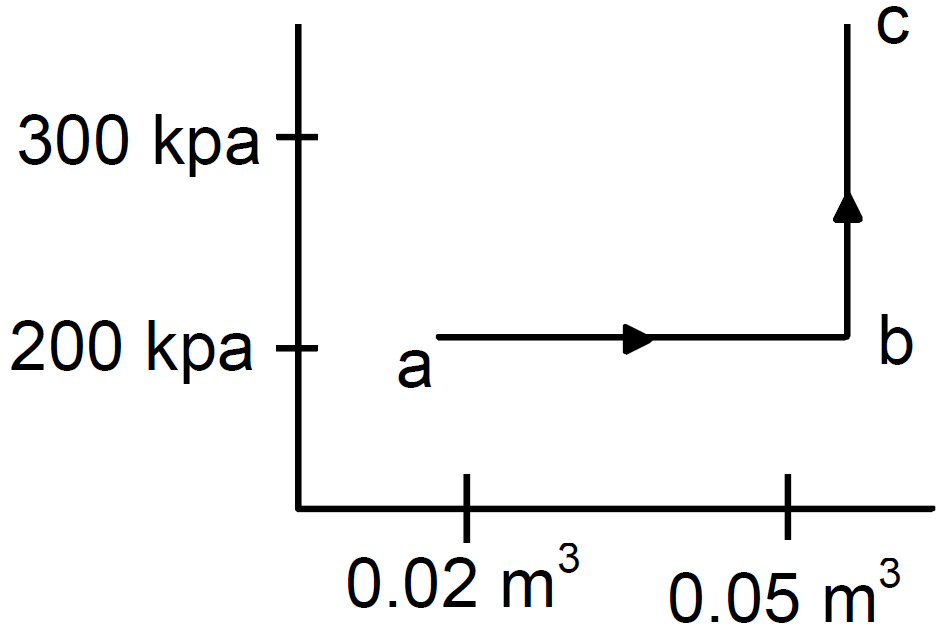 Now, $\Delta\text{Q}=(2625\times\text{J)J}$