Questions · Page 2 of 11

M.C.Q (1 Marks)

MCQ 511 Mark
A point object O is placed on the principal axis of a convex lens of focal length 20 cm at a distance of 40 cm to the left of it. The diameter of the lens is 10 cm. If the eye is placed 60 cm to the right of the lens at a distance h below the principal axis, then the maximum value of h to see the image will be
  • A
     0
  • B
    5 cm
  • 2.5 cm
  • D
     10 cm
Answer
Correct option: C.
2.5 cm
2.5 cm
View full question & answer
MCQ 521 Mark
If the focal length of objective and eye lens are 1.2 cm and 3 cm respectively and the object is put 1.25 cm away from the objective lens and the final image is formed at infinity. The magnifying power of the microscope is
  • A
    150
  • 200
  • C
    250
  • D
    400
Answer
Correct option: B.
200
 200
View full question & answer
MCQ 531 Mark
The length of the compound microscope is 14 cm. The magnifying power for relaxed eye is 25. If the focal length of eye lens is 5 cm, then the object distance for objective lens will be
  • 1.8 cm
  • B
     1.5 cm
  • C
    2.1 cm
  • D
    2.4 cm
Answer
Correct option: A.
1.8 cm
 1.8 cm
View full question & answer
MCQ 541 Mark
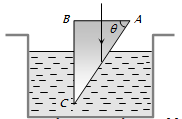
A glass prism (μ = 1.5) is dipped in water (μ = 4/3) as shown in figure. A light ray is incident normally on the surface AB. It reaches the surface BC after totally reflected, if
  • $\sin \theta \geq 8/9 $
  • B
    $2 / 3<\sin \theta<8 / 9$
  • C
    $\sin \theta \leq 2 / 3$
  • D
    It is not possible
Answer
Correct option: A.
$\sin \theta \geq 8/9 $
$\sin \theta \geq 8 / 9$
View full question & answer
MCQ 551 Mark
If in compound microscope $m_1$ and $m_2$ be the linear magnification of the objective lens and eye lens respectively, then magnifying power of the compound microscope will be
  • A
    $m_1-m_2$
  • B
    $\sqrt{m_1+m_2}$
  • C
    $\left(m_1+m_2\right) / 2$
  • $m _1 \times m _2$
Answer
Correct option: D.
$m _1 \times m _2$
(d) $m _1 \times m _2$
View full question & answer
MCQ 561 Mark
Magnifying power of a simple microscope is (when final image is formed at D = 25 cm from eye)
  • A
    $\frac{D}{f}$
  • $1+\frac{ D }{ f }$
  • C
    $1+\frac{ f }{ D }$
  • D
    $1-\frac{D}{f}$
Answer
Correct option: B.
$1+\frac{ D }{ f }$
(b) $1+\frac{ D }{ f }$
View full question & answer
MCQ 571 Mark
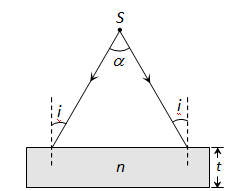
A diverging beam of light from a point source S having divergence angle a, falls symmetrically on a glass slab as shown. The angles of incidence of the two extreme rays are equal. If the thickness of the glass slab is t and the refractive index n, then the divergence angle of the emergent beam is
  • A
    Zero
  • $\alpha$
  • C
    $\sin ^{-1}(1 / n)$
  • D
    $2 \sin ^{-1}(1 / n)$
Answer
Correct option: B.
$\alpha$
$\alpha$
View full question & answer
MCQ 581 Mark
One face of a rectangular glass plate 6 cm thick is silvered. An object held 8 cm in front of the first face, forms an image 12 cm behind the silvered face. The refractive index of the glass is
  • A
     0.4
  • B
     0.8
  • 1.2
  • D
     1.6
Answer
Correct option: C.
1.2
1.2
View full question & answer
MCQ 591 Mark
Microscope is an optical instrument which
  • A
    Enlarges the object
  • Increases the visual angle formed by the object at the eye
  • C
     Decreases the visual angle formed by the object at the eye
  • D
     Brings the object nearer
Answer
Correct option: B.
Increases the visual angle formed by the object at the eye
 Increases the visual angle formed by the object at the eye
View full question & answer
MCQ 601 Mark
Light enters at an angle of incidence in a transparent rod of refractive index n. For what value of the refractive index of the material of the rod the light once entered into it will not leave it through its lateral face whatsoever be the value of angle of incidence
  •  $n>\sqrt{2}$
  • B
     n = 1
  • C
     n = 1.1
  • D
     n = 1.3
Answer
Correct option: A.
 $n>\sqrt{2}$
 $n>\sqrt{2}$
View full question & answer
MCQ 611 Mark
A ray of light falls on the surface of a spherical glass paper weight making an angle α with the normal and is refracted in the medium at an angle β. The angle of deviation of the emergent ray from the direction of the incident ray
  • A
     (α - β)
  •  2(α- β)
  • C
     (α – β)/2
  • D
     (β - α)
Answer
Correct option: B.
 2(α- β)
2(α- β)
View full question & answer
MCQ 621 Mark
A thin rod of length f/3 lies along the axis of a concave mirror of focal length f. One end of its magnified image touches an end of the rod. The length of the image is
  • A
     $f$
  • $\frac{1}{2} f$
  • C
     $2 f$
  • D
    $\frac{1}{4} f$
Answer
Correct option: B.
$\frac{1}{2} f$
$\frac{1}{2} f$
View full question & answer
MCQ 631 Mark
The focal length of the objective lens of a compound microscope is
  • A
    Equal to the focal length of its eye piece
  •  Less than the focal length of eye piece
  • C
     Greater than the focal length of eye piece
  • D
     Any of the above three
Answer
Correct option: B.
 Less than the focal length of eye piece
Less than the focal length of eye piece
View full question & answer
MCQ 641 Mark
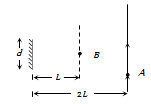
A point source of light B is placed at a distance L in front of the centre of a mirror of width d hung vertically on a wall. A man walks in front of the mirror along a line parallel to the mirror at a distance 2L from it as shown. The greatest distance over which he can see the image of the light source in the mirror is
  • A
     d/2
  • B
     d
  • C
    2d
  • 3d
Answer
Correct option: D.
3d
3d
View full question & answer
MCQ 651 Mark
In a compound microscope magnification will be large, if the focal length of the eye piece is
  • A
     Large
  • Smaller
  • C
    Equal to that of objective
  • D
    Less than that of objective
Answer
Correct option: B.
Smaller
Smaller
View full question & answer
MCQ 661 Mark
The focal lengths of the objective and eye-lens of a microscope are 1 cm and 5 cm respectively. If the magnifying power for the relaxed eye is 45, then the length of the tube is
  • A
    30 cm
  • B
     25 cm
  • 15 cm
  • D
    12 cm
Answer
Correct option: C.
15 cm
15 cm
View full question & answer
MCQ 671 Mark
A person uses spectacles of power +2D. He is suffering from
  • A
     Short sightedness or myopia
  •  Long sightedness or hypermetropia
  • C
     Presbyopia
  • D
     Astigmatism
Answer
Correct option: B.
 Long sightedness or hypermetropia
 Long sightedness or hypermetropia
View full question & answer
MCQ 681 Mark
A man cannot see clearly the objects beyond a distance of 20 cm from his eyes. To see distant objects clearly he must use which kind of lenses and of what focal length
  • A
     100 cm convex
  • B
     100 cm concave
  • C
     20 cm convex
  •  20 cm concave
Answer
Correct option: D.
 20 cm concave
20 cm concave
View full question & answer
MCQ 691 Mark
Amount of light entering into the camera depends upon
  • A
    Focal length of the objective lens
  • B
     Product of focal length and diameter of the objective lens
  • C
    Distance of the object from camera
  • Aperture setting of the camera
Answer
Correct option: D.
Aperture setting of the camera
 Aperture setting of the camera
View full question & answer
MCQ 701 Mark
The hyper-metropia is a
  • A
     Short-side defect
  •  Long- side defect
  • C
     Bad vision due to old age
  • D
    None of these
Answer
Correct option: B.
 Long- side defect
Long- side defect
View full question & answer
MCQ 711 Mark
Retina of eye acts like ........ of camera
  • A
    Shutter
  • Film
  • C
     Lens
  • D
    None of these
Answer
Correct option: B.
Film
Film
View full question & answer
MCQ 721 Mark
Two parallel pillars are 11 km away from an observer. The minimum distance between the pillars so that they can be seen separately will be
  • 3.2 m
  • B
     20.8 m
  • C
     91.5 m
  • D
    183 m
Answer
Correct option: A.
3.2 m
3.2 m
View full question & answer
MCQ 731 Mark
When the object is self-luminous, the resolving power of a microscope is given by the expression
  • $\frac{2 \mu \sin \theta}{1.22 \lambda}$
  • B
    $\frac{\mu \sin \theta}{\lambda}$
  • C
    $\frac{2 \mu \cos \theta}{1.22 \lambda}$
  • D
    $\frac{2 \mu}{\lambda}$
Answer
Correct option: A.
$\frac{2 \mu \sin \theta}{1.22 \lambda}$
(a) $\frac{2 \mu \sin \theta}{1.22 \lambda}$
View full question & answer
MCQ 741 Mark
The maximum magnification that can be obtained with a convex lens of focal length 2.5 cm is (the least distance of distinct vision is 25 cm)
  • A
     10
  • B
    0.1
  • C
     62.5
  •  11
Answer
Correct option: D.
 11
11
View full question & answer
MCQ 751 Mark
The magnifying power of a microscope with an objective of 5 mm focal length is 400. The length of its tube is 20 cm. Then the focal length of the eye-piece is
  • A
    200 cm
  • B
    160 cm
  • 2.5 cm
  • D
    0.1 cm
Answer
Correct option: C.
2.5 cm
2.5 cm
View full question & answer
MCQ 761 Mark
An electron microscope is superior to an optical microscope in
  •  Having better resolving power
  • B
     Being easy to handle
  • C
    Low cost
  • D
     Quickness of observation
Answer
Correct option: A.
 Having better resolving power
Having better resolving power
View full question & answer
MCQ 771 Mark
The magnifying power of a simple microscope can be increased, if we use eye-piece of
  • A
    Higher focal length
  • Smaller focal length
  • C
    Higher diameter
  • D
    Smaller diameter
Answer
Correct option: B.
Smaller focal length
View full question & answer
MCQ 781 Mark
In a compound microscope, if the objective produces an image $I_o$ and the eye piece produces an image $I_e$, then
  • A
    $I_o$ is virtual but $I_e$ is real
  • $I_o$ is real but $I_e$ is virtual
  • C
    $I_o$ and $I_e$ are both real
  • D
    $I_o$ and $I_e$ are both virtual
Answer
Correct option: B.
$I_o$ is real but $I_e$ is virtual
View full question & answer
MCQ 791 Mark
A person is suffering from the defect astigmatism. Its main reason is
  • A
     Distance of the eye lens from retina is increased
  • B
    Distance of the eye lens from retina is decreased
  • The cornea is not spherical
  • D
    Power of accommodation of the eye is decreased
Answer
Correct option: C.
The cornea is not spherical
 The cornea is not spherical
View full question & answer
MCQ 801 Mark
Myopia is due to
  •  Elongation of eye ball
  • B
     Irregular change in focal length
  • C
     Shortening of eye ball
  • D
     Older age
Answer
Correct option: A.
 Elongation of eye ball
Elongation of eye ball
View full question & answer
MCQ 811 Mark
Finger prints are observed by the use of
  • A
    Telescope
  •  Microscope
  • C
    Gallilean telescope
  • D
    Concave lens
Answer
Correct option: B.
 Microscope
Microscope
View full question & answer
MCQ 821 Mark
A person wears glasses of power – 2.5 D. The defect of the eye and the far point of the person without the glasses are respectively
  • A
     Farsightedness, 40 cm
  •  Nearsightedness, 40 cm
  • C
     Astigmatism, 40 cm
  • D
     Nearsightedness, 250 cm
Answer
Correct option: B.
 Nearsightedness, 40 cm
Nearsightedness, 40 cm
View full question & answer
MCQ 831 Mark
A man with defective eyes cannot see distinctly object at the distance more than 60 cm from his eyes. The power of the lens to be used will be
  • A
    $+60 D$
  • B
    $-60 D$
  • $-1.66 D$
  • D
    $\frac{1}{1.66} D$
Answer
Correct option: C.
$-1.66 D$
(c) $– 1.66 D$
View full question & answer
MCQ 841 Mark
Near and far points of a human eye are
  • A
    0 and 25 cm
  • B
     0 and ¥
  • C
    25 cm and 100 cm
  • 25 cm and ¥
Answer
Correct option: D.
25 cm and ¥
 25 cm and ¥
View full question & answer
MCQ 851 Mark
Match the List I with the List II from the combinations shown
(I) Presbiopia (A) Sphero-cylindrical lens
(II) Hypermetropia (B) Convex lens of proper power may be used close to the eye
(III) Astigmatism (C) Concave lens of suitable focal length
(IV) Myopia (D) Bifocal lens of suitable focal length
  • A
     I-A; II-C; III-B; IV-D
  • B
    I-B; II-D; III-C; IV-A
  •  I-D; II-B; III-A; IV-C
  • D
     I-D; II-A; III-C; IV-B
Answer
Correct option: C.
 I-D; II-B; III-A; IV-C
I-D; II-B; III-A; IV-C
View full question & answer
MCQ 861 Mark
An eye specialist prescribes spectacles having a combination of convex lens of focal length 40 cm in contact with a concave lens of focal length 25 cm. The power of this lens combination in diopters is
  • A
     + 1.5
  •  – 1.5
  • C
    + 6.67
  • D
    – 6.67
Answer
Correct option: B.
 – 1.5
 – 1.5
View full question & answer
MCQ 871 Mark
A person wears glasses of power – 2.0 D. The defect of the eye and the far point of the person without the glasses will be
  • Nearsighted, 50 cm
  • B
     Farsighted, 50 cm
  • C
    Nearsighted, 250 cm
  • D
    Astigmatism, 50 cm
Answer
Correct option: A.
Nearsighted, 50 cm
Nearsighted, 50 cm
View full question & answer
MCQ 881 Mark
When objects at different distances are seen by the eye, which of the following remains constant
  • A
     The focal length of the eye lens
  • B
     The object distance from the eye lens
  • C
     The radii of curvature of the eye lens
  •  The image distance from the eye lens
Answer
Correct option: D.
 The image distance from the eye lens
The image distance from the eye lens
View full question & answer
MCQ 891 Mark
A person cannot see objects clearly beyond 2.0 m. The power of lens required to correct his vision will be
  • A
     + 2.0 D
  • B
     – 1.0 D
  • C
     + 1.0 D
  •  – 0.5 D
Answer
Correct option: D.
 – 0.5 D
 – 0.5 D
View full question & answer
MCQ 901 Mark
Circular part in the centre of retina is called
  • A
     Blind spot
  • Yellow spot
  • C
    Red spot
  • D
    None of the above
Answer
Correct option: B.
Yellow spot
Yellow spot
View full question & answer
MCQ 911 Mark
A person's near point is 50 cm and his far point is 3 m. Power of the lenses he requires for
(i) reading and (ii) for seeing distant stars are
  • A
    – 2 D and 0.33 D
  •  2 D and – 0.33 D
  • C
     – 2 D and 3 D
  • D
     2 D and – 3 D
Answer
Correct option: B.
 2 D and – 0.33 D
 2 D and – 0.33 D
View full question & answer
MCQ 921 Mark
For which of the following colour, the magnifying power of a microscope will be maximum
  • A
     White colour
  • B
     Red colour
  • Violet colour
  • D
    Yellow colour
Answer
Correct option: C.
Violet colour
 Violet colour
View full question & answer
MCQ 931 Mark
The human eye has a lens which has a
  • A
    Soft portion at its centre
  • B
    Hard surface
  •  Varying refractive index
  • D
    Constant refractive index
Answer
Correct option: C.
 Varying refractive index
Varying refractive index
View full question & answer
MCQ 941 Mark
A person can see clearly only upto a distance of 25 cm. He wants to read a book placed at a distance of 50 cm. What kind of lens does he require for his spectacles and what must be its power
  • A
     Concave, – 1.0 D
  • B
     Convex, + 1.5 D
  •  Concave, – 2.0 D
  • D
    Convex, + 2.0 D
Answer
Correct option: C.
 Concave, – 2.0 D
Concave, – 2.0 D
View full question & answer
MCQ 951 Mark
A short sighted person can see distinctly only those objects which lie between 10 cm and 100 cm from him. The power of the spectacle lens required to see a distant object is
  • A
     + 0.5 D
  •  – 1.0 D
  • C
     – 10 D
  • D
     + 4.0 D
Answer
Correct option: B.
 – 1.0 D
 – 1.0 D
View full question & answer
MCQ 961 Mark
In human eye the focussing is done by
  • A
     To and fro movement of eye lens
  • B
     To and fro movement of the retina
  •  Change in the convexity of the lens surface
  • D
     Change in the refractive index of the eye fluids
Answer
Correct option: C.
 Change in the convexity of the lens surface
Change in the convexity of the lens surface
View full question & answer
MCQ 971 Mark
A man is suffering from colour blindness for green colour. To remove this defect, he should use goggles of
  • A
     Green colour glasses
  • B
     Red colour glasses
  • C
     Smoky colour glasses
  •  None of the above
Answer
Correct option: D.
 None of the above
None of the above
View full question & answer
MCQ 981 Mark
The sensation of vision in the retina is carried to the brain by
  • A
     Ciliary muscles
  • B
     Blind spot
  • C
     Cylindrical lens
  • Optic nerve
Answer
Correct option: D.
Optic nerve
Optic nerve
View full question & answer
MCQ 991 Mark
A person is suffering from myopic defect. He is able to see clear objects placed at 15 cm. What type and of what focal length of lens he should use to see clearly the object placed 60 cm away
  • Concave lens of 20 cm focal length
  • B
    Convex lens of 20 cm focal length
  • C
     Concave lens of 12 cm focal length
  • D
     Convex lens of 12 cm focal length
Answer
Correct option: A.
Concave lens of 20 cm focal length
View full question & answer
MCQ 1001 Mark
The impact of an image on the retina remains for
  •  0.1 sec
  • B
     0.5 sec
  • C
     10 sec
  • D
     15 sec
Answer
Correct option: A.
 0.1 sec
0.1 sec
View full question & answer