Questions

3 Marks Question

🎯

Test yourself on this topic

20 questions · timed · auto-graded

Question 13 Marks
The spring shown in figure is unstretched when a man starts pulling on the cord. The mass of the block is M. If the man exerts a constant force F, find
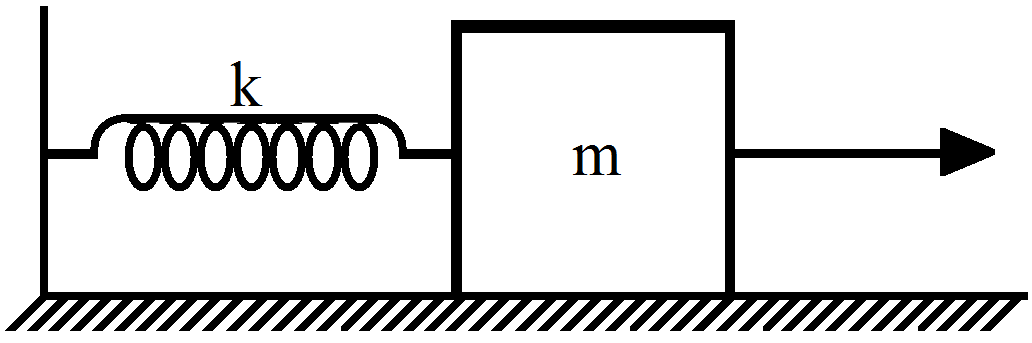
  1. The amplitude and the time period of the motion of the block,
  2. The energy stored in the spring when the block passes through the equilibrium position and,
  3. The kinetic energy of the block at this position.
Answer
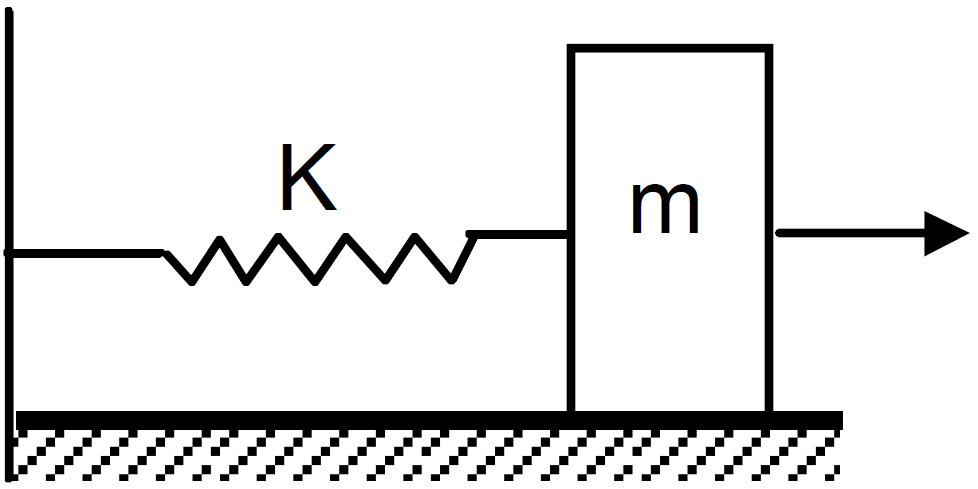
  1. We have F = kx
$\Rightarrow\text{x}=\frac{\text{F}}{\text{k}}$

Acceleration $=\frac{\text{F}}{\text{m}}$

Time period $\text{T}=2\pi\sqrt{\frac{\text{displacement}}{\text{Acceleration}}}$

$=2\pi\frac{\frac{\text{F}}{\text{k}}}{\frac{\text{F}}{\text{m}}}=2\pi\sqrt{\frac{\text{m}}{\text{k}}}$

Amplitude = max displacement $=\frac{\text{F}}{\text{k}}$
  1. The energy stored in the spring when the block passes through the equilibrium position,
$\Big(\frac{1}{2}\Big)\text{kx}^2=\Big(\frac{1}{2}\Big)\text{k}\Big(\frac{\text{F}}{\text{k}}\Big)^2$

$=\Big(\frac{1}{2}\Big)\text{k}\Big(\frac{\text{F}^2}{\text{k}^2}\Big)$

$=\Big(\frac{1}{2}\Big)\Big(\frac{\text{F}^2}{\text{k}}\Big)$
  1. At the mean position, P.E. is 0. K.E. is $\Big(\frac{1}{2}\Big)\text{kx}^2=\Big(\frac{1}{2}\Big)\Big(\frac{\text{F}^2}{\text{x}}\Big)$
View full question & answer
Question 23 Marks
A spring stores 5J of energy when stretched by 25cm. It is kept vertical with the lower end fixed. A block fastened to its other end is made to undergo small oscillations. If the block makes 5 oscillations each second, what is the mass of the block?
Answer
$\text{x}=25\text{cm}=0.25\text{m}$$\text{E}=5\text{J}$
$\text{f}=5$
So, $\text{T}=\frac{1}{5}\sec.$
Now, $\text{P.E}=\Big(\frac{1}{2}\Big)\text{kx}^2$
$\Rightarrow\Big(\frac{1}{2}\Big)\text{kx}^2=5$
$\Rightarrow\Big(\frac{1}{2}\Big)\text{k}(0.25)^2=5$
$\Rightarrow\text{k}=160\text{N/m}.$
Again, $\text{T}=2\pi\sqrt{\frac{\text{m}}{\text{k}}}$
$\Rightarrow\frac{1}{5}=2\pi\sqrt{\frac{\text{m}}{160}}$
$\Rightarrow\text{m}=0.16\text{kg.}$
View full question & answer
Question 33 Marks
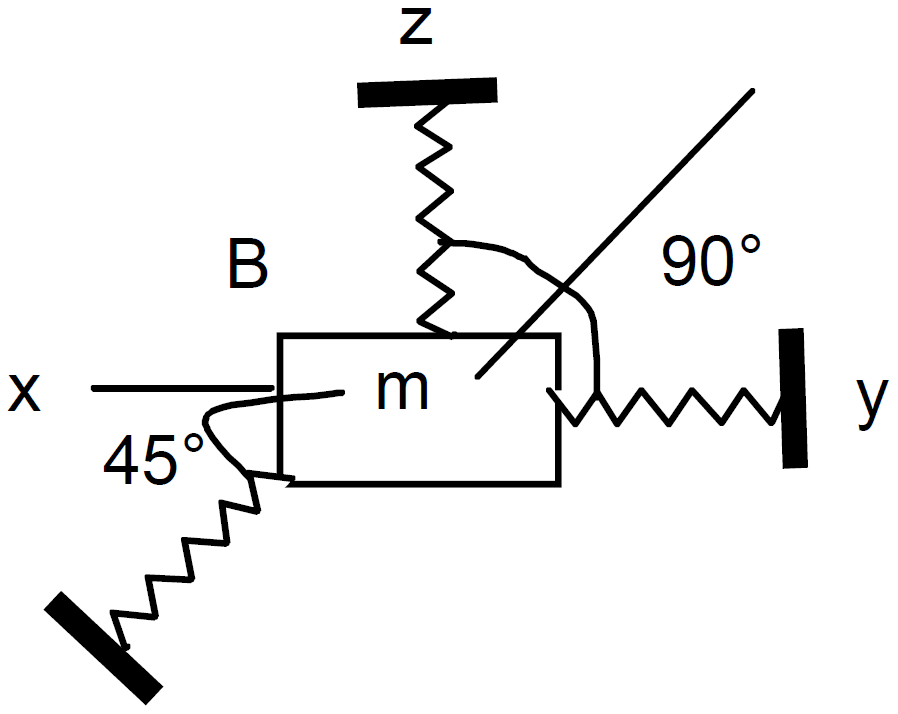
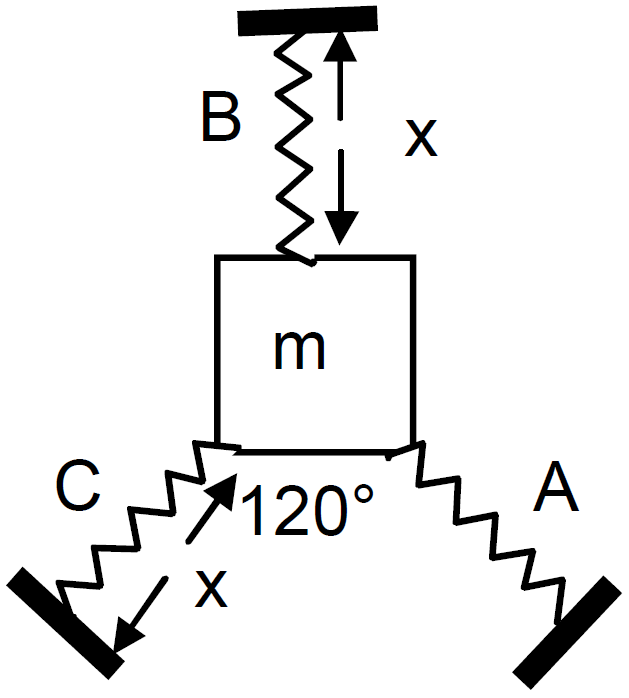
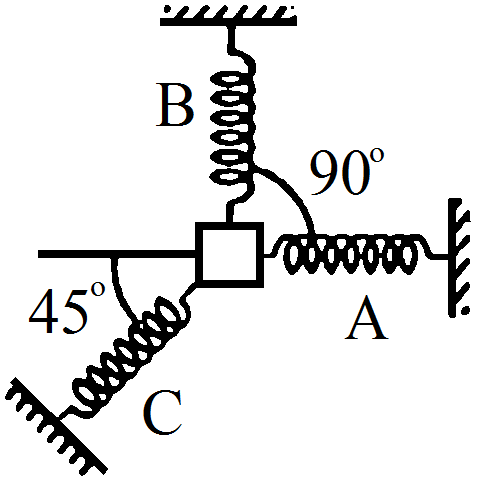
A particle of mass in is attatched to three springs A, B and C of equal force constants k as shown in figure If the particle is pushed slightly against the spring C and released, find the time period of oscillation.
Answer
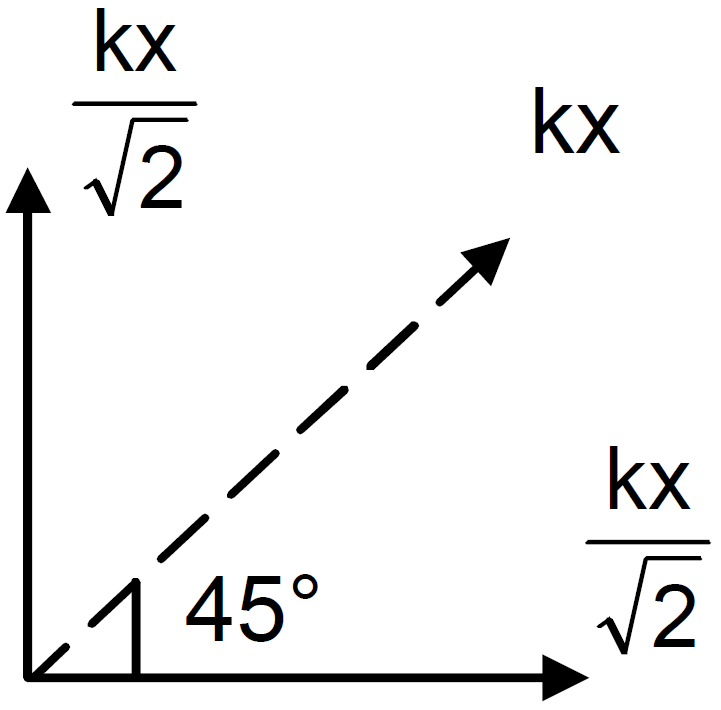
Suppose the particle is pushed slightly against the spring ‘C’ through displacement ‘x’. Total resultant force on the particle is kx due to spring C and $\frac{\text{kx}}{\sqrt{2}}$ due to spring A and B.$\therefore$ Total Resultant force $=\text{kx}+\sqrt{\Big(\frac{\text{kx}}{\sqrt{2}}\Big)^2+\Big(\frac{\text{kx}}{\sqrt{2}}\Big)^2}=\text{kx}+\text{kx}=2\text{kx}.$
Acceleration $=\frac{2\text{kx}}{\text{m}}$ Time period $\text{T}=2\pi\sqrt{\frac{\text{displacement}}{\text{Acceleration}}}=2\pi\sqrt{\frac{\text{x}}{\frac{2\text{kx}}{\text{m}}}}=2\pi\sqrt{\frac{\text{m}}{2\text{k}}}$$\big[$Cause: When the body pushed against ‘C’ the spring C, tries to pull the block towards XL. At that moment the spring A and B tries to pull the block with force $\frac{\text{kx}}{\sqrt{2}}$ and $\frac{\text{kx}}{\sqrt{2}}$ respectively towards xy and xz respectively. So the total force on the block is due to the spring force ‘C’ as well as the component of two spring force A and B.$\big]$

View full question & answer
Question 43 Marks
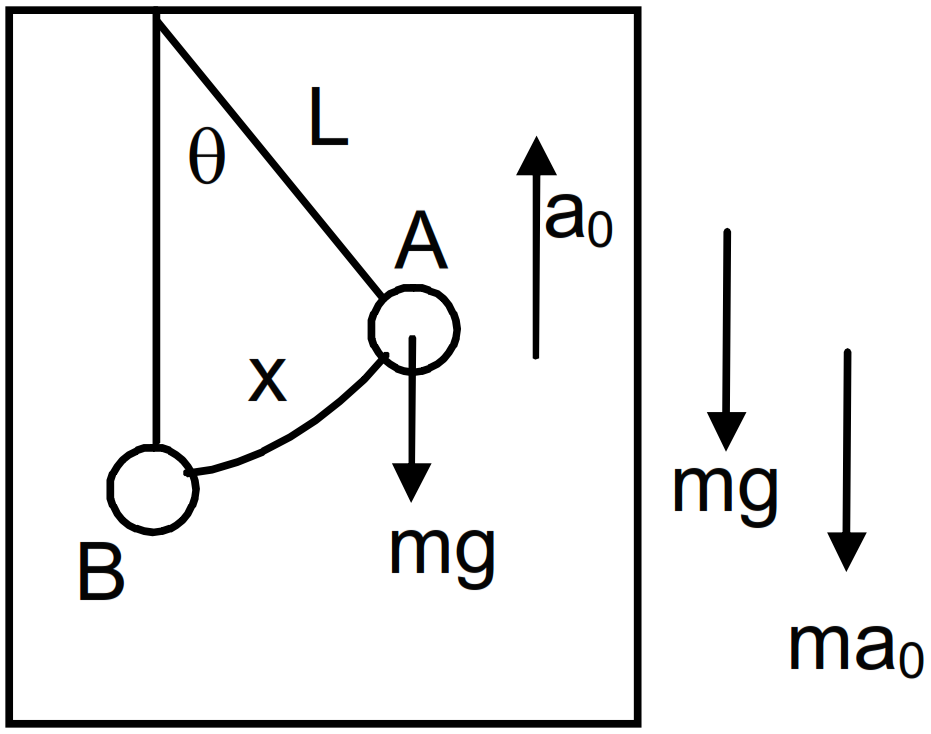
A simple pendulum of lerigth 1 feet suspended from the ceiling of an elevator takes $\frac{\pi}{3}$ seconds to complete one oscillation. Find the acceleration of the elevator.
Answer
Let the elevator be moving upward accelerating ‘$a_0’$
Here driving force $\text{F}=\text{m}(\text{g}+\text{a}_0)\sin\theta$ Acceleration $=\text{(g}+\text{a}_0)\sin\theta$$=(\text{g}+\text{a}_0)\theta$ $(\sin\theta\rightarrow\theta)$
$=\frac{(\text{g}+\text{a}_0)\text{x}}{\ell}=\omega^2\text{x}$
$\text{T}=2\pi\sqrt{\frac{\ell}{\text{g}+\text{a}_0}}$
Given that, $\text{T}=\frac{\pi}{3}\sec,\ell=1\text{ft}$ and $\text{g}=32\text{ft}/\text{sec}^2$$\frac{\pi}{3}=2\pi\sqrt{\frac{1}{32+\text{a}_0}}$
$\frac{1}{9}=4\Big(\frac{1}{32+\text{a}}\Big)$
$\Rightarrow32+\text{a}=36$
$\Rightarrow\text{a}=36-32=4\text{ft}/\text{sec}^2$
View full question & answer
Question 53 Marks
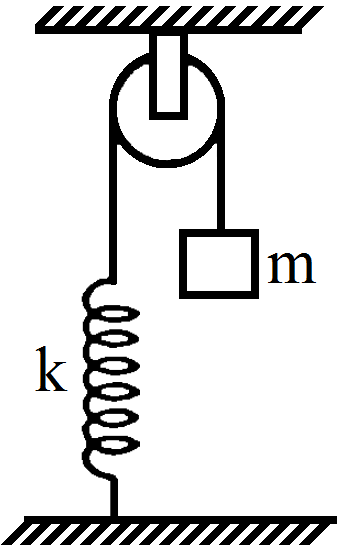
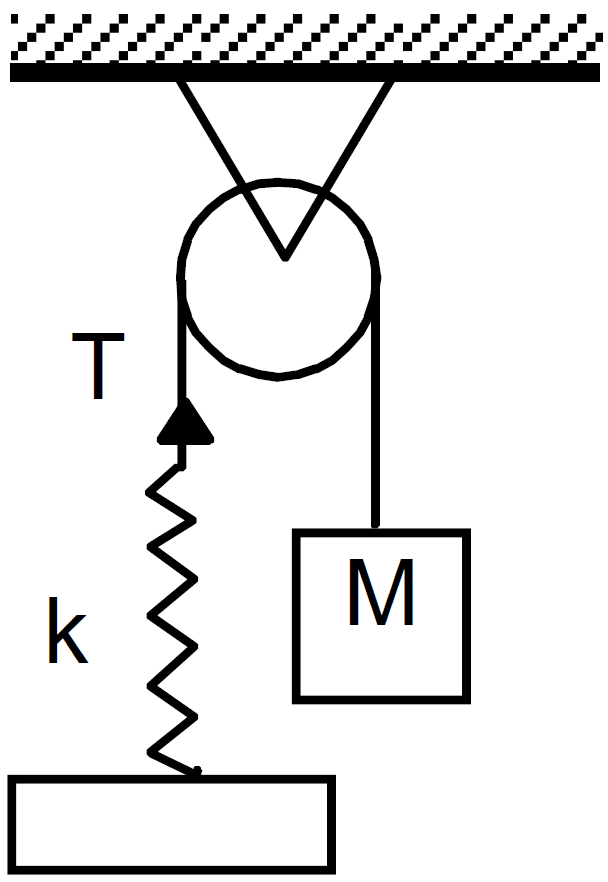
The string, the spring and the pulley shown in figure are light. Find the time period of the mass m.
Answer
When only ‘m’ is hanging, let the extension in the spring be $'\ell'$ So $\text{T}_1=\text{k}\ell=\text{mg}.$ When a force F is applied, let the further extension be ‘x’$\therefore\text{T}_2=\text{k}(\text{x}+\ell)$
$\therefore$ Driving force $=\text{T}_2-\text{T}_1=\text{k}(\text{x}+\ell)-\text{k}\ell=\text{kx}$
$\therefore$ Acceleration $=\frac{\text{k}\ell}{\text{m}}$
$\text{T}=2\pi\sqrt{\frac{\text{displacement}}{\text{Acceleration}}}=2\pi\sqrt{\frac{\text{x}}{\frac{\text{kx}}{\text{m}}}}=2\pi\sqrt{\frac{\text{m}}{\text{k}}}$
View full question & answer
Question 63 Marks
The maximum speed and acceleration of a particle executing simple harmonic motion are 10cm/s and $50cm/s^2$. Find the position(s) of the particle when the speed is 8cm/s.
Answer
$\text{v}_{\text{max}}=10\text{cm/sec}.$$\Rightarrow\text{r}\omega=10$
$\Rightarrow\omega^2=\frac{100}{\text{r}^2}\ ...(1)$
$\text{A}_{\text{max}}=\omega^2\text{r}=50\text{cm/sec}$
$\Rightarrow\omega^2=\frac{50}{\text{y}}=\frac{50}{\text{r}}\ ...(2)$
$\therefore\frac{100}{\text{r}^2}=\frac{50}{\text{r}}$
$\Rightarrow\text{r}=2\text{cm}.$
$\therefore\omega=\sqrt{\frac{100}{\text{r}^2}}=5\sec^2$
Again, to find out the positions where the speed is 8m/sec,
$\text{v}^2=\omega^2(\text{r}^2-\text{y}^2)$
$\Rightarrow64=25(4-\text{y}^2)$
$\Rightarrow4-\text{y}^2=\frac{64}{25}$
$\Rightarrow\text{y}^2=1.44$
$\Rightarrow\text{y}=\sqrt{1.44}$
$\Rightarrow\text{y}=\pm1.2\text{cm}$ from mean position.
View full question & answer
Question 73 Marks
A particle is subjected to two simple harmonic motions of same time period in the same direction. The amplitude of the first motion is 3.0cm and that of the second is 4.0cm. Find the resultant amplitude if the phase difference between the motions is:
  1. 60°
  2. 90°
Answer
The particle is subjected to two SHMs of same time period in the same direction.
Given, $\text{r}_1=3\text{cm},\ \text{r}_2=4\text{cm}$ and $\phi=$ phase difference.
Resultant amplitude $=\text{R}=\sqrt{\text{r}_1^2+\text{r}_2^2+2\text{r}_1\text{r}_2\cos\phi}$
  1. When $\phi=0^\circ,$
$\Rightarrow\text{R}=\sqrt{(3^2+4^2+2\times3\times4\cos0^\circ)}=7\text{cm}$
  1. When $\phi=60^\circ,$
$\text{R}=\sqrt{(3^2+4^2+2\times3\times4\cos60^\circ)}=6.1\text{cm}$
  1. When $\phi=90^\circ,$
$\text{R}=\sqrt{(3^2+4^2+2\times3\times4\cos90^\circ)}=5\text{cm}$
View full question & answer
Question 83 Marks
A uniform rod of length l is suspended by an end and is made to undergo small oscillations. Find the length of the simple pendulum having the time period equal to that of the rod.
Answer
Let A → suspension of point. B → Centre of Gravity.$\ell'=\frac{\ell}{2},\ \text{h}=\frac{\ell}{2}$
Moment of inertia about A is$\text{I}=\text{I}_{\text{C.G}}+\text{mh}^2=\frac{\text{m}\ell^2}{12}+\frac{\text{m}\ell^2}{4}=\frac{\text{m}\ell^2}{3}$
$\Rightarrow\text{T}=2\pi\sqrt{\frac{\text{I}}{\text{mg}\Big(\frac{\ell}{2}\Big)}}=2\pi\sqrt{\frac{2\text{m}\ell^2}{3\text{mgl}}}=2\pi\sqrt{\frac{2\ell}{3\text{g}}}$
Let, the time period ‘T’ is equal to the time period of simple pendulum of length ‘x’.$\therefore\text{T}=2\pi\sqrt{\frac{\text{x}}{\text{g}}}.$
So, $\frac{2\ell}{3\text{g}}=\frac{\text{x}}{\text{g}}$$\Rightarrow\text{x}=\frac{2\ell}{3}$
$\therefore$ Length of the simple pendulum $=\frac{2\ell}{3}$
View full question & answer
Question 93 Marks
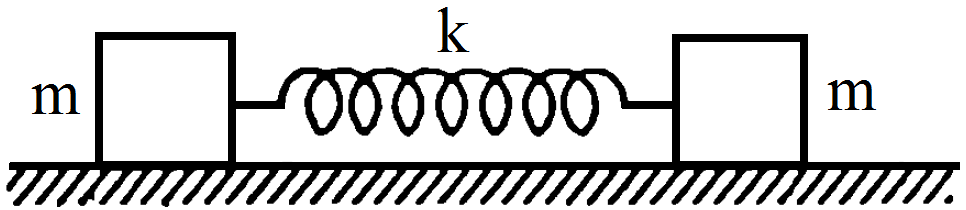
Consider the situation shown in figure Show that if the blocks are displaced slightly in opposite directions and released, they will execute simple harmonic motion. Calculate the time period.
Answer
The centre of mass of the system should not change during the motion. So, if the block ‘m’ on the left moves towards right a distance ‘x’, the block on the right moves towards left a distance ‘x’. So, total compression of the spring is 2x. By energy method $\frac{1}{2}\text{k}(2\text{x})^2+\frac{1}{2}\text{mv}^2+\frac{1}{2}\text{mv}^2=\text{C}$$\Rightarrow\text{mv}^2+2\text{k}\text{x}^2=\text{c}.$
Taking derivative of both sides with respect to ‘t’.$\text{m}\times2\text{v}\frac{\text{dv}}{\text{dt}}+2\text{k}\times2\text{x}\frac{\text{dx}}{\text{dt}}=0$
$\therefore\text{ma}+2\text{kx}=0$ $\Big[$ because $\text{v}=\frac{\text{dx}}{\text{dt}}$ and $\text{a}=\frac{\text{dv}}{\text{dt}}\Big]$
$\Rightarrow\frac{\text{a}}{\text{x}}=-\frac{2\text{k}}{\text{m}}=\omega^2$
$\Rightarrow\omega=\sqrt{\frac{2\text{k}}{\text{m}}}$
$\Rightarrow$ Time period $\text{T}=2\pi\sqrt{\frac{\text{m}}{2\text{k}}}$
View full question & answer
Question 103 Marks
The pendulum of a certain clock has time period 2.04s. How fast or slow does the clock run during 24 hours?
Answer
The pendulum of the clock has time period 2.04sec.
Now, No. or oscillation in 1 day $=\frac{24\times3600}{2}=43200$
But, in each oscillation it is slower by $(2.04-2.00)=0.04\sec.$
So, in one day it is slower by,
= 43200 × (0.04) = 12sec = 28.8min
So, the clock runs 28.8 minutes slower in one day.
View full question & answer
Question 113 Marks
Consider a simple harmonic motion of time period T. Calculate the time taken for the displacement to change value from half the amplitude to the amplitude.
Answer
$\text{y}_1=\frac{\text{r}}{2},\ \text{y}_2=\text{r}$ (for the two given position)Now, $\text{y}_1=\text{r}\sin\omega\text{t}_1$
$\Rightarrow\frac{\text{r}}{2}=\text{r}\sin\omega\text{t}_1$
$\Rightarrow\sin\omega\text{t}_1=\frac{1}{2}$
$\Rightarrow\omega\text{t}_1=\frac{\pi}{2}$
$\Rightarrow\frac{2\pi}{\text{t}}\times\text{t}_1=\frac{\pi}{6}$
$\Rightarrow\text{t}_1=\frac{\text{t}}{12}$
Again, $\text{y}_2=\text{r}\sin\omega\text{t}_2$
$\Rightarrow\text{r = r}\sin\omega\text{t}_2$
$\Rightarrow\sin\omega\text{t}_2=1$
$\Rightarrow\omega\text{t}_2=\frac{\pi}{2}$
$\Rightarrow\Big(\frac{2\pi}{\text{t}}\Big)\text{t}_2=\frac{\pi}{2}$
$\Rightarrow\text{t}_2=\frac{\text{t}}{4}$
So, $\text{t}_2-\text{t}_1=\frac{{\text{t}}{}}{4}-\frac{\text{t}}{12}=\frac{\text{t}}{6}$
View full question & answer
Question 123 Marks
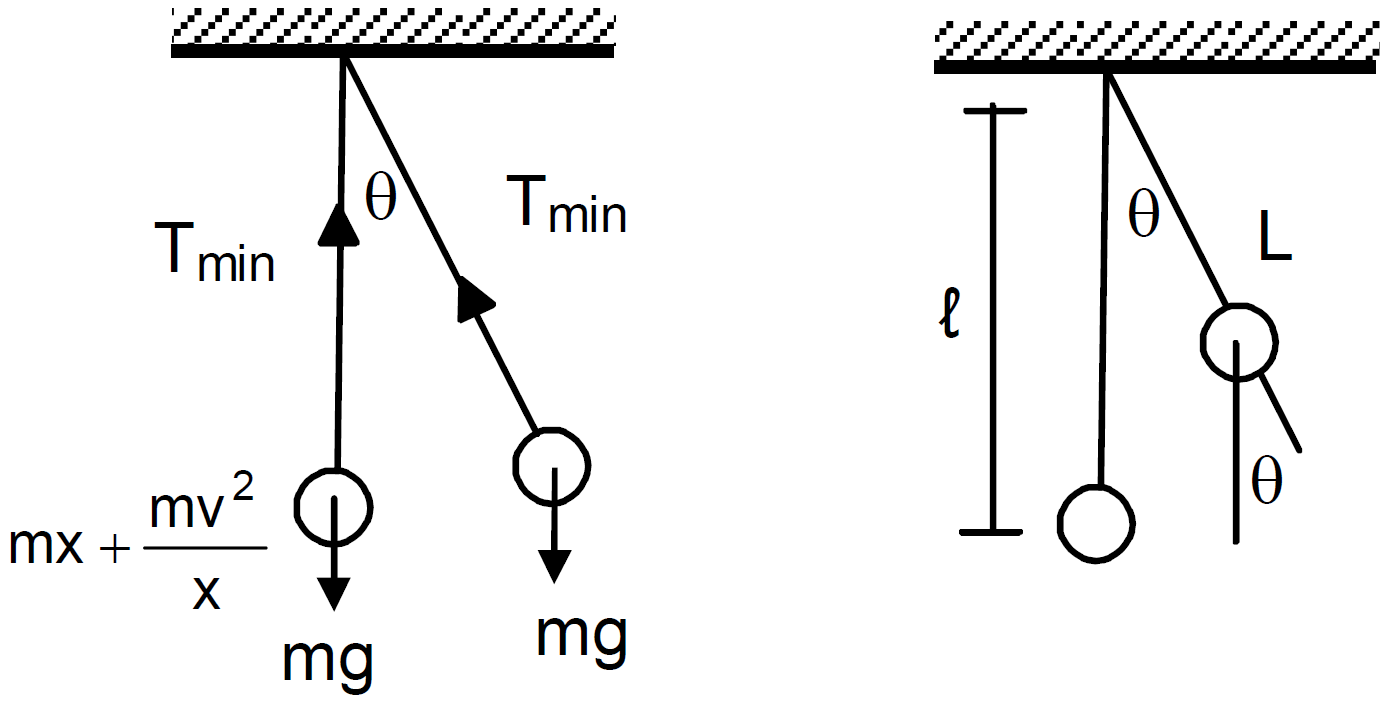
The maximum tension in the string of an oscillating pendulum is double of the minimum tension. Find the angular amplitude.
Answer
The tension in the pendulum is maximum at the mean position and minimum on the extreme position. Here $\Big(\frac{1}{2}\Big)\text{mv}^2-0=\text{mg}\ell(1-\cos)\theta$$\text{v}^2=2\text{g}\ell(1-\cos\theta)$
Now, $\text{T}_{\text{max}}=\text{mg}+2\text{mg}(1-\cos)\theta$ $\Big[\text{T}=\text{mg}+\Big(\frac{\text{mv}^2}{\ell}\Big)\Big]$ Again, $\text{T}_{\text{min}}=\text{mg}\cos\theta$ According to question, $\text{T}_{\text{max}}=2\text{T}_\text{min}$$\Rightarrow\text{mg}+2\text{mg}-2\text{mg}\cos\theta=2\text{mg}\cos\theta$
$\Rightarrow3\text{mg}=4\text{mg}\cos\theta$
$\Rightarrow\cos\theta=\frac{3}{4}$
$\Rightarrow\theta=\cos^{-1}\Big(\frac{3}{4}\Big)$
View full question & answer
Question 133 Marks
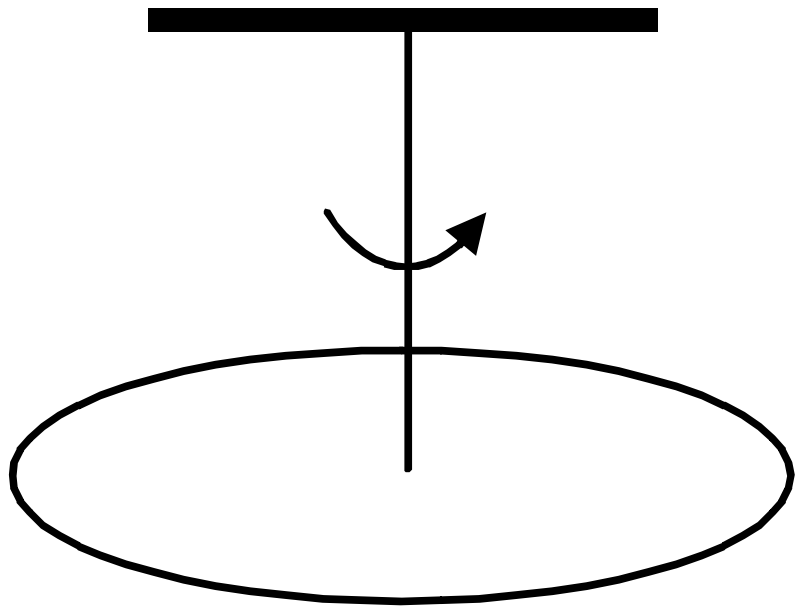
A uniform disc of mass m and radius r is suspended through a wire attached to its centre. If the time period of the torsional oscillations be T, what is the torsional constant of the wire.
Answer
M.I. of the centre of the disc. $=\frac{\text{mr}^2}{2}$$\text{T}=2\pi\sqrt{\frac{\text{l}}{\text{k}}}=2\pi\sqrt{\frac{\text{mr}^2}{2\text{k}}}$ [where K = Torsional constant]
$\text{T}^2=4\pi^2\frac{\text{mr}^2}{2\text{K}}=2\pi^2\frac{\text{mr}^2}{\text{k}}$
$\Rightarrow2\pi^2\text{mr}^2=\text{KT}^2$
$\Rightarrow\text{K}=\frac{2\text{mr}^2\pi^2}{\text{T}^2}$
$\therefore$ Torsional constant $\text{K}=\frac{2\text{mr}^2\pi^2}{\text{T}^2}$
View full question & answer
Question 143 Marks
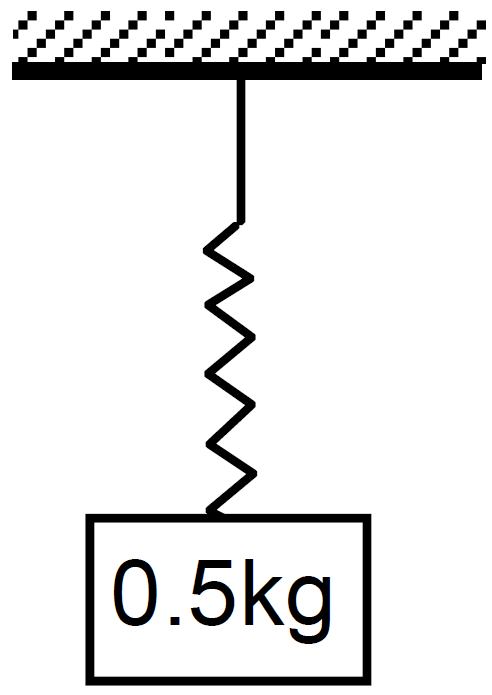
A block of mass 0.5kg hanging from a vertical spring executes simple harmonic motion of amplitude 0.1m and time period 0.314s. Find the maximum force exerted by. the spring on the block.
Answer
$\text{x}=\text{r}=0.1\text{m}$$\text{T}=0.314\sec$
$\text{m}=0.5\text{kg}.$
Total force exerted on the block = weight of the block + spring force.
$\text{T}=2\pi\sqrt{\frac{\text{m}}{\text{k}}}$
$\Rightarrow0.314=2\pi\sqrt{\frac{0.5}{\text{k}}}$
$\text{k}=200\text{N/m}$
$\therefore$ Force exerted by the spring on the block is $\text{F}=\text{kx}=201.1\times0.1=20\text{N}$
$\therefore$ Maximum force $=\text{F}+\text{Weight}=20+5=25\text{N}$
View full question & answer
Question 153 Marks
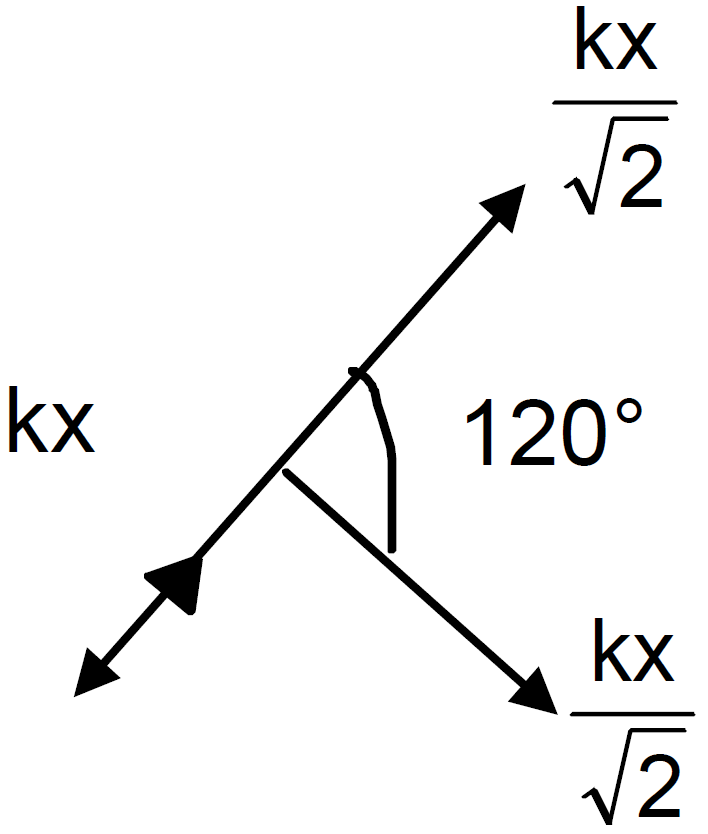
Repeat the previous exercise if the angle between each pair of springs is 120° initially.
Answer
In this case, if the particle ‘m’ is pushed against ’C’ a by distance ‘x’. Total resultant force acting on man ‘m’ is given by,$\text{F}=\text{kx}+\frac{\text{kx}}{2}=\frac{3\text{kx}}{2}$
Because net force $\text{A }\&\text{ B}=\sqrt{\Big(\frac{\text{kx}}{2}\Big)^2+\Big(\frac{\text{kx}}{2}\Big)^2+2\Big(\frac{\text{kx}}{2}\Big)\Big(\frac{\text{kx}}{2}\Big)\cos120^\circ}=\frac{\text{kx}}{2}$$\therefore\text{a}=\frac{\text{F}}{\text{m}}=\frac{3\text{kx}}{2\text{m}}$
$\Rightarrow\frac{\text{a}}{\text{x}}=\frac{3\text{k}}{2\text{m}}=\omega^2$
$\Rightarrow\omega=\sqrt{\frac{3\text{k}}{2\text{m}}}$
$\therefore$ time period $\text{T}=\frac{2\pi}{\omega}=2\pi\sqrt{\frac{2\text{m}}{3\text{k}}}$

View full question & answer
Question 163 Marks
A body of mass 2kg suspended through a vertical spring executes simple harmonic motion of period 4s. If the oscillations are stopped and the body hangs in equilibrium, find the potential energy stored in the spring.
Answer
$\text{m} = 2\text{kg}$$\text{T}=4\sec.$
$\text{T}=2\pi\sqrt{\frac{\text{m}}{\text{k}}}$
$\Rightarrow4=2\pi\sqrt{\frac{2}{\text{k}}}$
$\Rightarrow2=\pi\sqrt{\frac{2}{\text{k}}}$
$\Rightarrow4=\pi^2\Big(\frac{\text{2}}{\text{k}}\Big)$
$\Rightarrow\text{k}=\frac{2\pi^2}{4}$
$\Rightarrow\text{k}=\frac{\pi^2}{2}$
$\Rightarrow\text{k}=\frac{\pi^2}{2}=5\text{N/m}$
But, we know that $\text{F}=\text{mg}=\text{kx}$
$\Rightarrow\text{x}=\frac{\text{mg}}{\text{k}}=\frac{2\times10}{5}=4$
$\therefore$ Potential Energy $=\big(\frac{1}{2}\big)\text{kx}^2=\big(\frac{1}{2}\big)\times5\times16=5\times8=40\text{J}$
View full question & answer
Question 173 Marks
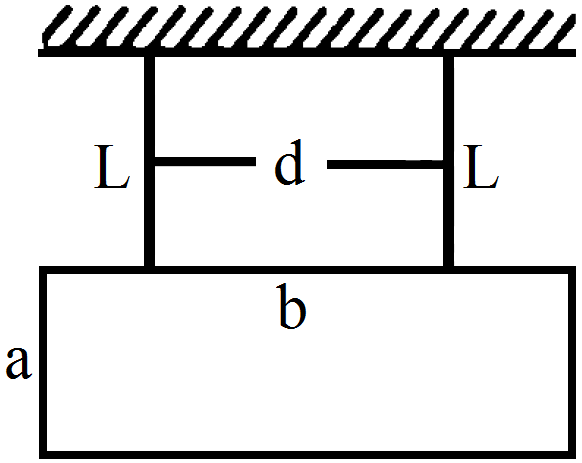
A rectangular plate of sides a and b is suspended from a ceiling by two parallel strings of length L each figure The separation between the strings is d. The plate is displaced slightly in its plane keeping the strings tight. Show that it will execute simple harmonic motion. Find the time period.
Answer
Here we have to consider oscillation of centre of mass, Driving force $\text{F}=\text{mg}\sin\theta.$ Acceleration $=\text{a}=\frac{\text{F}}{\text{m}}=\text{g}\sin\theta.$ For small angle $\theta,\ \sin\theta=\theta.$$\therefore\text{a}=\text{g}\theta=\text{g}\Big(\frac{\text{X}}{\text{L}}\Big)$[where g and L are constant]
$\therefore\text{a}\propto\text{x},$
So the motion is simple Harmonic Time period $\text{T}=2\pi\sqrt{\frac{\text{Displacement}}{\text{Acceleration}}}$$=2\pi\sqrt{\frac{\text{x}}{\Big(\frac{\text{gx}}{\text{L}}\Big)}}$
$=2\pi\sqrt{\frac{\text{L}}{\text{g}}}$
View full question & answer
Question 183 Marks
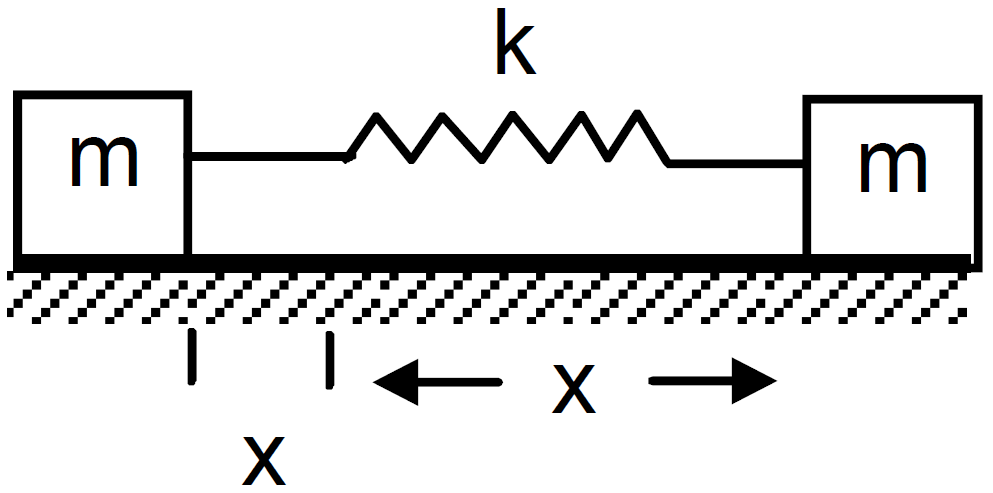
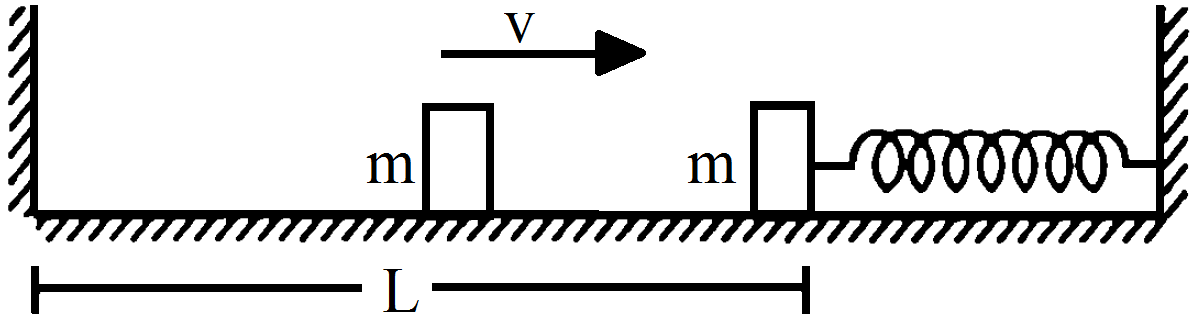
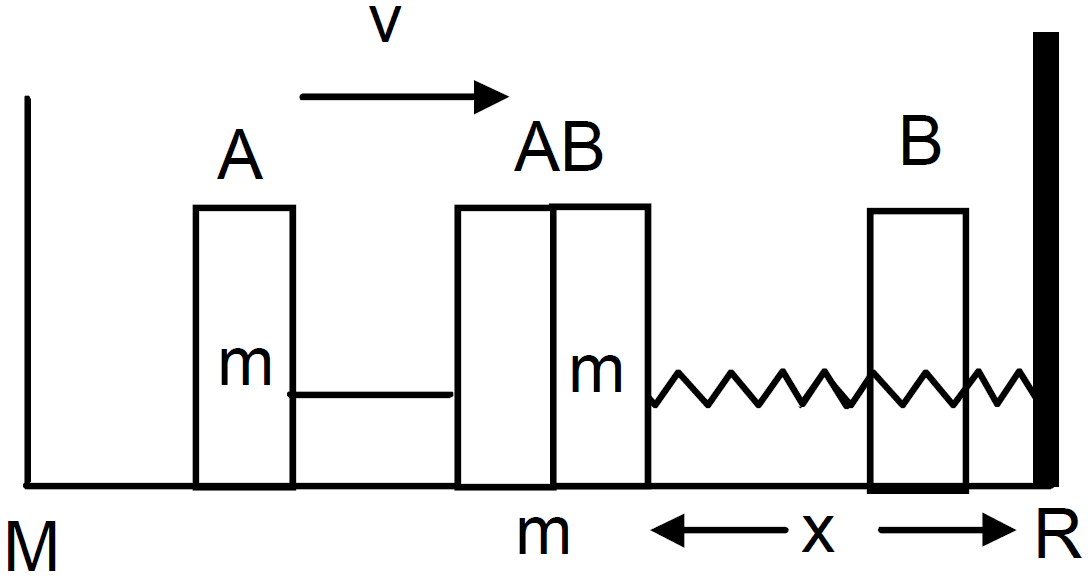
The left block in figure moves at a speed v towards the right block placed in equilibrium. All collisions to take place are elastic and the surfaces are frictionless. Show that the motions of the two blocks are periodic. Find the time period of these periodic motions. Neglect the widths of the blocks.
Answer
When the block A moves with velocity ‘V’ and collides with the block B, it transfers all energy to the block B. (Because it is a elastic collision). The block A will move a distance ‘x’ against the spring, again the block B will return to the original point and completes half of the oscillation. So, the time period of B is $\frac{2\pi\sqrt{\frac{\text{m}}{\text{k}}}}{2}=\pi\sqrt{\frac{\text{m}}{\text{k}}}$ The block B collides with the block A and comes to rest at that point. The block A again moves a further distance ‘L’ to return to its original position.$\therefore$ Time taken by the block to move from M → N and N → M
is $\frac{\text{L}}{\text{V}}+\frac{\text{L}}{\text{V}}=2\Big(\frac{\text{L}}{\text{V}}\Big)$$\therefore$ So time period of the periodic motion is $2\Big(\frac{\text{L}}{\text{V}}\Big)+\pi\sqrt{\frac{\text{m}}{\text{k}}}$
View full question & answer
Question 193 Marks
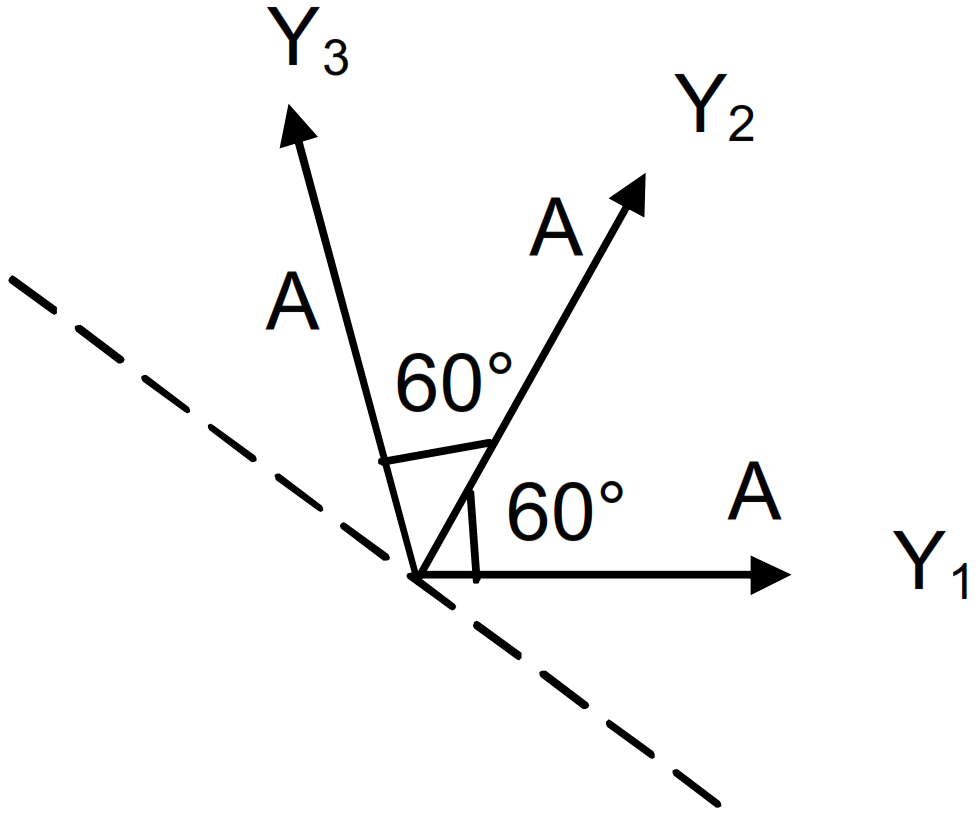
Three simple harmonic motions of equal amplitudes A and equal time periods in the same direction combine. The phase of the second motion is 60° ahead of the first and the phase of the third motion is 60° ahead of the second. Find the amplitude of the resultant motion.
Answer
Three SHMs of equal amplitudes ‘A’ and equal time periods in the same dirction combine. The vectors representing the three SHMs are shown it the figure. Using vector method, Resultant amplitude = Vector sum of the three vectors$=\text{A}+\text{A}\cos60^\circ+\text{A}\cos60^\circ=\text{A}+\frac{\text{A}}{2}+\frac{\text{A}}{2}=2\text{A}$
So the amplitude of the resultant motion is 2A.
View full question & answer
Question 203 Marks
A particle is subjected to two simple harmonic motions, one along the X-axis and the other on a line making an angle of 45° with the X-axis, The two motions are given by,$\text{x}=\text{x}_0\sin\omega\text{t}$ and $\text{s}=\text{s}_0\sin\omega\text{t}$
Find the amplitude of the resultant motion.
Answer
The particle is subjected to two simple harmonic motions represented by,$\text{x}=\text{x}_0\sin\omega\text{t}$
$\text{s}=\text{s}_0\sin\omega\text{t}$
and, angle between two motions $=\theta=45^\circ$$\therefore$ Resultant motion will be given by,
$\text{R}=\sqrt{(\text{x}^2+\text{s}^2+2\text{xs}\cos45^\circ)}$
$=\sqrt{\Big\{\text{x}_0^2\sin^2\omega\text{t}+\text{s}_0^2\sin^2\omega\text{t}+2\text{x}_0\text{s}_0\sin^2\omega\text{tx}\Big(\frac{1}{\sqrt{2}}\Big)\Big\}}$
$=\big[\text{x}_0^2+\text{s}_0^2=\sqrt{2}\text{x}_0\text{s}_0\big]^{\frac{1}{2}}\sin\omega\text{t}$
$\therefore$ Resultant amplitude $=\big[\text{x}_0^2+\text{s}_0^2=\sqrt{2}\text{x}_0\text{s}_0\big]^{\frac{1}{2}}$
View full question & answer