Questions

M.C.Q (1 Marks)

🎯

Test yourself on this topic

33 questions · timed · auto-graded

MCQ 11 Mark
The excess pressure inside a soap bubble is twice the excess pressure inside a second soap bubble. The volume of the first bubble is n times the volume of the second where n is:
  • A
    4
  • B
    2
  • C
    1
  • 0.125.
Answer
Correct option: D.
0.125.
Let the excess pressure inside the second bubble be P.
$\therefore$ Excess pressure inside the first bubble = 2P
Let the radius of the second bubble be R.
Let the radius of the first bubble be x.
Excess pressure inside the 2nd soap bubble:
$\text{P}=\frac{4\text{s}}{\text{R}}\ \cdots(1)$
Excess pressure inside the 1 st soap bubble:
$2\text{P}=\frac{4\text{s}}{\text{x}}$
From (1), we get:
$2\Big(\frac{2\text{S}}{\text{R}}\Big)=\frac{\text{4S}}{\text{x}}$
$\Rightarrow\text{x}=\frac{\text{R}}{2}$
Volume of the fust bubble $=\frac{4}{3}\pi\text{x}^3$
Volume of the second bubble $=\frac{4}{3}\pi\text{x}^3$
$\Rightarrow\frac{4}{3}\pi\text{x}^3=\text{n}\frac{4}{3}\pi\text{R}^3$
$\Rightarrow\text {x}^3=\text{n}\text{R}^3$
$\Rightarrow\Big(\frac{\text{R}}{2}\Big)^3=\text{n}\text{R}^3$
$\Rightarrow\text{n}=\frac{1}{8}=0.125$
View full question & answer
MCQ 21 Mark
A wire can sustain the weight of 20kg before breaking. If the wire is cut into two equal parts, each part can sustain a weight of.
  • A
    10kg
  • 20kg
  • C
    40kg
  • D
    80kg.
Answer
Correct option: B.
20kg
Explanation:
As the wire is cut into two equal parts, both have equal cross-sectional areas. Therefore, a weight of 20kg exerts a force of 20g on both the pieces Breaking stress depends upon the material of the wire.
Since 20g of force is exerted on wires with equal cross-sectional areas, both the wires can sustain a weight of 20kg.
View full question & answer
MCQ 31 Mark
A raindrop falls near the surface of the earth with almost uniform velocity because:
  • A
    Its weight is negligible.
  • B
    The force of surface tension balances its weight.
  • The force of viscosity of air balances its weight.
  • D
    The drops are charged and atmospheric electric field balances its weight.
Answer
Correct option: C.
The force of viscosity of air balances its weight.
Air has viscosity Ouring rainfall, the raindrops acquire acceleration due to gravity However, the increase in velocity is hindered by the viscous force acting upwards. A gradual balance between the two opposing forces causes the raindrops to attain a terminal velocity, thus, falling with a uniform velocity.
View full question & answer
MCQ 41 Mark
The viscous force acting between two layers of a liquid is given by $\frac{\text{F}}{\text{A}}=-\eta\frac{\text{dv}}{\text{dz}}$ This $\frac{\text{F}}{\text{A}}$ may be called:
  • A
    Pressure.
  • B
    Longitudinal stress.
  • Tangential stress.
  • D
    Volume stress.
Answer
Correct option: C.
Tangential stress.
Explanation:
The viscous force acts tangentially between two parallel layers of a liquid. In terms of force on a material, it is analogous to a shearing force.
View full question & answer
MCQ 51 Mark
A piece of wood is taken deep inside a long column of water and released. It will move up:
  • A
    With a constant upward acceleration.
  • With a decreasing upward acceleration.
  • C
    With a deceleration.
  • D
    With a uniform velocity.
Answer
Correct option: B.
With a decreasing upward acceleration.
Explanation:
The density of wood is less than that of water. When a piece of wood is immersed deep inside a long column of water and released, it experiences a buoyant force that gives it an upward acceleration. The veloetty of wood increases as its motion Is accelerated by the buoyant force. However, the viscous drag force acts simultaneously to oppose its upward motion. As a result, the initial acceleration decreases and the wood rises with a decreasing upward acceleration.
View full question & answer
MCQ 61 Mark
An ice cube is suspended in vacuum in a gravity free hall. As the ice melts it.
  • A
    Will retain its cubical shape.
  • Will change its shape to spherical.
  • C
    Will fall down on the floor of the hall.
  • D
    Will fly up.
Answer
Correct option: B.
Will change its shape to spherical.
Explanation:
As the ice cube melts completely, the water thus formed will have minimum surface area due to its surface tension. Any state of matter that has a minimum surface area to its volume takes the shape of a sphere. Therefore, as the ice melts, it will take the shape of a sphere.
View full question & answer
MCQ 71 Mark
The force of viscosity is:
  • Electromagnetic.
  • B
    Gravitational.
  • C
    Nuclear.
  • D
    Weak.
Answer
Correct option: A.
Electromagnetic.
Explanation:
The force of viscosity arises from molecular Interaction between different layers of fluids that are In motion. Molecular forces are electromagnetic in nature. Therefore, viscosity must also be electromagnetic.
View full question & answer
MCQ 81 Mark
A solid sphere falls with a terminal velocity of 20m/s in air. If it is allowed to fall in vacuum,
  • A
    Terminal velocity will be 20m/s
  • B
    Terminal velocity will be less than 20m/s
  • C
    Terminal velocity will be more than 20m/s
  • There will be no terminal velocity.
Answer
Correct option: D.
There will be no terminal velocity.
Explanation:
In vacuum, no viscous force exists The sphere therefore, will have constant acceleration because of gravity. An accelerated motion implies that it won't have uniform velocity throughout its mouon. In other words, there will be no terminal velocity.
View full question & answer
MCQ 91 Mark
A 20cm long capillary tube is dipped in water. The water rises up to 8cm. If the entire arrangement is put in a freely falling elevator, the length of water column in the capillary tube will be:
  • A
    8cm
  • B
    6cm
  • C
    10cm
  • 20cm
Answer
Correct option: D.
20cm
Explanation:
Height of water column m capillary tube is given by:
$\text{h}=\frac{2\text{T}\cos\theta}{\text{r}\rho\text{g}}$
A free foiling elevator experiences zero gravity,
$\Rightarrow\text{h}=\frac{2\text{T}\cos\theta}{\text{r}\rho0}=\infty$
But, h = 20cm (given)
Therefore, the height of the water column will remain at a maximum of 20cm.
View full question & answer
MCQ 101 Mark
When water droplets merge to form a bigger drop:
  • Energy is liberated.
  • B
    Energy is absorbed.
  • C
    Energy is neither liberated nor absobred.
  • D
    Energy may either be liberated or absorbed depending on the nature of the liquid.
Answer
Correct option: A.
Energy is liberated.
Explanation:
As the water droplets merge to form a single droplet, the surface area decreases. With this decrease in surface area, the surface energy of the resulting drop also decreases. Therefore, extra energy must be liberated from the drop in accordance with the conservation of energy.
View full question & answer
MCQ 111 Mark
The rise of a liquid in a capillary tube depends on
  1. The material.
  2. The length.
  3. The outer radius.
  4. The inner radius of the tube.
  • A
    $1 , 2$ and $3$
  • B
    $2, 3$ and $4$
  • $1 , 3$ and $4$
  • D
    $2, 3$ and $4$
Answer
Correct option: C.
$1 , 3$ and $4$
Height of the liquid in the capillary tube is given by:
$\text{h}=\frac{2\text{S}\cos\theta}{\text{r}\rho\text{g}}$
$h =$ Height
$S =$ Surface tension
$r =$ Inner rndius of the tube
$\rho =$ Density of the liquid
$g =$ Acceleration due to gravity
  1. $\theta$ and $\rho$ depend upon the material of the capillary tube and the liquid.
  2. $H$ is dependent on the length of the tube. If the length is insufficient, then $h$ will be low.
  3. $R$ is the inner radius of the tube.
View full question & answer
MCQ 121 Mark
Viscosity is a property of:
  • A
    Liquids only.
  • B
    Solids only.
  • C
    Solids and liquids only.
  • Liquids and gases only.
Answer
Correct option: D.
Liquids and gases only.
Explanation:
Viscosity is one property of fluids. Fluids Include both liquids and gases.
View full question & answer
MCQ 131 Mark
A wire elongates by 1.0mm when a load W is hung from it. If this wire goes over a a pulley and two weights W each are hung at the two ends, he eloogation of he wire will be:
  • A
    0.5m
  • 1.0mm
  • C
    2.0mm
  • D
    4.0mm.
Answer
Correct option: B.
1.0mm
Explanatoin:
Let the Young's modulus of the material of the wue be Y.
Force = Weight = W (given)
Let C.S.A. = A
x = 1mm = Elongation in the first case
Lenghth = L
$\text{Y}=\frac{\frac{\text{W}}{\text{A}}}{\frac{\text{x}}{\text{L}}}=\frac{\text{wl}}{\text{Ax}}$
Let y be the elongation on one side of the wire when put in a pulley. When put in a pulley, the length of the wire on each side $=\frac{\text{L}}{2}$
$\frac{\frac{\text{W}}{\text{A}}}{\frac{\text{y}}{\frac{\text{L}}{2}}}=\text{Y}$
$\Rightarrow\frac{\frac{\text{W}}{\text{A}}}{\text{y}\frac{\text{L}}{2}}=\frac{\text{WL}}{\text{Ax}}$
$\Rightarrow\text{Y}=\frac{\text{x}}{2}$
Total elongation in the wire $=2\text{y}=2\Big(\frac{\text{x}}{2}\big)=\text{x}=1\text{mm}$
View full question & answer
MCQ 141 Mark
The breaking stress of a wire depends on:
  • Material of the wire.
  • B
    Length of the wire.
  • C
    Radius of the wire.
  • D
    Shape of the cross-section.
Answer
Correct option: A.
Material of the wire.
Explanation:
Breaking stress depends upon the intermolecular/ inter-atomic forces of attractioo within materials. In other words, it depends upon the material of the wire.
View full question & answer
MCQ 151 Mark
Air is pushed into a soap, bubble of radius r to double its radius. If the surface tension of the soap solution is S, the work done in the process is:
  • A
    $8\ \pi\text{r}^2\text{S}$
  • B
    $12\ \pi\text{r}^2\text{S}$
  • C
    $16\ \pi\text{r}^2\text{S}$
  • $24\ \pi\text{r}^2\text{S}\cdot$
Answer
Correct option: D.
$24\ \pi\text{r}^2\text{S}\cdot$
Explanation:
No, of surfaces of a soap bubble = 2
Increase in surface area $=4\pi\big(2\text{r}\big)^{2}-4\pi(\text{r})^2=12\pi\text{r}^2$
Total increase in surface area $=2\times12\pi\text{r}^2=24\pi\text{r}^2$
Work done = change in surface energy $=\text{S}\times24\pi\text{r}^2=24\pi\text{r}^2\text{S}$
View full question & answer
MCQ 161 Mark
The dimension $\mathrm{ML}^{-1} \mathrm{~T}^{-2}$ can correspond to:
  • A
    Moment of a force.
  • B
    Surface tension.
  • Modulus of elasticity.
  • D
    Moefficient of viscosity.
Answer
Correct option: C.
Modulus of elasticity.
Dimension of modulus of elasticity: $\frac{\frac{\text{F}}{\text{A}}}{\frac{\triangle\text{l}}{\text{l}}}=\frac{\big[\text{MLT}^{-1}\big]}{\text{L}^2}=\big[\text{ML}^{-1}\text{T}^{-2}\big]$
Dimension of moment of force: $=\big[\text{MLT}^{-2}\big][\text{L}]=\big[\text{ML}^{2}\text{T}^{-2}\big]$
Dimension of surface tension: $\frac{\text{F}}{\text{L}}=\frac{\big[\text{MLT}^{-2}\big]}{\text{L}}=\big[\text{MT}^{-2}\big]$
Dimension of coefflcient of viscosity: $\frac{\text{FL}}{\text{A}\text{v}}=\frac{\big[\text{MLT}^{-2}[\text{L}]}{\big[\text{L}^2\big]\big[\text{LT}^{-1}\big]}=\big[\text{ML}^{-1}\text{T}^{-1}\big]$
View full question & answer
MCQ 171 Mark
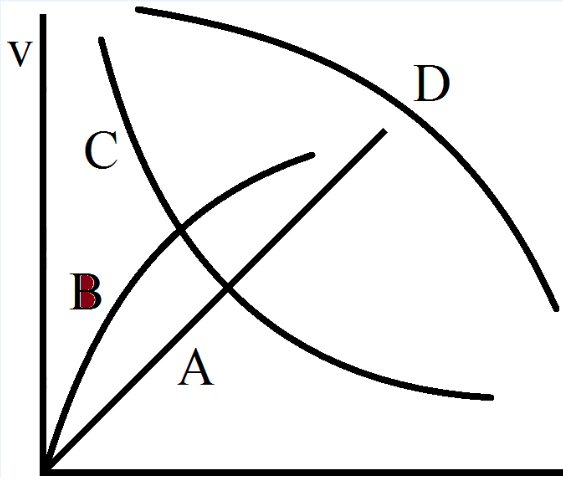
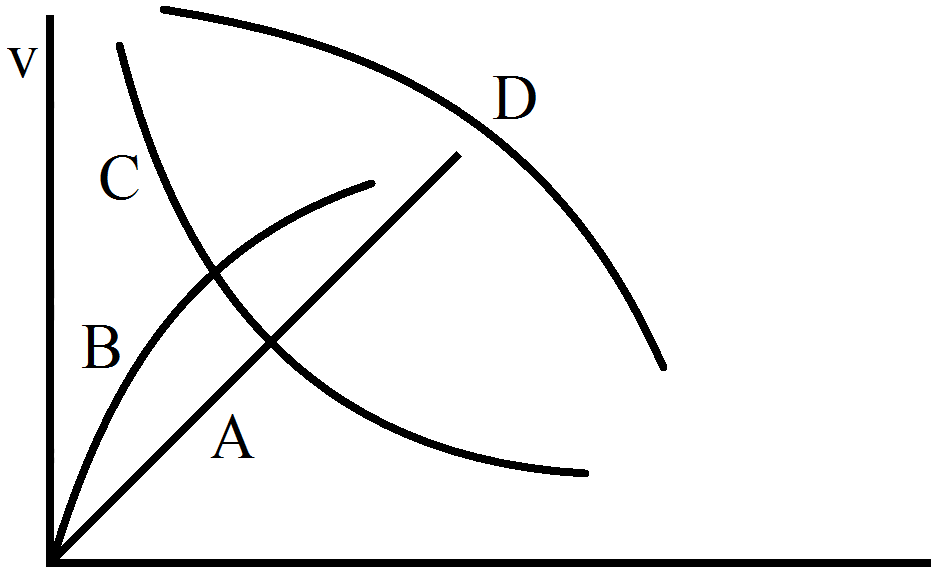
A spherical ball is dropped in a long column of a viscous liquid. The speed of the ball as a function of time may be best represented by the graph:
  • A
    A
  • B
  • C
    C
  • D
    D
Answer
Correct option: B.
B
​​​
​​​​​​​Explanation:
Initially, when the ball starts moving, its velocity is small Gradually, the velocity of the ball increases due to acceleration caused by gravity. However. as the velooty Increases. The viscous force acting on the ball also increases. This force tends to decelerate the ball. Therefore, after reaching a certain maximum velocity, the ball slows down.
View full question & answer
MCQ 181 Mark
The length of a metal wire is $l_1$ when the tension in it $T_1$ and is $l_2$ when the tension is $T_2$. The natural length of the wire is:
  • A
    $\frac{\text{l}_1+\text{l}_2}{2}$
  • B
    $\sqrt{\text{l}_2\text{l}_2}$
  • $\frac{\text{T}_2\text{l}_1-\text{T}_1\text{l}_2}{\text{T}_2-\text{T}_1}$
  • D
    $\frac{\text{l}_1\text{T}_2+\text{l}_2\text{T}_1}{\text{T}_2+\text{T}_1}$
Answer
Correct option: C.
$\frac{\text{T}_2\text{l}_1-\text{T}_1\text{l}_2}{\text{T}_2-\text{T}_1}$
Let the Young's modulus be $Y$.
$\text{C.S.A}. = A$
Actual length of the wire $= L$
For tension $T_1:$
$\text{Y}=\frac{\frac{\text{T}_1}{\text{a}}}{\frac{(\text{L}-\text{l}_1)}{\text{l}\cdot}}\ \cdot(1)$
For tension $T_2:$
$\text{Y}=\frac{\frac{\text{T}_2}{\text{A}}}{\frac{(\text{L}-\text{l}_2)}{\text{L}}}\ \cdots(2)$
From $(1)$ and $(2),$
$\frac{\frac{\text{T}_1}{\text{A}}}{\frac{(\text{L}-\text{l}_1)}{\text{L}}}=\frac{\frac{\text{T}_2}{\text{A}}}{\frac{(\text{L}-\text{l}_2)}{\text{L}}}$
$\Rightarrow\frac{\text{T}_1}{(\text{L}-\text{l}_1)}=\frac{\text{T}_2}{(\text{L}-\text{l}_2)}$
$\Rightarrow\text{L}=\frac{\text{T}_2\text{l}_1-\text{T}_1\text{l}_2}{\text{T}_2-\text{T}_1}$
View full question & answer
MCQ 191 Mark
If two soap bubbles of different radii are connected by a tube:
  • A
    Air flows from bigger bubble to the smaller bubble till the sizes become equal.
  • B
    Air flows from bigger bubble to the smaller bubble till the sizes are interchanged.
  • Air flows from the smaller bubble to the bigger.
  • D
    There lis no flow of air.
Answer
Correct option: C.
Air flows from the smaller bubble to the bigger.
Explanation:
The smaller bubble has a greater inner pressure than the bigger bubble. Air moves from a region of high pressure to a region of low pressure. Therefore, air moves from the smaller to the bigger bubble.
View full question & answer
MCQ 201 Mark
Two wires A and B are made of same material. The wore A has a length l and diameter r while the wire B has a length 2l and diameter $\frac{\text{r}}{2}$. If the two wires are stretched by the same force, the elongation in A divided by the elongation in 8 is:
  • $\frac{1}{8}$
  • B
    $\frac{1}{4}$
  • C
    $4$
  • D
    $8$
Answer
Correct option: A.
$\frac{1}{8}$
Explanation:
Let the Young's modulus of the wire's material be Y.
Here:
Force = F
$\text{A}_1=\pi\text{r}^2$
$\text{L}_1=1$
$\text{A}_2=\pi\Big(\frac{\text{r}}{2}\Big)^2=\frac{\pi\text{r}^2}{4}$
$\text{L}_2=2\text{l}$
Let the elongation in A be x and that in B be y.
Since the Young's modulus for both the wires is the same:
$\text{Y}=\frac{\frac{\text{F}}{\text{A}_1}}{\frac{\text{x}}{\text{l}}}=\frac{\frac{\text{F}}{\text{A}}}{\frac{\text{Y}}{2\text{l}}}$
$\Rightarrow\frac{\text{x}}{\text{y}}=\frac{\text{A}_2}{2\text{A}_1}$
$\Rightarrow\frac{\text{x}}{\text{y}}=\frac{1}{8}$
View full question & answer
MCQ 211 Mark
If more air is pushed in a soap bubble, the pressure in it:
  • Decreases.
  • B
    Increases.
  • C
    Remains same.
  • D
    Becomes zero.
Answer
Correct option: A.
Decreases.
Explanation:
Excess pressure inside a bubble is given by $\text{P}= \frac{4\text{T}}{\text{r}}\cdot$
When air is pushed into the bubble, it grows in size. Therefore, its radius increases. An increase in size causes the pressure inside the soap bubble to decrease as pressure is inversely proportional to the radius.
View full question & answer
MCQ 221 Mark
By a surface of a liquid we mean.
  • A
    A geometrical plane like $x = 0$
  • B
    All molecules exposed to the atmosphere.
  • A layer of thickness of the order of $10^{-8}m.$
  • D
    A layer of thickness of the order of $10^{-4}m.$
Answer
Correct option: C.
A layer of thickness of the order of $10^{-8}m.$
The surface of a liquid refers to the layer of molecules that have higher potential energy than the bulk of the liquid. This layer is typically $10$ to $15$ times the diameter of the molecule.
Now, the size of an average molecule is around $1\ nm = 10^{-9}m$ so a diameter of $10$ to $15$ times would be of order, $10 \times 10^{-9}= 10^{-8}m.$
View full question & answer
MCQ 231 Mark
A rope $1\ cm$ in diameter breaks if the tension in it exceeds $500 \ N$. The maximum tension that may be given to a similar rope of diameter $2\ cm$ is :
  • A
    $500\ N$
  • B
    $250\ N$
  • C
    $1000\ N$
  • $2000\ N.$
Answer
Correct option: D.
$2000\ N.$
$F_1= 500N$
Let the required breaking force on the $2\ cm$ wire be $F$.
Breaking stress in $1\ cm$ wire $=\frac {\text{F}_1}{\text{A}_1}=\frac{500}{\pi\Big(\frac{0.01}{2}\Big)^2}$
Breaking stress in $2\ cm$ wire $=\frac{\text{F}_2}{\text{A}_2}=\frac{\text{F}_2}{\pi\Big(\frac{0.02}{2}\Big)^2}$
The breaking stress is the same for a material.
$\Rightarrow\frac{500}{\pi\Big(\frac{0.01}{2}\Big)^2}=\frac{\text{F}_2}{\pi\Big(\frac{0.02}{2}\Big)^2}$
$\Rightarrow\text{F}_2=2000\text{N}$
View full question & answer
MCQ 241 Mark
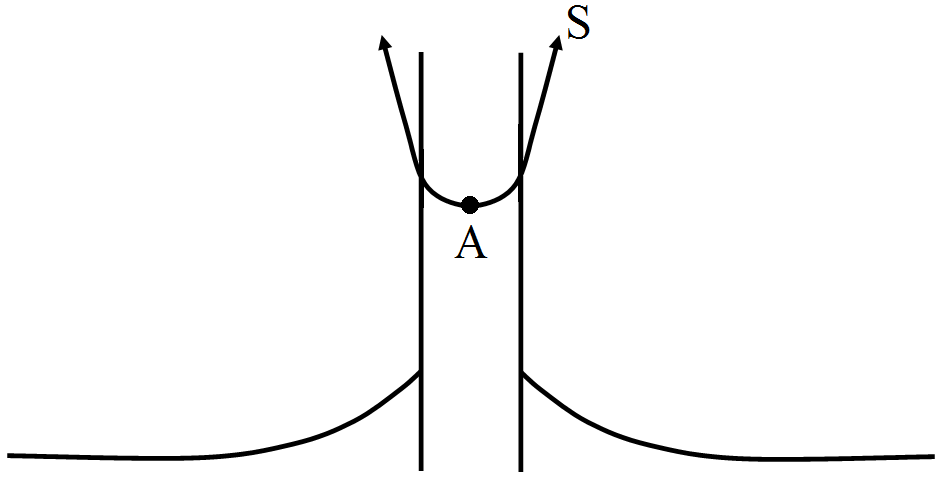
shows a capillary tube of radius $r$ dipped into water. If the atmospheric pressure is $P_0$ the pressure at point $A$ is:
  • A
    $\text{P}_0$
  • B
    $\text{P}_0+ \frac{2\text{S}}{\text{r}}$
  • $\text{P}_0- \frac{2\text{S}}{\text{r}}$
  • D
    $\text{P}_0- \frac{4\text{S}}{\text{r}}$
Answer
Correct option: C.
$\text{P}_0- \frac{2\text{S}}{\text{r}}$

Here:
Radius of the tube $= r$
Net upward force due to surface tension $=\text{S}\cos\theta\times2\pi\text{r}$
Upward pressure $=\frac{\text{s}\cos\theta\times2\pi\text{r}}{\pi\text{r}^2}=\frac{2\text{S}\cos\theta}{\text{r}}$
Net downward pressure due to atmosphere $= P_0$
$\Rightarrow$ Net pressure at $A =\text{P}_0=\frac{2\text{S}\cos\theta}{\text{r}}$
Since $\theta$ is small,
$\cos\theta\approx1$
$\Rightarrow$ Net pressure $=\text{P}_0-\frac{2\text{s}}{\text{r}}$
View full question & answer
MCQ 251 Mark
When a metal wire is stretched by a load, the fractional change in its volume $\frac{\triangle\text{V}}{\text{V}}$ is proportional to.
  • $\frac{\triangle\text{l}}{\text{l}}$
  • B
    $\Big(\frac{\triangle\text{l}}{\text{l}}\Big)^2$
  • C
    $\sqrt{\frac{\triangle\text{l}}{\text{l}}}$
  • D
    None of these.
Answer
Correct option: A.
$\frac{\triangle\text{l}}{\text{l}}$
Explanation:
C.S.A = A
Lenghth = l
Volume of the wire V = Al
Assuming no lateral strain when longitudinal strain occurs:
Increase in volume: $\triangle\text{V}=\text{A}\triangle\text{l}$
$\Rightarrow\frac{\triangle\text{v}}{\text{V}}=\frac{\text{A}\triangle\text{l}}{\text{A}\text{l}}=\frac{\triangle\text{l}}{\text{l}}$
So, $\frac{\triangle\text{V}}{\text{V}}$ is directly proportional $\frac{\triangle\text{l}}{\text{l}}\cdot$
View full question & answer
MCQ 261 Mark
When a metal wire elongates by hanging a load on it, the gravitational potential energy is decreased.
  • A
    This energy completely appears as the increased kinetic energy of the block.
  • B
    This energy completely appears as the increased elastic potential energy of the wire.
  • C
    This energy completely appears as heat.
  • None of these.
Answer
Correct option: D.
None of these.
None of these is the correct option. The decreased gravitational potential energy transforms partly as elastic energy, partly as kinetic energy and also in the form of dissipated heat energy.
View full question & answer
MCQ 271 Mark
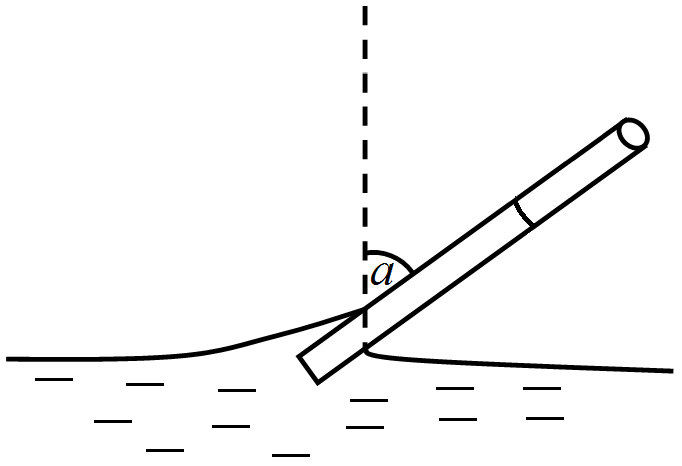
Water rises in a vertical capillary tube upto a length of 10cm. If the tube is inclined at 45°, the length of water risen in the tube will be:
  • A
    $10\text{cm}$
  • $10\sqrt{2}\text{cm}$
  • C
    $\frac{10}{\sqrt{2}}\text{cm}$
  • D
    None of these.
Answer
Correct option: B.
$10\sqrt{2}\text{cm}$
Explanation:

Given:
l = 10cm
$\alpha=45^\circ$
Rise in water level after the tube is tilted = h
$\Rightarrow\text{l}=\text{h}\cos45^\circ$
$\Rightarrow\text{h}=\frac{\text{l}}{\cos45^\circ}=\frac{10}{\Big(\frac{1}{\sqrt{2}}\Big)}=10\sqrt{2}\text{cm}$
View full question & answer
MCQ 281 Mark
A heave uniform rod Is hanging vertically form a foxed support. It is stretched by its won weight. The diameter of the rod is.
  • Smallest at the top and gradually increases down the rod.
  • B
    Largest at the top and gradually decreased down the rod.
  • C
    Uniform everywhere.
  • D
    Maximum in the middle.
Answer
Correct option: A.
Smallest at the top and gradually increases down the rod.
Explanation:
As the rod is of uniform mass distribution and stretched by its own weight, the topmost part of the rod experiences maximum stress due to the weight of the entire rod. This stress leads to lateral strain and the rod becomes thinner. Moving down along the length of the rod, the stress decreases because the lower parts bear lesser weight of the rod. With reduced stress, the lateral strain also reduces. Hence, the diameter of the rod gradually increases from top to bottom.
View full question & answer
MCQ 291 Mark
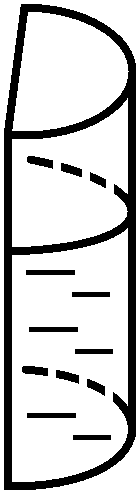
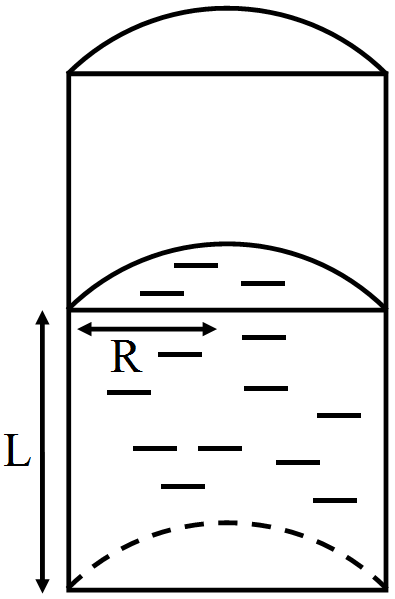
A liquid is contained in a vertical tube of semicircular cross-section The contact angle is zero. The forces of surface tension on the curved part and on the flat part are in ratio:
  • A
    $1:1$
  • B
    $1:2$
  • $\pi:2$
  • D
    $2:\pi$
Answer
Correct option: C.
$\pi:2$
Explanation:

Let the height of the liquid filled column be L
Let the radius be denoted by R
Total perimeter of the curved part = semi - circumference of upper area $=\pi\text{r}$
Total surface tension force $=\pi\text{RS}$
Total perimeter of the flat part $=2\text{R}$
Total surface tension force $=2\text{RS}$
Ratio of curved surface force to flat surface force $=\frac{\pi\text{RS}}{2\text{RS}}=\frac{\pi}{2}$
View full question & answer
MCQ 301 Mark
A heavy mass is attached to a thin wire and is whirled in a vertical circle. The wire is most likely to break.
  • A
    When the mass is at the highest point.
  • When the mass is at the lowest point.
  • C
    When the wire is horizontal.
  • D
    At an angle of $\cos^{-1}\Big(\frac{1}{3}\Big)$ from the upward vertical.
Answer
Correct option: B.
When the mass is at the lowest point.
Explanation:
If the velocity of the mass is a maximum at the bottom, then the string experiences tension due to both the weight of the mass and the high centrifugal force. Both these factors weigh the mass downwards. The tension is therefore, maximum at the lowest point, causing the string to most likely break at the bottom.
View full question & answer
MCQ 311 Mark
A solid sphere moves at a terminal velocity of $20m/s$ in air at a place where $g = 9.8m/s^2.$ The sphere is taken in a gravity free hall having air at the same pressure and pushed down at a speed of $20m/s$
  1.  Its initial acceleration will be $9.8m/s^2$ downward.
  2. Its initial acceleration will be $9.8m/s^2$ upward.
  3. The magnitude of acceleration will decrease as the time passes.
  4. It will eventually stop.
  • A
    $1$ and $2$ 
     
  • B
    $1$ and $3$
  • C
    $2$ and $3$
  • D
    $3$ and $4$
Answer
There Isxplanaition: no gravltatlonal force acting downwards.
However, when the starting velocity Is $20m/s,$ the viscous force, which is directly proportional to velocity, becomes maximum and tends to accelerate the ball upwards.
When the ball falls under gravity,
neglecting the density of air:
Mess of the sphere $= m$
Radius $= r$
Viscous drag coelf $=\eta$
Terminal velocity is given by:
$\text{mg}=6\pi\eta\text{r}\text{v}\text{T}$
$\Rightarrow\frac{6\pi\eta\text{r}\text{v}\text{T}}{\text{m}}=\text{g}\ \cdots(1)$
Now, at terminal velocity, the acceleration of the ball due to the viscous force is given by:
$\text{a}=\frac{6\pi\eta\text{r}\text{v}\text{T}}{\text{m}}$
Comparing equations $(1)$ and $(2),$ we find that:
$\text{a}=\text{g}$
View full question & answer
MCQ 321 Mark
The properties of a surface are different from those of the bulk liquid because the surface molecules:
  • A
    Are smaller than other molecules.
  • B
    Acquire charge due to collision from air molecules.
  • C
    Find different type of molecules in their range of influence.
  • D
    Feel a net force in one direction.
Answer
Feel a net force in one direction.
The surface molecules acquire air and liquid molecules in their sphere of influence.
The surface molecules have different magnitudes of forces pulltng them from the top and the bulk.
So, they are affected by a net finite force in one direction.
View full question & answer
MCQ 331 Mark
When a capillary tube is dipped into a liquid, the liquid neither rises nor falls in the capillary.
  • A
    The surface tension of the liquid must be zero.
     
  • The contact angle must be $90^\circ$.
     
  • C
    The surface tension may be zero.
     
  • D
    The contact angle may be $90^\circ$
Answer
Correct option: B.
The contact angle must be $90^\circ$.
 
If the liquid level does not rise, it may be assumed that the surface tension is zero or the contact angle must be $90^\circ$, 
View full question & answer
M.C.Q (1 Marks) - Physics STD 12 Science Questions - Vidyadip