Questions

[5 marks Questions]

🎯

Test yourself on this topic

27 questions · timed · auto-graded

Question 15 Marks
What are the basic features of the Indian Constitution?
Answer
The basic features of Indian constitution are sovereign democratic republic, justice, liberty, equality and fraternity. In the constitution of India, Justice means justice for all. Social justice means, justice for the whole society, no discrimination on the basis of caste or colour. Economic justice implies equal distribution of wealth and political justice means equal participation of every individual to participate in the government.
Liberty: Indian citizens are given freedom of thought, expression, belief, faith and worship.
Equality: Liberty without equality is meaningless .Every citizen of India is treated equally before law and is ensured equal protection.
Fraternity: It means brotherhood among the people of India.
View full question & answer
Question 25 Marks
How does the Indian Constitution protect social groups?
Answer
To protect India’s social groups, the Indian Constitution has given all Indians the following rights:
  1. All Indians are equal before law. No one can be denied justice or illtreated on grounds of caste, community, gender or religion.
  2. Untouchability has been abolished and its practice is a punishable offence.
  3. Every Indian is free to live or travel anywhere within the country.
  4. No child below the age of 14 can be forced to do hazardous work. Child labour is thus banned in India.
  5. Every Indian has the right to follow the religion of his or her choice. India is a secular country. It means that all religions are equal before the government and the law of the land.
  6. Every community has the right to preserve and promote its own language, script and customs.
  7. A person can move to the court of law if he or she is denied any of these rights.
View full question & answer
Question 35 Marks
What are the occupations {work.s) which are treated good?
Answer
  1. Teaching.
  2. Pottery.
  3. Weaving.
  4. Fishing.
  5. Farming.
  6. These works are rated high.
View full question & answer
Question 45 Marks
How do we discriminate some persons from others?
Answer
We discriminate some persons from others by doing the following activities:
  1. We do something to put others down.
  2. We stop them from taking part in certain activities.
  3. We prevent them from taking up jobs.
  4. We stop them from living in certain localities or neighbourhoods.
  5. We prevent them from taking water from the same well or pump.
  6. We do not allow persons taking tea in the same cup or glass as others.
View full question & answer
Question 55 Marks
What do the terms ‘Difference and ‘Prejudice mean to you? What is stereotyping? How does it create discrimination?
Answer
Difference can be understood as difference among people like different types of food, clothes, languages, culture and religions. All these are influenced by geographical and historical factors. Prejudice means to judge others negatively or as inferior on the basis of skin colour, accent, culture or clothes.
When we fix an individual or group into a particular framework, we create a stereotype. It is a popular belief about a specific social group based on assumptions and not facts. Stereotyping creates inequality and discrimination. This further leads to rejection from the community. For example, dalits are treated as untouchables and inferior.
View full question & answer
Question 65 Marks
What safeguards have been provided in the Constitution of India against inequality and discrimination?
Answer
  1. Everyone has equal rights and opportunities.
  2. Untouchability is seen as a crime. It has been legally abolished.
  3. People are free to choose any kind of work.
  4. Govt. jobs are open to all people.
  5. Specific steps to realise this right to equality for poor and other marginal communities.
Respect to diversity ensures equality.
  1. Freedom to follow any religion
  2. Freedom to speak their own language
  3. Freedom to celebrate their festivals
  4. Freedom to express oneself.
View full question & answer
Question 75 Marks
What are the plights of the ‘Untouchables’?
Answer
Untouchables are those people who are engaged in mean works like scavenging. They remove dead animals from the villages.
These untouchables faced several plights:
  1. They were not allowed to enter the homes of upper castes.
  2. They could not take water from village well or water pump.
  3. They could not sit with others.
  4. Their children could not sit with other children in school.
  5. They were not given the same rights as others.
View full question & answer
Question 85 Marks
Why do we have to strive for equality even today?
Answer
  1. Every effort has been made to remove inequality and discrimination from the society of free India.
  2. Still, inequalities and discrimination exist there.
  3. We have to strive for removal of inequalities and discrimination.
For this:
  1. people have to make efforts.
  2. Positive actions are to be done.
  3. Govts, also have to make efforts and make rules and implement them.
View full question & answer
Question 95 Marks
Who fought against the inequalities they experienced in their lives?
Answer
  1. Dalits.
  2. Women.
  3. Tribals and.
  4. Peasants.
View full question & answer
Question 105 Marks
How the stereotype thinking that “Girls are burden on their parents”, affects the life of a daughter?
Answer
The stereotype thinking that girls are a burden on their parents affects the life of a daughter right from their birth to their marriage. They are treated as temporary member by their family members. They are not treated equally with boys. They are not given adequate opportunity to go to school or make progress. Even in the ancestral property, no rights are reserved for them.
View full question & answer
Question 115 Marks
How can the stereotype that girls are a burden on their parents affect the life of a daughter? Imagine this situation and list at least five different effects that this stereotype can have on the way daughters get treated in the house.
Answer
This is a belief in many parts of India that girls are a burden on their parents. This can affect the life of a girl in negative ways. A girl continuously hears all sorts of comments from her parents and relatives. Following are the some effects that this stereotype can have on the way daughters get treated in the house:
  • A girl may not be sent to school or is sent to school only to study up to primary classes.
  • The girl may not get enough nutrition because nutritious food shall be kept reserve for the boys.
  • The girl may be forced into marriage at an early age.
  • A girl may not be allowed to enjoy her childhood and is forced to do household chores.
  • She may not get proper medical care in case she falls ill.
View full question & answer
Question 125 Marks
What are the facilities available in Kerala for Muslim girls which have made girl education more than any other part of the country?
Answer
  1. Schools are nearer to residences.
  2. Good government bus facilities to reach schools.
  3. 60% of the teachers are women.
  4. Teachers do not face difficulties in reaching rural schools from far off places due to traveling facilities.
View full question & answer
Question 135 Marks
Explain the “right against exploitation”.
Answer
Our constitution prohibits beggar and other forms of forced labour. It also prohibits selling and buying of human being. According to this, human trafficking (buying & selling) is a criminal offence. No one has the right to force another individual to work for him without adequate wages or compensation.
View full question & answer
Question 145 Marks
Which activities are considered low?
Answer
Activities considered low are:
  1. Cleaning.
  2. Washing.
  3. Haircutting.
  4. Garbage picking.
These activities are valued less.
These works are seen as dirty.
View full question & answer
Question 155 Marks
How does prejudice lead to inequality and discrimination?
Answer
Prejudices or stereotype images often result in inequality and discrimination on the basis of gender, caste, class, religion, language, region, strata, place of birth, etc. At times, people of a certain community may be prevented from having water from the same tap in a village. Likewise, economic status may be a determinant for discrimination. Poor people face discrimination in every field- jobs, schools, offices, hospitals, etc. and this may result in increasing their vulnerability to the fulfilment of basic needs like food, clothing and shelter. Poverty becomes the biggest cause of discrimination.
View full question & answer
Question 165 Marks
What problems are created by the stereotypes?
Answer
Stereotypes create the following problems:
  1. They stop us from looking at each person as a unique person.
  2. They prefer their special qualities and not of others.
  3. They fit large number of people in one pattern or type.
  4. They prevent us from doing certain things.
View full question & answer
Question 175 Marks
How does discrimination take place even on grounds of caste and class?
Answer
Discrimination may even take place on grounds of caste and class. Certain sections are described to be poor just because they belong to a lower caste. Further, class discrimination of rich or poor may lead to prejudice and seclusion of certain community from the political mainstream. People doing menial work are regarded as people with little skills or are even called untouchables. People who are up the ladder regard themselves as superior while those who are down the ladder are regarded as inferior or untouchables. The rigidity of caste system is still prevalent in small cities, towns and villages.
View full question & answer
Question 185 Marks
How did Dr. Ambedkar strive for upliftment of Dalits?
Answer
Dr B.R. Ambedkar was the first person from their caste to complete his college education and proceed to England to become a lawyer. He made endless efforts to gain entry, for the Dalits, into the temples. Later on in life, he took up Buddhism and converted to Buddhism that treated all men equally. He was elected to the Constituent Assembly from Bengal in November 1946. He became the Chairman of the Drafting Committee in 1947. Later, as Law Minister in the Union Cabinet, he did much for the upliftment of the untouchables. He rightly believed that the Dalits had to come forward and help themselves.
View full question & answer
Question 195 Marks
Match the following statements in a way that challenges stereo types.
 
Column I
 
Column II
(a)
Two surgeons were sitting down to lunch when one of them made a call on the mobile phone.
(1)
Suffers from chronic asthma
(b)
The boy who won the drawing competition went to the dias.
(2)
To become an astronaut which she did
(c)
One of the fastest athletes in the world.
(3)
To speak with her daughter who had just returned from school
(d)
She was not that well-off but had a dream.
(4)
On a wheelchair to collect his prize
Answer
 
Column I
 
Column II
(a)
Two surgeons were sitting down to lunch when one of them made a call on the mobile phone.
(3)
To speak with her daughter who had just returned from school
(b)
The boy who won the drawing competition went to the dias.
(4)
On a wheelchair to collect his prize
(c)
One of the fastest athletes in the world.
(1)
Suffers from chronic asthma
(d)
She was not that well-off but had a dream.
(2)
To become an astronaut which she did
View full question & answer
Question 205 Marks
Enlist things which we can be prejudiced about?
Answer
  1. People’s religious beliefs.
  2. Colour of people’s skin.
  3. Region they come from.
  4. Accent they speak.
  5. Clothes they wear.
View full question & answer
Question 215 Marks
Enumerate the reasons responsible for discrimination.
Answer
Reasons responsible for discrimination:
  1. Different religions.
  2. Different languages.
  3. Living in different regions.
  4. Different customs and practices.
  5. Different economic backgrounds.
View full question & answer
Question 225 Marks
Explain briefly the caste system in India.
Answer
India has a hierarchical caste system in the society. The Indian term for caste is jati, which generally designates a group varying in size from a handful to many thousands. There are thousands of such jatis, and each has its distinctive rules and customs.Varna refers to the ancient and somewhat ideal fourfold division of the Hindu society:
  1. The Brahmans, the priestly and learned class.
  2. The Kshatriyas, the warriors and rulers.
  3. The Vaisyas, farmers and merchants.
  4. The Sudras, peasants and laborers.
The Caste System was born and maintained by the Brahmins, the priestly class, they are the ones to get more advantage from it.
View full question & answer
Question 235 Marks
Sometimes people make prejudiced comments in our presence. We are often not in a position to do anything about this because it is difficult to say something right then and there. Divide the class into groups and each group discuss what they could do in one of the following situations:
  1. A friend begins to tease a classmate because he is poor.
  2. You are watching TV with your family and one of them makes a prejudicial comment about a particular religious community.
  3. Children in your class refuse to share their food with a particular person because they think she is dirty.
  4. Someone tells you a joke that makes fun of a community because of their accent.
  5. Some boys make remarks about girls not being able to play games as well as them.
Discuss in class what the different groups have suggested for the above situations, and also talk about the problems that can come up when raising the issue
Answer
  1. We should try to educate the tormentor against this practice. If one to one talk fail then we should take the help of teachers.
  2. b. I will request the family member to develop respect for others’ religion. I will try to increase his awareness that all religions teach the path of love with fellow human beings.
  3. c. I will lead by setting an example. I shall be the first person to share food with the child who is being seen as dirty. This will help in changing the mindset of others.
  4. d. I will educate that person about harms of making jokes at someone’s place of origin. I will try to show him the futility of prejudices and stereotypes.
  5. e. I will make a scrapbook which would be full of pictures of female sports stars. I will tell about the glories which Sania Mirza and Saina Nehwal have brought for the country.
View full question & answer
Question 245 Marks
Question Box :
Despite the children offering money, the cartmen refused them. Why ?
How did people at the station discriminate against Dr. Ambedkar and his brothers ?
How do you think Dr. Ambedkar felt as a child when he saw the stationmaster's reaction to his statement that they were Mahars ?
Have you ever experienced prejudice or witnessed an incident of discrimination ? How did this make you feel ?

Read the story of Bhimrao Ambedkar and answer the following questions :
1. Despite the children offering money, the cartmen refused them. Why ?
2. How did people at the station discriminate against Dr. Ambedkar and his brothers ?
3. How do you think Dr. Ambedkar felt as a child when he saw the stationmaster's reaction to his statement that they were Mahars ?
4. Have you ever experienced prejudice or witnessed an incident of discrimination ?
5. How did this make you feel ?
Answer
1. Despite the children offering money, the cartman refused them because they were Mahars, the untouchable caste of the Bombay Presidency.
2. People at the station discriminated against Dr. Ambedkar and his brothers by refusing them to sit or studying near the upper caste people.
3. Dr. Ambedkar felt very disgusted when he saw the station master's reaction to his statement that they were Mahars.
4. Yes, we have seen prejudice in our childhood.
5. This made us feel disappointed and sad.
View full question & answer
Question 255 Marks
Question Box :
A common stereotype about Muslims is that they are not interested in educating girls and therefore do not send girls to school. However, studies have now shown that poverty amongst Muslims is an important reason why Muslim girls do not attend school or leave school after a few years.

Wherever effort has been made to reach education to the poor, there the Muslim community has shown an interest in sending their girls to school. For example in the state of Kerala, the distance between the school and the home is not much. There is a good government bus service that helps teachers reach schools in rural areas and over sixty percent of the teachers are women. These factors have helped children from poorer families, including Muslim girls, attend school in much larger numbers.

In other states, where such efforts have not been made children from poorer families whether Muslim, tribal, or so-called lower castes find it difficult to attend school. Therefore, poverty not religion is the cause for the non-attendance of Muslim girls in school.
Study the above extract and answer the questions given below :
1. What is a common stereotype about Muslims?
2. What reason has been given in recent studies for not sending Muslim girls to schools?
3. Why do Muslim girls study in schools in Kerala along with other girls?
4. What is the real cause of Muslim girls not going to school?
Answer
1. The common stereotype about Muslims is that Muslims are not interested in educating their girls and that they do not send their girls to schools.
2. The studies have suggested poverty as the reason for not sending Muslim girls to school.
3. In Kerala Muslim girls go to schools along with other girls in large numbers:
• The distance between the school and home is very less.
• Women teachers are in large numbers in schools.
• The bus service in Kerala is very efficient.
4. It is poverty, not religion.
View full question & answer
Question 265 Marks
Question Box :
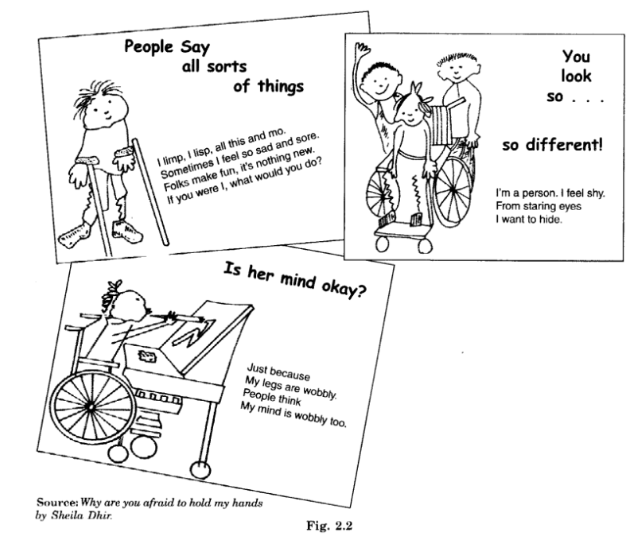
The children you see in the illustrations here were seen as 'disabled'. This term has been changed and now the term used is 'children with special needs. Common stereotypes about them are given in large letters. Their own feelings and thoughts to are given.
Image

• Discuss what these children are saying about stereotypes regarding them and why.
• Do you think children with special needs should be a part of regular schools or study in a separate school? Give reasons for your answer.
Answer
• Picture I:
Stereotypes. People say all sorts of things
The child says:
• I limp.
• I lisp, all this and more.
• Sometimes I feel so sad and sore.
• If you were I, what would you do?
Picture II:
Stereotypes. You look so so different!
The child says:
• I am a person.
• I feel shy.
• From staring eyes, I want to hide.
Picture III:
Stereotypes. Is her mind okay?
The child says:
• Just because my legs are wobbly.
• People think my mind is wobbly too.
• These children are saying about stereotypes because they understand the attitudes of the people around them. They mock them and they tease them.
• We think children with special needs should be a part of regular school and should not study in a separate school because they would learn many things more in regular school and will not feel degraded.
View full question & answer
Question 275 Marks
Look again at the statements that you believed to be true about rural and urban life in India. Do you have a prejudice against rural or urban people? Find out if this is shared by others and discuss the reasons why people have these prejudices.
Can you list some of the prejudices that you have noticed around you? How do they affect the ways in which people treat each other?
Answer
1. No, we do not have a prejudice against the rural or urban people.
2. This view is also shared by others around us.
3. Some people have prejudices against others because of the following reasons.
• Negative attitude towards others.
• Superiority complex.
• Treating oneself above all others.
• Overconfidence in oneself.
• Wrong attitude formation.
• Pessimism,
4. Prejudices noticed around us:
• Caste
• Colour
Eating habits.
5. They affect the ways in which people treat each other.
• They laugh at
• They tease
• They speak the fifty languages
• Sometimes they begin to abuse others.
View full question & answer
[5 marks Questions] - Social Science STD 6 Questions - Vidyadip