Question 15 Marks
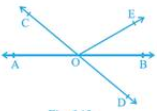
In Figure lines $AB$ and $CD$ intersect at $O$. If $\angle AOC + \angle BOE = {70^ \circ }$ and $\angle BOD = {40^ \circ }$,find $\angle BOE$ and reflex $\angle COE$
Answer
View full question & answer→We are given that $\angle A O C+\angle B O E=70^{\circ}$ and $\angle B O D=40^{\circ}$
We need to find $\angle B O E$ and reflex $\angle C O E$
From the given figure, we can conclude that $\angle A O E$ and $\angle B O E$ form a linear pair.
We know that sum of the angles of a linear pair is $180^{\circ}$
$\therefore \angle AOE + \angle BOE = 180^\circ $
$ \because \angle AOE = \angle AOC + \angle COE$
$ \therefore \angle AOC + \angle COE + \angle BOE = 180^\circ $
$ \therefore \angle AOC + \angle BOE + \angle COE = 180^\circ $
$ \Rightarrow 70^\circ + \angle COE = 180^\circ $
$ \Rightarrow \angle COE = 180^\circ - 70^\circ $
$= 110^\circ $
Reflex $\angle COE = 360^\circ - \angle COE$
$= 360^\circ - 110^\circ $
$= 250^\circ $
$ \angle AOC = \angle BOD$ (Vertically opposite angles), or
$\angle BOD + \angle BOE = 70$
But, we are given that $\angle BOD = 40^\circ .$
$40^\circ + \angle BOE = 70^\circ $
$ \angle BOE = 70^\circ - 40^\circ $
$= 30^\circ $.
Therefore, we can conclude that Reflex $\angle COE =250^{\circ}$ and $\angle BOE =30^{\circ}$
We need to find $\angle B O E$ and reflex $\angle C O E$
From the given figure, we can conclude that $\angle A O E$ and $\angle B O E$ form a linear pair.
We know that sum of the angles of a linear pair is $180^{\circ}$
$\therefore \angle AOE + \angle BOE = 180^\circ $
$ \because \angle AOE = \angle AOC + \angle COE$
$ \therefore \angle AOC + \angle COE + \angle BOE = 180^\circ $
$ \therefore \angle AOC + \angle BOE + \angle COE = 180^\circ $
$ \Rightarrow 70^\circ + \angle COE = 180^\circ $
$ \Rightarrow \angle COE = 180^\circ - 70^\circ $
$= 110^\circ $
Reflex $\angle COE = 360^\circ - \angle COE$
$= 360^\circ - 110^\circ $
$= 250^\circ $
$ \angle AOC = \angle BOD$ (Vertically opposite angles), or
$\angle BOD + \angle BOE = 70$
But, we are given that $\angle BOD = 40^\circ .$
$40^\circ + \angle BOE = 70^\circ $
$ \angle BOE = 70^\circ - 40^\circ $
$= 30^\circ $.
Therefore, we can conclude that Reflex $\angle COE =250^{\circ}$ and $\angle BOE =30^{\circ}$