Questions · Page 6 of 6

M.C.Q

MCQ 2511 Mark
Two sides of a triangle are oflengths $5\ cm$ and $1.5\ cm$. The length of the third side of the triangle cannot be:
  • A
    $3.6\ cm$
  • B
    $3.8\ cm$
  • C
    $4\ cm$
  • $3.4\ cm$
Answer
Correct option: D.
$3.4\ cm$
Given that: Two sides of triangle are $5\ cm$ and $1.5\ cm$. We know that the sum of two sides of the triangle is always greater than the third side. Hence, $3.4\ cm$ cannot be the third side. If it is the third side the sum of $3.4\ cm$ and $1.5\ cm$ will be smaller than $5\ cm,$ so, the triangle will not be possible.
View full question & answer
MCQ 2521 Mark
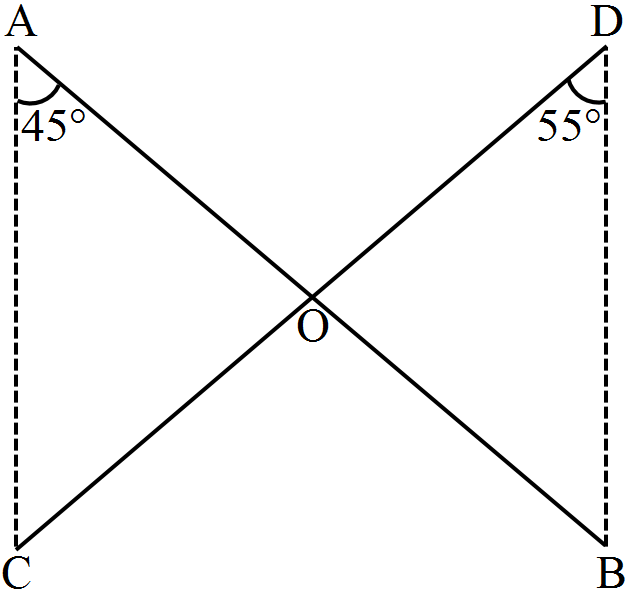
Line sgements $AB$ and $CD$ intersect at $O$ such that $\text{AC}||\text{DB}.$ If $\angle\text{CAB} = 45^\circ$ and $\angle\text{CDB} = 55^\circ,$ then $\angle\text{BOD} =$
  • $80^\circ $
  • B
    $90^\circ$
  • C
    $100^\circ$
  • D
    $135^\circ$
Answer
Correct option: A.
$80^\circ $

$\text{AC}||\text{DB}$
And, AB is transverse to these parallel lines
So, $\angle\text{CAB} = \angle\text{ABD}$ (Alternate angles)
$\Rightarrow \angle\text{ABD} = 45^\circ$
Now In $\triangle\text{BOD}$
$\angle\text{BOD} + \angle\text{ODB} + \angle\text{DBA} = 180^\circ$
$\angle\text{DBA} = \angle\text{ABD} = 45^\circ, \ \angle\text{ODB} = 55^\circ$
So, $\angle\text{BOD} = 180^\circ - 45^\circ - 55^\circ$
$= 80^\circ$
View full question & answer
MCQ 2531 Mark
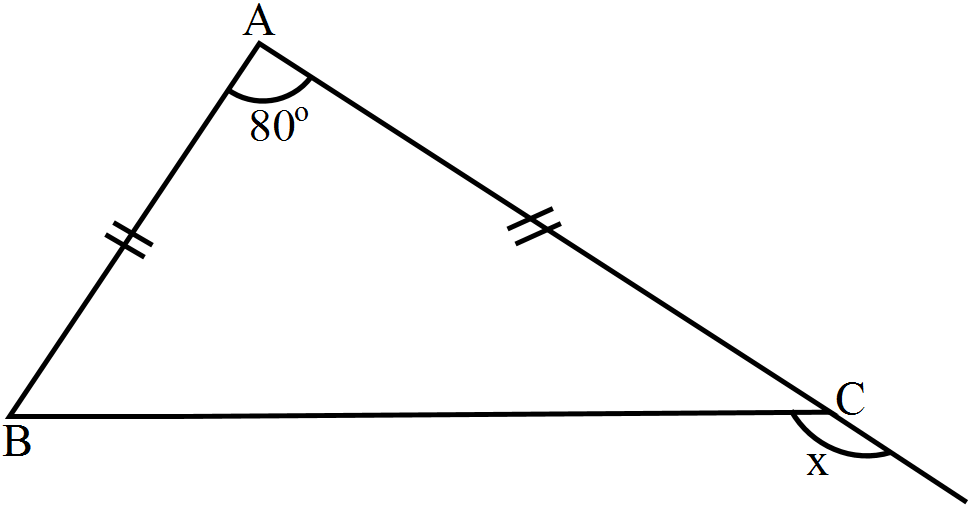
In fig, in $\triangle\text{ABC}, AB = AC$, then the value of $x$ is:
  • A
    $100^{\circ}$
  • B
    $80^{\circ}$
  • C
    $120^{\circ}$
  • $130^{\circ}$
Answer
Correct option: D.
$130^{\circ}$
Triangle $ABC$ is an iscosceles triangle and hence in the triangle other two angles are $50$ and $50.$
Therefore,$X = 180 - 50 = 130$
View full question & answer
MCQ 2541 Mark
In $\triangle\text{ABC},$ if $\angle\text{B} = 30^\circ$ and $\angle\text{C} = 70^\circ,$ then which of the following is the longest side?
  • A
    $AB$ or $AC$
  • $BC$
  • C
    $AB$
  • D
    $AC$
Answer
Correct option: B.
$BC$
Since the sum of all sides of a triangle is $180^\circ .$ So, $\angle\text{C} = 70^\circ,\ \angle\text{B} = 30^\circ,\ \angle\text{A} = 80^\circ.$
We have a theorem which states that the side opposite to the greatest angle is the longest.
So, the side opposite to angle $A$ is the longest.
View full question & answer
MCQ 2551 Mark
If two acute angles of a right triangle are equal, then each acute is equal to:
  • A
    $30^\circ$
  • $45^\circ$
  • C
    $60^\circ$
  • D
    $90^\circ$
Answer
Correct option: B.
$45^\circ$
Let the measure of each acute angle of a triangle be $x^\circ $.Then, we have
$x^\circ + x^\circ + 90^\circ = 180^\circ$
$i.e. 2x^\circ = 90^\circ$
$i.e. x^\circ = 45^\circ$
View full question & answer
MCQ 2561 Mark
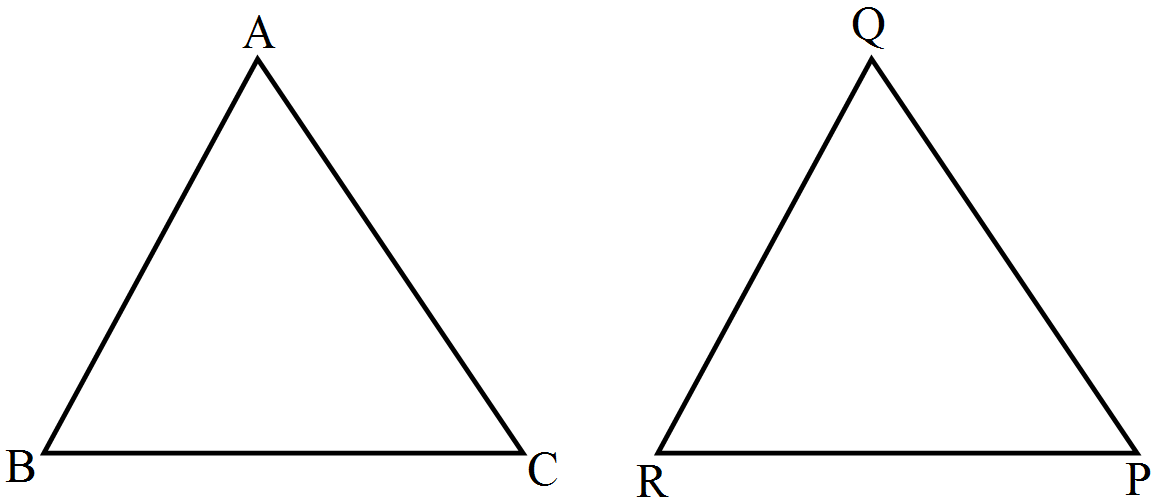
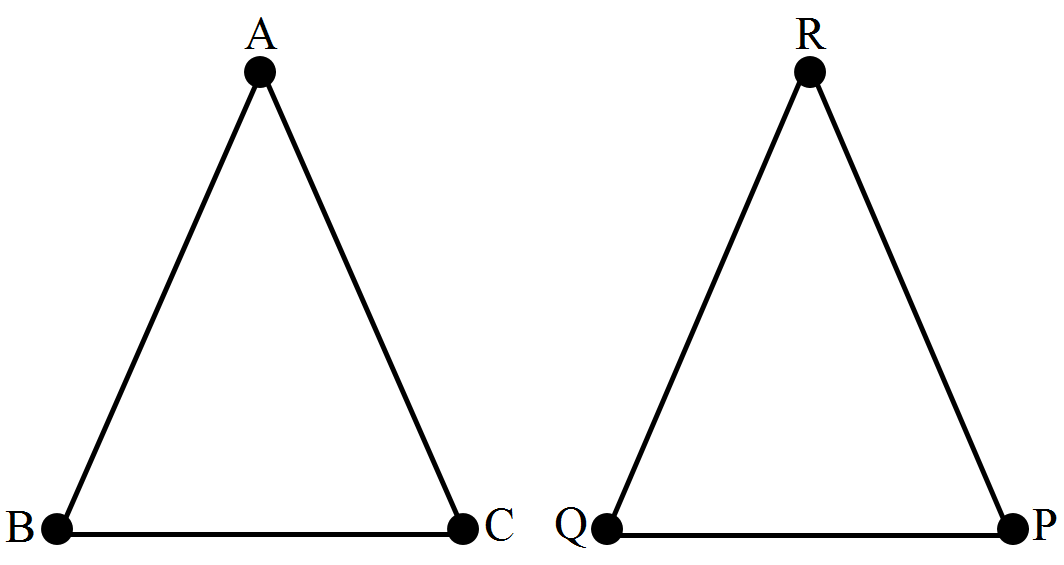
If $\triangle\text{ABC}\cong\triangle\text{PQR}$ then which of the following is not true?
  • $BC = PQ$
  • B
    $AC = PR$
  • C
    $BC = QR$
  • D
    $AB = PQ$
Answer
Correct option: A.
$BC = PQ$

Since $ABC$ is not congruent to $RPQ, BC = PQ$ is not true.
View full question & answer
MCQ 2571 Mark
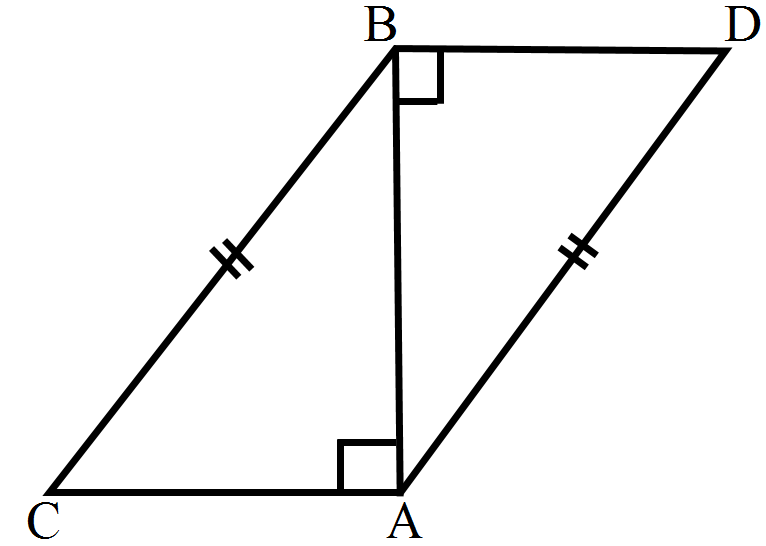
In the adjoining figure, $BC = AD$, $\text{CA}\bot\text{AB}$ and $\text{BD}\bot\text{AB}.$ The rule by which $\triangle\text{ABC}\cong\triangle\text{BAD}$ is:
  • A
    $ASA$
  • $RHS$
  • C
    $SSS$
  • D
    $SAS$
Answer
Correct option: B.
$RHS$
In $\triangle\text{ABC}$ and $\angle\text{BAG} = \angle\text{ABD}$
$BAD$, we have (Right angles)
$BC = AD$ (Hypotentuses and Given)
$AB = AB$ (conunon in both)
Hence, $\triangle\text{ABC}\cong\triangle\text{BAD}$ by $RHS$ criterion.
View full question & answer
MCQ 2581 Mark
If $\angle\text{OCA}=80^\circ, \ \angle\text{COA}=40^\circ,$ and $\angle\text{BDO}=70^\circ$ then $x^\circ + y^\circ = ?$
  • A
    $270^\circ$
  • B
    $210^\circ$
  • $230^\circ$
  • D
    $190^\circ$
Answer
Correct option: C.
$230^\circ$
In the given figure, $\angle\text{BOD} = \angle\text{COA}$ (Vertically opposite angles)$\therefore\ \angle\text{BOD} = 40^\circ ... (\text{i})$
In $\triangle\text{ACO}$
$\angle\text{OAE}=\angle\text{OCA}+\angle\text{COA}$ (Exterior angle of a triangle is equal to the sum of two opposite interior angles)
$⇒ \text{x}^\circ = 80^\circ + 40^\circ = 120^\circ ... \ (\text{ii})$
In $\angle\text{BDO},$
$\angle\text{DBF}=\angle\text{BDO}+\angle\text{BOD}$ (Exterior angle of a triangle is equal to the sum of two opposite interior angles)
$⇒\text{y}^\circ=70^\circ+40^\circ=110^\circ\ ...\ (\text{iii})$
Adding $(2)$ and $(3)$ we get
$\text{x}^\circ+\text{y}^\circ=120^\circ+110^\circ=230^\circ$
View full question & answer
MCQ 2591 Mark
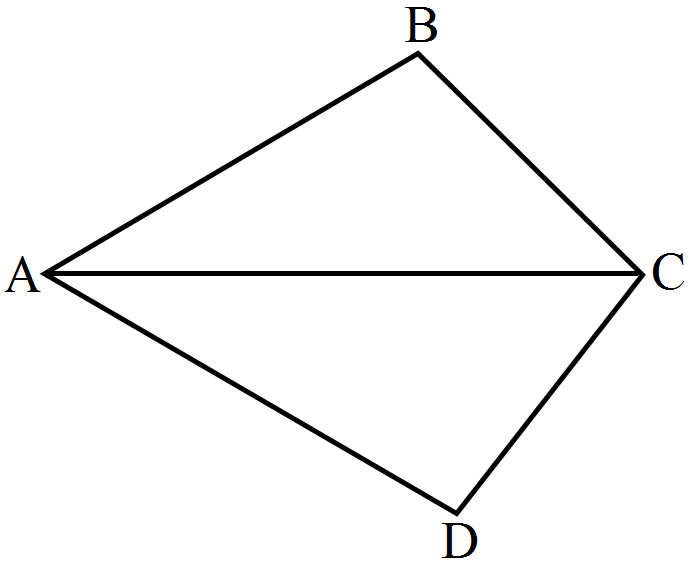
In the adjoining figure, $\triangle\text{ABC}\cong\triangle\text{ADC}.$ If $\angle\text{BAC} = 30^\circ$ and $\angle\text{ABC} = 100^\circ$ then $\angle\text{ACD}$ is equal to:
  • A
    $80^{\circ}$
  • B
    $60^{\circ}$
  • C
    $30^{\circ}$
  • $50^{\circ}$
Answer
Correct option: D.
$50^{\circ}$
In triangle ABC, $\angle\text{BAC} = 30^\circ$and $\angle\text{ABC} = 100^\circ$ (Given)$\angle\text{BAC} + \angle\text{ABC} + \angle\text{BCA} = 180^\circ$
$\angle\text{BAC} = 50^\circ$
Also $\angle\text{ACD} = 50^\circ$(Since, $\triangle\text{ABC}\cong\triangle\text{ADC}$)
View full question & answer
MCQ 2601 Mark
In $\triangle\text{ABC},$ if $\angle\text{B} = 30^\circ$ and $\angle\text{C} = 70^\circ,$ then which of the following is the longest side?
  • A
    $AC$
  • $BC$
  • C
    $AB$
  • D
    $AB$ or $AC$
Answer
Correct option: B.
$BC$
Since the sum of all sides of a triangle is $180^\circ .$
So, $\angle\text{C}=70^\circ,\ \angle\text{B}=70^\circ,\ \angle\text{A}=80^\circ,$
We have a theorem which states that the side opposite to the greatest angle is the longest.
So, the side opposite to angle A is the longest.
View full question & answer
MCQ 2611 Mark
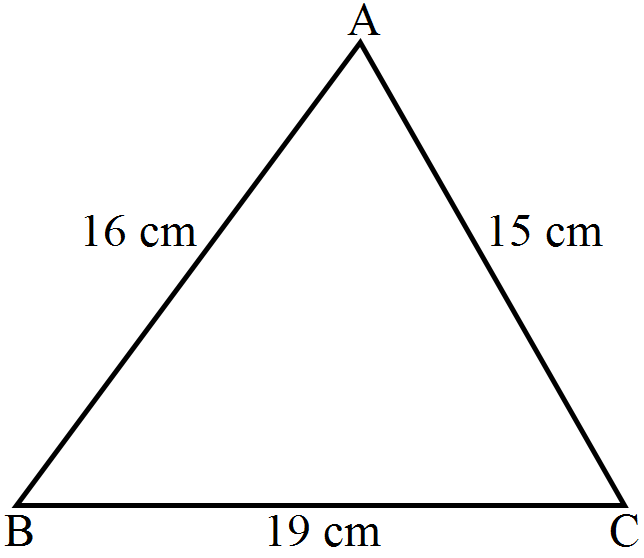
In fig. which of the following statement is true?
  • A
    $\angle\text{B} = \angle\text{C}$
  • $\angle\text{B}$ is the smallest angle in the triangle.
  • C
    $\angle\text{B}$ is the greatest angle in the triangle.
  • D
    $\angle\text{A}$ is the smallest angle in the triangle.
Answer
Correct option: B.
$\angle\text{B}$ is the smallest angle in the triangle.

In a triangle angle opposite to smallest side is least $AC$ is least side and hence $B$ is smaller.

View full question & answer
MCQ 2621 Mark
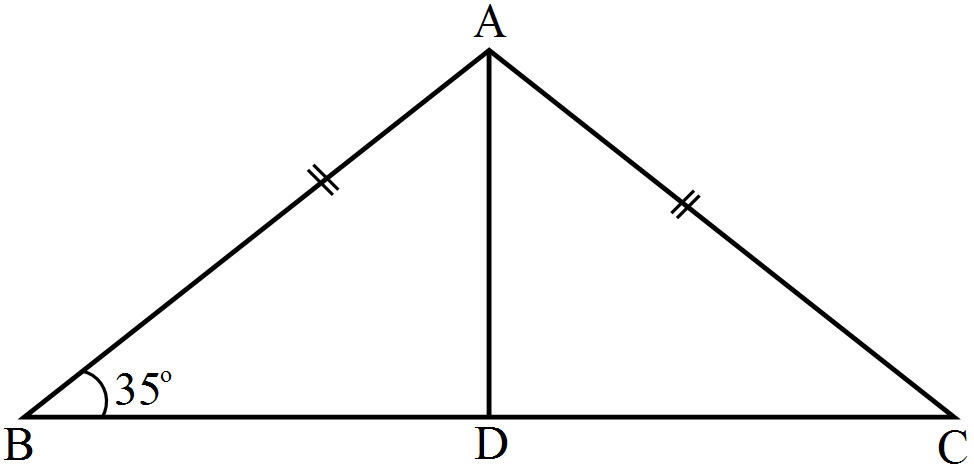
$ABC$ is an isosceles triangle such that $AB = AC$ and $AD$ is the median to base BC. Then, $\angle\text{BAD}=$
  • $55^\circ$
  • B
    $70^\circ$
  • C
    $35^\circ$
  • D
    $110^\circ$
Answer
Correct option: A.
$55^\circ$

If $AD$ is the median, then $D$ is the mid-point of $BC.$
$\text{BD}=\text{DC}$
So consider $\triangle\text{ADB}$ and $\triangle\text{ADC}$
$\text{AD}=\text{AD}$ (common)
$\text{DB}=\text{DC}$
$\text{BA}=\text{CA}$
So by SSS, $\triangle\text{ADB}\cong\triangle\text{ADC}$
Now $\angle\text{B}=\angle\text{C}=35^\circ$
$\Rightarrow\angle\text{BAD}=\angle\text{DAC}$
So in $\triangle\text{ABC},$
$\angle\text{A}+\angle\text{B}+\angle\text{C}=180^\circ$
$\Rightarrow2\angle\text{BAD}+35^\circ+35^\circ=180^\circ$
$\Rightarrow2\angle\text{BAD}=110^\circ$
$\Rightarrow\angle\text{BAD}=55^\circ$
Hence, correct option is $(a).$
View full question & answer
MCQ 2631 Mark
In $\triangle\text{ABC},$ $\angle\text{A} = 35^\circ$ and $\angle\text{B} = 65^\circ$, then the longest side of the triangle is:
  • $AB$
  • B
    $BC$
  • C
    $AC$
  • D
    None of these
Answer
Correct option: A.
$AB$
As per angle sum property, $\angle\text{A} +\angle\text{B}+\angle\text{C}= 180^\circ$
Hence, $35^\circ + 65^\circ + \angle\text{C} = 180^\circ$
$\Rightarrow\ \angle\text{C} = 80^\circ$ which is the greatest angle.
We know that the side opposite to the greatest angle i.e $AB$ would be the greatest.
Hence, $AB$ is the longest side.
View full question & answer
MCQ 2641 Mark
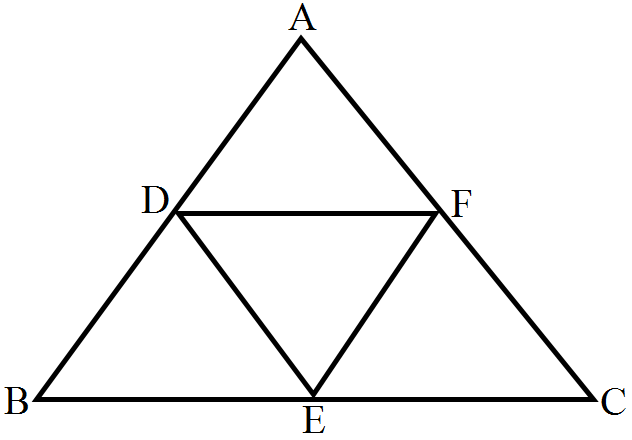
$D, E$ and $F$ are the mid points of sides $AB, BC$ and $CA$ of $\triangle\text{ABC}.$ If perimetre of $\triangle\text{ABC}.$ is $16\ cm,$ then perimetre of $\triangle\text{DEF}.$
 
  • A
    $4\ cm$
  • $8\ cm$
  • C
    None of these
  • D
    $32\ cm$
Answer
Correct option: B.
$8\ cm$
Using relation,$\text{Perimeter.}\ \triangle\text{DEF}=\frac{1}{2}\text{Perimeter.}\ \triangle\text{ABC}$
$=\frac{1}{2}\times16=18\text{cm}$
View full question & answer
MCQ 2651 Mark
If $a, b, c$ are the lengths of the sides of a triangle, then
  • A
    $A – B > C$
  • B
    $C > A + B$
  • $C < A + B$
  • D
    $C = A + B$
Answer
Correct option: C.
$C < A + B$
Put the sidesof triangle $a, b, c$
For a possible triangle the following are possible.
$a + b > = c$
$b + c > = a$
$a + c > = b$
View full question & answer
MCQ 2661 Mark
In triangles $ABC$ and $PQR, AB = AC$, $\angle\text{C} = \angle\text{P}$ and $\angle\text{B} = \angle\text{Q}.$ The two triangles are:
  • A
    Congruent but not isosceles.
  • B
    Isosceles and congruent.
  • Isosceles but not congruent.
  • D
    Neither congruent nor isosceles.
Answer
Correct option: C.
Isosceles but not congruent.
Given: $\triangle\text{ABC}$ and $\triangle\text{PQR}, \ \text{AB = AC}, \ \angle\text{C} = \angle\text{P}$ and $\angle\text{B} = \angle\text{Q}.$

$\text{AB = AC}$
$\Rightarrow\ \angle\text{B} = \angle\text{C}$ (opposite angles to equal sides are equal)
Hence, $\triangle\text{ABC}$ is an isosceles triangle.
$\angle\text{C} = \angle\text{P}$ and $\angle\text{B} = \angle\text{Q}$ (given)
$\Rightarrow \angle\text{P} = \angle\text{Q}\ \ (\therefore \angle\text{B} = \angle\text{C})$
$\Rightarrow \text{QR} = \text{PR}$ (opposite sides to equal angles are equal)
Hence, $\triangle\text{PQR}$ is an isosceles triangle.
So, the two triangles are isosceles but not congruent.
As $AAA$ is not the criterion for a triangle to be congruent.
View full question & answer
MCQ 2671 Mark
Which is true?
  • A triangle can have two right angles.
  • B
    A triangle can have two obtuse angles.
  • C
    A triangle can have two acute angles.
  • D
    An exterior angle of a triangle is less than either of the interior opposite angles.
Answer
Correct option: A.
A triangle can have two right angles.

We know that, by the angle sum property,
the sum of all the angles of a triangle is $180^\circ ...(i)$
So, if two angles are right angles, then their sum is $180^\circ .$
So, the measure of the third angle is zero, which is not possible.
Thus, $(a)$ is not true.

View full question & answer
MCQ 2681 Mark
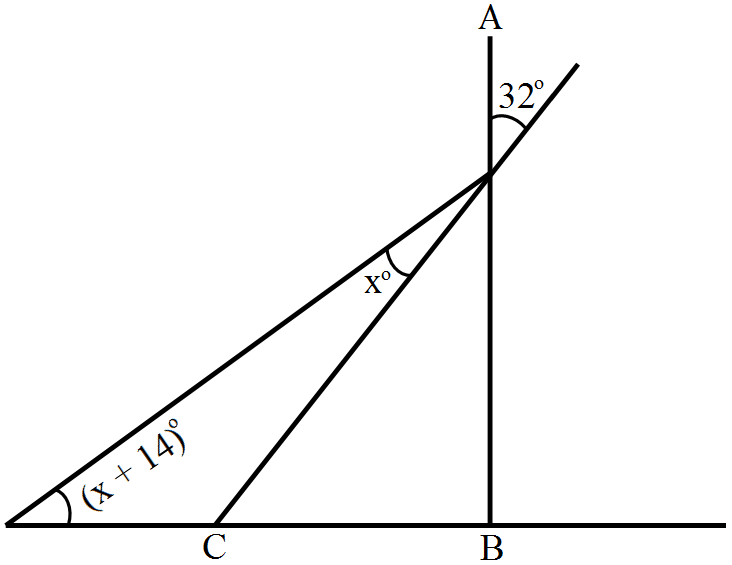
In Fig. if $\text{AB}\perp\text{BC},$ then $x =$
  • A
    $18^\circ$
  • $22^\circ$
  • C
    $25^\circ$
  • D
    $32^\circ$
Answer
Correct option: B.
$22^\circ$
$\text{AB}\perp\text{BC}$$\Rightarrow\angle\text{ABC}=90^\circ$
$\angle\text{CAB}=32^\circ$ (Opposite angles)
Now, in $\triangle\text{ABD}$
$\angle\text{DAB}=\text{x}^\circ+32^\circ$
$\angle\text{ABD}=90^\circ$
$\angle\text{BDA}=\text{x}^\circ+14^\circ$
In a $\triangle,$ sum of all angles $= 180^\circ$
$\Rightarrow\angle\text{DAB}+\angle\text{ABD}+\angle\text{BDA}=180^\circ$
$\Rightarrow\text{x}^\circ+32^\circ+90^\circ+\text{x}^\circ+14^\circ=180^\circ$
$\Rightarrow2\text{x}^\circ=180^\circ-136^\circ$
$\Rightarrow2\text{x}^\circ=44^\circ$
$\Rightarrow\text{x}^\circ=22^\circ$
View full question & answer
MCQ 2691 Mark
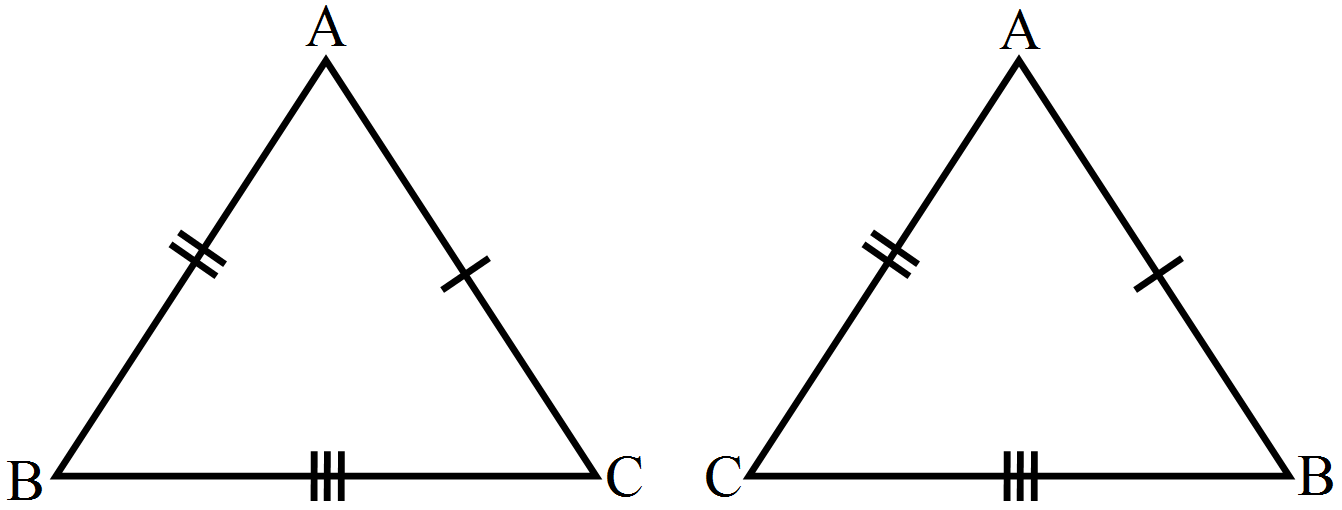
If $\triangle\text{ABC}\cong\triangle\text{ACB},$ then $\triangle\text{ABC}$ is isosceles with.
  • $AB = AC$
  • B
    $AB = BC$
  • C
    $AC = BC$
  • D
    None of these
Answer
Correct option: A.
$AB = AC$

$\triangle\text{ABC}\cong\triangle\text{ACB}$
$\Rightarrow\text{AB}=\text{AC}$
or
$\text{AC}=\text{AB}$
So, in $\triangle\text{ABC}$ is isosceles with $\text{AB}=\text{AC}.$
Hence, correct option $(a).$
View full question & answer
MCQ 2701 Mark
It is not possible to construct a triangle when the lengths of its sides are:
  • $5.3\ cm, 2.2\ cm, 3.1\ cm$
  • B
    $6\ cm, 7\ cm, 8\ cm$
  • C
    $4\ cm, 6\ cm, 6\ cm$
  • D
    $9.3\ cm, 5.2\ cm, 7.4\ cm$
Answer
Correct option: A.
$5.3\ cm, 2.2\ cm, 3.1\ cm$
Put the sidesof triangle $a, b, c$
For a possible triangle the following are should possible.
$a + b > = c$
$b + c > = a$
$a + c > = b$
Here, $2.2 + 3.1 = 5.3$
So, $a + b = c$
So the triangle becomes a streight line.
So we cannot draw a triangle with sides $5.3\ cm, 2.2\ cm, 3.1\ cm.$
View full question & answer
MCQ 2711 Mark
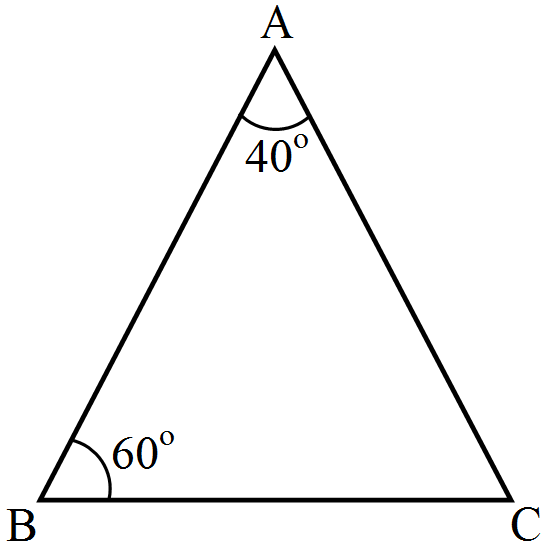
In $\triangle\text{ABC, }\angle\text{A}=40^{\circ}$ and $\angle\text{B}=60^{\circ}.$ Then the longest side of $\triangle\text{ABC}$ is:
  • A
    $BC$
  • B
    $AC$
  • $AB$
  • D
    cannot be determined
Answer
Correct option: C.
$AB$

In $\triangle\text{ABC},$
$\angle\text{A}+\angle\text{B}+\angle\text{C}=180^{\circ}$ ...(Using Angle Sum Property)
$\Rightarrow40^{\circ}+60^{\circ}+\angle\text{C}=180^{\circ}$
$\Rightarrow\angle\text{C}=80^{\circ}$
We know that, the greater angle has the longest side opposite to it.
Since $\angle\text{A}<\angle\text{B}<\angle\text{C, }\text{BC < AC < AB}.$
So, the longest side is $AB.$
View full question & answer
MCQ 2721 Mark
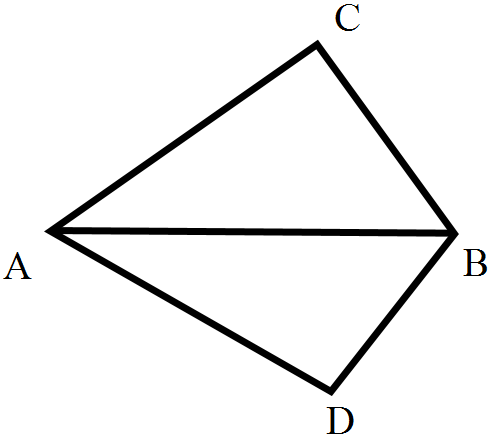
In the above quadrilateral $ACBD$, we have $AC= AD$ and $AB$ bisect the $LA$ .Which of the following is true?
  • A
    $\triangle\text{ABC}\cong\triangle\text{ABD}$
  • B
    $\angle\text{C}=\angle\text{D}$
  • $\text{All are true}$
  • D
    $\text{BC = BD}$
Answer
Correct option: C.
$\text{All are true}$
$\text{AC = AD}$$\angle\text{AB}= \angle\text{BAD}$
$\text{AB = AB}$
By SAS, we have
$\triangle\text{ABC}\cong\triangle\text{ABD}$
Hence, we have $\text{BC = BD}$ and $\angle\text{C}= \angle\text{D}.$
So, all the given options are true.
View full question & answer
MCQ 2731 Mark
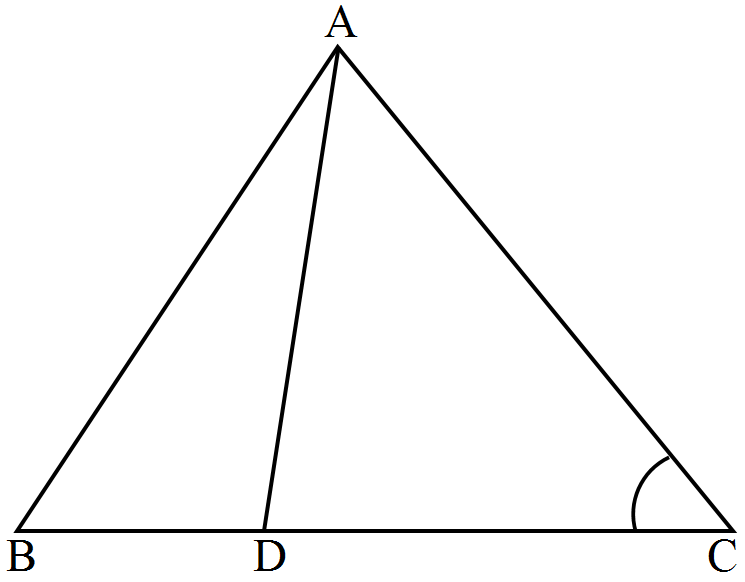
In the given figure, $AB > AC$. Then, which of the following is true?
  • A
    $AB < AD$
  • B
    Cannot be determined
  • $AB > AD$
  • D
    $AB = AD$
Answer
Correct option: C.
$AB > AD$
$AB > AC$ [given.]
$∴ \ \angle\text{ACB} > \angle\text{ABC}$
Now, $\angle\text{ADB} > \angle\text{ACD}$ (exterior angle is always greater than each interior angle)
$⇒ \angle\text{ADB} > \angle\text{ACB} > \angle\text{ABC}$
$\Rightarrow\ \angle\text{ADB} > \angle\text{ADB}$
$⇒\text{AB > AD}$
View full question & answer