Questions

3 Marks Question

Take a timed test

40 questions · self-marked practice — reveal the answer and mark yourself.

Question 13 Marks
Why is abscisic acid also known as stress hormone?
Answer
A fairly high concentration of abscisic acid (ABA) is found in leaves of plants growing under stress conditions, such as drought, flooding, injury, mineral deficiency etc. It is accompanied by loss of turgor and closure of stomata. When such plants are transferred to normal conditions, they regain normal turgor and ABA concentration decreases. Since the synthesis of ABA is accelerated under stress condition and the same is destroyed or inactivated when stress is relieved, it is also known as stress hormone.
View full question & answer
Question 23 Marks
Would a defoliated plant respond to photoperiodic cycle? Why?
Answer
No, a defoliated plant would not respond to photoperiodic cycle because photoperiodic stimulus is picked up by the leaves only. Even one leaf or a part of it is sufficient for this purpose. For perception of photoperiodic cycle, there must be the presence of leaves under inductive photoperiod, so that, the hormone responsible for flowering can be produced.
View full question & answer
Question 33 Marks
Many discoveries in science have been accidental. This is true for plant hormones also. Can you justify this statement by giving an example? Also what term is used for such accidental findings?
Answer
The plant hormones are synthesized by the plant cells individually accordingly and when needed. Few hormones are specifically synthesized at a particular plant part, like auxin synthesized in growing shoot apices. Ethylene is emitted by ripened fruits, Cytokinin is found in dividing cells. Unlike plants animal being more advanced, and organized they have proper hormone secreting glands and organs. In both plant and animals these are transported through the transport system of their body. In plants, hormones are translocated via xylem and phloem to the site of activity.
View full question & answer
Question 43 Marks
What are the structural characteristics of:
  1. Meristematic cells near root tip?
  2. The cells in the elongation zone of the root?
Answer
  1. Meristematic cells near root tip are in the process of active divisions, i.e., mitotic cell division. Each chromosome splits lengthwise into two homologous chromatids, which pass equally into daughter cells.
  2. The cells in the elongation zone of the root have enlarge size due to vacuolation, i.e., by absorption of water. In these a large central vacuole is present, which push the cytoplasm to a thin boundary layer against the cell wall. The daughter cells formed after divisions have half the size of the parent cell.
View full question & answer
Question 53 Marks
Arun visited his village in vacations to see his grandfather. He went to the field one day along with his grandfather where he observed the poor growth of the sugarcane. He discussed the issue and the reason behind this with his grandfather. Sugarcane is the main crop in their village. His grandfather asked him to suggest some methods in order to increase the yield of sugarcane, in a healthy way. Being a biology student Arun told his grandfather to use gibberellins ($\mathrm{GA}_3$) spray on the sugarcane crop.
  1. What are gibberellins?
  2. What are other physiological responses influenced by gibberellins? Give arty two.
  3. What message is conveyed by grandfather and Arun's character?
Answer
  1. Gibberellins are plant growth regulators which enhance the longitudinal growth of stem when applied to intact plants. The presence of meristematic cells is neccessary for the elongation growth caused by gibberellins.
  2. It causes elongation of internodes in plants. So, in sugarcane it increases the yield of the crop.
  3. Arun's grandfather wanted Arun to apply the knowledge gained in class for human welfare. Arun is intelligent, loves nature and he takes initiatives.
View full question & answer
Question 63 Marks
Give the chemical name of one example of each of the following and mention one function of each of them:
  1. Natural auxins.
  2. Synthetic auxins.
  3. Gaseous plant hormones.
Answer
  1. Indole acetic acid, is responsible for apical dominance, cell division in vascular cambium and xylem differentiation.
  2. 2, 4 dichlorophenoxy acetic acid is used as a weedicide to get a weed-free lawn.
  3. Ethylene promotes ripening of fruits and root growth and formation of root hairs.
View full question & answer
Question 73 Marks
Explain the following terms:
  1. Vernalisation.
  2. Photoperiodism.
  3. Differentiation.
Answer
  1. Vernalisation refers to the low temperature treatment given to the seeds/ seedlings of certain plants to promote flowering.
  2. Photoperiodism refers to the response of plants to duration of light/ dark periods for flowering.
  3. Differentiation is the process by which totipotent embryonic or meristematic cells undergo changes in the structure, shape and chemical nature according to the function they are going to perform.
View full question & answer
Question 83 Marks
What are plant growth regulators? Name any four different chemical nature of them with one example of each.
Answer
Plant growth regulators are small, simple molecules secreted in minute quantities, that influence various physiological functions in plants. They are of diverse chemical composition.
  1. Indole compounds [such as- Indole-3- Acetic Acid (IAA)].
  2. Adenine derivatives [such as kinetin, 6-furfuryl amino purine].
  3. Derivatives of carotenoids [such as Abscisic Acid (ABA)].
  4. Terpenes [such as gibberellic acids].
View full question & answer
Question 93 Marks
Why is the term short-day plants a misnomer? Give one example of short-day plants.
Answer
The term short-day plants is actually a misnomer. When photoperiodism was discovered, the duration of the light period was thought to be critical for flowering. However, subsequently researchers found that when the long night period was interrupted in short-day plants, by a brief exposure to light, they failed to flower. In other words, the requirement is actually for a long night or a critical dark period rather than for a short day length. Thus, a short-day plant is more appropriately called as a long-night plant.Common examples of short-day plants are Xanthium and Chrysanthemum.
View full question & answer
Question 103 Marks
Name the categories of plant hormones concerned with each of the following and describe one other function of each of the three categories of plant hormones.
  1. Inhibition of seed germination.
  2. Promote flowering.
  3. Cell division promoting activity.
Answer
  1. Abscisic acid: Gives signals for closure of stomata in plants to prevent water loss during water stress.
  2. Auxin: Controls cell division and xylem differentiation.
  3. Cytokinin: Helps in the growth of lateral buds and overcome apical dominance.
View full question & answer
Question 113 Marks
  1. Describe the three categories of plants based on their response to photoperiods.
  2. Mention any four events in the life of a plant, where two or more PGRs interact to effect the event.
Answer
  1. The three categories of plants are as follows:
  1. Long day plants (LDP) are those plants which requires an exposure to light for a period exceeding the critical light period for their flowering.
  2. Short day plants (SDP) are those plants which require an exposure to light for a period shorter than the critical light period for initiation of flowering; actually they require long uninterrupted dark period for flower initiation.
  3. Day neutral plants (DNP) are those plants which show no such correlation between the duration of exposure to light and initiation of flowering.
  1. Dormancy of seeds/ buds, parthenocarpy, sensecence, abscission, apical dominance.
View full question & answer
Question 123 Marks
In animals there are special glands secreting hormones, whereas there are no glands in plants. Where are plant hormones formed? How are the hormones translocated to the site of activity?
Answer
In plants, auxins are synthesized in different regions E.g., auxin is synthesized in shoot apices, leaf primordial and developing seeds and is transported to stem and root from cell to cell by diffusion. Transport of gibberellins synthesized in shoot buds, root tips and developing seeds occurs through simple diffusion and through conducting channels. Cytokinin synthesized in roots move upwardly through xylem. Abscisic acid produced in many parts of plants, mainly inside the chloroplasts of green cells is transported through diffusion and transport channel.
View full question & answer
Question 133 Marks
A rubber band stretches and reverts back to its original position. Bubble gum stretches, but it would not return to its original position. Is there any difference between the two processes? Discuss it with respect to plant growth (Hint: Elasticity (reversible) Plasticity (irreversible)).
Answer
From the theory of physics, we know that if a substance regains its original shape after the removal of deforming forces, the substance is said to exhibit elasticity. On the other hand, if a substance fails to regain its original shape after the removal of deforming forces, the substance is said to exhibit plasticity. In above examples; rubber band is showing elasticity. But bubble gum is showing plasticity.
View full question & answer
Question 143 Marks
Give one antagonistic functions of each of the following hormone pairs.
  1. Gibberellins- Abscisic acid
  2. Cytokinin- Ethylene
  3. Ethylene- Auxin
Answer
For the regulation of every phase of growth, i.e., for differentiation and developmental processes in plants two or more phytohormones are intimately related to each other. These can either act synergistically or antagonistically. Thus, every PGR has one or the other role to play. Likewise, there are also number of events in the life of a plant where more than one PGR is also involved to affect that particular event to take place, For example.
  1. Dormancy of seeds and buds is mostly due to abscisic acid, while it is broken down by gibberellins.
  2. Auxins and cytokinins act antagonistically in controlling apical dominance, i.e., auxins cause apical dominance, while cytokinins help to overcome them.
  3. Senescence is prevented by both auxins and cytokinins, while its stimulation is done by abscisic acid.
  4. Auxins and cytokinins act synergistically in promoting cell division.
View full question & answer
Question 153 Marks
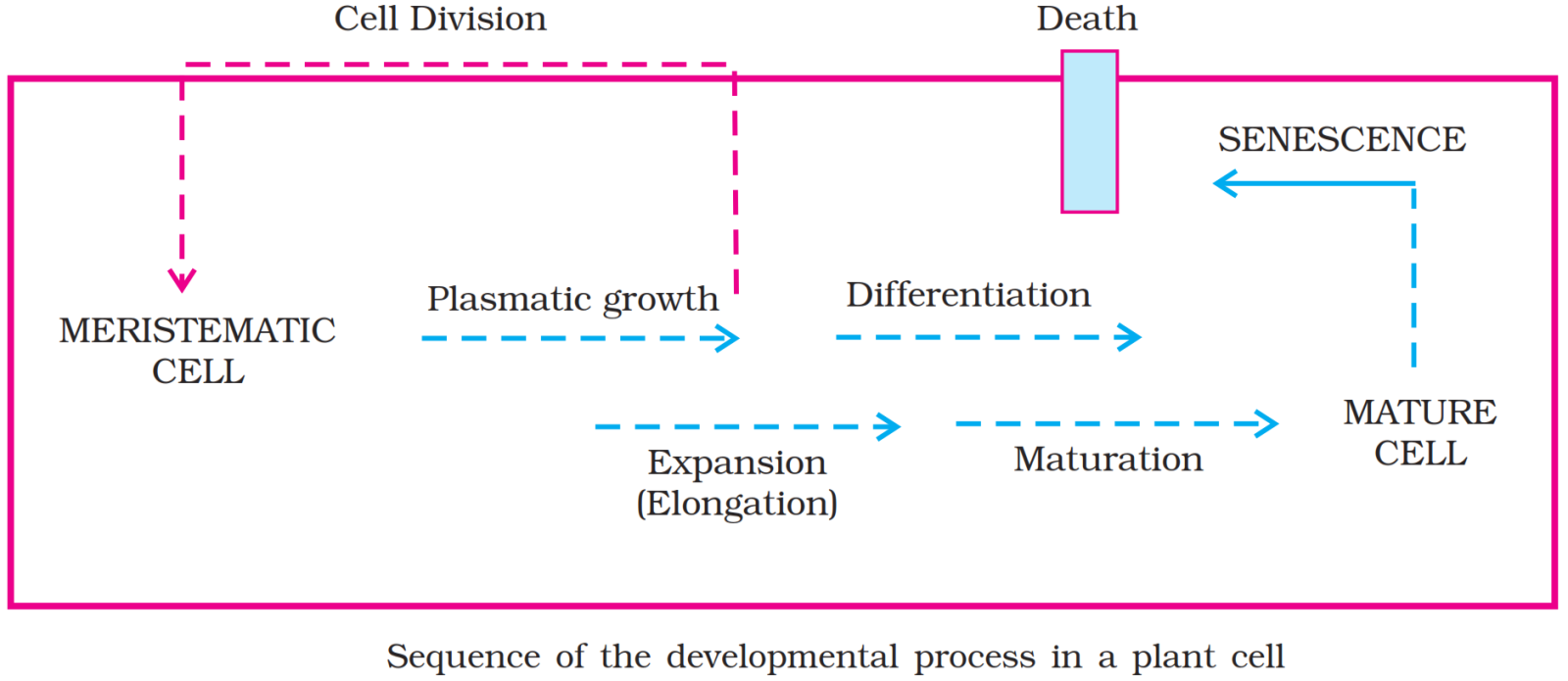
What is meant by development in plants? Represent schematically the processes in the development of a plant cell.
Answer
Development in plant refers to all the changes that a plant undergoes during its life cycle, from the germination of seed to senescence.
View full question & answer
Question 163 Marks
It has been observed that some plants need periodic exposure to light to induce flowering. This phenomenon is called photoperiodism. How does sunlight affect the human life?
Answer
Sunlight is very important for human life. Sunlight is the main source of energy for all the living beings on this planet. Green plants are the main channels through which the solar energy is converted into chemical energy; during photosynthesis. That energy is transferred to different living beings through the food chain or energy chain. Even the fossil fuel we use is a changed form of biomass which stores the converted form of solar energy. Our body also needs regular exposure to sunlight to be in proper shape. We often notice that during winters and rainy seasons, people often get depresses when there is no sunshine for many days at a stretch.
View full question & answer
Question 173 Marks
Classify the following: plants into Long-Day Plants (LDP), Short Day Plants (SDP) and Day Neutral Plants (DNP) Xanthium, Henbane (Hyoscyamus niger), Spinach, Rice, Strawberry, Bryophyllum, Sunflower, Tomato, Maize.
Answer
  • Long day plants are Henbane (Hyoscyamus niger), spinach
  • Short day plants are Xanthium, rice, strawberry, Bryophyllum. (It is a short day plant but requires long photoperiods for floral initiation and short photoperiods for blossoming).
  • Day neutral plants are sunflower, maize, tomato.
View full question & answer
Question 183 Marks
Define differentiation? Also give details about how can you distinguish between dedifferentiation and redifferentiation?
Answer
The cells which are derived from root apical meristem and shoot and other meristems undergo certain changes to attain maturity to perform specific functions. This process which leads to maturation of cells is termed as differentiation. During this, the cells undergo a few major structural changes both in their cell walls and protoplasm to perform some specific functions throughout their life.
  1. In plants, some living differentiated cells, e.g., parenchyma can regain the capacity to divide mitotically under certain conditions. A dedifferentiated tissue can act as meristem, e.g., interfascicular vascular cambium, cork cambium and wound meristem.
  2. The product of dedifferentiated cells or tissues which lose the ability to divide is called redifferentiated cells and the term is known as redifferentiation. Secondary xylem and secondary phloem from interfascicular vascular cambium, secondary cortex and cork are the examples of redifferentiated tissues.
View full question & answer
Question 193 Marks
Mention the characteristics of meristematic phase, elongation phase and maturation phase of plant growth.
Answer
The meristematic phase is characterised by cells, which:
  1. Have a dense cytoplasm.
  2. Possess a prominent nucleus.
  3. Have a thin, primary cellulosic cell wall.
  4. Abundant plasmodesmatal connections.
The cells in the elongation phase show:
  1. Increased vacuolation.
  2. Cell enlargement.
  3. Deposition of new (secondary) cell wall material.
The cells in the maturation phase have attained:
  1. Their maximum size and final shape.
  2. The characteristic wall thickening.
  3. Protoplasmic modifications.
View full question & answer
Question 203 Marks
A gardener finds some broad-leaved dicot weeds growing in his lawns. What can be done to get rid of the weeds efficiently?
Answer
The dicotyledonous plants grow by their apical shoot meristems while grasses (which make lawns) possess intercalary meristem. Certain auxins, such as synthetic 2, 4-Dichlorophenoxyacetic acid (2, 4-D) when applied in excess can damage the shoot apical meristems but they do not cause any damage to the- intercalary meristems. Thus, when 2, 4-D is sprayed on lawns, only the dicots get killed and the lawns become free of weeds.
View full question & answer
Question 213 Marks
Does the growth pattern in plants differ from that in animals? Do all the parts of plant grow indefinitely? If not, name the regions of plant, which can grow indefinitely.
Answer
Yes, the growth pattern in plants differs from that in animals.Plant growth is unique because plants retain the capacity for unlimited growth throughout their life.This ability of the plants is due to the presence of meristems at certain locations in their body.The cells of such meristems have the capacity to divide and self-perpetuate. The product, however, soon loses the capacity to divide and such cells make up the plant body.This form of growth wherein new cells are always being added to the plant body by the activity of the meristem is called the open form of growth.
View full question & answer
Question 223 Marks
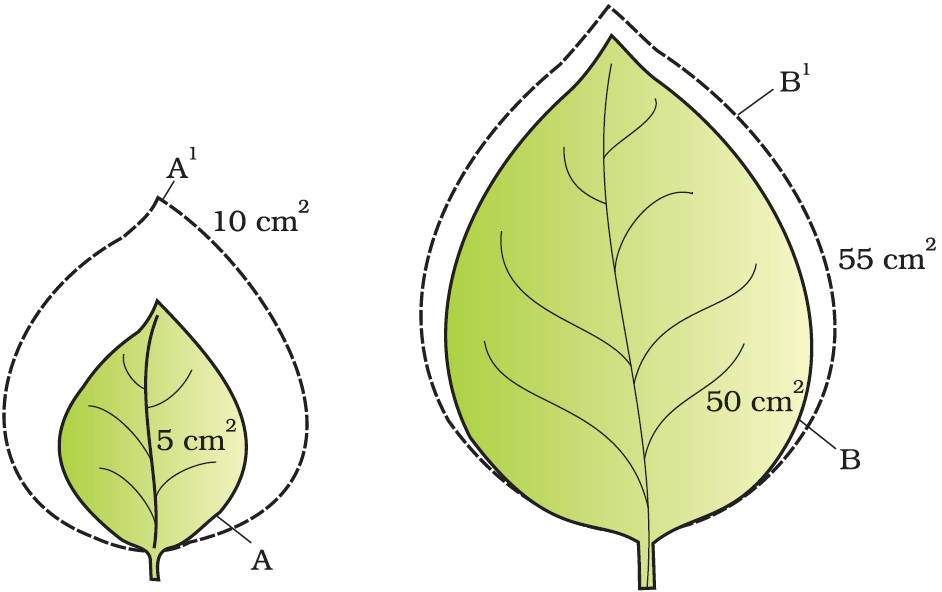
Which of them shows higher relative growth rate? Justify.
Answer
Relative growth rate of A $=\frac{(10-5)}{\text{x}\times5}=\frac{5}{\text{x}}\text{cm}^2$ Relative growth rate of B $=\frac{(55-50)}{50\times\text{x}}=\frac{5}{50\text{x}}\text{cm}^2$ Thus, A shows higher relative growth rate.
View full question & answer
Question 233 Marks
What is the mechanism underlying the phenomenon by which the terminal/ apical bud suppresses the growth of lateral buds? Suggest measures to overcome this phenomenon.
Answer
This phenomenon is called apical dominance.The growing shoot apex inhibits the growth of lateral branches.This happens because of a high concentration of auxins in shoot apex. To prevent apical dominance, shoot apex is trimmed.This helps auxins to move to other meristematic regions and to promote lateral branching.
View full question & answer
Question 243 Marks
Name the categories of plant hormones concerned with each of the following and describe one other function of each of the three categories of plant hormones:
  1. Inhibition of seed germination.
  2. Promote flowering.
  3. Cell division-promoting activity.
Answer
  1. Abscisic acid: It signals closure of stomata to prevent water loss during water stress.
  2. Auxins: It controls cell division and xylem differentiation.
  3. Cytokinins: They delay senescence of leaves.
View full question & answer
Question 253 Marks
How does the process of vernalisation vary among different food crop varities?
Answer
Beside light, the temperature also affects the flowering and other vital phenomenon of plants. It has been observed that there are some plants which do not flower until they are not exposed to low temperature, i.e., they depend either qualitatively or quantitatively on exposure to low temperature to flower. This chilling requirement of the plants for flowering is known as vernalisation. It prevents the precocious reproductive development late in the growing season, enabling plant to have sufficient time to reach the level of maturity. Examples of Vernalisation:
  1. Food plants like wheat, barley, rye has two types of food varieties.
  1. Spring varieties: These are planted in spring and are normally come to flower and produce grain before the end of same growing season.
  2. Winter varieties: These are planted in autumn season If they are planted in spring season they would fail to flower or produce a mature grain within a span of flowering season. Thus, winter variety germinated in winter remains as seedling, resumes growth in the spring and are harvested by mid-summer.
  1. Similarly the same process ofvernalisation is observed in another varieties, like biennial plants, which are monocarpic in nature that usually flower and die in second season. if these biennial plants are subjected to a cold treatment thus, stimulate subsequent photoperiodic flowering response.
View full question & answer
Question 263 Marks
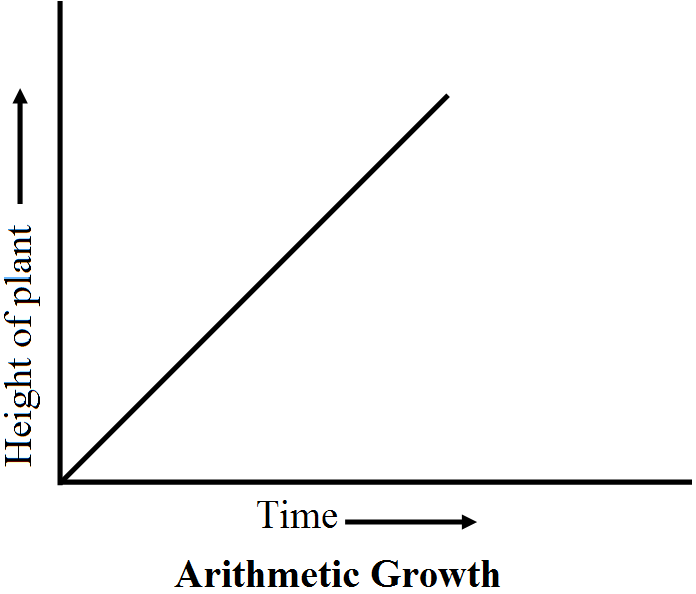
Explain arithmetic growth in plants.
Answer
In arithmetic growth, following mitotic cell division, only one daughter cell continues to divide while the other differentiates and matures. The simplest expression of arithmetic growth is exemplified by a root elongating at a constant rate. Mathematically, it is expressed as: $L_t=L_0+r t L_t=$ length at time ' $t$ ' $L_0=$ length at time 'zero' $r=$ growth rate/ elongation per unit time.
View full question & answer
Question 273 Marks
In botanical gardens and tea gardens, gardeners trim the plants regularly so that they remain bushy. Does this practice have any scientific explanation?
Answer
Mostly in higher plants, the growing apical bud inhibits the growth of the lateral (axillary) buds, a phenomenon called apical dominance. Removal of shoot tips (decapitation) usually results in the growth of lateral buds. Hence, in botanical gardens and tea gardens, gardeners trim the plants regularly so that they remain bushy.
View full question & answer
Question 283 Marks
What is the difference between florigen and other plant growth hormones?
Answer
Differences between florigen and other plant growth hormones are:
S. No.
Florigen
Other Plant Growth Hormones
1.
It is a hypothetical hormone and has not been extracted from plants.
All plant growth hormones have been isolated from plant sources.
2.
It is supposed to be synthesised in leaves.
They are synthesised in apical meristems.
3.
Florigen is formed only when the plants attain a specific reproductive maturity.
Growth hormones are formed in all stages of plant development including seed germination.
View full question & answer
Question 293 Marks
Ankit, a Xl class student was continuously listening to his sister and her friend's discussion about the growth of plant. They were discussing that plant growth involves three phenomena, i.e., differentiation, dedifferentiation and redifferention. Listening this Ankit interrupted them in between and asked her sister to elaborate the things in detail and the basic phenomenon behind it. As the topic was the part of the Ankit's syllabus also. Her sister explained him that the cells in plant undergo differentiation to attain a maturity in order to perform specific functions.
  1. What is dedifferentiation? Name two tissues formed by this process phenomenon.
  2. What is redifferentiation?
  3. What value is learnt from the Ankit's character as an ideal biology student.
Answer
  1. The living differentiated cells also show another interesting phenomenon during which they regain the capacity to divide mitotically under certain conditions. The dedifferentiated cell can act as a meristem, e.g., formation of meristems-interfasicular cambium and cork cambium from fully differentiated parenchyma cells.
  2. The product of dedifferentiated cells or tissue when lose the capacity to divide, but mature to perform specific functions is known as redifferentiation, e.g., secondary cortex and cork.
  3. Ankit is curious, scientifically inclined and a good listener.
View full question & answer
Question 303 Marks
Light plays an important role in the life of all organisms. Name any three physiological processes in plants which are affected by light.
Answer
Physiological processes in plants that are affected by light are:
  1. Photosynthesis: It is the process of manufacturing of food from inorganic substances in presence of sunlight.
  2. Transpiration: It is loss of water in vapor form, from the stomata. In majority of plants, stomata open in light.
  3. Photoperiodism: Duration of light hours affect the growth and development of plants, especially flowering.
View full question & answer
Question 313 Marks
What would be expected to happen, if:
  1. $\mathrm{GA}_3$ is applied to rice seedlings.
  2. A rotten fruit gets mixed with unripe fruits.
  3. You forget to add cytokinin to the culture medium.
Answer
  1. The rice seedlings would grow tall due to elongation of internodes.
  2. The ripening of fruits will be hastened due to release of ethylene by the rotten fruit.
  3. Roots will be initiated from the callus.
View full question & answer
Question 323 Marks
Auxins are growth hormones capable of promoting cell elongation. They have been used in horticulture to promote growth, flowering and rooting. Explain the meaning of the following terms related to auxins.
  1. Auxin precursors.
  2. Anti-auxins.
  3. Synthetic auxins.
Answer
  1. Auxin precursors: The substances that produce the auxin are called auxin precursors. For example, tryptophan is the auxin precursor.
  2. Anti-auxins: The substances which inhibit the synthesis or transport of auxin are called anti-auxins. For example, TIBA (Triiodobenzoic acid) is anti-auxin compound.
  3. Synthetic auxins: The artificially synthesised chemicals having auxin-like property are called synthetic auxins. For example, NAA. (Naphthalene acetic acid) and 2, 4-D (2, 4-Dichloro phenoxyacetic acid).
View full question & answer
Question 333 Marks
  1. Define vernalisation.
  2. What are short-day plants?
  3. Name the plant growth regulator, which is snythesised by ripening fruits.
Answer
  1. Vernalisation refers to the low temperature treatment given to the seeds/ seedlings of certain plants to promote flowering.
  2. Short-day plants are those plants which require an exposure to light for a period less than the critical photoperiod.
  3. Ethylene.
View full question & answer
Question 343 Marks
What are meristems? How does the primary growth differ from that of secondary growth?
Answer
Meristems are tissues present in the growing regions of plants. Primary growth refers to the elongation (growth in length) of stems and roots. All plants exhibit primary growth. Root apical meristem and shoot apical meristem are responsible for the primary growth of the plants and principally contribute to the elongation of the plants along their axis. The growth that makes plants thicker (growth in diameter) is called secondary growth. For example, in dicotyledonous plants and gymnosperms, the lateral meristems, vascular cambium and cork cambium appear later in. life. These are the meristems. Their activity in plant helps these plants to grow in girth (diameter).
View full question & answer
Question 353 Marks
In a slide showing different types of cells can you identify which type of the cell may be meristematic and the one which is incapable of dividing and how?
Answer
The meristematic cells can be identified on the basis of the following characteristics:
  1. Cells have thin cellulose walls and dense cytoplasm with large nucleus.
  2. Plasmodesmatal connections are more numerous among meristematic cells.
  3. Ell division, i.e., mitosis and its various stages are distinctly visible.
  4. Chromosomes of cells replicate and divide into two homologous chromatids.
All these features contribute to open ended growth where structure is never complete in meristematic regions. On the other hand, cells incapable of dividing show features such as:
  1. Cells have large vacuoles.
  2. Attain particular shape, size and thickening.
  3. Undergo structural and physiological differentiation.
View full question & answer
Question 363 Marks
To get a carpet like grass lawns are mowed regularly. Is there any scientific explanation for this?
Answer
Regular mowing (cutting at apex) of lawn grass removes the apical portion of the plant which causes the lateral branches to grow faster. As the apical buds inhibits growth of lateral buds by releasing auxin, (phenomenon called apical dominance). Because of mowing of the grass, it becomes bushy and growth is faster. So,-to maintain evenness of the grass (carpet-like) in the lawn, this practice is followed regularly to overcome the problem of apical dominance.
View full question & answer
Question 373 Marks
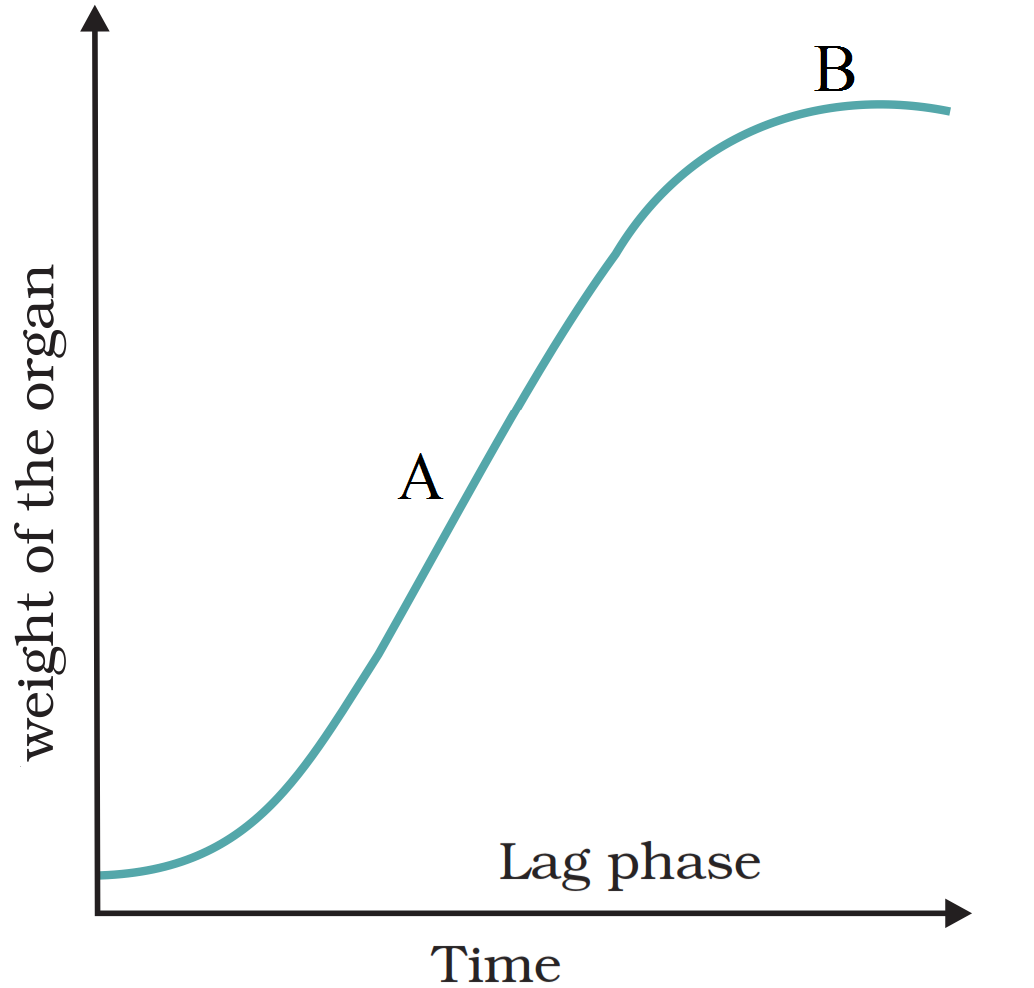
This is a graph depicting growth curve of plant organ:
  1. Name the growth curve.
  2. What do 'A' and 'B' depict?
  3. Write the mathematical expression for phase 'A' of this type of growth.
Answer
  1. It is a sigmoid growth curve.
  2.  
  • A is exponential or log phase, where the growth is maximum.
  • B is stationary phase that is reached due to limited nutrient supply.
  1. $W_1 = W_0e^{rt}$​​​​​​​
where, $W_1​​​​​​​$​​​​​​​ - final size/ weight.
$W_0 $- initial size/ weight.
r - relative growth rate.
t - the time of growth.
e - the base of natural logarithm.
View full question & answer
Question 383 Marks
How are gibberellins useful in agriculture to improve productivity? Give three points in support of your answer.
Answer
  1. Application of gibberellins increases the length of the stem and thereby increase the yield of sugar in sugarcane.
  2. Gibberellins delay senescence and the fruits can be left on the trees for longer duration, so as to increase the market period.
  3. Gibberellins cause fruits like apple to elongate and improve in shape.
  4. Spraying juvenile conifers hastens the maturity period, leading to early seed production.
View full question & answer
Question 393 Marks
Differentiate between primary and secondary growth in plants.
Answer
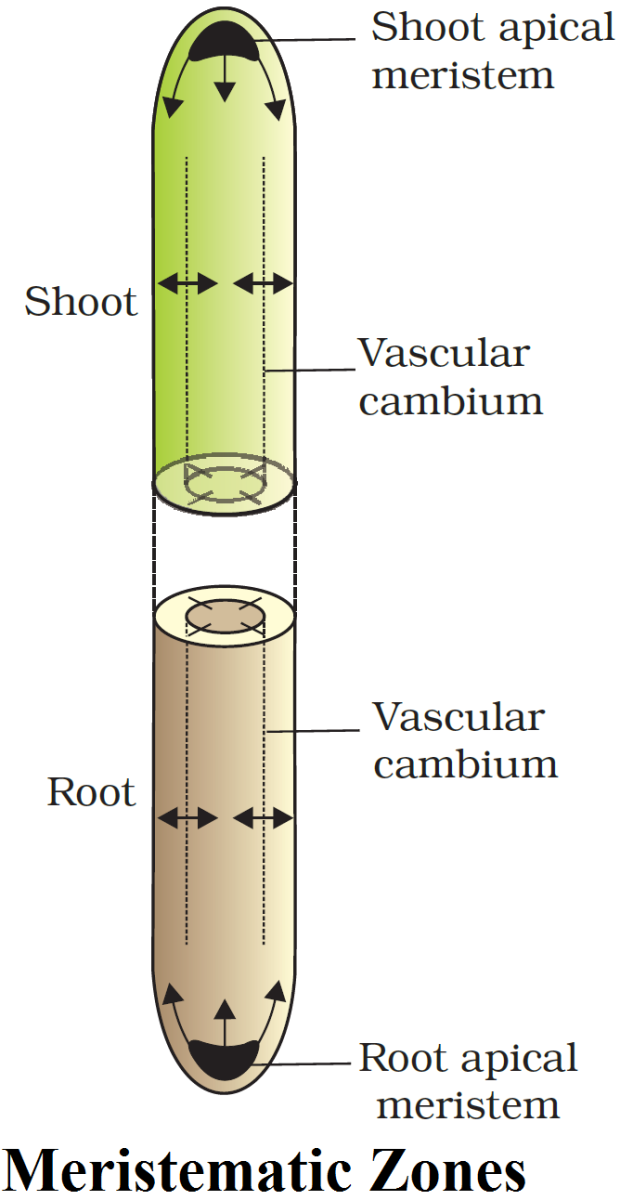
Apical, lateral and intercalary are the special regions, where growth is localised in plants. At the apex of every root and shoot apical meristems are present which are responsible for the elongation of plant along their axis. This is known as primary growth of the plant. The lateral meristems, vascular cambium and cork cambium appear later in life in dicotyledonous plants and gymnosperms and are responsible for the increase in the girth of the stem. This increase in girth is known as secondary growth of the plant. Diagrammatic representation if locations of root apical meristem, shoot apical meristem and vascular cambium. Arrows exhibit the direction of growth of cells and organ.
View full question & answer
Question 403 Marks
Kritika's biology teacher explained the different phases of plant growth in her class. She taught that growth of plants takes place in three successive steps or phases from germination to maturation phase. Kritika reached home and asked her elder sister, a biology post-graduate student to clarify the phases in detail. Kritika's sister told her that she will explain the complete process with the help of experimentation. She took few seeds of pea and germinated them on a circular filter paper, soaked with water in a petri-dish. After two days of growth, she picked up a couple of seedlings with straight radicle and marked it from tip to base with the help of a waterproof ink and again placed the seedlings on moist filter paper to allow them to grow.
  1. Mention different phases of growth in plants?
  2. List the conditions required for growth.
  3. What values are reflected from nature of Kritika's sister?
Answer
  1. Plant growth takes place in three steps or phases:
  1. Cell division (meristematic) phase.
  2. Cell enlargement phase.
  3. Cell maturation phase.
  1. Growth involves synthesis of new protoplasm, cell division, cell enlargement and cell differentiation. The conditions required are water, oxygen, nutrients and optimum temperature.
  2. Kritika's sister is concerned about her sister's studies. She is a patient listener. She understands her sister's problems and apply her skills to solve them.
View full question & answer