Questions

2 Marks Questions

Take a timed test

38 questions · self-marked practice — reveal the answer and mark yourself.

Question 12 Marks
What do you understand by the terms:
Water-gas shift reaction.
Answer
Water shift reaction: It is a reaction of carbon monoxide of syngas mixture with steam in the presence of a catalyst as,
$\text{CO}_{(\text{g})}+\text{H}_2\text{O}_{(\text{g})}\xrightarrow[\text{Catalyst}]{\ \ \ \ \ \ \ \ \ {673\text{K}} \ \ \ \ \ \ \ }\text{CO}_{2(\text{g})}+\text{H}_{2(\text{g})}$
This reaction is used to increase the yield of dihydrogen obtained from the coal gasification reaction as,
$\text{C}_{\text{g}}+\text{H}_2\text{O}_{(\text{g})}\xrightarrow{\ \ \ \ \ \ \ \ \ \ \ \ \ }\text{CO}_{\text{(g)}}+\text{H}_{2\text{(g)}}$
View full question & answer
Question 22 Marks
Knowing the properties of $\mathrm{H}_2 \mathrm{O}$ and $\mathrm{D}_2 \mathrm{O}$, do you think that $\mathrm{D}_2 \mathrm{O}$ can be used for drinking purposes?
Answer
No, heavy water $\left(\mathrm{D}_2 \mathrm{O}\right)$ cannot be used for drinking purposes because it is injurious to health due to presence of $\mathrm{D}^{+}$ ions. Heavy water of high concentration retards the growth of plants and animals. Heavy water has germicide and bactericide properties.
View full question & answer
Question 32 Marks
What do you understand by the terms:
Hydrogen economy.
Answer
Hydrogen economy: Hydrogen economy is a technique of using dihydrogen in an efficient way. It involves transportation and storage of dihydrogen in the form of liquid or gas. Dihydrogen releases more energy than petrol and is more eco–friendly. Hence, it can be used in fuel cells to generate electric power. Hydrogen economy is about the transmission of this energy in the form of dihydrogen.
View full question & answer
Question 42 Marks
Why does hydrogen occur in a diatomic form rather than in a monoatomic form under normal conditions?
Answer
The ionization enthalpy of hydrogen atom is very high $\left(1312 \mathrm{~kJ} \mathrm{~mol}^{-1}\right)$. Hence, it is very hard to remove its only electron. As a result, its tendency to exist in the monoatomic form is rather low. Instead, hydrogen forms a covalent bond with another hydrogen atom and exists as a diatomic $\left(\mathrm{H}_2\right)$ molecule.
View full question & answer
Question 52 Marks
What do you understand by the terms:
Hydrogenation.
Answer
Hydrogenation: Hydrogenation is the addition of dihydrogen to another reactant. This process is used to reduce a compound in the presence of a suitable catalyst.
For example: hydrogenation of vegetable oil using nickel as a catalyst gives edible fats such as vanaspati, ghee etc.
View full question & answer
Question 62 Marks
What do you understand by the terms:
Fuel-cell.
Answer
Fuel cells: Fuel cells are devices for producing electricity from fuel in the presence of an electrolyte. Dihydrogen can be used as a fuel in these cells. It is preferred over other fuels because it is eco-friendly and releases greater energy per unit mass of fuel as compared to gasoline and other fuels.
View full question & answer
Question 72 Marks
Arrange Li, F, H in increasing order of ionisation enthalpy. Give reason.
Answer
Li < H < F is increasing order of ionisation enthalpy because Li is larger in size, therefore, it can lose electron easily, whereas 'F' has highest ionization enthalpy due to more effective nuclear charge.
View full question & answer
Question 82 Marks
Name the isotope of hydrogen which contains equal number of protons and neutrons.
Answer
Deuterium $(^2_1\text{H})$
Number of protons (p) = number of electrons
= atomic number = 1
Number of neutrons (n) = Mass number - atomic number
= 2 - 1 = 1
View full question & answer
Question 92 Marks
Account for the following:
  1. Soft water lathers with soap but not hard water.
  2. Temporary hardness of water can be removed by boiling.
Answer
  1. It is because $\mathrm{Ca}^{2+}$ and $\mathrm{Mg}^{2+}$ ions react with soap to form insoluble calcium or magnesium salts of fatty acids which is also called scum.
$\text{Ca}^{2+}+2\text{C}_{17}\text{H}_{35}\text{COOCNa}\\\xrightarrow{\ \ \ \ \ \ \ }\text{Ca}(\text{COOC}_{17}\text{H}_{35})_2+2\text{Na}^+$

$\text{Mg}^2+2\text{C}_{17}\text{H}_{35}\text{COONC}\\\xrightarrow{\ \ \ \ \ \ \ \ }\text{Mg}(\text{COOC}_{17}\text{H}_{35})_2+2\text{Na}^+$
  1. On boiling, hydrogen carbonates of calcium and magnesium change into carbonates which are insoluble and can be removed by filtration.
View full question & answer
Question 102 Marks
Why can dilute solutions of hydrogen peroxide not be concentrated by heating. How can a concentrated solution of hydrogen peroxide be obtained?
Answer
Hydrogen peroxide cannot be concentrated by heating as it can cause bums on heating. It can be extracted with water and concentrated to $\sim30\%$ by distillation under redused pressure. It can be further concetrated to $\sim85\%$ by careful distillation under low pressure. The remaining water can be frozen out to abtain pure $\mathrm{H}_2 \mathrm{O}_2$.
View full question & answer
Question 112 Marks
Arrange
a. $\mathrm{RbH}, \mathrm{CH}, \mathrm{LiH}, \mathrm{KH}$, in increasing order of ionic character.
b. $\mathrm{H}_2 \mathrm{O}_2, \mathrm{O}_3, \mathrm{O}_2$ in increasing order or bond length of $\mathrm{O}-\mathrm{O}$ bond.
Answer
a. $\mathrm{LiH}<\mathrm{KH}<\mathrm{RbH}<\mathrm{CS}$ it is increasing order of ionic character.
b. $\mathrm{O}_2<\mathrm{O}_3<\mathrm{H}_2 \mathrm{O}_2$ is increasing order of bond length because $\mathrm{O}_2$ has double bond, $\mathrm{O}_3$ has bond order between 1 and 2 due to reference and $\mathrm{H}_2 \mathrm{O}_2$ has single bond $(\mathrm{H}-\mathrm{O}-\mathrm{O}-\mathrm{H})$.
View full question & answer
Question 122 Marks
  1. Name three group of d-block elements which do not form hydride.
  2. What happens when hypchlorous acid reacts with $\mathrm{H}_2 \mathrm{O}_2$?
Answer
  1. Group 7, 8, 9 do not form hydride.
  2. $\text{H}_2\text{O}_2+\text{HOCl}\xrightarrow{\ \ \ \ \ \ }\text{HCl}+\text{H}_2\text{O}+\text{O}_2$
$\text{HCl},\text{O}_2$ and $\text{H}_2\text{O}$ are formed. $\text{HOCl}$ acts as oxidising

agent.
View full question & answer
Question 132 Marks
Write two reactions to explain amphoteric nature of water.
Answer
A substance is termed amphoteric if it can show both, the acidic and basic behaviour Water is an amphoteric substance. It has the ability to act as an add as well as a base. With $\text{NH}_3$ (which is a base) it acts as an add.
$\text{NH}_3(\text{aq})+\text{H}_2\text{O}(\text{l})\rightleftharpoons\text{NH}^+_4(\text{aq})+\text{OH}^-(\text{aq)}$
It acts as a base with $\text{H}_2\text{S}$ which is a Bronsted acid.
$\text{H}_2\text{S}(\text{aq})+\text{H}_2\text{O}(\text{l})\rightleftharpoons\text{H}_3\text{O}+(\text{aq})+\text{HS}^-(\text{aq})$
View full question & answer
Question 142 Marks

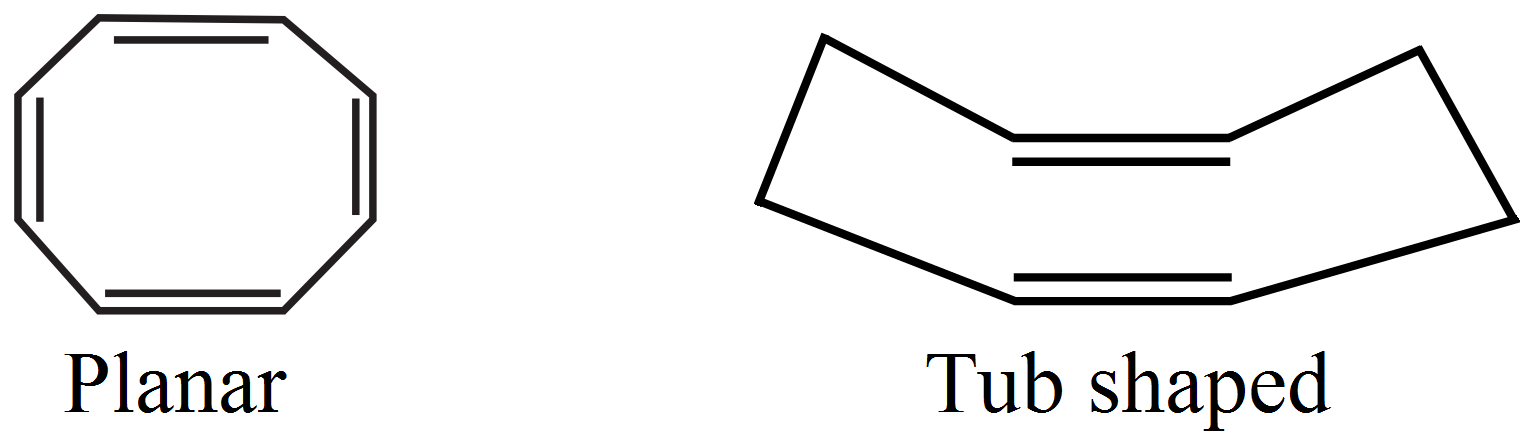
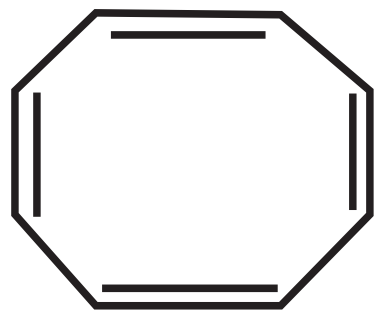
Explain why the following system are not aromatic?
Answer

Cyclo-octatetraene is not planar but is tub shaped. It is, therefore, a non-planar system having 8 n-electrons.
Therefore, the molecule is not aromatic since it does not contain a planar cyclic cloud having (4n + 2) n-electrons.
View full question & answer
Question 152 Marks
With the help of suitable examples, explain the property of $\text{H}_2\text{O}_2$ that is responsible for its bleaching action?
Answer
$\text{H}_2\text{O}_2$ decomposes slowly on exposure to light.
$2\text{H}_2\text{O}_2(\text{l})\xrightarrow{\ \ \ \ \ \ \ \ \ }2\text{H}_2\text{O}(\text{l})+\text{O}_2(\text{g})$
In dailly life it is used as a hair bleach and as a mild disinfectant.
As an antiseptic it is sold in the market as perhydrol.
View full question & answer
Question 162 Marks
Complete the reactions:
  1. $ \text{H}_2+\text{CO}+\text{R}-\text{CH}=\text{CH}_2\xrightarrow{\ \ \ \ \ }$
  2. $\text{H}_2+\text{RCH}_2\text{CH}_2\text{CHO}\xrightarrow{\ \ \ \ \ }$
Answer
  1. $\text{H}_2+\text{CO}+\text{R}-\text{CH}=\text{CH}_2\\\ \ \ \ \ \ \ \ \ \ \ \ \ \ \ \ \ \ \ \ \ \ \ \ \ \ \ \ \ \ \ \ \ \ \ \ \ \ \ \ \text{O}\\\\ \ \ \ \ \ \ \ \ \ \ \ \ \ \ \ \ \ \ \ \ \ \ \ \ \ \ \ \ \ \ \ \ \ \ \ \ \ \ \ \ \| \\ \xrightarrow{\ \ \ \ \ }\text{R}-\text{CH}_2-\text{CH}_2-\text{C}-\text{H}$
  2. $\text{H}_2+\text{RCH}_2\text{CH}_2\text{CHO}\xrightarrow{\ \ \ \ \ \ \ }\text{RCH}_2\text{CH}_2\text{CH}_2\text{OH}$
View full question & answer
Question 172 Marks
What mass of hydrogen peroxide will be present in 2 litres of a 5 molar solution? Calculate the mass of oxygen which will be liberated by the decomposition of 200mL of this solution.
Answer
Molecular mass of $\mathrm{H}_2 \mathrm{O}_2=34$ Mass of $\mathrm{H}_2 \mathrm{O}_2$ present in 1 molar solution $=34 \mathrm{~g}$ Mass of $\mathrm{H}_2 \mathrm{O}_2$ present in 2 liters of 1 molar solution $=2 \times 34=68 \mathrm{~g}$ Mass of $\mathrm{H}_2 \mathrm{O}_2$ present in 200 ml solution of $1 \mathrm{~molar} \mathrm{~H}_2 \mathrm{O}_2$ solution,
$=\frac{34}{5}=6.8\text{g}\ 2\text{H}_2\text{O}_2\rightarrow2\text{H}_2\text{O}+\text{O}_2\\\ \ \ \ \ \ \ \ \ \ \ \ \ \ \ \ \ \ \ \ \ \ \ \ \ \ \ 68\text{g}\ \ \ \ \ \ \ \ \ \ \ \ \ \ \ \ \ \ \ \ \ 32\text{g}\\\ \ \ \ \ \ \ \ \ \ \ \ \ \ \ \ \ \ \ \ \ \ \ \ \ \ \ 6.8\text{g}\ \ \ \ \ \ \ \ \ \ \ \ \ \ \ \ \ \ \ 3.2\text{g}$
View full question & answer
Question 182 Marks
Hydrogen generally forms covalent compounds. Give reason.
Answer
Because of ionization enthalphy, hydrogen resembles more with halogens, $\Delta \mathrm{H}$ of Li is $520 \mathrm{~kJ} \mathrm{~mol}^{-1}, \mathrm{~F}$ is $1680 \mathrm{~kJ} \mathrm{~mol}^{-1}$ and that of $\mathrm{H} 1312 \mathrm{~kJ} \mathrm{~mol}^{-1}$.
Like halogens, it forms a diatomic molecule, combines with elements to form hydrides and a large number of covalent compounds.
View full question & answer
Question 192 Marks
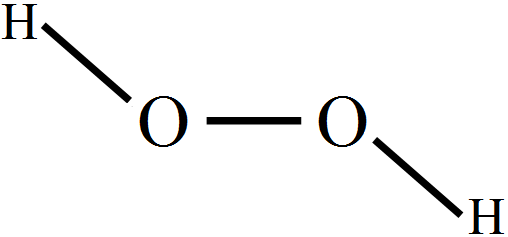
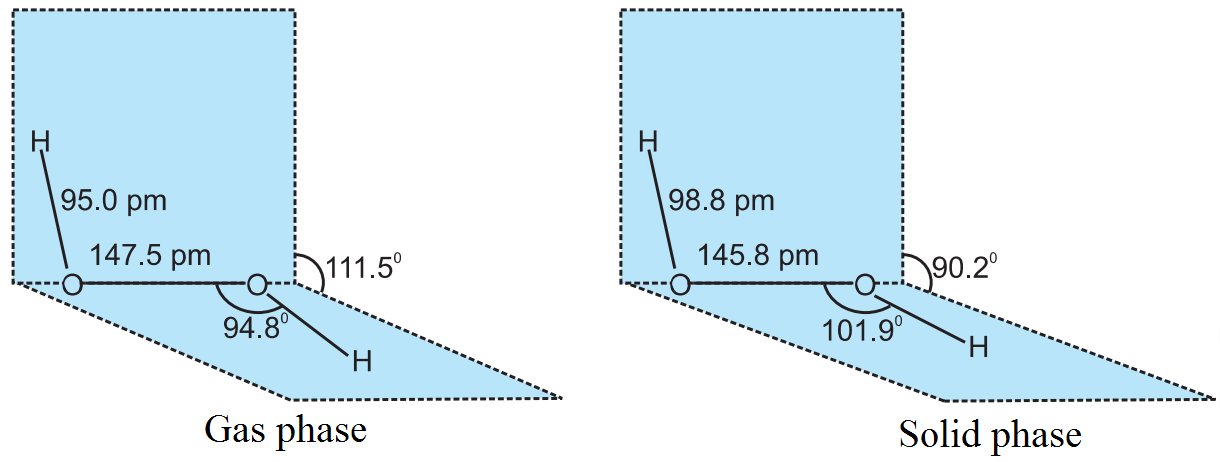
Draw the gas phase and solid phase structure of $\text{H}_2\text{O}_2$.
Answer
Structure of $\text{H}_2\text{O}_2$ is slightly different in gas phase and solid phase.
View full question & answer
Question 202 Marks
An ionic hydride of an alkali metal has significant covalent character and is almost unreactive towards oxygen and chlorine. This is used in the synthesis of other useful hydrides. Write the formula of this hydride. Write its reaction with $\text{Al}_2\text{Cl}_6$.
Answer
Lithium hydride is rather unrective at moderate temperatures with $\text{O}_2$ or $\text{Cl}_2$.
$8\text{LiH} + \text{Al}_2\text{Cl}_6\rightarrow2\text{LiAlH}_4+6\text{LiCl}$
View full question & answer
Question 212 Marks
Complete the following equations:
  1. $\text{Cr}_2\text{O}_7+\text{H}_2\text{O}\xrightarrow{\ \ \ \ \ \ \ }$
  2. $\text{sn}+\text{NaOH}+\text{H}_2\text{O}\xrightarrow{\ \ \ \ \ \ \ }$
Answer
  1. $\text{Cl}_2\text{O}_7+\text{H}_2\text{O}\xrightarrow{\ \ \ \ \ \ }2\text{HClO}_4$
  2. $\text{Sn}+\text{NaOH}+\text{H}_2\text{O}\xrightarrow{\ \ \ \ \ \ \ \ }\text{Na}_2\text{SO}_39+2\text{H}_2$
View full question & answer
Question 222 Marks
Give a method for the manufacture of hydrogen peroxide and explain the reactions involved therein.
Answer
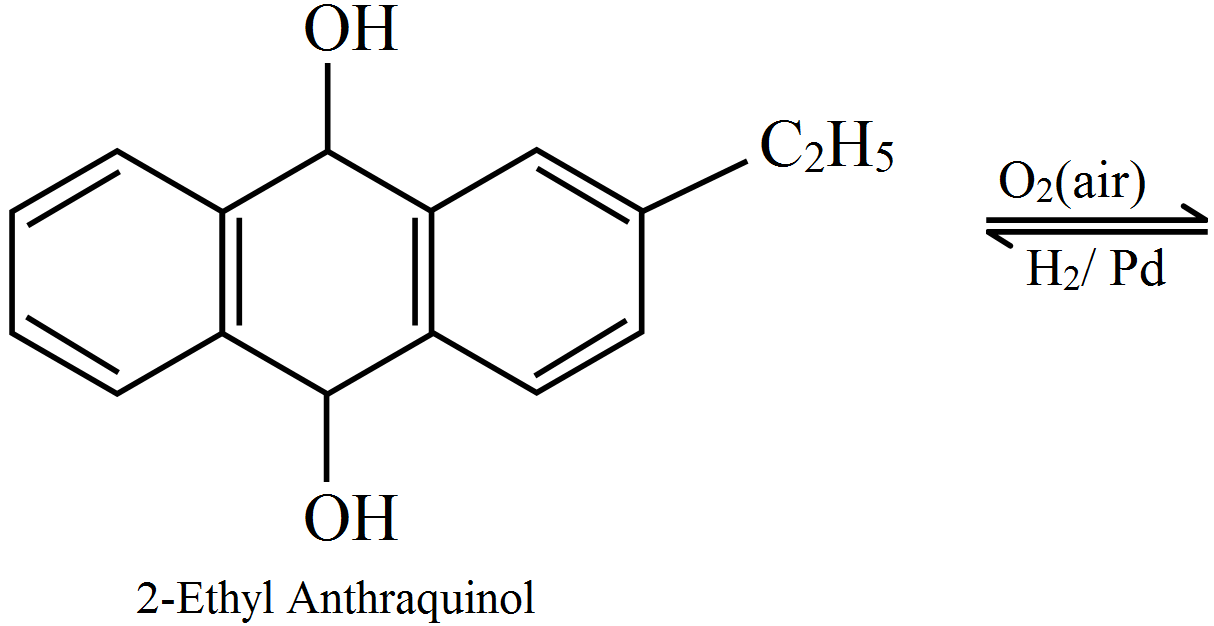
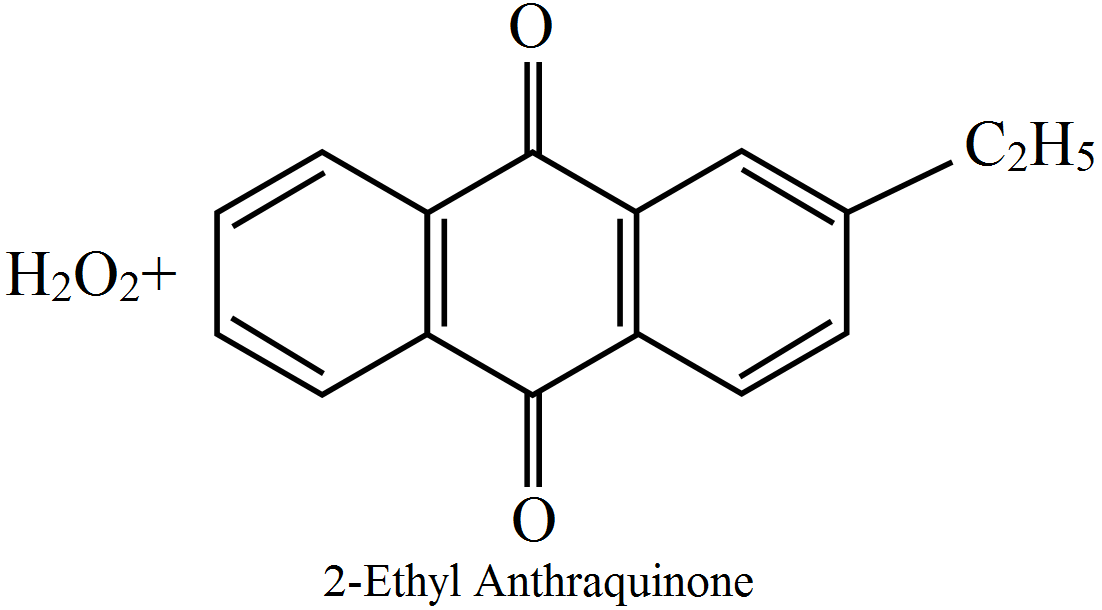
Industrial preparation: $\text{H}_2\text{O}_2$ is prepared by the auto-oxidation of 2-alkylanthraquinols
2-alkylanthraquinols + (oxidised product)
$2\text{Fe}^{2-}(\text{aq})+2\text{H}^-(\text{aq})+\text{H}_2\text{O}_2(\text{aq})\rightarrow2\text{Fe}^{3+}(\text{aq})+2\text{H}_2\text{O}(\text{l})$
$\text{pbS}+4\text{H}_2\text{O}_2(\text{aq})\rightarrow\text{PbSO}_4(\text{s})+4\text{H}_2\text{O}(\text{l})$
View full question & answer
Question 232 Marks
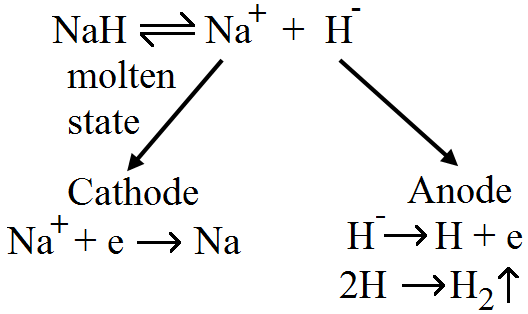
Sodium forms a crystalline ionic solid with dihydrogen. The solid is nonvolatile and non- conducting in nature. It reacts violently with water to produce dihydrogen gas. Write the formula of this compound and its reaction with water. What will happen on electrolysis of the melt of this solid.
Answer
The hydride is,

Sodium and hydrogen are the products of electrolysis of molten NaH.
View full question & answer
Question 242 Marks
If same mass of liquid water and a piece of ice are taken, then why is the density of ice less than that of liquid water?
Answer
The mass per unit volume (i.e., mass/ volume) is called density. Since water expands on freezing, therefore, volume of ice for the same mass of water is more than liquid water. In other words, density of ice is lower than liquid water and hence ice floats on water.
View full question & answer
Question 252 Marks
Is demineralised or distill water useful for drinking purposes? If not, how can it be made useful?
Answer
No, demineralised or distill water is not useful for drinking purposes. It can be made useful by adding small quantity of minerals like $\mathrm{Ca}^{2+}, \mathrm{Mg}^{2+}$, etc.
View full question & answer
Question 262 Marks
What happens when
  1. Calcium phosphide is hydrolysed
  2. Ammonia reacts with water
Answer
  1. Phosphine is formed.
$\text{Ca}_3\text{P}_2+6\text{H}_2\text{O}\xrightarrow{\ \ \ \ \ \ }3\text{Ca}(\text{OH})_2+2\text{PH}_3$
  1. $\mathrm{NH}^{+}{}_4$ and $\mathrm{OH}^{-}$are formed.
$\text{NH}_3+\text{H}_2\text{O}\xrightarrow{\ \ \ \ \ \ \ }\text{NH}_4^++\text{OH}^-$
View full question & answer
Question 272 Marks
Why is hydrogen peroxide stored in wax lined bottles?
Answer
Actually, $\mathrm{H}_2 \mathrm{O}_2$, is highly reactive and it is stored in wax-lined glasses or in plastic bottles so that no light enters to it and no self decomposition takes place because when light is provided to the peroxide it decomposes itself to water and oxygen gas.
View full question & answer
Question 282 Marks
Complete the following reactions:
  1. $\text{CO}\text{(g)}+\text{H}_2(\text{aq})\xrightarrow[\text{Catalyst}\ ]{\Delta}$
  2. $\text{Ca}(\text{HCO}_3)_2(\text{s})+\text{Ca}(\text{OH})_2(\text{aq})\xrightarrow{\ \ \ \ \ \ \ }$
Answer
  1. $\text{CO}(\text{g})+2\text{H}_2(\text{aq})\xrightarrow[\text{Catalyst}]{\Delta}\text{CH}_3\text{OH}$
  2. $\text{Ca}(\text{HCO}_3)_2(\text{s})+\text{Ca}(\text{OH})_2(\text{aq})\\\xrightarrow{\ \ \ \ \ \ \ \ }2\text{CaCO}_3(\text{s})+2\text{H}_2\text{O}(\text{l})$
View full question & answer
Question 292 Marks
How is hydrogen peroxide prepared industrially? Explain why it is stored in coloured waxlined glass or plastic bottles?
Answer
Industrial hydrogen peroxide is obtained by the auto oxidation of 2-ethyl Anthraqunol.


In the above case 1% $\text{H}_2\text{O}_2$ is formed. It is concentrated to 30% by distillation under reduced pressure. The remaining water can be frozen to get pure $\text{H}_2\text{O}_2$​​​​​​​ It is stored in wax coated glass bottle because it decomposes in presence of traces of alkali present in glass container, therefore, stored in wax coated glass bottles.
View full question & answer
Question 302 Marks
Name the classes of hydrides to which $\mathrm{H}_2 \mathrm{O}, \mathrm{B}_2 \mathrm{H}_6$ and NaH belong.
Answer
$\mathrm{H}_2 \mathrm{O}$ - Electron rich covalent hydride/ molecular hydride.
$\mathrm{B}_2 \mathrm{H}_6$ - Electron deficient molecular hydride.
NaH - Ionic hydride.
View full question & answer
Question 312 Marks
How is Tritium produced in nature? What is half life of Tritium? Give its use.
Answer
$^{14}_7\text{N}+\ ^1_0\text{n}\xrightarrow{\ \ \ \ \ \ \ \ \ }\ ^{12}_6\text{C}+\ ^3_1\text{H}$
It is prepared by bombardment of neutron on $^{14}_7\text{N}.$ Half life of Tritium is 12.3 years.
It is used to determine age of old samples of water and wire.
View full question & answer
Question 322 Marks
Can phosphorus with inter electronic configuration $3 s^2 3 p^3$ for $\mathrm{PH}_5$ ?
Give reason.
Answer
No, phosphorus can not form $\mathrm{PH}_5$ because $\mathrm{H}_2$ is not a good oxidising agent. It can not provide energy for excitation of electron to 3 d -orbital. $\therefore \mathrm{PH}_5$ does not exist.
View full question & answer
Question 332 Marks
  1. How would you prepare dihydrogen from water by using a reducing agent?
  2. How would you prepare dihydrogen from a substance other than water?
  3. How would you prepare very pure $\text{H}_2$ in the laboratory?
  4. How would you prepare heavy hydrogen in the laboratory?
Answer
  1. $2\text{Na}+2\text{H}_2\text{O}\xrightarrow{\ \ \ \ \ \ \ \ }2\text{NaOH}+\text{H}_2$
  2. $\text{Zn}+2\text{HCl}\xrightarrow{\ \ \ \ \ \ \ }\text{ZnCl}_2+\text{H}_2$
  3. It is obtained by electrolysis of acidified water.
  4. It is obtained by electrolysis of heavy water.
View full question & answer
Question 342 Marks
Illustrate oxidising, reducing and acidic properties of hydrogen peroxide with equations.
Answer
  1. Reducing action in acidic medium.
$2\text{MnO}_4^-+6\text{H}^++5\text{H}_2\text{O}_2\rightarrow2\text{Mn}^{2+}+8\text{H}_2\text{O}+5\text{O}_2$

$\text{HOCl}+\text{H}_2\text{O}_2\rightarrow\text{H}_3\text{O}^-+\text{Cl}^-+\text{O}_2$
  1. Oxidising action in basic medium.
$2\text{Fe}^{2+}+\text{H}_2\text{O}_2\rightarrow2\text{Fe}^{3+}+2\text{OH}^-$
View full question & answer
Question 352 Marks
A colourless liquid 'A' contains H and O elements only. If decompose slowly on exposure to light. It is stabilized by mixing urea to store in presence of light.
  1. Suggest possible structure of 'A'.
  2. Write chemical equation for its decomposition reaction in light.
Answer
  1. 'A' is $\mathrm{H}_2 \mathrm{O}_2$ It has open book structure.
  1. $2\text{H}_2\text{O}_2\xrightarrow{\text{Sunlight}}2\text{H}_2\text{O}+\text{O}_2$
View full question & answer
Question 362 Marks
Distinguish clearly between salt-like and covalent hydrides.
Answer
Salt-like hydrides are also called ionic hydrides. They are formed by group 1 and 2 elements with $\mathrm{H}_2$. They are basic in nature. They dissolve in water forming alkali and give $\mathrm{H}_2$ gas, e.g., $\mathrm{NaH}, \mathrm{CaH}_2, \mathrm{KH}$, etc.
$\mathrm{NaH}+\mathrm{H}_2 \mathrm{O} \longrightarrow \mathrm{NaOH}+\mathrm{H}_2$
Covalent hydrides are formed between less electropositive or electronegative elements, e.g., $\mathrm{B}_2 \mathrm{H}_6 \mathrm{~AlH}_3, \mathrm{BeH}_2$ etc. They are insoluble in water.
View full question & answer
Question 372 Marks
Identify electron rich, electron precise, electron deficient out of these
$\text{B}_2\text{H}_6,\text{NH}_3,\text{H}_2\text{O,}\text{CH}_4$
Answer
Electron deficient: $\mathrm{B}_2 \mathrm{H}_6$
Electron rich the following: $\mathrm{H}_2 \mathrm{O}$ and $\mathrm{NH}_3$
Electron precise: $\mathrm{CH}_4$
View full question & answer
Question 382 Marks
When the first element of the periodic table is treated with dioxygen, it gives a compound whose solid state floats on its liquid state. This compound has an ability to act as an acid as well as a base. What products will be formed when this compound undergoes autoionisation?
Answer
The first element is hydrogen and its molecular form is dihydrogen ($\text{H}_2$).
It reacts with oxygen to form water whose solid state is ice which is lighter than water and floats over water.
Water is amphoteric in nature, i.e., it acts as an acid in the presence of strong bases and acts as a base in the presence of strong acids.
As an acid,
$\text{H}_2\text{O}(\text{l})+\text{NH}_3(\text{aq}) \xrightarrow{\ \ \ \ \ }\text{NH}+4(\text{aq})+\text{OH}-(\text{aq})\\\text{acid}\ \ \ \ \ \ \ \ \ \ \text{base}$
As a base,
$\text{H}_2O(\text{l}) +\text{H}_2\text{S(aq)}\xrightarrow{\ \ \ \ \ \ \ }\text{H}_3\text{O}^+ + \text{HS}^-$
Due to amphoteric nature,water undergoes self ionization as,
$\text{H}_2\text{O}+\text{H}_2\text{O} \xrightarrow{\ \ \ \ \ \ \ } \text{H}_3\text{O}^+ + \text{OH}^-$
View full question & answer