Question 12 Marks
Find out the oxidation state of sodium in $\mathrm{Na}_2 \mathrm{O}_2$.
AnswerLet the oxidation state of Na be x. The oxidation state of oxygen, in case of peroxides, is –1.
Therefore,
2(x) + 2(-1) = 0
2x - 2 = 0
2x = 2
x = +1
Therefore, the oxidation sate of sodium is +1
View full question & answer→Question 22 Marks
Why are alkali metals not found in nature?
AnswerAlkali metals include lithium, sodium, potassium, rubidium, cesium, and francium. These metals have only one electron in their valence shell, which they lose easily, owing to their low ionization energies. Therefore, alkali metals are highly reactive and are not found in nature in their elemental state.
View full question & answer→Question 32 Marks
How would you explain the following observations?
BaO is soluble but $\mathrm{BaSO}_4$ is insoluble in water.
AnswerBaO is soluble in water, but $\mathrm{BaSO}_4$ is not. $\mathrm{Ba}^{2+}$ is a large cation and $\mathrm{O}^{2-}$ is a small anion. The size compatibility of $\mathrm{Ba}^{2+}$ and $\mathrm{O}^{2-}$ is not high. As a result, BaO is unstable. The lattice energy released during its formation is also not very large. It can easily be overcome by the hydration energy of the ions. Therefore, BaO is soluble in water. In $\mathrm{BaSO}_4$ $\mathrm{Ba}^{2+}$ and $\mathrm{SO}_4^{2-}$ are both large-sized. The lattice energy released is high. Hence, it is not soluble in water.
View full question & answer→Question 42 Marks
State as to why:
Sodium is found to be more useful than potassium?
AnswerBlood plasma and the interstitial fluids surrounding the cells are the regions where sodium ions are primarily found. Potassium ions are located within the cell fluids. Sodium ions are involved in the transmission of nerve signals, in regulating the flow of water across the cell membranes, and in transporting sugars and amino acids into the cells. Hence, sodium is found to be more useful than potassium.
View full question & answer→Question 52 Marks
What happens when:
Sodium peroxide dissolves in water?
AnswerWhen sodium peroxide is dissolved in water, it is readily hydrolysed to form sodium hydroxide and water. The chemical equation involved in the reaction is:
$\text{Na}_2\text{O}_{2(\text{s})}+2\text{H}_2\text{O}_{(\text{l})}\xrightarrow{\ \ \ \ \ \ }2\text{NaOH}_{(\text{aq})}+\text{H}_2\text{O}_{2(\text{aq})}$
View full question & answer→Question 62 Marks
Which one of the alkaline earth metal carbonates is thermally the most stable?
a. $\mathrm{MgCO}_3$
b. $\mathrm{CaCO}_3$
c. $\mathrm{SrCO}_3$
d. $\mathrm{BaCO}_3$
Answer
- Cs
Explanation:
Atomic size increases as we move down the alkali group. As a result, the binding energies of their atoms in the crystal lattice decrease. Also, the strength of metallic bonds decreases on moving down a group in the periodic table. This causes a decrease in the melting point. Among the given metals, Cs is the largest and has the least melting point.
View full question & answer→Question 72 Marks
State as to why:
A solution of $\text{Na}_2\text{CO}_3$ is alkaline?
AnswerWhen sodium carbonate is added to water, it hydrolyses to give sodium bicarbonate and sodium hydroxide (a strong base). As a result, the solution becomes alkaline.
$\text{Na}_2\text{CO}_3+\text{H}_2\text{O}\xrightarrow{\ \ \ \ \ \ }\text{NaHCO}_3+\text{NaOH}$
View full question & answer→Question 82 Marks
How would you explain the following observations?
BeO is almost insoluble but $\mathrm{BeSO}_4$ is soluble in water
AnswerBeO is almost insoluble in water and $\mathrm{BeSO}_4$ is soluble in water. $\mathrm{Be}^{2+}$ is a small cation with a high polarizing power and $\mathrm{O}^{2-}$ is a small anion. The size compatibility of $\mathrm{Be}^{2+}$ and $\mathrm{O}^{2-}$ is high. Therefore, the lattice energy released during their formation is also very high. When BeO is dissolved in water, the hydration energy of its ions is not sufficient to overcome the high lattice energy. Therefore, BeO is insoluble in water. On the other hand, $\mathrm{SO}_4^{2-}$ ion is a large anion. Hence, $\mathrm{Be}^{2+}$ can easily polarize $\mathrm{SO}_4^{2-}$ ions, making $\mathrm{BeSO}_4$ unstable. Thus, the lattice energy of $\mathrm{BeSO}_4$ is not very high and so it is soluble in water.
View full question & answer→Question 92 Marks
Comment on each of the following observations:
The mobilities of the alkali metal ions in aqueous solution are $\mathrm{Li}^{+}<\mathrm{Na}^{+}<\mathrm{K}^{+}<\mathrm{Rb}^{+}<\mathrm{Cs}^{+}$
AnswerThis is attributed to the hydration of the cation in water. As a result, size of the cation increases and its mobility decreases. Due to the smallest size, $\mathrm{Li}^{+}$ion is hydrated to the maximum and has least mobility while $\mathrm{Cs}^{+}$ion due to least hydration has maximum mobility.
View full question & answer→Question 102 Marks
What happens when:
Sodium metal is dropped in water?
AnswerWhen Na metal is dropped in water, it reacts violently to form sodium hydroxide and hydrogen gas. The chemical equation involved in the reaction is:
$2\text{Na}_{(\text{s})}+2\text{H}_2\text{O}_{(\text{l})}\xrightarrow{\ \ \ \ \ \ \ }2\text{NaOH}_{(\text{aq})}+\text{H}_{2(\text{g})}$
View full question & answer→Question 112 Marks
What happens when:
Sodium metal is heated in free supply of air?
AnswerOn being heated in air, sodium reacts vigorously with oxygen to form sodium peroxide. The chemical equation involved in the reaction is:
$2\text{Na}_{(\text{s})}+\text{O}_{2(\text{s})}\xrightarrow{\ \ \ \ \ \ \ }\text{Na}_2\text{O}_{2 (\text{s})}$
View full question & answer→Question 122 Marks
Explain why can alkali and alkaline earth metals not be obtained by chemical reduction methods?
AnswerAlkali and alkaline earth metals cannot be extracted by the reduction of their oxides and other compounds as they are strong reducing agents themselves and no such reducing agents are there which can reduce them to get pure metal.
View full question & answer→Question 132 Marks
Why are potassium and caesium, rather than lithium used in photoelectric cells?
AnswerAll the three, lithium, potassium, and cesium, are alkali metals. Still, K and Cs are used in the photoelectric cell and not Li.
This is because as compared to Cs and K, Li is smaller in size and therefore, requires high energy to lose an electron. While on the other hand, K and Cs have low ionization energy. Hence, they can easily lose electrons. This property of K and Cs is utilized in photoelectric cells.
View full question & answer→Question 142 Marks
Comment on each of the following observations:
$\mathrm{E}^{\ominus}$ for $\mathrm{M}^{2+}(\mathrm{aq})+2 \mathrm{e}^{-} \rightarrow \mathrm{M}(\mathrm{s})$ (where $\mathrm{M}=\mathrm{Ca}, \mathrm{Sr}$ or Ba ) is nearly constant.
Answer
- Enthalpy of vaporization,
- Ionization enthalpy
- Enthalpy of hydration. Since the combined effect of these factors is approximately the same for Ca, Sr and Ba, therefore, their electrode potentials are nealy constant.
View full question & answer→Question 152 Marks
Potassium carbonate cannot be prepared by Solvay process. Why?
AnswerPotassium carbonate being more soluble than sodium bicarbonate does not get precipitated when $\text{CO}_2$ is passed through a concentrated solution of KCl saturated with ammonia.
View full question & answer→Question 162 Marks
The hydroxides and carbonates of sodium and potassium are easily soluble in water while the corresponding salts of magnesium and calcium are sparingly soluble in water. Explain.
AnswerThe atomic size of sodium and potassium is larger than that of magnesium and calcium. Thus, the lattice energies of carbonates and hydroxides formed by calcium and magnesium are much more than those of sodium and potassium. Hence, carbonates and hydroxides of sodium and potassium dissolve readily in water whereas those of calcium and magnesium are only sparingly soluble.
View full question & answer→Question 172 Marks
Explain why is sodium less reactive than potassium.
AnswerThis is mainly due to high ionization enthalpy of sodium as compared to potassium. Therefore, potassium is more electropositive and a stronger reducing agent than sodium. It also reacts with water more violently than sodium.
View full question & answer→Question 182 Marks
How would you explain the following observations?
LiI is more soluble than KI in ethanol.
AnswerLiI is more soluble than KI in ethanol. As a result of its small size, the lithium ion has a higher polarizing power than the potassium ion. It polarizes the electron cloud of the iodide ion to a much greater extent than the potassium ion. This causes a greater covalent character in LiI than in KI. Hence, LiI is more soluble in ethanol.
View full question & answer→Question 192 Marks
Lithium hydride can be used to prepare other useful hydrides. Beryllium hydride is one of them. Suggest a route for the preparation of beryllium hydride starting from lithium hydride. Write chemical equations involved in the process.
AnswerLiH is first reacted with anhydrous aluminium chloride. The reaction is carried out in ether.
$8\text{LiH}+\text{Al}_2\text{Cl}_6\xrightarrow{\text{Ether}}2\text{LiAlH}_4+6\text{LiCl LiAlH}_4$ is used for the preparation of beryllium hydride. Beryllium chloride is reacted with $\mathrm{LiAlH}_4$ to form beryllium hydride.
$2\text{BeCl}_2+\text{LiAlH}_4\xrightarrow{\ \ \ }2\text{BeH}_2+\text{LiCl}+\text{AlCl}_3$
View full question & answer→Question 202 Marks
Account for the following:
- $\mathrm{K}_2 \mathrm{CO}_3$ cannot be prepared by Solvay process.
- Alkali metals are not found in nature in free state.
Answera. It is because $\mathrm{KHCO}_3$ is highly soluble in water, therefore, it cannot be precipitated and cannot be changed to $\mathrm{K}_2 \mathrm{CO}_3$ on heating.
b. It is because alkali metals are highly reactive, so, they are found in combined state.
View full question & answer→Question 212 Marks
Heat of hydration of $\mathrm{Na}+($ size 102 pm$)=-397 \mathrm{~kJ} \mathrm{~mol}^{-1}$ whereas $\mathrm{Ca}^{2+}($ size 100 pm$)=-1656 \mathrm{kj} \mathrm{~mol}^{-1}$ Explain the difference.
Answer$\mathrm{Ca}^{2+}$ is smaller in size than $\mathrm{Na}^{+}$and also it has higher charge, therefore, its hydration energy is more than that of $\mathrm{Na}^{+}$.
View full question & answer→Question 222 Marks
Why is it that on being heated in excess supply of air K, Rb and Cs form superoxides in preference to oxides and peroxides?
Answer$\mathrm{K}, \mathrm{Rb}$ and Cs are more reactive therefore, they form superoxides in preference to oxides and peroxides. $\mathrm{K}^{+}, \mathrm{Rb}^{+}$and $\mathrm{Cs}^{+}$ions are large cations and superoxides ion $\mathrm{O}^{-}{ }_2$, is also large. Larger cations stabilize larger anions, therefore, they form superoxides.
View full question & answer→Question 232 Marks
Give a brief account on the following:
i. $\mathrm{KO}_2$ is paramagnetic in nature.
ii. Sodium is stored under kerosene oil.
Answeri. In $\mathrm{KO}_2, \mathrm{O}_2^{-}$, superoxide ion is present. $\mathrm{O}_2^{-}$, ion has one unpaired electron in its antibonding molecular orbital. Hence, it is paramagnetic in nature.
ii. Sodium is stored in kerosene oil because in air, sodium is easily oxidised to oxide which may dissolve in the moisture to form hydroxide.
View full question & answer→Question 242 Marks
Identify A, B, C and D and give their chemical formulae.
- $\text{A}+\text{NaCl}\xrightarrow{\ \ \ \ \ \ \ }\text{NaCl}+\text{NH}_3+\text{H}_2\text{O}$
- $\text{NH}_3+\text{CO}_2+\text{H}_2\text{O}\xrightarrow{ \ \ \ \ \ \ \ }\text{B}$
- $\text{B}+\text{NaCl}\xrightarrow{ \ \ \ \ \ \ \ \ }\text{C}+\text{NH}_4\text{Cl}$
- $\text{C}\xrightarrow{\text{Heat}}\text{Na}_2\text{CO}_3+\text{H}_2\text{O}+\text{D}$
Answer
- $\text{NH}_4\text{Cl}+\text{NaOH}\xrightarrow{ \ \ \ \ \ \ \ }\text{NaCl}+\text{NH}_3+\text{H}_2\text{O;}\\ \ \ \ \ \text{A}$
Thus, A is ammonium chloride.
- $\text{NH}_3+\text{CO}_2+\text{H}_2\text{O}\xrightarrow{ \ \ \ \ \ \ \ }\text{NH}_4\text{HCO}_3\\ \ \ \ \ \ \ \ \ \ \ \ \ \ \ \ \ \ \ \ \ \ \ \ \ \ \ \ \ \ \ \ \ \ \ \ \ \ \ \ \ \ \ \ \ \ \ \ \ \ \ \ \text{B}$
Thus, B is ammonium bicarbonate.
- $\text{NH}_4\text{HCO}_3+\text{NaCl}\xrightarrow{ \ \ \ \ \ \ \ \ \ }\text{NH}_4\text{Cl}+\text{NaHCO}_3\\ \ \ \ \ \ \ \ \ \ \ \ \ \ \ \ \ \ \ \ \ \ \ \ \ \ \ \ \ \ \ \ \ \ \ \ \ \ \ \ \ \ \ \ \ \ \ \ \ \ \ \ \ \ \ \ \ \ \ \ \ \ \ \ \ \ \ \text{C}$
Thus, C is sodium bicarbonate.
- $2\text{Na}\text{HCO}_3\xrightarrow{ \ \ \ \ \ \ \Delta \ \ \ \ \ \ }\text{Na}_2\text{CO}_3+\text{H}_2\text{O}+\text{CO}_2\\ \ \ \ \ \ \ \ \ \ \ \ \ \ \ \ \ \ \ \ \ \ \ \ \ \ \ \ \ \ \ \ \ \ \ \ \ \ \ \ \ \ \ \ \ \ \ \ \ \ \ \ \ \ \ \ \ \ \ \ \ \ \ \ \ \ \ \text{D}$
Thus, D is carbon dioxide. View full question & answer→Question 252 Marks
Why is $\mathrm{MgSO}_4$ soluble in water whereas $\mathrm{BaSO}_4$ is insoluble in water?
Answer$\mathrm{MgSO}_4$ is soluble in water because hydration energy is more than lattice energy, whereas $\mathrm{BaSO}_4$ is insoluble in water because lattice energy is more than hydration energy.
View full question & answer→Question 262 Marks
What happens when:
- Sodium metal is dropped in water.
- Sodium metal is dissolved in liquid ammonia.
Answer
- It catches fire because reaction is highly exothermic and hydrogen gas is liberated which catches fire.
$2\text{Na}+2\text{H}_2\text{O}\xrightarrow{\ \ \ \ \ \ }2\text{NaOH}+\text{H}_2$
- The solution turns blue due to solvated electron or ammoniated electron $e\left(\mathrm{NH}_3\right)_x$.
$2\text{Na}+2\text{NH}_3\xrightarrow{\ \ \ \ \ \\ \ \ }2\text{NaNH}_2+\text{H}_2$ View full question & answer→Question 272 Marks
Which metal is present in chlorophyll? How does this metal react with $\text{N}_2$?
AnswerMg is present in chlorophyll. Mg reacts with $\text{N}_2$ to form magnesium nitride.
$3\text{Mg}+\text{N}_2\xrightarrow{\ \ \\ \ \ }\text{Mg}_3\text{N}_2\\ \ \ \ \ \ \ \ \ \ \ \ \ \ \ \ \ \ \ \ \ \ \ ^\text{(Magnesium nitride)}$
View full question & answer→Question 282 Marks
Why are alkali metals always univalent? Why are they good reducing agents?
AnswerAlkali metals have largest atomic size, they can lose electrons easily therefore, they are good reducing agents. Secondly, they have low standard reduction potential. They are always univalent because after losing one electron, they acquire nearest noble gas configuration.
View full question & answer→Question 292 Marks
i. $\mathrm{BaCl}_2, \mathrm{MgCl}_2, \mathrm{CaCl}_2, \mathrm{BeCl}_2$ [Increasing ionic, character]
ii. $\mathrm{Mg}(\mathrm{OH})_2, \mathrm{Ca}(\mathrm{OH})_2, \mathrm{Ba}(\mathrm{OH})_2, \mathrm{Sr}(\mathrm{OH})_2$, [Increasing solubility in water]
Answeri. $\mathrm{BaCl}_2<\mathrm{MgCl}_2<\mathrm{CaCl}_2<\mathrm{BeCl}_2$
ii. $\mathrm{Mg}(\mathrm{OH})_2<\mathrm{Ca}(\mathrm{OH})_2<\mathrm{SI}(\mathrm{OH})_2<\mathrm{Ba}(\mathrm{OH})_2$
View full question & answer→Question 302 Marks
a. Arrange $\mathrm{MgO}, \mathrm{SrO}, \mathrm{K}_2 \mathrm{O}, \mathrm{Cs}_2 \mathrm{O}, \mathrm{Na}_2 \mathrm{O}$ in increasing order of basic character.
b. Arrange $\mathrm{CaCO}_3, \mathrm{KHCO}_3, \mathrm{NaHCO}_3, \mathrm{Na}_2 \mathrm{CO}_3$ in increasing order of Solubility.
Answera. $\mathrm{MgO}<\mathrm{SrO}<\mathrm{Na}_2 \mathrm{O}<\mathrm{K2O}<\mathrm{Cs}_2 \mathrm{O}$.
b. $\mathrm{CaCO}_3<\mathrm{Na}_2 \mathrm{CO}_3<\mathrm{NaHCO}_3<\mathrm{KHCO}_3$.
View full question & answer→Question 312 Marks
Why do alkali metals impart colour to the flame?
AnswerAlkali metals are largest in size in their respective periods and hence, have low ionisation enthalpies. Their valence electrons easily absorb energy levels. When thesa electron return to the ground state, the absorbed energy is emitted, which falls in the visible region imparting colour to the flame e.g., lithium imparts crimson red, sodium imparts golden yellow.
View full question & answer→Question 322 Marks
What is light soda ash? Why is it called so?
AnswerLight soda ash is anhydrous $\mathrm{Na}_2 \mathrm{CO}_3$. It is called so because it is fluffy solid with a low packing density of about $0.5 \mathrm{gcm}^{-3}$.
View full question & answer→Question 332 Marks
Calcium burns in nitrogen to produce a white powder which dissolves in sufficient water to produce a gas A and an alkaline solution. The solution on exposure to air produces a thin solid layer of B on the surface. Identify the compounds A and B.
Answer$\mathrm{A}=\mathrm{NH}_3$
$\mathrm{~B}=\mathrm{CaCO}_3$
The reactions are as follows.
$3\text{Ca}+\text{N}_2\xrightarrow{\ \ \ \ \ \ \ \\ }\text{Ca}_3\text{N}_2\\ \ \ \ \ \ \ \ \ \ \ \ \ \ \ \ \ \ \ \ \ \ \ \ \ \ \ \text{Calcium nitride}$
$\text{Ca}_3\text{N}_2+6\text{H}_2\text{O}\xrightarrow{ \ \ \ \ \ \ }3\text{Ca(OH)}_2+2\text{NH}_3\\ \ \ \ \ \ \ \ \ \ \ \ \ \ \ \ \ \ \ \ \ \ \ \ \ \ \ \ \ \ \ \ \ \ \ \ \ \ \ \ \ \ \ \ \ \ \ \ \ \ \ \ \ \ \ \ \ \ \ \ \ \text{A}$
$\text{Ca(OH)}_2+\text{CO}_2\xrightarrow{ \ \ \ \ \ }\text{CaCO}_3+\text{H}_2\text{O}\\ \ \ \ \ \ \ \ \ \ \ \ \ \ \ \ \ \ \ \ \text{From air}\ \ \ \ \ \ \ \text{B}$
(Solid layer is due to $\mathrm{CaCO}_3$)
View full question & answer→Question 342 Marks
Name an alkali metal carbonate which is thermally unstable and why? Give its decomposition reaction.
Answer$\mathrm{Li}_2 \mathrm{CO}_3$ is thermally unstable because it is covalent. It decomposes to form $\mathrm{Li}_2 \mathrm{O}$ and $\mathrm{CO}_2$.
$\text{Li}_2\text{CO}_3\xrightarrow{\text{heat}}\text{Li}_2\text{O}+\text{CO}_2$
View full question & answer→Question 352 Marks
An element of group 2 forms covalent oxide which is amphoteric in nature and dissolves in water to give an amphoteric hydroxide. Identify the element and write chemical reactions of the hydroxide of the element with an alkali and an acid.
AnswerIn group 2, Be is the element which gives covalent oxide BeO, which is amphoteric in nature. The rest elements of this group give ionic oxides which are basic in nature. BeO dissolves in water and gives sparingly soluble hydroxide which reacts with acid and base to give salt.
$\text{BeO}+\text{H}_2\text{O}\xrightarrow{\ \ \ }\text{Be}\text{(OH)}_2$
$\text{Be(OH)}_2+2\text{OH}^-\xrightarrow{\ \ \ }[\text{Be(OH)}_4]^{2-}\\\text{Beryllate ion}$
$\text{Be(OH)}_2+2\text{HCl}+2\text{H}_2\text{O}\xrightarrow{\ \ \ }[\text{Be}(\text{OH})_4]\text{Cl}_2$
View full question & answer→Question 362 Marks
Write Lewis strucure of $\mathrm{O}_2{}-$ ion and find out oxidation state of each oxygen atom? What is the average oxidation state of oxygen in this ion?
AnswerLewis structure of $\mathrm{O}_2{}-$ is 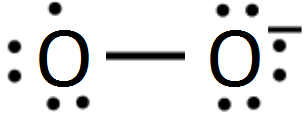 Oxygen atom with no charge has 6 electrons. Thus, its oxidation state is 0. Oxygen atom that carries negative charge has 7 electrons. Thus, its oxidation state is -1.
Average O.S. $=\frac{0+(-1)}{2}=\frac{-1}{2}$ View full question & answer→Question 372 Marks
- Why is Na(Hg) less reactive than Na?
- Which has higher density Na or K?
Answer
- Amalgamation increases over voltage and hence, reactivity decreases. Secondly, mercury is less reactive which will make Na(Hg) less reactive.
- Na has higher density than K.
View full question & answer→Question 382 Marks
- Which reagent is used to reduce alkynes to form trans-alkenes?
- Which metal is used for fusion with organic compound in Lassaigne extract or sodium extract?
Answer
- Na/l iquid $\text{NH}_3$ is used as reducing agent to get trans-alkene from alkynes.
- Na metal is used.
View full question & answer→Question 392 Marks
Which alkali metal ion forms largest hydrated ion in aqueous solution and why?
Answer$\mathrm{Li}^+$ forms largest hydrated cations because it has highest hydration energy. It has smallest size therefore, it is most hydrated.
View full question & answer→Question 402 Marks
Account for the following:
i. Arrange $LiCl , NaCl _2, BeCl _2$ in increasing order of covalent character.
ii. $CO _2$ turns the lime water milky. On passing $CO _2$ in excess, milkiness disappears.
Answer
- $BeCl_2 > LiCl > NaCl$
$Be^{2+}$ has highest polarising power due to smaller cation and higher charge than $Li^+.$
$\therefore BeCl_2$ is more covalent than LiCl. NaCl is least covalent, most ionic therefore, $Na^+ $ being larger cation has lowest polarising power.
- $CO_2$ turns lime water milky due to the formation of white precipitate of $CaCO_3.$
$\text{Ca(OH)}_2+\text{CO}_2\xrightarrow{ \ \ \ \ \ \ \ \ }\text{CaCO}_3\downarrow+\text{H}_2\text{O}$
$\text{Lime water} \ \ \ \ \ \ \ \ \ \ \ \ \ \ \ \ \ \ \text{Milkiness}$
On passing $CO_2$ in excess soluble calcium bicarbonate is formed and milkiness disappears.
$\text{CaCO}_3+\text{CO}_2+\text{H}_2\text{O}\xrightarrow{\$
$\ \ \ \ \$
$\ }\text{Ca(HCO}_3)_2$
$\ \ \ \ \ \ \ \ \ \ \ \ \ \ \ \ \ \ \ \ \ \ \ \ \ \ \ \ \ \ \ \ \ \ \ \ \ \ \ \ \ \ \ \ \ \ \ \ \text{(Soluble)}$ View full question & answer→Question 412 Marks
Which out of Li, Na, K, Be, Mg, Ca has lowest ionisation enthalpy and why?
AnswerK has lowest ionisation energy due to larger atomic size among these elements. The force of attraction between valence electron and nucleus is less, therefore, it can lose electron easily.
View full question & answer→Question 422 Marks
When water is added to compound (A) of calcium, solution of compound (B) is formed. When carbon dioxide is passed into the solution, it turns milky due to the formation of compound (C). If excess of carbon dioxide is passed into the solution milkiness disappears due to the formation of compound (D). Identify the compounds A, B, C and D. Explain why the milkiness disappears in the last step.
AnswerCompound A is Calcium Oxide i.e. CaO . When water is added to it, calcium hydroxide i.e. $\mathrm{Ca}(\mathrm{OH})_2(\mathrm{~B})$ is formed. When $\mathrm{CO}_2$ is passed into it, it turns milky due to the formation of Calcium carbonate i.e. $\mathrm{CaCO}_3$ (C). When excess of $\mathrm{CO}_2$ is passed into it milkiness disappears due to the formation of Calcium bicarbobate $\mathrm{Ca}\left(\mathrm{HCO}_3\right)_2(\mathrm{D})$
$2\text{CaO(s)}+\text{H}_2\text{O}\xrightarrow{\ \ \ }\text{Ca}(\text{OH})_2(\text{l)}\\\ \ \ \ \ \text{(A)}\ \ \ \ \ \ \ \ \ \ \ \ \ \ \ \ \ \ \ \ \ \ \ \ \ \ \ \ \ \ \text{(B)}$
$\text{Ca(OH})_2(\text{l})+\text{CO}_2(\text{g})\xrightarrow{\ \ \ }\text{CaCO}_3(\text{s})+\text{H}_2\text{O}(\text{l})\\\ \ \ \ \ \ \ \ \text{(B)}\ \ \ \ \ \ \ \ \ \ \ \ \ \ \ \ \ \ \ \ \ \ \ \ \ \ \ \ \ \ \ \ \ \ \ \ (\text{C)}$
$\text{CaCO}_3(\text{s})+\text{CO}_2(\text{g})+\text{H}_2\text{O}(\text{l})\xrightarrow{\ \ \ }\text{Ca}(\text{HCO}_3)_2(\text{aq})\\\ \ \ \ \ \ \text{(C)}\ \ \ \ \ \ \ \ \ \ \ \ \ \ \ \ \ \ \ \ \ \ \ \ \ \ \ \ \ \ \ \ \ \ \ \ \ \ \ \ \ \ \ \ \ \ \ \ \ \ \ \ \ \text{(D)}$
View full question & answer→Question 432 Marks
Ions of an element of group 1 participate in the transmission of nerve signals and transport of sugars and aminoacids into cells. This element imparts yellow colour to the flame in flame test and forms an oxide and a peroxide with oxygen. Identify the element and write chemical reaction to show the formation of its peroxide. Why does the element impart colour to the flame?
Answer$\text{Na}^+$ ions participate in the transmisssion of nerve signals and gives oxide and peroxide.
$4\text{Na}+\text{O}_2\xrightarrow{\ \ \ }2\text{Na}_2\text{O}$
$2\text{Na}+\text{O}_2\xrightarrow{\ \ \ }\text{Na}_2\text{O}_2$
$2\text{Na}_2\text{O}+\text{O}_2\xrightarrow{\ \ \ }2\text{Na}_2\text{O}_2$
View full question & answer→Question 442 Marks
Name an element from Group 2 which forms an amphoteric oxide and awater soluble sulphate.
AnswerDue to small size and somewhat high ionization enthalpy of $\mathrm{Be}, \mathrm{Be}(\mathrm{OH})_2$ is amphoteric in nature, i.e., it reacts with both acids and bases. Further, due to small size, the hydration enthalpy of $\mathrm{Be}^{2+}$ ions is much higher than the lattice enthalpy of $\mathrm{BeSO}_4$. As a result, $\mathrm{BeSO}_4$ is highly soluble in water.
View full question & answer→Question 452 Marks
- List two properties showing similarity between.
- State as to why a solution of $\mathrm{Na}_2 \mathrm{CO}_3$ is alkaline in nature?
Answer
-
- Both Li and Mg are harder than other members of their respective groups.
- Both react slowly with water.
- A solution of sodium carbonate is alkaline because carbonate part of sodium carbonate gets hydrolysed by water as per the following reaction to furnish $\text{OH}^-$ (hydroxyl ions).
$\text{CO}_3^{2-}+\text{H}_2\text{O}\xrightarrow{ \ \ \ \ \ \ \ }\text{HCO}_3^-+\text{OH}^-$
It is a salt of weak acid and strong base, therefore, alkaline in nature. View full question & answer→Question 462 Marks
Identify (A), (B), (C) and (D) and give their chemical formulae.
$\text{(A)}+\text{NaOH}\xrightarrow{\ \\ \ \ \\ \ \ \\ \ \ }\text{NaCl}+\text{NH}_3+\text{H}_2\text{O}$
$\text{(B)}+\text{NaCl}\xrightarrow{\ \\ \ \ \\ \ \ \\ \ \ }\text{(C)}+\text{NH}_4\text{Cl}$
$\text{(C)}\xrightarrow{\text{Heat}}\text{Na}_2\text{CO}_3+\text{H}_2\text{O}+\text{(D)}$
Answer$\text{NH}_4\text{Cl}+\text{NaOH}\xrightarrow{\ \\ \ \ \\ \ \ \\ \ \ }\text{NaCl}+\text{NH}_3+\text{H}_2\text{O},\\ \text{(A)}$
Thus 'A' is ammonium chloride.
$\text{NH}_3+\text{CO}_2+\text{H}_2\text{O}\xrightarrow{\ \\ \ \ \\ \ \ \\ \ \ }\text{NH}_4\text{HCO}_3;\\ \ \ \ \ \ \ \ \ \ \ \ \ \ \ \ \ \ \ \ \ \ \ \ \ \ \ \ \ \ \ \ \ \ \ \ \ \ \ \ \ \ \ \ \ \ \ \ \text{(B)}$
Thus 'B' is ammonium bicarbonate.
$\text{NH}_4\text{HCO}_3+\text{NaCl}\xrightarrow{\ \\ \ \ \\ \ \ \\ \ \ }\text{NH}_4\text{Cl}+\text{NaHCO}_3;\\ \ \ \ \ \ \ \ \ \ \ \ \ \ \ \ \ \ \ \ \ \ \ \ \ \ \ \ \ \ \ \ \ \ \ \ \ \ \ \ \ \ \ \ \ \ \ \ \ \ \ \ \ \ \ \ \ \ \ \ \ \ \text{(C)}$
Thus 'C' is sodium bicarbonate.
$2\text{Na}\text{HCO}_3\xrightarrow{\Delta\ \ \ \ }\text{Na}_2\text{CO}_3+\text{H}_2\text{O}+\text{CO}_2;\\ \ \ \ \ \ \ \ \ \ \ \ \ \ \ \ \ \ \ \ \ \ \ \ \ \ \ \ \ \ \ \ \ \ \ \ \ \ \ \ \ \ \ \ \ \ \ \ \ \ \ \ \ \ \ \ \ \ \ \ \ \ \text{(D)}$
Thus 'D' is carbon dioxide.
View full question & answer→Question 472 Marks
Which one of the alkaline earth metal carbonate is thermally most and least stable and why?
Answer$\mathrm{BaCO}_3$ is thermally most stable due to greater ionic character and high lattice energy whereas $\mathrm{BeCO}_3$ is thermally least stable because it is covalent and has less lattice energy.
View full question & answer→Question 482 Marks
Element Aburns in nitrogen to give an ionic compound B. Compound B reacts with water to give C and D. A solution of C becomes milky on bubbling carbon dioxide. Identify A, B, C and D.
AnswerElement A is Calcium
$3\text{Ca}+\text{N}_2\xrightarrow{ \ \ \ \ \ \ \ \ \ \ \ }\text{Ca}_3\text{N}_2\xrightarrow{6\text{H}_2\text{O} }3\text{Ca(OH)}_2+2\text{NH}_3\\ \ \ \ \text{A}\ \ \ \ \ \ \ \ \ \ \ \ \ \ \ \ \ \ \ \ \ \ \ \ \ \ \ \text{B}\ \ \ \ \ \ \ \ \ \ \ \ \ \ \ \ \ \ \ \ \ \ \ \ \text{C}\ \ \ \ \ \ \ \ \ \ \ \ \ \ \text{D}$
$\text{Ca(OH)}_2\xrightarrow{\text{CO}_2}\text{CaCO}_3+\text{H}_2\text{O}\\ \ \ \ \ \ \ \ \ \ \ \ \ \ \ \ \ \ \ \ \ \ \ \ \ \ \ \ \text{Milky}$
Compound, B = $Ca_3N_2$
Compound, C = $Ca(OH)_2$
Compound, D = $NH_3$
View full question & answer→Question 492 Marks
Why are ionic hydrides of only alkali metals and alkaline earth metals are known? Give two examples.
AnswerAlkali metals and alkaline earth metals are most electropositive due to low ionisation energy or enthalpy therefore, they can form ionic hydrides, e.g., $\mathrm{NaH}, \mathrm{KH}$ and $\mathrm{CaH}_2$.
View full question & answer→Question 502 Marks
- Kidney stones are made up of which compound?
- Why do crystalline salts of Group 2 elements contain more water of crystallization than, Group 1 elements.
Answer
- Calcium oxalate.
- It is because divalent cations have higher hydration energy than monovalent cations.
View full question & answer→Question 512 Marks
How would you explain
i. BeO is insoluble but $\mathrm{BeSO}_4$ is soluble in water?
ii. $\mathrm{Be}(\mathrm{OH})_2$ dissolves in NaOH but $\mathrm{Mg}(\mathrm{OH})_2$ does not?
Answeri. Lattice energy of BeO is greater than its hydration energy so, it is insoluble in water while in case of $\mathrm{BeSO}_4$, hydration energy is greater than lattice energy, so it is readily soluble in water.
ii. $\mathrm{Be}(\mathrm{OH})_2$ is amphoteric and therefore, it dissolves in NaOH forming sodium beryllate
$\mathrm{Be}(\mathrm{OH})_2+2 \mathrm{NaOH} \longrightarrow \mathrm{Na}_2 \mathrm{BeO}_2+2 \mathrm{H}_2 \mathrm{O}$
On the other hand, $\mathrm{Mg}(\mathrm{OH})_2$, is basic and does not dissolve in NaOH .
View full question & answer→Question 522 Marks
What happens when:
i. $\mathrm{LiNO}_3$ is heated.
ii. $\mathrm{KNO}_3$ is heated.
Write the chemical reactions involved.
Answeri. $4 \mathrm{LiNO}_3 \longrightarrow 2 \mathrm{Li}_2 \mathrm{O}+4 \mathrm{NO}_2+\mathrm{O}_2$
Lithium nitrate, on heating gives $\mathrm{Li}_2 \mathrm{O}, \mathrm{NO}_2$ and $\mathrm{O}_2$ gas.
ii. Potassium nitrate, on heating gives $\mathrm{KNO}_2$ (potassium nitrate) and $\mathrm{O}_2$ gas.
$2 \mathrm{KNO}_3(\mathrm{~s}) \xrightarrow{\text { heat }} 2 \mathrm{KNO}_2(\mathrm{~s})+\mathrm{O}_2(\mathrm{~s})$
View full question & answer→Question 532 Marks
- Give one important ore of sodium and potassium element.
- What are the raw materials used for the manufacture of washing soda by Solvay process?
Answer
- Sodium : NaCl
Potassium : KCl
- Raw materials used for the manufacture of washing soda by Solvay process are $\mathrm{NaCl}, \mathrm{CaCO}_3$ and $\mathrm{NH}_3$.
View full question & answer→Question 542 Marks
Why does $\mathrm{BeCl}_2$ react with water to give acidic solution? Give chemical reaction.
Answer$\mathrm{BeCl}_2$ is covalent, therefore, it gets hydrolysed to form $\mathrm{Be}(\mathrm{OH})_2$ and $\mathrm{HCl}, \mathrm{HCl}$, being strong acid, solution is acidic in nature.
$\text{BeCl}_2+2\text{H}_2\text{O}\xrightarrow{\ \ \ \\ \ \ \ }\text{Be(OH)}_2+2\text{HCl}$
View full question & answer→Question 552 Marks
i. Why is it necessary to remove $\mathrm{CO}_2$ continuously during the manufacture of CaO from $\mathrm{CaCO}_3$ ?
ii. $\mathrm{CaCO}_3 \rightarrow \mathrm{CaO}+\mathrm{CO}_2$ why the temperature of this reaction is maintained at 1270 K ?
Answeri. As the reaction is reversible in nature, $\mathrm{CO}_2$, formed in the reaction must be removed as soon as it is formed so that the reaction does not proceed in the backward direction.
ii. The temperature shouldn't be allowed to rise above 1270 K , otherwise silica $\left(\mathrm{SiO}_2\right)$ present as impurity in limestone will combine with CaO to form $\mathrm{CasiO}_3$
$\text{CaO}+\text{SiO}_2\xrightarrow{\text{Above } 1270\text{K}}\text{CaSiO}_3$
View full question & answer→