MCQ 11 Mark
If f : R → R is defined by f(x) = 3x + |x|, then f(2x) - f(-x) - 6x =
- Af(x)
- B2f(x)
- C-f(x)
- Df(-x)
Answer
View full question & answer→- f(x)
166 questions · self-marked practice — reveal the answer and mark yourself.
Solution:
R is a relation from {11, 12, 13} to {8, 10, 12}, defined by y = x - 3
Now, we have,
11 - 3 = 8
13 - 3 = 10
So, R = {(13, 10), (11, 8)}
$\therefore$ R-1 = {(10, 13), (8, 11)}
Solution:
Given, function $ \text{f}(\text{x})=\sin \big(\frac{2\pi\text{x}}{3}\big)+\cos \big(\frac{\pi\text{x}}{2}\big)$
Now, period of $ \text{f}(\text{x})=\big(\frac{2\pi\text{x}\times{3}}{2\pi}\big)=3$
and period of $\cos \Big(\frac{\text{n}\pi}{2}\Big)=\frac{2\text{n}}{\frac{\text{n}}{2}} = \big(\frac{2\pi\text{}\times{2}}{ \pi}\big)= 2 × 2 = 4$ $$
Now, period of f(x) = LCM(3, 4) = 12 Hence, period of function $\text{f(x)} = \sin\frac{2\pi\text{x}}{3} + \cos \big(\frac{\pi\text{x}}{2}\big) + \cos$ $$is 12
Solution:
Given, $\text{f(x)}=\sqrt{\text{x}^2+1}\ ...(\text{i})$
Replacing x by y in (i), we get
$\text{f(y)}=\sqrt{\text{y}^2+1}$
$\therefore\ \text{f(x)}\text{f(y)}=\sqrt{\text{x}^2+1}\sqrt{\text{y}^2+1}$
$=\sqrt{(\text{x}^2+1)(\text{y}^2+1)}$
$=\sqrt{\text{x}^2\text{y}^2+\text{x}^2+\text{y}^2+1}$
Also, replacing x by xy in (i), we get
$\text{f(xy)}=\sqrt{\text{x}^2\text{y}^2+1}$
Now,
$\text{x}^2\text{y}^2+1\leq\text{x}^2\text{y}^2+\text{x}^2+\text{y}^2+1$
$\Rightarrow\sqrt{\text{x}^2\text{y}^2+1}\leq\sqrt{\text{x}^2\text{y}^2+\text{x}^2+\text{y}^2+1}$
$\Rightarrow\text{f}(\text{xy})\leq\text{f(x)}\text{f(y)}$
Solution:
Given,
function is $ \text{f}(\text{x}) = \frac{1}{(2 -\cos 3\text{x})}$
Since $ -1 \leq \cos \text{3x} \leq1$ for all$\text{ x }∈\text{R}$
So,$ -1 \leq 2 \cos \text{3x} \leq1$for all$\text{ x }∈\text{R}$
⇒ $\text{f}(\text{x})$ is defined for all$\text{ x }∈\text{R}$
So, domain of f(x) is R.
Solution:
We know that, $-1\leq-\cos\text{x}\leq1$
$\Rightarrow-1\leq-\cos\text{x}\leq1$
$\Rightarrow-2\leq-2\cos\text{x}\leq2$
$\Rightarrow-1\leq-2\cos\text{x}\leq3$
Now $\text{f(x)}=\frac{1}{1-2\cos\text{x}}$ is defined if
$-1\leq-2\cos\text{x}\leq0$ or $0<1-2\cos\text{x}\leq3$
$\Rightarrow-1\geq\frac{1}{1-2\cos\text{x}}>-\infty$ or $\infty>\frac{1}{1-2\cos\text{x}}\geq\frac{1}{3}$
$\Rightarrow\frac{1}{1-2\cos\text{x}}\in(-\infty, -1]\cup\Big[\frac{1}{3},\infty\Big)$
Solution:
$\text{f(x)}=\sqrt{5|\text{x}|-\text{x}^2-16}$
For f(x) to be defined, $5|\text{x}|-\text{x}^2-6\geq0$
$\Rightarrow5|\text{x}|-\text{x}^2-6\geq0$
$\Rightarrow\text{x}^2-5|\text{x}|+6\leq0$
For x > 0, |x| = x
$\Rightarrow\text{x}^2-5\text{x}+6\leq0$
$\Rightarrow(\text{x}-2)(\text{x}-3)\leq0$
$\Rightarrow\text{x}\in[2,3]\ ...(\text{i})$
For x < 0, |x| = -x
$\Rightarrow\text{x}^2+5\text{x}+6\leq0$
$\Rightarrow(\text{x}+2)(\text{x}+3)\leq0$
$\Rightarrow\text{x}\in\big[-3,-2\big]\ ...(\text{ii})$
From (i) and (ii),
$\text{x}\in\big[-3,-2\big]\cup\big[2,3\big]$
Or, $\text{domain(f)}=\big[-3,-2\big]\cup\big[2,3\big]$
Solution:
The function $\text{f}(\text{x})= ^{7-\text{x}}\text{P}_\text{x-3}$ is defined only if x is an integer satisfying the following inequalities:
$ 7 - \text{x} ≥ 0.....(1)$
$ \text{x} - 3 ≥ 0......(2)$
$ 7 - \text{x} ≥ \text{x} - 3........(3)$
Now, from 1, we get $ \text{x} ≤ 7 ……… (4)$
from 2, we get $\text{x} ≥ 3 ……………. (5)$
and from 2, we get $\text{x} ≤ 5 ………. (6)$
From 4, 5 and 6, we get
$ 3 ≤ \text{x} ≤ 5$
So, the domain is {3, 4, 5}.
Solution:
$\text{f(x)}=\sqrt{\frac{(\text{x}+1)(\text{x}-3)}{\text{x}-2}}$
For f(x) to be defined,
$(\text{x}-2)\neq0$
$\Rightarrow\text{x}\neq2\ ...(\text{i})$
Also,
$\frac{(\text{x}+1)(\text{x}-3)}{\text{x}-2}\geq0$
$\Rightarrow\frac{(\text{x}+1)(\text{x}-3)(\text{x}-2)}{(\text{x}-2)^2}\geq0$
$\Rightarrow(\text{x}+1)(\text{x}-3)(\text{x}-2)\geq0$
$\Rightarrow\text{x}\in\big[-1,2\big)\cup\big[3,\infty\big)\ ...(\text{ii})$
From (i) and (ii),
$\text{x}\in\big[-1,2\big)\cap\big[3,\infty\big)$
Solution:
Since, $\text{f(x)}=\cos[\text{x}],$ where $\frac{-\pi}{2}<\text{x}<\frac{\pi}{2}$
$-\frac{\pi}{2}<\text{x}<\frac{\pi}{2}$
$\Rightarrow-1.57<\text{x}<1.57$
$\Rightarrow[\text{x}]\ \in\ \{-1,0,1,2\}$
Thus, $\cos[\text{x}]=\{\cos(-1),\cos0,\cos1,\cos2\}$
Range of $\text{f(x)}=\{\cos1,1,\cos2\}$
Solution:
$\frac{\text{ (x}^{2} + \ 2)}{(\text{x}^{2} + \ 1)}$
Given f(x) = x2 + 2 and $ \text{g}(\text{x})=\frac{\text{x}}{(\text{x}\ - \ 1)}$
Now, $\text{gof(x)} = \text{g}(\text{x}^2 + 2) = \text{got}(\text{x})=\text{g}(\text{x}^2 +2)=\frac{\text{ (x}^{2} +\ 2)}{(\text{x}^{2} \ +\ 2\ -\ 1)}=\frac{(\text{x}^2\ +\ 2)}{(\text{x}^2\ +\ 1)}$
Solution:
$\text{f(x)}=27\text{x}^3+\frac{1}{\text{x}^3}$
$\Rightarrow\text{f(x)}=\Big(3\text{x}+\frac{1}{\text{x}}\Big)\Big(9\text{x}^2+\frac{1}{\text{x}^2}-3\Big)$
$\Rightarrow\text{f(x)}=\Big(3\text{x}+\frac{1}{\text{x}}\Big)\Big(\Big(3\text{x}+\frac{1}{\text{x}}\Big)^2-9\Big)$
$\Rightarrow\text{f}(\alpha)=\Big(3\alpha+\frac{1}{\alpha}\Big)\Big(\Big(3\alpha+\frac{1}{\alpha}\Big)^2-9\Big)$
Since $\alpha$ and $\beta$ are the roots of $3\text{x}+\frac{1}{\text{x}}=12,$
$3\alpha+\frac{1}{\alpha}=12$ and $3\beta+\frac{1}{\beta}=12$
$\Rightarrow\text{f}(\alpha)=12\big((12)^2-9\big)$ and $\text{f}(\beta)=12\big((12)^2-9\big)$
$\Rightarrow\text{f}(\alpha)=\text{f}(\beta)=\big((12)^2-9\big)$
Solution:
Given that: $\text{f(x)}=\frac{4-\text{x}}{\text{x}-4}$
We know that f(x) is defined if $\text{x}-4\neq0 \Rightarrow \text{x}\neq4$
So, the domain of f(x) is = R - {4}
Let $\text{f(x)}=\text{y}=\frac{4-\text{x}}{\text{x}-4}$
$\Rightarrow\text{yx}-4\text{y}=4-\text{x}\Rightarrow\text{yx}+\text{x}=4\text{y}+4$
$\Rightarrow\text{x}(\text{y}+1)=4\text{y}+4\Rightarrow\text{x}=\frac{4(1+\text{y})}{1+\text{y}}$
If x is real number, then $1+\text{y}\neq0\Rightarrow\text{x}\neq1$
$\therefore$ Range of f(x) = R - {-1)
Solution:
Given,
$\text{f(x)}=\cos^2\text{x}+\sin^4\text{x}$
$\Rightarrow\text{f(x)}=1-\sin^2\text{x}+\sin^4\text{x}$
$\Rightarrow\text{f(x)}=\Big(\sin^2\text{x}-\frac{1}{2}\Big)^2+\frac{3}{4}$
The minimum value of $\text{f(x)}$ is $\frac{3}{4}$
Also,
$\sin^2\text{x}\leq1$
$\Rightarrow\ \sin^2\text{x}-\frac{1}{2}\leq\frac{1}{2}$
$\Rightarrow\ \Big(\sin^2\text{x}-\frac{1}{2}\Big)^2\leq\frac{1}{4}$
$\Rightarrow\ \Big(\sin^2\text{x}-\frac{1}{2}\Big)^2+\frac{3}{4}\leq\frac{1}{4}+\frac{3}{4}$
$\Rightarrow\ \text{f(x)}\leq1$
The maximum value of f(x) is 1
$\therefore\ \text{f(R)}=\Big(\frac{3}{4},1\Big)$
Solution:
$\frac{\text{ (x}^{2} + \ 2)}{(\text{x}^{2} + \ 1)}$
Given f(x) = x2 + 2 and $ \text{g}(\text{x})=\frac{\text{x}}{(\text{x}\ - \ 1)}$
Now, gof(x) = g(x2 + 2) = $\text{got}(\text{x})=\text{g}(\text{x}^2 +2)=\frac{\text{ (x}^{2} +\ 2)}{(\text{x}^{2} \ +\ 2\ -\ 1)}=\frac{(\text{x}^2\ +\ 2)}{(\text{x}^2\ +\ 1)}$
Solution:
$\text{f(x)}=\sin[\pi^2]\text{x}+\sin[-\pi^2]\text{x}$
$\Rightarrow\text{f(x)}=\sin\big[9.8\big]\text{x}+\sin\big[-9.8\big]\text{x}$
$\Rightarrow\text{f(x)}=\sin9\text{x}-\sin10\text{x}$
$\Rightarrow\text{f}\Big(\frac{\pi}{2}\Big)=\sin9\times\frac{\pi}{2}-\sin10\times\frac{\pi}{2}$
$\Rightarrow\text{f}\Big(\frac{\pi}{2}\Big)=1-0=1$
Solution:
{(-1, 1), (1, 1), (-2, 2), (2, 2), (-3, 3), (3, 3), ……}. This function involves relation {(x, y), y = |x|} which is involved in modulus function.
So, above function is modulus function.
Solution:
$\text{f(x)}=|\text{x}-1|$
Since, $|\text{x}^2-1|\neq|\text{x}-1|^2$
$\text{f(x)}^2\neq(\text{f(x)})^2$
Thus, (i) is wrong.
Since, $|\text{x}+\text{y}-1|\neq|\text{x}-1||\text{y}-1|$
$\text{f}(\text{x}+\text{y})\neq\text{f(x)}\text{f(y)}$
Thus, (ii) is wrong.
Since, $|\text{|x|}-1\neq||\text{x}-1||=|\text{x}-1|$
$\text{f(|x|)}\neq|\text{f(x)}|$
Thus, (iii) is wrong.
Hence, none of the given options is the answer.
Solution:
Let $\text{y}=\text{f}(\text{x})=\text{x}^{2}+1$
⇒ $\text{y}=\text{x}^{2}+1$
⇒ $ \text{y}-1=\text{x}^{2}$
⇒ $ \text{x} = ±\sqrt{(\text{y} – 1)}$
⇒ $\text{f}^{-1} \text{x} = ±\sqrt{(\text{x} – 1)}$
Now, $\text{f}^{-1} (26) = ±\sqrt{(\text{26} – 1)}$
⇒ $\text{f}^{-1} (26) = ±\sqrt{(\text{25} )}$
⇒ $\text{f}^{-1} (26) = ± {5 }$
Solution:
A = {1, 2, 3} and B = {1, 4, 6, 9}
R is a relation from A to B defined by: x is greater than y.
Then R = {(2, 1), (3, 1)}
$\therefore$ Range (R) = {1}
Solution:
For every value of $\text{x}\in\text{R},$ there is a unique value $\text{y} \in\text{R}$
i.e., there is a unique image for all values of $\text{x}\in\text{R},$
Also, values of x occur only once in the ordered pairs.
Thus, it is a function.
Solution:
Since $ \tan^1$ x exists if $\text{x}\in(-\infty,\infty)$
So, (2x + 1) is defined if
$ -\infty < 2\text{x} + 1 <\infty$
$\Rightarrow-\infty < \times <\infty$
$\Rightarrow \text{x}\in (-\infty,\infty)$
$\Rightarrow \text{x}\in \text{R}$
So, domain of $ \tan^-1(2\text{x}+1)$ is R.
Solution:
If set P has m elements and set Q has n elements then P × Q has m × n elements.
m × n = 10 ⇒ if m = 1 then n = 10,
if m = 2 then n = 5,
if m = 5 then n = 2 and if m = 10 then n = 1.
Solution:
A = {1, 2, 4}, B = {2, 4, 5} and C = {2, 5}
(A - B) = {1}
(B - C) = {4}
So, (A - B) × (B - C) = {(1, 4)}
Solution:
We know, square root is always non-negative.$\sqrt{9-\text{x}^2}>0$.
So, the range of the function is set of positive real numbers from 0 to 3.
Solution:
$\text{f(x)}=\sqrt{2-2\text{x}-\text{x}^2}$
Since,
$2-2\text{x}-\text{x}^2\geq0$$\text{x}^2+2\text{x}-2\leq0$
$\Rightarrow\text{x}^2-2\text{x}-2+1-1\leq0$
$\Rightarrow(\text{x}-1)^2-\big(\sqrt{3}\big)^2\leq0$
$\Rightarrow\big[\text{x}-\big(1-\sqrt{3}\big)\big]\big[\text{x}-\big(1+\sqrt{3}\big)\big]\leq0$
$\Rightarrow\big(-1-\sqrt{3}\big)\leq\text{x}\leq(-1+\sqrt{3})$
Thus, domain
$(\text{f})=\big[-1-\sqrt{3},-1+\sqrt{3}\big]$The domain and range of the function f given by f(x) = 2 - x - 5| is.
Solution:
We have, f(x) = 2 - |x - 5|
Clearly, f(x) is defined for all
$\text{x}\in\text{R}.$$\therefore$ Domain of f = R
Now, $|\text{x}-5|\geq0,\forall\text{x}\in\text{R}$
$\Rightarrow-|\text{x}-5|\leq0$
$\Rightarrow2-|\text{x}-5|\leq2$
$\therefore\text{f(x)}\leq2$
$\therefore$ Range of $\text{f}=(-\infty, 2]$
Solution:
We know that $-1\leq\cos\text{x}\leq1$ for all $\text{x}\in\text{R}$
Now,
$-1\leq\cos\text{x}\leq1$
$\Rightarrow-1\leq\cos\text{x}\leq1$
$\Rightarrow-2\leq-2\cos\text{x}\leq2$
$\Rightarrow-1\leq1-2\cos\text{x}\leq3$ (Adding 1 ro each term)
But,
$\cos\text{x}\neq\frac{1}{2}$
$\Rightarrow1-2\cos\text{x}\in\big[-1,3\big]-\{0\}$
$\Rightarrow\frac{1}{1-2\cos\text{x}}\in\big(-\infty,-1\big]\cap\Big[\frac{1}{3},\infty\Big)$
$\therefore\ \text{Range of }\text{f(x)}=\big(-\infty,-1\big]\cap\Big[\frac{1}{3},\infty\Big)$
Disclaimer: The range of the function does not matches with either of the given options. The range matches with option (c) if it is given as $\big(-\infty,-1\big]\cap\Big[\frac{1}{3},\infty\Big)$
Solution:
$\text{f(x)}=\frac{4^{\text{x}}}{4^{\text{x}}+2}\text{ x }\in\text{R},$
$\text{f}\big(\text{1}-\text{x}\big)=\frac{4^{1-\text{x}}}{4^{1-\text{x}}+2}$
$=\frac{4}{2\times4^{\text{x}}+4}$
$=\frac{2}{4^{\text{x}}+2}$
$\text{f(x)}+\text{f}(1-\text{x})=\frac{4^{\text{x}}}{4^{\text{x}}+2}+\frac{2}{4^{\text{x}}+2}$
$=\frac{4^{\text{x}}+2}{4^{\text{x}}+2}=1$
Solution:
Given,
$\text{f(x)}=\frac{\sin^{4}\text{x}+\cos^2\text{x}}{\sin^2\text{x}+\cos^4\text{x}}$
On dividing the numerator and denominator by $\cos^4\text{x},$ we get
$\text{f(x)}=\frac{\tan^4\text{x}+\sec^2\text{x}}{1+\tan^2\text{x}\sec^2\text{x}}$
$=\frac{1+\tan^4\text{x}+\tan^2\text{x}}{1+\tan^2\text{x}(1+\tan^2\text{x})}$
$=\frac{1+\tan^{4}\text{x}+\tan^{2}\text{x}}{1+\tan^{4}\text{x}+\tan^{2}\text{x}}=1$ $(\text{For every x}\in\text{R})$
$\text{For x}=2002,$
We have,
$\text{f}(2002)=1$
Solution:
Given, $ \text{f}(\text{x}) = \cos(2\text{x} + 5)$
Period of $\text{f}(\text{x})=\frac{2\pi}{5}$
Since f(x) is a periodic function with period $\text{f}(\text{x})=\frac{2\pi}{5}$ so it is not injective.
The function f is not surjective also as its range [-1, 1] is a proper subset of its co-domain R.
Solution:
If either set P or set Q is a null set then $\text{P}\times\text{Q}$ is an empty set.
i.e. if P is $ \phi$ or Q is $ \phi$ then $ \text{P} ×\text{Q}=\phi $.
Solution:
Given that: $\text{f(x)}=\sqrt{1+\text{x}^2}$
$\Rightarrow\text{f(xy)}=\sqrt{1+\text{x}^2\text{y}^2}$
and $\text{f(x)}.\text{f(y)}=\sqrt{1+\text{x}^2}.\sqrt{1+\text{x}^2}=\sqrt{1+\text{x}^2 +\text{y}^2+\text{x}^2\text{y}^2}$
$\therefore\sqrt{1+\text{x}^2\text{y}^2}\leq\sqrt{1+\text{x}^2 +\text{y}^2+\text{x}^2\text{y}^2}$
$\text{f(xy)} \leq \text{f(x)}.\text{f(y)}$
Solution:
$\text{f(x)}=\cos(\log_\text{e}\text{x})$
$\Rightarrow\text{f}\Big(\frac{1}{\text{x}}\Big)=\cos\Big(\log_\text{e}\Big(\frac{1}{\text{x}}\Big)\Big)$
$\Rightarrow\text{f}\Big(\frac{1}{\text{x}}\Big)=\cos\Big(-\log_\text{e}(\text{x})\Big)$
$\Rightarrow\text{f}\Big(\frac{1}{\text{x}}\Big)=\cos\Big(\log_\text{e}(\text{x})\Big)$
Similarly,
$\text{f}\Big(\frac{1}{\text{y}}\Big)=\cos(\log_\text{e}\text{y})$
Now,
$\text{f(xy)}=\cos(\log_\text{e}\text{xy})=\cos\big(\log_\text{e}\text{x}+\log_\text{e}\text{y}\big)$
and
$\text{f}\Big(\frac{\text{x}}{\text{y}}\Big)=\cos\Big(\log_\text{e}\frac{\text{x}}{\text{y}}\Big)=\cos\big(\log_\text{e}\text{x}-\log_\text{e}\text{y}\big)$
$\Rightarrow\text{f}\Big(\frac{\text{x}}{\text{y}}\Big)+\text{f(xy)}=\cos\big(\log_\text{e}\text{x}+\log_\text{e}\text{y}\big)+\cos\big(\log_\text{e}\text{x}-\log_\text{e}\text{y}\big)$
$\Rightarrow\text{f}\Big(\frac{\text{x}}{\text{y}}\Big)+\text{f(xy)}=2\cos\big(\log_\text{e}\text{x}\big)\cos(\log_\text{e}\text{y})$
$\Rightarrow\frac{1}{2}\Big[\text{f}\Big(\frac{\text{x}}{\text{y}}\Big)+\text{f(xy)}\Big]=\cos\big(\log_\text{e}\text{x}\big)\cos\big(\log_\text{e}\text{y}\big)$
$\Rightarrow\text{f}\Big(\frac{1}{\text{x}}\Big)\text{f}\Big(\frac{1}{\text{y}}\Big)-\frac{1}{2}\Big\{\text{f(xy)}+\text{f}\Big(\frac{\text{x}}{\text{y}}\Big)\Big\}=\cos\big(\log_\text{e}\text{x}\big)\cos\big(\log_\text{e}\text{y}\big)\\\ \ -\cos\big(\log_\text{e}\text{x}\big)\cos\big(\log_\text{e}\text{y}\big)=0$
Disclaimer: The question in the book has some error, so none of the options are matching with the solution. The solution is created according to the question given in the book.
Solution:
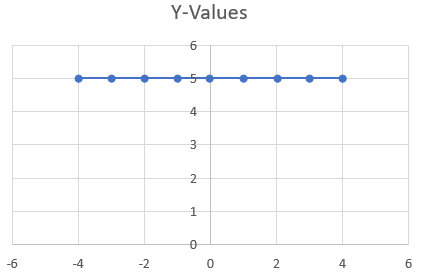
Since the above function can have all real values of x. So, domain is set of real numbers.
Solution:
As, $\text{|x|}=\begin{cases}\text{x},\ \text{x}\geq0\\-\text{x}<0\end{cases}$
So, $\text{f(x)}=\frac{\text{x}}{|\text{x}|}$
When, $\text{x}<0\text{ i.e.,}\text{ x}\in\big[-4,0\big)$
$\text{f(x)}=\frac{\text{x}}{-\text{x}}=-1$
and when, $\text{x}>0\text{ i.e., x}\in\big(0,4\big]$
$\text{f(x)}=\frac{\text{x}}{\text{x}}=1$
So, range $\text{f}=\{-1,1\}$
Solutuion:
We know radical cannot be negative.
So, $9-\text{x}^2,\geq 0$
$ (3 - \text{x}) (3 + \text{x}) ≥$
$\Rightarrow (\text{x} - 3) (\text{x} + 3) ≤ 0$
$ \Rightarrow \text{x} ∈ [-3,3].$
Solution:
If set A has m elements and set B has n elements then A × B has m × n elements.
We know, a set has 2r subsets if it has r number of elements.
Here, A × B has 2 × 3 = 6 elements. So, number of subsets of A × B will be 26 i.e. 64.
Solution:
$\text{f(x)}=\log|\text{x}|$
For f(x) to be defined,
$|\text{x}|>0,$ which is always true.
But $|\text{x}|\neq0$
$\Rightarrow\text{x}\neq0$
Thus, $\text{domain(f)}=\text{R}-\{0\}$
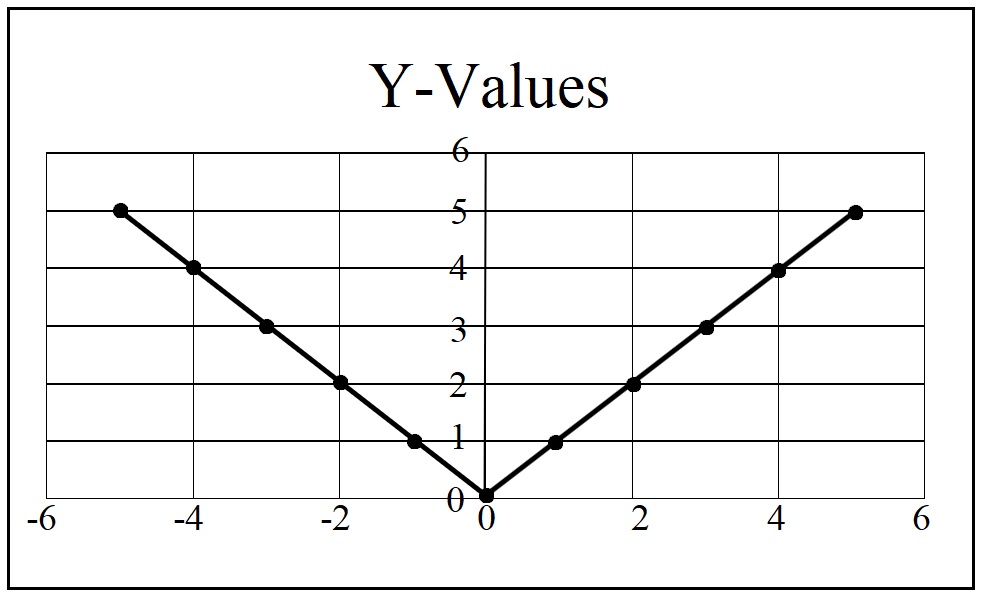
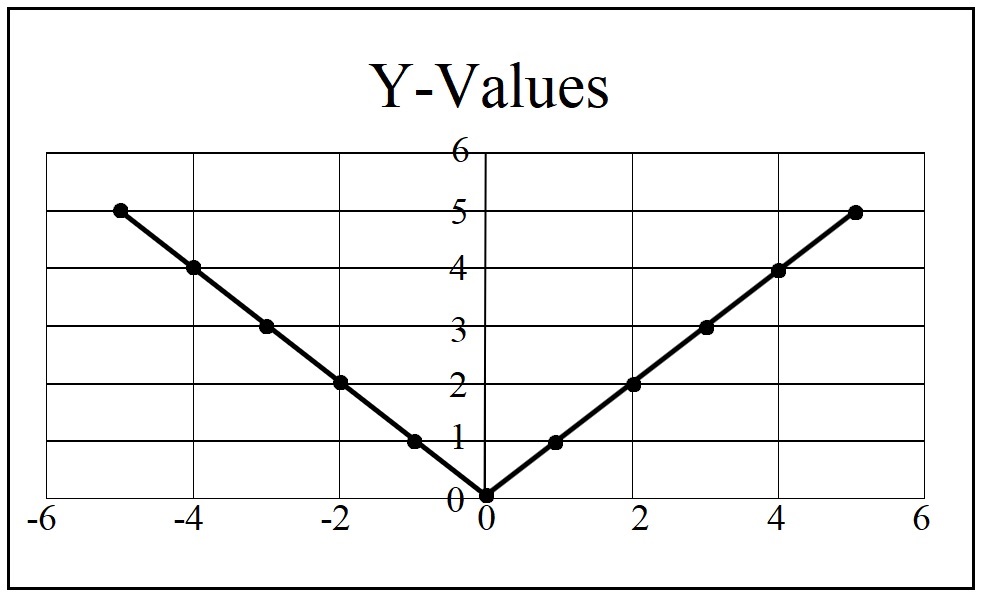
Solution:
Since the above function can have positive real value of y for all real values of x. So, range is set of positive real numbers.
Solution:
We know, domain of a relation is the set from which relation is defined i.e. set A.
So, domain = {1, 4, 8, 9}.
Solution:
If f : A → B, such that $\text{y}\in\text{B},$ then $\text{f}^{-1}(\text{y})=\{\text{x}\in\text{A}:\text{f(x)}=\text{y}\}$
In other words, f-1{y} is the set of pre-images of y.
Let $\text{f}^{-1}\{9\}=\text{x}$
Then, $\text{f(x)}=9$
$\Rightarrow\text{x}^2=9$
$\Rightarrow\text{x}=\pm3$
$\therefore\ \text{f}^{-1}\{9\}=\{-3,3\}$
Solution:
We have, f(x) = 3x2 – 1 and g(x) = 3 + x
f(x) = g(x)
⇒ 3x2 – 1 = 3 + x
⇒ 3x2 – x - 4 = 0
⇒ (3x - 4)(x + 1) = 0
$\therefore\text{x}=-1, \frac{4}{3}$
Solution:
Given,
$\text{f(x)}=\cos(\log\text{x})$
$\Rightarrow\ \text{f(x}^2)=\cos(\log(\text{x}^2))$
$\Rightarrow\ \text{f(x}^2)=\cos(2\log(\text{x}))$
Similarly,
$\text{f}(\text{y}^2)=\cos(2\log(\text{y}))$
Now,
$\text{f}\Big(\frac{\text{x}^2}{\text{y}^2}\Big)=\cos\Big(\log\Big(\frac{\text{x}^2}{\text{y}^2}\Big)\Big)=\cos\big(\log\text{x}^2-\log\text{y}^2\big)$
and $\text{f}(\text{x}^2\text{y}^2)=\cos(\log\text{x}^2\text{y}^2)=\cos\big(\log\text{x}^2+\log\text{y}^2\big)$
$\Rightarrow\ \text{f}\Big(\frac{\text{x}^2}{\text{y}^2}\Big)+\text{f}(\text{x}^2\text{y}^2)=\cos\big((2\log\text{x}-2\log\text{y})\big)+\cos\big((2\log\text{x}-2\log\text{y})\big)$
$\Rightarrow\ \text{f}\Big(\frac{\text{x}^2}{\text{y}^2}\Big)+\text{f}(\text{x}^2\text{y}^2)=2\cos(2\log\text{x})\cos(2\log\text{y})$
$\Rightarrow\frac{1}{2}\bigg[\Big(\text{f}\Big(\frac{\text{x}^2}{\text{y}^2}\Big)+\text{f}(\text{x}^2\text{y}^2)\bigg]=\cos(2\log)\cos(2\log\text{y})$
$\Rightarrow\ \text{f(x}^2)\text{f}(\text{y}^2)-\frac{1}{2}\Big\{\text{f}\Big(\frac{\text{x}^2}{\text{y}^2}\Big)+\text{f}\big(\text{x}^2\text{y}^2\big)\Big\}\\\ =\cos(2\log)\cos(2\log\text{y})-\cos(2\log)\cos(2\log\text{y})=0$
$ (-2, \infty )$
Solution:
$\text{f(x)}=64\text{x}^3+\frac{1}{\text{x}^3}$
$\Rightarrow\text{f(x)}=\Big(4\text{x}+\frac{1}{\text{x}}\Big)\Big(16\text{x}^2+\frac{1}{\text{x}^2}-4\Big)$
$\Rightarrow\text{f(x)}=\Big(4\text{x}+\frac{1}{\text{x}}\Big)\Big(\Big(4\text{x}+\frac{1}{\text{x}}\Big)^2-12\Big)$
$\Rightarrow\text{f}(\text{a})=\Big(4\alpha+\frac{1}{\alpha}\Big)\Big(\Big(4\alpha+\frac{1}{\alpha}\Big)^2-12\Big)$ and $\text{f}(\beta)=\Big(4\beta+\frac{1}{\beta}\Big)\Big(\Big(4\beta+\frac{1}{\beta}\Big)^2-12\Big)$
Since $\alpha$ and $\beta$ are the roots of $4\text{x}+\frac{1}{\text{x}}=3,$
$4\alpha+\frac{1}{\alpha}=3$ and $4\beta+\frac{1}{\beta}=3$
$\Rightarrow\text{f}(\alpha)=3\big((3)^2-12\big)=-9$ and $\text{f}(\beta)=3\big((3)^2-12\big)=-9$
$\Rightarrow\text{f}(\alpha)=\text{f}(\beta)=-9$
Solution:
$\text{f(x)}=\sqrt{4\text{x}-\text{x}^2}$
Clearly, f(x) assumes real values if
$4\text{x}-\text{x}^2\geq0$
$\Rightarrow\text{x}(4-\text{x})\geq0$
$\Rightarrow-\text{x}(\text{x}-4)\geq0$
$\Rightarrow\text{x}(\text{x}-4)\leq0$
$\Rightarrow\text{x}\in[0,4]$
Hence, domain $(\text{f})=[0,4]$
Solution:
Given, f(x) = ax + b and g(x) = cx + d and
Now, f{g(x)} = g{f(x)}
⇒ f{cx + d} = g{ax + b}
⇒ a(cx + d) + b = c(ax + b) + d
⇒ ad + b = cb + d
⇒ f(d) = g(b)
Solution:
We know, codomain of a relation is the set to which relation is defined i.e. set A.
So, codomain = {1,2,3,4,5}.
Solution:
A relation from set A to set B is a subset of cartesian product of A × B In ordered pair, first element should belong to set A and secondelement should belongs to set B.
In {(1, 1), (1, 2), (1, 3), (1, 4)}, 1 and 2 should also be in the set B which is not so as given in question.
Hence, {(1, 1), (1, 2), (1, 3), (1, 4)} is not a relation from set A to set B.
Solution:
$3\text{f(x)}+5\text{f}\Big(\frac{1}{\text{x}}\Big)=\frac{1}{\text{x}}-3\ ...(\text{i})$
Multiplying (1) by 3,
$15\text{f}\Big(\frac{1}{\text{x}}\Big)+9\text{f(x)}=\frac{3}{\text{x}}-9\ ...(\text{ii})$
Replacing x by $\frac{1}{\text{x}}$ in (i)
$3\text{f}\Big(\frac{1}{\text{x}}\Big)+5\text{f(x)}=\text{x}-3$
Multiplying by 5
$15\text{f}\Big(\frac{1}{\text{x}}\Big)+25\text{f(x)}=5\text{x}-15\ ...(\text{iii})$
Solving (ii) and (iii),
$-16\text{f(x)}=\frac{3}{\text{x}}-5\text{x}+6$
$\Rightarrow\text{f(x)}=\frac{1}{16}\Big(-\frac{3}{\text{x}}+5\text{x}-6\Big)$
Disclaimer: The question in the book has some error, so, none of the options are matching with the solution. The solution is created according to the question given in the book.
Solution:
Given,
Number of elements in set A = 3
Number of elements in set B = 2
Therefore, the number of functions that can be defined from A into B is = 23 = 8
Solution:
We have,
$|\text{i}|=\sqrt{1^2+0^2}=1$
Thus, $\text{i }\phi\ 1$ satisfies $\text{x}\ \phi\text{ y}\Leftrightarrow|\text{x}|=\text{y}$
Solution:
Given, function $\text{f}(\text{x})=\frac{\text{x}}{(1+\text{x}^2)}$
Since f(x) is defined for all real values of x
So, domain(f) = R.
Solution:
A relation from a set A to a set B is said to be a function if every element of set A has one and one image in set B.
Solution:
$2\text{f(x)}-3\text{f}\Big(\frac{1}{\text{x}}\Big)=\text{x}^2\ ...(\text{i})$ $(\text{x}\neq0)$
Replacing x by $\frac{1}{\text{x}}$
$2\text{f}\Big(\frac{1}{\text{x}}\Big)-3\text{f(x)}=\frac{1}{\text{x}^2}\ ...(\text{ii})$
Solving equations (i) & (ii)
$-5\text{f(x)}=\frac{3}{\text{x}^2}+2\text{x}^2$
$\Rightarrow\text{f(x)}=\frac{-1}{5}\Big(\frac{3}{\text{x}^2}+2\text{x}^2\Big)$
Thus, $\text{f(2)}=\frac{-1}{5}\Big(\frac{3}{4}+2\times4\Big)$
$=\frac{-1}{5}\Big(\frac{3+32}{4}\Big)$
$=-\frac{7}{4}$
Solution:
$\text{f(x)}=\frac{\text{x}}{|\text{x}|}$
Let $\text{y}=\frac{\text{x}}{|\text{x}|}$
For x > 0, |x| = x
$\Rightarrow\text{y}=\frac{\text{x}}{\text{x}}=1$
For x < 0, = -x
$\Rightarrow\text{y}=\frac{\text{x}}{-\text{x}}=-1$
Thus, range of f(x) is {-1, 1}
Solution:
Given that: $\text{f(x)}=\frac{\text{x}^2+2\text{x}+1}{\text{x}^2-\text{x}-6}$
f(x) is defined if $\text{x}^2-\text{x}-6\neq0$
$\Rightarrow\text{x}^2-3\text{x}+2\text{x}-6\neq0$
$\Rightarrow(\text{x}-3)(\text{x}+2)\neq0$
$\Rightarrow\text{x}\neq-2,\text{x}\neq3$
So, the domain of f(x) = R - {-2, 3}
Solution:
Given,
$\text{f(x)}=\cos(\log\text{x})$
$\therefore\ \text{f(y)}=\cos(\log\text{y})$
Now,
$\text{f}\Big(\frac{\text{x}}{\text{y}}\Big)=\cos\Big(\cos\Big(\frac{\text{x}}{\text{y}}\Big)\Big)=\cos(\log\text{x}-\log\text{y})$
and
$\text{f(xy)}=\cos(\log\text{xy})=\cos(\log\text{x}+\log\text{y})$
$\Rightarrow\text{f}\Big(\frac{\text{x}}{\text{y}}\Big)+\text{f(xy)}=\cos(\log\text{x}-\log\text{y})+\cos(\log\text{x}+\log\text{y})$
$\Rightarrow\text{f}\Big(\frac{\text{x}}{\text{y}}\Big)+\text{f(xy)}=2\cos(\log\text{x})\cos(\log\text{y})$
$\Rightarrow\frac{1}{2}\Big[\text{f}\Big(\frac{\text{x}}{\text{y}}\Big)+\text{f(xy)}\Big]=\cos(\log\text{x})\cos(\log\text{y})$
$\Rightarrow\text{f(x})\text{f}(\text{y})-\frac{1}{2}\Big\{\text{f}\Big(\frac{\text{x}}{\text{y}}\Big)+\text{f}\big(\text{x}\text{y}\big)\Big\}\\=\cos(\log\text{x})\cos(\log\text{y})-\cos(\log\text{x})\cos(\log\text{y})=0$
Solution:
$\text{f(x)}=\log\Big(\frac{1+\text{x}}{1-\text{x}}\Big)$ and $\text{g(x)}=\frac{3\text{x}+\text{x}^3}{1+3\text{x}^2}$
Now,
$\frac{1+\text{g(x)}}{1-\text{g(x)}}=\frac{1+\frac{3\text{x}+\text{x}^3}{1+3\text{x}^2}}{1-\frac{3\text{x}+\text{x}^3}{1+3\text{x}^2}}$
$=\frac{1+3\text{x}^2+3\text{x}+\text{x}^3}{1+3\text{x}^2-3\text{x}-\text{x}^3}$
$=\frac{(1+\text{x})^3}{(1-\text{x})^3}$
Then, $\text{f}(\text{g(x)})=\log=\log\Big(\frac{1+\text{g(x)}}{1-\text{g(x)}}\Big)$
$=\log\Big(\frac{1+\text{x}}{1-\text{x}}\Big)^3$
$=3\text{f}(\text{x})$
Solution:
We have, n(A) = m and n(B) = n
n(A × B) = n(A).n(B) = mn
Total number of relation from A to B = Number of subsets of A × B = 2mn
So, total number if non-empty relations = 2mn - 1
Solution:
A = {1, 2, 3, 4, 5, 6, 7, 8, 9}
x R y ⇔ y = 3x
For x = 1, y = 3
For x = 2, y = 6
For x = 3, y = 9
Thus, R = {(1, 3), (2, 6), (3, 9)}
Solution:
x + 2y = 8
⇒ x = 8 - 2y
For y = 1, x = 6
y = 2, x = 4
y = 3, x = 2
Then R = {(2, 3), (4, 2), (6, 1)}
$\therefore$ Domain of R = {2, 4, 6}
Solution:
$\text{f(x)}=\frac{\text{x}+2}{|\text{x}+2|},\text{ x}\neq-2$
Let $\text{y}=\frac{\text{x}+2}{|\text{x}+2|}$
For |x + 2| > 0
Or x > -2
$\text{y}=\frac{\text{x}+2}{\text{x}+2}=1$
For |x + 2| < 0
Or x < -2
$\text{y}=\frac{\text{x}+2}{-(\text{x}+2)}=-1$
Thus, y = {-1, 1}
Or range f(x) = {-1, 1}
Solution:
Given, f(x) = ex
and g(x) = logx
fog(x) = f(g(x))
= f(logx)
= elog x
= x
So, fog(1) = 1
Solution:
The given equation is $[\text{x}^2]-5[\text{x}]+6=0$
$[\text{x}^2]-5[\text{x}]+6=0$
$\Rightarrow[\text{x}^2\big]-3\big[\text{x}\big]-2\big[\text{x}\big]+6=0$
$\Rightarrow\big[\text{x}\big]\big([\text{x}]-3\big)-2\big([\text{x]}-3\big)=0$
$\Rightarrow\big([\text{x}]-2)\big([\text{x}]-3)=0$
$\Rightarrow\big[\text{x}\big]-2=0$ or $[\text{x}]-3=0$
$\Rightarrow[\text{x}]=2$ or $[\text{x}]=3$
$\Rightarrow\text{x}\in\big[2,3\big)$ or $\big[3,4\big)$
$\Rightarrow\text{x}\in\big[2,4\big)$
Solution:
If set P has m elements and set Q has n elements then P × Q has m × n elements.
Here, m = 4 and n = 5 therefore P × Q has 4 × 5 = 20 element.
Solution:
Given,
$\text{f(x)}=\frac{2^{\text{x}}+2^{-\text{x}}}{2}$
Now,
$\text{f}(\text{x}+\text{y})\text{f}(\text{x}-\text{y})=\Big(\frac{2^{\text{x}+\text{y}}+2^{-\text{x}-\text{y}}}{2}\Big)\Big(\frac{2^{\text{x}-\text{y}}+2^{-\text{x}+\text{y}}}{2}\Big)$
$\Rightarrow\ \text{f}(\text{x}+\text{y})\text{f}(\text{x}-\text{y})=\frac{1}{4}\big(2^{2\text{x}}+2^{-2\text{y}}+2^{2\text{y}}+2^{-2\text{x}}\big)$
$\Rightarrow\ \text{f}(\text{x}+\text{y})\text{f}(\text{x}-\text{y})=\frac{1}{2}\Big(\frac{2^{2\text{x}}+2^{-2\text{x}}}{2}+\frac{2^{2\text{y}}+2^{-2\text{y}}}{2}\Big)$
$\Rightarrow\text{f}(\text{x}+\text{y})\text{f}(\text{x}-\text{y})=\frac{1}{2}\big[\text{f}(2\text{x})+\text{f}(2\text{y})\big]$
Solution:
Given,
From {2, 3, 4, 5} to {3, 6, 7, 10}, x R y ⇔ x is relatively prime to y
2 is relatively prime to 3, 7
3 is relatively prime to 7, 10
4 is relatively prime to 3, 7
5 is relatively prime to 3, 6, 7
So, domain of R is {2, 3, 4, 5}
Solution:
$\text{f}(\text{x})={\frac{\text{|x|}}{\text{x}}}$ {for $ \text{x} ≠ 0$ and 0 for $ \text{x} = 0$}.
Function is {(-3, -1), (-2, -1), (-1, 1), (0, 0), (1, 1), (2, 1), (3, 1), …….}
This is signum function.
Solution:
We have [x]2 - 5[x] + 6 = 0
⇒ [x]2 - 3[x] 2[x] + 6 = 0
⇒ [x]([x] - 3) -2([x] - 3) = 0
⇒ ([x] - 3)([x] - 2) = 0 ⇒ [x] = 2, 3
So, x ∈ [2, 3]
Solution:
$\text{f(x)}=\log\Big(\frac{1+\text{x}}{1-\text{x}}\Big)$
Then, $\text{f}\Big(\frac{2\text{x}}{1+\text{x}^2}\Big)=\log\Bigg(\frac{1+\frac{2\text{x}}{1+\text{x}^2}}{1-\frac{2\text{x}}{1+\text{x}^2}}\Bigg)$
$=\log\Bigg(\frac{\frac{1+\text{x}^2+2\text{x}}{1+\text{x}^2}}{1-\frac{2\text{x}}{1+\text{x}^2}}\Bigg)$
$=\log\bigg(\frac{(1+\text{x})^2}{(1-\text{x})^2}\bigg)$
$=2\log\Big(\frac{1+\text{x}}{1-\text{x}}\Big)$
$=2(\text{f(x)})$
Solution:
Range is the set of elements of codomain which have their preimage in domain.
Relation R = {(1, 1), (1, -1), (4, 2), (4, -2), (9, 3), (9, -3)}.
Range = {-1, 1, -2, 2, -3, 3}.
Solution:
We have,
R = {(1, 3), (2, 2), (3, 3)}
We observe that each element of the given set has appeared as first component in one and only one ordered pair of R.
So, R = {(1, 3), (2, 2), (3, 3)} is a function.
Solution:
Given, g(x) = ax + b
Again, g(1) = 1
⇒ a × 1 + b = 1
⇒ a + b = 1 ……… 1
and g(2) = 3
⇒ a × 2 + b = 3
⇒ 2a + b = 3 …….. 2
Solve equation 1 and 2, we get
a = 2, b = -1
Solution:
y2 = x gives two values of y for a value of x
i.e. there are two images for a value of x.
For example: (2)2 = 4 and (-2)2 = 4
Thus, it is not a function.
Solution:
We know, codomain of a relation is the set to which relation is defined i.e. set B.
So, codomain = {-1, 1, -2, 2, -3, 3, 5}.
Solution:
$\text{f(x)}=\sqrt{\text{x}-3-2\sqrt{\text{x}-4}}-\sqrt{\text{x}-3+2\sqrt{\text{x}-4}}$
For f(x) to be defined, $\text{x}-4\geq0$
$\Rightarrow\text{x}-4\geq0$
$\Rightarrow\text{x}\geq4\ ...(\text{i})$
Also, $\text{x}-3-2\sqrt{\text{x}-4}\geq0$
$\Rightarrow\text{x}-3-2\sqrt{\text{x}-4}\geq0$
$\Rightarrow\text{x}-3\geq2\sqrt{\text{x}-4}$
$\Rightarrow(\text{x}-3)^2\geq\big(2\sqrt{\text{x}-4}\big)^2$
$\Rightarrow\text{x}^2+9-6\text{x}\geq4(\text{x}-4)$
$\Rightarrow\text{x}^2-10\text{x}+25\geq0$
$\Rightarrow\big(\text{x}-5\big)^2\geq0,$ which is always true.
Similarly, $\text{x}-3+2\sqrt{\text{x}-4}\geq0$ is always true.
Thus, domain $(\text{f(x)})=\big[4,\infty)$
Solution:
Given, $\text{f(x)}=\cos(\log\text{x})$
Then, $\text{f(x)}\text{f(4)}-\frac{1}{2}\Big\{\text{f}\Big(\frac{\text{x}}{4}\Big)+\text{f}(4\text{x})\Big\}$
$=\cos(\log\text{x})\cos(\log4)+\frac{1}{2}\Big\{\cos\Big(\log\frac{\text{x}}{4}\Big)+\cos(\log4\text{x})\Big\}$
$=\frac{1}{2}\big[\cos(\log\text{x}+\log4\big)+\cos(\log\text{x}-\log4)\big]\\-\frac{1}{2}\Big\{\cos\Big(\log\frac{\text{x}}{4}\Big)+\cos(\log4\text{x})\Big\}$
$=\frac{1}{2}\Big\{\cos(\log4\text{x})+\cos\Big(\log\frac{\text{x}}{4}\Big)-\cos\Big(\log\frac{\text{x}}{4}\Big)-\cos(\log4\text{x})\Big\}$
$=\frac{1}{2}\times0=0$
Solution:
$\text{f(x)}=\sqrt{\frac{\text{x}-2}{\text{x}+2}}+\sqrt{\frac{1-\text{x}}{1+\text{x}}}$
For f(x) to be defined,
$\text{x}+2\neq0$
$\Rightarrow\text{x}\neq-2\ ...(\text{i})$
And $1+\text{x}\neq0$
$\Rightarrow\text{x}\neq-1\ ...(\text{ii})$
Also, $\frac{\text{x}-2}{\text{x}+2}\geq0$
$\Rightarrow\frac{(\text{x}-2)(\text{x}-2)}{(\text{x}-2)^2}\ge0$
$\Rightarrow(\text{x}-2)(\text{x}+2)\geq0$
$\Rightarrow\text{x}\in(\infty,-2)\cup\big[2,\infty\big)\ ...(\text{iii})$
And $\frac{1-\text{x}}{1+\text{x}}\geq0$
$\Rightarrow\frac{(1-\text{x})(1+\text{x})}{(1+\text{x})^2}\geq0$
$\Rightarrow(1-\text{x})(1+\text{x})\geq0$
$\Rightarrow\text{ x}\in\big(-\infty,-1\big)\cup\big[1,\infty\big)\ ...(\text{iv})$
From (i), (ii), (iii) and (iv) we get
$\text{x }\in\phi$
Thus, domain $(\text{f(x)})=\phi$
Solution:
We have, $\text{f(x)}=\sqrt{4-\text{x}}+\frac{1}{\sqrt{\text{x}^2-1}}$
f(x) is defined if $4 - \text{x}\geq 0$and $\text{x}^2-1>0$
$\Rightarrow\text{x}\leq4$ and $(\text{x}+1)(\text{x}-1)>0$
$\Rightarrow\text{x}\leq4$ and $(\text{x}<-1 \ \text{or} \ \text{x}>1)$
$\therefore$ Domain of $\text{f}=(-\infty, -1)\cup(1, 4]$
Solution:
Period of sin$ \sin\Big(\frac{\pi\text{x}}{2}\Big)=\frac{2\pi}{\big(\frac{\pi\text{x}}{2}\big) }=4=\frac{2\pi}{\big(\frac{\pi\text{x}}{2}\big)}=4$
Period of cos$ \cos\Big(\frac{\pi\text{x}}{3}\Big)=\frac{2\pi}{\big(\frac{\pi\text{x}}{3}\big) }=6 $
Period of tan$ \sin\Big(\frac{\pi\text{x}}{2}\Big)=\frac{2\pi}{\big(\frac{\pi\text{x}}{2}\big) }=4$
So, period of f(x) = LCM (4, 6, 4) = 12
Solution:
Given,
$\text{f(x)}=\begin{cases}-1,&\text{for}-2\leq\text{x}\leq0\\\text{x}-1,&\text{for }0\leq\text{x}\leq2\end{cases}$
We know,
$|\text{x}|\geq0$
$\Rightarrow\text{f(|x|)}=|\text{x}|-1\ ...(\text{i})$
Also,
If $\text{x}\leq0,$ then $|\text{x}|=-\text{x}\ ...(\text{ii})$
$\{\text{x}\in[-2,2]:\text{x}\leq0\text{ and }\text{f}(\text{|x|})=\text{x}\}$
$=\{\text{x}:|\text{x}|-1=\text{x}\}$ [Using(i)]
$=\{\text{x}:-\text{x}-1=\text{x}\}$ [Using (ii)]
$=\Big\{\text{x}:2\text{x}=\frac{-1}{2}\Big\}$
$=\Big\{\text{x}:\text{x}=\frac{-1}{2}\Big\}$
$=\Big\{-\frac{1}{2}\Big\}$
Solution:
Given $ \text{f}(\text{x}) = \text{x}^2 + 2$ and $\text{gof}(\text{x}) =\text{g}(\text{x}^{2} - 1)$
Now, $\text{gof}(\text{x}) =\text{g}(\text{x}^{2} + 2)$
$ = \frac{(\text{x}^{2} + 2)}{(\text{x}^{2} + 2 – 1)}$
$ = \frac{(\text{x}^{2} + 2)}{(\text{x}^{2} + 1)}$
Solution:
$\text{R}=\{(\text{x, y}):\text{x, y}\in\text{Z},\text{ x}^2+\text{y}^2\leq4\}$
We know that,
$(-2)^2+0^2\leq4$
$\Rightarrow(2)^2+0^2\leq4$
$\Rightarrow(-1)^2+0^2\leq4$
$\Rightarrow(1)^2+0^2\leq4$
$\Rightarrow(-1)^2+(1)^2\leq4$
$\Rightarrow0^2+0^2\leq4$
$\Rightarrow(1)^2+(1)^2\leq4$
$\Rightarrow(-1)^2+(-1)^2\leq4$
Hence, domain(R) = {-2, -1, 0, 1, 2}
$ \text{A }\times ({\text{B} \cap\text{C})} = (\text{A}\times \text{ B}) ∩ (\text{A}\times \text{ C})$
A, C is a subset of
Which of the following statment is correct?
Solution:
We have $\text{f(x)}\sqrt{\text{a}^2-\text{x}^2}$
Clearly f(x) is defined, if ${\text{a}^2-\text{x}^2}\geq0$
$\Rightarrow\text{x}^2\leq\text{a}^2$
$\Rightarrow-\text{a}\leq\text{x}\leq\text{a} \ [\therefore\text{a}>0]$
$\therefore$ Domain of f is [-a, a]
Solution:
Given,
$\text{f(x)}=\text{x},\text{ g(x)}=\frac{1}{\text{x}}$ and $\text{h(x)}=\text{f(x)}\text{g(x)}$
Now,
$\text{h(x)}=\text{x}\times\frac{1}{\text{x}}=1$
We observe that the domain of f is R and the domain of g is R - {0}
$\therefore\ \text{Domain of h}=\text{Domain of f }\cap\text{ Domain of g}\\\ \ \ =\text{R }\cap\big[\text{R}-\{0\}\big]=\text{R}-\{0\}$
$\Rightarrow\text{x}\in\text{R},\text{ x}\neq0$
Solution:
$\text{e}^{\text{f(x)}}=\frac{10+\text{x}}{10-\text{x}}$
$\Rightarrow\text{ f(x)}=\log_\text{e}\Big(\frac{10+\text{x}}{10-\text{x}}\Big)\ ...(\text{i})$
$\Rightarrow\ \text{f(x)}=\text{kf}\Big(\frac{200\text{x}}{100+\text{x}^2}\Big)$
$\Rightarrow\ \log_\text{e}\Big(\frac{10+\text{x}}{10-\text{x}}\Big)=\text{k}\log_\text{e}\Bigg(\frac{10+\frac{200\text{x}}{100+\text{x}^2}}{10-\frac{200\text{x}}{100+\text{x}^2}}\Bigg)$ {from (1)}
$\Rightarrow\ \log_\text{e}\Big(\frac{10+\text{x}}{10-\text{x}}\Big)=\text{k}\log_\text{e}\Big(\frac{1000+10\text{x}^2+200\text{x}}{1000+10\text{x}^2-200\text{x}}\Big)$
$\Rightarrow\ \log_\text{e}\Big(\frac{10+\text{x}}{10-\text{x}}\Big)=\text{k}\log_\text{e}\bigg(\frac{(\text{x}+10)^2}{(\text{x}-10)^2}\bigg)$
$\Rightarrow\ \log_\text{e}\Big(\frac{10+\text{x}}{10-\text{x}}\Big)=2\text{k}\log_\text{e}\frac{(\text{x}+10)}{(\text{x}+10)}$
$\Rightarrow\ 1=2\text{k}$
$\Rightarrow\ \text{k}=\frac{1}{2}=0.5$
Solution:
A = {1, 2, 3}, B = {1, 3, 5}
R = {(1, 3), (2, 5), (3, 3)}
$\therefore$ R-1 = {(3, 3), (3, 1), (5, 2)}
Solution:
Given that: f(x) = ax + b
⇒ f(-1) = a(-1) + b
⇒ -5 = -a + b
⇒ a - b = 5 ...........(i)
f(3) = 3a + b
⇒ 3 = 3a + b
⇒ 3a + b = 3 ........(ii)
On solving eqn. (i) and (ii), We get a = 2, b = -3
Solution:
$\text{f(x)}=\sqrt{\frac{\text{x}+3}{(2-\text{x})(\text{x}-5)}}$
For f(x) to be defined,
$(2-\text{x})(\text{x}-5)\neq0$
$\Rightarrow\text{x}\neq2,5\ ...(\text{i})$
Also, $\frac{(\text{x}+3)}{(2-\text{x})(\text{x}-5)}\geq0$
$\Rightarrow\frac{(\text{x}+3)(2-\text{x})(\text{x}-5)}{(2-\text{x})^2(\text{x}-5)^2}\geq0$
$\Rightarrow(\text{x}+3)(\text{x}-2)(\text{x}-5)\leq0$
$\Rightarrow\text{x}\in\big(-\infty,-3\big]\cap(2,5)\ ...(\text{ii})$
From (i) and (ii)
$\text{x}\in\big(-\infty,-3\big]\cup(2,5)$
Solution:
In each ordered pair of A × B, first element belongs to set A and second element belongs to set B.
1, $ 2 ∈\text{A} $ so, $ \text{A} = {1, 2}.$
Solution:
Given, f(x) = ex
and g(x) = logx
fog(x) = f(g(x))
= f(logx)
= elog x
= x
So, fog(1) = 1
Solution:
Let T is a positive real number.
Let f(x) is periodic with period T.
Now, f(x + T) = f(x), for all $\text{x} \in \text{R}$
⇒ x + T - [x + T] = x - [x], for all $ \text{x} \in \text{R}$
⇒ [x + T] - [x] = T, for all $ \text{x} \in \text{R}$
Thus, there exist T > 0 such that f(x + T) = f(x) for all $ \text{x} \in \text{R}$
Now, the smallest value of T satisfying f(x + T) = f(x) for all $ \text{x} \in \text{R}$ is 1
So, f(x) = x - [x] has period 1
Solution:
Two ordered pairs are said to be equal if and only if their corresponding elements are equal i.e. a = x and b = y.
Solution:
If R is a relation from set A to set B, then R is always a subset of A × B.
Solution:
f(x) = 2x + 3 and g(x) = x2 + 7
g(f(x)) = 8
⇒ (f(x))2 + 7 = 8
⇒ (2x + 3)2 + 7 = 8
⇒ x2 + 3x + 2 = 0
⇒ (x + 2)(x + 1) = 0
⇒ x = -1, -2
Solution:
n(A × B) = n(A) × n(B)
n(A × B) = p × q = pq
Solution:
Range is the set of elements of codomain which have their preimage in domain.
Relation R = {(1, 2), (2, 3), (3, 4), (4, 5)}.
Range = {2, 3, 4, 5}.
Solution:
f(x) = 2x + |x|
Then, f(2x) + f(-x) - f(x)
= 2(2x) + 2|x| + (-2x) + |-x| - 2x + |x|
= 4x - 2x - 2x + 2|x| + |-x| - |x|
= 0 + 2|x| + |x| - |x| = 2|x|
= 2|x|
Solution:
$\text{f(x)}=|\text{x}-1|\geq0\ \forall\text{ x}\in\text{R}$
Thus, range $=\big[0,\infty\big)$
Solution:
Two ordered pairs are said to be equal if and only if their corresponding elements are equal.
x + 2 = 5 ⇒ x = 3
y - 3 = 7 ⇒ y = 10
Hence, x = 3 and y = 10.
The domain and range of real function f defined by $\text{f(x)}=\sqrt{\text{x}-1}$ is given by.
Solution:
We have, $\text{f(x)}=\sqrt{\text{x}-1}$
Clearly, f(x) is defined if $\text{x}-1\geq0$
$\Rightarrow\text{x}\geq1$
$\therefore$ Domain of $\text{f}=[1, \infty)$
Now for $\text{x}\geq1,\text{x}-1\geq0$
$\Rightarrow\sqrt{\text{x}-1}\geq1$
⇒ Range of $= [0, \infty)$
Solution:
Given, f(x) = x2 - 3x + 2
Now, f(f(y)) = f(x2 - 3x + 2)
= (x2 - 3x + 2)2 - 3(x2 - 3x + 2) + 2
= x4 - 6x3 + 10x2 - 3x.
Solution:
$\text{f(x)}=\frac{\text{x}^2-\text{x}}{\text{x}^2+2\text{x}}$
Let, $\text{y}=\frac{\text{x}^2-\text{x}}{\text{x}^2+2\text{x}}$ $\big[\text{Also},\text{ x}\neq0\big]$
$\Rightarrow\text{y}=\frac{\text{x}(\text{x}-1)}{\text{x}(\text{x}+2)}$
$\Rightarrow\text{y}=\frac{(\text{x}-1)}{(\text{x}+2)}$
$\Rightarrow\text{xy}+2\text{y}=\text{x}-1$
$\Rightarrow\text{x}=\frac{2\text{y}+1}{1-\text{y}}$
Here, $1-\text{y}\neq0$
Or, $\text{y}\neq1$
Also, $\text{x}\neq0$
$\Rightarrow\frac{2\text{y}+1}{1-\text{y}}\neq0$
$\Rightarrow\text{y}\neq-\frac{1}{2}$
Thus, range $\text{(f)}=\text{R}-\Big\{-\frac{1}{2},1\Big\}$
Solution:
We know, A × B has 2 × 4 i.e. 8 elements.
Number of subsets of A × B is 28 i.e. 256.
A relation is a subset of cartesian product so,
number of possible relations are 256.
Solution:
Two functions f and g are said to be equal if
Solution:
Given, n(A) = m
n(B) = n
$\therefore$ n(A × B) = mn
Then, the number of relations from A to is 2mn
Solution:
$\text{f(x)}=\frac{\text{x}+1}{\text{x}-1}$
$\text{f}(\text{f}(\text{f(2)}))$
$=\text{f}\Big(\text{f}\Big(\frac{2+1}{2-1}\Big)\Big)$
$=\text{f}(\text{f}(3))$
$=\text{f}\Big(\frac{3+1}{3-1}\Big)$
$=\text{f}(2)=3$
Solution:
$\text{f(x)}=\sqrt{\text{x}-1}+\sqrt{3-\text{x}}$
For f(x) to be defined,
$(\text{x}-1)\geq0$
$\Rightarrow\text{x}\geq1\ ...(\text{i})$
and $(3-\text{x})\geq0$
From (i) and (ii),
$\text{x}\in[1,3]$
Solution:
Given thatn + 2n + 3n + …. + 99n
$ =\text{ n} × (1 + 2 + 3 + …….. + 99)$
$=\frac{\text{n} \times99 \times100}{2}$
$=\text{n} × 99 × 50$
$= \text{n} × 9 × 11 × 2 × 25$
To make it perfect square we need 2 × 11
So n = 2 × 11 = 22.
Now n2 = 22 × 22 = 484
So, the number of digit in n2 = 3.
Solution:
A relation from a set A to a set B is said to be a function if every element of set A has one and one image in set B.
In {(1, 2), (1, 4), (2, 5), (3, 8)}, since element 1 has two images 2 and 4 which is not possible in a function so, it is not a function. Rest all have
one and only one image so they can be called a function.
Solution:
Given, A finite set with n elements
Its Cartesian product with itself will have n2 elements.
$\therefore$ Number of relations on $\text{A}=2^{\text{n}^2}$
Solution:
Period of $\sin \Big(\frac{\pi\text{x}}{2}\Big) = 2\pi\Big(\frac{\pi}{2}\Big) = 4$
Period of $\cos \Big(\frac{\pi\text{x}}{2}\Big) = 2\pi\Big(\frac{\pi}{2}\Big) = 4$
So, period of f(x) = LCM (4, 4) = 4