Questions

M.C.Q (1 Marks)

Take a timed test

30 questions · self-marked practice — reveal the answer and mark yourself.

Question 11 Mark

The value of $\frac{1-\tan^215^\circ}{1+\tan^215^\circ}$ is:

  1. $1$

  2. $\sqrt{3}$

  3. $\frac{\sqrt{3}}{2}$

  4. $2$

Answer
  1. $\frac{\sqrt{3}}{2}$

Solution:

Given that, $\frac{1-\tan^215^\circ}{1+\tan^215^\circ}$

Let $\theta=15^\circ\therefore2\theta=30^\circ$

$\cos2\theta=\frac{1-\tan^2\theta}{1+\tan^2\theta}$

$\Rightarrow\cos30^\circ=\frac{1-\tan^215^\circ}{1+\tan^215^\circ}\Rightarrow\frac{\sqrt3}{2}=\frac{1-\tan^215^\circ}{1+\tan^215^\circ}$

Hence, the correct option is (c).
View full question & answer
Question 21 Mark

The value of $\sin\frac{\pi}{10}\sin\frac{13\pi}{10}$ is:

  1. $\frac{1}{2}$

  2. $-\frac{1}{2}$

  3. $-\frac{1}{4}$

  4. $1$

[Hint: Use $\sin18^\circ=\frac{\sqrt{5}-1}{4}$ and $\cos36^\circ=\frac{\sqrt{5}+1}{4}$]

Answer
  1. $-\frac{1}{4}$

Solution:

$\sin\frac{\pi}{10}\sin\frac{13\pi}{10}=\sin\frac{\pi}{10}\sin\Big(\pi+\frac{3\pi}{10}\Big)=-\sin\frac{\pi}{10}\sin\frac{3\pi}{10}$

$=-\sin18^\circ\sin54^\circ=-\sin18^\circ\cos36^\circ$

$=-\Big(\frac{\sqrt5-1}{4}\Big)\Big(\frac{\sqrt5+1}{4}\Big)=\frac{1-5}{16}=-\frac{1}{4}$

View full question & answer
Question 31 Mark

If $\tan\theta=\frac{1}{2}$ and $\tan\phi=\frac{1}{3},$ then the value of $\theta+\phi$ is:

  1. $\frac{\pi}{6}$

  2. $\pi$

  3. $0$

  4. $\frac{\pi}{4}$

Answer
  1. $\frac{\pi}{4}$

Solution:

We have, $\tan\theta=\frac{1}{2}$ and $\tan\phi=\frac{1}{3}$

$\tan(\theta+\phi)=\frac{\tan\theta+\tan\phi}{1-\tan\theta\cdot\tan\phi}=\frac{\frac{1}{2}+\frac{1}{3}}{1-\frac{1}{2}\cdot\frac{1}{3}}=\frac{\frac{5}{6}}{1-\frac{1}{6}}=1$

$\therefore\theta+\phi=\frac{\pi}{4}$

View full question & answer
Question 41 Mark

The value of $\sin\frac{\pi}{18}+\sin\frac{\pi}{9}+\sin\frac{2\pi}{9}+\sin\frac{5\pi}{18}$ is given by:

  1. $\sin\frac{7\pi}{18}+\sin\frac{4\pi}{9}$

  2. $1$

  3. $\cos\frac{\pi}{6}+\cos\frac{3\pi}{7}$

  4. $\cos\frac{\pi}{9}+\sin\frac{\pi}{9}$

Answer
  1. $\sin\frac{7\pi}{18}+\sin\frac{4\pi}{9}$

Solution:

The given expression is $\sin \frac{\pi}{18}+\sin\frac{\pi}{9}+\sin\frac{2\pi}{9}+\sin\frac{5\pi}{18}$

$=\Big(\sin\frac{5\pi}{18}+\sin\frac{\pi}{18}\Big)+\Big(\sin\frac{2\pi}{9}+\sin\frac{\pi}{9}\Big)$

$=2\sin\bigg(\frac{\frac{5\pi}{18}+\frac{\pi}{18}}{2}\bigg)\cdot\cos\bigg(\frac{\frac{5\pi}{18}-\frac{\pi}{8}}{2}\bigg)+2\sin\bigg(\frac{\frac{2\pi}{9}+\frac{\pi}{9}}{2}\bigg)\cdot\cos\bigg(\frac{\frac{2\pi}{9}-\frac{\pi}{9}}{2}\bigg)$

$=2\sin\frac{\pi}{6}\cdot\cos\frac{\pi}{9}+2\sin\frac{\pi}{6}\cdot\cos\frac{\pi}{18}$

$=2\times\frac{1}{2}\cos\frac{\pi}{9}+2\times\frac{1}{2}\cos\frac{\pi}{18}=\cos\frac{\pi}{9}+\cos\frac{\pi}{18}$

$=\sin\Big(\frac{\pi}{2}-\frac{\pi}{9}\Big)+\sin\Big(\frac{\pi}{2}-\frac{\pi}{18}\Big)=\sin\frac{7\pi}{18}+\sin\frac{8\pi}{18}$

$=\sin\frac{7\pi}{18}+\sin\frac{4\pi}{9}.$ Hence, the correct option is (a).

View full question & answer
Question 51 Mark

Which of the following is correct?

  1. $\sin1^\circ>\sin1$

  2. $\sin1^\circ<\sin1$

  3. $\sin1^\circ=\sin1$

  4. $\sin1^\circ=\frac{\pi}{18^\circ}\sin1$

[Hint: $1\text{radian} =\frac{180^\circ}{\pi}=57^\circ30'\text{approx}$]
Answer
  1. $\sin1^\circ<\sin1$

Solution:

we know that if $\theta$ increase then the value of $\sin\theta$ also increase

so, $\sin1^\circ<\sin1\Big[\because1\text{radian}=\frac{\pi}{180}\sin1\Big]$

Hence the correct option is (b).

View full question & answer
Question 61 Mark

The value of $\cos^248^\circ-\sin^212^\circ$ is:

  1. $\frac{\sqrt{5}+1}{8}$

  2. $\frac{\sqrt{5}-1}{8}$

  3. $\frac{\sqrt{5}+1}{5}$

  4. $\frac{\sqrt{5}+1}{2\sqrt{2}}$

[Hint: Use $\cos^2\text{A}-\sin^2\text{B}=\cos(\text{A + B})\cos(\text{A}-\text{B})$]

Answer
  1. $\frac{\sqrt{5}+1}{8}$

Solution:

Given expression is $\cos^248^\circ-\sin^212^\circ$

$\cos^248^\circ-\sin^212^\circ=\cos(48^\circ+12^\circ).\cos(48^\circ-12^\circ)$

$[\therefore\cos^2\text{A}-\sin^2\text{B}=\cos(\text{A+B}).\cos(\text{A}-\text{B})]$

$=\cos60^\circ.\cos36^\circ=\frac{1}{2}\times\frac{\sqrt5+1}{4}=\frac{\sqrt5+1}{8}$

Hence,the correct option is (a).

View full question & answer
Question 71 Mark

If $\tan\alpha=\frac{\text{m}}{\text{m}+1},\tan\beta=\frac{1}{2\text{m}+1},$ then $\alpha+\beta$ is equal to:

  1. $\frac{\pi}{2}$

  2. $\frac{\pi}{3}$

  3. $\frac{\pi}{6}$

  4. $\frac{\pi}{4}$

Answer
  1. $\frac{\pi}{4}$

Solution:

 Given that, $\tan\alpha=\frac{\text{m}}{\text{m}+1}$ and $\tan\beta=\frac{1}{2\text{m}+1}$

Now, $\tan(\alpha+\beta)=\frac{\tan\alpha+\tan\beta}{1-\tan\alpha\cdot\tan\beta}=\frac{\frac{\text{m}}{\text{m}+1}+\frac{1}{2\text{m}+1}}{1-\Big(\frac{\text{m}}{\text{m}+1}\Big)\Big(\frac{1}{2\text{m}+1}\Big)}$

$=\frac{\text{m}(2\text{m}+1)+\text{m}+1}{(\text{m}+1)(2\text{m}+1)-\text{m}}=\frac{2\text{m}^2+2\text{m}+1}{2\text{m}^2+3\text{m}+1-\text{m}}=1$

$\therefore\alpha+\beta=\frac{\pi}{4}$

View full question & answer
Question 81 Mark

If $\alpha+\beta=\frac{\pi}{4},$ then the value of $(1+\tan\alpha)(1+\tan\beta)$ is:

  1. 1
  2. 2
  3. -2
  4. Not defined
Answer
  1. 2

Solution:

Given that, $\alpha+\beta=\frac{\pi}{4}\Rightarrow\tan(\alpha+\beta)=\tan\frac{\pi}{4}$

$\Rightarrow\frac{\tan\alpha+\tan\beta}{1-tan\alpha\tan\beta}=1$

$\Rightarrow\tan\alpha+\tan\beta=1-\tan\alpha\tan\beta$

$\Rightarrow\tan\alpha+\tan\beta+\tan\alpha\tan\beta=1$

On adding 1 both sides, we get,

$\Rightarrow1+\tan\alpha+\tan\beta+\tan\alpha\tan\beta=1+1$ 

$\Rightarrow1(1+\tan\alpha)+\tan\beta(1+\tan\alpha)=2$

$\Rightarrow(1+\tan\alpha)(1+\tan\beta)=2$

Hence, the correct option is (b)

View full question & answer
Question 91 Mark

The value of $\cos1^\circ\cos2^\circ\cos3^\circ...\cos179^\circ$ is:

  1. $\frac{1}{\sqrt{2}}$
  2. 0
  3. 1
  4. -1
Answer
  1. 0

Solution:

since $\cos90^\circ=0,$ we have

$\cos1^\circ\cos2^\circ\cos3^\circ\dots\cos90^\circ\dots\cos179^\circ=0$

View full question & answer
Question 101 Mark

The value of $\sin50^\circ-\sin70^\circ+\sin10^\circ$ is equal to:

  1. 1
  2. 0
  3. $\frac{1}{2}$
  4. 2
Answer
  1. 0

Solution:

$\sin50^\circ-\sin70^\circ+\sin10^\circ$

$=2\cos\Big(\frac{50^\circ+70^\circ}{2}\Big)\sin\Big(\frac{50^\circ-70^\circ}{2}\Big)+\sin10^\circ$

$=-2\cos60^\circ\sin10^\circ+\sin10^\circ=-2\cdot\frac{1}{2}\sin10^\circ+\sin10^\circ=0$ 

View full question & answer
Question 111 Mark

Number of solutions of the equation $\tan\text{x}+\sec\text{x}=2\cos\text{x}$ lying in the interval $[0,2\pi]$ is:

  1. 0
  2. 1
  3. 2
  4. 3
Answer
  1. 2

Solution:

Given equation is $\tan\text{x}+\sec\text{x}=2\cos\text{x}$

$\Rightarrow\frac{\sin\text{x}}{\cos\text{x}}+\frac{1}{\cos\text{x}}=2\cos\text{x}$

$\Rightarrow1+\sin\text{x}=2\cos^2\text{x}\Rightarrow2\cos^2\text{x}-\sin\text{x}-1=0$

$\Rightarrow2(1-\sin^2\text{x})-\sin\text{x}-1=0\Rightarrow2-2\sin^2\text{x}-\sin\text{x}-1=0$

$\Rightarrow-2\sin^2\text{x}-\sin\text{x}+1=0\Rightarrow2\sin^2\text{x}+\sin\text{x}-1=0$

since, the equation is a quadratic equation in $\sin\text{x}$ so it will have 2 solutions. 

Hence, the correct option is (c)

View full question & answer
Question 121 Mark

$\cos2\theta\cos2\phi+\sin^2(\theta-\phi)-\sin^2(\theta+\phi)$ is equal to:

  1. $\sin2(\theta+\phi)$

  2. $\cos2(\theta+\phi)$

  3. $\sin2(\theta-\phi)$

  4. $\cos2(\theta-\phi)$

[Hint: Use $\sin^2\text{A}-\sin^2\text{B}=\sin(\text{A+B})\sin(\text{A}-\text{B})$]

Answer
  1. $\cos2(\theta+\phi)$

Solution:

$\cos2\theta\cos2\phi+\sin^2(\theta-\phi)-\sin^2(\theta+\phi)$

$=\cos2\theta\cos2\phi+\sin(\theta-\phi+\theta+\phi)\sin(\theta-\phi-\theta-\phi)$

$=\cos2\theta\cos2\phi-\sin2\theta\sin2\phi=\cos(2\theta+2\phi)=\cos2(\theta+\phi)$

View full question & answer
Question 131 Mark

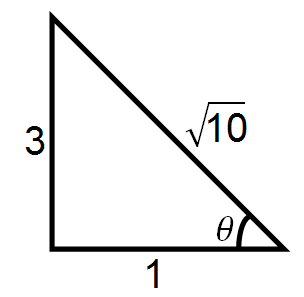
If $\tan\theta=3$ and $\theta$ lies in third quadrant, then the value of $\sin\theta$ is:

  1. $\frac{1}{\sqrt{10}}$

  2. $-\frac{1}{\sqrt{10}}$

  3. $\frac{-3}{\sqrt{10}}$

  4. $\frac{3}{\sqrt{10}}$

Answer
  1. $\frac{-3}{\sqrt{10}}$

Solution:

$\tan\theta=3,\theta$ lies in third quadrant, it is positive.

$\tan\theta=\frac{\text{P}}{\text{B}}=\frac{3}{1}$ 

Then, Hypotenuse $=\sqrt{(3)^2+(1)^2}=\sqrt{9+1}=\sqrt10$


$\therefore\sin\theta=\frac{3}{\sqrt{10}}$ where $\theta$ lies in third quadrant

Hence the correct option is (c).

View full question & answer
Question 141 Mark

If $\tan\theta=\frac{\text{a}}{\text{b}},$ then $\text{b}\cos2\theta+\text{a}\sin2\theta$ is equal to:

  1. a
  2. b
  3. $\frac{\text{a}}{\text{b}}$
  4. None
Answer
  1. b

Solution:

Given that, $\tan\theta=\frac{\text{a}}{\text{b}}$ 

$\text{b}\cos2\theta+\text{a}\sin2\theta=\text{b}\Big[\frac{1-\tan^2\theta}{1+\tan^2\theta}\Big]+\text{a}\Big[\frac{2\tan\theta}{1+\tan^2\theta}\Big]$

$=\text{b}\Bigg[\frac{1-\frac{\text{a}^2}{\text{b}^2}}{1+\frac{\text{a}^2}{\text{b}^2}}\Bigg]+\text{a}\Bigg[\frac{\frac{2\text{a}}{\text{b}}}{1+\frac{\text{a}^2}{\text{b}^2}}\Bigg]$

$=\text{b}\Big[\frac{\text{b}^2-\text{a}^2}{\text{b}^2+\text{a}^2}\Big]+\Bigg[\frac{\frac{2\text{a}^2}{\text{b}}}{\frac{\text{b}^2+\text{a}^2}{\text{b}^2}}\Bigg]$

$=\frac{\text{b}^3+\text{a}^2\text{b}}{\text{b}^2+\text{a}^2}+\frac{2\text{a}^2\text{b}}{\text{b}^2+\text{a}^2}=\frac{\text{b}^3-\text{a}^2\text{b}+2\text{a}^2\text{b}}{\text{b}^2+\text{a}^2}$

$=\frac{\text{b}^3+\text{a}^2\text{b}}{\text{b}^2+\text{a}^2}=\frac{\text{b}(\text{b}^2+\text{a}^2)}{\text{b}^2+\text{a}^2}=\text{b}$

Hence, the correct option is (b).

View full question & answer
Question 151 Mark

The value of $\tan75^\circ-\cot75^\circ$ is equal to: 

  1. $2\sqrt{3}$

  2. $2+\sqrt{3}$

  3. $2-\sqrt{3}$

  4. $1$

Answer
  1. $2\sqrt{3}$

Solution:

$\tan75^\circ-\cot75^\circ=\frac{\sin75^\circ}{\cos75^\circ}-\frac{\cos75^\circ}{\sin75^\circ}\\=\frac{2(\sin^275^\circ-\cos^275^\circ)}{2\sin75^\circ\cos75^\circ}=\frac{-2\cos150^\circ}{\sin150^\circ}$ 

$=-2\cot150^\circ=-2\cot(180^\circ-30^\circ)=2\cot30^\circ=2\sqrt3$

View full question & answer
Question 161 Mark

The value of $\cos12^\circ+\cos84^\circ+\cos156^\circ+\cos132^\circ$ is:

  1. $\frac{1}{2}$

  2. $1$

  3. $-\frac{1}{2}$

  4. $\frac{1}{8}$

Answer
  1. $-\frac{1}{2}$

Solution:

$\cos12^\circ+\cos84^\circ+\cos156^\circ+\cos132^\circ$

$=(\cos12^\circ+\cos132^\circ)+(\cos84^\circ+\cos156^\circ)$

$=2\cos72^\circ\cos60^\circ+2\cos120^\circ\cos36^\circ$

$=\cos72^\circ-\cos36^\circ=\sin18^\circ-\cos36^\circ$

$=\Big(\frac{\sqrt5-1}{4}\Big)-\Big(\frac{\sqrt5+1}{4}\Big)=\frac{-1}{2}$

View full question & answer
Question 171 Mark

The minimum value of $3\cos\text{x}+4\sin\text{x}+8$ is:

  1. 5
  2. 9
  3. 7
  4. 3
Answer
  1. 3

Solution:

The given expression is $3\cos\text{x}+4\sin\text{x}+8$

Let $\text{y}=3\cos\text{x}+4\sin\text{x}+8$

$\Rightarrow\text{y}-8=3\cos\text{x}+4\sin\text{x}$

Minimum value of $\text{y}-8=-\sqrt{(3)^2+(4)^2}$

$\Rightarrow\text{y}-8=-\sqrt{9+16}=-5$

$\Rightarrow\text{y}=8-5=3$

so, the minimum value of the given expression is 3.

Hence, the correct option is (d).

View full question & answer
Question 181 Mark

If $\sin\theta+\cos\theta=1,$ then the value of $\sin2\theta$ is equal to:

  1. 1
  2. $\frac{1}{2}$
  3. 0
  4. -1
Answer
  1. 0

Solution:

Given that, $\sin\theta+\cos\theta=1$

Squaring both sides, we get,

$\Rightarrow(\sin\theta+\cos\theta)^2=(1)^2$ 

$\Rightarrow\sin^2\theta+\cos^2\theta+2\sin\theta\cos\theta=1$

$\Rightarrow1+\sin2\theta=1$

$\Rightarrow\sin2\theta=1-1=0$

Hence, the correct option is (c).

View full question & answer
Question 191 Mark

The value of $\sin(45^\circ+\theta)-\cos(45^\circ-\theta)$ is:

  1. $2\cos\theta$

  2. $2\sin\theta$

  3. 1

  4. 0

Answer
  1. 0

Solution:

Given expression is $(\sin45^\circ+\theta)-\cos(45^\circ-\theta)$

$\sin(45^\circ+\theta)=\sin45^\circ\cos\theta+\cos45^\circ\sin\theta$

$=\frac{1}{\sqrt2}\cos\theta+\frac{1}{\sqrt2}\sin\theta$

$\cos(45^\circ-\theta)=\cos45^\circ\cos\theta+\sin45^\circ\sin\theta$

$$$=\frac{1}{\sqrt2}\cos\theta+\frac{1}{\sqrt2}\sin\theta$

$\sin(45^\circ+\theta)-\cos(45^\circ-\theta)$

$=\frac{1}{\sqrt2}\cos\theta+\frac{1}{\sqrt2}\sin\theta-\frac{1}{\sqrt2}\cos\theta-\frac{1}{\sqrt2}\sin\theta$

= 0. Hence, the correct option is (d). 

View full question & answer
Question 201 Mark

The value of $\tan3\text{A}-\tan2\text{A}-\tan\text{A}$ is equal to:

  1. $\tan3\text{A}\tan2\text{A}\tan\text{A}$

  2. $-\tan3\text{A}\tan2\text{A}\tan\text{A}$

  3. $\tan\text{A}\tan2\text{A}-\tan2\text{A}\tan3\text{A}\tan\text{A}$

  4. $\text{None of these}$

Answer
  1. $\tan3\text{A}\tan2\text{A}\tan\text{A}$

Solution:

$3\text{A}=\text{A}+2\text{A}$

$\Rightarrow\tan3\text{A}=\tan(\text{A+2A})$

$\Rightarrow\tan3\text{A}=\tan\text{A}+\tan\frac{2\text{A}}{1}-\tan\text{A}.\tan2\text{A}$

$\Rightarrow\tan\text{A}+\tan2\text{A}=\tan3\text{A}-\tan3\text{A}.\tan2\text{A}.\tan\text{A}$

$\Rightarrow\tan3\text{A}-\tan2\text{A}-\tan\text{A}=\tan3\text{A}.\tan2\text{A}.\tan\text{A}$

View full question & answer
Question 211 Mark

If $\sin\theta+\text{cosec}\theta=2,$ then $\sin^2\theta+\text{cosec}^2\theta$ is equal to:

  1. 1
  2. 4
  3. 2
  4. None of these
Answer
  1. 2

Solution:

$\sin\theta+\text{cosec}\theta=2$

$\Rightarrow\sin\theta+\frac{1}{\sin\theta}=2$

$\Rightarrow\sin^2\theta+1=2\sin\theta\Rightarrow(\sin\theta-1)^2=0\Rightarrow\sin\theta=1$

$\therefore\sin^2\theta+\text{cosec}^2\theta=1+1=2$

View full question & answer
Question 221 Mark

If for real values of x, $\cos\theta=\text{x}+\frac{1}{\text{x}},$ then:

  1. $\theta$ is an acute angle
  2. $\theta$ is right angle
  3. $\theta$ is an obtuse angle
  4. No value of $\theta$ is possible
Answer
  1. No value of $\theta$ is possible

Solution:

given that, $\cos\theta=\text{x}+\frac{1}{\text{x}}\Rightarrow\cos\theta=\frac{\text{x}^2+1}{\text{x}}$

$\Rightarrow\text{x}^2+1=\text{x}\cos\theta\Rightarrow\text{x}^2-\text{x}\cos\theta+1=0$

$$For real value of $\text{x},\text{b}^2-4\text{a}\text{c}\geq0$

$\Rightarrow(-\cos\theta)^2-4\times1\times1\geq0$

$\Rightarrow\cos^2\theta-4\geq0\Rightarrow\cos^2\theta\geq4$

$\Rightarrow\cos\theta\geq\pm2[-1\leq\cos\theta\leq1]$

so, the value of $\theta$ is not possible.

Hence, the correct options (d).

View full question & answer
Question 231 Mark

If $\tan\alpha=\frac{1}{7},\tan\beta=\frac{1}{3},$ then $\cos2\alpha$ is equal to:

  1. $\sin2\beta$

  2. $\sin4\beta$

  3. $\sin3\beta$

  4. $\cos2\beta$

Answer
  1. $\sin4\beta$

Solution:

Given that, $\tan\alpha=\frac{1}{7}$ and $\tan\beta=\frac{1}{3}$

$\cos2\alpha=\frac{1-\tan^2\alpha}{1+\tan^2\alpha}=\frac{1-\Big(\frac{1}{7}\Big)^2}{1+\Big(\frac{1}{7}\Big)^2}=\frac{1-\frac{1}{49}}{1+\frac{1}{49}}$

$=\frac{48}{50}=\frac{24}{25}$

Now $\tan2\beta=\frac{2\tan\beta}{1-\tan^2\beta}=\frac{2\times\frac{1}{3}}{1-\frac{1}{9}}=\frac{\frac{2}{3}}{\frac{8}{9}}=\frac{2}{3}\times\frac{9}{8}=\frac{3}{4}$

$\therefore\tan^2\beta=\frac{3}{4}$

$\sin4\beta=\frac{2\tan2\beta}{1+\tan^22\beta}$$$

$=\frac{2\times\frac{3}{4}}{1+\Big(\frac{3}{4}\Big)^2}=\frac{\frac{3}{2}}{1+\frac{9}{16}}=\frac{3}{2}\times\frac{16}{25}=\frac{24}{25}$

$\cos2\alpha=\sin4\beta=\frac{24}{25}$

Hence, the correct option is (b).

View full question & answer
Question 241 Mark

The value of $\tan1^\circ\tan2^\circ\tan3^\circ...\tan89^\circ$ is:

  1. 0
  2. 1
  3. $\frac{1}{2}$
  4. Not defined
Answer
  1. 1

Solution:

$\tan1^\circ\tan2^\circ\tan^\circ\dots\tan89^\circ$

$=[\tan1^\circ\tan2^\circ\dots\tan44^\circ]\\\tan45^\circ[\tan(90^\circ-44^\circ)\tan(90^\circ-43^\circ)\dots\tan(90^\circ-1^\circ)]$

$=[\tan1^\circ\tan2^\circ\dots\tan44^\circ][\cot44^\circ\cot43^\circ\dots\cot1^\circ]$

$=1-1\dots1-1=1$

View full question & answer
Question 251 Mark

The value of $\cot\Big(\frac{\pi}{4}+\theta\Big)\cot\Big(\frac{\pi}{4}-\theta\Big)$ is:

  1. -1

  2. 0

  3. 1

  4. Not defined

Answer
  1. 1

Solution:

$\cot\Big(\frac{\pi}{4}+\theta\Big)\cdot\cot\Big(\frac{\pi}{4}-\theta\Big)=\frac{\cot\frac{\pi}{4}\cot\theta-1}{\cot\theta+\cot\frac{\pi}{4}}\times\frac{\cot\frac{\pi}{4}\cot\theta+1}{\cot\theta-\cot\frac{\pi}{4}}$

$=\frac{1.\cot\theta-1}{\cot\theta+1}\times\frac{1.\cot\theta+1}{\cot-1}$

$=\frac{\cot\theta-1}{\cot\theta+1}\times\frac{\cot\theta+1}{\cot\theta-1}=1$

Hence, the correct option is (c).

View full question & answer
Question 261 Mark

If $\sin\theta=\frac{-4}{5}$ and $\theta$ lies in third quadrant then the value of $\cos\frac{\theta}{2}$ is:

  1. $\frac{1}{5}$

  2. $-\frac{1}{\sqrt{10}}$

  3. $-\frac{1}{\sqrt{5}}$

  4. $\frac{1}{\sqrt{10}}$

Answer
  1. $-\frac{1}{\sqrt{5}}$

Solution:

Given that, $\sin\theta=-\frac{4}{5},\theta$ lies in third quadrant

$\cos\theta=\sqrt{1-\sin^2\theta}=\sqrt{1-\Big(\frac{-4}{5}\Big)^2}$

$=\sqrt{1-\frac{16}{25}}=\sqrt{\frac{9}{25}}=\pm\frac{3}{5}$

$\therefore\cos\theta=-\frac{3}{5},\theta$ lies in third quadrant

$\cos\theta=2\cos^2\frac{\theta}{2}-1\Big[\because\pi<\theta\frac{3\pi}{2},\therefore\frac{\pi}{2}<\frac{\theta}{2}<\frac{3\pi}{4}\Big]$

$\Rightarrow\frac{-3}{5}=2\cos^2\frac{\theta}{2}-1$

$\Rightarrow2\cos^2\frac{\theta}{2}=1-\frac{3}{5}=\frac{2}{5}\Rightarrow\cos^2\frac{\theta}{2}=\frac{2}{5\times2}=\frac{1}{5}$

$\Rightarrow\cos\frac{\theta}{2}=\pm\frac{1}{\sqrt5}$

$\Rightarrow\cos\frac{\theta}{2}=-\frac{1}{\sqrt5}\Big[\because\frac{\pi}{2}<\frac{\theta}{2}<\frac{3\pi}{4}\Big]$

Hence, the correct option is (c).

View full question & answer
Question 271 Mark

If $\tan\text{A}=\frac{1}{2},\tan\text{B}=\frac{1}{3},$ then $\tan(2\text{A + B})$ is equal to:

  1. 1
  2. 2
  3. 3
  4. 4
Answer
  1. 3

Solution:

Given that, $\tan\text{A}=\frac{1}{2}$ and $\tan\text{B}=\frac{1}{3}$

$\tan2\text{A}=\frac{2\tan\text{A}}{1-\tan^2\text{A}}=\frac{2\times\frac{1}{2}}{1-\Big(\frac{1}{2}\Big)^2}$

$=\frac{1}{1-\frac{1}{4}}=\frac{1}{\frac{3}{4}}=\frac{4}{3}$

so, $\tan2\text{A}=\frac{4}{3}$ and $\tan\text{B}=\frac{1}{3}$

$\tan(\text{2A+B})=\frac{\tan2\text{A}+\tan\text{B}}{1-\tan\text{A}.\tan\text{B}}=\frac{\frac{4}{3}+\frac{1}{3}}{1-\frac{4}{3}\times\frac{1}{3}}$

$=\frac{\frac{5}{3}}{\frac{9-4}{9}}=\frac{5}{3}\times\frac{9}{5}=3$

Hence, the correct option is (c).

View full question & answer
Question 281 Mark

If $\text{f(x)}=\cos^2\text{x}+\sec^2\text{x},$ then:

  1. $\text{f(x)}<1$

  2. $\text{f(x)}=1$

  3. $2<\text{f(x)}<1$

  4. $\text{f(x)}\geq2$

[Hint: $\text{A.M}\geq\text{G.M.}$]

Answer
  1. $\text{f(x)}\geq2$

Solution:

Given that; $\text{f(x)}=\cos^2\text{x}+\sec^2\text{x}$

We know that $\text{AM}\geq\text{GM}$

$\Rightarrow\frac{\cos^2\text{x}+\sec^2\text{x}}{2}\geq\sqrt{\cos^2\text{x}.\sec^2\text{x}}$

$\Rightarrow\frac{\cos^2\text{x}+\sec^2\text{x}}{2}\geq1$ $\big[\text{since}\sec\theta=\frac{1}{\cos\theta}\big]$

$\Rightarrow\cos^2\text{x}+\sec^2\text{x}\geq2$

$\Rightarrow\text{f(x)}\geq2$

Hence, the correct option is (d)

View full question & answer
Question 291 Mark

Which of the following is not correct?

  1. $\sin\theta=-\frac{1}{5}$

  2. $\cos\theta=1$

  3. $\sec\theta=\frac{1}{2}$

  4. $\tan\theta=20$

Answer
  1. $\sec\theta=\frac{1}{2}$

Solution:

$\sin\theta=-\frac{1}{5}$ is correct. $\because-1\leq\sin\theta\leq1$ 

so (a) is correct.

$\cos\theta=1$ is correct. $\because\cos0^\circ=1$

so (b) is correct.

$\sec\theta=-\frac{1}{2}\Rightarrow\cos\theta=2$ is not correct. $\because-1\leq\cos\theta\leq1$

Hence, (c) is not correct.

View full question & answer
Question 301 Mark

If A lies in the second quadrant and $3\tan\text{A}+4=0,$ then the value of $2\cot\text{A}-5\cos\text{A}+\sin\text{A}$ is equal to:

  1. $\frac{-53}{10}$

  2. $\frac{23}{10}$

  3. $\frac{37}{10}$

  4. $\frac{7}{10}$

Answer
  1. $\frac{23}{10}$

Solution:

Given that, $3\tan\text{A}+4=0,$ A lies in second quadrant 

$\therefore\tan\text{A}=\frac{-4}{3}$ 

$\cos\text{A}=\frac{-3}{5}$ [A lies in second quadrant]

and $\sin\text{A}=\frac{4}{5}$ and $\cot\text{A}=\frac{-3}{4}$

$\therefore2\cot\text{A}-5\cos\text{A}+\sin\text{A}=2\Big(\frac{-3}{4}\Big)-5\Big(\frac{-3}{5}\Big)+\frac{4}{5}\\=\frac{-3}{2}+3+\frac{4}{5}=\frac{-15+30+8}{10}=\frac{23}{10}$ 

Hence, the correct option is (b).

View full question & answer