6.4 grams of copper have 0.1 mole
1 mole = No atoms
0.1 mole = (no × 0.1) atoms
= 6 × 1023 × 0.1 atoms = 6 × 10²² atoms
1 atom contributes 1 electron
6 × 10²² atoms contributes 6 × 10²² electrons.
27 questions · timed · auto-graded
$\text{k}=\frac{1}{\text{dim entional formulae of r}}=\big[\text{L}^{-1}\big]$ Unit of k = m-1

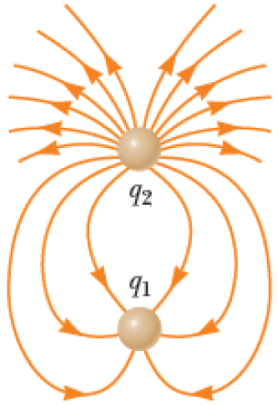
$\frac{\text{q}_1}{\text{q}_2}=\frac{6}{18}$
$\Rightarrow\frac{\text{q}_1}{\text{q}_2}=\frac{1}{3}$
6 lines are entering q1 and 18 are coming our of q2.
$\text{m}=10,\ \text{mg}=10\times10^{-3}\text{g}\times10^{-3}\text{kg},$
$\text{q}=1.5\times10^{-6}\text{C}$
But $\text{qE}=\text{mg}$
$\Rightarrow(1.5\times10^{-6})\text{E}=10\times10^{-6}\times10$
$\Rightarrow\text{E}=\frac{10\times10^{-4}\times10}{1.5\times10^{-6}}$
$=\frac{100}{1.5}=66.6\text{N/C}$
$=\frac{100\times10^3}{1.5}=\frac{10^{5+1}}{15}$
$=6.6\times10^{3}$

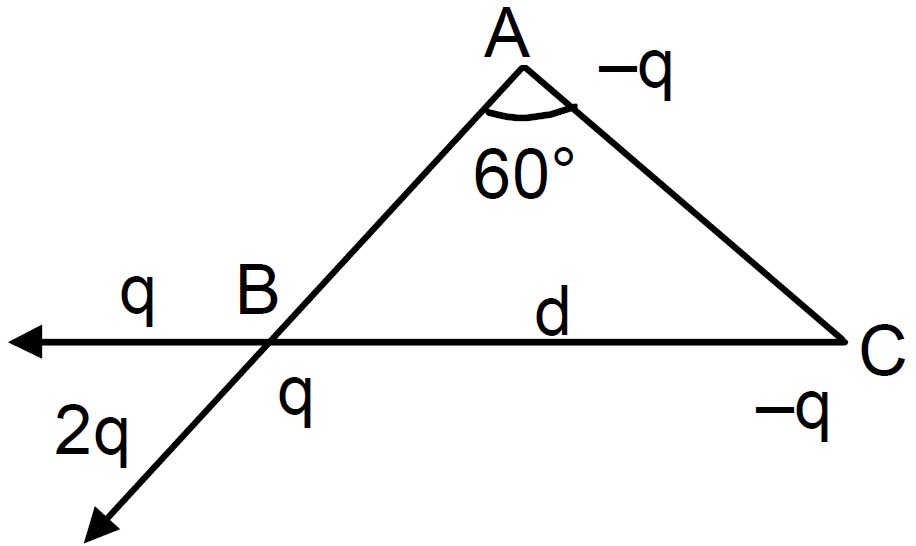
Let -q & -q are placed at A & C
Where 2q on B
So length of A = d
So the dipole moment = (q × d) = P
So, Resultant dipole moment
$\text{P}=\Big[(\text{qd})^2+(\text{qd})^2+2\text{qd}\times\text{qd}\cos60^\circ\Big]^{\frac{1}{2}}$
$=\big[3\text{q}^2\text{d}^2\big]^{\frac{1}{2}}$
$=\sqrt{3}\text{qd}$
$=\sqrt{3}\text{p}$
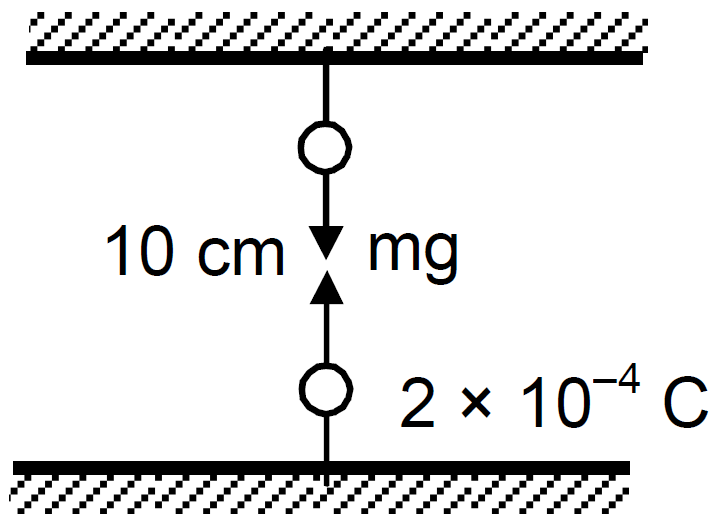
Mass of the bob = 100g = 0.1kg
So Tension in the string = 0.1 × 9.8 = 0.98N.
For the Tension to be 0, the charge below should repel the first bob.
$\Rightarrow\text{F}=\frac{\text{kq}_1\text{q}_2}{\text{r}^2}$ $\big[\text{T}-\text{mg}+\text{F}=0\ \Rightarrow\text{T}=\text{mg}-\text{f},\ \text{T}=\text{mg}\big]$
$\Rightarrow0.98=\frac{9\times10^9\times2\times10^{-4}\times\text{q}^2}{(0.01)^2}$
$\Rightarrow\text{q}_2=\frac{0.98\times1\times10^{-2}}{9\times2\times10^5}$
$=0.054\times10^{-9}\text{N}$
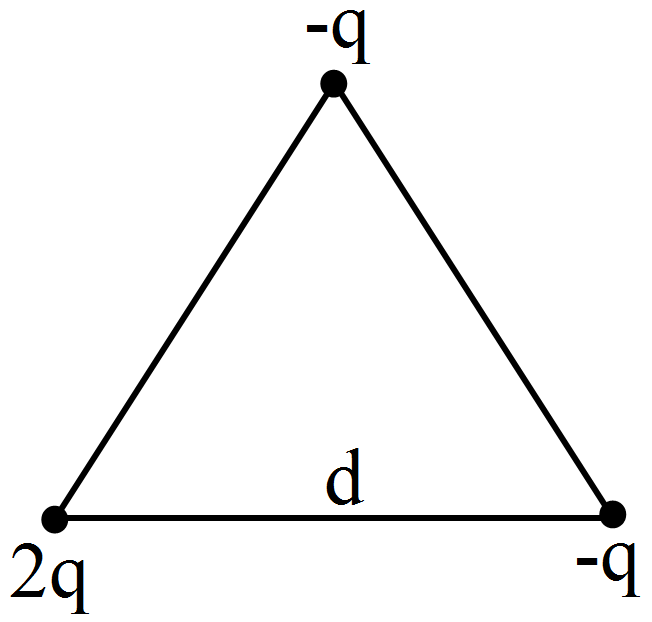
Three charges are held at three corners of a equilateral trangle.
Let the charges be A, B and C.
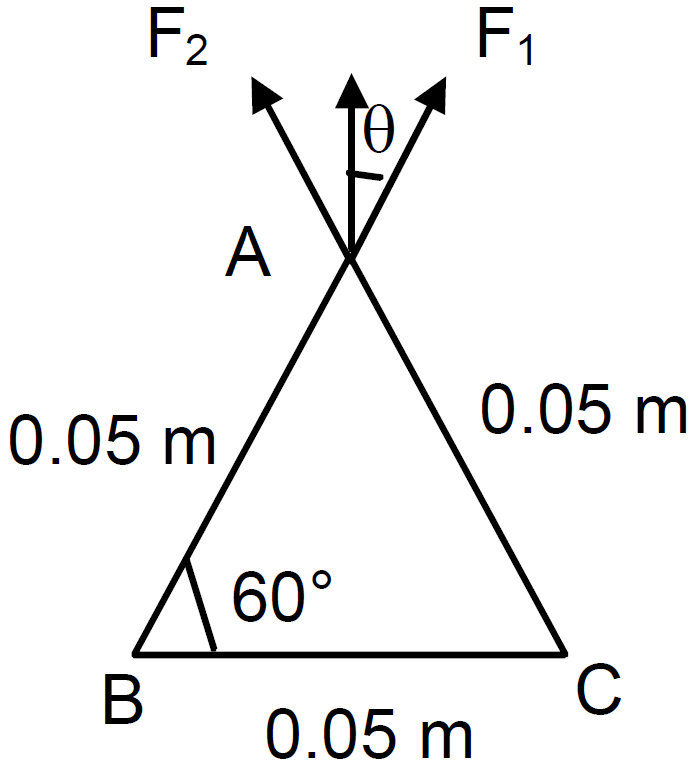
It is of length 5cm or 0.05m
Force exerted by B on A = F1
Force exerted by C on A = F2
So, force exerted on A = resultant F1 = F2
$\Rightarrow\text{F}=\frac{\text{kq}_2}{\text{r}^2}$
$=\frac{9\times10^9\times2\times2\times2\times10^{-12}}{5\times5\times10^{-4}}$
$=\frac{36}{25}\times10$
$=14.4$
Now, force on A = 2 × F cos 30° since it is equilateral $\triangle.$
⇒ Force on $\text{A}=2\times1.44\times\sqrt{\frac{3}{2}}$
$=24.94\text{N}.$
$\text{r}=1\text{cm}=10^{-2}$ (As they rubbed with each other. So the charge on each sphere are equal)
So, $\text{F}=\frac{\text{kq}_1\text{q}_2}{\text{r}^2}$
$\Rightarrow0.1=\frac{\text{kq}^2}{(10^{-2})^2}$
$\Rightarrow\text{q}^2=\frac{0.1\times10^{-4}}{9\times10^9}$
$\Rightarrow\text{q}^2=\frac{1}{9}\times10^{-14}$
$\Rightarrow\text{q}=\frac{1}{3}\times10^{-7}$
$1.6\times10^{-19}\text{c}$ Carries by 1 electron
1 c carried by $\frac{1}{1.6\times10^{-19}}$
$0.33\times10^{-7}$ c carries by
$\frac{1}{1.6\times10^{-19}} \times0.33\times10^{-7}$
$=0.208\times10^{12}$
$=2.08\times10^{11}$
Each are brought from infinity to 10cm a part d = 10 × 10-2m
So work done = negative of work done. (Potential E)
$\text{P.E}=\int\limits_\infty^{10}\text{F}\times\text{ds}$
$\text{P.E}=\text{K}\times\frac{\text{q}_1\text{q}_2}{\text{r}}$
$=\frac{9\times10^9\times4\times10^{10}}{10\times10^{-2}}$
$=36\text{J}$
$\text{r}=20\text{cm}=0.2\text{m}$
(E1 = electric field due to q1, E2 = electric field due to q2)
$\Rightarrow\frac{(\text{r}-\text{x})^2}{\text{x}^2}=\frac{-\text{q}_2}{\text{q}_1}\Rightarrow\frac{(\text{r}-1)^2}{\text{x}}=\frac{-\text{q}_2}{\text{q}_1}$
$=\frac{4\times10^{-6}}{2\times10^{-6}}=\frac{1}{2}$
$\Rightarrow\Big(\frac{\text{r}}{\text{x}}-1\Big)=\frac{1}{\sqrt{2}}$
$=\frac{1}{1.414}$
$\Rightarrow\frac{\text{r}}{\text{x}}=1.414+1$
$=2.414$
$\Rightarrow\text{x}=\frac{\text{r}}{2.414}$
$=\frac{20}{2.414}$
$=8.285\text{cm}$
$\text{q}_1=\text{q}_2=\text{q}=1.0\text{C}$
Distance between the charges, $\text{r}=2\text{km}=2\times10^3\text{m}$ By Coulomb's Law, electrostatic force,$\text{F}=\frac{1}{4\pi\in_0}\frac{\text{q}_1\text{q}_2}{\text{r}^2}$
$\text{F}=9\times10^9\times\frac{1\times1}{(2\times10^3)^2}$
$=2.25\times10^3\text{N}$
Let my mass, m, be 50kg. Weight of my body, W = mg$\Rightarrow\text{W}=50\times10\text{N}=500\text{N}$
Now,$\frac{\text{Weight of my body}}{\text{Force between the charges}}=\frac{500}{2.25\times10^3}$
$=\frac{1}{4.5}$
So, the force between the charges is 4.5 times the weight of my body.$\text{F}=\frac{1}{4\pi\in_0}\frac{\text{q}_1\text{q}_2}{\text{r}^2}$
$\Rightarrow490=9\times10^9\times\frac{\text{q}^2}{1^2}$
$\Rightarrow\text{q}^2=54.4\times10^{-9}$
$\Rightarrow\text{q}=\sqrt{54.4\times10^{-9}}$
$=23.323\times10^{-5}\text{C}$
$\text{q}=2.3\times10^{-4}\text{C}$
$\Rightarrow\text{v}^2=\frac{\text{Fe}\times\text{r}}{\text{m}_\text{e}}$
$=\frac{8.2\times10^{-8}\times0.53\times10^{-10}}{9.1\times10^{-31}}$
$=0.4775\times10^{13}$
$=4.775\times10^{12}\text{m}^2/\text{s}^2$
$\text{v}=2.18\times10^6\text{m/s}$
$\Rightarrow10\text{J}=(200-100)\text{v}\times\text{q}_0$
$\Rightarrow100\text{q}_0=10\text{v}$
$\Rightarrow\text{q}_0=\frac{10}{100}$
$=0.1\text{C}$
$\text{q}=2.0\times10^{-8}\text{c},\ \text{Find}\ell=?$

Force between them $\text{F}=\frac{\text{kq}_1\text{q}_2}{\text{r}^2}$
$=\frac{9\times10^92\times10^{-8}\times2\times10^{-8}}{10^{-2}}$
$=36\times10^{-5}\text{N}$
So, $\text{F}=-\text{kx}$ or $\text{x}=\frac{\text{F}}{-\text{K}}$
$=\frac{36\times10^{-5}}{100}$
$=36\times10^{-7}\text{cm}$
$=3.6\times10^{-6}\text{m}$
$\text{F}=\frac{\text{q}_1\text{q}_2}{4\pi\in_0\text{r}^2}$
Where, q1 and q2 are the charges on the charged particles . r = separation between the charged particles.$\in_0$ = parmittivity of free space.
According to the Law of Superposition, the electrostatic force between two charged particles are unaffected due to the presence of other charges.
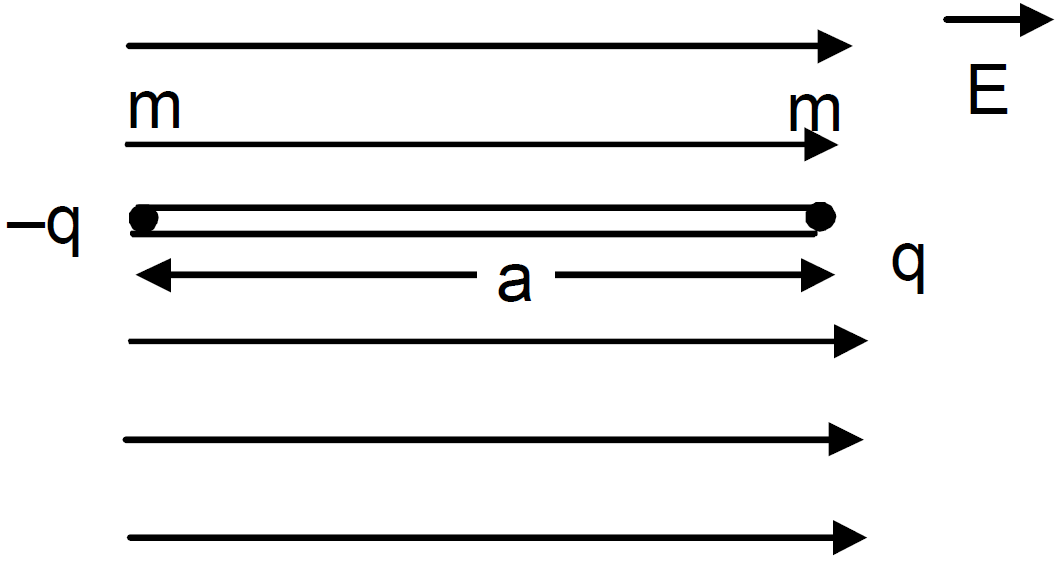
$\text{T}=2\pi\sqrt{\frac{\ell}{\text{g}}}$ $\big(\ell=$ length, q = acceleration$\big)$
Now, force experienced by the charges F = Eq Now, acceleration $=\frac{\text{F}}{\text{m}}$$=\frac{\text{Eq}}{\text{m}}$
Hence length = a so, Time period $=2\pi\sqrt{\frac{\text{a}}{\Big(\frac{\text{Eq}}{\text{m}}\Big)}}$$=2\pi\sqrt{\frac{\text{ma}}{\text{Eq}}}$
$=3.34\times10^{25}$
$\therefore$ Total charge $=3.34\times10^{25}\times1.6\times10^{-19}$
$=5.34\times10^6\text{C}$
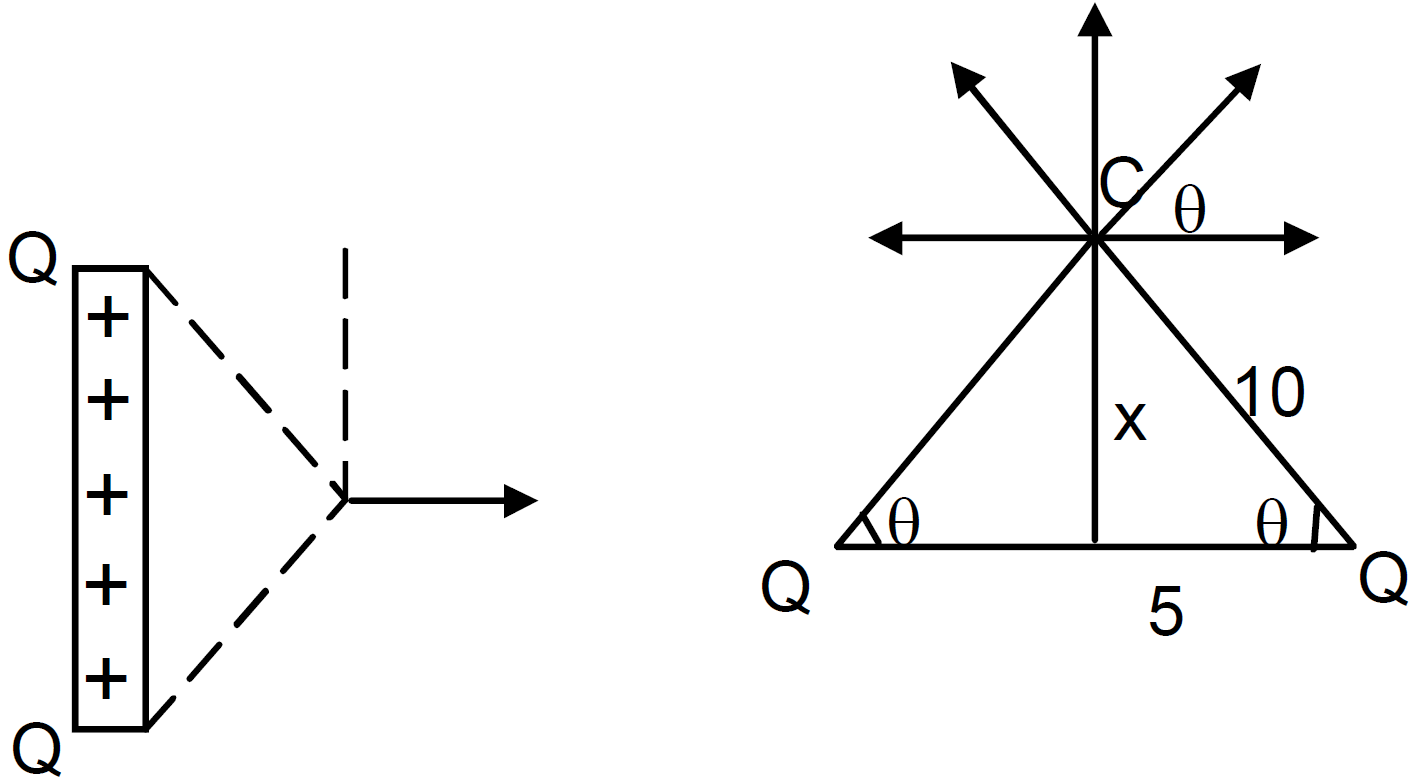
$\text{G}=50\mu\text{C}=50\times10^{-6}\text{C}$
We have, $\text{E}=\frac{2\text{KQ}}{\text{r}}$ for a charged cylinder
$\Rightarrow\text{E}=\frac{2\times9\times10^9\times50\times10^{-6}}{5\sqrt{3}}$
$=\frac{9\times10^{-5}}{5\sqrt{3}}$
$=1.03\times10^{-5}$
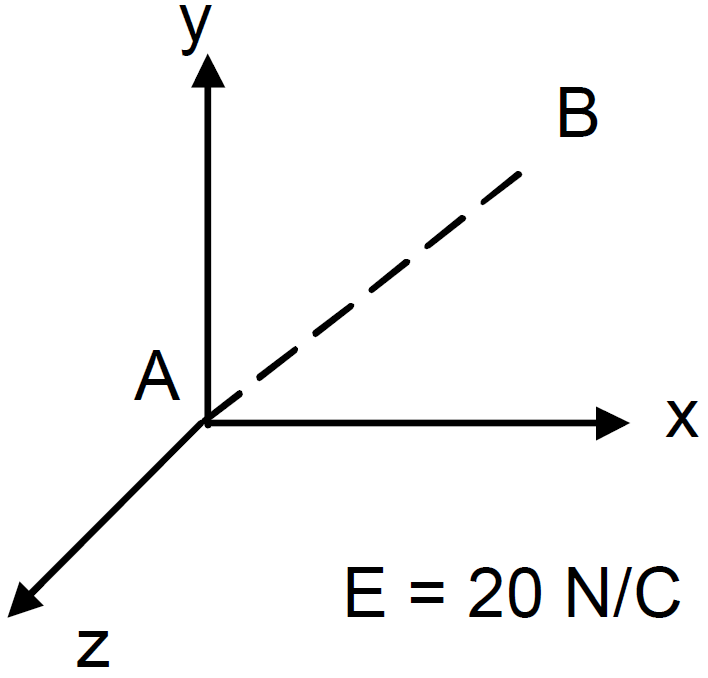
$\Rightarrow\text{V}_\text{B}-\text{V}_\text{A}=\text{E}\times\text{d}$
$=20\times\sqrt{16}$
$=80\text{V}$
$\Rightarrow\text{V}_\text{B}-\text{V}_\text{A}=\text{E}\times\text{d}$
$=20\times\sqrt{(6-4)^2}$
$=20\times2$
$=40\text{V}$
$\Rightarrow\text{V}_\text{B}-\text{V}_\text{A}=\text{E}\times\text{d}$
$=20\times\sqrt{(6-0)^2}$
$=20\times6$
$=120\text{V}.$
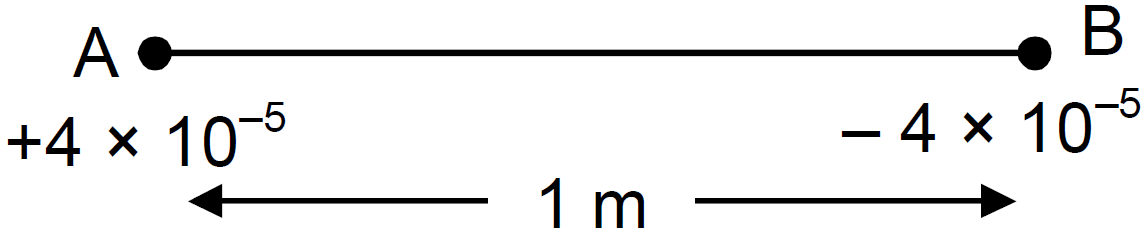
$\text{q}_1=\text{q}_2=4\times10^{-5}$
$\text{s}=1\text{m},\ \text{m}=5\text{g}$
$=0.005\text{kg}$
$\text{F}=\text{K}\frac{\text{q}^2}{\text{r}^2}$
$=\frac{9\times10^9\times\big(4\times10^{-5}\big)^2}{1^2}$
$=14.4\text{N}$
Acceleration ‘a’ $=\frac{\text{F}}{\text{m}}$
$=\frac{14.4}{0.005}$
$=2880\text{m/s}^2$
Now, $\text{u}=0,$
$\text{s}=50\text{cm}=0.5\text{m}$
$\text{a}=2880\text{m/s}^2,\ \text{V}=?$
$\Rightarrow\text{V}=\sqrt{2880}$
$=53.66\text{m/s}\approx54\text{m/s}$ for each particle.
$\text{m}=10\text{g}$
$\text{F}=\frac{\text{KQ}}{\text{r}}$
$=\frac{9\times10^9\times2\times10^{-4}}{10\times10^{-2}}$
$\text{F}=1.8\times10^{-7}$
$\text{F}=\text{m}\times\text{a}$
$\Rightarrow\text{a}=\frac{1.8\times10^{-7}}{10\times10^{-3}}$
$=1.8\times10^{-3}\text{m/s}^2$
$\text{V}^2-\text{u}^2=2\text{as}$
$\Rightarrow\text{V}^2=\text{u}^2+2\text{as}$
$\text{V}=\sqrt{0+2\times1.8\times10^{-3}\times10\times10^{-2}}$
$=\sqrt{3.6\times10^{-4}}$
$=0.6\times10^{-2}$
$=6\times10^{-3}\text{,m/s}.$