Question
Assume that each atom in a copper wire contributes one free electron. Estimate the number of free electrons in a copper wire having a mass of 6.4g (take the atomic weight of copper to be 64g mol-1.

Answer

64 grams of copper have 1 mole
6.4 grams of copper have 0.1 mole
1 mole = No atoms
0.1 mole = (no × 0.1) atoms
= 6 × 1023 × 0.1 atoms = 6 × 10²² atoms
1 atom contributes 1 electron
6 × 10²² atoms contributes 6 × 10²² electrons.

Need a full question paper?

Generate a complete, print-ready paper with questions like this in minutes — across 16+ boards, with answer keys.
Start Generating Free

Similar questions

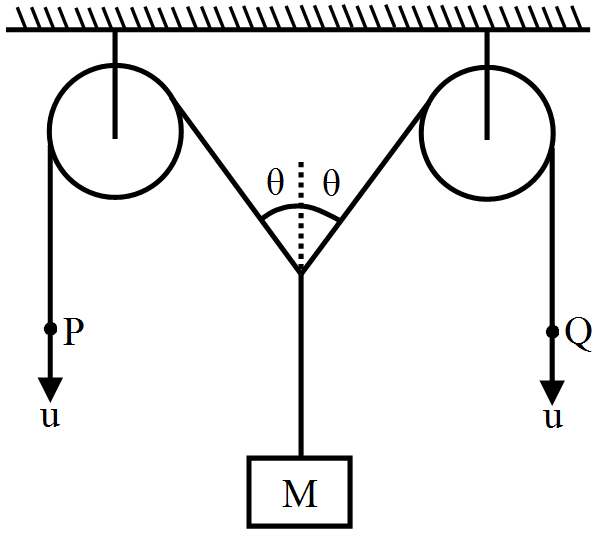
In the given arrangement, if the points P and Q move down with a velocity u, find the velocity of M?

An ice cube of mass 0.1 kg at $0^{\circ} C$ is placed in an isolated container which is at $227^{\circ} C$. The specific heat S of the container varies with temperature T according to the empirical relation $S = A + BT$, where $A =100 cal / kg - K$ and $B=2 \times 10^{-2} cal / kg - K ^2$. If the final temperature of the container is $27^{\circ} C$, determine the mass of the container. (Latent heat of fusion of water $=8 \times 10^4$ call kg. Specific heat of water $=10^3 cal / kg - K$ ).
Two equal and opposite forces act on a rigid body. Under what conditions will the body (i) rotate (ii) not rotate?
Is $\text{p}=\frac{\text{E}}{\text{c}}$ valid for electrons?
A uniform tube closed at one end, contains a pellet of mercury 10cm long. When the tube is kept vertically with the closed-end upward, the length of the air column trapped is 20cm. Find the length of the air column trapped when the tube is inverted so that the closedend goes down. Atmospheric pressure = 75cm of mercury.
Consider a variation of the previous problem (figure). Suppose the circular loop lies in a vertical plane. The rod has a mass m. The rod and the loop have negligible resistances but the wire connecting O and C has a resistance R. The rod is made to rotate with a uniform angular velocity $\omega$ in the clockwise direction by applying a force at the midpoint of OA in a direction perpendicular to it. Find the magnitude of this force when the rod makes an angle $\theta$ with the vertical.
Two vessels have the same base area but different shapes. The first vessel takes twice the volume of water that the second vessel requires to fill upto a particular common height. Is the force exerted by the water on the base of the vessel the same in the two cases ? If so, why do the vessels filled with water to that same height give different readings on a weighing scale?
What should be the average velocity of water in a tube of diameter 2.0cm so that the flow is laminar? The viscosity of water is 0.001N m-2s.
Two identical point masses, each of mass $M$ are connected to one another by a massless string of length $L$. $A$ constant force $F$ is applied at the mid-point of the string. If l be the instantaneous distance between the two masses, what will be the acceleration of each mass?
Find the value of 60W on a system having 100g, 20cm and 1 minute as the fundamental units.