Question types

Kinetic Theory question types

33 questions across 4 question groups — pick any mix to generate a Physics paper with step-by-step answer keys.

33
Questions
4
Question groups
5
Question types
Sample Questions

Kinetic Theory questions

One sample from each question group in this chapter. Select any group above to see the full set with answer keys.

In a diatomic molecule, the rotational energy at a given temperature.
  1. Obeys Maxwell’s distribution.
  2. Have the same value for all molecules.
  3. Equals the translational kinetic energy for each molecule.
  4. Is (2/3)rd the translational kinetic energy for each molecule.
View full solution
When an ideal gas is compressed adiabatically, its temperature rises the molecules on the average have more kinetic energy than before. The kinetic energy increases,
  1. Because of collisions with moving parts of the wall only.
  2. Because of collisions with the entire wall.
  3. Because the molecules gets accelerated in their motion inside the volume.
  4. Because of redistribution of energy amongst the molecules.
View full solution
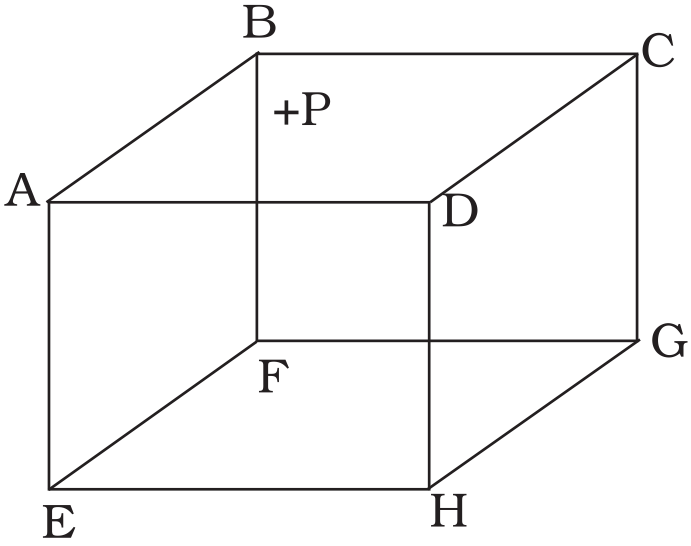
ABCDEFGH is a hollow cube made of an insulator (figure) face A BCD has positive charge on it. Inside the cube, we have ionised hydrogen. The usual kinetic theory expression for pressure.
  1. Will be valid.
  2. Will not be valid, since the ions would experience forces other than due to collisions with the walls.
  3. Will not be valid, since collisions with walls would not be elastic.
  4. Will not be valid because isotropy is lost.

View full solution
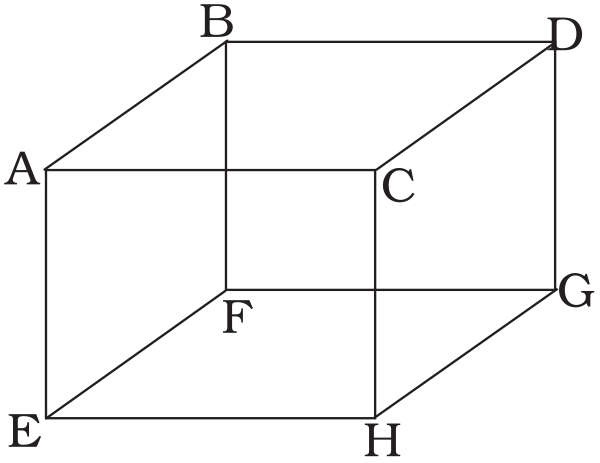
1 mole of an ideal gas is contained in a cubical volume V, ABCDEFGH at 300K (figure). One face of the cube (EFGH) is made up of a material which totally absorbs any gas molecule incident on it. At any given time,
  1. The pressure on EFGH would be zero.
  2. The pressure on all the faces will be equal.
  3. The pressure of EFGH would be double the pressure on ABCD.
  4. The pressure on EFGH would be half that on ABCD.

View full solution
Calculate the ratio of the mean free paths of the molecules of two gases having molecular diameters 1 A and 2 A. The gases may be considered under identical conditions of temperature, pressure and volume.
View full solution
A box of 1.00m3 is filled with nitrogen at 1.5 atm at 300K. The box has a hole of an area 0.010 mm2. How much time is required for the pressure to reduce by 0.10atm, if the pressure outside is 1atm.
View full solution
Consider an ideal gas with following distribution of speeds.
Speed m/s
200
400
600
800
1000
% of molecules
10
20
40
20
10
If all the molecules with speed 1000m/s escape from the system, calculate new Vrms and hence T.
View full solution
Consider a rectangular block of wood moving with a velocity v0 in a gas at temperature T and mass density ρ. Assume the velocity is along x-axis and the area of cross-section of the block perpendicular to v0 is A. Show that the drag force on the block is $4\rho\text{ Av}_0\sqrt{\frac{\text{KT}}{\text{m}}}$ where m is the mass of the gas molecule.
View full solution
A gas mixture consists of molecules of A, B and C with masses mA > mB > mc. Rank the three types of molecules in decreasing order of (a) average KE, (b) rms speeds.
View full solution
Consider an ideal gas with following distribution of speeds.
Speed m/s
200
400
600
800
1000
% of molecules
10
20
40
20
10
Calculate Vrms and hence T. (m = 3.0 × 10⁻²⁶kg)
View full solution

Generate a Kinetic Theory paper free

Pick question groups from the list above, set marks and difficulty, and export a branded PDF with step-by-step answer keys. First 3 chapters free — no signup.

Download App