Questions

M.C.Q (1 Marks)

Take a timed test

13 questions · self-marked practice — reveal the answer and mark yourself.

Question 11 Mark
In a diatomic molecule, the rotational energy at a given temperature.
  1. Obeys Maxwell’s distribution.
  2. Have the same value for all molecules.
  3. Equals the translational kinetic energy for each molecule.
  4. Is (2/3)rd the translational kinetic energy for each molecule.
Answer
  1. Obeys Maxwell’s distribution.
  1. Is (2/3)rd the translational kinetic energy for each molecule.

Explanation:

Consider a diatomic molecule along z-axis so its rotational energy about z-axis is zero. So energy of diatomic molecule,

$\text{E}=\frac{1}{2}\text{mv}_\text{x}^2+\frac{1}{2}\text{mv}_\text{y}^2+\frac{1}{2}\text{mv}_\text{z}^2+\frac{1}{2}\text{I}_\text{x}\omega_\text{x}^2+\frac{1}{2}\text{I}_\text{y}\omega_\text{y}^2$ (as moment of inertia along z axis is zero)
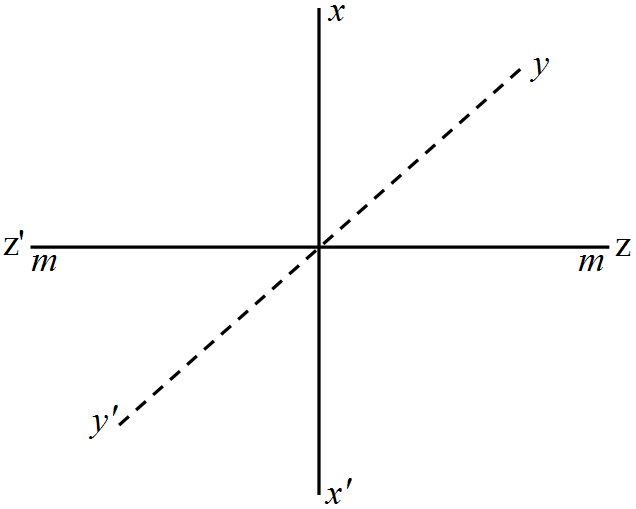
The independent terms in the above expression is 5.

As we can predict velocities of molecules by Maxwell’s distribution.

Hence the above expression also obeys Maxwell’s distribution.

As 2 rotational and 3 translational energies are associated with each molecule.

So the rotational energy at given temperature is 2/3 of its translational Kinetic energy of each molecule.
View full question & answer
Question 21 Mark
When an ideal gas is compressed adiabatically, its temperature rises the molecules on the average have more kinetic energy than before. The kinetic energy increases,
  1. Because of collisions with moving parts of the wall only.
  2. Because of collisions with the entire wall.
  3. Because the molecules gets accelerated in their motion inside the volume.
  4. Because of redistribution of energy amongst the molecules.
Answer
  1. Because of collisions with moving parts of the wall only.

Explanation:

As the ideal gas compress, then the mean free path becomes smaller so the number of collisions per second between the molecules and walls increases which increase the temperature of gas in turn Kinetic energy of gas molecule increases. Kinetic energy depends on temperature.

View full question & answer
Question 31 Mark
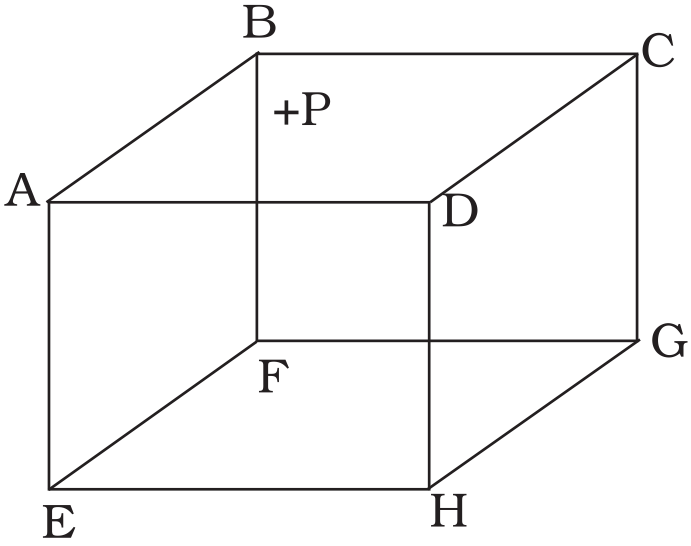
ABCDEFGH is a hollow cube made of an insulator (figure) face A BCD has positive charge on it. Inside the cube, we have ionised hydrogen. The usual kinetic theory expression for pressure.
  1. Will be valid.
  2. Will not be valid, since the ions would experience forces other than due to collisions with the walls.
  3. Will not be valid, since collisions with walls would not be elastic.
  4. Will not be valid because isotropy is lost.

Answer
  1. Will not be valid, since the ions would experience forces other than due to collisions with the walls.
  1. Will not be valid because isotropy is lost.

Explanation:

Due to the presence of hydrogen ions and +ve charged wall ABCD there will be electrostatic force which acts apart of collision, so Kinetic theory of gas will not be valid. Due to the presence of ions in place of hydrogen molecules the isotropy is also lost.

View full question & answer
Question 41 Mark
Boyle’s law is applicable for an:
  1. Diabatic process.
  2. Isothermal process.
  3. Isobaric process.
  4. Isochoric process.
Answer
  1. Isothermal process.

Explanation:

Boyle’s law is applicable at constant temperature, and temperature remains constant in isothermal process,

PV = nRT (n, R and T are constant)

$\therefore$ PV = constant

$\text{P}\alpha\frac{1}{\text{V}}$ (where constant = nRT)

View full question & answer
Question 51 Mark
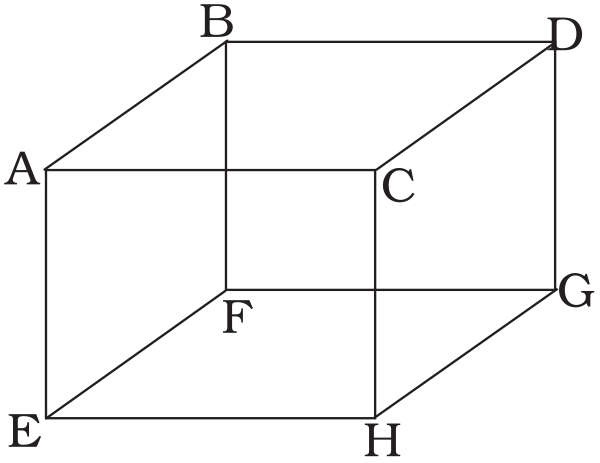
1 mole of an ideal gas is contained in a cubical volume V, ABCDEFGH at 300K (figure). One face of the cube (EFGH) is made up of a material which totally absorbs any gas molecule incident on it. At any given time,
  1. The pressure on EFGH would be zero.
  2. The pressure on all the faces will be equal.
  3. The pressure of EFGH would be double the pressure on ABCD.
  4. The pressure on EFGH would be half that on ABCD.

Answer
  1. The pressure on EFGH would be half that on ABCD.

Explanation:

Pressure on the wall due to force exerted by molecule on walls due to its rate of transfer of momentum to the wall. The molecule bounces back due to elastic collision and magnitude of momentum transferred to wall by each molecule is 2mv but wall EFGH absorbs those molecule which strikes to it. Therefore rate of change in momentum to it become only mv so the pressure of EFGH would be half of ABCD.

View full question & answer
Question 61 Mark
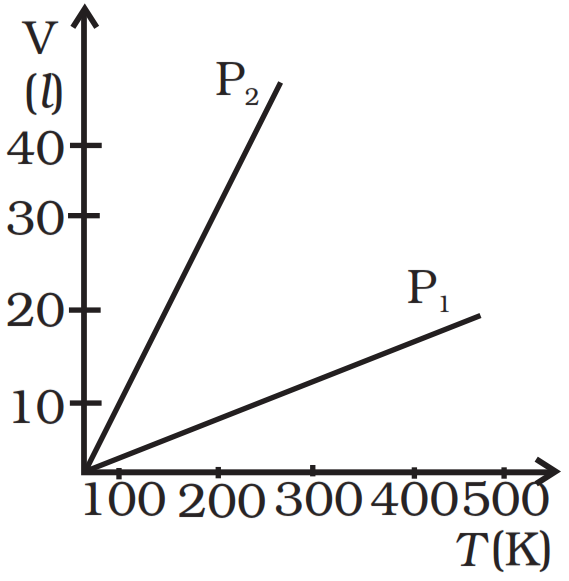
Volume versus temperature graphs for a given mass of an ideal gas are shown in figure. At two different values of constant pressure. What can be inferred about relation between P1 and P2?

  1. P1 > P2
  2. P1 = P2
  3. P< P2
  4. Data is insufficient.
Answer
  1. P1 > P2

Explanation:

$\text{V}\propto\text{T}$ as n, R and P are constant

$\frac{\text{V}_1}{\text{T}_1}$ = constant or slope of graph is constant

$\text{V}=\frac{\text{nRT}}{\text{P}}$

$\frac{\text{dv}}{\text{dt}}=\frac{\text{nR}}{\text{P}}\text{ so }\frac{\text{dV}}{\text{dT}}$ increase when P decreases

$\frac{\text{dV}}{\text{dT}}\alpha\frac{1}{\text{P}}$ as slope of P1 is smaller than P2.

Hence, P1 > P2 verifies option (a).

View full question & answer
Question 71 Mark
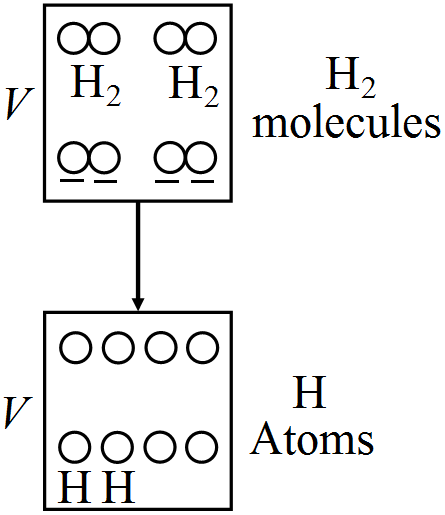
1 mole of H2 gas is contained in a box of volume V = 1.00m3 at T = 300K. The gas is heated to a temperature of T = 3000K and the gas gets converted to a gas of hydrogen atoms. The final pressure would be (considering all gases to be ideal).
  1. Same as the pressure initially.
  2. 2 times the pressure initially.
  3. 10 times the pressure initially.
  4. 20 times the pressure initially.
Answer
  1. 20 times the pressure initially.

Explanation:

The situation is shown in the diagram, H2 gas is contained in a box is heated and gets converted to a gas of hydrogen atoms. Then the number of moles would become twice.

According to gas equation,

PV = nRT

P = Pressure of gas, n = Number of moles

R = Gas constant, T = Temperature PV = nRT

As volume (V) of the container is constant.

Hence, when temperature (T) becomes 10 times, (from 300K to 3000K) pressure (P) also becomes 10 times, as P ∝ T.

Pressure is due to the bombardment of particles and as gases break, the number of moles becomes twice of initial, so n2 = 2n1

So P ∝ nT

$\Rightarrow\frac{\text{P}_2}{\text{P}_1}=\frac{\text{n}_2\text{T}_2}{\text{n}_1\text{T}_1}=\frac{(2\text{n}_1)(3000)}{\text{n}_1(300)}=20$

$\Rightarrow\text{P}_2=20\text{P}_1$

Hence, final pressure of the gas would be 20 times the pressure initially.

View full question & answer
Question 81 Mark
An inflated rubber balloon contains one mole of an ideal gas, has a pressure P. volume V and temperature T. If the temperature rises to 1.1 T, and the volume is increased to 1.05V, the final pressure will be:
  1. 1.1 P
  2. P
  3. Less than P
  4. Between P and 1.1
Answer
  1. Between P and 1.1

Explanation:

PV = nRT n and R are constant for the system here

$\frac{\text{PV}}{\text{T}}$ = constant

or

$\frac{\text{P}_1\text{V}_1}{\text{T}_1}=\frac{\text{P}_2\text{V}_2}{\text{T}_2}$

$\text{P}_2=\frac{\text{P}_1\text{V}_1}{\text{T}_1}\times\frac{\text{T}_2}{\text{V}_2}$

$=\frac{\text{p}\text{V1.1T}}{\text{T1.05V}}=\frac{1.1}{1.05}\text{p}$

$=(1.0476)\text{p}$

i.e. P2 is between P and 1.1p.

So option (d) verifies.

View full question & answer
Question 91 Mark
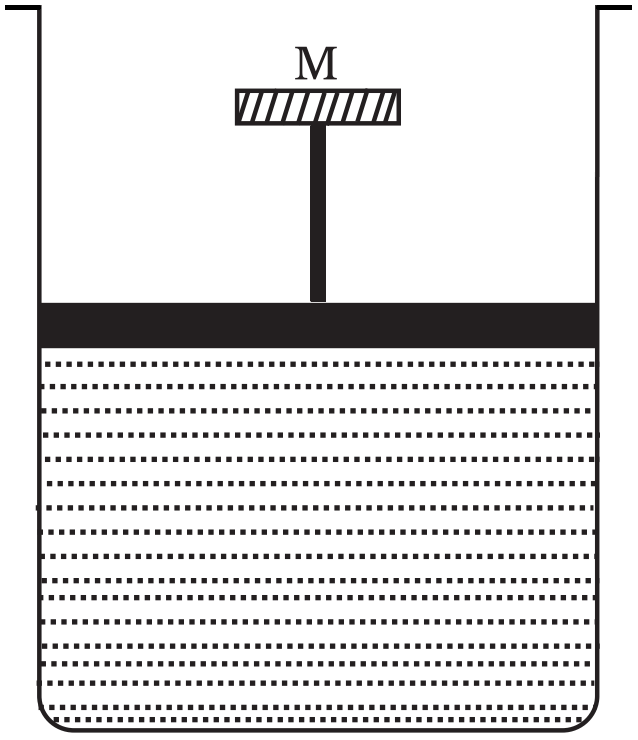
A cylinder containing an ideal gas is in vertical position and has a piston of mass M that is able to move up or down without friction ( figure). If the temperature is increased.

  1. Both P and V of the gas will change.
  2. Only P will increase according to Charles’ law.
  3. V will change but not P.
  4. P will change but not V.
Answer
  1. V will change but not P.

Explanation:

The pressure on the ideal gas does not changes from initial to final position. According to the given arrangement P = Mg/ A which shows that pressure is constant. As piston and cylinder is frictionless so by ideal gas equation, PV = nRT.

View full question & answer
Question 101 Mark
Diatomic molecules like hydrogen have energies due to both translational as well as rotational motion. From the equation in kinetic theory $\text{PV} = \frac{2}{3}$ E,E is:
  1. The total energy per unit volume.
  2. Only the translational part of energy because rotational energy is very small compared to the translational energy.
  3. Only the translational part of the energy because during collisions with the wall pressure relates to change in linear momentum.
  4. The translational part of the energy because rotational energies of molecules can be of either sign and its average over all the molecules is zero.
Answer
  1. Only the translational part of the energy because during collisions with the wall pressure relates to change in linear momentum.

Explanation:

According to kinetic theory equation, $\text{PV} = \frac{2}{3}$ E [where P= Pressure V = volume]

E is representing only translational part of energy.

Internal energy contains all types of energies like translational, rotational, vibrational etc.

But the molecules of an ideal gas is treated as point masses in kinetic theory, so its kinetic energy is only due to translational motion.

Point mass does not have rotational or vibrational motion.

Here, we assumed that the walls only exert perpendicular forces on molecules.

They do not exert any parallel force, hence there will not be any type of rotation present.

The wall produces only change in translational motion.

View full question & answer
Question 111 Mark
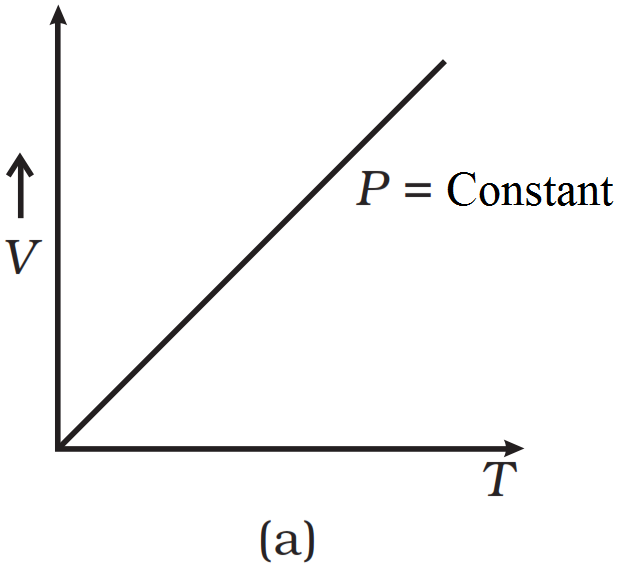
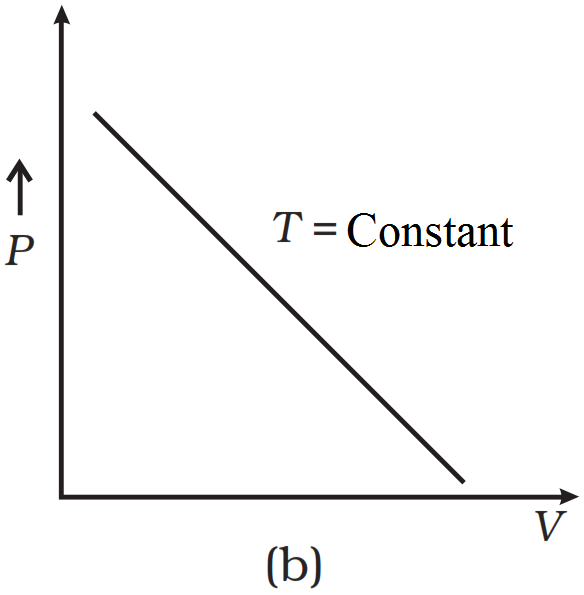
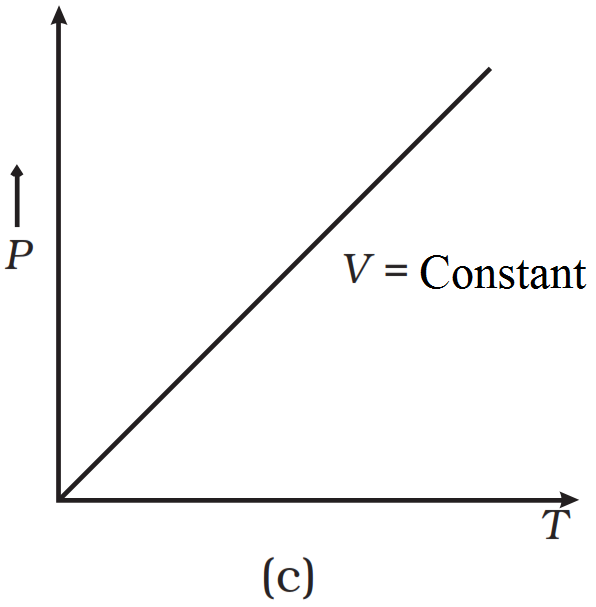
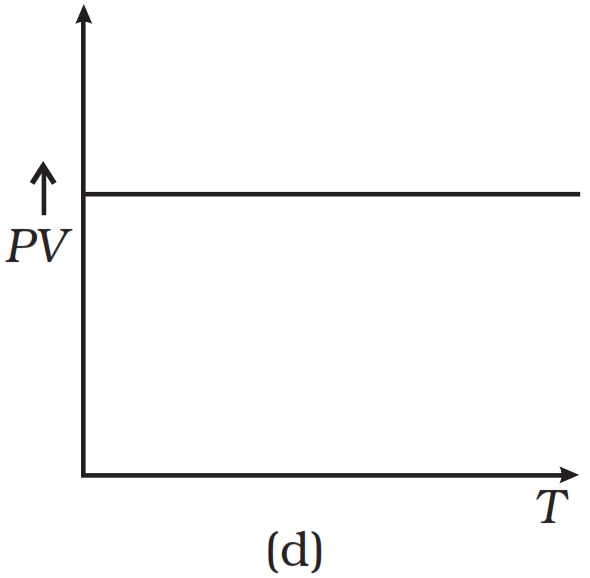
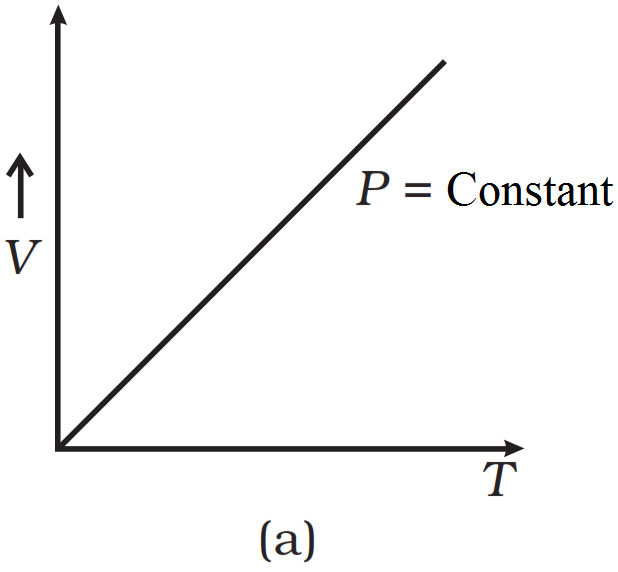
Which of the following diagrams (figure) depicts ideal gas behaviour?

Answer


Explanation:

For ideal gas behaviour,

PV = nRT

  1. When pressure, P = constant.

From (i) Volume V $\propto$ Temperature T

Graph of V versus T will be straight line.

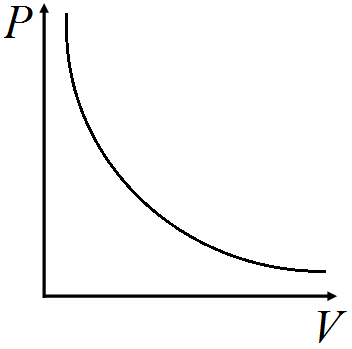
  1. When T = constant.

So, graph of P versus V will be a rectangular hyperbola.

Hence this graph is wrong.

The correct graph is shown below:

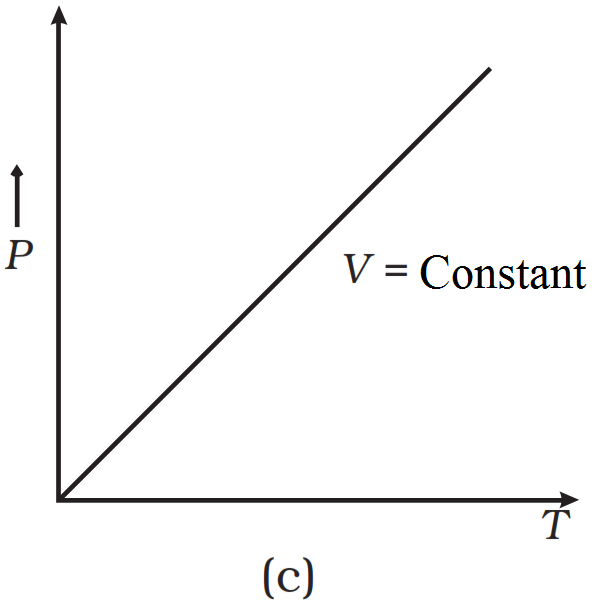
  1. When V = constant.

From (i) $\text{P}\propto\text{T}$

So, graph is a straight line passing throught the origin.

  1. From (i) $\text{PV}\propto\text{T}$

$\Rightarrow\frac{\text{PV}}{\text{T}}$ = constant

So, graph of PV versus T will be a straight line parallel to the temperature axis (x-axis).

i.e., slope of this graph will be zero.

So, (d) is not correct.

View full question & answer
Question 121 Mark
A cubic vessel (with face horizontal + vertical) contains an ideal gas at NTP. The vessel is being carried by a rocket which is moving at a speed of 500ms-1 in vertical direction. The pressure of the gas inside the vessel as observed by us on the ground:
  1. Remains the same because 500ms-1 is very much smaller than vrms of the gas.
  2. Remains the same because motion of the vessel as a whole does not affect the relative motion of the gas molecules and the walls.
  3. Will increase by a factor equal to (v2rms + (500)2)/ v2rms where vrms was the original mean square velocity of the gas.
  4. Will be different on the top wall and bottom wall of the vessel.
Answer
  1. Remains the same because motion of the vessel as a whole does not affect the relative motion of the gas molecules and the walls.

Explanation:

As the relative velocity of molecules with respect to the walls of container does not change in rocket, due to the mass of a molecule is negligible with respect to the mass of whole system and system of gas moves as a whole and g = 0 on molecule everywhere. The acceleration of rocket is also zero because rocket is moving with constant speed. Hence the pressure inside the vessel of gas as observed by us on the ground remains same.

View full question & answer
Question 131 Mark
A vessel of volume V contains a mixture of 1 mole of hydrogen and 1 mole of oxygen (both considered as ideal). Let f1(v)dv denotes the fraction of molecules with speed between v and (v + dv) with f2(v)dv, similarly for oxygen. Then,
  1. f1(v) + f2(v) = f (v) obeys the Maxwell’s distribution law.
  2. f1(v), f2(v) will obey the Maxwell’s distribution law separately.
  3. Neither f1(v)nor f2(v)will obey the Maxwell’s distribution law.
  4. f2(v) and f1(v)will be the same.
Answer
  1. f1(v), f2(v) will obey the Maxwell’s distribution law separately.

Explanation:

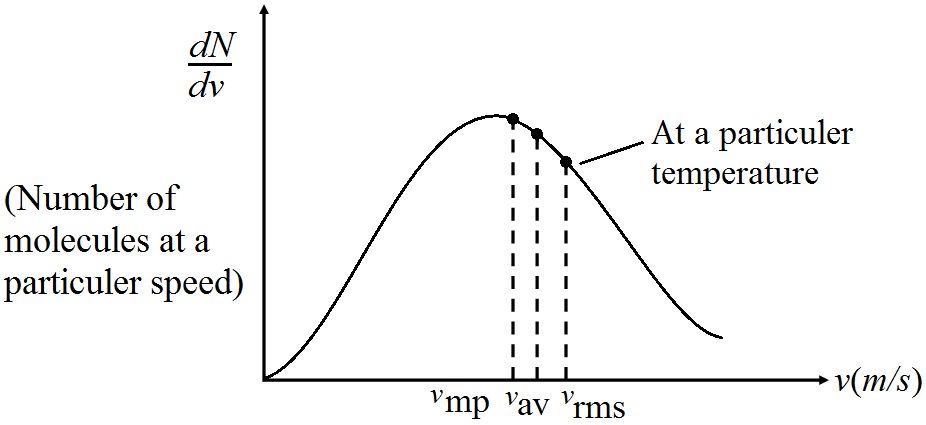
Key concept: Maxwell’s Law (or the Distribution of Molecular Speeds):

  1. The vrms gives us a general idea of molecular speeds in a gas at a given temperature.

This doesn’t mean that the speed of each molecule is vrms. Many of the molecules have speed less than vrms and many have speeds greater than vrms.

  1. Maxwell derived equation gives the distribution of molecules in different speeds as follows:

The masses of hydrogen and oxygen molecules are different.

For a function f(v), the number of molecules dn = f[v), which are having speeds between v and v + dv. The Maxwell-Boltzmann speed distribution function (Nv = dn/ dv depends on the mass of the gas molecules.

For each function f1(v) and f2(v), n will be different, hence each function f1(v) and f2(v) will obey the Maxwell’s distribution law separately.

View full question & answer
M.C.Q (1 Marks) - Physics STD 11 Science Questions - Vidyadip