Question
Boyle’s law is applicable for an:
  1. Diabatic process.
  2. Isothermal process.
  3. Isobaric process.
  4. Isochoric process.

Answer

  1. Isothermal process.

Explanation:

Boyle’s law is applicable at constant temperature, and temperature remains constant in isothermal process,

PV = nRT (n, R and T are constant)

$\therefore$ PV = constant

$\text{P}\alpha\frac{1}{\text{V}}$ (where constant = nRT)

Need a full question paper?

Generate a complete, print-ready paper with questions like this in minutes — across 16+ boards, with answer keys.
Start Generating Free

Similar questions

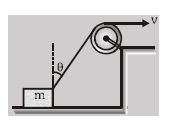
A block is dragged on a smooth plane with the help of a rope which moves with a velocity $v$ as shown in figure. The horizontal velocity of the block is
The acceleration due to gravity at a height $1\, km$ above the earth is the same as at a depth $d$ below the surface of earth. Then  $d\,=$ ......... $km$
The equation of state for a gas is given by $PV = nRT + \alpha V$, where $n$ is the number of moles and $\alpha $ is a positive constant. The initial temperature and pressure of one mole of the gas contained in a cylinder are $T_o$ and $P_o$ respectively. The work done by the gas when its temperature doubles isobarically will be
Which of the following is not a vector quantity?
Three particles each of mass $m$ are located at the vertices of an equilateral triangle $ABC$. They start moving with equal speeds $v$ each along the medians of the triangle and collide at its centroid $G$. If after collision, $A$ comes to rest and $B$ retraces its path along $GB,$ then $C$
The coordinates of a moving particle at any time $‘t’$ are given by $ x = \alpha t^3$ and $y = \beta t^3$. The speed of the particle at time $‘t’$ is given by
By a surface of a liquid we mean.
  1. A geometrical plane like x = 0
  2. All molecules exposed to the atmosphere.
  3. A layer of thickness of the order of 10-8m.
  4. A layer of thickness of the order of 10-4m.
A closed pipe and an open pipe have their first overtones identical in frequency. Their lengths are in the ratio
In which of the following graphs, the total change in momentum is zero?
Gas obey $P^2V =$ constant. The initial temperature and volume are $T_0$ and $V_0$. If gas expands to volume $2V_0$, the final temp is