Questions

3 Marks Question

🎯

Test yourself on this topic

8 questions · timed · auto-graded

Question 13 Marks
What is terminal velocity and derive an expression for it?
Answer
Terminal velocity is the maximum constant velocity acquired by the body which is falling freely in a viscous medium, due to the balanced net downward force acting on the body with the upward resistive viscous force offered by the medium on the body. When a small spherical body falls freely through a viscous medium then 3 forces act on it:-
i. Weight of body acting vertically downwards.
ii. Up thrust due to buoyancy = weight of fluid displaced by the body, acting upwards.
iii. Viscous drag $\left( F _{ V }\right)$ or resistive viscous force acting in the direction opposite to the motion of body.
Let $\rho=$ Density of the material of the spherical body
$r =$ Radius of the spherical body
$\sigma=$ Density of the viscous medium.
$\therefore$ True weight of the body $= W =$ volume of the body $\times$ density of the body $\times g$
$
\therefore W=\frac{4}{3} \pi r^3 \rho g
$
Up ward thrust by the fluid, $F _{ T }=$ weight of medium displaced by the spherical body $=$ volume of the body $\times$ density of the viscous
$
\begin{aligned}
& \text { medium } \times g \\
& =\frac{4}{3} \pi r^3 \sigma g
\end{aligned}
$
Say, $v_T=$ Terminal velocity of body
According to Stoke's law, viscous drag or viscous force, $F_V=6 \pi \eta v_T$ ( $\eta$ being coefficient of viscosity of the medium)
When the body attains terminal velocity $v_T$, then
$
\begin{aligned}
& F_{T}+F_{V}=W \\
& \Rightarrow \frac{4}{3} \pi r^3 \sigma g+6 \pi \eta r v_T=\frac{4}{3} \pi r^3 \rho g \\
& \therefore v_T=\frac{2 r^2(\rho-\sigma) g}{9 \eta}
\end{aligned}
$
i. $v_T$ directly depends on radius of body and difference of the pressure of material and medium.
ii. $v_T$ inversely depends of co-efficient of viscosity of the medium.
View full question & answer
Question 23 Marks
A mass of 4 kg rests on a horizontal plane. The plane is gradually inclined until at an angle $\theta=15^{\circ}$ with the horizontal, the mass just begins to slide. What is the coefficient of static friction between the block and the surface?
Image
Answer
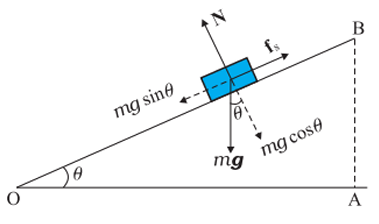
The forces acting on a block of mass $m$ at rest on an inclined plane are
i. the weight mg acting vertically downwards
ii. the normal force N of the plane on the block, and
iii. the static frictional force fs opposing the impending motion.
In equilibrium, the resultant of these forces must be zero. Resolving the weight mg along the two directions shown, we have $mg \sin \theta= f _{ s }, mg \cos \theta= N$
As $\theta$ increases, the self-adjusting frictional force fs increases until at $\theta=\theta_{\max ^{\prime}} f _{ s }$ achieves its maximum value,
$
\left(f_{s}\right)_{\max }=\mu_{s} N
$
Therefore,
$
\tan \theta_{\max }=\mu_s \text { or } \theta_{\max }=\tan ^{-1} \mu_s
$
When $\theta$ becomes just a little more than $\theta_{\max }$, there is a small net force on the block and it begins to slide. Note that $\theta_{\max }$ depends only on $\mu_s$ and is independent of the mass of the block.
For $\theta_{\max }=15^{\circ}$
$
\begin{aligned}
& \mu_{s}=\tan 15^{\circ} \\
& =0.27
\end{aligned}
$
View full question & answer
Question 33 Marks
A particle is moving along a straight line and its position is given by the relation $x=\left(t^3-6 t^2-15 t+40\right) m$ Find:
a. The time at which velocity is zero.
b. Position and displacement of the particle at that point.
c. Acceleration of the particle at that point.
Answer
$
x=t^3-6 t^2-15 t+40
$
$\therefore v=\frac{d x}{d t}=\left(3 t^2-12 t-15\right) m / s$ (As velocity $=1$ st order derivative of displacement, x with respect to time, t ) and $a=\frac{d v}{d t}=(6 t-12) m / s^2$ (As acceleration = 1st order derivative of velocity, v with respect to time, t )
a. By the problem, $v =3 t ^2-12 t -15=0$
$
\begin{aligned}
& \Rightarrow 3 t^2-15 t+3 t-15=0 \\
& \Rightarrow 3 t(t-5)+3(t-5)=0 \\
& \Rightarrow(3 t+3)(t-5)=0
\end{aligned}
$
So we get, either $t=-1$ or $t=5$
But we know that time cannot be negative.
 $\therefore t =5$ seconds.
b. Now, position at $t =5 s$,
$
x_5=(5)^3-6(5)^2-15(5)+40=-60 m \text { (final position) }
$
and (ii) Now to get displacement, at $t =0 s$, position $x _0=40 m$ (initial position)
$\therefore$ Displacement from $t=0 s$ to $t =5 s$,
$
\begin{aligned}
& s=x_5-x_0 \\
& \Rightarrow s=-60-40 \\
& \Rightarrow s=-100 m
\end{aligned}
$
c. Acceleration at $t =5 s$, using the equation $a=6 t^2-12 m / s ^2$
$
\begin{aligned}
& \therefore a=6(5)-12 \\
& \Rightarrow a=(30-12) \\
& \Rightarrow a=18 m / s^2
\end{aligned}
$
This is the acceleration of the particle at that instant when velocity becomes zero.
View full question & answer
Question 43 Marks
A mercury drop of radius 1.0 cm is sprayed into $10^6$ droplets of equal size. Calculate the energy expended. The surface tension of mercury $=32 \times 10^{-2} Nm ^{-1}$.
Answer
The volume of $10^6$ droplets = Volume of a larger drop
$
\begin{aligned}
& 10^6 \times \frac{4}{3} \pi r^3=\frac{4}{3} \pi R^3 \\
& r=10^{-2} R=10^{-2} \times 1.0=10^{-2} cm=10^{-4} m
\end{aligned}
$
The surface area of a larger drop
$
=4 \pi R^2=4 \pi \times\left(10^{-2}\right)^2=4 \pi \times 10^{-4} m^2
$
The surface area of $10^6$ droplets
$
\begin{aligned}
& =4 \pi r^2 \times 10^6=4 \pi \times\left(10^{-4}\right)^2 \times 10^6 \\
& =4 \pi \times 10^{-2} m^2
\end{aligned}
$
$\therefore$ Increase in surface area
$
=4 \pi \times 10^{-4}(100-1)=4 \pi \times 99 \times 10^{-4} m^2
$
$\therefore$ Work done in spraying a spherical drop of mercury
$=$ Surface tension $\times$ increase in surface area
$
=32 \times 10^{-2} \times 4 \pi \times 99 \times 10^{-4}=3.98 \times 10^{-2} J
$
View full question & answer
Question 53 Marks
One kilogram molecule of a gas at 400k expands isothermally until its volume is doubled. Find the amount of work done and heat produced.
View full question & answer
Question 63 Marks
The flow rate of water from a tap of diameter 1.25 cm is $0.48 \frac{L}{ min }$. The coefficient of viscosity of water is $10^{-3}$ Pa s. After some time the flow rate is increased to $3 L / min$. Characterise the flow for both the flow rates.
Answer
Let the speed of the flow be $v$.
Given, diameter of tap $= d =1.25 cm$
Volume of water flowing out per second.
$
Q=v \times \frac{\pi d^2}{4} \Rightarrow v=\frac{4 Q}{d^2 \pi}
$
Estimate Reynold's number, $R _{ e }=\frac{4 \rho Q}{\pi d \eta}$
$
\begin{aligned}
& Q=0.48 \frac{L}{\min }=8 \times 10^{-3} \frac{L}{s}=8 \times 10^{-6} \frac{m^3}{s} \\
& R_e=\frac{4 \times 10^3 \times 8 \times 10^{-6}}{3.14 \times 1.25 \times 10^{-2} \times 10^{-3}}
\end{aligned}
$
$R_e=815$ [i.e. below 1000 , the flow is steady] After some time, when
$
\begin{aligned}
& Q=3 \frac{L}{\min }=5 \times 10^5 \frac{m^3}{s} \\
& R_{e}=\frac{4 \times 10^3 \times 5 \times 10^{-5}}{314 \times 1.25 \times 10^{-2} \times 10^{-3}}=5095
\end{aligned}
$
$\therefore$ The flow will be turbulent.
View full question & answer
Question 73 Marks
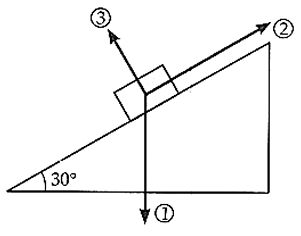
A block of wood of mass 3 kg is resting on the surface of a rough inclined surface, inclined at an angle $\theta$ as shown in the figure.
Image
a. Name the forces $(1,2,3)$.
b. If the coefficient of static friction is 0.2 , calculate the value of all three forces.
$
\text { (use } g=10 m / s^2 \text { ) }
$
View full question & answer
Question 83 Marks
Define thermal conduction. Briefly explain its molecular mechanism.
Answer
Conduction of Heat is a process where heat is transferred from the hotter part of the body to the colder part without involving any actual movement of the body molecules.
In conduction, the heat transfer takes place at the molecular level without actual movement of molecules, from the hottest to the coldest surface.
In the process of heat transfer, the molecules pump into their neighbors and transfer the energy to them which continue as long as heat is still being added
The transfer between bodies continue unit the temperature different decays and a state knows as thermal equilibrium occurs. Greater the value thermal conductivity K of body better is its heat conducting capability.
For insulator this value of K is zero.
View full question & answer
3 Marks Question - Physics STD 11 Science Questions - Vidyadip