Question 15 Marks
An air chamber of volume $V$ has a neck of the area of cross-section $A$ into which a ball of mass $m$ can move without friction. Show that when the ball is pressed down through some distance and released, the ball executes SHM. Obtain the formula for the time period of this SHM, assuming pressure-volume variations of the air to be
i. isothermal and
ii. adiabatic.
i. isothermal and
ii. adiabatic.
Answer
View full question & answer→Oscillations of a ball in the neck of an air chamber. The figure shows an air chamber of volume V , having a neck of area of crosssection $A$ and a ball of mass $m$ fitting smoothly in the neck. If the ball be pressed down a little and released, it starts oscillating up and down about the equilibrium position.
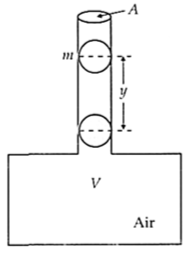
If the ball be depressed by distance $y$, then the decrease in volume of air in the chamber is $\Delta V= Ay$.
$\therefore$ Volume strain $=\frac{\Delta V}{V}=\frac{A y}{V}$
If pressure P is applied to the ball, then hydrostatic stress $= P$
$\therefore$ Bulk modulus of elasticity of air,
$
E=-\frac{P}{\Delta V / V}=-\frac{P}{A y / V} \text { or } P=-\frac{E A}{V} y
$
Restoring force, $F = PA =-\frac{E A y}{V} A=-\frac{E A^2}{V} y$
Thus F is proportional to y and acts in its opposite direction. Hence the ball executes SHM with force constant, $k =\frac{E A^2}{V}$
The period of oscillation of the ball is
$
T=2 \pi \sqrt{\frac{m}{k}}=2 \pi \sqrt{\frac{m}{E A^2 / V}}=2 \pi \sqrt{\frac{m V}{E A^2}}
$
i. If the $P - V$ variations are isothermal, then $E = P$,
$
\therefore T=2 \pi \sqrt{\frac{m V}{P A^2}}
$
ii. If the $P - V$ variations are isothermal, then $E =\gamma P$,
$
\therefore T=2 \pi \sqrt{\frac{m V}{\gamma P A^2}}
$
If the ball be depressed by distance $y$, then the decrease in volume of air in the chamber is $\Delta V= Ay$.
$\therefore$ Volume strain $=\frac{\Delta V}{V}=\frac{A y}{V}$
If pressure P is applied to the ball, then hydrostatic stress $= P$
$\therefore$ Bulk modulus of elasticity of air,
$
E=-\frac{P}{\Delta V / V}=-\frac{P}{A y / V} \text { or } P=-\frac{E A}{V} y
$
Restoring force, $F = PA =-\frac{E A y}{V} A=-\frac{E A^2}{V} y$
Thus F is proportional to y and acts in its opposite direction. Hence the ball executes SHM with force constant, $k =\frac{E A^2}{V}$
The period of oscillation of the ball is
$
T=2 \pi \sqrt{\frac{m}{k}}=2 \pi \sqrt{\frac{m}{E A^2 / V}}=2 \pi \sqrt{\frac{m V}{E A^2}}
$
i. If the $P - V$ variations are isothermal, then $E = P$,
$
\therefore T=2 \pi \sqrt{\frac{m V}{P A^2}}
$
ii. If the $P - V$ variations are isothermal, then $E =\gamma P$,
$
\therefore T=2 \pi \sqrt{\frac{m V}{\gamma P A^2}}
$