Question
What is meant by resolution of a vector? Prove that a vector can be resolved along two given directions in one and only one way.

Answer

Resolution of a vector. It is the process of splitting a vector into two or more vectors in such a way that their combined effect is same as that of the given vector. The vectors into which the given vector is splitted are called component vectors. A component of a vector in any direction gives a measure of the effect of the given vector in that direction. The resolution of a vector is just opposite to the process of vector addition.
Resolution of a vector along two given directions.
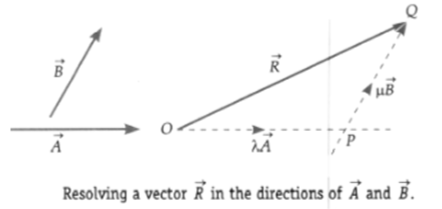
Suppose we wish to resolve a vector $\vec{R}$ in the direction of two coplanar and non-parallel vectors $\vec{A}$ and $\vec{B}$, as shown in Figure.
Image
Suppose $\overrightarrow{O Q}$ represent vector $\vec{R}$ in the directions of $\vec{A}$ and $\vec{B}$.
Q draw lines parallel to vectors $\vec{A}$ and $\vec{B}$ respectively to meet at point P. From triangle law of vector addition.
$
\overrightarrow{O Q}=\overrightarrow{O P}+\overrightarrow{P Q}
$
As $\overrightarrow{O P} \| \vec{A}$ therefore, $\overrightarrow{O P}=\lambda \vec{A}$
As $\overrightarrow{P Q} \| \vec{B}$ therefore, $\overrightarrow{P Q}=\mu \vec{B}$
Here $\lambda$ and $\mu$ are scalar. Hence
$
\vec{R}=\lambda \vec{A}+\mu \vec{B} \ldots \text { (i) }
$
Thus the vector $\vec{R}$ has been resolved in the direction of $\vec{A}$ and $\vec{B}$. Here $\lambda \vec{A}$ is the component of $\vec{R}$ in the direction $\vec{A}$ and $\mu \vec{B}$ is the component in the direction of $\vec{B}$.
Uniqueness of resolution. Let us assume that $\vec{R}$ can be resolved in the directions of $\vec{A}$ and $\vec{B}$ in another way.
Then $\vec{R}=\lambda^{\prime} \vec{A}+\mu^{\prime} \vec{B} \ldots$... (ii)
From equation (i) and (ii), we have
$
\begin{aligned}
& \lambda \vec{A}+\mu \vec{B}=\lambda^{\prime} \vec{A}+\mu^{\prime} \vec{B} \\
& \text { or }\left(\lambda-\lambda^{\prime}\right) \vec{A}=\left(\mu^{\prime}-\mu\right) \vec{B}
\end{aligned}
$
But $\vec{A}$ and $\vec{B}$ are non-zero vectors acting along different directions. The above equation is possible only if
$
\begin{aligned}
& \lambda-\lambda^{\prime}=0 \text { and } \mu^{\prime}-\mu=0 \\
& \text { or } \lambda^{\prime}=\lambda \text { and } \mu^{\prime}=\mu
\end{aligned}
$
Hence there is one and only one way in which a vector $\vec{R}$ can be resolved in the directions of vectors $\vec{A}$ and $\vec{B}$.

Need a full question paper?

Generate a complete, print-ready paper with questions like this in minutes — across 16+ boards, with answer keys.
Start Generating Free

Similar questions

Two cylindrical hollow drums of radii R and 2R, and of a common height h, are rotating with angular velocities $\omega$ (anti-clockwise) and $\omega$ (clockwise), respectively. Their axes, fixed are parallel and in a horizontal plane separated by $(3\text{R}+\delta).$ They are now brought in contact $(\delta\rightarrow0){:}$
  1. Show the frictional forces just after contact.
  2. Identify forces and torques external to the system just after contact.
  3. What would be the ratio of final angular velocities when friction ceases?
Write the law of force for simple harmonic motion and prove that $T=2 \pi \sqrt{\frac{m}{ k }}$.
The ceiling of a long hall is 25m high. What is the maximum horizontal distance that a ball thrown with a speed of 40ms-1 can go without hitting the ceiling of the hall?
An aircraft is flying at a height of 3400m above the ground. If the angle subtended at a ground observation point by the aircraft positions 10.0s apart is 30°, what is the speed of the aircraft?
Explain the mathematical analysis of progressive wave.
Four equal charges 2.0 × 10-6C each are fixed at the four corners of a square of side 5cm. Find the Coulomb force experienced by one of the charges due to the rest three.
A conducting loop of area 5.0cm2 is placed in a magnetic field which varies sinusoidally with time as $\text{B}=\text{B}_0\sin\omega\text{t}$ wherer $\text{B}_0=0.20\text{T}$ and $\omega=300\text{s}^{-1}.$ The normal to the coil makes an angle of 60° with the field. Find
  1. The maximum emf induced in the coil.
  2. The emf induced at $\text{t}=\Big(\frac{\pi}{900}\Big)\text{s}$
  3. $\text{t}=\Big(\frac{\pi}{600}\Big)\text{s}.$
  4. The emf induced at $\text{t}=\Big(\frac{\pi}{600}\Big)\text{s}.$
Oxygen is filled in a closed metal jar of volume 1.0 × 10⁻³m3 at a pressure of 1.5 × 10⁵Pa and temperature 400K. The jar has a small leak in it. The atmospheric pressure is 1.0 × 10⁵Pa and the atmospheric temperature is 300K Find the mass of the gas that leaks out by the time the pressure and the temperature inside the jar equalise with the surrounding.
  1. Define escape velocity.
  2. Derive expression for the escape velocity of an object from the surface of a planet.
  3. Does it depend on location from where it is projected?
Earthquakes generate sound waves inside the earth. Unlike a gas, the earth can experience both transverse (S) and longitudinal (P) sound waves. Typically the speed of S wave is about 4.0km s–1, and that of P wave is 8.0km s–1. A seismograph records P and S waves from an earthquake. The first P wave arrives 4 min before the first S wave. Assuming the waves travel in straight line, at what distance does the earthquake occur?