Questions

3 Marks Question

Take a timed test

8 questions · self-marked practice — reveal the answer and mark yourself.

Question 13 Marks
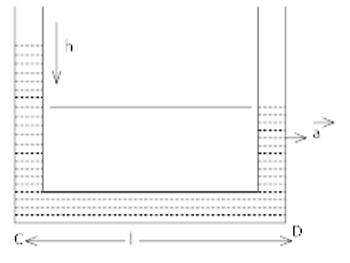
A liquid stands at the same level in the $U$ - tube when at rest. If $A$ is the area of cross section of tube and $g$ is the acceleration due to gravity, what will be the difference in height of the liquid in the two limbs when the system is given acceleration 'a'?
Image
Answer
Let $l =$ Length of the horizontal portion of tube. Mass of liquid in the portion $CD =$ Volume $\times$ Density
Let $P =$ Density of water
Volume $=$ Area $\times$ Length
$
\begin{aligned}
& A=\text { Area of cross }- \text { section of tube. } \\
& =a \times 1
\end{aligned}
$
So, Mass of liquid in portion $CD =( Al ) \times \rho= Al \rho$
Force on the above Mass towards left $= M \times \bar{a}$
$\bar{a}=$ acceleration
Force $= Alp \times \bar{a} \ldots( i )$
Also, due to difference in height of liquid, the downward force exerted on liquid in the horizontal portion CD
$\Rightarrow$ Pressure $=\frac{\text { force }}{\text { Area }}$
Pressure $= h \rho g$
$h =$ height; $\rho=$ Density; $g =$ acceleration due to gravity
So, Force $=$ Pressure $\times$ Area
Force $= h \rho g \times A \ldots$ (ii)
Equating equation (i) and equation (ii) for force on C D :
$
\begin{aligned}
& Alp \times a=hp g \times A \\
& h=\frac{a l}{g}
\end{aligned}
$
View full question & answer
Question 23 Marks
The efficiency of a Carnot engine is $1 / 2$. If the sink tem perature is reduced by $100^{\circ} C$, then engine efficiency becomes $2 / 3$. Find
i. sink temperature
ii. source temperature
iii. Explain, why a Carnot engine cannot have $100 \%$ efficiency?
View full question & answer
Question 33 Marks
What is the pressure inside the drop of mercury of radius 3.00 mm at room temperature? Surface tension of mercury at that temperature $\left(20^{\circ} C \right)$ is $4.65 \times 10^{-1} Nm ^{-1}$. The atmospheric pressure is $1.01 \times 10^5 Pa$. Also give the excess pressure inside the drop.
Answer
Radius of mercury drop $r =3.00 mm=3 \times 10^{-3} m$
surface tension of mercury $S =4.65 \times 10^{-1} Nm ^{-1}$
atmospheric pressure $P _{ atm }=1.01 \times 10^5$ pa
Total pressure $\left( P _{\text {total }}\right)$ inside the mercury drop $=$ excess pressure inside mercury + atmospheric pressure
equation for excess pressure inside mercury $P = p _{ i }- p _0=\frac{2 S}{r}$
thus $P _{\text {total }}= P + P _{ atm }=\frac{2 S}{r}+ P _{ atm }$
$
\begin{aligned}
& P_{\text {total }}=\frac{2 \times 4.65 \times 10^{-1}}{3 \times 10^{-3}}+\left(1.01 \times 10^5\right) \\
& P_{\text {total }}=1.0131 \times 10^5 Pa
\end{aligned}
$
excess pressure $P =\frac{2 S}{r}=\frac{2 \times 4.65 \times 10^{-1}}{3 \times 10^{-3}}$
$
P=310 Pa
$
View full question & answer
Question 43 Marks
If a number of little droplets of water, each of radius $r$, coalesce to form a single drop of radius $R$, show that the rise in temperature will be given by $\Delta \theta=\frac{3 \sigma}{J}\left(\frac{1}{r}-\frac{1}{R}\right)$ where $\sigma$ is the surface tension of water and J is the mechanical equivalent of heat.
Answer
Let n be the number of little droplets which coalesce to form a single drop. Then The volume of $n$ little droplets = Volume of a single drop or $n \times \frac{4}{3} \pi r^3=\frac{4}{3} \pi R^3$ or $mr ^3= R ^3$
Decrease in surface area $= n \times 4 \pi r^2-4 \pi R^2$
$
\begin{aligned}
& =4 \pi\left[nr^2-R^2\right]=4 \pi\left[\frac{n r^3}{r}-R^2\right] \\
& =4 \pi\left[\frac{R^3}{r}-R^2\right]=4 \pi R^3\left[\frac{1}{r}-\frac{1}{R}\right]\left[\because nr^3=R^3\right]
\end{aligned}
$
Energy evolved,
$W =$ Surface tension $\times$ decrease in surface area
$
=4 \pi \sigma R^3\left[\frac{1}{r}-\frac{1}{R}\right]
$
Heat produced,
$
Q=\frac{W}{J}=\frac{4 \pi \sigma R^3}{J}\left[\frac{1}{r}-\frac{1}{R}\right]
$
But $Q = ms \Delta \theta$
$=$ Volume of single drop $\times$ density of water $\times$ specific heat of water $\times \Delta \theta$
$
=\frac{4}{3} \pi R^3 \times 1 \times 1 \times \Delta \theta
$
Hence
$\begin{aligned} & \frac{4}{3} \pi R^3 \Delta \theta=\frac{4 \pi \sigma R^3}{J}\left[\frac{1}{r}-\frac{1}{R}\right] \\ & \text { or } \Delta \theta=\frac{3 \sigma}{J}\left[\frac{1}{r}-\frac{1}{R}\right]\end{aligned}$
View full question & answer
Question 53 Marks
Answer
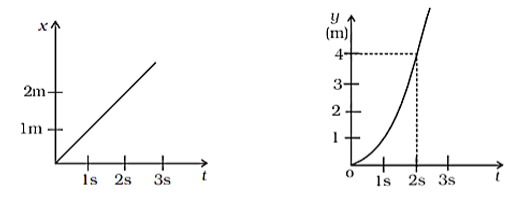
From graph (a) $x = t$
$
\begin{aligned}
& v_x=\frac{d x}{d t}=1 ms^{-1} \\
& a_x=\frac{d^2 x}{d t^2}=\frac{d v_x}{d t}=0
\end{aligned}
$
From graph (b) $y=t^2$
$
\begin{aligned}
& v_y=\frac{d y}{d t}=2 t \\
& a_y=\frac{d v_y}{d t}=2 \\
& a_{x}=0, a_{y}=2 m s^{-1}
\end{aligned}
$
Here, $m =500 g=0.5 kg$
$
F_{x}=0.5 \times 0=0 N
$
$F_y=m a_y=0.5 \times 2=1 N$ toward Y -axis, 
Hence, resultant force acting on particle is $F=\sqrt{F_x^2+F_y^2}=\sqrt{0^2+1^2}=\sqrt{1}$
 $\therefore F =1 N$ along y -axis.
View full question & answer
Question 63 Marks
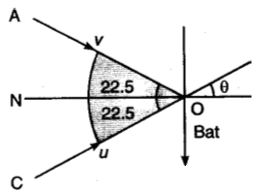
A batsman deflects a ball by an angle of $45^{\circ}$ without changing its initial speed which is equal to $54 km / h$. What is the impulse imparted to the ball? (Mass of the ball is 0.15 kg .)
Answer
The ball struck by the bat is deflected back such that the total angle is $45^{\circ}$.
Image
Now, initial momentum of ball $= mu \cos \theta$
$
\begin{aligned}
& =\frac{0.15 \times 54 \times 1000 \times \cos 22.5}{3600} \\
& =0.15 \times 15 \times 0.9239 \text { along ON }
\end{aligned}
$
Final momentum of ball $=$ mucos $\theta$ along ON
Impulse $=$ change in momentum
$=\operatorname{mucos} \theta-(-m u c o s \theta)$
$=2 mucos \theta$
$=2 \times 0.15 \times 15 \times 0.9239$
i.e., Impulse $=4.16 kg ms ^{-1}$
View full question & answer
Question 73 Marks
A stone is dropped from the top of a cliff and is found to ravel 44.1 m diving the last second before it reaches the ground. What is the height of the cliff? $g =9.8 m / s ^2$.
Answer
Let $h$ be the height of the cliff and $n$ be the total time taken by the stone while falling. As
$
\begin{aligned}
& u=0 \\
& a=g=9.8 m / s^2 \\
& S_{n t h}=u+\frac{a}{2}(2 n-1) \\
& 44.1=0+\frac{9.8}{2}(2 n-1) \\
& 88.2=9.8(2 n-1) \\
& 2 n-1=9 \\
& n=\frac{10}{2}=5 s
\end{aligned}
$
for Height of the cliff using equation
$
\begin{aligned}
& h=u t+\frac{1}{2} a t^2 \\
& h=u n+\frac{1}{2} g n^2 \\
& h=0 \times 5+\frac{1}{2} \times 9.8 \times(5)^2 \\
& h=4.9 \times 25 \\
& h=122.5 m
\end{aligned}
$
View full question & answer
Question 83 Marks
A 20 cm thick layer of ice has been formed on the surface of a freshwater lake during extreme winter. The temperature of the air is $-10^{\circ} C$. Find how long will it take for another 1 mm layer of water to freeze? Thermal conductivity of ice $=2.1 W m ^{-1} K^{-1}$, latent heat of fusion of water $=3.36 \times 10^5 J kg ^{-1}$ and density of ice $=10^3$ $kg m ^{-3}$.
Answer
Given: Thickness of ice layer formed, $l =20 cm=0.2 m$,
Temperature just below ice layer (in the lake) $T _1=0^{\circ} C$,
Temperature of air (above ice layer) $T _2=-10^{\circ} C$,
Thermal conductivity of ice $K =2.1 W m ^{-1} K^{-1}$,
Latent heat of fusion of water $L _{ f }=3.36 \times 10^5 J kg ^{-1}$ and ice density $\rho=10^3 kg m ^{-3}$.
Let A be the surface area of the lake that takes time t for the formation of ice layer by $\Delta l=1 mm=10^{-3} m$
$\therefore$ Mass of water formed in time $t , m = A . \Delta l . \rho=A \times 10^{-3} \times 10^3= A kg$
From the heat energy relation, $H =\frac{\Delta Q}{\Delta t}=\frac{K A\left(T_1-T_2\right)}{l}$, we have
$
\begin{aligned}
& \frac{m L_f}{t}=\frac{A L_f}{t}=\frac{K A\left(T_1-T_2\right)}{l} \\
& \text { or } t=\frac{L_f \cdot l}{K\left(T_1-T_2\right)}=\frac{3.36 \times 10^5 \times 0.2}{2.1 \times[0-(-10)]}=\frac{3.36 \times 10^5 \times 0.2}{2.1 \times 10} \\
& =3200 s=53 \min 20 s
\end{aligned}
$
So it would take 53 min 20 sec to form the layer of ice.
View full question & answer
3 Marks Question - Physics STD 11 Science Questions - Vidyadip