Question 14 Marks
View full question & answer→Questions
4 Marks Question
Take a timed test
2 questions · self-marked practice — reveal the answer and mark yourself.
Question 24 Marks
Certain collisions are referred to as elastic collisions. Elastic collisions are collisions in which both momentum and kinetic energy are conserved. The total system kinetic energy before the collision equals the total system kinetic energy after the collision. If total kinetic energy is not conserved, then the collision is referred to as an inelastic collision.
The coefficient of restitution, denoted by (e), is the measure of degree elasticity of collision. It is defined as the ratio of the final to inital relative speed between two objects after they collide. It normally ranges from 0 to 1 where 1 would be a perfectly elastic collision. A perfectly inelastic collision has a coefficient of 0 . In real life most of the collisions are neither perfectly elastic nor perfectly inealstic and $0< e <1$.
1. The following are the data of a collision between a truck and a car.
Mass of the car $=1000 kg$
Mass of the truck $=3000 kg$
Mass of the truck Before collision:
Speed of the car $=20 m / s$
Momentum of the car $=20000 kg m / s$
Speed of the truck $=20 m / s$
Momentum of the truck $=60000 kg m / s$
After collision:
Speed of the car $=40 m / s$ in the opposite direction
Momentum of the car $=40000 kg m / s$ in the opposite direction
Speed of the truck $=0$
Momentum of the truck $=0$
The collision is
(a) Both elastic since kinetic energy and momentum is conserved
(b) Elastic since momentum is conserved
(c) Inelastic since kinetic energy is conserved
(d) Elastic since kinetic energy is conserved
2. The coefficient of restitution is the measure of
(a) Malleability of a substance (b) Conductivity of a substance
(c) degree of elasticity of collision (d) Elasticity of a substance
3. Coefficient of restitution is defined as
(a)
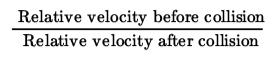
(b) Relative velocity after collision x relative velocity before collision
(c) Relative velocity after collision + relative velocity before collision
(d)
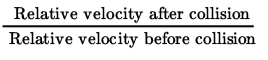
OR
In real life most of the collisions are
(a) Range of coefficient of restitution is 0 < e < 1
(b) both neither perfectly nor perfectly inelastic and range of coefficient of restitution is 0 < e < 1.
(c) neither perfectly elastic nor perfectly inelastic
(d) perfectly inelastic
4. For perfectly elastic and perfectly inelastic collision, the value of coefficient of restitution are respectively
(a) $+1,-1$ (b) 0,1 (c) $0,-1$ (d) 1,0
View full question & answer→The coefficient of restitution, denoted by (e), is the measure of degree elasticity of collision. It is defined as the ratio of the final to inital relative speed between two objects after they collide. It normally ranges from 0 to 1 where 1 would be a perfectly elastic collision. A perfectly inelastic collision has a coefficient of 0 . In real life most of the collisions are neither perfectly elastic nor perfectly inealstic and $0< e <1$.
1. The following are the data of a collision between a truck and a car.
Mass of the car $=1000 kg$
Mass of the truck $=3000 kg$
Mass of the truck Before collision:
Speed of the car $=20 m / s$
Momentum of the car $=20000 kg m / s$
Speed of the truck $=20 m / s$
Momentum of the truck $=60000 kg m / s$
After collision:
Speed of the car $=40 m / s$ in the opposite direction
Momentum of the car $=40000 kg m / s$ in the opposite direction
Speed of the truck $=0$
Momentum of the truck $=0$
The collision is
(a) Both elastic since kinetic energy and momentum is conserved
(b) Elastic since momentum is conserved
(c) Inelastic since kinetic energy is conserved
(d) Elastic since kinetic energy is conserved
2. The coefficient of restitution is the measure of
(a) Malleability of a substance (b) Conductivity of a substance
(c) degree of elasticity of collision (d) Elasticity of a substance
3. Coefficient of restitution is defined as
(a)
(b) Relative velocity after collision x relative velocity before collision
(c) Relative velocity after collision + relative velocity before collision
(d)
OR
In real life most of the collisions are
(a) Range of coefficient of restitution is 0 < e < 1
(b) both neither perfectly nor perfectly inelastic and range of coefficient of restitution is 0 < e < 1.
(c) neither perfectly elastic nor perfectly inelastic
(d) perfectly inelastic
4. For perfectly elastic and perfectly inelastic collision, the value of coefficient of restitution are respectively
(a) $+1,-1$ (b) 0,1 (c) $0,-1$ (d) 1,0