Question
Need a full question paper?
Generate a complete, print-ready paper with questions like this in minutes — across 16+ boards, with answer keys.
Explore more
Similar questions
The cathode of a diode valve is replaced by another cathode of double the surface area. Keeping the voltage and temperature conditions the same, will the place current decrease, increase or remain the same?
Cathode rays constitute a stream of:
- Electrons.
- Protons.
- Positive ions.
- Negative ions.
Suppose you are running fast in a field when you suddendly find a snake in front of you. You stop quickly. Which force is responsible for your deceleration?
Read the passage given below and answer the following questions from (i) to (v).
Force of Friction on Connected Bodies When bodies are in contact, there are mutual contact forces satisfying the third law of motion. The component of contact force normal to the surfaces in contact is called normal reaction. The component parallel to the surfaces in contact is called friction
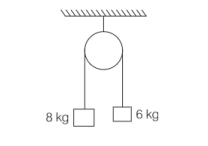
In the above figure, 8 kg and 6 kg are hanging stationary from a rough pulley and are about to move. They are stationary due to roughness of the pulley.
→Force of Friction on Connected Bodies When bodies are in contact, there are mutual contact forces satisfying the third law of motion. The component of contact force normal to the surfaces in contact is called normal reaction. The component parallel to the surfaces in contact is called friction
In the above figure, 8 kg and 6 kg are hanging stationary from a rough pulley and are about to move. They are stationary due to roughness of the pulley.
- Which force is acting between pulley and rope?
- Gravitational force
- Tension force
- Frictional force
- Buoyant force
- The normal reaction acting on the system is
- 8g
- 6g
- 2g
- 4g
- The tension is more on side having mass of:
- 8kg
- 6kg
- Same on both
- Nothing can be said
- The force of friction acting on the rope is:
- 20N
- 30N
- 40N
- 50N
- Coefficient of friction of the pulley is
- $\frac{1}{6}$
- $\frac{1}{7}$
- $\frac{1}{5}$
- $\frac{1}{4}$
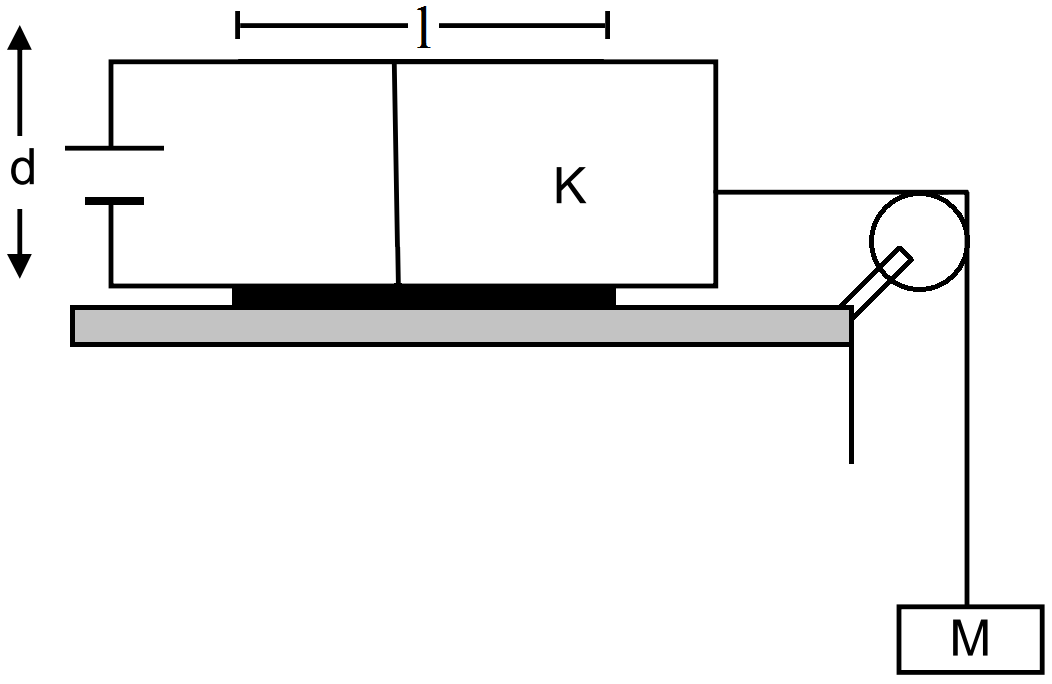
Consider the situation shown in figure. The width of each plate is b. The capacitor plates are rigidly clamped in the laboratory and connected to a battery of emf $\in.$ All surfaces are frictionless. Calculate the value of M for which the dielectric slab will stay in equilibrium.
→You are holding a cage containing a bird. Do you have to make less effort if the bird flies from its position in the cage and manages to stay in the middle without touching the walls of the cage? Does it make a difference whether the cage is completely closed or it has rods to let air pass?
A metallic loop is placed in a nonuniform magnetic field. Will an emf be induced in the loop?
A simple pendulum fixed in a car has a time period of 4 seconds when the car is moving uniformly on a horizontal road. When the accelerator is pressed, the time period changes to 3.99 seconds. Making an approximate analysis, find the acceleration of the car.
The weight Mg of an extended body is generally shown in a diagram to act through the centre of mass. Does it mean that the earth does not attract other particles?
Read the passage given below and answer the following questions from 1 to 5.
Earth’s Satellite:
Earth satellites are objects which revolve around the earth. Their motion is very similar to the motion of planets around the Sun. In particular, their orbits around the earth are circular or elliptic. Moon is the only natural satellite of the earth with a near circular orbit with a time period of approximately 27.3 days which is also roughly equal to the rotational period of the moon about its own axis. Also, the speed that a satellite needs to be travelling to break free of a planet or moon’s gravity well and leave it without further propulsion is known as escape velocity. For example, a spacecraft leaving the surface of earth needs to be going 7 miles per second or nearly 25000 miles per hour to leave without falling back to the surface or falling into orbit.
→Earth’s Satellite:
Earth satellites are objects which revolve around the earth. Their motion is very similar to the motion of planets around the Sun. In particular, their orbits around the earth are circular or elliptic. Moon is the only natural satellite of the earth with a near circular orbit with a time period of approximately 27.3 days which is also roughly equal to the rotational period of the moon about its own axis. Also, the speed that a satellite needs to be travelling to break free of a planet or moon’s gravity well and leave it without further propulsion is known as escape velocity. For example, a spacecraft leaving the surface of earth needs to be going 7 miles per second or nearly 25000 miles per hour to leave without falling back to the surface or falling into orbit.
- Gas escapes from the surface of a planet because it acquires an escape velocity. The escape velocity will depend on which of the following factors?
- Mass of the planet
- Mass of the particle escaping
- Temperature of the planet
- None of the above
- The escape velocity of a satellite from the earth is ve If the radius of earth contracts to $(\frac{1}{4})$ th of its value, keeping the mass of the earth constant, escape velocity will be:
- doubled
- halved
- tripled
- unaltered
- The ratio of escape velocity at earth (ve) to the escape velocity at a planet (v p), whose radius and mean density are twice as that of earth is:
- $1:2\sqrt{2}$
- 1 : 4
- $1:\sqrt{2}$
- 1 : 2
- A satellite S is moving in an elliptical orbit around the earth. The mass of the satellite is very small as compared to the mass of the earth, then:
- the angular momentum of S about the centre of the earth changes in direction, but its magnitude remains constant
- the total mechanical energy of S varies periodically with time
- the linear momentum of S remains constant in magnitude
- the acceleration of S is always directed towards the centre of the earth
- The orbital velocity of an artificial satellite in a circular orbit just above the earth’s surface is vo The orbital velocity of a satellite orbiting at an altitude of half of the radius, is:
- $\frac{3}{2}\text{v}_\circ$
- $\frac{2}{3}\text{v}_\circ$
- $\sqrt{\frac{3}{2}\text{v}_\circ}$
- $\sqrt\frac{2}{3}\text{v}_\circ$