Questions · Page 1 of 3

1 Marks Question

Take a timed test

50 questions · 1 auto-graded MCQ + 49 self-marked written.
Question 11 Mark
Which of the following examples represent periodic motion? An arrow released from a bow.
Answer
There is no repetition, hence not periodic.
View full question & answer
Question 21 Mark
Which of the following functions of time represent (a) simple harmonic, (b) periodic but not simple harmonic, and (c) non-periodic motion? Give period for each case of periodic motion ($\omega$ is any positive constant): $\text{exp}(-\omega^2\text{t}^2)$
Answer
Non-periodic motion The given function $\text{exp}(-\omega^2\text{t}^2)$ is an exponential function. Exponential functions do not repeat themselves. Therefore, it is a non-periodic motion.
View full question & answer
Question 31 Mark
Which of the following examples represent periodic motion? A swimmer completing one (return) trip from one bank of a river to the other and back.
Answer
There is no repetition of the motion as the swimmer just completes one trip hence not periodic.
View full question & answer
Question 41 Mark
Which of the following examples represent (nearly) simple harmonic motion and which represent periodic but not simple harmonic motion?General vibrations of a polyatomic molecule about its equilibrium position.
Answer
A polyatomic molecule has many natural frequencies of oscillation. Its vibration is the superposition of individual simple harmonic motions of a number of different molecules. Hence, it is not simple harmonic, but periodic.
View full question & answer
Question 51 Mark
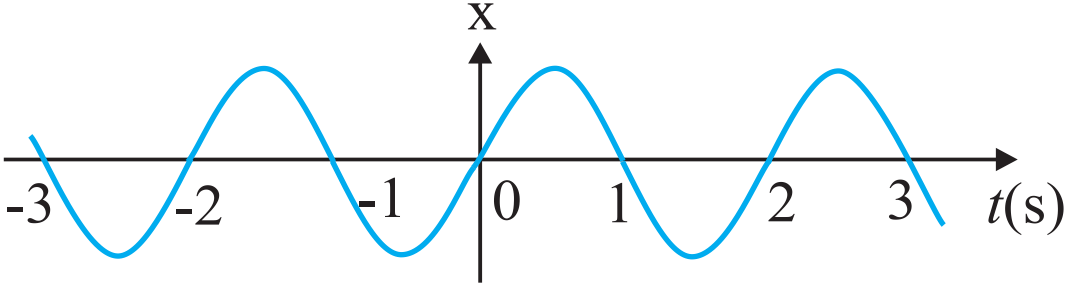
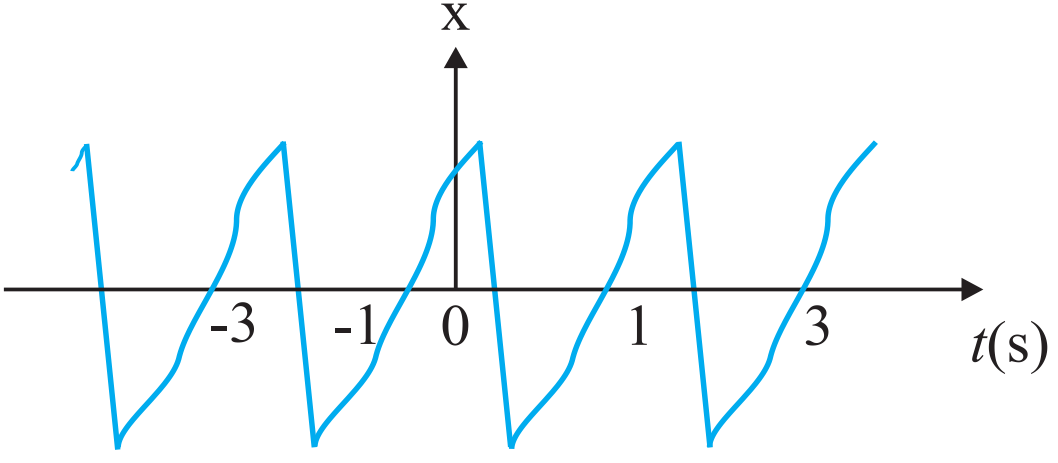
Fig. depicts four x-t plots for linear motion of a particle. Which of the plots represent periodic motion? What is the period of motion (in case of periodic motion)?
Answer
In this case, the motion of the particle repeats itself after 2s. Hence, it is a periodic motion, having a period of 2s.
View full question & answer
Question 61 Mark
A particle is in linear simple harmonic motion between two points, A and B, 10cm apart. Take the direction from A to B as the positive direction and give the signs of velocity, acceleration and force on the particle when it is: At the end A.
Answer

From above figure, where A and B represent the two extreme positions of a SHM. For velocity, the direction from A to B is taken to b positive. The acceleration and the force, along AP are taken as positive and along Bp are taken as negative.
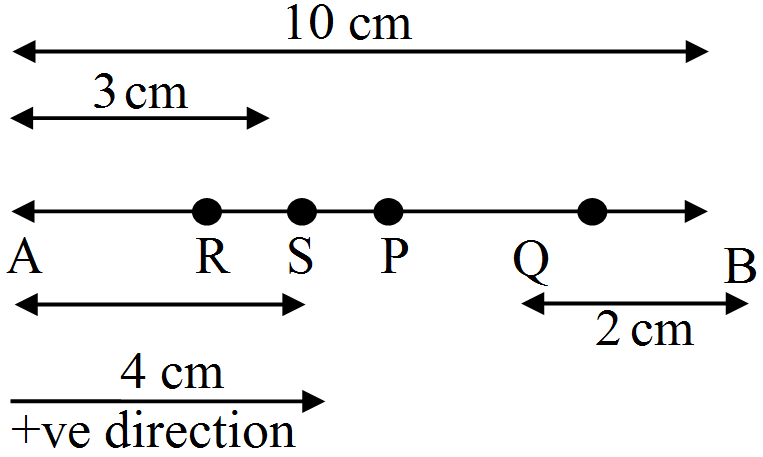
At the end A, the particle executing SHM is momentarily at rest being its extreme position of motion. Therefore, its velocity is zero. Acceleration is positive because it is directed along AP, Force is also Positive since the force is directed along AP.
View full question & answer
Question 71 Mark
Which of the following functions of time represent (a) simple harmonic, (b) periodic but not simple harmonic, and (c) non-periodic motion? Give period for each case of periodic motion ($\omega$ is any positive constant): $1+\omega\text{t}+\omega^2\text{t}^2$
Answer
The given function $1+\omega\text{t}+\omega^2\text{t}^2$ is non-periodic.
View full question & answer
Question 81 Mark
Which of the following examples represent periodic motion? A freely suspended bar magnet displaced from its N-S direction and released.
Answer
The motion is repeated after a certain interval of time, hence periodic. In fact, the bar magnet oscillates about its mean position with a definite period of time.
View full question & answer
Question 91 Mark
A particle is in linear simple harmonic motion between two points, A and B, 10cm apart. Take the direction from A to B as the positive direction and give the signs of velocity, acceleration and force on the particle when it is:At the mid-point of AB going towards A.
Answer

From above figure, where A and B represent the two extreme positions of a SHM. For velocity, the direction from A to B is taken to b positive. The acceleration and the force, along AP are taken as positive and along Bp are taken as negative.
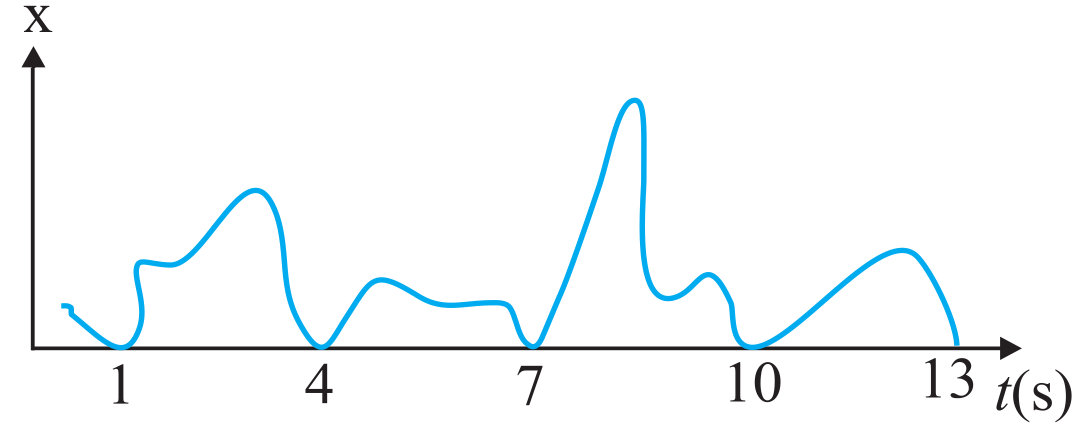
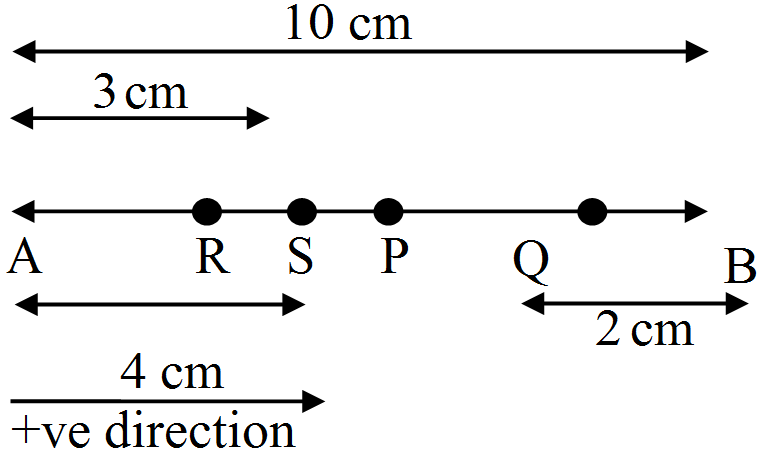
At the mid-point of AB going towards A, the particle is at its mean position P, with a tendency to move along PA. Hence, velocity is positive. Both acceleration and force are zero.
View full question & answer
Question 101 Mark
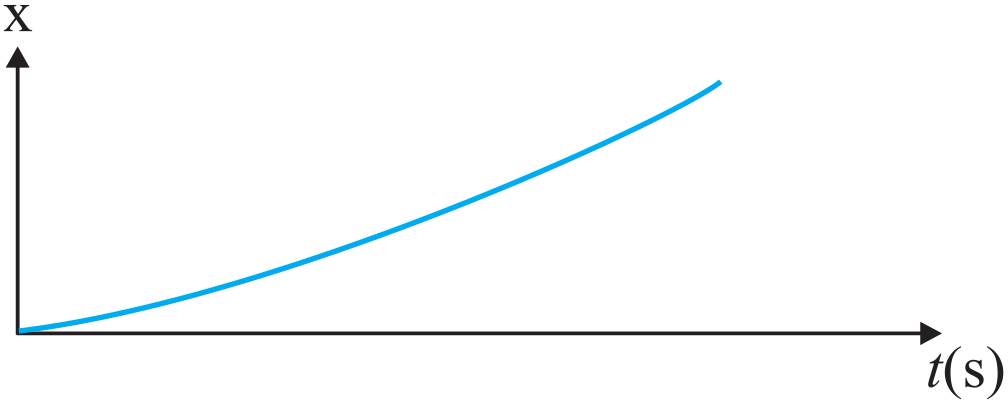
Fig. depicts four x-t plots for linear motion of a particle. Which of the plots represent periodic motion? What is the period of motion (in case of periodic motion)?
Answer
It is not a periodic motion. This is because the particle repeats the motion in one position only. For a periodic motion, the entire motion of the particle must be repeated in equal intervals of time.
View full question & answer
Question 111 Mark
Which of the following examples represent (nearly) simple harmonic motion and which represent periodic but not simple harmonic motion? The rotation of earth about its axis.
Answer
It is periodic but not simple harmonic motion because it is not to and fro about a fixed point.
View full question & answer
Question 121 Mark
A particle is in linear simple harmonic motion between two points, A and B, 10cm apart. Take the direction from A to B as the positive direction and give the signs of velocity, acceleration and force on the particle when it is: At the end B.
Answer

From above figure, where A and B represent the two extreme positions of a SHM. For velocity, the direction from A to B is taken to b positive. The acceleration and the force, along AP are taken as positive and along Bp are taken as negative.
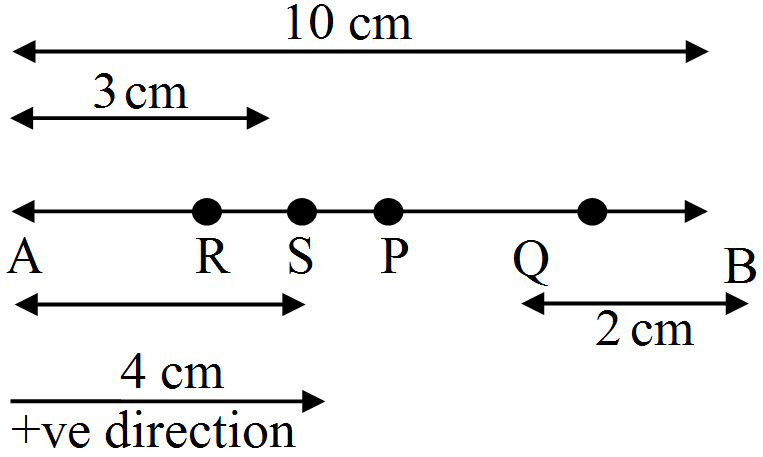
At the end B, velocity is zero. Here, acceleration and force are negative as they are directed along BP.
View full question & answer
Question 131 Mark
A particle is in linear simple harmonic motion between two points, A and B, 10cm apart. Take the direction from A to B as the positive direction and give the signs of velocity, acceleration and force on the particle when it is:At 3cm away from A going towards B.
Answer

From above figure, where A and B represent the two extreme positions of a SHM. For velocity, the direction from A to B is taken to b positive. The acceleration and the force, along AP are taken as positive and along Bp are taken as negative.
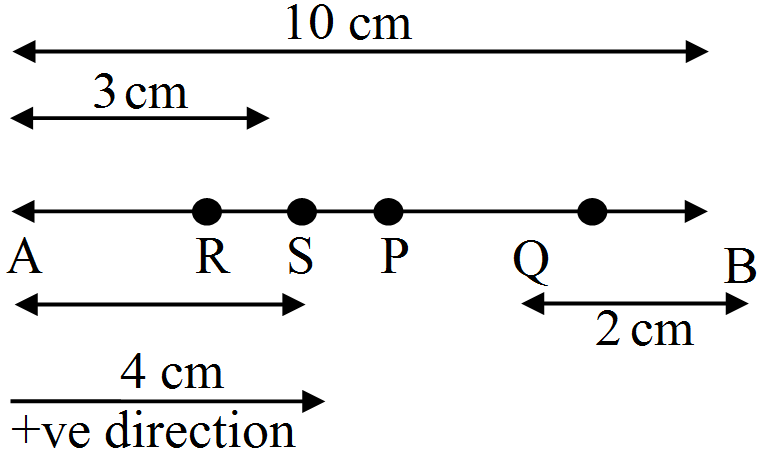
At 3cm away from A going towards B, the particle is at R, with a tendency to move along RP, which is positive direction. Here, velocity, acceleration all are positive.
View full question & answer
MCQ 141 Mark
Which of the following relationships between the acceleration a and the displacement $x$ of a particle involve simple harmonic motion?
  • A
    $a=0.7 x$
  • B
    $a=-200 x^2$
  • $a=-10 x$
  • D
    $a=100 x^3$
Answer
Correct option: C.
$a=-10 x$
In $\text{SHM}$, acceleration a is related to displacement by the relation of the form $a = -kx$, which is for relation $(c)$.
View full question & answer
Question 151 Mark
Which of the following examples represent (nearly) simple harmonic motion and which represent periodic but not simple harmonic motion? Motion of a ball bearing inside a smooth curved bowl, when released from a point slightly above the lower most point.
Answer
It is simple harmonic motion because the ball moves to and fro about the lowermost point of the bowl when released. Also, the ball comes back to its initial position in the same period of time, again and again.
View full question & answer
Question 161 Mark
Which of the following examples represent periodic motion?A hydrogen molecule rotating about its centre of mass.
Answer
Rotatary motion is periodic as repeating after fixed time-interval.
View full question & answer
Question 171 Mark
A particle is in linear simple harmonic motion between two points, A and B, 10cm apart. Take the direction from A to B as the positive direction and give the signs of velocity, acceleration and force on the particle when it is:At 2cm away from B going towards A.
Answer

From above figure, where A and B represent the two extreme positions of a SHM. For velocity, the direction from A to B is taken to b positive. The acceleration and the force, along AP are taken as positive and along Bp are taken as negative.
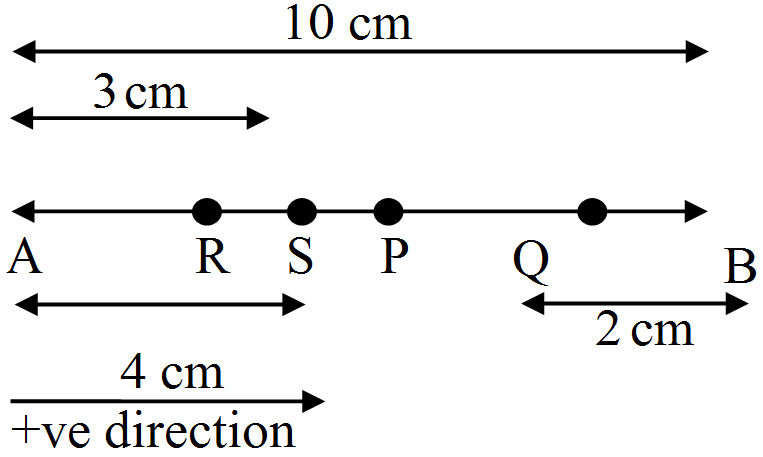
At 2cm away from B going towards A, the particle is at Q, with a tendency to move along QP, which is negative direction. Therefore, velocity, acceleration and force all are positive.
View full question & answer
Question 181 Mark
A particle is in linear simple harmonic motion between two points, A and B, 10cm apart. Take the direction from A to B as the positive direction and give the signs of velocity, acceleration and force on the particle when it is:At 4cm away from B going towards A.
Answer

From above figure, where A and B represent the two extreme positions of a SHM. For velocity, the direction from A to B is taken to b positive. The acceleration and the force, along AP are taken as positive and along Bp are taken as negative.
At 4cm away from A going towards A, the particles is at S, with a tendency to move along SA, which is negative direction. Therefore, velocity is negative but acceleration is directed towards mean position, along SP. Hence it is positive and also force is positive similarly.
View full question & answer
Question 191 Mark
Which of the following examples represent (nearly) simple harmonic motion and which represent periodic but not simple harmonic motion? Motion of an oscillating mercury column in a U-tube.
Answer
It is a simple harmonic motion because the mercury moves to and fro on the same path, about the fixed position, with a certain period of time.
View full question & answer
Question 201 Mark
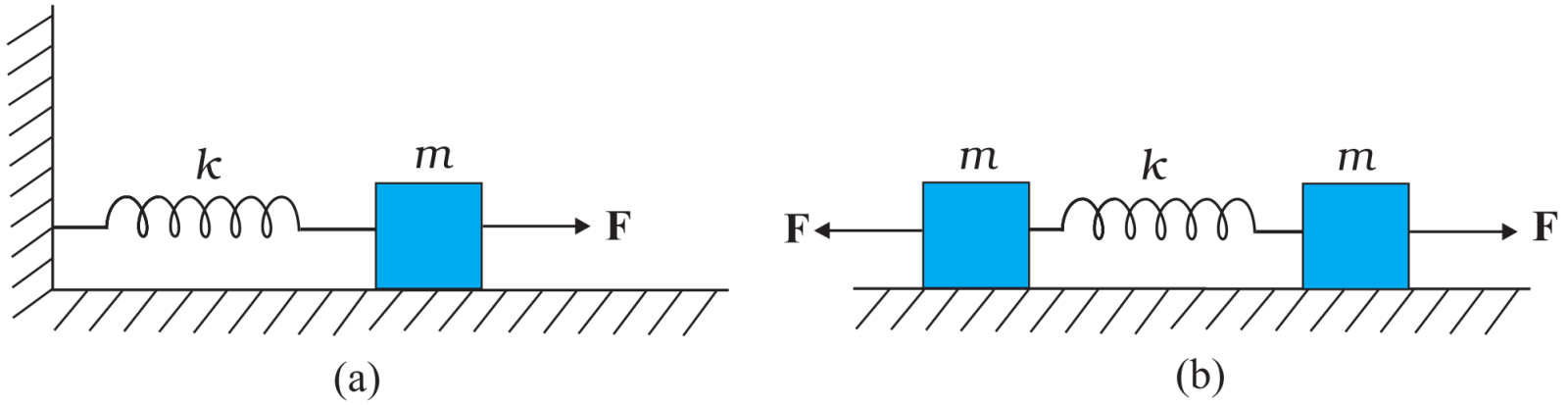
Figure (a) shows a spring of force constant k clamped rigidly at one end and a mass m attached to its free end. A force F applied at the free end stretches the spring. Figure (b) shows the same spring with both ends free and attached to a mass m at either end. Each end of the spring in Fig. (b) is stretched by the same force F.
What is the maximum extension of the spring in the two cases?
Answer
The maximum extension of the spring in both cases will = Flk, where k is the spring constant of the springs used.
View full question & answer
Question 211 Mark
Fig. depicts four x-t plots for linear motion of a particle. Which of the plots represent periodic motion? What is the period of motion (in case of periodic motion)?
Answer
In this case, the motion of the particle repeats itself after 2s. Hence, it is a periodic motion, having a period of 2s.
View full question & answer
Question 221 Mark
Fig. depicts four x-t plots for linear motion of a particle. Which of the plots represent periodic motion? What is the period of motion (in case of periodic motion)?
Answer
It is not a periodic motion. This represents a unidirectional, linear uniform motion. There is no repetition of motion in this case.
View full question & answer
Question 231 Mark
Answer the following questions:What is the frequency of oscillation of a simple pendulum mounted in a cabin that is freely falling under gravity?
Answer
When a simple pendulum mounted in a cabin falls freely under gravity, its acceleration is zero. Hence the frequency of oscillation of this simple pendulum is zero.
View full question & answer
Question 241 Mark
Which of the following examples represent periodic motion? An arrow released from a bow.
Answer
There is no repetition, hence not periodic.
View full question & answer
Question 251 Mark
How is the path difference related to phase difference?
Answer
Path difference $=\frac{\lambda}{2\pi}\times\text{phase difference}$
View full question & answer
Question 261 Mark
Which of the following functions of time represent (a) simple harmonic, (b) periodic but not simple harmonic, and (c) non-periodic motion? Give period for each case of periodic motion ($\omega$ is any positive constant):$\text{exp}(-\omega^2\text{t}^2)$
Answer
Non-periodic motion The given function $\text{exp}(-\omega^2\text{t}^2)$ is an exponential function. Exponential functions do not repeat themselves. Therefore, it is a non-periodic motion.
View full question & answer
Question 271 Mark
What is an epoch? Name the unit in which it is measured.
Answer
The initial difference in position from mean position expressed in radians is called epoch.
View full question & answer
Question 281 Mark
What is the force equation of a SHM?
Answer
According to force equation of SHM, F = -kx, where, k is a constant known as force constant.
View full question & answer
Question 291 Mark
A body of mass m is situated in a potential field $\text{U}(\text{x})=\text{U}_0(1-\cos\text{ax}),$ Where $U_0$ and a are constant. find the time period of small oscillation.
Answer
$\because\text{dW}=\text{F}.\text{dx}$ if W = U, then$\text{dU}=\text{F}.\text{dx}\ \text{or}\ \text{F}=\frac{-\text{dU}}{\text{dx}}$ (here restoring force is opposite to displacement)
$\text{F}=\frac{-\text{d}}{\text{dx}}[\text{U}_0(1-\cos\text{ax})=\frac{-\text{d}}{\text{dx}}[\text{U}_0+\text{U}_0\cos\text{a}_\text{x}]$
$\text{F}=-[0-\text{U}_0(-\sin\text{ax}).\text{a}]$
$\text{F}=-\text{aU}_0\sin\text{a}\text{x}$
For SHM. ax is small
So sin ax becomes ax ...(i)
$\therefore\text{F}=-\alpha.\text{U}_0\text{ax}=-\text{a}^2\text{U}_0\text{x}\ ...(\text{ii})$
$\alpha_2\text{U}_0$ are constants.
$\therefore\text{F}\propto-\text{x}.$ so motion is SHM.
Here from (ii) $k = a^2U_0$
$\text{m}\omega^2=\text{a}^2\text{U}_0\Rightarrow\omega^2=\text{a}^2\frac{\text{U}_0}{\text{m}}$
$\Big(\frac{2\pi}{\text{T}}\Big)^2=\text{a}^2\frac{\text{U}_0}{\text{m}}\Rightarrow\text{T}^2=4\pi\frac{\text{m}}{\text{U}_0\text{a}^2}\ \text{or}$
$\text{T}=\frac{2\pi}{\text{a}}\sqrt{\frac{\text{m}}{\text{U}_0}}.$
From (i) this time period is valid for small angle ax.
View full question & answer
Question 301 Mark
What happens to the time period of a simple pendulum if its length is doubled?
Answer
The time period is increased by a factor of $\sqrt{2}$.
View full question & answer
Question 311 Mark
What forces keep the simple pendulum in simple harmonic motion?
Answer
Restoring force $\text{mg}\sin\theta$ and proper tension maintain simple harmonic motion in simple pendulum.
View full question & answer
Question 321 Mark
Is the damping force constant on a system executing S.H.M?
Answer
No. It is directly proportional to velocity which is a variable with time.
View full question & answer
Question 331 Mark
Why a point on a rotating wheel cannot be considered as executing S.H.M.?
Answer
It is only periodic and not oscillatory.
View full question & answer
Question 341 Mark
Which of the following examples represent periodic motion? A swimmer completing one (return) trip from one bank of a river to the other and back.
Answer
There is no repetition of the motion as the swimmer just completes one trip hence not periodic.
View full question & answer
Question 351 Mark
Which of the following examples represent (nearly) simple harmonic motion and which represent periodic but not simple harmonic motion?General vibrations of a polyatomic molecule about its equilibrium position.
Answer
A polyatomic molecule has many natural frequencies of oscillation. Its vibration is the superposition of individual simple harmonic motions of a number of different molecules. Hence, it is not simple harmonic, but periodic.
View full question & answer
Question 361 Mark
A pendulum is making one oscillation in every two seconds. What is the frequency of oscillation?
Answer
0.5Hz.
View full question & answer
Question 371 Mark
Why does the time period of a swing not change when two persons sit on it instead of one?
Answer
$\text{T}=2\pi\frac{\text{l}}{\text{g}},$ so it does not depend upon the mass.
View full question & answer
Question 381 Mark
What will be the time period of oscillation, if the length of a second pendulum is one third?
Answer
$\frac{\text{T}_2^2}{\text{T}_1^2}=\frac{\text{l}_2}{\text{l}_1}\frac{\Big(\frac{\text{l}}{3}\Big)}{\text{l}}\frac{1}{3}$$\frac{\text{T}_2^2}{\text{T}_1^2}=\frac{(2)^2}{3}$
$\text{T}_2=\frac{2}{\sqrt{3}}\text{s}$
View full question & answer
Question 391 Mark
What are the basic properties required by a system to oscillate?
Answer
Inertia and elasticity are the properties which are required by a system to oscillate.
View full question & answer
Question 401 Mark
Is it correct to say the “linear combinations of S.H.M. is a S.H.M."?
Answer
Yes, e.g., $\text{a}\sin\omega\text{t + b}\cos\omega\text{t}$ is a linear combination which is also S.H.M. with amplitude $\sqrt{\text{a}^2+\text{b}^2}.$
View full question & answer
Question 411 Mark
What is the main difference between forced oscillations and resonance?
Answer
In forced oscillations, a body oscillates with the help of external periodic force with a frequency different from natural frequency of body but in resonance a body oscillates with its own natural frequency with the help of an external periodic force whose frequency is equal to natural frequency of body.
View full question & answer
Question 421 Mark
Two exactly similar simple pendula are vibrating with amplitudes 1cm and 3cm. What is the ratio of their energies of vibration?
Answer
$\frac{\text{E}_1}{\text{E}_2}=\frac{\text{a}_1^2}{\text{a}_2^2}=\Big(\frac{1}{3}\Big)^2=\frac{1}{9}$.
View full question & answer
Question 431 Mark
Can the motion of an artificial satellite around earth be taken as S.H.M?
Answer
No, it is a circular and periodic motion but not to and fro about a mean position which is essential for SHM.
View full question & answer
Question 441 Mark
What is the phase difference between particle velocity and particle acceleration in SHM?
Answer
Particle acceleration in SHM is ahead in phase by $\frac{\pi}{2}$ as compared to the particle velocity.
View full question & answer
Question 451 Mark
Which of the following functions of time represent (a) simple harmonic, (b) periodic but not simple harmonic, and (c) non-periodic motion? Give period for each case of periodic motion ($\omega$ is any positive constant):$1+\omega\text{t}+\omega^2\text{t}^2$
Answer
The given function $1+\omega\text{t}+\omega^2\text{t}^2$ is non-periodic.
View full question & answer
Question 461 Mark
Two springs of force constants $\text{k}_1$ and $\text{k}_2$ are joined in series. What is the force constant of the combination?
Answer
The force constant k of series combination is given by $\frac{1}{\text{k}}=\frac{1}{\text{k}_1}+\frac{1}{\text{k}_2}$$\text{k}=\frac{\text{k}_1\text{k}_2}{\text{k}_1+\text{k}_2}$.
View full question & answer
Question 471 Mark
Which of the following examples represent periodic motion? A freely suspended bar magnet displaced from its N-S direction and released.
Answer
The motion is repeated after a certain interval of time, hence periodic. In fact, the bar magnet oscillates about its mean position with a definite period of time.
View full question & answer
Question 481 Mark
How would the period of spring mass system change, when it is made to oscillate horizontally and then vertically?
Answer
The time period remains same in both the cases.
View full question & answer
Question 491 Mark
A particle is in linear simple harmonic motion between two points, A and B, 10cm apart. Take the direction from A to B as the positive direction and give the signs of velocity, acceleration and force on the particle when it is:At the mid-point of AB going towards A.
Answer

From above figure, where A and B represent the two extreme positions of a SHM. For velocity, the direction from A to B is taken to b positive. The acceleration and the force, along AP are taken as positive and along Bp are taken as negative.
At the mid-point of AB going towards A, the particle is at its mean position P, with a tendency to move along PA. Hence, velocity is positive. Both acceleration and force are zero.
View full question & answer
Question 501 Mark
When a pendulum clock gains time, what adjustment should be made?
Answer
When a pendulum clock gains time, it means it has gone fast i.e., it makes more vibrations per day than required. This shows that the time period of oscillation has decreased. Therefore, to correct it, the length of pendulum should be properly increased.
View full question & answer
1 Marks Question - Physics STD 11 Science Questions - Vidyadip