Questions · Page 2 of 3

1 Marks Question

Question 511 Mark
How will the time period of a simple pendulum change when its length is doubled?
Answer
It becomes $\sqrt{2}$ times the original time period.
View full question & answer
Question 521 Mark
Sometimes, when an automobile picks up speed, its body begins to rattle. Why?
Answer
This is because of resonant vibrations.
View full question & answer
Question 531 Mark
If the displacement is represented by $\text{x}=3\sin\omega\text{t}+4\cos\omega\text{t},$ what is the amplitude?
Answer
Phase difference between $3\sin\omega\text{t}$ and $4\cos\omega\text{t}$ is $\frac{\pi}{2}.$$\therefore$ The amplitude is $\sqrt{3^2+4^2},$ i.e., 5 units.
View full question & answer
Question 541 Mark
Is the damping force constant on a system executing SHM?
Answer
No, because damping force depends upon velocity and is more when the system moves fast and is less when the system moves slow.
View full question & answer
Question 551 Mark
Show that for a particle executing S.H.M, velocity and displacement have a phase difference of $\frac{\pi}{2}.$
Answer
Let the displacement equation of SHM$\text{x}=\text{a}\cos\omega\text{t}$
Velocity $\text{v}=\frac{\text{dx}}{\text{dt}}=\text{a}\omega(-\sin\omega\text{t})=-\text{a}\omega\sin\omega\text{t}$$\Rightarrow\text{v}=\text{a}\omega\cos\Big(\frac{\pi}{2}+\omega\text{t}\Big)$
Now, phase of displacement $\phi_1=\omega\text{t}$ Phase of velocity $\phi_2=\frac{\pi}{2}+\omega\text{t}$$\therefore$ Difference in phase of velocity to that of phase of displacement
$\triangle\phi=\phi_2-\phi_1=\Big(\frac{\pi}{2}+\omega\text{t}\Big)-(\omega\text{t})=\frac{\pi}{2}$
View full question & answer
Question 561 Mark
Define force constant.
Answer
Force constant is defined as the restoring force developed in a body per unit displacement.
View full question & answer
Question 571 Mark
On what factors does the energy of a harmonic oscillator depend?
Answer
Energy of a harmonic oscillator depends on the mass, frequency and amplitude of oscillation.
View full question & answer
Question 581 Mark
What is the maximum value of the kinetic energy/ in the case of S.H.M.?
Answer
Maximum value of K.E. is total energy, i.e. $\frac{1}{2}\text{m}\omega^2\text{A}^2.$
View full question & answer
Question 591 Mark
Give the name of three important characteristics of a SHM.
Answer
Three important characteristics of an SHM are amplitude, time period (or frequency) and phase.
View full question & answer
Question 601 Mark
What provides restoring force in the following cases?
  1. A spring compressed and then left free to vibrate.
  2. Water disturbed in $U-$tube.
  3. Pendulum disturbed from its mean position.
Answer
  1. Elasticity of the material of the spring.
  2. Weight of water.
  3. Weight of pendulum.
View full question & answer
Question 611 Mark
When is the tension maximum in the string of a simple pendulum?
Answer
At the lower-most point or mean position.
View full question & answer
Question 621 Mark
What will be the time period of oscillation, if the length of a second pendulum is one third?
Answer
$\frac{\text{T}_2^2}{\text{T}_2^1}=\frac{\text{l}_2}{\text{l}_1}=\frac{\text{l}}{\frac{3}{1}}=\frac{1}{3}$$\text{T}^2_2=\frac{(2)^2}{3}$
$\text{T}_2=\frac{2}{\sqrt{3}}\text{ sec}$
View full question & answer
Question 631 Mark
Can a motion be periodic but not oscillatory? If your answer is yes, give an example and if not explain why?
Answer
Yes, e.g., circular motion is periodic but not oscillatory.
View full question & answer
Question 641 Mark
The amplitude of a harmonic oscillator is doubled. How does its energy change?
Answer
As $\text{E}\propto\text{A}^2$ the energy of harmonic oscillator will became 4 times, its original value when its amplitude is doubled.
View full question & answer
Question 651 Mark
Which of the following examples represent (nearly) simple harmonic motion and which represent periodic but not simple harmonic motion? The rotation of earth about its axis.
Answer
It is periodic but not simple harmonic motion because it is not to and fro about a fixed point.
View full question & answer
Question 661 Mark
A simple harmonic motion is described by a = -16x where a → acceleration, x → displacement in m. What is the time period?
Answer
For S.H.M., $\text{a}=-\omega^2\text{x}$ Comparing with $\text{a}=-16\text{x}$$\because\omega^2=16\Rightarrow\omega=\frac{2\pi}{\text{T}}=\sqrt{16}=4$
$\therefore\text{T}=\frac{\pi}{2}\text{ second}$
View full question & answer
Question 671 Mark
State force law for a simple harmonic motion.
Answer
Force $\text{F}\propto-\text{x}$$\Rightarrow\text{F = kx}$
$\Rightarrow\text{F}=-\text{m}\omega^2\text{x}.$
View full question & answer
Question 681 Mark
Is oscillation of a mass suspended by a spring simple harmonic in nature?
Answer
Yes, it is if the spring is perfectly elastic.
View full question & answer
Question 691 Mark
All oscillatory motions are periodic and vice-versa. Is it true?
Answer
No, There are other types of periodic motions also. Circular motion and rotatory motion are periodic but non-oscillatory.
View full question & answer
Question 701 Mark
What provides the restoring force for simple harmonic oscillations in the following cases?
  1. Simple pendulum.
  2. Spring.
  3. Column of mercury in $U-$tube.
Answer
  1. Part of the force of gravity.
  2. Elastic restoring force.
  3. Force due to difference in column of mercury or pressure difference between the levels on the two limbs.
View full question & answer
Question 721 Mark
A simple pendulum of length l suspended from a roof of a trolley which moves in a horizontal direction with an acceleration a. Find its time period of oscillation.
Answer
The trolley is accelerated horizontally by a. So, there will be two accelerations, g vertically down and horizontal acceleration a. The net acceleration is $\sqrt{\text{g}^2+\text{a}^2}.$ The time period.$\text{T}=2\pi\sqrt{\frac{\text{l}}{\sqrt{\text{g}^2+\text{a}^2}}}.$
View full question & answer
Question 731 Mark
What will be the change in the time period of a loaded spring when taken to moon?
Answer
No change, since $\text{T}=2\pi\sqrt{\frac{\text{m}}{\text{k}}}$
View full question & answer
Question 741 Mark
A cylindrical wooden block of cross-section $15.0 \mathrm{~cm}^2$ and mass 230 gm is floated over water with an extra weight 50 gm attached to its bottom. The cylinder floats vertically. From the state of equilibrium, it is slightly depressed and released. If the specific gravity of wood is 0.30 and $\mathrm{g}=9.8 \mathrm{~m}$ per $\mathrm{sec}^2$, find the frequency of oscillation of the block.
Answer
Area of cross-section of the block $=\pi \mathrm{r}^2=15 \mathrm{~cm}^2=15 \times 10^{-4} \mathrm{~m}^2$ Total weight of the block $=(230+50)=280 \mathrm{gm}=$ 0.28 kg Density of wood $=0.30 \mathrm{gm} / \mathrm{c} . \mathrm{c}=300 \mathrm{~kg} / \mathrm{m}^3$ Density of water $=10^3 \mathrm{~kg}$
When the cylinder is depressed in water through a distance $y$ the restoring force $=$ weight of water displaced $\mathrm{F}=$ Aydg $=\left(15 \times 10^{-4}\right) \times 10^3 \times 9.8$ newton/metre $=1.5 \times 9.8 \mathrm{~N} / \mathrm{m}$ Hence the frequenry of orillation is given by
$=\frac{1}{2\pi}\sqrt{\Big(\frac{\text{k}}{\text{m}}\Big)}$
$=\frac{1}{2\pi}\sqrt{\frac{1.5\times9.8}{0.28}}$
$=1.15\text{Hz}$
View full question & answer
Question 751 Mark
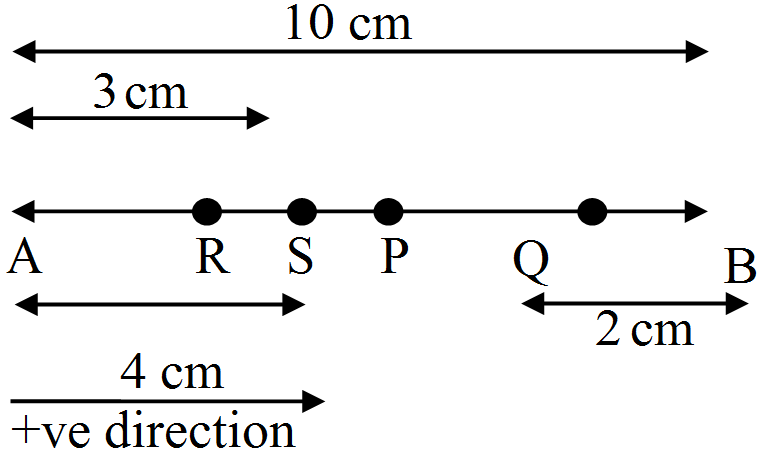
A particle is in linear simple harmonic motion between two points, A and B, 10cm apart. Take the direction from A to B as the positive direction and give the signs of velocity, acceleration and force on the particle when it is: At the end B.
Answer

From above figure, where A and B represent the two extreme positions of a SHM. For velocity, the direction from A to B is taken to b positive. The acceleration and the force, along AP are taken as positive and along Bp are taken as negative.
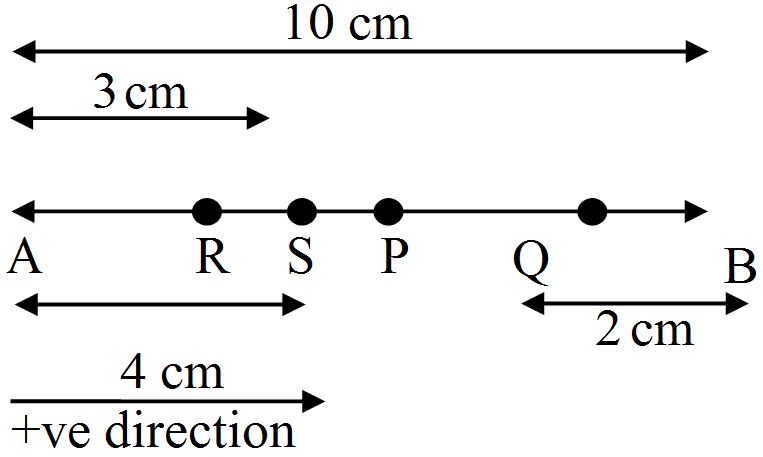
At the end B, velocity is zero. Here, acceleration and force are negative as they are directed along BP.
View full question & answer
Question 761 Mark
The maximum acceleration is a and the maximum velocity is v. What is the amplitude?
Answer
$\text{a}_{\text{max}}=-\omega^2\text{A = a, v}_{\text{max}}=\omega\text{A = v}$$\frac{\text{a}_{\text{max}}}{\text{v}_{\text{max}}}=\frac{\text{a}}{\text{v}}=-\omega,$
Also $\text{v}=\omega\text{A}=\frac{\text{a}}{\text{v}}\text{A}$
$\therefore\text{A}=\frac{\text{v}^2}{\text{a}}$
View full question & answer
Question 781 Mark
If the total energy with an oscillating system is E, what is the kinetic energy at $\text{x}=\frac{\text{A}}{3}?$
Answer
K.E. $=\frac{1}{2}\text{m}\omega^2(\text{A}^2-\text{x}^2)$ Total energy, $\text{E}=\frac{1}{2}\text{m}\omega^2\text{A}^2$ At, $\text{x}=\frac{\text{A}}{3},$ K.E. $=\frac{1}{2}\text{m}\omega^2\Big(\text{A}^2-\frac{\text{A}^2}{9}\Big)$$=\frac{8}{9}\frac{1}{2}\text{m}\omega^2\text{A}^2=\frac{8}{9}\text{E}$
View full question & answer
Question 791 Mark
What is I second's pendulum? What is the length of a second's pendulum?
Answer
A pendulum having a time period of 2 seconds is called second's pendulum. Since $\text{T}=2\pi\sqrt{\frac{\text{l}}{\text{g}}},$$\text{l}=\frac{\text{T}^2\text{g}}{4\pi^2}=\frac{4\text{g}}{4\pi^2}=1\text{m}$
View full question & answer
Question 801 Mark
Two simple pendulum of equal length cross each other at mean position. What is their phase difference?
Answer
$\pi$ radians.
View full question & answer
Question 811 Mark
What is the frequency of oscillation of a simple pendulum mounted in a cabin that is freely falling under gravity?
Answer
f = 0.
View full question & answer
Question 821 Mark
What is the frequency of variation of potential or kinetic energy when the frequency of the oscillation is f?
Answer
Since K.E. or P.E. $\propto\cos^2\omega\text{t}$ or $\sin^2\omega\text{t},$ the frequency of variation is 2f.
View full question & answer
Question 831 Mark
Two clocks, one working with oscillating pendulum and the other with spring are given. Which one will you use in satellite?
Answer
The clock with spring is preferred, since it is not influenced by variation in g.
View full question & answer
Question 841 Mark
Why the amplitude of the vibrating pendulum should be small?
Answer
For S.H.M., restoring force should always be pointing towards the mean position which is not possible at large angles.
View full question & answer
Question 851 Mark
Which of the following conditions is not sufficient for $\text{S.H.M}$. and why?
  1. Acceleration displacement.
  2. Restoring force o displacement.
Answer
Acceleration $\propto$ displacement is not sufficient since it does not refer the direction of these quantities. As you know acceleration is always against displacement.
View full question & answer
Question 861 Mark
What determines the natural frequency of a body?
Answer
Natural frequency of a body depends upon:
  1. Elastic properties of the material of the body and.
  2. Dimensions of the body.
View full question & answer
Question 871 Mark
State the conditions when motion of a particle can be an SHM.
Answer
For SHM, the restoring force on the particle must be proportional to its displacement and directed towards mean position.
View full question & answer
Question 881 Mark
A particle is in linear simple harmonic motion between two points, A and B, 10cm apart. Take the direction from A to B as the positive direction and give the signs of velocity, acceleration and force on the particle when it is:At 3cm away from A going towards B.
Answer

From above figure, where A and B represent the two extreme positions of a SHM. For velocity, the direction from A to B is taken to b positive. The acceleration and the force, along AP are taken as positive and along Bp are taken as negative.
At 3cm away from A going towards B, the particle is at R, with a tendency to move along RP, which is positive direction. Here, velocity, acceleration all are positive.
View full question & answer
Question 891 Mark
Can a simple pendulum vibrate at the centre of Earth?
Answer
No. This is because of zero value of g at the centre of Earth.
View full question & answer
Question 901 Mark
A simple pendulum is inside a space craft. What should be its time period of vibration?
Answer
Infinity or it does not oscillate.
View full question & answer
Question 911 Mark
A driver wearing an electronic digital watch goes down into sea water with terminal velocity v. How will the time in the water proof watch be affected?
Answer
It will not be affected as its action is independent of gravity and buoyant force.
View full question & answer
Question 921 Mark
What is the total energy of a simple harmonic oscillator?
Answer
$\frac{1}{2}\text{m}\omega^2\text{r}^2$ where r = amplitude, $\omega$ = angular frequency, m = mass of the oscillator.
View full question & answer
Question 931 Mark
A simple pendulum is mounted inside a space craft. What should be its time period of oscillation?
Answer
A simple pendulum is mounted inside a space craft. its time period of oscillation is given by$\text{T}=2\pi\sqrt{\frac{\text{l}}{\text{g}}}$
Here, I = 0, so T becomes infinity.
View full question & answer
Question 941 Mark
Two springs of force constant $\mathrm{k}_1$ and $\mathrm{k}_2$ are joined in parallel. What is the force constant of the combination?
Answer
Force constant $k$ of parallel combination is given by $k=k_1+k_2$. Thus, force constant of the parallel combination is equal to the sum of individual force constants of two springs.
View full question & answer
Question 961 Mark
Will a pendulum gain or lose time when taken to the top of a mountain?
Answer
At height as we move up 'g' decreases. Since $\text{T}\propto\frac{1}{\sqrt{\text{g}}}$ time period increases.
View full question & answer
Question 981 Mark
A particle is executing $\text{S.H.M.}$ Identify the positions of the particle where:
  1. $\text{K.E}$. of the particle is zero.
  2. $\text{P.E}$. is zero.
  3. $\text{P.E}$. is one fourth of the total energy.
  4. $\text{P.E}$. and $\text{K.E}$. are equal.
Answer
  1. At extreme position $(x = A)$
  2. At mean position $(x = 0)$
  3. $\frac{1}{2}\text{m}\omega^2(\text{A}^2-\text{x}^2)=\frac{1}{4}\times\frac{1}{2}\text{m}\omega^2\text{A}^2$
$\Rightarrow\text{x}=\frac{\sqrt{3}\text{A}}{2}$
  1. $\frac{1}{2}\text{m}\omega^2(\text{A}^2-\text{x}^2)=\frac{1}{2}\text{m}\omega^2\text{A}^2$
$\Rightarrow\text{x}=\frac{\text{A}}{\sqrt{2}}$
View full question & answer
Question 991 Mark
At what points is the energy entirely kinetic and potential in SHM?
Answer
At mean position, the energy is entirely K.E. At extreme positions, the energy is entirely P.E.
View full question & answer
Question 1001 Mark
A mass of 2 kg is attached to the spring of spring constant $50 \mathrm{Nm}^{-1}$. The block is pulled to a distance of 5 cm from its equilibrium position at $\mathrm{x}=0$ on a horizontal frictionless surface from rest at $\mathrm{t}=0$. Write the expression for its displacement at anytime $t$.
View full question & answer
1 Marks Question - Page 2 - Physics STD 11 Science Questions - Vidyadip