MCQ
Which thermodynamic property has the same value in systems when they are in thermal equilibrium?
  • Heat
  • B
    Pressure
  • C
    Volume
  • D
    None of these

Answer

Correct option: A.
Heat
A

Need a full question paper?

Generate a complete, print-ready paper with questions like this in minutes — across 16+ boards, with answer keys.
Start Generating Free

Similar questions

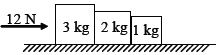
Three blocks of masses $3\, kg, 2\, kg$ and $1\, kg$ are placed side by side on a smooth  surface as shown in figure. A horizontal force of $12\,N$ is applied to $3\, kg$ block. The  net force on $2\, kg$ block is ............ $N$
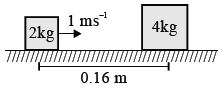
The friction coefficient between the horizontal surface and each of the block shown in  figure is $0.2.$ The collision between the blocks is perfectly elastic. What is the  separation between the blocks when they come to rest :- .............. $\mathrm{cm}$
A spherical drop of oil of radius $1\, cm$ is broken into $1000$ droplets of equal radii. If the surface tension of oil is $50$ dynes/cm, the work done is
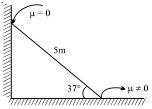
$A\, 5\, m$ long pole of $3\, kg$ mass is placed against a smooth vertical well as shown in the figure. Under equilibrium condition, if the pole makes an angle of $37^o$ with the horizontal, the frictional force between the pole and horizontal surface is
Consider two containers $A$ and $B$ containing identical gases at the same pressure, volume and temperature. The gas in container $A$ is compressed to half of its original volume isothermally while the gas in container $B$ is compressed to half of its original value adiabatically. The ratio of final pressure of gas in $B$ to that of gas in $A$ is
The unit of Young’s modulus is
A particle performs $SHM$ on $x-$ axis with time period of $0.5\,sec,$ such that it's velocity is zero at $x = -3\,cm$ and at $x = 9\,cm$. It was located at $x = 0$ and moving in negative $'x'$ at $t = 0$. The equation of $SHM$ of the particle is
A pipe $17\, cm$ long is closed at one end. Which harmonic mode of the pipe resonates  a $1.5\, kHz$ source ? 
(Speed of sound in air $= 340\, m\, s^{-1}$)
A bomb is dropped from an aeroplane moving horizontally at constant speed. When air resistance is taken into consideration, the bomb
$A$ block of mass $m$ moving with a velocity $v_0$ on a smooth horizontal surface strikes and compresses a spring of stiffness $k$ till mass comes to rest as shown in the figure. This phenomenon is observed by two observers:

$A$: standing on the horizontal surface

$B$: standing on the block 

According to observer $B$, the potential energy of the spring increases