Questions

M.C.Q (1 Marks)

🎯

Test yourself on this topic

16 questions · timed · auto-graded

MCQ 11 Mark
An electron and a proton are moving under the influence of mutual forces. In calculating the change in the kinetic energy of the system during motion, one ignores the magnetic force of one on another. This is because:
  • A
    The two magnetic forces are equal and opposite, so they produce no net effect.
  • The magnetic forces do no work on each particle.
  • C
    The magnetic forces do equal and opposite (but non-zero) work on each particle.
  • D
    The magenetic forces are necessarily negligible.
Answer
Correct option: B.
The magnetic forces do no work on each particle.
Key concept: To calculate the change in kinetic energy of the system during motion we have to apply work energy, theorem. According to this theorem, Net work done = Final kinetic energy - Initial kinetic energy of the object The above statement shows the connection between work and kinetic energy as:
“The work done by the net force acting on an object is equal to the change in the kinetic energy of that object”.
Net work done (IF) on a particle equals change in kinetic energy of the particle.
$\sum\text{W}=\text{K}_2-\text{K}_1$
According to the problem as the electron and proton are moving under the influence of mutual forces, the magnetic forces will be perpendicular to their motion, hence, it acts as a centripetal force for the particle. In this way the particle performs the uniform circular morion, this implies speed will remain constant. So, there is no change in kinetic energy of the particle. Hence no work is done by these forces.
$\vec{\text{F}_\text{m}}=\text{q}(\vec{\text{v}}\times\vec{\text{B}})\cdot\text{F}_\text{m}$
(magnetic force) will be perpendicular to both B and v, where B is the external magnetic field and v is the velocity of particle. That is why one ignores the magnetic force of one particle on another.
View full question & answer
MCQ 21 Mark
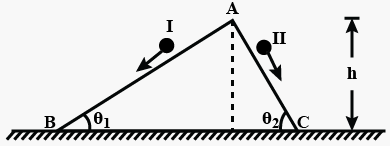
Two inclined frictionless tracks, one gradual and the other steep meet at a from where two stones are allowed to slide down from rest, one on each track as shown in which of the following statement is correct?
Image
  • A
    Both the stones reach the bottom at the same time but not with the same speed.
  • B
    Both the stones reach the bottom with the same speed and stone $I$ reaches the bottom earlier than stone $II.$
  • Both the stones reach the bottom with the same speed and stone $II$ reaches the bottom earlier than stone $I.$
  • D
    Both the stones reach the bottom at different times and with different speeds.
Answer
Correct option: C.
Both the stones reach the bottom with the same speed and stone $II$ reaches the bottom earlier than stone $I.$
As shown in diagram $AB$ and $AC$ are two smooth planes inclined to the angle $\theta_1$ and $\theta_2$ respectively. As friction is absent here,
hence, mechanical energy will be conserved.
As both the tracks having common height $h,$ From conservation of mechanical energy,
$\frac{1}{2}\text{mv}^2=\text{mgh} ($for both tracks $I$ and $II)$
$\text{v}=\sqrt{2\text{gh}}$
Hence, speed is same for both stones. For stone $I, a_1 =$ acceleration along inclines plane $=\text{g}\sin\theta_1$
Similarly, for stone $II, \text{a}_2=\text{g}\sin\theta_2$ as $\theta_2>\theta_1$ hence, $\text{a}_2>\text{a}_1$
And both length for track $II$ is also less, hence stone $II$ reaches earkier than stone $I.$
View full question & answer
MCQ 31 Mark
A proton is kept at rest. A positively charged particle is released from rest at a distance d in its field. Consider two experiments one in which the charged particle is also a proton and in another, a positron. In the same time t, the work done on the two moving charged particles is:
  • A
    Same as the same force law is involved in the two experiments.
  • B
    Less for the case of a positron, as the positron moves away more rapidly and the force on it weakens.
  • More for the case of a positron, as the positron moves away a larger distance.
  • D
    Same as the work done by charged particle on the stationary proton.
Answer
Correct option: C.
More for the case of a positron, as the positron moves away a larger distance.
Positron because their charges are same. As the mass of positron is much lesser than proton, (1/1840 times) it moves away through much larger distance compared to proton. Change in their momentum will be same. So, velocity of lighter particle will be greater than that of a heavier particle. So, positron is moved through a larger distance.
As work done = force × distance. As forces are same in case of proton and positron but distance moved by positron is larger, hence, work done will be more.
View full question & answer
MCQ 41 Mark
A body is falling freely under the action of gravity alone in vacuum. Which of the following quantities remain constant during the fall?
  • A
    Kinetic energy.
  • B
    Potential energy.
  • Total mechanical energy.
  • D
    Total linear momentum.
Answer
Correct option: C.
Total mechanical energy.
As the body is falling freely under gravity, the potential energy decreases continuously and kinetic energy increases continuously as all the conservative forces are doing work. So, total mechanical energy (PE + KE) of the body will be constant.
Let us discuss this in detail:
In the given diagram an object is dropped from-a height H from ground.
At point A total mechanical energy will be EA = K.E + P.E
$\text{E}_\text{A}=\frac{1}{2}\text{mv}^2+\text{mgH}$
As velocity will be zero at A, so its kinetic energy will be zero.
$\text{E}_\text{A}=\text{mgH}$
Velocity at point B will be, $\text{v}_\text{B}=\sqrt{2\text{gh}}$
So, energy at point B will be $\text{E}_\text{B}=\text{KE}+\text{PE}$
$\text{E}_\text{B}=\frac{1}{2}\text{m}(2\text{gh})+\text{mg}(\text{H}-\text{h})$
$\text{E}_\text{B}=\text{mgh}+\text{mgH}-\text{mgh}$
$\text{E}_\text{B}=\text{mgH}$
Now, velocity at point C will be $\text{v}_\text{c}=\sqrt{2\text{gh}}$
So, energy at point will be $\text{E}_\text{c}=\text{KE}+\text{PE}$
$\text{E}_\text{c}=\frac{1}{2}\text{m}(2\text{gH})+\text{mg}(0)$
$\text{E}_\text{c}=\text{mgH}$
So, total mechanical energy will remain same (if we neglect the air friction).
View full question & answer
MCQ 51 Mark
A mass of 5kg is moving along a circular path of radius 1m. If the mass moves with 300 revolutions per minute, its kinetic energy would be:
  • $250\pi^2$
  • B
    $100\pi^2$
  • C
    $5\pi^2$
  • D
    $0$
Answer
Correct option: A.
$250\pi^2$
According to the problem, Radius = 1m, mass = m = 5kg
$\text{f}=\frac{300}{60}$
Angular velocity will be
$=2\pi\text{f}=(300\times2\pi)\text{rad/ min}$
$=(300\times3.14)\text{rad/ 60s}$
$=\frac{300\times2\times3.14}{60}\text{rad/ s}=10\pi\text{rad/ s}$
And relation between linear velocity and angular velocity is $\text{v}=\omega\text{R}$
$=\Big(\frac{300\times2\pi}{60}\Big)(1\text{m})$
$=10\pi\text{m/ s}$
And kinetic energy $=\frac{1}{2}\text{mv}^2$
$=\frac{1}{2}\times5\times(10\pi^2)$
$=100\pi^2\times5\times\frac{1}{2}$
$=250\pi^2\text{J}$
View full question & answer
MCQ 61 Mark
In a shotput event an athlete throws the shotput of mass $10 \ kg$ with an initial speed of $1 \mathrm{~m} \mathrm{~s}^{-1}$ at $45^{\circ}$ from a height $1.5 m$ above ground. Assuming air resistance to be negligible and acceleration due to gravity to be $10 \mathrm{m} \mathrm{~s}^{-2}$, the kinetic energy of the shotput when it just reaches the ground will be:
  • A
    $20.5J$
  • B
    $5.0J$
  • C
    $52.5J$
  • $155.0J$
Answer
Correct option: D.
$155.0J$
If air resistance is negligible, total mechanical energy of the system will remain constant.
And let us take ground as a reference where potential energy will be zero.
According to the problem, $\mathrm{h}=1.5 \mathrm{~m}, \mathrm{v}=1 \mathrm{~m} / \mathrm{s}, \mathrm{m}=10 \mathrm{~kg}, \mathrm{~g}=10 \mathrm{~m} \mathrm{~s}^{-2}$
Initial energy of the shotput $=(\mathrm{PE})_{\mathrm{i}}+(\mathrm{KE})_{\mathrm{i}}$
$=\text{mgh}+\frac{1}{2}\text{mv}^2$
$=10\times10\times1.5+\frac{1}{2}\times10\times(1)^2$
$=150+5$
$=155.0\text{J}$
From conservation of mechanical energy,
$\text{(PE)}_\text{i}+\text{(KE)}_\text{i}=\text{(PE)}_\text{f}+\text{(KE)}_\text{f}$
So, final kinetic energy of the shotput is $155J$
View full question & answer
MCQ 71 Mark
During inelastic collision between two bodies, which of the following quantities always remain conserved
  • A
    Total kinetic energy.
  • B
    Total mechanical energy.
  • Total linear momentum.
  • D
    Speed of each body.
Answer
Correct option: C.
Total linear momentum.
If in a collision kinetic energy after collision is not equal to kinetic energy before collision, the collision is said to inelastic. Coefficient of restitution $0<\mathrm{e}<1$ When we are considering the two bodies as system the total external force on the system will be zero. Hence, total linear momentum of the system remain conserved. Here kinetic energy appears in other forms, i.e. energy may be lost in the form of heat and sound etc. In some cases $(\mathrm{KE})_{\text {final }}<(\mathrm{KE})_{\text {initial }}$ such as when initial $KE$ is converted into intertial energy of the product $($as heat, elastic or excitation$)$ while in other cases $(\mathrm{KE})_{\text {final }}>(\mathrm{KE})_{\text {initial }}$ such as when internal energy stored in the colliding particles is released.
Examples:
Collision between two billiard balls.
Collision between two automobiles on a road.
In fact all majority of collisions belong to this category.
View full question & answer
MCQ 81 Mark
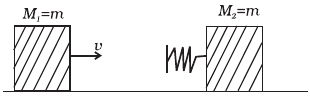
Two blocks $M _1$ and $M _2$ having equal mass are free to move on a horizontal frictionless surface. $M _2$ is attached to a massless spring as shown in. Initially $M _2$ is at rest and $M _1$ is moving toward $M _2$ with speed $v$ and collides head$-$on with $M _2$.
Image
  • A
    While spring is fully compressed all the $KE$ of $M_1$ is stored as $PE$ of spring.
  • B
    If the surface on which blocks are moving has friction, then collision cannot be elastic.
  • C
    If spring is massless, the final state of the $M_1$ is state of rest.
  • Both $B$ and $C$
Answer
Correct option: D.
Both $B$ and $C$
If there is not specified we always consider the collision elastic. When two bodies of equal masse collides elastically, their velocities are interchanged in these types of collision.
Kinetic energy and linear momentum remain conserved. According to the above diagram when $m _1$ comes in contact with the spring, $m_1$ is retarded by the spring force and $m_2$ is accelerated by the spring force.
$a.$ The spring will continue $*$to compress until the two blocks acquire common velocity. So some of kinetic energy of block $M_x$ store into $P.E$ and some part of it stores into $K.E$ of block $M_2$. So option $(a)$ is incorrect.
$b.$ As surfaces are frictionalless momentum of the system will be conserved. So option $(b)$ is also incorrect.
$c.$ The two bodies of equal mass exchange their velocities in a head on elastic collision between them. So, if spring is massless, the final state of the $M _1$ is state of rest.
$d.$ Since there is a loss of $K.E$ when the blocks collides on the rough surface. Hence, the collision is inelastic.
View full question & answer
MCQ 91 Mark
A man, of mass $m,$ standing at the bottom of the staircase, of height $L$ climbs it and stands at its top.
  • A
    Work done by all forces on man is equal to the rise in potential energy $\text{mgL.}$
  • B
    The reaction force from a step does not do work because the point of application of the force does not move while the force exists.
  • C
    Work done by the gravitational force on man is $\text{mgL}$
  • Both $B$ and $C$
Answer
Correct option: D.
Both $B$ and $C$
  1. Work done by gravitational force on man is $\text{(-mgL)}$ as gravitational force is downward and displacement $L$ is upward. The Work done by man to lift him up by muscular force will be $\text{(+mgL)}$ as force applied by muscles is in the direction of displacement. So net work done $\text{= -mgL + mgL = 0.}$
  1. As there is no displacement point where the reaction acts so, Work Done by reaction torce is zero. As the velocity of person atmost zero at top. So $KE = 0.$ Hence, Work Done by reaction force is zero.
View full question & answer
MCQ 101 Mark
A bicyclist comes to a skidding stop in 10m. During this process, the force on the bicycle due to the road is 200N and is directly opposed to the motion. The work done by the cycle on the road is:
  • A
    +2000J
  • B
    -200J
  • zero
  • D
    -20,000J
Answer
Correct option: C.
zero
As the friction is present in fhis problem, so mechanical energy is not conserved. So energy will be lost due to dissipation by friction^Here, work is done by the frictional force on the cycle and is equal to 200 × 10 = -2000J
As the road does not move at all, therefore, work done by the cycle on the road is zero. Important point. We should be aware that here the energy of bicyclist is lost during the motion, but it is lost due to friction in the form of heat.
View full question & answer
MCQ 111 Mark
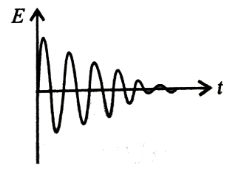
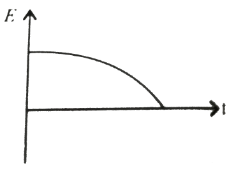
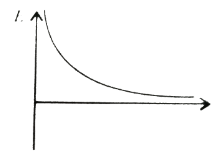
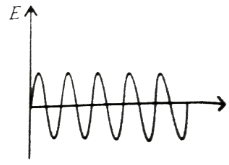
Which of the diagrams shown in represents variation of total mechanical energy of a pendulum oscillating in air as function of time?
  • A
    Image
  • B
    Image
  • Image
  • D
    Image
Answer
Correct option: C.
Image
Explanation: When a pendulum oscillates in air, its total mechanical energy decreases continuously in overcoming resistance due to air. Therefore, total mechanical energy of the pendulum decreases exponentially with time. The variation of $\text{E v/st}$ is correctly represented by curve $(c)$ in which the relation between energy and time is shown.
View full question & answer
MCQ 121 Mark
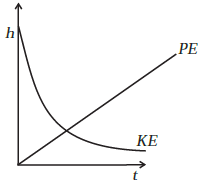
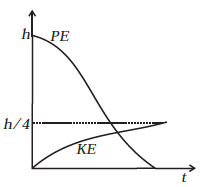
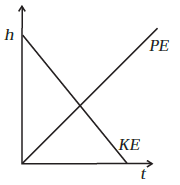
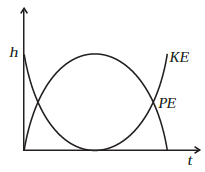
A raindrop falling from a height h above ground, attains a near terminal velocity when it has fallen through a height $(3/4)h.$ Which of the diagrams shown in correctly shows the change in kinetic and potential energy of the drop during its fall up to the ground?
  • A
    Image
  • Image
  • C
    Image
  • D
    Image
Answer
Correct option: B.
Image
At height h from ground raindrop have maximum potential energy. And kinetic velocity will be zero $($at the instant when it dropped its velocity will be zero$)$, then as the rain drop falls its $PE$ starts decreasing and kinetic energy start increasing.
The total mechanical energy will remain conserved if we neglect the air resistance. If there is some air resistance, there is some force called upthrust $($in fluids$)$ which opposes its motion. It depends upon velocity of object as the velocity increases, upthrust also increases. Hence during fall of raindrop first its velocity increases and then become constant after some time. This constant velocity is called terminal velocity, hence $KE$ also become constant. $PE$ decreases continuously as the drop is falling continuously. The variation in $PE$ and $KE$ is best represented by $(b).$
View full question & answer
MCQ 131 Mark
A bullet of mass $m$ fired at $30^\circ$ to the horizontal leaves the barrel of the gun with a velocity $v.$ The bullet hits a soft target at a height $h$ above the ground while it is moving downward and emerges out with half the kinetic energy it had before hitting the target. Which of the following statements are correct in respect of bullet after it emerges out of the target?
  1. The velocity of the bullet will be reduced to half its initial value.
  2. The velocity of the bullet will be more than half of its earlier velocity.
  3. The bullet will continue to move along the same parabolic path.
  4. The bullet will move in a different parabolic path.
  5. The bullet will fall vertically downward after hitting the target.
  6. The internal energy of the particles of the target will increase.The internal energy of the particles of the target will increase.
  • A
    Only $a$
  • $b,d$ and $f$
  • C
    $a,b$ and $e$
  • D
    All of the above
Answer
Correct option: B.
$b,d$ and $f$
  1. Let $\text{KE}_2$, $\text{KE}_1$ are the kinetic energy of bullet before and after hitting and targrt,
$1\text{KE}_2=\frac{1}{2}\text{KE}_1$
$\frac{1}{2}\text{mv}^2_2=\frac{1}{2}\cdot\frac{1}{2}\text{mv}^2_1$
$\text{v}^2_2=\frac{1}{2}\text{v}^2_1=\Big(\frac{\text{v}_1}{\sqrt{2}}\Big)^2$
$=\Big(\frac{\text{v}_1\sqrt{2}}{2}\Big)^2=(0.707\text{v}_1)^2$
  1. $\mathrm{v}_2=0.707 \mathrm{v}_1$. Hence, the velocity of bullet after target is not reduce to half. If rejects option $(a).$
  2. $\mathrm{v}_2=0.707 \mathrm{v}_1$. So velocity of bullet after target is more than half of its earlier velocity verifies option $(b).$
  3. Bullet has horizontal velocity so its path will be parabolic but with new parabola as both components $vx$ and $vy$ changes after emerging out from target. So rejects the option $(c).$
  4. As above discussed path of bullet after target will be of new parabola, verifies the option $(d).$
  5. As bullet has horizontal and vertical components so has new parabola of range smaller than previous. So rejects the option $(e).$
  6. As some parts of kinetic energy of bullet converted into heat so internal energy o target increased. Verifies option $(f).$
View full question & answer
MCQ 141 Mark
A man squatting on the ground gets straight up and stand. The force of reaction of ground on the man during the process is:
  • A
    Constant and equal to mg in magnitude.
  • B
    Constant and greater than mg in magnitude.
  • C
    Variable but always greater than mg.
  • At first greater than mg, and later becomes equal to mg.
Answer
Correct option: D.
At first greater than mg, and later becomes equal to mg.
In the process of squatting on the ground he gets straight up and stand. Then he is tilted somewhat, the man exerts a variable force on the ground to balance his weight, hence he also has to balance frictional force besides his, weight in this case.
N = Normal reaction force = friction + mg ⇒ N > mg
Once the man gets straight up that variable force = 0
Normal reaction force = mg
View full question & answer
MCQ 151 Mark
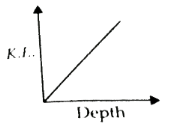
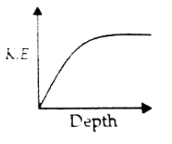
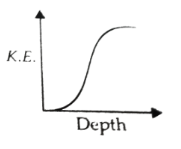
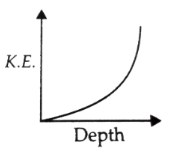
Which of the diagrams in correctly shows the change in kinetic energy of an iron sphere falling freely in a lake having sufficient depth to impart it a terminal velocity?
  • A
  • C
  • D
Answer
Correct option: B.
Constant after some depth. This constant velocity is called terminal velocity, hence KE become constant beyond this depth, which is best represented by (b).
View full question & answer
MCQ 161 Mark
A cricket ball of mass $150g$ moving with a speed of $126\ km/ h$ hits at the middle of the bat, held firmly at its position by the batsman. The ball moves straight back to the bowler after hitting the bat. Assuming that collision between ball and bat is completely elastic and the two remain in contact for $0.001s$, the force that the batsman had to apply to hold the bat firmly at its place would be:
  • A
    $10.5 N$
  • B
    $21 N$
  • $1.05 \times 10^4$
  • D
    $N$
Answer
Correct option: C.
$1.05 \times 10^4$
We know that force $\text{F}=\frac{\Delta\text{p}}{\Delta\text{t}}$ and $\frac{\Delta\text{p}}{\Delta\text{t}}=\frac{\text{m}[(-\text{v})-\text{u}]}{\text{t}}=\frac{-2\text{mv}}{\text{t}}$
And the magnitude of force will be, $\text{F}=\frac{2\text{mv}}{\text{t}}$
According to the problem, $\text{m}=150\text{g}=\frac{150}{1000}\text{kg}=\frac{3}{20}\text{kg}$
$\Delta\text{t}=$ time of contact $=0.001\text{s}$
$\text{u}=126\text{km/ h}=\frac{126\times1000}{60\times60}\text{m/ s}=35\text{}\text{m s}$
$\text{v}=-126\text{km/ h}=-35\text{m/ s}$
Change in momentum of the ball
$\Delta\text{P}=\text{m(v}-\text{u})$
$=\frac{3}{20}(-70)=-\frac{21}{2}$
We know that force $\text{F}=\frac{\Delta\text{P}}{\Delta\text{t}}$
$=\frac{\frac{-21}{2}}{0.001}\text{N}=-1.05\times10^4\text{N}$
Here, $-ve$ sign shows that force will be opposite to the direction of movement of the ball before hitting. So the force that the batsman had to apply to hold the bat firmly at its place would be $F = 1.05 \times 10^4N K$
View full question & answer