Question types

MODEL PAPER 9 question types

38 questions across 6 question groups — pick any mix to generate a BIOLOGY paper with step-by-step answer keys.

38
Questions
6
Question groups
5
Question types
Sample Questions

MODEL PAPER 9 questions

One sample from each question group in this chapter. Select any group above to see the full set with answer keys.
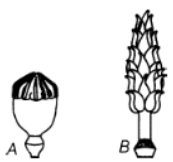

Which of the following is included in bioinsecticide?
  • A
    Viruses and bacteria
  • B
    Viruses, bacteria, fungi, protozoans and mites
  • C
    Viruses, bacteria, fungi and protozoa
  • D
    Viruses, bacteria and fungi
View full solution
Arrange the following in the decreasing order (most important first) of their importance, for the welfare of human society. Give reasons for your answer.
Biogas, Citric acid, Penicillin and curd
View full solution
Read the sequence of the nucleotides in the given segment of mRNA and the respective amino acid sequence in the polypeptide chain.
Image
Polypeptide: met-phe-met-proline-valine-serine
i. Provide the triplet of bases (codon) for
a. valine
b. proline
ii. Write the nucleotide sequence of the DNA strand from which this mRNA was transcribed
iii. What does the last codon of this RNA stand for?
View full solution
Q 143 Marks Question3 Marks
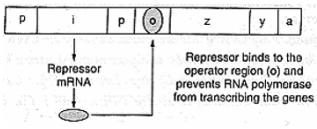
Look at the figure below depicting lac operon of E.coli.
Image
i. What could be the series of events when an inducer is present in the medium in which E.coli is growing?
ii. Name the inducer.
View full solution
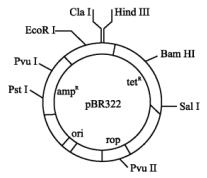
Study the figure of vector pBR322 given below in which foreign DNA is ligated at the Bam HI site of tetracyline resistance gene.
Image
Answer the following questions:
i. Mention the function of rop.
ii. What will be the selectable marker for this recombinant plasmid and why?
iii. Explain transformation.
View full solution
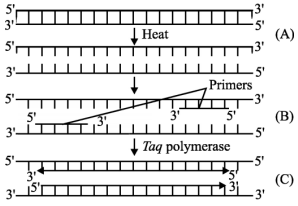
The melding of a technique for repeated rounds of DNA synthesis with the discovery of a thermostable DNA polymerase has given scientists the very powerful technique known as polymerase chain reaction (PCR). PCR is based on three simple steps required for any DNA synthesis reaction: (1) denaturation of the template into single strands; (2) annealing of primers to each original strand for new strand synthesis; and (3) extension of the new DNA strands from the primers.
In the given figure, one cycle of polymerase chain reaction (PCR) is shown:
Image
i. Name the steps A, B and C.
ii. Give the purpose of each of these steps.
iii. State the contribution of Thermus aquaticus in this process.
View full solution
Assertion (A): Epiphytes grow on other plants.
Reason (R): They grow only in humid areas.
  • A
    Both A and R are true and R is the correct explanation of A.
  • B
    Both A and R are true but R is not the correct explanation of A.
  • C
    A is true but R is false.
  • D
    A is false but R is true.
View full solution
Assertion (A): The earliest organisms that appeared on the earth were non-green and presumably anaerobes.
Reason (R): The first autotrophic organisms were the chemo-autotrophs that never released oxygen.
  • A
    Both A and R are true and R is the correct explanation of A.
  • B
    Both A and R are true but R is not the correct explanation of A.
  • C
    A is true but R is false.
  • D
    A is false but R is true.
View full solution
Assertion (A): Ormeloxifene, also known as centchroman, is used as a nonsteroidal oral contraceptive.
Reason (R): It causes an asynchrony in the menstrual cycle between ovulation and the development of the uterine lining.
  • A
    Both A and R are true and R is the correct explanation of A.
  • B
    Both A and R are true but R is not the correct explanation of A.
  • C
    A is true but R is false.
  • D
    A is false but R is true.
View full solution
Assertion : The use of fertilizers greatly enhances crop productivity.
Reason : Irrigation is very important in increasing crop productivity.
  • A
    If both Assertion & Reason are true but the reason is not the correct explanation of the assertion
  • B
    If both Assertion & Reason are true and the reason is the correct explanation of the assertion,
  • C
    If Assertion is true statement but Reason is false
  • D
    If both Assertion and Reason are false statements
View full solution
Read the following text carefully and answer the questions that follow:
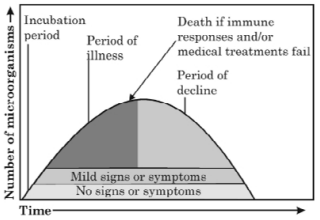
When a microorganism invades a host, a definite sequence of events usually occur leading to infection and disease, causing suffering to the host. This process is called pathogenesis. Once a microorganism overcomes the defense system of the host, development of the disease follows a certain sequence of events as shown in the graph. Study the graph given below for the sequence of events leading to appearance of a disease and answer the questions that follow:
Image
i. In which period, according to the graph there are maximum chances of a person transmitting a disease/infection and why? (1)
ii. Study the graph and write what is an incubation period. Name a sexually transmitted disease that can be easily transmitted during this period. Name the specific type of lymphocytes that are attacked by the pathogen of this disease. (1)
iii. Draw a schematic labelled diagram of an antibody. (2)
OR
In which period, the number of immune cells forming antibodies will be the highest in a person suffering from pneumonia?
Name the immune cells that produce antibodies. (2)
View full solution
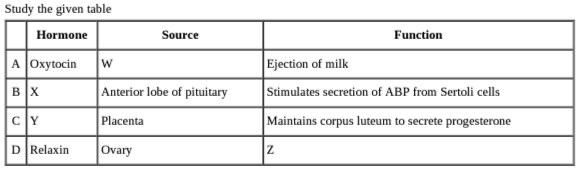
Read the following text carefully and answer the questions that follow:
Image
i. Identify the hormones X and Y respectively. (1)
ii. Label W and Z. (1)
iii. Name the hormones produced only during pregnancy in human female. Mention their source organs. (2)
OR
Name any two hormones which are secreted by placenta and are also present in a non-pregnant woman. (2)
View full solution

Generate a MODEL PAPER 9 paper free

Pick question groups from the list above, set marks and difficulty, and export a branded PDF with step-by-step answer keys. First 3 chapters free — no signup.

Download App