Questions

4 Marks Questions

Take a timed test

6 questions · self-marked practice — reveal the answer and mark yourself.

Question 14 Marks
Differentiate between:
a. hypocotyol and epicotyl
b. coleoptile and coleorrhiza
c. integument and testa
d. perisperm and pericarp
Answer
a. Hypocotyl - The portion of embryonic axis between the radical and cotyledon
Epicotyl - The portion of embryonic axis between the plumule and cotyledon
b. Coleoptile - It is a conical protective sheath over the plumule in monocot seeds.
Coleorrhiza - It is a protective sheath over the radical and root tip.
c. Integument is the covering of ovule, while testa is the outer seed coat developed from the outer integuments.
d. Perisperm is the residual persistent nucellus, while the pericarp is the fruit wall derived from the ovary wall.
View full question & answer
Question 24 Marks
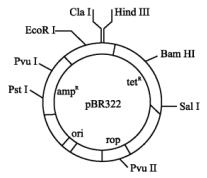
Study the figure of vector pBR322 given below in which foreign DNA is ligated at the Bam HI site of tetracyline resistance gene.
Image
Answer the following questions:
i. Mention the function of rop.
ii. What will be the selectable marker for this recombinant plasmid and why?
iii. Explain transformation.
Answer
i. 'Rop' codes for the proteins involved in the replication of plasmid.
ii. Selectable marker: Ampicillin resistance gene. It will help distinguishing transformants from non-transformants after plating them on ampicillin containing medium.
iii. Transformation: It is the phenomenon by which the DNA isolated frond one type of cell and introduced into another type, is able to bring about some of the properties of former to the later.
View full question & answer
Question 34 Marks
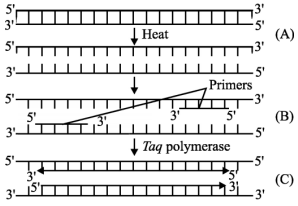
The melding of a technique for repeated rounds of DNA synthesis with the discovery of a thermostable DNA polymerase has given scientists the very powerful technique known as polymerase chain reaction (PCR). PCR is based on three simple steps required for any DNA synthesis reaction: (1) denaturation of the template into single strands; (2) annealing of primers to each original strand for new strand synthesis; and (3) extension of the new DNA strands from the primers.
In the given figure, one cycle of polymerase chain reaction (PCR) is shown:
Image
i. Name the steps A, B and C.
ii. Give the purpose of each of these steps.
iii. State the contribution of Thermus aquaticus in this process.
Answer
i. (A) Denaturation, (B) Annealing, (C) Thermus aquaticus.
ii. Denaturation: Heat denatures DNA to separate complementary strands.
Annealing: Primers hybridizes to the denatured DNA strands.
Thermus aquaticus: This enzyme induces denaturation of double-stranded DNA at high temperature.
Extension: Extension of primers resulting in the synthesis of copies of the target DNA sequence.
iii. Enzyme Taq polymerase is isolated from the bacterium Thermus aquaticus. The function of Taq DNA polymerase in PCR reaction is to amplify the DNA for the production of multiple copies of it. Taq DNA polymerase is a thermostable DNA polymerase which can even work at a higher temperature.
View full question & answer
Question 44 Marks
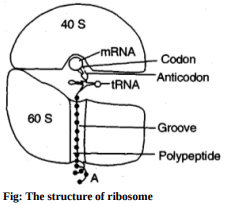
Describe the structure of a ribosome, taking into consideration, its role in protein synthesis.
Answer
      • Ribosomes are also called as protein factories as they help in the protein synthesis.
      • Each ribosome has two unequal subunits named as small (40 s) and large (60 s) subunits.
      • The larger subunit of the ribosome has a groove for pushing out the newly formed polypeptide and protecting the same from cellular enzymes.
      • The smaller subunit fits over the larger one like a cap but leaves a tunnel for mRNA.
      • The two subunits come together only at the time of protein formation during the phenomenon known as association in which Mg2+ plays an important role.
      • Soon after the completion of protein synthesis, the two subunits separate by the process called dissociation.
      • The different parts of ribosome connected with protein synthesis are:
      • A tunnel for mRNA which lies between the two subunits.
      • A groove which is a part of large subunit; for the passage of newly synthesized polypeptide.
      • There are two reactive sites - P and A.
      • P-site (peptidyl transfer or donor site) is jointly contributed by two ribosomal subunits.
      • A-site (amino-acyl or acceptor site) is located on the larger subunit of the ribosome and faces the tunnel between the two subunits.
      • Smaller sub-unit of the ribosome has a point for recognizing mRNA and binding area for initiation factors.
        Image
View full question & answer
Question 54 Marks
Give an account of the methods used in sequencing the human genome.
Answer
Two approaches were involved in sequencing the human genome.
Using Expressed Sequence Tags (ESTS): In this approach, all the genes that are expressed as RNA are identified and then sequenced.
Blind Approach: This approach involved sequencing the whole set of the genome and then assigning different regions in the sequence with functions. This is referred to as sequence annotation. This approach is comprised of the following steps:
i. Total DNA from a cell is isolated and converted into random fragments of smaller sizes.
ii. These fragments are cloned in a suitable host by using specialized vectors. The cloning results in the amplification of each fragment and makes it easy to sequence the fragment. Bacteria and yeast are the commonly used hosts for this purpose. The vectors were called BAC (bacterial artificial chromosomes) and YAC (yeast artificial chromosomes).
iii. Automated DNA sequencers were used to sequence the fragments. Then these sequences were arranged on the basis of some overlapping regions present in them.
iv. For generating overlapping fragments in these sequences; help of computer programmes was taken because it was not possible for humans to do so.
v. Then the sequences were annotated and assigned to each chromosome.
vi. Genetic physical mapping of the genome was done on the basis of polymorphism in some segments of the DNA.
View full question & answer
Question 64 Marks
Compare the characteristic features of insect pollinated and wind pollinated flowers. Explain how the respective features assist in pollination.
View full question & answer