Questions

2 Marks Questions

Take a timed test

144 questions · self-marked practice — reveal the answer and mark yourself.

Question 12 Marks
What is self-incompatibility? Why does self-pollination not lead to seed formation in self-incompatible species?
Answer
Self-incompatibility is a genetic mechanism to prevent self pollen from fertilizing the ovules by inhibiting pollen germination or pollen tube growth in the pistil.
Self-pollination does not lead to seed formation in self-incompatible species because of interaction between the chemicals of the pollen and those of the stigma.
View full question & answer
Question 22 Marks
If one can induce parthenocarpy through the application of growth substances, which fruits would you select to induce parthenocarpy and why?
Answer
Parthenocarpy is the process of developing fruits without involving the process of fertilization or seed formation. Therefore, the seedless varieties of economically important fruits such as orange, lemon, water melon etc. are produced using this technique. This technique involves inducing fruit formation by the application of plant growth hormones such as auxins.
View full question & answer
Question 32 Marks
Arrange the following terms in the correct developmental sequence:
Pollen grain, sporogenous tissue, microspore tetrad, pollen mother cell, male gametes.
Answer
Sporogenous tissue → pollen mother cell → microspore tetrad → Pollen grain → male gamete.
View full question & answer
Question 42 Marks
Mention two strategies evolved to prevent self-pollination in flowers.
Answer
Continued self-pollination decreases the vigour and vitality of a particular race. Thus, flowering plants have developed many devices to discourage self-pollination and to encourage cross-pollination.
Dichogamy and self-sterility are two most common devices that ensure cross-pollination.
Dichogamy: Maturation of anther and stigma at different times in a bisexual flower prevent self-pollination.
Self-sterility (or self-incompatibility): Due to the presence of self-sterile gene in some flowers, pollen grains do not germinate on the stigma of that flowers. e.g.,- tobacco, potato.
View full question & answer
Question 52 Marks
Name the parts of an angiosperm flower in which development of male and female gametophyte take place.
Answer
The male gametophyte or the pollen grain develops inside the pollen chamber of the anther, whereas the female gametophyte (also known as the embryo sac) develops inside the nucellus of the ovule from the functional megaspore.
View full question & answer
Question 62 Marks
Why is apple called a false fruit? Which part(s) of the flower forms the fruit?
Answer
Botanically ripened ovary is called a true fruit. The fruits in which thalamus and other floral parts develop along with the ovary are called false fruits. For example – apple, strawberry, cashew etc. In apple the main edible portion of the fruit is the fleshy thalamus. Ovary forms the fruit after fertilization or without fertilization in parthenocarpic fruits.
View full question & answer
Question 72 Marks
What is meant by monosporic development of female gametophyte?
Answer
In many flowering plants, only one out of the four megaspores enlarges and develops into female gametophyte or embryo sac. The other three megaspores degenerate. This type of embryo sac formation is called as monosporic type of development.
View full question & answer
Question 82 Marks
Why do you think the zygote is dormant for sometime in a fertilised ovule?
Answer
The zygote is dormant for sometime in fertilized ovule the embryo develops only after the formation of the endosperm as endosperm is the source of nutrition for the developing embryo. Thus, the zygote waits for endosperm formation.
View full question & answer
Question 92 Marks
How many cells are present in the pollen grains at the time of their release from anther? Name the cells.
Answer
Pollen grain may be released at$-$
  • $2-$celled stage, one vegetative and one generative cell,
  • $3-$celled stage, one vegetative cell and two male gametes.
View full question & answer
Question 112 Marks
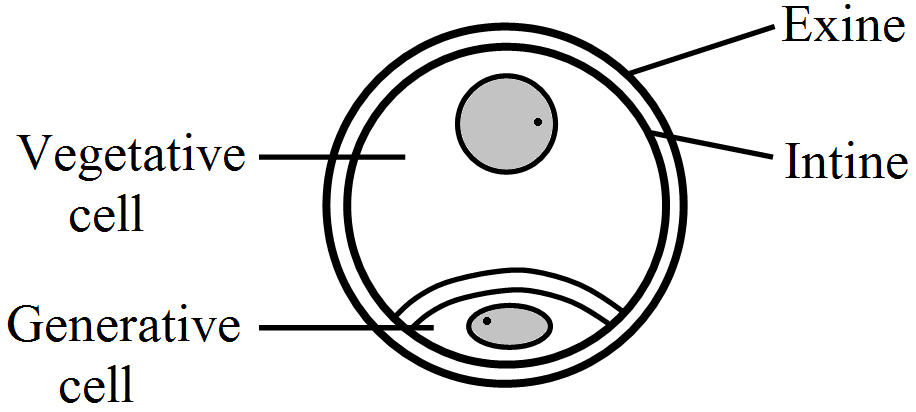
A pollen grain in angiosperm at the time of dehiscence from an anther could be $2-$celled or $3-$celled. Explain. How are the cells placed within the pollen grain when shed at a $2-$celled stage?
Answer
  • In $2-$celled stage the mature pollen grain contains a generative and vegetative cell, whereas in $3-$celled stage one vegetative cell and two male gametes are present.
  • The generative cell floats in the cytoplasm of vegetative cell.
View full question & answer
Question 122 Marks
A single pea plant in your kitchen garden produces pods with viable seeds, but the individual papaya plant does not. Explain.
Answer
Pea - flowers of pea plants are bisexual, monoecious/self-pollinated (to produce pods with viable seeds).
Papaya - Dioecious plant/unisexual plant bearing male and female flowers on separate plants, unable to produce viable seeds as there is no cross pollination/it could be a male plant which is unable to produce fruit and seeds.
View full question & answer
Question 132 Marks
In angiosperms, zygote is diploid while primary endosperm cell is triploid. Explain.
Answer
An unusual form of reproduction see in flowering plants, in which one sperm nucleus fases with an egg to form a Zygote there both are haploid (homogenous cells), and after fusion they make a diploid cell, like zygote. Simultaneous fusion of the second male gamete with the polar nuclei, resulting in a primary endosperm nucleus, which is often triploid, 3n’, a unique characteristic all angiosperms.
View full question & answer
Question 142 Marks
State one advantage and one disadvantage of cleistogamy.
Answer
Advantage- Self-pollination assured/seed production assured.
Disadvantage- Least variations/leading to inbreeding depression.
View full question & answer
Question 152 Marks
If you squeeze a seed of orange you might observe many embryos of different sizes. How is it possible? Explain.
Answer
Some of the nucellar cells, surrounding embryo sac divide, protrude into the embryo sac, develop into the embroys thus each seed contains many embryos of different sizes.
View full question & answer
Question 162 Marks
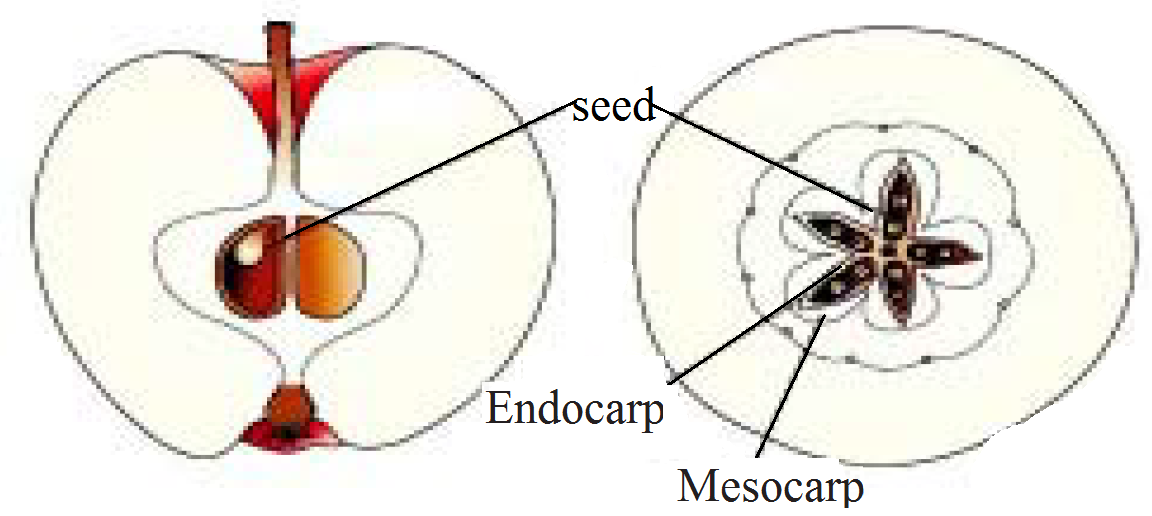
Draw a sectional view of an apple and label the different parts of an ovary in it. Fruits develop from an ovary. Then why is apple referred to as a false fruit?
Answer

Any one diagram one label from seed, endocarp & mesocarp.
Thalamus also contributes to fruit formation.
View full question & answer
Question 172 Marks
Apomixis resembles asexual reproduction, as well as mimics sexual reproduction in plants. Explain with the help of a suitable example.
Answer
Since there is no fertilisation in apomixis it resemble asexual reproduction, and development of embryo/seed/fruit formation is mimicing sexual reproduction.
In Citrus/ Mango some of the nucellar cells surrounding the embryo sac, act as diploid egg cell, which are formed without reduction division, and develop into embryo, without fertilisation.
View full question & answer
Question 182 Marks
Mention the ploidy of the different types of cells present in the female gametophyte of an angiosperm.
Answer
Synergids = haploid, egg = haploid, polar nuclei = haploid, antipodals = haploid, all types of cell of female gametophyte are haploid.
View full question & answer
Question 192 Marks
List the post$-$fertilization events in angiosperms.
Answer
  • Development of endosperm.
  • Embryogeny$/$development of embryo.
  • Seed formation.
  • Fruit formation.
View full question & answer
Question 202 Marks
In a flowering plant a microspore mother cell produce four male gametophytes while a megaspore mother cell form only one female gametophyte. Explain.
Answer
A microspore mother cell/PMC on meiosis forms 4 functional pollen grains/male gametophyte.
A megaspore mother cell/MMC on meiosis also forms four megaspores but out of it only one is functional and other three degenerate.
View full question & answer
Question 212 Marks
Name the organic materials the exine and intine of an angiosperm pollen grains are made up of. Explain the role of exine.
Answer
Exine- Sporopollenin.
Intine- Cellulose and pectin.
Role- Most resistant organic material/can withstand high temperature, acid and alkali.
View full question & answer
Question 222 Marks
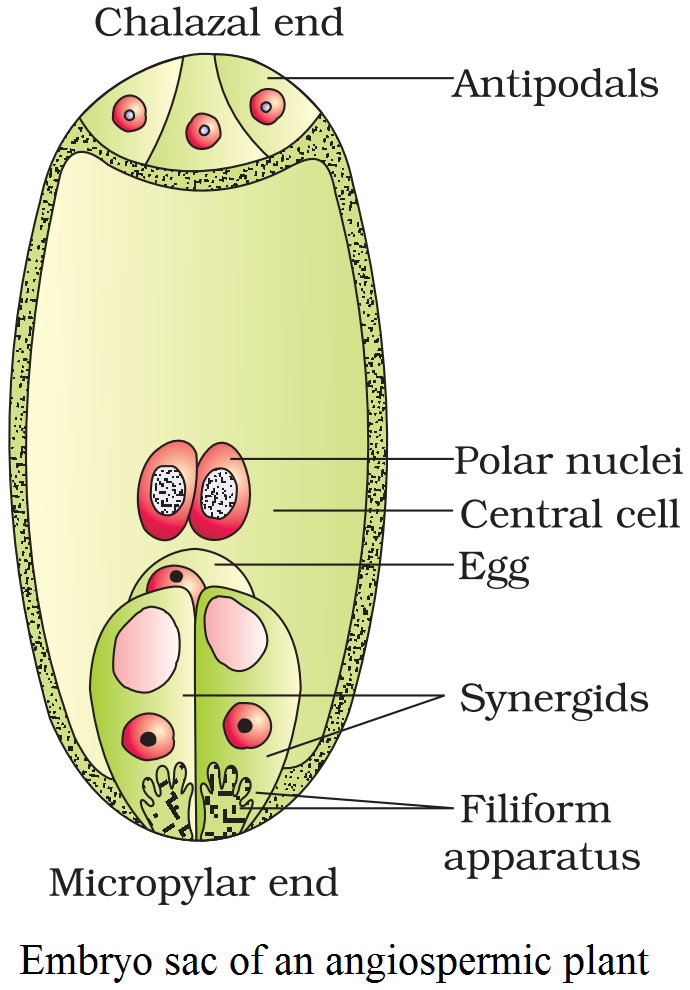
A mature embryo-sac in a flowering plant may possess 7-cells, but 8-nuclei. Explain with the help of a diagram only.
View full question & answer
Question 232 Marks
Geitonogamous flowering plants are genetically autogamous but functionally cross-pollinated. Justify.
Answer
Geitonogamy is a kind of pollination in which the pollen grains are transferred from the anther of a flower to the stigma of another flower on the same plant.Geitonogamous flowering plants are genetically autogamous as the gametes come from the same parent plant but since the pollen grains are being transferred to a different flower which needs a pollinating agent, it is functionally an example of cross-pollination.
View full question & answer
Question 242 Marks
Where is sporopollenin present in plants? State its significance with reference to its chemical nature.
Answer
Present in exine, of pollen/pollen grain.
Sporopollenin is the most resistant organic material hence protects the pollen/gamete/gametophyte, provides protection to pollen from unfavourable conditions or chemicals (acids, enzymes, high temperature etc.)
View full question & answer
Question 252 Marks
Differentiate between albuminous and non-albuminous seeds, giving one example of each.
Answer
Albuminous- (with residual) endosperm is not completely used up during embryonic development eg. wheat/maize/castor/sunflower.
Non-albuminous- (without residual) endosperm is completely consumed during embryonic development eg. pea/groundnut.
View full question & answer
Question 262 Marks
Mention the reasons for difference in ploidy of zygote and primary endosperm nucleus in an angiosperm.
Answer
Zygote formed by the fusion of male gamete (n) and egg cell (n), hence diploid (2n),
Primary endosperm nucleus formed by the fusion of two polar nuclei/secondary nucleus (n + n) and male gamete (n), hence triploid (3n).
View full question & answer
Question 272 Marks
You are conducting artificial hybridization on papaya and potato. Which on of them would require the step of emasculation and why? However for both you will use the process of bagging. Justify giving one reason.
Answer
Potato plant bears bisexual flowers. This is the reason that the process of emasculation, that is, removal of stamen will be performed in potato and not in papaya that bears unisexual flowers. However, bagging is performed in both the flowers because the stigma needs to be protected from getting pollinated with undesired pollen.
View full question & answer
Question 282 Marks
Write briefly the role of pollination in the growth and development in an angiosperm.
Answer
Pollination is transfer of pollen grains from anthers to the stigma of a flower. Pollination is prerequisite for fertilisation, events after fertilisation like endosperm development, seed setting and fruit formation. Thus, pollination plays an important role in the growth and development of angiosperms.
View full question & answer
Question 292 Marks
Name the product of fertilisation that forms the kernel of coconut. How does the kernel differ from coconut water?
Answer
Endosperm forms the kernel of coconut.
The coconut water is free-nuclear endosperm whereas kernel is cellular endosperm.
View full question & answer
Question 312 Marks
Describe the structure of mature angiospermic pollen grain. Mention one difference between the pollen of dicot and monocot.
Answer
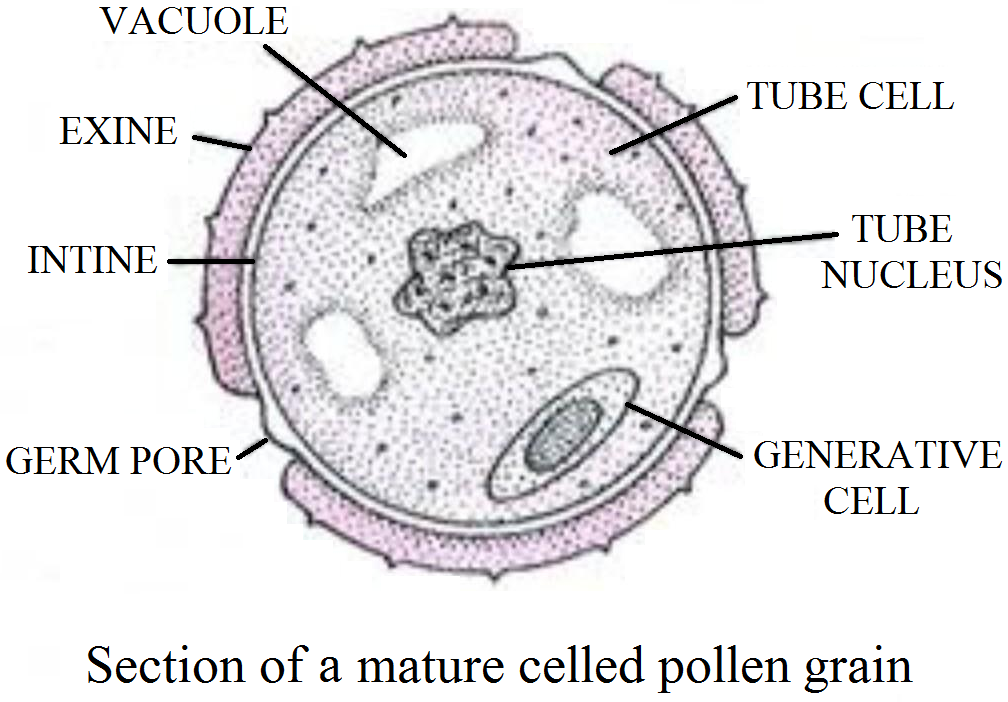
Pollen grains or microspores are generally spherical in outline. The wall of pollen grain is called sporoderm, which is made up of two layers-An outer thick exine and an inner thin intine.
The exine is made up of sporopollenin which is biologically the most resistant substance and can withstand high temperature and strong acids and alkali. At one or more places, the exine is very thin or absent. These regions are called germ pores.
Intine is continuous layer made up of cellulose and pectin. A mature pollen grain has two cells-a vegetative cell and a generative cell. The vegetative cell is bigger and has food reserve and a large irregular nucleus. The generative cell is small, spindle shaped and floats in the cytoplasm of vegetative cell. In dicots, pollen grains are with three germ pores, while in monocots, they are with single germinal furrow.
View full question & answer
Question 322 Marks
Mention the similarity between autogamy and geitonogamy
Answer
In both cases pollen grains come from the same plant. So they are genetically similar.
View full question & answer
Question 332 Marks
Banana is a true fruit and also a parthenocarpic fruit. Justify.
Answer
Since banana fruit is formed from the ovary, it is true fruit. It is parthenocarpic because the ovary develops into fruit without fertilization
View full question & answer
Question 342 Marks
What is the role of integuments of ovule after fertilization? Which is the most common type of ovule found in angiosperms?
Answer
The integuments of ovule get transformed into seed coats, outer testa and inner tegmen. Anatropous ovule.
View full question & answer
Question 352 Marks
Mention an advantage and a disadvantage of a cleistogamous flower.
Answer
  • Advantage: Since cleistogamous flowers are autogamous, there is an assured seed$-$set.
  • Disadvantage: Continued self$-$pollination leads to inbreeding depression.
View full question & answer
Question 362 Marks
“Pollen grains in wheat are shed at 3-celled stage while in peas they are shed at 2-celled stage.” Explain. Where are germ pores present in a pollen grain?
Answer
At the time of shedding wheat pollen consists of one vegetative and two male gametes, which is the 3celled stage. While pea pollen consists of one vegetative and one generative cell which is the 2-celled stage. Germ pores are present on the exine where sporpollenin is absent.
View full question & answer
Question 372 Marks
What are the commercial uses of pollen grains?
Answer
Pollen analysis has become a standard tool: Government agencies analyze the pollen content of fake Viagra and other prescription drugs to determine where they came from. Museums use pollen to authenticate paintings by master artists. Oil companies study fossil pollen to locate hydrocarbon deposits. Archaeologists study pollen to learn how ancient human communities used plants, and even the seasons at which they occupied a particular site. And paleobotanists study pollen evidence to reconstruct former environments, thousands or even millions of years into the past.
View full question & answer
Question 382 Marks
Geitonogamous flowering plants are genetically autogamous but functionally cross-pollinated. Justify.
Answer
Geitonogamous flowers are genetically autogamous because both male and female flowers are borne on the same flower. They are functionally cross-pollinated because the pollen from one flower is transferred to the stigma of a different flower.
View full question & answer
Question 392 Marks
Why should a bisexual flower be emasculated and bagged prior to artificial pollination?
Answer
A bisexual flower is emasculated to prevent self-pollination in the flower and it is bagged after emasculation to prevent contact of unwanted pollen grain with the stigma of the flower.
View full question & answer
Question 402 Marks
Differentiate between:
  1. Hypocotyl and coleoptile.
  2. Protandry and protogyny.
Answer
  1.  
S. No.
Hypocotyl
Epicotyl
1.
The portion of the embryonal axis which lies below the cotyledon in a dicot embryo is known as the hypocotyl.
The portion of the embryonal axis which lies above the cotyledon in a dicot embryo is known as the epicotyl.
2.
It terminates with the radicle.
It terminates with the plumule.
 
  1.  
S. No.
protandry
protogyny
1.
protandry is (botany) the condition of flowers whose male parts mature before the female ones.
protogyny is (botany) the condition of flowers whose female parts mature before the male ones.
2.
the condition in which an organism begins life as a male and then changes into a female.
the condition in which an organism begins life as a female and then changes into a male.
View full question & answer
Question 412 Marks
Mention the function of each of the following:
Tassels of corn cob.
Answer
These are the stigma and style which wave in the wind to trap pollen grains.
View full question & answer
Question 422 Marks
Which is the triploid tissue in a fertilised ovule? How is the triploid condition achieved?
Answer
Primary Endosperm Nucleus (PEN) shows triploid condition. When one of the male gametes fuses with the polar nuclei, it results in the formation of triploid PEN.
View full question & answer
Question 432 Marks
List the post$-$fertilisation events in angiosperms.
Answer
  1. Development of endosperm.
  2. Embryogeny$/$ development of embryo.
  3. Seed formation.
  4. Fruit formation.
View full question & answer
Question 442 Marks
Why should a breeder need to emasculate a bisexual flower? Mention a condition in a flower, where emasculation is not necessary?
Answer
  • Emasculation is necessary to prevent the self-pollen grains falling on the stigma in case of bisexual flowers.
  • Emasculation is not needed when the female parent chosen bears unisexual, i.e. female flowers.
View full question & answer
Question 462 Marks
Name the type of fruit, apple is categorised under and why? Mention two other examples, which belong to the same category as apple.
Answer
  • Apple is categorised as false fruit, because the thalamus, a part other than the ovary, also contributes to fruit formation.
  • When any part of the flower other than the ovary becomes a part of the fruit, the fruit is said to be a false fruit.
  • The other examples are strawberry and cashew.
View full question & answer
Question 472 Marks
Both nucellus and endosperm have abundant reserve food materials. How is their food reserve utilised in angiosperms?
Answer
Nucellus:
  • The food reserve in the nucellus is used by the developing megaspore as well as the embryo.
  • The residual persistant nucellus in the mature seed, is called perisperm.
Endosperm:
  • The food reserve in the endosperm is used by the embryo during seed development.
  • The food reserve in the residual endosperm (in endospermic seeds like castor) is used by the embryo during seed germination.
View full question & answer
Question 482 Marks
Describe the development of endosperm after double fertilization in an angiosperm. Why does endosperm development proceeds that of zygote?
Answer
Endosperm Development:
  • Endosperm develops first followed by an embryo.
  • Endosperm develops from PEN.
  • The PEN undergoes successive nuclear divisions to give rise to free nuclei and this stage of endosperm development is called free nuclear endosperm.
  • Subsequently, cell wall is formed on the periphery and endosperm becomes cellular.
  • This division is followed by cytokinesis and thus endosperm becomes cellular. It is now called cellular endosperm.
Functions:
  • The cells of endosperm tissue are triploid and filled with reserve food material to nourish the developing embryo.
  • The water of tender coconut in the centre is free-nuclear endosperm and white kernel in the outer part is the multicellular endosperm.
  • The endosperm may be completely consumed by the developing embryo, e.g., pea, beans, or it may persist in mature seed, e.g., coconut.
View full question & answer
Question 492 Marks
Can an unfertilised, apomictic embryo sac give rise to a diploid embryo? If yes, then how?
Answer
Yes, if the embryo develops from the cells of nucellus or integument it will be diploid.
View full question & answer
Question 502 Marks
Given below are the events that are observed in an artificial hybridization programme. Arrange them in the correct sequential order in which they are followed in the hybridisation programme.
(a) Re-bagging (b) Selection of parents (c) Bagging (d) Dusting the pollen on stigma (e) Emasculation (f) Collection of pollen from male parent.
Answer
(b) Selection of parents → (e) Emasculation → (c) Bagging → (f) Collection of pollen from male parent → (d) Dusting the pollen on stigma → (a) Re-bagging.
View full question & answer
Question 512 Marks
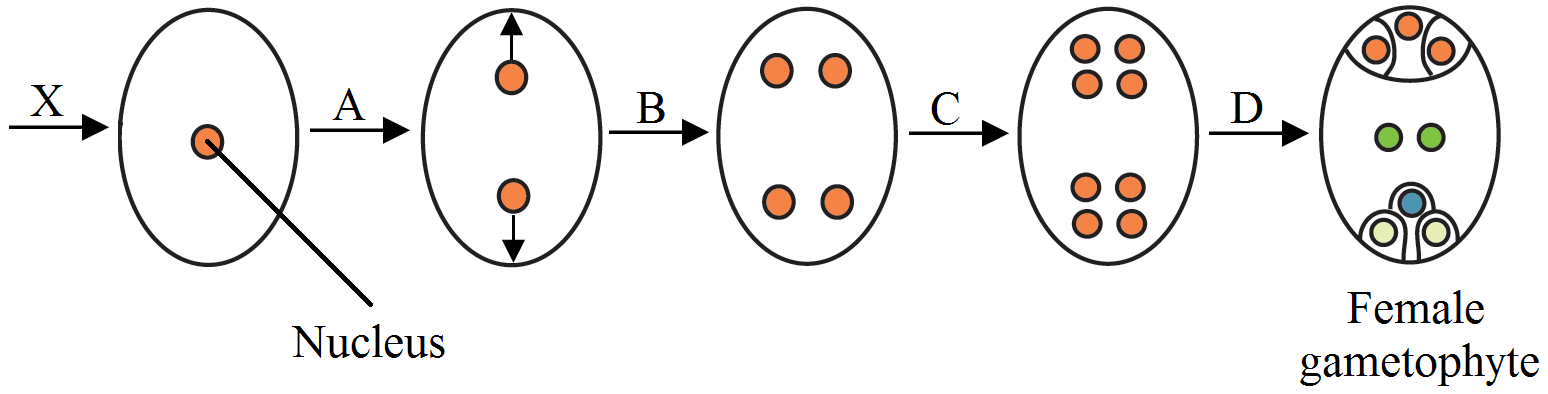
Fill in the following labels with the type of cell function.
Answer

X – Meiosis (Reduction division)
A – Mitosis
B – Mitosis
C – Mitosis
D – Cells reorganised as polar nuclei, antipodals and egg apparatus.
View full question & answer
Question 522 Marks
What is the importance of microspore mother cell undergoing meiosis?
Answer
Megaspore mother cell is diploid. In all the plants undergoing sexual reproduction their gamets must be haploid.
MMC undergoes meosis to produce haploid egg. This egg fuses with a sperm from pollen grain to produce seed.
View full question & answer
Question 532 Marks
Does self incompatibility impose any restrictions on autogamy? Give reasons and suggest the method of pollination in such plants.
Answer
Self-incompatibility imposes restriction to antogamy. The device to prevent inbreeding is self - incompatibility or self - sterlity. This is a genetic mechanism and prevents self-pollen (from the same flower or other flowers of the same plant) from fertilising the ovules by inhibiting pollen germination or pollen tube growth in the pistil. Self incompatiblity is overcome by mixed pollination.
View full question & answer
Question 542 Marks
Draw a labelled diagram of the sectional view of a mature pollen grain of angiosperms. Explain the function of any two of its parts.
Answer
Exine-It can withstand high temperature/ strong acids. Intine-It is thin layer made up of cellulose and pectin.
View full question & answer
Question 552 Marks
Define seed dormancy. Give the causes and significance of seed dormancy.
Answer
The inability of seeds to germinate even if external conditions are favourable is called seed dormancy. Seed dormancy may be due to one or more of the following reasons:
  1. Hard and impermeable seed coats.
  2. Presence of certain inhibitory substances such as abscisic acid (ABA), coumarin etc.
Significance:
  1. It helps the seeds to tide over the unfavourable period.
  2. It enables the seeds to be disseminated safely and help them to germinate, when the environmental conditions are favourable.
View full question & answer
Question 562 Marks
List the two steps that are essential for carrying out artificial hybridisation in crop plants and why.
Answer
  1. Selection of parents: Only those plants should be selected which have desired traits.
  2. Crossing over: Pollen grains from selected male plant is collected and transferred to the female plant after which it is bagged.
View full question & answer
Question 572 Marks
Answer the following questions:
How are parthenocarpic fruits produced by some plants and apomictic seeds by some others? Explain.
Answer
Parthenocarpic fruits are formed when ovary develops into fruit without fertilisation. Apomictic seeds are formed when formation of seeds take place without fertilisation.
View full question & answer
Question 582 Marks
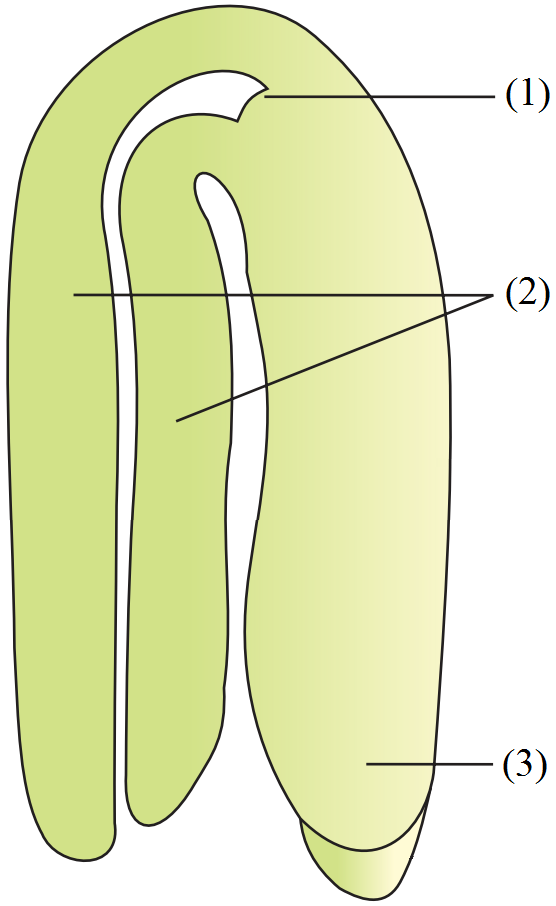
the given figure of a typical dicot embryo, label the parts $(1), (2)$ and $(3).$ State the function of each of the labelled part.
Answer
  1. Plumule: forms the shoot.
  2. Cotyledons: Supply the food material.
  3. Radicle: Grows into the root.
View full question & answer
Question 592 Marks
Even though each pollen grain has two male gametes, why are at least 10 pollen grains and not 5 pollen grains required to fertilise 10 ovules present in a particular carpel?
Answer
A pollen tube carrying two male gametes, enter a ovule and release two male gametes which fuse with two different structures in a embryo sac (the egg and two polar nuclei). Hence for fertilisation of 10 ovules, 10 pollen grains are required and not 5 pollen grains.
View full question & answer
Question 612 Marks
What is the function of the two male gametes produced by each pollen grain in angiosperms.
Answer
One of the male gametes fuses with the female gamete and forms the embryo. The embryo subsequently develops into a new plant. Another male gamete fuses with polar nuclei and eventually forms endosperm. Endosperm supplies food to the developing embryo.
View full question & answer
Question 622 Marks
The microscopic pollen grains of the past are obtained as fossils. Which compound makes this possible?
Answer
The pollen grains can be best preserved as fossils. This is possible due to the effect of sporopollenin. It is the most resistant biological substance known and can withstand high temperature as well as action of alkali or acids.
View full question & answer
Question 632 Marks
A mature embryo sac in a flowering plant may possess 7-cells, but 8-nuclei. Explain with the help of a diagram only.
Answer
A typical angiospermic embryo sac is 8-nucleated and 7-celled.
View full question & answer
Question 642 Marks
Name the oldest seed that has germinated. Where was it found?
Answer
Lupinus arcticus germinated and flowered after about 10,000 years of dormancy. This happened in Arctic tundra.
View full question & answer
Question 662 Marks
What is agamospermy? How is agamospermy different from parthenogenesis and parthenocarpy?
Answer
The phenomenon of asexual reproduction that mimics sexual reproduction as it forms seed without fertilisation is called agamospermy.
Parthenogenesis refers to the development of unfertilised ovule into an adult individual. On the other hand, parthenocarpy is the phenomenon of formation of fruits without fertilisation of an ovary.
View full question & answer
Question 672 Marks
Are pollination and fertilisation necessary in apomixis? Give reasons.
Answer
The triploid tissue in the ovule is the endosperm. Its triploid condition is attained due to the fusion of two polar nuclei and one nucleus of male gamete (also referred to as triple fusion).
View full question & answer
Question 682 Marks
How does geitonogamy differ from xenogamy?
Answer
In geitonogamy pollen grains are transferred from the anther to the stigma of another flower, of the same plant whereas in xenogamy pollen grains are transferred from the anther, to the stigma of a different flower.
View full question & answer
Question 692 Marks
Double fertilisation is reported in plants of both, castor and groundnut. However, the mature seeds of groundnut are non-albuminous and castor are albuminous. Explain the post fertilisation events that are responsible for it.
Answer
The development of endosperm (preceding the embryo) takes place from primary endosperm nucleus (PEN) in both, castor and groundnut.
The developing embryo derives nutrition from endosperm.
PEN undergoes repeated division to give free nuclei. Subsequently cell wall is formed and endosperm becomes cellular. At this stage endosperm is retained in castor or is not fully consumed but in groundnut endosperm is consumed by growing embryo.
View full question & answer
Question 702 Marks
List the adaptive features of water-pollinated flowers like Vallisneria.
Answer
  1. In Vallisneria, the male flowers are released on the surface of water and female flowers reach the surface by the long stalk.
  2. Pollen grains are protected from wetting by a mucilaginous covering.
View full question & answer
Question 712 Marks
Explain the steps that ensure cross pollination in an autogamous flower.
Answer
A bisexual flower is emasculated at unopened stage to prevent self-pollination in the flower and it is bagged after emasculation to prevent contact of unwanted pollen grain with the stigma of the flower. Artificial pollination is then performed when the stigma is ready and the flower is rebagged.
View full question & answer
Question 722 Marks
What is pericarp? Mention its functions.
Answer
The wall of the ovary that develops into wall of the fruit is called pericarp.
Functions:
  1. Protects the seed till its maturity.
  2. Helps in dispersal.
View full question & answer
Question 732 Marks
Explain the mutually rewarding relationship between Yucca plant and a species of moth.
Answer
  • The plant Yucca and the moth, both of them cannot complete their life cycles without each other.
  • The moth deposits its eggs in the locule of the ovary; during this, the flower gets pollinated by the moth.
  • The larvae of the moth come out of the eggs, when the seeds start developing; some of the seeds are eaten by the larvae as food.
View full question & answer
Question 742 Marks
List the different types of pollination depending upon the source of pollen grain.
Answer
Depending on the source of pollen grain, pollination can be classified into:
  1. Autogamy: It is the transfer of pollen grain from anther to the stigma of the same flower.
  2. Geitonogamy: lt is the transfer of pollen grains from anther of one flower to the stigma of another flower on the same plant. Geitonogamy is functionally cross-pollination involving pollinating agent, but genetically it is equivalent to autogamy since, the pollen grains come from the same plant.
  3. Xenogamy: It is the transfer of Pollen grains from anther to the stigma of different plants of same species. It brings genetically different types of pollen grains to the stigma.
View full question & answer
Question 752 Marks
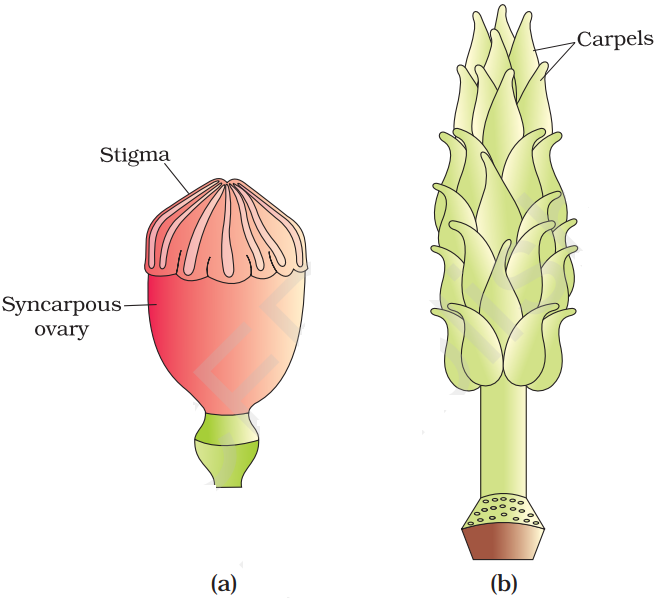
Identify the type of carpel with the help of diagrams given below:
Answer
Figure ‘a’ shows multicarpellary syncarpous condition and figure ‘b’ shows multicarpellary apocarpous condition.
View full question & answer
Question 762 Marks
If the chromosome number of plant species is 16, what would be the chromosome number and the ploidy level of the:
  1. Microspore mother cell and
  2. The endosperm cells?
Answer
  1. Microspore mother cell = 16 (Diploid)
  2. Endosperm cell = 24 (Triploid)
View full question & answer
Question 772 Marks
Why does the zygote begin to divide only after the division of primary endosperm cell?
Answer
The zygote needs nourishment during its development. As the mature, fertilised embryo sac offers very little nourishment to the zygote, the primary endosperm cell (PEC) divides and generates the endosperm tissue which nourishes the zygote. Hence, the zygote always divides after division of PEC.
View full question & answer
Question 782 Marks
Mention the reasons for difference in ploidy of zygote and primary endosperm nucleus in an angiosperm.
OR
In angiosperms, zygote is diploid while primary endosperm cell is triploid. Explain.
Answer
A zygote is formed by the fusion of haploid male gamete with the haploid egg to form a diploid cell; whereas, primary endosperm nucleus (PEN) is formed by the fusion of haploid male gamete with two haploid polar nuclei, forming a triploid nucleus.
View full question & answer
Question 792 Marks
For a layman, both apples and mangoes are 'fruits'. Do you agree? Give reasons in support of your answer.
Answer
  • Yes, it is because, both are fleshy and juicy and are eaten raw.
  • In apple, a false fruit, the thalamus becomes edible while in mango, a true fruit, the mesocarp is edible.
View full question & answer
Question 812 Marks
Differentiate between pericarp and perisperm.
Answer
Difference between pericarp and perisperm are:
S. No.
Pericarp
Perisperm
1.
It is the covering of fruits that develops from ovary wall.
It is unused nucellus in the seed.
2.
It is a part of the fruit.
It is a part of the seed.
3.
It is usually fleshy or dry.
It is usually dry.
4.
It is found in all fruits.
 
It is present in only a few seeds.
View full question & answer
Question 822 Marks
What is entomophily? Describe the features of entomophilous flowers.
Answer
It is a mode of cross pollination in which the pollen grains are transferred to the stigma through the insects like bees, butterflies, etc.
Features of Entomophilous flowers:
  • The flowers are generally large, colourful, fragrant and rich in nectar.
  • Pollen grains are often surrounded by a sticky substance, pollenkitt.
View full question & answer
Question 832 Marks
Draw a labelled diagram of:
  1. An apocarpous pistil and.
  2. A syncarpous pistil. Name an example for each.
Answer
  1. e.g. Michelia
  2. e.g. Papaver
View full question & answer
Question 842 Marks
Explain the function of each of the following:
Germ pores
Answer
Germ pores allow germination of pollen grain and formation of pollen tubes.
View full question & answer
Question 852 Marks
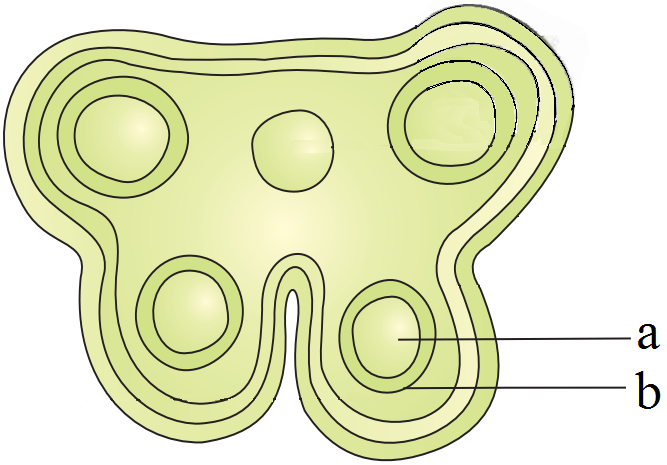
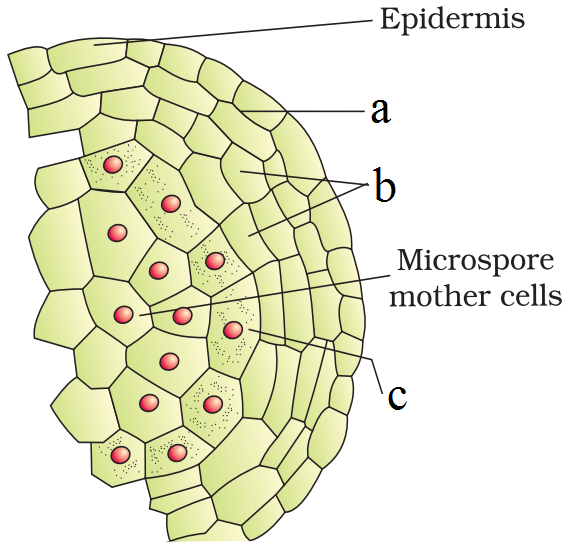
Given alongside is an enlarged view of one microsporangium of a mature anther.
Name ‘a’, ‘b’ and ‘c’ wall layers.
Answer
a = Endothecium,
b = Middle layers,
c = Tapetum.
View full question & answer
Question 862 Marks
What is filiform apparatus? What is its function?
Answer
The synergids have special cellular thickenings at the micropylar tip called filiform apparatus. They guide the entry of pollen tubes into the synergids.
View full question & answer
Question 872 Marks
A pollen grain in angiosperm at the time of dehiscence from an anther could be 2-celled or 3-celled. Explain, how are the cells placed within the pollen grain when shed at a 2-celled stage.
Answer
In about 60% of angiosperms, pollen grains ale shed at the 2-celled stage. However, in about 40% flowering plants, the generative cell may further divide mitotically to give rise to two male gametes and pollen grains are shed at this 3-celled stage.
The placement of cells within the pollen grain when shed at 2-celled stage can be visualised as,
View full question & answer
Question 882 Marks
Answer the following questions:
State one advantage and one disadvantage of cleistogamy to the plant.
Answer
Advantage: Self-pollination is assured, thus ensuring seed formation.
Disadvantage: Least variations observed and it leads to inbreeding depression.
View full question & answer
Question 892 Marks
Name all the haploid cells present in an unfertilised mature embryo sac of a flowering plant. Write the total number of cells in it.
Answer
An unfertilised embryo sac of angiosperm is composed of 8-nuclei and 7 cells. Among 8 nuclei, 6 are enclosed by cell walls and organised into cell, while the remaining 2 nuclei (called polar nuclei) are situated above the egg apparatus. Out of 6 cells, 3 are grouped at micropylar end and constitute the egg apparatus, made up of 2 synergids and 1 egg cell. The other 3 are located at chalazal end and are called antipodals. All the cells of the embryo sac are haptoid except the central cell which is first binucleate and then becomes diploid due to fusion of polar nuclei.
View full question & answer
Question 902 Marks
In a flowering plant a microspore mother cell produce four male gametophytes while a megaspore mother cell form only one female gametophyte. Explain.
Answer
Male gametophytes are formed by meiosis of single microspore mother cell whereas female gametophytes are formed by meiosis of single megaspores mother cell to produce 4 megaspores, out of which 3 degenerate and only one survives. The surviving megaspore undergoes mitotic division to form the female gametophyte.
View full question & answer
Question 912 Marks
In a flowering plant, a microspore mother cell produces four male gametophytes while a megaspore mother cell forms only one female gametophyte. Explain.
Answer
In flowering plants, microspore mother cells undergo meiosis and form microspore tetrad. After attaining maturity, these microspores separate from each other and each microspore develops into a male gametophyte. On the other hand, megaspore mother cell divides by meiotic division to produce four megaspores. From these, three degenerate while, the one undergoes further development and mitotic divisions to produce female gametophyte.
View full question & answer
Question 922 Marks
Even though each pollen grain has two male gametes, why are at least 10 pollen grains and not 5 pollen grains are required to fertilise 10 ovules present in a particular carpel?
Answer
One male gamete fuses with egg cell while second male gamete fuses with central cell during the process of double fertilisation.
View full question & answer
Question 932 Marks
Fill in the following labels with the type of process occurring at each step.
Answer
X- Meiosis (reduction division).
A- Mitosis.
B- Mitosis.
C- Mitosis.
D- Cells reorganised as polar nuclei, antipodals and egg apparatus.
View full question & answer
Question 942 Marks
Draw a vertical section of a maize grain and label (i) pericarp, (ii) scutellum, (iii) coleoptile and (iv) radicle.
View full question & answer
Question 952 Marks
Why are some seeds of Citrus referred to as polyembryonic? How are they formed?
Answer
  • It is a case of polyembryony, the phenomenon of occurrence of more than one embryo in a seed.
  • Some of the nucellar cells surrounding the embryo sac start dividing, protrude into the embryo sac and develop into embroys.
View full question & answer
Question 962 Marks
In the $T.S.$ of a mature anther given below, identify $“ \ a\ ”$ and $“ \ b\ ”$ and mention their function.
Answer
  1. Sporogenous tissue: It forms pollen grains.
  2. Tapetum: It provides nourishment to the developing pollen grains.
View full question & answer
Question 972 Marks
Banana is a parthenocarpic fruit whereas oranges show polyembryony. How are they different from each other with respect to seeds?
Answer
Banana develops from an ovary without fertilisation having non-viable seeds so it is called parthenocarpic fruit. An orange contain seeds with more than one embryo thus, it shows polyembryony.
View full question & answer
Question 982 Marks
Given alongside is an enlarged view of one microsporangium of a mature anther. Mention the characteristics and function of the cells forming wall layer ‘c’.
Answer
Tapetum provides nourishment to the developing pollen grains. The tapetal cells also secrete Ubisch granules that provide sporopollenin and other materials for exine formation.
View full question & answer
Question 992 Marks
Who are called pollen robbers?
Answer
Many insects may consume pollen or the nectar without bringing about pollination. These floral visitors are referred to as pollen/ nectar robbers.
View full question & answer
Question 1002 Marks
Why is geitonogamy also referred to as genetical autogamy?
Answer
Geitonogamy is functionally a cross-pollination, involving a pollinating agent. But genetically, it is similar to autogamy since, the pollen grains come from the same plant. So, it is also referred to as genetical autogamy.
View full question & answer
Question 1012 Marks
Differentiate between albuminous and non-albuminous seeds, with an example for each.
Answer
S.No.
Albuminous seed
 
Non-albuminous seed
1.
In some seeds, the endosperm persists as food storage tissue.
 
If the endosperm is completely consumed by the developing embryo before seed maturation, the seeds
are called non-albuminous.
2.
Example: Castor
 
Example: Pea
View full question & answer
Question 1022 Marks
A non biology person is quite shocked to know that apple is a false fruit, mango is a true fruit and banana is a seedless fruit. As a biology student how would you satisfy this person?
Answer
In apple only the thalamus (along with ovary) portion contributes to fruit. Therefore, it is a false fruit. Mango develops only from the ovary, therefore it is a true fruit.
Banana develops from ovary but without fertilisation. The method is known as parthenocarpy. Since there is no fertilisation, no seeds are formed in banana.
View full question & answer
Question 1032 Marks
Emasculation may not be necessary, yet bagging is necessary. Justify giving the condition when such a thing can happen.
Answer
When the flower chosen is unisexual (female), there is no need for emasculation. Yet bagging is necessary to prevent contamination of the stig pollen grains.
View full question & answer
Question 1042 Marks
Write the cellular contents carried by the pollen tube. How does the pollen tube gain its entry into the embryo sac?
Answer
Pollen tube carries two male gametes.
Pollen tube, after reaching the ovary, enters the ovule through the micropyle and then enters one of the synergids through the filiform apparatus which guides the entry of pollen tube into egg cell.
View full question & answer
Question 1052 Marks
If you squeeze a seed of orange you might observe many embryos of different sizes? How is it possible? Explain.
Answer
In orange, the nucellar cells surrounding the embryo sac start dividing, protrude into the embryo sac and develop into a number of embryos of different sizes.
View full question & answer
Question 1062 Marks
Describe the structure of pollen grain and the process of its germination.
Answer
Structure of Pollen Grain: Pollen grains are generally spherical and are about 25-50 micrometres in diameter. It has has an outer layer exine and inner layer intine. Mature Pollen grain contains a bigger vegetative cell and a smaller generative cell.
Germination of Pollen Grain: The process of development of pollen tube is called germination. Hydration of stigma results in elongation of tube cells into the pollen tube. Pollen tube then grows towards the ovule for further process.
View full question & answer
Question 1072 Marks
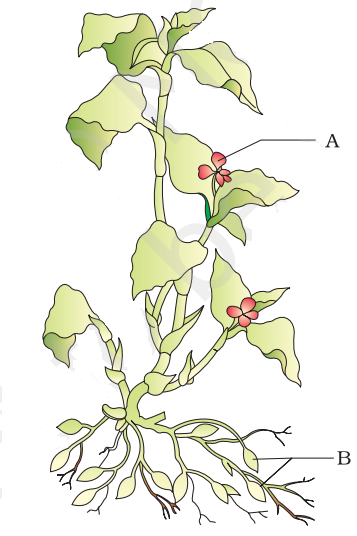
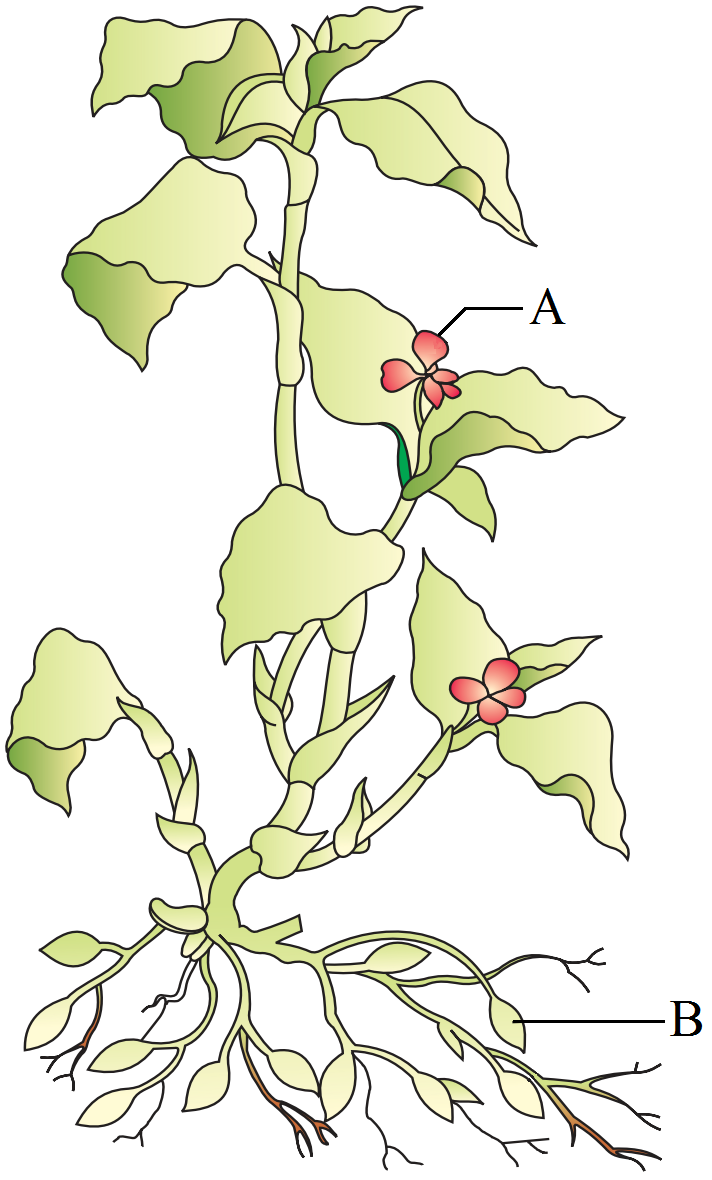
In the figure given below the plant bears two different types of flowers marked ‘A’ and ‘B’. Identify the types of flowers and state the type of pollination that will occur in them.
Answer
'A' is chasmogamous flower while 'B' is cleistogamous flower. A bisexual flower which normally open is called chasmogamous flower. Cleistogamous flowers do not open at all.
Cleistogamous flowers are invariably autogamous as there is no chance of cross-pollen landing on the stigma.
In a normal flower which opens and exposes the anthers and stigma complete autogamy is rather rare. Chasmogamous flower may show autogamy, geitonogamy or xenogamy.
View full question & answer
Question 1082 Marks
Explain any two ways by which apomictic seeds get developed.
Answer
Ways by which apomictic seeds develop are:
  1. A diploid egg is formed without reduction division which develops into embryo without fertilisation.
  2. Some cells of the nucellus, which are diploid in nature, start dividing and without fertilisation develop into embryo.
View full question & answer
Question 1092 Marks
In angiosperms, zygote is diploid while primary endosperm cell is triploid. Explain.
Answer
Zygote is the product of a fusion of a haploid male gamete and haploid female gamete, i.e. egg cell. Therefore, it is diploid.$\text{Male gamete} + \text{Egg }\xrightarrow{\ \ }\text{Zygote}\\ \ \ \ \ \ \ \ \ \ \ \ \ \ \ \ \ \ \ \ \text{(n)} + \text{(n)} \xrightarrow{}\text{(2n)}$
Whereas, primary endosperm cell is a product of fusion of secondary necleus (2n) and a haploid male gamete. So, it is triploid.$\text{Secondary nucleus} +\text{ Male gamete}\xrightarrow{}\text{Primary endosperm cell}\\ \ \ \ \ \ \ \ \ \ \ \ \ \ \ \ \ \ \ \ \ \ \ \ \ \ \ (2\text{n)} +\text{ (n)}\xrightarrow{}\text{ (3n)}$
View full question & answer
Question 1102 Marks
Name two fruits each with:
  1. Fleshy pericarp and
  2. Dry pericarp.
Answer
  1. Guava, tomato, mango.
  2. Groundnut, mustard, bean.
View full question & answer
Question 1112 Marks
Banana is a parthenocarpic fruit, whereas oranges showpolyembryony. How are they different from each other with respect to seeds?
Answer
  1. Parthenocarpic fruits are generally seedless or havenon-viable seeds.
  2. In oranges, each seed has more than one embryo, i.e. polyembryony and seeds are viable.
View full question & answer
Question 1122 Marks
Write the location and function of synergid.
Answer
The synergid cells are located in the female gametophyte and are essential for angiosperm reproduction. During the fertilization process, a pollen tube grows into one of the synergid cells, ceases growth, ruptures, and releases its two sperm cells into this cell.
View full question & answer
Question 1132 Marks
What is the role of filiform apparatus?
Answer
The function of filiform apparatus is to guide entry of pollen tube and release of sperm cells.
Filiform apparatus: The synergid cell wall forming an extremely thick structure at the micropylar end is called the filiform apparatus. It bears several finger-like projections into the structure of synergid cytoplasm.
View full question & answer
Question 1142 Marks
Explain the function of each of the following:
Coleorhiza
Answer
Coleorhiza protects the radical of (monocot) embryo.
View full question & answer
Question 1152 Marks
What are parthenocarpic fruits? Mention one characteristic feature of such fruits.
Answer
  • The fruits that are formed without fertilisation of the ovary, are called parthenocarpic fruits.
  • They are generally seedless or seeds are not viable.
View full question & answer
Question 1162 Marks
Explain giving two reasons why pollen grains can be best preserved as fossils.
Answer
  1. Pollens are produced in large numbers.
  2. The sporopollenin in exine protects the pollen from harsh conditions.
View full question & answer
Question 1172 Marks
Answer the following questions:
Mature seeds of legumes are non-albuminous. Then, can it be assumed that double fertilisation does not occur in legumes? Explain your answer
Answer
No it cannot be assumed so because fertilisation does takes place but the endosperm is consumed during development.
View full question & answer
Question 1182 Marks
Why does the zygote begin to divide only after the division of Primary endosperm cell (PEC)?
Answer
The zygote needs nourishment during its development. As the mature, fertilised embryo sac offers very little nourishment to the zygote, the PEC divides and generates the endosperm tissue which nourishes the zygote. Hence, the zygote always divides after division of PEC.
View full question & answer
Question 1192 Marks
Why do some plants have both chasmogamous and cleistogamous flowers?
Answer
Viola (common pansy) and Commelina can produce both chasmogamous and cleistogamous flowers on the same plant. These flowers produce seeds by outcrossing and selfing, respectively. This mixed breeding system is considered a successful reploductive strategy.
View full question & answer
Question 1202 Marks
How many cellular nuclei does the pollen tube of angiosperm have? What is the ploidy of each of the nuclei?
Answer
Pollens are shed at either 2-celled or 3-celled stage. Cells are formed mitotically from haploid cells.
View full question & answer
Question 1212 Marks
Not all hydrophytes are pollinated by water. Justify by giving two examples.
Answer
All hydrophytes are not pollinated by water. Those hydrophytes whose flowers emerge above the surface of water are pollinated by insects or wind, e.g. water hyacinth and water lily are pollinated by insects.
View full question & answer
Question 1222 Marks
  1. Where are germ pores present in a pollen grain?
  2. How are the two cells arranged in a pollen grain, when shed at the two-celled stage?
Answer
  1. In a pollen grain, germ pores are present in the exine, where sporopollenin is absent.
  2. In the two-celled pollen grain, the generative cell floats in the cytoplasm of the vegetative cell.
View full question & answer
Question 1232 Marks
Identify the types of flower shown in $A$ and $B.$ Which out of the two will produce an assured seed set.
Answer
  1. $A:$ Chasmogamous flower
  2. $B:$ Cleistogamous flower
Cleistogamous flower produces assured seed set.
View full question & answer
Question 1242 Marks
Differentiate between the two cells enclosed in a mature male gametophyte of an angiosperm.
Answer
S.No
Vegetative cell
Generative cell
1.
It is bigger in size
It is smaller and floats in the cytoplasm of vegetative cell.
2.
It has food reserves.
It gives rise to two male gametes.
View full question & answer
Question 1252 Marks
Why are some seeds referred to as apomictic seeds? Mention one advantage and one disadvantage to a farmer who uses them.
Answer
Seeds that are produced without fertilisation are referred to as apomictic.
Advantage: Desired characters are retained in offspring (progeny) as there is no segregation of characters in offspring (progeny). Seed production is assured even in absence of pollinators. Apomictic seeds are economical as they can be used to grow crops year after year.
Disadvantage: Cannot control accumulation of deleterious genetic mutation. These are usually restricted to narrow ecological niches and lack ability to adapt to changing environment.
View full question & answer
Question 1262 Marks
How are the cells of tapetum different from the cells of the other wall layers?
Answer
S. No
Cells of tapetum
Cells of other wall layers
(i)
They have a dense cytoplasm.
They have a less dense cytoplasm.
(ii)
They often have more than one nucleus.
They have a single nucleus.
(iii)
They do not develop thickenings on their walls.
They may develop wall thickenings.
(iv)
Their function is to nourish the developing pollen grains.
They help in the dehiscence of the anther and liberation of pollen grains.
View full question & answer
Question 1272 Marks
Explain any two devices by which autogamy is prevented in flowering plants.
Answer
  1. Male and female flowers are present on different plants.
  2. The stamens and stigma of a bisexual flower mature at different times.
    1. Anthers mature earlier than the stigma and release pollens.
    2. The stigma matures earlier than the anther.
  3. Flowers are self-sterile or self-incompatible.
  4. Chasmogamous flowers are present with exposed stamens and stigma which facilitate cross-pollination.
View full question & answer
Question 1282 Marks
How does the Mediterranean orchid Ophrys ensures its pollination by bees?
Answer
The petals of the Ophrys resemble the female of a bee species in size, colour and odour. Male bee mistakes the Ophrys for female bee and tries to copulate. Few pollen grains adhered to the body of the male bee fall over stigma of the flower thereby leading to pollination showing sexual deceit.
View full question & answer
Question 1292 Marks
Explain the process of pollination in Vallisnaria.
Answer
In Vallisnaria, the female flower reaches the surface of water by a long stalk and the pollen grains are released on the surface of water. The pollen grains are carried passively by water currents and reach the stigma eventually.
View full question & answer
Question 1302 Marks
Answer the following questions:
List the differences between the embryos of dicot (pea) and monocot (grass family).
Answer
S. No.
Dicot embryo
Monocot embryo
(i)
It has two cotyledons.
It has one cotyledon.
(ii)
Radicle and plumule are not covered with sheath.
Radicle is covered with coleorhiza and plumule is covered by coleoptile.
View full question & answer
Question 1312 Marks
What is the fate of haploid megaspores formed by the megaspore mother cell in an angiosperm plant?
Answer
The diploid megaspore mother cell divides meiotically and forms four megaspores, which are usually arranged in a longitudinal row (linear tetrad). Out of four megaspores formed, three degenerate. The remaining one acts as functional megaspore (chalazal).
The nucleus of functional megaspore undergoes three successive mitotic divisions forming eight haploid nuclei, which get organised into three groups-three nuclei migrate to the micropylar end and form the egg apparatus (one egg cell, two synergids).
  • Three migrate towards chalazal end and form antipodal cells.
  • Two polar nuclei fuse to form a diploid secondary nucleus in the centre.
View full question & answer
Question 1322 Marks
Mention the location and function of tapetum inthe microsporangium of angiosperms. State the characteristic features of the cells forming this layer.
Answer
  • Tapetum is the innermost wall layer of the microsporangium.
  • It nourishes the developing pollen grains.
Characteristics of tapetal cells:
  1. They possess dense cytoplasm.
  2. They have more than one nucleus.
View full question & answer
Question 1332 Marks
A pollen grain in angiosperm at the time of dehiscence from an anther could be 2-celled or 3-celled. Explain. How are the cells placed within the pollen grain when shed at a 2-celled stage?
Answer
In 2-celled stage the mature pollen grain contains one generative and vegetative cells, whereas in 3-celled stage one vegetative cell and two male gamete cells are present.
The generative cell being small floats in the cytoplasm of the vegetative cell. The pollen grains are shed at this 2-celled stage.
View full question & answer
Question 1352 Marks
What is self-incompatibility?
Answer
The device to prevent inbreeding is self-incompatibility or self-sterlity. This is a genetic mechanism and prevents self-pollen (from the same flower or other flowers of the same plant) from fertilising the ovules by inhibiting pollen germination or pollen tube growth in the pistil.
View full question & answer
Question 1362 Marks
Some angiosperm seeds are said to be ‘Albuminous’, whereas few others are said to have a perisperm. Explain each with the help of an example.
Answer
Albuminous seeds are those which retain a part of endosperm as it is not completely used up during embryo development. For example, in wheat and maize. In some seeds remnants of nucellus are also persistent. This residual, persistent nucellus is the perisperm. For example, in black pepper and beet.
View full question & answer
Question 1372 Marks
How do plants produce seeds through apomixis? Explain with the help of an example.
Answer
  1. Certain nucellar cells around the embryo sac divide, protrude into embryo sac and develop into embryos, e.g. Citrus, mango, etc.
  2. The diploid egg cell of the embryo sac, formed without meiosis in the megaspore mother cell develops into embryo without fertilisation.
View full question & answer
Question 1382 Marks
Answer the following questions:
When do farmers prefer using apomictic seeds?
Answer
To maintain hybrid characters (year after year in a desired plant) and to avoid buying hybrid seeds every year (expensive seeds) farmers prefer using apomictic seeds.
View full question & answer
Question 1392 Marks
Name and explain the mechanism by which seeds from hybrid plants are developed that are able to retain the desired hybrid character in the progeny.
Answer
Apomixis is the mechanism:
  • It refers to the form of asexual reproduction that mimics sexual reproduction and seeds are formed without fertilisation.
  • Since there will be no segregation of the hybrid characters in the progeny plants, and they will be maintained for a number of generations.
View full question & answer
Question 1402 Marks
What is double fertilisation? Mention its significance.
Answer
Double fertilization is the joining of a female gametophyte with two male gametes. One sperm fertilizes the egg cell and the other sperm combines with the two polar nuclei of the large central cell of the embryo sac. This helps in providing enough nutrition to the embryo during seed germination.
View full question & answer
Question 1412 Marks
Mention the function of each of the following:
Tapetum in the microsporangium.
Answer
Provides nourishment to the developing pollen grains.
View full question & answer
Question 1422 Marks
Which are the three cells found in a pollen grain when it is shed at the three celled stage?
Answer
When a pollen grain is shed at the three celled stage, it contains a vegetative cell and two male gametes. The generative cell divides into two male gametes.
View full question & answer
Question 1432 Marks
Why is an apple called a false fruit and a banana a parthenocarpic fruit? Explain.
Answer
In normal conditions, the fruit develops from the ovary. However, in apple the thalamus also contributes to fruit formation. That is why it is called a false fruit.
Banana is called a parthenocarpic fruit because it develops without fertilisation and is thus seedless.
View full question & answer
Question 1442 Marks
The generative cell of a two-celled pollen divides in the pollen tube but not in a three-celled pollen. Give reasons.
Answer
In a 3-celled pollen, the generative cell has already divided and formed 2 male gametes. Hence, it will not divide again in the pollen tube. Since in a 2-celled pollen, the generative cell has not divided, it divides in the pollen tube.
View full question & answer