Questions

Case study (4 Marks)

Take a timed test

11 questions · self-marked practice — reveal the answer and mark yourself.

Question 14 Marks
For a first order reaction$, A \rightarrow$ Products$, \text{k}=\frac{2.303}{\text{t}}\log\frac{\text{a}}{\text{a}-\text{x}},$ where a is the initial concentration of $A$ and $(a - x)$ is the concentration of $A$ after time $t. k$ is rate constant. Its value is constant at constant temperature for a reaction. The time in which half of the reactant is consumed is called half$-$life period. Half$-$life period of a first order reaction is constant. Its value is independent of initial concentration or any other external conditions.In these questions $(Q.$ No. $i-iv),$ a statement of assertion followed by a statement ofreason is given. Choose the correct answer out of the following choices.
  1. Assertion and reason both are correct statements and reason is correct explanation for assertion.
  2. Assertion and reason both are correct statements but reason is not correct explanation for assertion.
  3. Assertion is correct statement but reason is wrong statement.
  4. Assertion is wrong statement but reason is correct statement.
  1. Assertion : Rate of reaction doubles when concentration of reactant is doubled if it is a first order reaction.
Reason : Rate constant also doubles.
  1. Assertion : For the first order reaction, half$-$life period is expressed as $\text{t}_\frac{1}{2}=\frac{2.303}{\text{k}}\log2.$
Reason : The half$-$life time of a first order reaction is not always constant and it depends upon the initial concentration of reactants.
  1. Reason : The half$-$life time of a first order reaction is not always constant and it depends upon the initial concentration of reactants.
Reason : Acid only acts as a catalyst whereas alkali acts as one of the reactants.
  1. Assertion : For a first order reaction, the concentration of the reactant decreases exponentially with time.
Reason : Rate of reaction at any time depends upon the concentration of the reactant at that time.
  1. Assertion : Half$-$life period for a first order reaction is independent of initial concentration of the reactant.
Reason : For a first order reaction, $\text{t}_\frac{1}{2}=\frac{0.693}{\text{k}},$ where $k$ is rate constant.
Answer
  1. $(c)$ Assertion is correct statement but reason is wrong statement.
For first order reaction, Rate$, = k[A_1]$ According to question,
$[A_2] = [2A_1]$
$\therefore$ Rate $2 = k[2A_1]$
$\Rightarrow$ Rate$_2 = 2$ Rate$_1$
For a given reaction, rate constant is constant and independent of the concentration of reactant.
  1. $(c)$ Assertion is correct statement but reason is wrong statement.
For first order reaction $\text{k}=\frac{2.303}{\text{t}}\log\frac{\text{a}}{\text{a}-\text{x}}$
$\text{k}=\frac{2.303}{\text{t}_\frac{1}{2}}\log\frac{\text{a}}{\text{a}-\frac{\text{a}}{2}}=\frac{2.303}{\text{t}_\frac{1}{2}}\log\frac{\text{a}}{\frac{\text{a}}{2}}=\frac{2.303}{\text{t}_\frac{1}{2}}\log2$
Therefore half$-$life period $\text{t}_\frac{1}{2}=\frac{2.303}{\text{k}}\log2.$
Thus $\text{t}_\frac{1}{2}$ is independent of initial concentration of reactant for first order reaction.
  1. $(a)$ Assertion and reason both are correct statements and reason is correct explanation for assertion.
$\text{CH}_3\text{COOC}_2\text{H}_5+\text{H}_2\text{O}\xrightarrow{\ \ \text{H}^+\ \ }\text{CH}_3\text{COOH}+\text{C}_2\text{H}_5\text{OH}$
Rate $\propto[\text{CH}_3\text{COOC}_2\text{H}_5]$
$\text{CH}_3\text{COOC}_2\text{H}_5+\text{NaOH}\rightarrow\text{CH}_3\text{COONa}+\text{C}_2\text{H}_5\text{OH}$
Rate $\propto[\text{CH}_3\text{COOC}_2\text{H}_5][\text{NaOH}]$
  1. $(a)$ Assertion and reason both are correct statements and reason is correct explanation for assertion.
For a first order reaction, $[\text{A}]=[\text{A}]_0\text{e}^{-\text{kt}}$
or $\log[\text{A}]=-\frac{\text{kt}}{2.303}+\log[\text{A}]_0$
  1. $(a)$ Assertion and reason both are correct statements and reason is correct explanation for assertion.
For a first order reaction, $\text{t}_\frac{1}{2}$ is inversely proportional to $k,$ it does not depend on the initial concentration of the reactant.
View full question & answer
Question 24 Marks
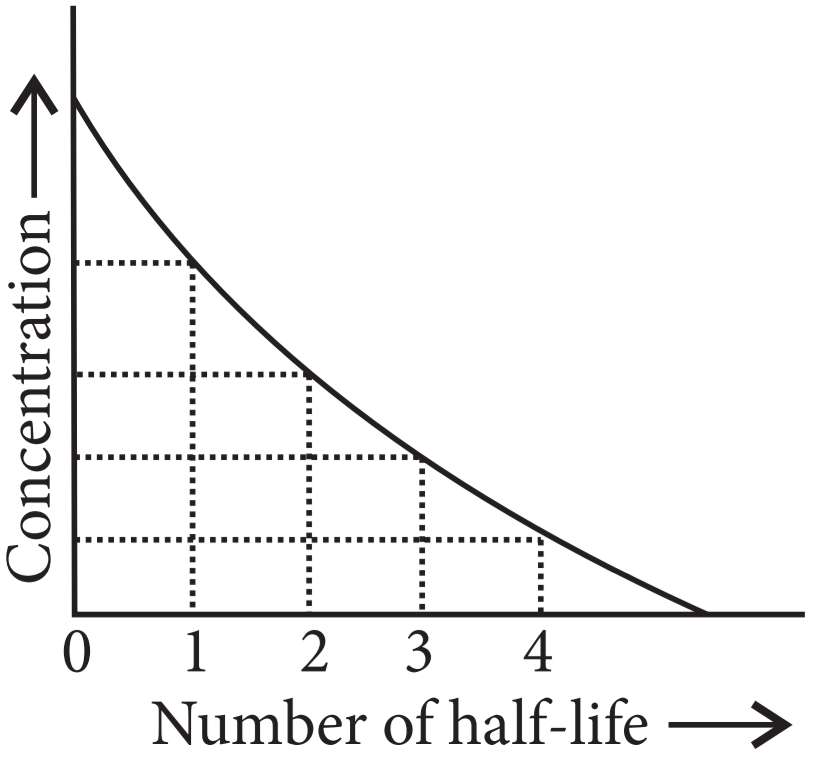
The half$-$life of a reaction is the time required for the concentration of reactant to decrease by half, i.e.,

$[\text{A}]_\text{t}=\frac{1}{2}[\text{A}]$
For first order reaction,
$\text{t}_\frac{1}{2}=\frac{0.693}{\text{k}}$
this means $\text{t}\frac{1}{2}$ is independent of initial concentration. Figure shows that typical variation of concentration of reactant exhibiting first order kinetics. It may be noted that though the major portion of the first order kinetics may be over in a finite time, but the reaction will never cease as the concentration of reactant will be zero only at infinite time.
The following questions are multiple choice questions. Choose the most appropriate answer:
  1. A first order reaction has a rate constant $k = 3.01 \times 10^{-3} /s$. How long it will take to decompose half of the reactant?
  1. $2.303s$
  2. $23.03s$
  3. $230.3s$
  4. $2303s$
  1. The rate constant for a first order reaction is $7.0 \times 10^{-4} s^{-1}$. If initial concentration ofreactant is $0.080 M,$ what is the half life of reaction?
  1. $990s$
  2. $79.2s$
  3. $12375s$
  4. $10.10 \times 10^{-4}s$
  1. For the half$-$life period of a first order reaction, which one of the following statements is generally false?
  1. It is independent of initial concentration.
  2. It is independent of temperature.
  3. It decreases with the introduction of a catalyst.
  4. None of these.
  1. The rate of a first order reaction is $0.04\ mol\  L^{-1} s^{-1}$ at $10$ minutes and $0.03\ mol\ L^{-1}\ s^{-1}$ at $20$ minutes after initiation. The half$-$life of the reaction is :
  1. $4.408$ min
  2. $44.086$ min
  3. $24.086$ min
  4. $2.408$ min
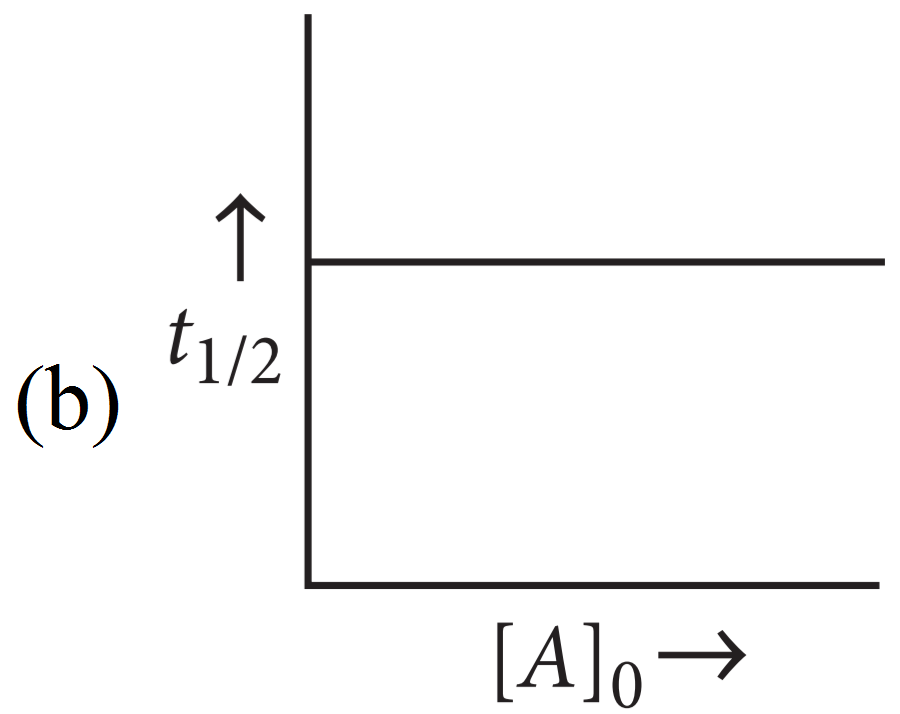
  1. The plot of $\text{t}_\frac{1}{2}$ vs initial concentration $[A]_0$ for a first order reaction is given by :
Answer
  1. $(c)\ 230.3s$
For a first order reaction :
$\text{t}_\frac{1}{2}=\frac{0.693}{\text{k}},\text{k}=3.01\times10^{-3}\text{s}^{-1}$
$\therefore\text{t}_\frac{1}{2}=\frac{0.693}{3.01\times10^{-3}}=230.3\text{s}$
  1. $(a)\ 990s$
Half life $\Big(\text{t}_\frac{1}{2}\Big)$ of a first order reaction is given as :
$\text{t}_\frac{1}{2}=\frac{0.693}{7.0\times10^{-4}}=990\text{s}$
  1. $(b)$ It is independent of temperature.
For a first order reaction $\text{t}_\frac{1}{2}=\frac{0.693}{\text{K}}$
Therefore $\text{t}_\frac{1}{2}$ depends upon $k$ and hence depends on temperature because rate constant $k$ is a function of temperature.
  1. $(c)\ 24.086$ min
Let the concentrations of the reactant after $10\ min$ and $20$ min be $C_1$ and $C_2$ respectively.
$\therefore$ Rate after $10\ min = k.C_1$
$= 0.04 \times 60\ mol\ L^{-1}\ min^{-1}$
and rate after $20$ min $= k.C_2$
$= 0.03 \times 60\ mol\ L^{-1}\ min^{-1}$
$\therefore\frac{\text{C}_1}{\text{C}_2}=\frac{4}{3}$
Let the reaction starts after $10$ minutes.
$\text{k}=\frac{2.303}{10}\log\frac{\text{C}_1}{\text{C}_2}=\frac{2.303}{10}\log\frac{4}{3}=0.02878$
$\therefore\text{t}_\frac{1}{2}=\frac{0.6932}{\text{k}}=\frac{0.6932}{0.02878}=24.086\ \text{min}$
  1.  

For a first order reactions, $\text{t}_\frac{1}{2}=\text{k[A]}_0^0=\text{k}.$
Thus $\text{t}_\frac{1}{2}$ is independent of initial concentration.
Hence plot of $\text{t}_\frac{1}{2}$ vs $[A]_0$ will be a horizontal line.
View full question & answer
Question 34 Marks
For a reaction, $A + B \rightarrow$ Products, the rate law is $-$ Rate $= k[A][B]^{3/2}$ Can the reaction be an elementary reaction? Explain.
Answer
During an elementary reaction, the number of atoms or ions colliding to react is referred to as molecularity.
Had this been an elementary reaction the order of reaction with respect to $B$ would have been $1,$ but in the given rate law it is $\frac{3}{2}$.
This indicates that the reaction is not an elementary reaction.
View full question & answer
Question 44 Marks
Decrease in concentration of reactant or increase in concentration of product per unit time is called rate of reaction. lt is of two types :
  1. Instantaneous rate of reaction : Rate of change of concentration of reactant or product at a particular time is called instantaneous rate of reaction.
$\text{r}_\text{inst.}=\frac{\text{dC}}{\text{dt}}$
where$, dC =$ infinitely small change in concentration
$dt =$ infinitely small change in time.
  1. Average rate of reaction : Ratio of change in concentration and time required for the change is average rate of reaction.
$\text{r}_\text{av}=\frac{\triangle\text{x}}{\triangle\text{t}}=\frac{\text{Change in concentration}}{\text{Time required for the change}}$
For a reaction of the type$, m_1A + m_2B \rightarrow n_1C + n_2D$
Rate of reaction is given as
$\frac{1}{\text{m}_1}\frac{\text{d[A]}}{\text{dt}}=-\frac{1}{\text{m}_2}\frac{\text{d[B]}}{\text{dt}}=+\frac{1}{\text{n}_1}\frac{\text{d[C]}}{\text{dt}}=+\frac{1}{\text{n}_2}\frac{\text{d[D]}}{\text{dt}}$
In these questions $(Q.$ No. $i-iv),$ a statement of assertion followed by a statement ofreason is given. Choose the correct answer out of the following choices.
  1. Assertion and reason both are correct statements and reason is correct explanation for assertion.
  2. Assertion and reason both are correct statements but reason is not correct explanation for assertion.
  3. Assertion is correct statement but reason is wrong statement.
  4. Assertion is wrong statement but reason is correct statement.
  1. Assertion: The kinetics of the reaction, $\text{mA}+\text{nB}+\text{pC}\rightarrow\text{m}'\text{ X}+\text{n}'\text{ Y}+\text{p}'\text{ Z}$ obey the rate expression as $\frac{\text{dx}}{\text{dt}}=\text{k}[\text{A}]^\text{m}[\text{B}]^\text{n}.$
Reason: The rate of the reaction does not depend upon the concentration of $C$.
  1. Assertion : Instantaneous rate of reaction is equal to $\frac{\text{dx}}{\text{dt}}.$
Reason : lt is the rate of reaction at any particular instant of time.
  1. Assertion : For the reaction, $\text{RCl}+\text{NaOH}\rightarrow\text{ROH}+\text{NaCl},$ the rate of reaction is reduced to half on reducing the concentration of $\ce{RCl}$ to half.
Reason : The rate of reaction is represented by $\ce{k[RCl}].$
  1. Assertion : ln rate law, unlike in the expression for equilibrium constants, the exponents for concentrations do not necessarily match the stoichiometric coefficients.
Reason: It is the mechanism and not the balanced chemical equation for the overall change that governs the reaction rate.
  1. Assertion : ln a reaction$, 2A + B \rightarrow A_2B,$ the reactant $B$ will disappear at twice the rate as $A$ will decrease.
Reason: The rate of disappearance of reactant will be $-\frac{1}{2}\frac{\text{d[A]}}{\text{dt}}=-\frac{\text{d[B]}}{\text{dt}}$
Answer
  1. $(a)$ Assertion and reason both are correct statements and reason is correct explanation for assertion.
Rate expression $\frac{\text{dx}}{\text{dt}}=\text{k}[\text{A}]^\text{m}[\text{B}]^\text{n}$
shows that the total order of reactions is $m + n + 0 = m + n,$ as the rate of reaction is independent of concentration of $C,$ i.e., the order with respect to $C$ is zero. This is the reason that $C$ does not figure in the rate expression.
  1. $(b)$ Assertion and reason both are correct statements but reason is not correct explanation for assertion.
Instantaneous rate of a reaction is equal to small change in concentration $(dx)$ during a small interval of time $(dt)$ at that particular instant of time divided by the time interval.
  1. $(a)$ Assertion and reason both are correct statements and reason is correct explanation for assertion.
For the given reaction, rate of reaction $(r) = \ce{k[RCl}]\ ($where $k$ is rate constant$)$.
Therefore if the concentration of $[\ce{RCl}]$ is reduced to half, then new rate $(\text{r}')=\frac{\text{k}}{2}[\text{RCl}].$
  1. $(a)$ Assertion and reason both are correct statements and reason is correct explanation for assertion.
  1. $(d)$ Assertion is wrong statement but reason is correct statement.
$2A + B \rightarrow A_2B$
The rate of disappearance of reactant will be
$-\frac{1}{2}\frac{\text{d[A]}}{\text{dt}}=\frac{\text{d[B]}}{\text{dt}}=\frac{\text{d}[\text{A}_2\text{B}]}{\text{dt}}$
Therefore, the reactant $B$ will disappear at half the rate as $A$ will decrease.
View full question & answer
Question 54 Marks
The following reaction, $\text{A}_{(\text{g})}\xrightarrow{\ \ \triangle\ \ \ }\text{P}_{(\text{g})}+\text{Q}_{(\text{g})}+\text{R}_{(\text{g})},$ follows first order kinetics. The half$-$life period of this reaction is $69.3s$ at $500^\circ C$. The gas $A$ is enclosed in a container at $500^\circ C$ and at a pressure of $0.4$ atm.
The following questions are multiple choice questions. Choose the most appropriate answer :
  1. The rate constant for the reaction is :
  1. $0.4s^{-1}$
  2. $0.02s^{-1}$
  3. $0.01s^{-1}$
  4. $0.3s^{-1}$
  1. The pressure of the gas $A$ after $230$ s will be :
  1. $0.04$ atm
  2. $0.36$ atm
  3. $0.4$ atm
  4. $0.036$ atm
  1. The total pressure of the system after $230$ swill be:
  1. $2.15$ atm
  2. $1.12$ atm
  3. $0.4$ atm
  4. $3.08$ atm
  1. The plot ofln$[A]$ vs twill be:
  1. Linear with slope $= k$
  2. Linear with intercept $= In[A]_0$
  3. Linear with slope $= In[A]_0$
  4. Linear with intercept $= [A]_0$
  1. Which of the following is not an example of first order reaction?
  1. $\text{C}_2\text{H}_{4(\text{g})}+\text{H}_{2(\text{g})}\rightarrow\text{C}_2\text{H}_{6(\text{g})}$
  2. $2\text{N}_2\text{O}_{5(\text{g})}\rightarrow4\text{NO}_{2(\text{g})}+\text{O}_{2(\text{g})}$
  3. $2\text{N}\text{H}_{3(\text{g})}\xrightarrow[\triangle]{\text{pt}}\text{N}_{2(\text{g})}+3\text{H}_{2(\text{g})}$
  4. $2\text{N}_2\text{O}_{(\text{g})}\xrightarrow{\ \ \triangle\ \ }2\text{N}_{2(\text{g})}+\text{O}_{2(\text{g})}$
Answer
  1. $(c)\ 0.01s^{-1}$
$\text{t}_\frac{1}{2}=69.3\text{s}$
For first order reaction,
$\text{k}=\frac{0.693}{\text{t}_\frac{1}{2}}=\frac{0.693}{69.3}=0.01\text{s}^{-1}$
  1. $(a)\ 0.04$ atm
$\text{k}=\frac{2.303}{\text{t}}\log\frac{\text{a}}{\text{a}-\text{x}}=\frac{2.303}{230}\log\frac{0.4}{0.4-\text{x}}$
$0.01=\frac{2.303}{230}\log\frac{0.4}{0.4-\text{x}}=0.01\log\frac{0.4}{0.4-\text{x}}$
$\frac{0.01}{0.01}=\log\frac{0.4}{0.4-\text{x}}$
$\Rightarrow1=\log\frac{0.4}{0.4-\text{x}}$
Antilog of $1=\frac{0.4}{0.4-\text{x}}$
$\Rightarrow10=\frac{0.4}{0.4-\text{x}}\Rightarrow\text{x}=0.36$
$\therefore\text{a}-\text{x}=0.4-0.36=0.04$ atm
  1. $(b)\ 1.12$ atm
For the given reaction,
$\text{A}_{(\text{g})}\xrightarrow{\ \ \triangle\ \ \ }\text{P}_{(\text{g})}+\text{Q}_{(\text{g})}+\text{R}_{(\text{g})}$
Initial pressur
$0.4$ $0$ $0$ $0$
Final pressure
$0.4-0.36$ $0.36$ $0.36$ $0.36$
Total pressure $= (0.4 - 0.36) + (3 \times 0.36) = 1.12$ atm
  1. $(b)$ Linear with intercept $= In[A]_0$
Expression that relates concentration of reactant and ti me for first order reaction is
$In[A] = -kt + In[A]_0$
So, the plot of In $[A]$ vs twill be linear with slope $= -k$ and intercept $= In[A]_0$
  1. $(c)\ 2\text{N}\text{H}_{3(\text{g})}\xrightarrow[\triangle]{\text{pt}}\text{N}_{2(\text{g})}+3\text{H}_{2(\text{g})}$
Decomposition of ammonia on a hot platinum surface at high pressure is a zero order reaction.
View full question & answer
Question 64 Marks
Number of molecules which must collide simultaneously to give product is called molecularity. It is equal to sum of coefficients of reactants present in stoichiometric chemical equation. For reaction, $m_1A + m_2B \rightarrow$ Product Molecularity $= [m_1 + m_2]$ ln complex reaction each step has its own molecularity which is equal to the sum of coefficients of reactants present in a particular step. Molecularity is a theoretical property. Its value is any whole number. Number of concentration terms on which rate of reaction depends is called order of reaction or sum of powers of concentration terms present in the rate equation is called order of reaction. If rate equation ofreaction is: Rate $=\text{k}\cdot\text{C}^{\text{m}_1}_\text{A}\cdot\text{C}^{\text{m}_2}_\text{B}$ Then order of reaction $= m_1 + m_2.$ ln simple reaction, order and molecularity are same. ln complex reaction, order of slowest step is the order ofover all reaction. This step is known as rate determining step. Order is an experimental property. Its value may be zero, fractional or negative. The following questions are multiple choice questions. Choose the most appropriate answer:
  1. Higher order $(> 3)$ reactions are rare due to:
  1. Shifting of equilibrium towards reactants due to elastic collisions.
  2. Loss of active species on collision.
  3. Low probability of simultaneous collision of all the reacting species.
  4. Increase in entropy and activation energy as more molecules are involved.
  1. The molecularity of the reaction:
$6\text{FeSO}_4+3\text{H}_2\text{SO}_4+\text{KClO}_3\rightarrow\text{KCl}+3\text{Fe}_2(\text{SO}_4)_3+3\text{H}_2\text{O}$ is:
  1. $6$
  2. $10$
  3. $3$
  4. $7$
  1. Which of the following statements is false in the following?
  1. Order of a reaction may be even zero.
  2. Molecularity of a reaction is always a whole number.
  3. Molecularity and order always have same values for a reaction.
  4. Order of a reaction depends upon the mechanism of the reaction.
  1. The rate of reaction, $A + 2B \rightarrow$ products, is given by the following equation:
$-\frac{\text{d}[\text{A}]}{\text{dt}}=\text{k}[\text{A}][\text{B}]^2$
If B is present in large excess, the order of the reaction is:
  1. Zero
  2. First
  3. Second
  4. Third
  1. The rate of the reaction, $A + B + C \rightarrow$  products, is given by $\text{r}=\frac{\text{d}[\text{A}]}{\text{dt}}=\text{k}[\text{A}]^\frac{1}{2}[\text{B}]^\frac{1}{3}[\text{C}]^\frac{1}{4}.$ The order of the reaction is:
  1. $\frac{1}{3}$
  2. $\frac{1}{4}$
  3. $\frac{1}{2}$
  4. $\frac{13}{12}$
Answer
  1. $(c)$ Low probability of simultaneous collision of all the reacting species.
The reactions of higher order are very rare because of the less chances of the molecules to come together simultaneously and collide.
  1. $(c)\ 3$
The total number of reactant molecules participating in a chemical reaction is known as its molecularity, hence the molecularity $= 6 + 3 + 1 = 10.$
  1. $(c)$ Molecularity and order always have same values for a reaction.
Molecularity may or may not be equal to the order of a reaction.
  1. $(b)$ First
From the expression
$-\frac{\text{d}[\text{A}]}{\text{dt}}=\text{k}[\text{A}][\text{B}]^2$
when $B$ is present in large excess, rate will be independent upon the change in cone. of $B,$ therefore order of reaction will be one.
  1. $(d)\ \frac{13}{12}$
Order of reaction $=\frac{1}{2}+\frac{1}{3}+\frac{1}{4}=\frac{6+4+3}{12}=\frac{13}{12}$
View full question & answer
Question 74 Marks
A reaction is said to be of the first order if the rate of the reaction depends upon one concentration term only. For a first order reaction of the type $A \rightarrow$ Products, the rate of the reaction is given as: rate $= k[A]$. The differential rate law is given as : $\frac{\text{dA}}{\text{dt}}=-\text{k}[\text{A}].$ The integrated rate law is : In $\frac{[\text{A}]}{[\text{A}]_0}=-\text{kt}, [A]$ is the concentration of reactant left at time $t$ and $[A]_0$ is the initial concentration of the reactant$, k$ is the rate constant.
The following questions are multiple choice questions. Choose the most appropriate answer :
  1. The unit of rate constant for a first order reaction is:
  1. $S^{-1}$
  2. $mol\ L^{-1} s^{-1}$
  3. $L\ mol^{-1} s^{-1}$
  4. $L^2\ mol^{-2} s^{-1}$
  1. Half$-$life period of a first order reaction is $10$ min. Starting with initial concentration $12M,$ the rate after $20$ min is:
  1. $0.693 \times 3M\ min^{-1}$
  2. $0.0693 \times 4M\ min^{-1}$
  3. $0.0693 \times M\ min^{-1}$
  4. $0.0693 \times 3M\ min^{-1}$
  1. $50\%$ of a first order reaction is complete in $23$ minutes. Calculate the ti me required to complete $90\%$ of the reaction.
  1. $70.4$ minutes.
  2. $76.4$ minutes.
  3. $38.7$ minutes.
  4. $35.2$ minutes.
  1. For a first order reaction$, (A) \rightarrow$ products, the concentration of $A$ changes from $0.1M$ to $0.025M$ in $40$ minutes. The rate of reaction when the concentration of $A$ is $0.01M,$ is:
  1. $3.47 \times 10^{-4} M/ min$
  2. $3.47 \times 10^{-5} M/ min$
  3. $1.73 \times 10^{-4} M/ min$
  4. $1.73 \times 10^{-5} M/ min$
  1. The half$-$life period ofa $1^{st}$ order reaction is $60$ minutes. What percentage will be left over after $240$ minutes?
  1. $6.25\%$
  2. $4.25\%$
  3. $5\%$
  4. $6\%$
Answer
  1. $(a)\ 0.693 \times 3M\ min^{-1}$
Unit of rate constant for a reaction of $n^{th}$ order $= (conc.)^{1 - n}$ time$^{-1}$
For a first order reaction$, n = 1$
Unit of rate constant $= (mol\ L^{-1})^{1-1}s^{-1} = s^{-1}$
  1. $(d)\ 0.0693 \times 3M\ min^{-1}$
$12\text{M}\xrightarrow{\ \ \ \text{t}_\frac{1}{2}\ \ \ \ }6\text{M}\xrightarrow{\ \ \ \text{t}\frac{1}{2}\ \ \ }3\text{M}\\_\text{initial conc}$
$\text{t}_\frac{1}{2}=10\text{min}$
$\text{k}=\frac{0.693}{10}=0.0693\text{min}^{-1}$
As $\text{t}_\frac{1}{2}$ is $10$ min, after $20$ minutes the concentration will be $3M$.
Hence, Rate $= 0.0693 \times 3M\ min^{-1}$
  1. $(b)\ 76.4$ minutes.
$\text{t}_\frac{1}{2}=23\text{ minutes}$
$\text{t}_\frac{1}{2}=\frac{0.693}{\text{k}}$
$\Rightarrow\text{k}=\frac{0.693}{\text{t}_\frac{1}{2}}$
$\Rightarrow\frac{0.693}{23}\text{min}^{-1}$
For $90\%$ completion,
$\text{t}=\frac{2.303}{\text{k}}\log\Big(\frac{\text{a}}{\text{a}-\text{x}}\Big)$
$\text{t}=\frac{2.303\times23}{0.693}\log\Big(\frac{100}{100-90}\Big)$
$\text{t} = 76.4\text{ minutes}$
  1. $(a)\ 3.47 \times 10^{-4} M/ min$
For the first order reaction,
$\text{k}=\frac{2.303}{\text{t}}\log\frac{\text{a}}{\text{a}-\text{x}}$
$\text{a}=0.1\text{M},\text{a}-\text{x}=0.025\text{M},\text{t}=40\text{min}$
$\text{k}=\frac{2.303}{40}\log\frac{0.1}{0.025}=\frac{2.303}{40}\log4$
$=0.0347\text{min}^{-1}$
$[A] \rightarrow$ product
Thus, rate $= k[A]$
rate $= 0.0347 \times 0.01M\ min^{-1} = 3.47 \times 10^{-4}M\ min^{-1}$
  1. $(a) 6.25\%$
$\text{t}_\frac{1}{2}=\frac{0.693}{\text{k}}$
$\Rightarrow\frac{0.693}{\text{t}_\frac{1}{2}}=\text{k}$
$\Rightarrow\frac{0.693}{60}=\text{k}$
$\text{k} = 0.01155 \text{ min}^{-1}$
$\text{k}=\frac{2.303}{\text{t}}\log\Big(\frac{\text{a}}{\text{a}-\text{x}}\Big)$
Let the initial amount $(a)$ be $100.$
$0.01155\ \text{min}^{-1}=\frac{2.303}{240\text{min}}\log\Big(\frac{100}{\text{a}-\text{x}}\Big)$
$\frac{0.01155^{-1}\times240\text{min}}{2.303}=\log\Big(\frac{100}{\text{a}-\text{x}}\Big)$
$1.204=\log100-\log(\text{a}-\text{x})$
$1.204=2-\log(\text{a}-\text{x})$
$\log(\text{a}-\text{x})=2-1.204=0.796$
$(\text{a}-\text{x})=6.25\%$
View full question & answer
Question 84 Marks
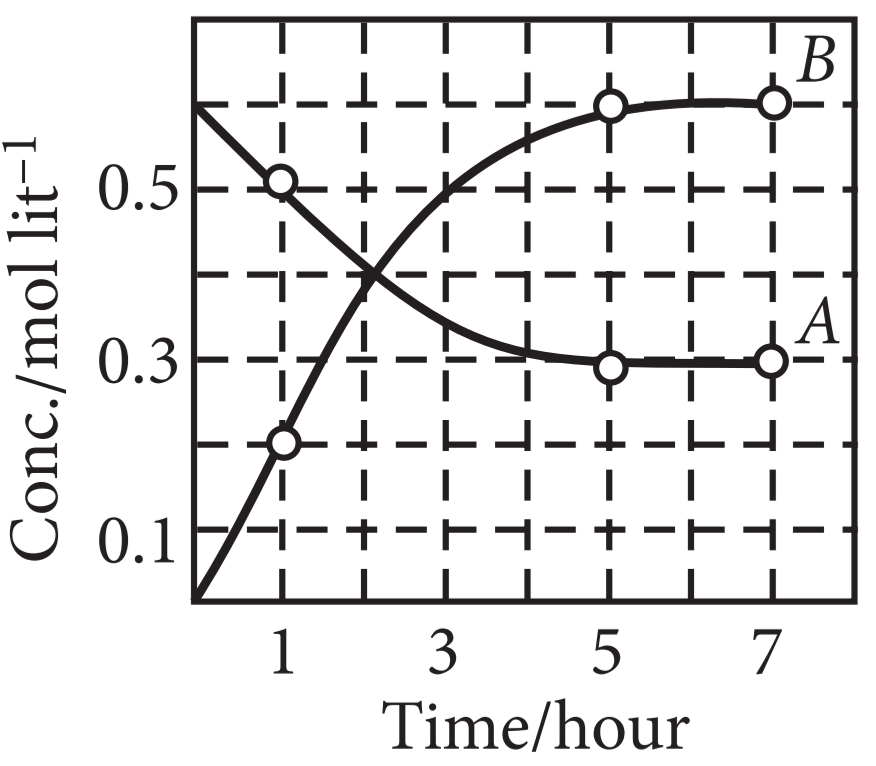
The progress of the reaction$, \text{A}\rightleftharpoons\text{nB}$ with time is represented in the following figure :

The following questions are multiple choice questions. Choose the most appropriate answer :
  1. What is the value of $n$?
  1. $1$
  2. $2$
  3. $3$
  4. $4$
  1. Find the value of the equilibrium constant.
  1. $0.6M$
  2. $1.2M$
  3. $0.3M$
  4. $2.4M$
  1. The initial rate of conversion of $A$ will be:
  1. $0.1 mol L^{-1}hr^{-1}$
  2. $0.2 mol L^{-1}hr^{-1}$
  3. $0.4 mol L^{-1}hr^{-1}$
  4. $0.8 mol L^{-1}hr^{-1}$
  1. For the reaction, if $\frac{\text{d}[\text{B}]}{\text{dt}}=2\times10^{-4},$ value of $-\frac{\text{d}[\text{A}]}{\text{dt}}$ will be:
  1. $2 \times 10^{-4}$
  2. $10^{-4}$
  3. $4 \times 10^{-4}$
  4. $0.5 \times 10^{-4}$
  1. Which factor has no effect on rate of reaction?
  1. Temperature.
  2. Nature of reactant.
  3. Concentration of reactant.
  4. Molecularity.
Answer
  1. $(b)\ 2$
According to the figure, in the given time of $4$ hours $(1$ to $5)$ concentration of $A$ falls from $0.5$ to $0.3M,$ while in the same time concentration of $B$ increases from $0.2$ to $0.6 M.$
Decrease in concentration of $A$ in $4$ hours
$= 0.5 - 0.3 = 0.2M$
Increase in concentration of $B$ in $4$ hours
$= 0.6 - 0.2 = 0.4M$
Thus, increase in concentration of $B$ in a given time is twice the decrease in concentration of $A.$
Thus$, n = 2.$
  1. $(b)\ 1.2M$
$\text{K}=\frac{[\text{B}]^2}{[\text{A}]}=\frac{(0.6)^2}{0.3}=1.2\text{M}$
  1. $(a)\ 0.1\ mol\ L^{-1}hr^{-1}$
From $t = 0$ to $t = 1hr,$
For $A, dx = 0.6 - 0.5 = 0.1\ mol\ L^{-1}$
$\therefore$ Initial rate of conversion of $\text{A}=\frac{\text{dx}}{\text{dt}}$
$=\frac{0.1\text{ mol}\text{ L}^{-1}}{1\text{hr}}=0.1\text{ mol}\text{ L}^{-1}\text{hr}^{-1}$
  1. $(b)\ 10^{-4}$
$\text{A}\rightleftharpoons2\text{B}$
$-\frac{\text{d}[\text{A}]}{\text{dt}}=+\frac{1}{2}\frac{\text{d}[\text{B}]}{\text{dt}}$
$=\frac{1}{2}\times2\times10^{-4}=10^{-4}$
  1. $(d)$ Molecularity.
The number of reacting species $($atoms, ions or molecules$)$ taking part in an elementary reaction is called molecularity and it has no influence on the rate of reaction.
View full question & answer
Question 94 Marks
A reaction in which rate ofreaction is independent of concentration of the reactants is called zero order reaction. Photochemical combination of hydrogen and chlorine to give hydrogen chloride is an example of zero order reaction. The rate constant of a zero order reaction is equal to the rate of reaction. The half life period of a zero order reaction is directly proportional to initial concentration of the reactant. For a zero order reaction, $\text{k}=\frac{1}{\text{t}}\left\{[\text{A}]-[\text{A}]\right\}$ In these questions $(Q. No. i-iv),$ a statement of assertion followed by a statement of reason is given. Choose the correct answer out of the following choices.
  1. Assertion and reason both are correct statements and reason is correct explanation for assertion.
  2. Assertion and reason both are correct statements but reason is not correct explanation for assertion.
  3. Assertion is correct statement but reason is wrong statement.
  4. Assertion is wrong statement but reason is correct statement.
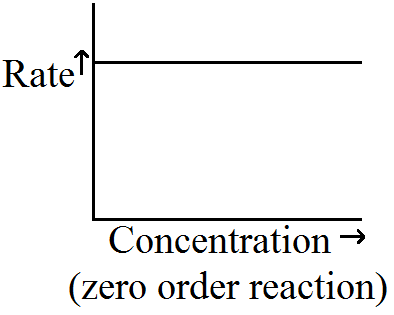
  1. Assertion: For a zero order reaction, plot of rate vs concentration will be a straight line parallel to concentration axis.
Reason: For a zero order reaction, rate is independent of concentration.
  1. Assertion: Photochemical combination of hydrogen and chlorine to give hydrogen chloride is an example of zero order reaction.
Reason: The rate of reaction depends on the concentration of hydrogen and independent of concentration of chlorine.
  1. Assertion: If in a zero order reaction, the concentration of the reactant is doubled, the half$-$life period is also doubled.
Reason: For a zero order reaction, the rate of reaction is independent of initial concentration.
  1. Assertion: ln a reaction $A \rightarrow $ products, the concentration of the reactant is reduced to zero after a finite time.
Reason: The order of reaction is zero.
  1. Assertion: Rate constant of a zero order reaction has same units as the rate of reaction.
Reason: Rate constant of a zero order reaction does not depend on the unit of concentration.
Answer
  1. $(a)$ Assertion and reason both are correct statements and reason is correct explanation for assertion.
  1. $(c)$ Assertion is correct statement but reason is wrong statement.
The reaction proceeds with a constant rate which is independent of concentration of hydrogen and chlorine. That is why, this reaction is a zero order reaction.
  1. $(b)$ Assertion and reason both are correct statements but reason is not correct explanation for assertion.
For a zero order reaction, $\text{t}_\frac{1}{2}=\frac{[\text{a}]}{2\text{k}}$.
  1. $(a)$ Assertion and reason both are correct statements and reason is correct explanation for assertion.

  1. $(c)$ Assertion is correct statement but reason is wrong statement.
For a zero order reaction, units of $k$ is mol $L^{-1} s^{-1}$, i.e., it depends upon units of concentration.
View full question & answer
Question 104 Marks
For the reaction : $2\text{NO}_\text{(g)}+\text{Cl}_{2\text{(g)}}\rightarrow2\text{NOCl}_\text{(g)},$ the following data were collected. All the measurements were taken at $263K.$
Experiment No.
Initial $\ce{[NO] (M)}$
Initial $\ce{[Cl_2] (M)}$
Initial rate of disapp. of $\ce{Cl_2 (M/ min)}$
$1.$ $0.15$ $0.15$ $0.60$
$2.$ $0.15$ $0.30$ $1.20$
$3.$ $0.30$ $0.15$ $2.40$
$4.$ $0.25$ $0.25$ $?$
The following questions are multiple choice questions. Choose the most appropriate answer:
  1. The molecularity of the reaction is:
  1. $1$
  2. $2$
  3. $3$
  4. $4$
  1. The expression for rate law is:
  1. $\text{r}=\text{k}[\text{NO}][\text{Cl}_2]$
  2. $\text{r}=\text{k}[\text{NO}]^2[\text{Cl}_2]$
  3. $\text{r}=\text{k}[\text{NO}][\text{Cl}_2]^2$
  4. $\text{r}=\text{k}[\text{NO}]^2[\text{Cl}_2]^2$
  1. The overall order of the reaction is:
  1. $2$
  2. $0$
  3. $1$
  4. $3$
  1. The value of rate constant is:
  1. $150.32\ M^{-2}\ min^{-1}$
  2. $200.08\ M^{-1}\ min^{-1}$
  3. $177.77\ M^{-2}\ min^{-1}$
  4. $155.75\ M^{-1}\ min^{-1}$
  1. The initial rate of disappearance of $Cl_2$ in experiment $4$ is:
  1. $1.75\ M\ min^{-1}$
  2. $3.23\ M\ min^{-1}$
  3. $2.25\ M\ min^{-1}$
  4. $2.77\ M\ min^{-1}$
Answer
  1. $(c)\ 3$
$2\text{NO}_\text{(g)}+\text{Cl}_{2\text{(g)}}\rightarrow2\text{NOCl}_\text{(g)}$
Molecularity $= 3$
  1. $(b)\ \text{r}=\text{k}[\text{NO}]^2[\text{Cl}_2]$
Let rate of this reaction, $\text{r}=\text{k}[\text{NO]}^\text{m}[\text{Cl}_2]^\text{n}$
then $\frac{\text{r}_1}{\text{r}_2}$
$=\frac{0.60}{1.20}$
$=\frac{\text{k}(0.15)^\text{m}(0.15)^\text{n}}{\text{k}(0.15)^\text{m}(0.30)^\text{n}}$
or, $\frac{1}{2}=\Big(\frac{1}{2}\Big)^\text{n}$
$\Rightarrow\text{n}=1$
Again from $\frac{\text{r}_2}{\text{r}_3}=\frac{1.20}{2.40}=\frac{\text{k}(0.15)^\text{m}(0.30)^\text{n}}{\text{k}(0.30)^\text{m}(0.15)^\text{n}}$
or $\frac{1}{2}=\Big(\frac{1}{2}\Big)^\text{m}\cdot\frac{2}{1}$ or $\frac{1}{4}$
$=\Big(\frac{1}{2}\Big)^\text{m}$
$\Rightarrow\text{m}=2$
Hence, expression for rate law is
$\text{r}=\text{k}[\text{NO}]^2[\text{Cl}_2]^1$
  1. $(d)\ 3$
As the order $w.r.t.\  NO$ is $2$ and order $w.r.t.\ Cl_2$ is $1,$
hence the overall order is $3.$
  1. $(c)\ 177.77\ M^{-2}\ min^{-1}$​​​​​​​
Substituting the values of experiment $1$ in rate law expression
$0.60\ M\  min^{-1} = k(0.15M)^2 (0.15M)^1$
or $\text{k}=\frac{0.60\text{M min}^{-1}}{0.0225\times0.15\text{M}^3}$
$=177.77\text{M}^{-2}\text{min}^{-1}$
  1. $(d)\ 2.77\ M\ min^{-1}$​​​​​​​
$r = 177.7\ M^{-2}\ min^{-1} \times (0.25M)^2 (0.25M)$
$= 2.77\ M\ min^{-1}$​​​​​​​
View full question & answer
Question 114 Marks
ln a reaction, the rates of disappearance of different reactants or rates of formation of different products may not be equal but rate of reaction at any instant of time has the same value expressed in terms of any reactant or product. Further, the rate of reaction may not depend upon the stoichiometric coefficients of the balanced chemical equation. The exact powers of molar concentrations of reactants on which rate depends are found experimentally and expressed in terms of 'order of reaction'. Each reaction has a characteristic rate constant depends upon temperature. The units of the rate constant depend upon the order of reaction.
The following questions are multiple choice questions. Choose the most appropriate answer:
  1. The rate constant of a reaction is found to be $3 \times 10^{-3} \text{mol}^{-2} L^2 \sec^{-1}$. The order of the reaction is:
  1. $0.5$
  2. $2$
  3. $3$
  4. $1$
  1. ln the reaction$, A + 3B \rightarrow 2C,$ the rate of formation of $C$ is:
  1. The same as rate of consumption of $A$.
  2. The same as the rate of consumption of $B$.
  3. Twice the rate of consumption of $A$.
  4. $\frac{3}{2}$ times the rate of consumption of $B$.
  1. Rate of a reaction can be expressed by following rate expression, Rate $= k[A]^2 [B],$ if concentration of $A$ is increased by $3$ times and concentration of $B$ is increased by $2$ times, how many times rate of reaction increases?
  1. $9$ times
  2. $27$ times
  3. $18$ times
  4. $8$ times
  1. The rate of a certain reaction is given by, rate $= k[H^+]^n.$ The rate increases $100$ times when the $pH$ changes from $3$ to $1$. The order $(n)$ of the reaction is:
  1. $2$
  2. $0$
  3. $1$
  4. $1.5$
  1. ln a chemical reaction $A + 2B \rightarrow$ products, when concentration of $A$ is doubled, rate of the reaction increases $4$ times and when concentration of $B$ alone is doubled rate continues to be the same. The order of the reaction is:
  1. $1$
  2. $2$
  3. $3$
  4. $4$
Answer
  1. $(c) \ 3$
Unit of k for $n^{th}$ order $= (\text{mol} \ L^{-1})^{1-n} \sec^{-1}$
Here $, k = 3 \times 10^{-3} \text{mol}^{-2} L^2 \sec^{-1}$
Unit of $k = \text{mol}^{-2} L^2 \sec^{-1} $
$\Rightarrow (\text{mol} \ L^{-1})^{-2} \sec^{-1}$
Comparing $(i)$ and $(ii)$ we get $, 1 - n = -2 $
$\Rightarrow n = 3$
  1. $(c)$ twice the rate of consumption of $A$.
Rate $=\frac{\text{d[A]}}{\text{dt}}=-\frac{1}{3}\frac{\text{d[B]}}{\text{dt}}=\frac{1}{2}\frac{\text{d[C]}}{\text{dt}}$
  1. $(c) \ 18$ times
Given $, R_1 = k[A]^2 [B]$
According to question $, R_2 = k[3A]^2 [2B]$
$= k \times 9 [A]^2 \times 2[B] = 18 \times k[A]^2 [B] = 18 R_1​​​​​​​$
  1. $(c)\  1$
Rate $(r) = k[H^+]^n$
When $pH = 3 ; [H^+] = 10^{-3}$
and when $pH = 1 ; [H^+] = 10^{-1}$
$\therefore\frac{\text{r}_1}{\text{r}_2}=\frac{\text{k}(10^{-3})^\text{n}}{\text{k}(10^{-1})^\text{n}}$
$\Rightarrow\frac{1}{100}=\Big(\frac{10^{-3}}{10^{-1}}\Big)^\text{n}$
$(\because\text{r}_2=100\text{r}_1)$
$\Rightarrow(10^{-2})^1=(10^{-2})^\text{n}$
$\Rightarrow\text{n}=1$​​​​​​​
  1. $(b)\ 2$
Let the order of reaction $\text{w.r.t. A}$ is $x$ and $\text{w.r.t. B}$ is $y$.
$\text{r}_1=\text{k}[\text{A}]^\text{x}[\text{B}]^\text{y}$
$\text{r}_2=\text{k}[\text{2A}]^\text{x}[\text{B}]^\text{y}$
$\text{r}_3=\text{k}[\text{A}]^\text{x}[\text{2B}]^\text{y}$
$\frac{\text{r}_1}{\text{r}_2}=\frac{\text{k}[\text{A}]^\text{x}[\text{B}]^\text{y}}{\text{k}[2\text{A}]^\text{x}[\text{B}]^\text{y}}$
$\Rightarrow\frac{1}{4}=\Big(\frac{1}{2}\Big)^\text{x}$
$\Rightarrow\Big(\frac{1}{2}\Big)^2=\Big(\frac{1}{2}\Big)^\text{x}$
$\Rightarrow\text{x}=2$
Similarly, $\frac{\text{r}_1}{\text{r}_3}=\frac{\text{k}[\text{A}]^\text{x}[\text{B}]^\text{y}}{\text{k}[\text{A}]^\text{x}[2\text{B}]^\text{y}}$
$\Rightarrow1=\Big(\frac{1}{2}\Big)^\text{y}$
$\Rightarrow\Big(\frac{1}{2}\Big)^0=\Big(\frac{1}{2}\Big)^\text{y}$
$\Rightarrow\text{y}=0$
Hence the rate law equation is
Rate $= k[A]^2 [B]^0$
​​​​​​​$\Rightarrow$ Order of reaction $= 2$
View full question & answer