Question 11 Mark
Write the IUPAC name of the following coordination compound:
$\left[\mathrm{Co}\left(\mathrm{NH}_3\right)_6\right] \mathrm{Cl}_3$
AnswerHexaamminecobalt (III) chloride.
View full question & answer→Question 21 Mark
Write the formula for the following coordination compound:
Tris (ethane–1, 2–diamine) chromium (III) chloride.
AnswerTris (ethane-1, 2-diamine) chromium (III) chloride $-\left[\mathrm{Cr}(\mathrm{en})_3\right] \mathrm{Cl}_3$
View full question & answer→Question 31 Mark
Write the IUPAC name of the following coordination compound:
$\left[\mathrm{Pt}\left(\mathrm{NH}_3\right)_2 \mathrm{Cl}\left(\mathrm{NH}_2 \mathrm{CH}_3\right)\right] \mathrm{Cl}$
AnswerDiamminechlorido (methylamine) platinum (II) chloride.
View full question & answer→Question 41 Mark
Specify the oxidation numbers of the metals in the following coordination entities:
$\left[\mathrm{Cr}\left(\mathrm{NH}_3\right)_3 \mathrm{Cl}_3\right]$
Answer$\left[\mathrm{Cr}\left(\mathrm{NH}_3\right)_3 \mathrm{Cl}_3\right]$
$x + 0 + 3 (-1) = 0$
$x = +3$
View full question & answer→Question 51 Mark
$\left[\mathrm{Fe}\left(\mathrm{H}_2 \mathrm{O}\right)_6\right]^{3+}$ is strongly paramagnetic whereas $\left[\mathrm{Fe}(\mathrm{CN})_6\right]^{3-}$ is weakly paramagnetic. Explain.
AnswerIn presence of $\mathrm{CN}^{-}$, (a strong ligand) the 3d electrons pair up leaving only one unpaired electron. The hybridisation is $\mathrm{d}^2 \mathrm{sp}^3$ forming inner orbital complex. In the presence of $\mathrm{H}_2 \mathrm{O}$, (a weak ligand), 3d electrons do not pair up. The hybridisation is $\mathrm{sp}^3 \mathrm{d}^2$ forming an outer orbital complex containing five unpaired electrons, thus greater the number of unpaired electrons more is the paramagnetic behavior.
View full question & answer→Question 61 Mark
Write the formula for the following coordination compound:
Tetraamminediaquacobalt (III) chloride.
AnswerTetraaminediaquacobalt (III) chloride - $\left[\mathrm{Co}\left(\mathrm{NH}_3\right)_4\left(\mathrm{H}_2 \mathrm{O}\right)_2\right] \mathrm{Cl}_3$
View full question & answer→Question 71 Mark
Discuss briefly giving an example in case the role of coordination compounds in:
Medicinal chemistry.
AnswerRole of coordination compounds in medicinal chemistry:
Certain coordination compounds of platinum (for example, cis-platin) are used for inhibiting the growth of tumours.
View full question & answer→Question 81 Mark
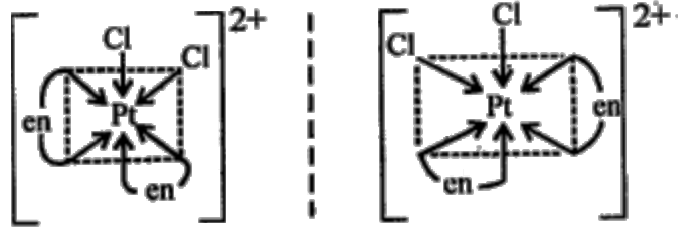
Draw the structures of optical isomers of: $\left[\mathrm{PtCl}_2(e n)_2\right]^{2+}$
Answer
$\left(\right.$ cis-isomer only $)\mathrm{Cis}-\left[\mathrm{PtCl}_2(\mathrm{en})_2\right]^{2+}$
View full question & answer→Question 91 Mark
Using IUPAC norms write the systematic name of the following:
$\left[\mathrm{Co}\left(\mathrm{NH}_3\right)_6\right] \mathrm{Cl}_3$
AnswerHexaammine cobalt (111) chloride.
View full question & answer→Question 101 Mark
Using IUPAC norms write the systematic name of the following:
$\left[\mathrm{Ti}\left(\mathrm{H}_2 \mathrm{O}\right)_6\right]^{3+}$
AnswerHexaaquatitanium (III) ion.
View full question & answer→Question 111 Mark
Predict the number of unpaired electrons in the square planar $[Pt(CN)_4]^{2–}$ ion.
Answer
$[Pt(CN)_4]^{2-}:$ the outer shell electronic
configurationof Pt is $5d^96s^1.$
In $+2$ state of Pt,is $5d^8$,i.e.,
For squre planer geometry, hybridisation is $dsp^2.$
Hence, the two d $e^{-1}s$ pair up to make one
d-orbital empty. So, there is no unpaired $r^-$
View full question & answer→Question 121 Mark
Write the IUPAC name of the following coordination compound:
$\mathrm{K}_2\left[\mathrm{PdCl}_4\right]$
AnswerPotassium tetrachloridopalladate (II).
View full question & answer→Question 131 Mark
Discuss briefly giving an example in case the role of coordination compound in:
Biological systems.
AnswerRole of coordination compounds in biological systems:
We know that photosynthesis is made possible by the presence of the chlorophyll pigment. This pigment is a coordination compound of magnesium. In the human biological system, several coordination compounds play important roles. For example, the oxygen-carrier of blood, i.e., haemoglobin, is a coordination compound of iron.
View full question & answer→Question 141 Mark
Using IUPAC norms write the formula for the following:
Pentaamminenitrito-O-cobalt (III).
Answer$\left[\mathrm{Co}\left(\mathrm{NH}_3\right)_5(\mathrm{ONO})\right]^{2+}$
View full question & answer→Question 151 Mark
Specify the oxidation number of the metal in the following coordination entitie:
$\mathrm{K}_3\left[\mathrm{Fe}(\mathrm{CN})_6\right]$
Answer$\mathrm{K}_3\left[\mathrm{Fe}(\mathrm{CN})_6\right]$
$3 + x + 6 (-l) = 0$
$x = +3$
View full question & answer→Question 161 Mark
Discuss briefly giving an example in case the role of coordination compounds in:
Extraction/ metallurgy of metals.
AnswerRole of coordination compounds in extraction/ metallurgy of metals:The process of extraction of some of the metals from their ores involves the formation of complexes. For example, in aqueous solution, gold combines with cyanide ions to form $[Au(CN)_2].$ From this solution, gold is later extracted by the addition of zinc metal.
View full question & answer→Question 171 Mark
Using IUPAC norms write the formula for the following:
Hexaamminecobalt (III) sulphate.
Answer$\left.\mathrm{Co}\left(\mathrm{NH}_3\right)_6\right]^2\left(\mathrm{SO}_4\right)_3$
View full question & answer→Question 181 Mark
Using IUPAC norms write the systematic name of the following:
$\left[\mathrm{Ni}\left(\mathrm{NH}_3\right)_6\right] \mathrm{Cl}_2$
AnswerHexaammine nickel (II) chloride.
View full question & answer→Question 191 Mark
How many geometrical isomers are possible in the following coordination entitie?
$\left[\mathrm{Co}\left(\mathrm{NH}_3\right)_3 \mathrm{Cl}_3\right]$
Answer$\left[\mathrm{Co}\left(\mathrm{NH}_3\right)_3 \mathrm{Cl}_3\right]$
Two geometrical isomers are possible (fac and mer) in this coordination entity.
View full question & answer→MCQ 201 Mark
How many ions are produced from the complex $\ce{Co(NH_3)_6Cl_2}$ in solution?
AnswerThe given complex can be written as $\ce{Co(NH_3)_6Cl_2}.$
Thus, $\ce{[Co(NH_3)_6]^+}$ along with two $Cl^-$ ions are produced.
View full question & answer→Question 211 Mark
Using IUPAC norms write the systematic name of the following:
$\left[\mathrm{Co}(\mathrm{en})_3\right]^{3+}$
AnswerTris (ethane -1, 2-diamine) cobaIt (III) ion.
View full question & answer→Question 221 Mark
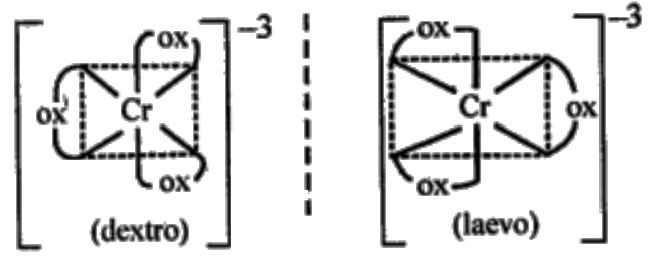
Draw the structures of optical isomers of:
$\left[\mathrm{Cr}\left(\mathrm{C}_2 \mathrm{O}_4\right)_3\right]^{3-}$
Answer$\left[\mathrm{Cr}\left(\mathrm{C}_2 \mathrm{O}_4\right)_3\right]^{3-} \Rightarrow\left[\mathrm{Cr}(\mathrm{ox})_3\right]^{3-}$
View full question & answer→Question 231 Mark
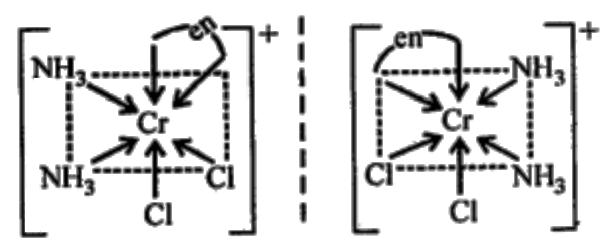
Draw the structures of optical isomers of:
$\left[\mathrm{Cr}\left(\mathrm{NH}_3\right)_2 \mathrm{Cl}_2(\mathrm{en})\right]^{+}$
Answer(cis-isomer only) Cis - $\left[\mathrm{Cr}\left(\mathrm{NH}_3\right)_2 \mathrm{Cl}_2(\mathrm{en})\right]^{+}$
View full question & answer→Question 241 Mark
Specify the oxidation number of the metal in the following coordination entitie:
$\left[\mathrm{CoBr}_2(\mathrm{en})_2\right]^{+}$
Answer$\left[\mathrm{CoBr}_2(\mathrm{en})_2\right]^{+}$
$x + 2 (-1) + 0 = +1$
$x = +3$
View full question & answer→Question 251 Mark
Using IUPAC norms write the formula for the following:
Diamminedichloridoplatinum (II).
Answer$\left[\mathrm{Pt}\left(\mathrm{NH}_3\right)_2 \mathrm{Cl}_2\right]$
View full question & answer→Question 261 Mark
Write the IUPAC name of the following coordination compound:
$\mathrm{[Co(NH_3)_5Cl]Cl_2}$
AnswerPentaamminechloridocobalt (III) chloride.
View full question & answer→Question 271 Mark
Using IUPAC norms write the systematic name of the following:
$\left[\mathrm{Pt}\left(\mathrm{NH}_3\right)_2 \mathrm{Cl}\left(\mathrm{NH}_2 \mathrm{CH}_3\right)\right] \mathrm{Cl}$
AnswerDiammine chlorido (methylamine) platinum (II) chloride.
View full question & answer→Question 281 Mark
Using IUPAC norms write the formula for the following:
Potassium tri (oxalato) chromate (III).
Answer$\mathrm{K}_3\left[\mathrm{Cr}\left(\mathrm{C}_2 \mathrm{O}_4\right)_3\right]$
View full question & answer→Question 291 Mark
Using IUPAC norms write the formula for the following:
Hexaammineplatinum (IV).
Answer$\left[\mathrm{Pt}\left(\mathrm{NH}_3\right)_6\right]^{4+}$
View full question & answer→Question 301 Mark
Using IUPAC norms write the systematic name of the following:
$\mathrm{[Ni(CO)_4]}$
AnswerTetra carbonyl nickel (0).
View full question & answer→Question 311 Mark
Using IUPAC norms write the systematic name of the following: $[Mn(H_2O)_6]^{2+}$
AnswerHexaaquamanganese (II) ion.
View full question & answer→Question 321 Mark
Write the formula for the following coordination compound:
Amminebromidochloridonitrito-N-platinate (II).
AnswerAmine bromido chlorido nitrito-N-platinate $(II) – [Pt(NH_3)BrCl(NO_2)]$
View full question & answer→Question 331 Mark
Using IUPAC norms write the formula for the following:
Potassium tetracyanonickelate (II).
Question 341 Mark
Using IUPAC norms write the systematic name of the following:
$[NiCl_4]^{2–}$
AnswerTetrachloridonickelate (II) ion.
View full question & answer→Question 351 Mark
Write the IUPAC name of the following coordination compound:
$K_3[Fe(C_2O_4)_3]$
AnswerPotassium trioxalatoferrate (III).
View full question & answer→Question 361 Mark
Using IUPAC norms write the formula for the following:
Tetrahydroxozincate (II).
Answer$[Zn(OH)_4J]^{2-}$
View full question & answer→Question 371 Mark
Using IUPAC norms write the formula for the following:
Tetrabromidocuprate (II).
Answer$[CuBr_4]^{2-}$
View full question & answer→Question 381 Mark
What will be the correct order for the wavelengths of absorption in the visible region for the following:
$[Ni(NO_2)_6]^{4–}, [Ni(NH_3)_6]^{2+}, [Ni(H_2O)_6]^{2+}?$
AnswerAs metal ion is fixed, the increasing field strengths,
i.e., the CFSE values of the ligands from the spectro-chemical series are in the order: $H_2O < NH_{3 }< NO_2^-;$
Thus, the energies absorbed for excitation will be in the order:
$[\text{Ni}(\text{H}_{2}\text{O})_{6}]^{2+} < [\text{Ni}(\text{N}\text{H}_{3})_{6}]^{2+} < [\text{Ni}(\text{N}\text{O}_{2})_{6}]^{4-}$
As $\text{E}=\frac{\text{hc}}{\lambda}$
the wavelenghs absorbed will be in the opposite order.
View full question & answer→Question 391 Mark
How many geometrical isomers are possible in the following coordination entitie?
$[Cr(C_2O_4)_3]^{3–}$
Answer$[Cr(C_2O_4)_3]^{3–}$
No geometrical isomers are possible in this coordination entity.
View full question & answer→Question 401 Mark
Write the formulas for the following coordination compounds:
Iron(III) hexacyanoferrate(II)
AnswerIron(III) hexacyanoferrate(II) $Fe_4[Fe(CN)_6]_3.$
View full question & answer→Question 411 Mark
Give evidence that $[Co(NH_3)_5Cl]SO_4$ and $[Co(NH_3)_5SO_4]Cl$ are ionisation isomers.
AnswerThe ionisation isomers dissolve in water to yield different ions and thus react differently to various reagents:
$[Co(NH_3)_5Cl]SO_4 + Ba^{2+} → BaSO_4(s) ↓$
$[Co(NH_3)_5SO_4]Cl + Ba^{2+} →$ No reaction
$[Co(NH_3)_5Cl]SO_4 + Ag^+ →$ No reaction
$[Co(NH_3)_5SO_4] Cl+ Ag+ → AgCl(s)$
View full question & answer→MCQ 421 Mark
Amongst the following, the most stable complex is:
AnswerCorrect option: C. $\ce{[Fe(C_2O_4)_3]^{3–}}$
In each of the given complex, $Fe$ is in $+3$ oxidation state. As $\ce{{[C_2O_4}]^{2-}}$ is didentate chelating ligand, it forms chelate rings and hence $(c)$ out of complexes given above is the most stable complex.
View full question & answer→Question 431 Mark
Using IUPAC norms write the systematic name of the following: $[Co(NH_3)_4Cl(NO_2)]Cl$
AnswerTetraammine chlorido nitrito-N-cobalt (IV) chloride.
View full question & answer→Question 441 Mark
Write the formula for the following coordination compound:
Dichloridobis (ethane–1, 2–diamine) platinum (IV) nitrate.
AnswerDichlororidobis (ethane-1, 2-diamine) platinum (IV) nitrate - $\left[\mathrm{PtCl}_2(\mathrm{en})_2\right]\left(\mathrm{NO}_3\right)_2$
View full question & answer→Question 451 Mark
Using IUPAC norms write the formula for the following:
Potassium tetrachloridopalladate (II).
Answer$\mathrm{K}_2\left[\mathrm{PdCl}_4\right]$
View full question & answer→Question 461 Mark
Specify the oxidation number of the metal in the following coordination entitie:
$\left[\mathrm{Co}\left(\mathrm{H}_2 \mathrm{O}\right)(\mathrm{CN})(\mathrm{en})_2\right]^{2+}$
Answer$\left[\mathrm{Co}\left(\mathrm{H}_2 \mathrm{O}\right)(\mathrm{CN})(\mathrm{en})_2\right]^{2+}$
$x + 0 + (-1) + 0 = +2$
$x = +3$
View full question & answer→Question 471 Mark
Write the IUPAC name of the following coordination compound:
$\mathrm{K}_3\left[\mathrm{Fe}(\mathrm{CN})_6\right]$
AnswerPotassium hexacyanoferrate (III).
View full question & answer→Question 481 Mark
Discuss briefly giving an example in case the role of coordination compounds in:
Analytical chemistry.
AnswerRole of coordination compounds in analytical chemistry:During salt analysis, a number of basic radicals are detected with the help of the colour changes they exhibit with different reagents. These colour changes are a result of the coordination compounds or complexes that the basic radicals form with different ligands.
View full question & answer→Question 491 Mark
Calculate the overall complex dissociation equilibrium constant for the $\mathrm{Cu}\left(\mathrm{NH}_3\right)_4{ }^{2+}$ ion, given that $\beta_4$ for this complex is $2.1 \times 10^{13}$.
Answer$\beta_{4} =2.1\times10^{13}$
The overall complex dissociation equilibrium constant is the reciprocal of the overall stability constant, $\beta_{4}$
$\therefore\frac{1}{\beta_{4}}=\frac{1}{2.1\times10^{13}}$
$=4.7\times10^{-14}$
View full question & answer→Question 501 Mark
Specify the oxidation number of the metal in the following coordination entitie:
$\left[\mathrm{PtCl}_4\right]^{2-}$
Answer$\left[\mathrm{PtCl}_4\right]^{2-}$
$x - 4 = -2$
$x = +2$
View full question & answer→Question 511 Mark
Write the formula for the following coordination compound:
Potassium tetracyanonickelate (II).
AnswerPotassium tetracyanonickelate (II) $-\mathrm{K}_2\left[\mathrm{Ni}(\mathrm{CN})_4\right]$
View full question & answer→Question 521 Mark
Using IUPAC norms write the formula for the following:
Pentaamminenitrito-N-cobalt (III).
Answer$\left[\mathrm{Co}\left(\mathrm{NH}_3\right)_5\left(\mathrm{NO}_2\right)\right]^{2+}$
View full question & answer→MCQ 531 Mark
The oxidation number of cobalt in $\ce{K[Co(CO)_4]}$ is:
AnswerWe know that $CO$ is a neutral ligand and $K$ carries a charge of $+1.$ Therefore, the complex can be written as $\ce{K^+[Co(CO)_4]^-} .$ Therefore, the oxidation number $−$ of $Co$ in the given complex is $-1.$ Hence, option $(iii)$ is correct.
View full question & answer→Question 541 Mark
Which of the following is more stable complex and why?
$[Co(NH_3)_6]^{3+}$ and $[Co(en)_3]^{3+}.$
Answer$[Co(en)_3]^{3+}:$ because (en) is a chelating ligand/bidentate ligand.
View full question & answer→Question 551 Mark
Give an example of linkage isomerism.
Answer$\left[\mathrm{Co}\left(\mathrm{NH}_3\right)_5\left(\mathrm{NO}_2\right)\right] \mathrm{Cl}_2$ and $\left[\mathrm{Co}\left(\mathrm{NH}_3\right)_5(\mathrm{ONO})\right] \mathrm{Cl}_2$.
View full question & answer→Question 561 Mark
What is the coordination number of each type of ions in a rock-salt type crystal structure?
Question 571 Mark
Write the coordination number and oxidation state of Platinum in the complex $\big[\text{Pt}(\text{en})_2\text{Cl}_2\big].$
AnswerIn the given complex $\big[\text{Pt}(\text{en})_2\text{Cl}_2\big],$
Ethylene diamine (en) is a bidentate ligand
Chloride is unidentate ligand
Therefore,
[(2 × 2) + (2 × 1)] = 6
Coordination number of Pt is 6.
The oxidation state of Pt is +2.
View full question & answer→Question 581 Mark
Write the hybridisation and magnetic behaviour of the complex $\mathrm{[Ni(CO)_4]}$.(At. no. of Ni = 28).
AnswerThe complex $\left[\mathrm{Ni}(\mathrm{CO})_4\right]$ involves $\mathrm{sp}^3$ hybridisation.
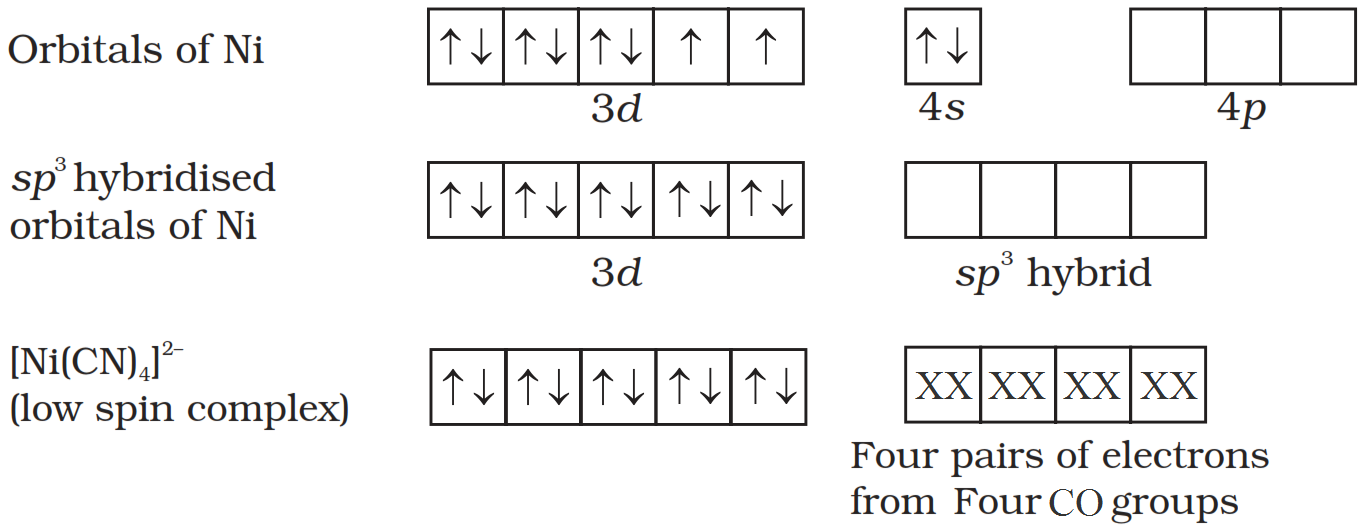
The complex is diamagnetic as evident from the absence of unpaired electrons. View full question & answer→Question 591 Mark
On the basis of crystal field theory, write the electronic configuration for $d^4$ ion if$\triangle_{0} < \text{P}$ .
Answerif$\triangle_ {0} < \text{P}$than fourth electron enters one of the $\text{e}_g$orbitals giving the configuration $\text{t}^3_\text{2g} \text{e}^1_g .$
View full question & answer→Question 601 Mark
Answer the following questions:
What is the coordination number of central metal ion in $\left[\mathrm{Fe}\left(\mathrm{C}_2 \mathrm{O}_4\right)_3\right]^{3-}$ ?
View full question & answer→Question 611 Mark
A metal ion $M^{n+}$ having valence $d^4$ electronic configuration combines with three bidentate ligands to form a complex compound. Assuming $\triangle_{0} > \text{P}$:
Explain orbital splitting during this complex formation.
AnswerAs$\triangle_{0} > \text{P}$ pairing will occur in the $\text{t}_\text{2g}$orbitals and eg orbitals will remain vacant.
View full question & answer→Question 621 Mark
Arrange the following complexes in the increasing order of conductivity of their solution:
$[\text{Co}(\text{NH}_3)3\text{Cl}_3], [\text{Co}(\text{NH}_3)_4\text{Cl}_2]\text{Cl}, [\text{Co}(\text{NH}_3)_6]\text{Cl}_3, [\text{Cr}(\text{NH}_3)_5\text{Cl}]\text{Cl}_2$
AnswerComplex which gives more ions on dissolution is more conducting.
$[\text{Co}(\text{NH}_3)_6]\text{Cl}_3 > [\text{Cr}(\text{NH}_3 )_5\text{Cl}]\text{Cl}_2 > [\text{Co}(\text{NH}_3 )_4\text{Cl}_2]\text{Cl} > [\text{Co}(\text{NH}_3)_3\text{Cl}_3]$
View full question & answer→Question 631 Mark
Write IUPAC name of coordination isomer of $[Co(NH_3)_6] [Cr(CN)_6].$
AnswerThe coordination isomer is $[Cr(NH_3)_6] [Co(CN)_6],$ Hexaamminechromium(III) hexacyanidocobaltate(III).
View full question & answer→Question 641 Mark
Why are low spin tetrahedral complexes not formed?
AnswerFor tetrahedral complexes, the crystal field stabilisation energy is less and is always lower than pairing energy. $\Delta_\text{t}=\frac{4}{9}\Delta_0$
View full question & answer→Question 651 Mark
Do we call metal carbonyls as organometallics? Why?
AnswerYes, metal carbonyls are called organometallics because C atom of CO is linked to the metal atom. In fact, the metal–carbon bonds have both $\sigma$ and $\pi$ character.
View full question & answer→Question 661 Mark
AnswerThe ligands especially anionic (or polar neutral ligands) has around them negatively charged field because of which they are called crystal fields.
View full question & answer→Question 671 Mark
Write the formula of Pentamminechloridoplatinum (IV).
Answer$\mathrm{[Pt(NH_3)_5Cl]Cl_3}$
View full question & answer→Question 681 Mark
A coordination compound with the molecular formula $CrCl_3.4H_2O$ precipitates AgCl with $AgNO_3$ solution. Its molar conductivity is found to be equivalent to two ions. What is the structural formula and name of the compound?
$[Co(NH_3)_3Cl_3], [Co(NH_3)_5Cl]Cl_2 , [Co(NH_3)_6]Cl_3 , [Co(NH_3)_4Cl_2]Cl$
Answer$[O(NH_3)_3Cl_3] < [Co(NH_3)_4Cl_2]Cl < [Co(NH_3)_5Cl]Cl_2 < [Co(NH_3)_6]Cl_3$
View full question & answer→Question 691 Mark
Which isomer of $\left[\mathrm{CoCl}_2(\mathrm{en})_2\right]^{+}$does not show optical isomerism?
AnswerTrans isomer does not show optical isomerism.
View full question & answer→Question 701 Mark
Square planar complexes with coordination number of four exhibit geometrical isomerism whereas tetrahedral complexes do not. Why?
AnswerTetrahedral complexes do not show geometrical isomerism because the relative positions of the ligands attached to the central metal atom are same with respect to each other.
View full question & answer→Question 711 Mark
Give the electronic configuration of the d-orbitals of Ti in $[Ti(H_2O)_6]^{3+}$ ion in an octahedral crystal field.
AnswerIn $[Ti(H_2O)_6]^{3+}$ ion, Ti is in +3 oxidation state. there is one electron in d-orbital and the electronic configuration is $\text{t}^1_\text{2g} \text{ e}^0_\text{g}.$
View full question & answer→Question 721 Mark
What is spectrochemical series?
AnswerThe series in which ligands are arranged in the order of increasing field strength is called spectrochemical series. The order is
I– < Br– < SCN – < Cl – < S2– < F – < OH – < C2O42– < H2O < NCS < EDTA4– < NH3 < en < CN – < CO
View full question & answer→Question 731 Mark
$CoSO_4Cl.5NH_3$ exists in two isomeric forms ‘A’ and ‘B’. Isomer ‘A’ reacts with $AgNO_3$ to give white precipitate, but does not react with $BaCl_2$. Isomer ‘B’ gives
white precipitate with BaCl2 but does not react with $AgNO_3$. Answer the following questions:
Identify ‘A’ and ‘B’ and write their structural formulae.
Answer$A = [Co(NH_3)_5SO_4]Cl$
$B = [Co(NH_3)_5Cl]SO_4$
View full question & answer→Question 741 Mark
A metal ion $M^{n+}$ having $d^4$ valence electronic configuration combines with three bidentate ligands to form a complex compound. Assuming $\triangle _ {0} > \text{P}$ :
Write the electronic configuration of the valence electrons of the metal $M^{n+}$ ion in terms of $\text{t}_\text{2g} $ and $\text{e} _\text{g}$.
Answer$\text{t}^4_\text{2g} \text{e}^0 _\text{g}$ .
View full question & answer→Question 751 Mark
Name a complex used in treatment of cancer.
AnswerCisplatin $\{cis-[Pt(NH_3)_2Cl_2])\}$ is used in the treatment of cancer.
View full question & answer→Question 761 Mark
A complex of the type $[M(AA)_2X_2]^{n+}$ is known to be optically active. What does this indicate about the structure of the complex? Give one example of such complex.
AnswerAn optically active $[M(AA)_2X_2]^{n+}$ indicates civ-octahedral structure e.g. $cis- [Pt(en)_2Cl_2]^{2+}$ or $cis-[Cr(en)_2Cl_2]^+$
View full question & answer→Question 771 Mark
Which compound is used to estimate the hardness of water volumetrically?
