Question 15 Marks
Describe the structure of a fuel cell. Draw labelled diagram of a structure of fuel cell?
Answer
View full question & answer→Fuel cells : The galvanic cell in which fuels like hydrogen $\left( H _2\right)$, methane $\left( CH _4\right)$, and methanol $\left( CH _3 OH \right)$ are present whose combustion energy is directly converted in to electrical energy which is called fuel cell. In the most successful fuel cell, the reaction of formation of water by the action of hydrogen and oxygen has been used.
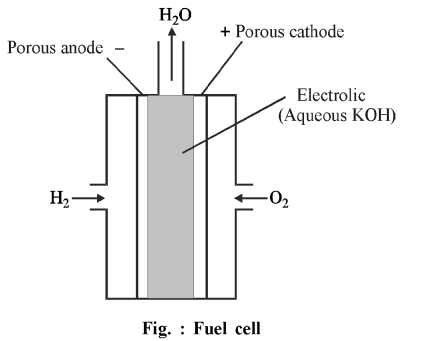
In the fuel cell, bubbles of $H _2$ and $O _2$ gases flow in to the concentrated aqueous NaOH solution through porous carbon electrodes. To increase the speed of electrode reaction, finely divided platinum or palladium metal (catalyst) is mixed in to the electrodes. Electrode reactions are as follows:
Cathode: $O _2(g)+2 H _2 O (l)+4 e ^{-} \rightarrow 4 OH ^{-}( aq )$
Anode: $2 H _2(g)+4 OH ^{-}( aq ) \rightarrow 4 H _2 O ( l )+4 e ^{-}$
The net reaction can be written as :
$
2 H_2(g)+O_2(g) \rightarrow 2 H_2 O(l)
$
As long as $H _2$ and $O _2$ gas continues to flow, electricity continues to be obtained, hence this cell never ends. Thermal plants have an efficiency of only $40 \%$ while fuel cells have an efficiency of $70 \%$.
Fuel cells were used to provide electricity in Apollo space program and water vapours formed by the reaction of $H _2$ and $O _2$ was condensed and used as drinking water for astronauts.
New electrode materials, catalysts and good electrolytes have been developed to increase the efficiency of fuel cells.
Due to being pollution free, fuel cells have been used in vehicles on trial basis.
In the fuel cell, bubbles of $H _2$ and $O _2$ gases flow in to the concentrated aqueous NaOH solution through porous carbon electrodes. To increase the speed of electrode reaction, finely divided platinum or palladium metal (catalyst) is mixed in to the electrodes. Electrode reactions are as follows:
Cathode: $O _2(g)+2 H _2 O (l)+4 e ^{-} \rightarrow 4 OH ^{-}( aq )$
Anode: $2 H _2(g)+4 OH ^{-}( aq ) \rightarrow 4 H _2 O ( l )+4 e ^{-}$
The net reaction can be written as :
$
2 H_2(g)+O_2(g) \rightarrow 2 H_2 O(l)
$
As long as $H _2$ and $O _2$ gas continues to flow, electricity continues to be obtained, hence this cell never ends. Thermal plants have an efficiency of only $40 \%$ while fuel cells have an efficiency of $70 \%$.
Fuel cells were used to provide electricity in Apollo space program and water vapours formed by the reaction of $H _2$ and $O _2$ was condensed and used as drinking water for astronauts.
New electrode materials, catalysts and good electrolytes have been developed to increase the efficiency of fuel cells.
Due to being pollution free, fuel cells have been used in vehicles on trial basis.