Question
Describe the standard hydrogen electrode with diagram.

Answer

self

Need a full question paper?

Generate a complete, print-ready paper with questions like this in minutes — across 16+ boards, with answer keys.

Start Generating Free

Similar questions

What is the difference between lanthanoids and actinoids?
Describe the methods of studying various first order reactions with examples.
Match the items of Column $I$ and Column $II$ on the basis of data given below$:$
$\text{E}^{\ominus}_{\text{F}_2/\text{F}^-}=2.87\text{V},\text{ E}^{\ominus}_{\text{Li}^+/\text{Li}}=-3.5\text{V},\text {E}^{\ominus}_{\text{Au}^{3+}/\text{Au}}=1.4\text{V},\text{ E}^{\ominus}_{ \text{Br}_2/\text{Br}^-}=1.09\text{V}$
 
Column $I$
 
Column $II$
$i.$ $F_2$ $a.$
Metal is the strongest reducing agent.
$ii.$ $Li$ $b.$
Metal ion which is the weakest oxidising agent.
$iii.$ $Au^{3+}$ $c.$
Non metal which is the best oxidising agent.
$iv.$ $Br^-$ $d.$
Unreactive metal.
$v.$ $Au$ $e.$
Anion that can be oxidised by $Au^{3+}$
$vi.$ $Li^+$ $f.$
Anion which is the weakest reducing agent.
$vii.$ $F^-$ $g.$
Metal ion which is an oxidising agent.
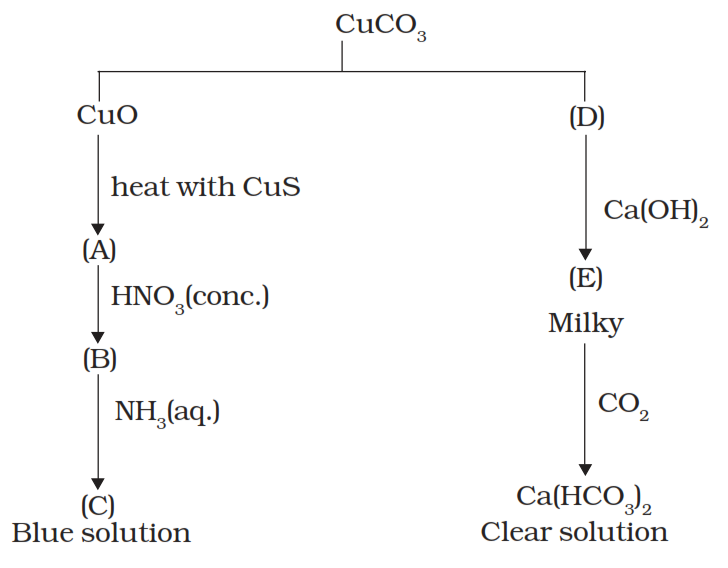
Identify $A$ to $E$ and also explain the reactions involved.
The rate constant for the first order decomposition of H2O2 is given by the following euqation :
$\log k=14.34-1.25 \times 10^4 K / T$
Calculate $E_{a}$ for this reaction and at what temperature will its half-period be 256 minutes?
  1. Complete the following chemical reaction equations:
i. $\text{MnO}_{4(aq)}^{-}+\text{C}_{2}\text{O}_{4(aq)}^{2-}+\text{H}^{+}_{(aq)}\rightarrow$
ii. $\text{Cr}_{2}\text{O}_{7(aq)}^{2-}+\text{Fe}^{2+}_{(aq)}+\text{H}_{(aq)}^{+}\rightarrow$
  1. Explain the following observations about the transition/inner transition elements:
  1. There is in general an increase in density of element from titanium (Z=22) to copper (Z=29).
  2. There occurs much more frequent metal-metal bonding in compounds of heavy transition elements (3rd series).
  3. The members in the actinoid series exhibit a larger number of oxidation states than the corresponding members in the lanthanoid series.
Give the electronic configuration of the following complexes on the basis of Crystal Field Splitting theory. $\ce{[CoF_6]^{3-}, [Fe(CN)_6]^{4-}}$ and $\ce{[Cu(NH_3)_6]^{2+}}$
(i). Write the structures of main products when benzene diazonium chloride $\left( C _6 H _5 N_2^{+} Cl ^{-}\right)$ reacts with the following reagents.
a. $HBF _4 / \Delta$
b. $Cu / HBr$
(ii). Write the structures of A, B and C in the following reactions:
a. $C _6 H _5 NO _2 \xrightarrow{ Sn / HCl } A \xrightarrow[\Delta]{ NaNO _2+ HCl } B \xrightarrow{273 K} H$
b. $CH _3 Cl \xrightarrow{ KCN } A \xrightarrow{ LiAlH _4} B \xrightarrow[273 K]{\stackrel{273 K}{ HNO }{ }_2} C$
What is meant by the following terms ? Give an example in each case :
(i) Cyanohydrin, (ii) Acetal, (iii) Oxime (iv) Ketal, (v) Imine, (vi) 2,4-DNP derivatives, (vii) Schiff's Base.
Which of the following compounds would undergo aldol condensation, which the Cannizzaro reaction and which neither? Write the structures of the expected products of aldol condensation and Cannizzaro reaction.
  1. Methanal
  2. 2-Methylpentanal
  3. Benzaldehyde
  4. Benzophenone
  5. Cyclohexanone
  6. 1-Phenylpropanone
  7. Phenylacetaldehyde
  8. Butan-1-ol
  9. 2,2-Dimethylbutanal.