Questions

Case study (4 Marks)

Take a timed test

10 questions · self-marked practice — reveal the answer and mark yourself.

Question 14 Marks
Read the passage given below and answer the following questions: The order of reactivity towards $S_N1$ reaction depends upon the stability of carbocation in the first step. Greater the stability of the carbocation, greater will be its ease of formation from alkyl halide and hence faster will be the rate of the reaction. As we know, $3^\circ$ carbocation is most stable, therefore, the tert-alkyl that halides will undergo $S_N1$ reaction very fast. For example, it has been observed that the reaction $(CH_3)_3CBr$ with $OH^-$ ion to give 2-methyl-2-propanol is about I million times as fast as the corresponding reaction of the methyl bromide to give methanol. The primary alkyl halides always react predominantly by $S_N2$ mechanism. On the other hand, the tertiary alkyl halides react predominantly by $S_N1$ mechanism. Secondary alkyl halides may react by either mechanism or by both the mechanisms without much preference depending upon the nature of the nucleophile and solvent. In these questions (Q. No. i-tv), a statement of assertion followed by a statement of reason is given. Choose tile correct answer out of tile following choices.
  1. Assertion and reason both are correct statements and reason is correct explanation for assertion.
  2. Assertion and reason both are correct statements but reason is not correct explanation for assertion.
  3. Assertion is correct statement but reason is wrong statement.
  4. Assertion is wrong statement but reason is correct statement.
  1. Assertion: Low concentration of nudeophile favours $S_N1$ mechanism.
Reason: $2^\circ$ alkyl halides are less reactive than $1^\circ$ towards $S_N1$ reactions.
  1. Assertion: Polar solvent slows down $S_N2$ reactions.
Reason: $CH_3-Br$ is less reactive than $CH_3Cl.$
  1. Assertion: Benzyl bromide when kept in acetone- water it produces benzyl alcohol.
Reason: The reaction follows $S_N2$ mechanism.
  1. Assertion: Rate of hydrolysis of methyl chloride to methanol is higher in DMF than in water.
Reason: Hydrolysis of methyl chloride follows second order kinetics.
  1. Assertion: $S_N1$ reaction is carried out in the presence of a polar protic solvent.
Reason: A polar protic solvent increases the stability of carbocation due to solvation.
Answer
  1. (c) Assertion is correct statement but reason is wrong statement.
Explanation:
Ability to accommodate a positive charge determines the ease of heterolysis leading to $S_N1$ mechanism. This ability to accommodate positive charge is more in the $2^\circ$ alkyl halide since it has two alkyl groups as compared to one in $1^\circ$ alkyl halide.
  1. (c) Assertion is correct statement but reason is wrong statement.
Explanation:
$CH_3 - Br$ is more reactive than $CH_3 Cl.$ The $C - Br$ has bond dissociation energy of $293\ kJ\ mol^{-1}$ while $C - Cl$ bond has its dissociation energy of $351\ kJ\ mol^{-1}$ As the bond dissociation energy increases, the ease of breaking of $C - X$ bond decreases, and hence the reactivity of haloalkanes decreases.
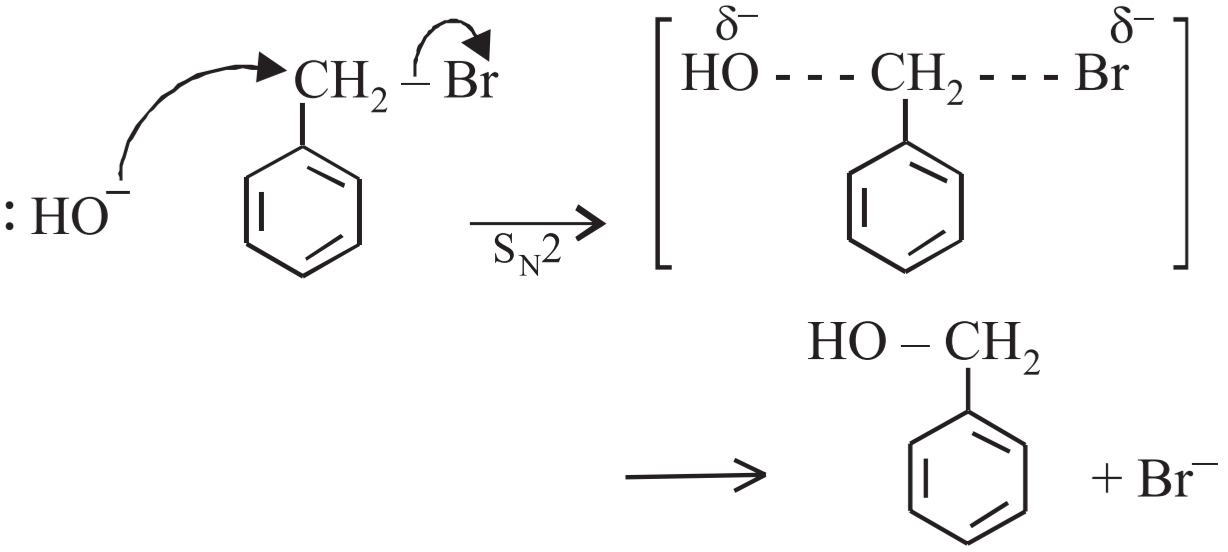
  1. (a) Assertion and reason both are correct statements and reason is correct explanation for assertion.
​​​​​​​​​​​​​​​​​​​​​Explanation:
  1. (a) Assertion and reason both are correct statements and reason is correct explanation for assertion.
  2. (a) Assertion and reason both are correct statements and reason is correct explanation for assertion.
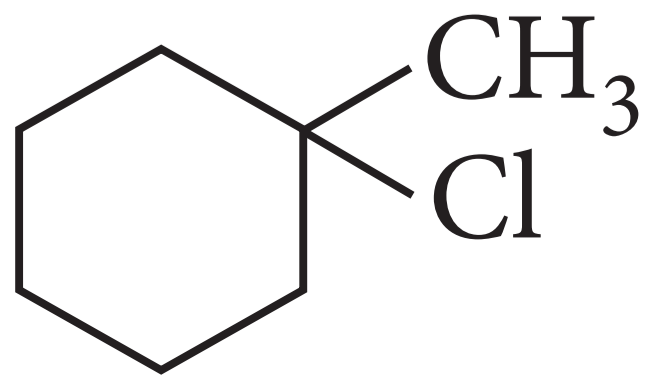
View full question & answer
Question 24 Marks
Read the passage given below and answer the following questions:
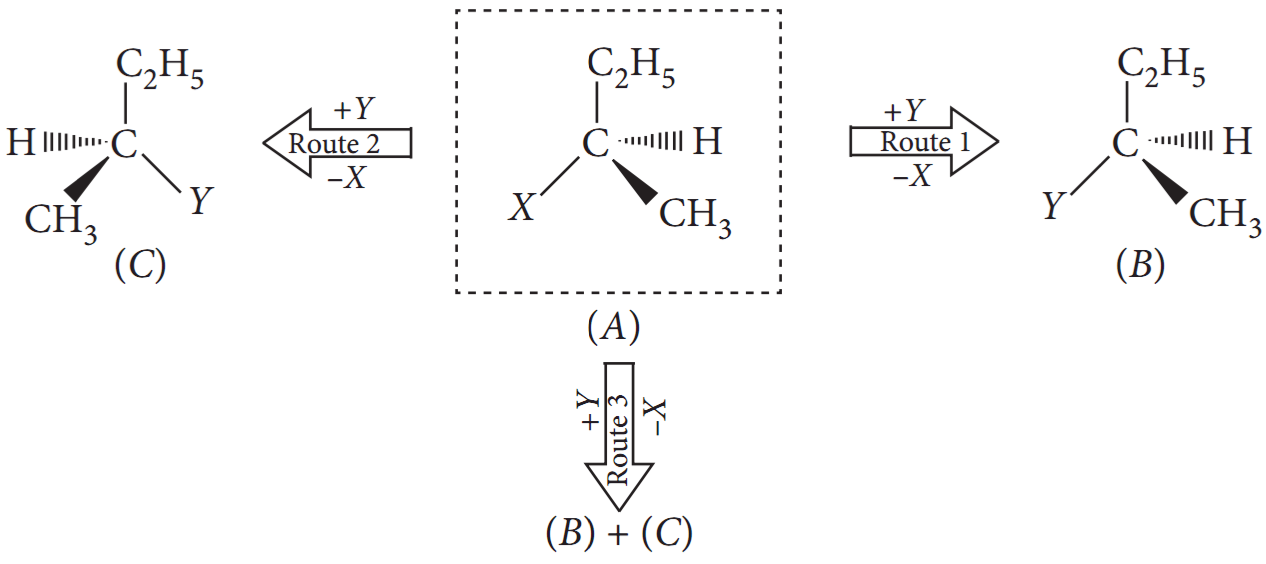
When a chemical reaction involves bond cleavage or bond formation at an asymmetric carbon atom, three different products may be formed. For example, during the substitution of a group $X$ by $Y$ in the following reaction, the three possible products may be shown below:
  1. If Bis the only product, the process is called retention of configuration because $B$ has the same configuration as the starting reactant $(A).$
  2. If C is the only product, the process is called inversion of configuration because $C$ has the configuration opposite to the starting reactant $(A).$
  3. If an equimolar mixture of Band $C (r.e., a 50 : 50$ mixture$)$ is fanned, then the process is called racemisation and the product is optically inactive because one isomer will rotate the light in the direction opposite to another.
In these questions (Q. No. i-iv), a statement of assertion followed by a statement of reason is given. Choose the correct answer out of the following choices.
  1. Assertion and reason both are correct statements and reason is correct explanation for assertion.
  2. Assertion and reason both are correct statements but reason is not correct explanation for assertion.
  3. Assertion is correct statement but reason is wrong statement.
  4. Assertion is wrong statement but reason is correct statement.
  1. Assertion: A reaction is said to be stereospecific if a particular stereoisomer of the reactant produces a specific stereoisomer of the product.
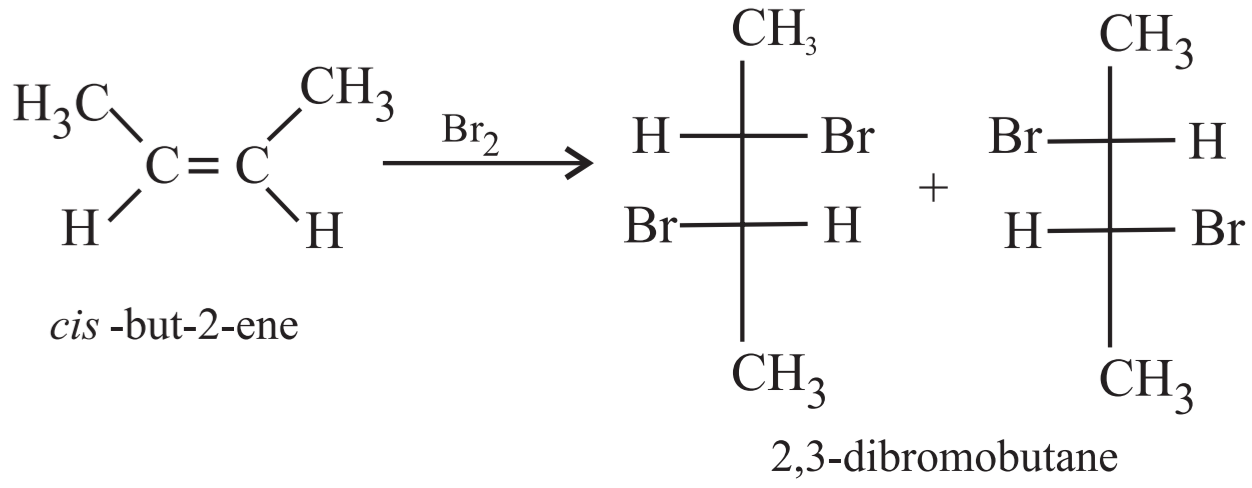
Reason: Bromination of cis$-2-$butene gives meso$-2, 3-$dibromobutane which is stereospecific.
  1. Assertion: Addition of $Br_2$ to cis-but-2-ene is stereoselective.
Reason: $S_N2$ reactions are stereospecific as well as stereoselective.
  1. Assertion: Optically active $2-$iodobutane on treatment with Nal in acetone undergoes recemization.
Reason: Repeated Walden inversions on the reactant and its product eventually gives a racemic mixture.
  1. Assertion: $S_N2$ reaction of an optically active alkyl halide with an aqueous solution of $KOH$ always gives an alcohol with opposite sign of rotation.
Reason: $S_N2$ reactions always proceed with inversion of configuration.
  1. Assertion: Nudeophilic substitution reaction of an optically active alkyl halide gives a mixture of en an ti om ers.
Reason: The reaction occurs by $S_N2$ mechanism.
Answer
  1. (c) Assertion is correct statement but reason is wrong statement.
Explanation:
Bromination of cis$-2-$butene gives $(±) 2, 3-$dibromobutane.
  1. (b) Assertion and reason both are correct statements but reason is not correct explanation for assertion.
  2. (a) Assertion and reason both are correct statements and reason is correct explanation for assertion.
  3. (a) Assertion and reason both are correct statements and reason is correct explanation for assertion.
  4. (a) Assertion and reason both are correct statements and reason is correct explanation for assertion.
​​​​​​​​​​​​​​​​​​​​​​​​​​​​​​​​​​​Explanation:
In case of optically active alkyl halides, $S_N1$ reac-tions are accompanied by racemisation. The carboca-tion formed is $sp^2$ hybridised and planar. The attack of the nucleophile may be accomplished from either side resulting in a mixture of products with opposite configuration i.e; racemic mixture.
View full question & answer
Question 34 Marks
Read the passage given below and answer the following questions:
Nucleophilic substitution reactions are of two types; substitution nucleophilic bimolecular $(S_N2)$ and substitution nucleophilic unimolecular $(S_N1)$ depending on molecules taking part in determining the rate of reaction. Reactivity of alkyl halide towards $S_N1$ and $S_N2$ reactions depends on various factors such as steric hindrance, stability of intermediate or transition state, and polarity of solvent. $S_N2$ reaction mechanism is favoured mostly by primary alkyl halide then secondary and then tertiary. This order is reversed in case of $S_N1$ reactions.
The following questions are multiple choice questions. Choose the most appropriate answer:
  1. Which of the following is most reactive towards nucleophilic substitution reaction?
  1. $C_6H_5Cl$
  2. $CH_2 = CHCl$
  3. $ClCH_2CH = CH_2$
  4. $CH_3CH = CHCl$
  1. Isopropyl chloride undergoes hydrolysis by:
  1. $S_N1$ mechanism.
  2. $S_N2$ mechanism.
  3. $S_N1$ and $S_N2$ mechanism.
  4. Neither $S_N1$ nor $S_N2$ mechanism.
  1. The most reactive nucleophile among the following is:
  1. $CH_3O^-$
  2. $C_6H_5O^-$
  3. $(CH_3)_2CHO^-$
  4. $(CH_3)_3CO^-$
  1. Tertiary alkyl halides are practically inert to substitution by $S_N2$ mechanism because of:
  1. Insolubility.
  2. Instability.
  3. Inductive effect.
  4. Stearic hindrance.
  1. Which of the following is the correct order of decreasing $S_N2$ reactivity?
  1. $RCH_2X > R_2CHX > R_3CX$
  2. $R_3CX > R_2CHX > RCH_2X$
  3. $R_2CHX > R_3CX > RCH_2X$
  4. $RCH_2X > R_3CX > R_2CHX$
Answer
  1. (c) $ClCH_2CH = CH_2$
​​​​​​​Explanation:

Allylic chlorides are most reactive.
  1. (c) $S_N1$ and $S_N2$ mechanism.
​​​​​​​​​​​​​​​​​​​​​​​​​​​​Explanation:

$2^\circ -$ alkyl halides undergo hydrolysis by $S_N1$ or $S_N2$ mechanism.
  1. (a) $CH_3O^-$​​​​​​​
​​​​​​​​​​​​​​​​​​​​​​​​​​​​​​​​​​​Explanation:

Smaller the size of the nucleophile $($i.e., $CH_3O^-),$ more reactive it is.
  1. (d) Stearic hindrance.
​​​​​​​​​​​​​​​​​​​​​​​​​​​​​​​​​​​​​​​​​​Explanation:

Stearic hindrance due to bulky alkyl groups prevents the attack of the nucleophile in $S_N2$ mechanism.
  1. (a) $RCH_2X > R_2CHX > R_3CX$
​​​​​​​​​​​​​​​​​​​​​​​​​​​​​​​​​​​​​​​​​​​​​​​​​Explanation:

Larger the number of alkyl groups at $\propto-$ carbon atom more is the stearic hindrance and hence lesser the reactivity towards $S_N2$ mechanism.
View full question & answer
Question 44 Marks
Read the passage given below and answer the following questions:
A chlorocompound $(A)$ on reduction with $Zn-Cu$ and ethanol gives the hydrocarbon $(B)$ with five carbon atoms. When $(A)$ is dissolved in dry ether and treated with sodium metal it gave $2, 2, 5, 5 -$ tetramethylhexane. The treatment of $(A)$ with alcoholic $KCN$ gives compound $( C).$
The following questions are multiple choice questions. Choose the most appropriate answer:
  1. The compound $(A)$ is:
  1. $1-$chloro$-2, 2-$dimethylpropane.
  2. $1-$chloro$-2, 2-$dimethyl butane.
  3. $1-$chloro$-2-$methyl butane.
  4. $2-$chloro$-2-$methyl butane.
  1. The reaction of $(C)$ with Na, $C_2H_5OH$ gives:
  1. $(CH_3)_3C CH_2CONH_2$
  2. $(CH_3)_3C NH_2$
  3. $(CH_3)_3C CH_2CH_2NH_2$
  4. $(CH_3)_2CHCH_2NH_2$
  1. The reaction of $(C)$ with Na, $C_2H_5OH$ is called:
  1. Gilman reaction.
  2. Mendius reaction.
  3. Grooves process.
  4. Swart's reaction.
  1. The reaction of $(A)$ with aq. $KOH$ will preferably favour:
  1. $S_N1$ mechanism.
  2. $S_N2$ mechanism.
  3. $E_1$ mechanism.
  4. $E_2$ mechanism.
  1. Compound $(B)$ is:
  1. $N-$pentane.
  2. $2, 2-$dimethylpropane.
  3. $2-$methylbutane.
  4. None of these.
Answer
  1. (a) $1-$chloro$-2, 2-$dimethylpropane.
Explanation:

$\ \ \ \ \ \ \ \ \ \ \ \ \text{CH}_3\\\ \ \ \ \ \ \ \ \ \ \ \ \ \ |\\\text{CH}_3-\text{C}-\text{CH}_2 -\text{Cl}\xrightarrow{\text{Ether/ Na}}\\\ \ \ \ \ \ \ \ \ \ \ \ \ \ |\\\ \ \ \ \ \ \ \ \ \ \ \ \ \text{CH}_3\ \ \ \ \\\text{I -Chloro-2, 2-di methylpropane }$

$\ \ \ \ \ \ \ \ \ \ \ \ \text{CH}_3\ \ \ \ \ \ \ \ \ \ \ \ \ \ \ \ \ \ \ \ \ \ \ \ \ \ \text{CH}_2\\\ \ \ \ \ \ \ \ \ \ \ \ \ |\ \ \ \ \ \ \ \ \ \ \ \ \ \ \ \ \ \ \ \ \ \ \ \ \ \ \ \ \ \ \ \ |\\\text{CH}_3-\text{C}-\text{CH}_2 -\text{CH}_2-\text{C}-\text{CH}_3\\\ \ \ \ \ \ \ \ \ \ \ \ \ |\ \ \ \ \ \ \ \ \ \ \ \ \ \ \ \ \ \ \ \ \ \ \ \ \ \ \ \ \ \ \ \ |\\\ \ \ \ \ \ \ \ \ \ \ \ \text{CH}_3\ \ \ \ \ \ \ \ \ \ \ \ \ \ \ \ \ \ \ \ \ \ \ \ \ \text{CH}_3\ \ \ \ \\\text{2, 2, 5, 5-Tetramethylhexane}$
  1. (c) $(CH_3)_3C CH_2CH_2NH_2$
Explanation:

$\ \ \ \ \ \ \ \ \ \ \ \ \text{CH}_3\\\ \ \ \ \ \ \ \ \ \ \ \ \ \ |\\\text{CH}_3-\text{C}-\text{CH}_2 \text{Cl}\xrightarrow{\text{alc.KCN}}\\\ \ \ \ \ \ \ \ \ \ \ \ \ \ |\\\ \ \ \ \ \ \ \ \ \ \ \ \ \text{CH}_3$

$\ \ \ \ \ \ \ \ \ \ \ \ \text{CH}_3\\\ \ \ \ \ \ \ \ \ \ \ \ \ \ |\\\text{CH}_3-\text{C}-\text{CH}_2 \text{CN}\xrightarrow{\text{Na/C}_2\text{H}_5\text{OH}}\\\ \ \ \ \ \ \ \ \ \ \ \ \ \ |\\\ \ \ \ \ \ \ \ \ \ \ \ \ \text{CH}_3$

$\ \ \ \ \ \ \ \ \ \ \ \ \text{CH}_3\\\ \ \ \ \ \ \ \ \ \ \ \ \ \ |\\\text{CH}_3-\text{C}-\text{CH}_2 \text{CH}_2\text{NH}_2\\\ \ \ \ \ \ \ \ \ \ \ \ \ \ |\\\ \ \ \ \ \ \ \ \ \ \ \ \ \text{CH}_3$
  1. (b) Mendius reaction.
  2. (a) $S_N1$ mechanism.
  3. (b) $2, 2-$dimethylpropane.
Explanation:

$\ \ \ \ \ \ \ \ \ \ \ \ \text{CH}_3\\\ \ \ \ \ \ \ \ \ \ \ \ \ \ |\\\text{CH}_3-\text{C}-\text{CH}_2 \text{Cl}\xrightarrow{\text{Zn-Cu/C}_2\text{H}_5\text{OH}}\\\ \ \ \ \ \ \ \ \ \ \ \ \ \ |\\\ \ \ \ \ \ \ \ \ \ \ \ \ \text{CH}_3$

$\ \ \ \ \ \ \ \ \ \ \ \ \text{CH}_3\\\ \ \ \ \ \ \ \ \ \ \ \ \ \ |\\\text{CH}_3-\text{C}-\text{CH}_3\\\ \ \ \ \ \ \ \ \ \ \ \ \ \ |\\\ \ \ \ \ \ \ \ \ \ \ \ \ \text{CH}_3$
View full question & answer
Question 54 Marks

Read the passage given below and answer the following questions:
The aryl halides are relatively less reactive towards nucleophilic substitution reactions as compared to alkyl halides. This low reactivity can be attributed to the following factors:
  • The $C - X$ bond in halobenzene has a partial double bond character due to involvement of halogen electrons in resonance with benzene ring.
  • The $C - X$ bond in aryl halides is less polar as compared to that in alkyl halides as $sp^2$ hyridised carbon is more electronegative than $sp^3$ hybridised carbon.
In these questions (Q. No. i-Iv), a statement of assertion followed by a statement of reason is given. Choose the correct answer out of the following choices.
  1. Assertion and reason both are correct statements and reason is correct explanation for assertion.
  2. Assertion and reason both are correct statements but reason is not correct explanation for assertion.
  3. Assertion is correct statement but reason is wrong statement.
  4. Assertion is wrong statement but reason is correct statement.
  1. Assertion: Primary benzylic halides are more reactive than primary alkyl halides towards $S_N1$ reactions.
Reason: Reactivity depends upon the nature of the nucleophile and the solvent.
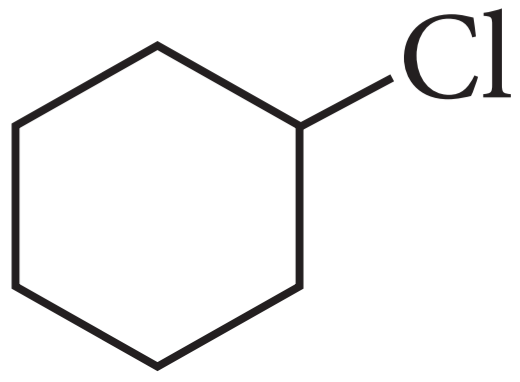
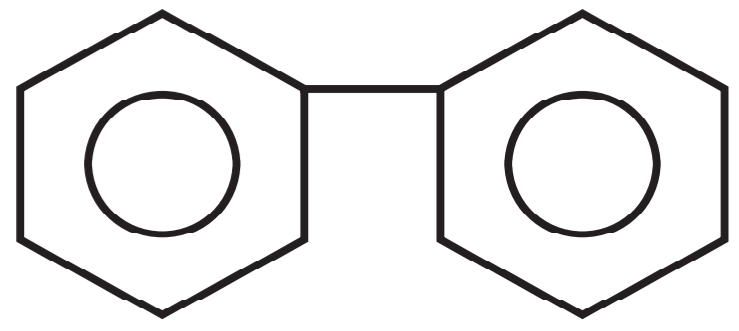
  1. Assertion: is more reactive than towards nucleophilic substitution reactions.
Reason: Tertiary alkyl halides react predominantly by $S_N1$ mechanism.
  1. Assertion: Chlorobenzene is more reactive than p-chloroanisole to nucleophilic substitution reactions.

Reason: Greater the stability of carbanion, greater is its ease of formation and hence, more reactive is the aryl halide.
  1. Assertion: $4-$Nitrochlorobenzene undergoes nucleophilic substitution more readily than chlorobenzene.
Reason: Chlorobenzene undergoes nucleophilic substitution by elimination-addition mechanism while 4-nitrochlorobenzene undergoes nucleophilic substitution by addition-elimination mechanism.
  1. Assertion: Chlorobenzene is less reactive than benzene towards the electrophilic substitution reaction.
Reason: Resonance destabilises the carbocation.
Answer
  1. (b) Assertion and reason both are correct statements but reason is not correct explanation for assertion.
​​​​​​​Explanation:
Primary benzylic halides show higher reactivity in $S_N1$ reactions than primary alkyl halides. This is due to the greater stabilisation of the benzylic carbocation intermediates by resonance.
  1. (a) Assertion and reason both are correct statements and reason is correct explanation for assertion.
  2. (a) Assertion and reason both are correct statements and reason is correct explanation for assertion.
​​​​​​​​​​​​​​​​​​​​​​​​​​​​​​​​​​​Explanation:
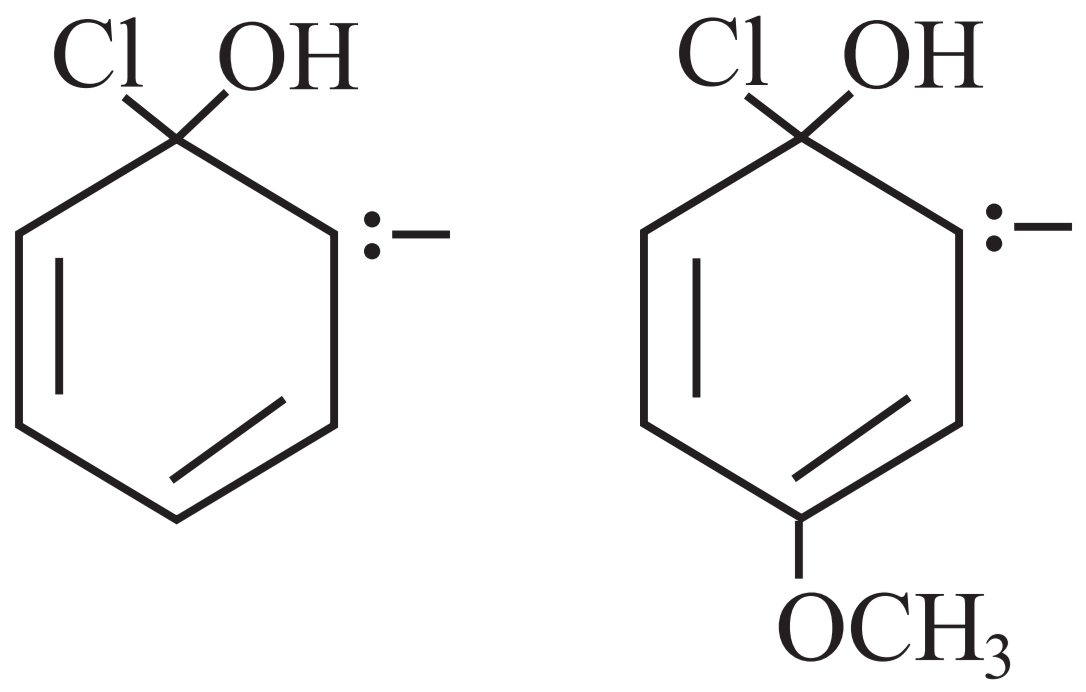
On comparing the relative stabilities of carbanion of chlorobenzene and p-chloroanisole,

The electron donating group $(OCH_3)$ in anisole tends to intensify the negative charge relative to carbanion in chlorobenzene. Thus, p-chloroanisole is less reactive than chlorobenzene.
  1. (b) Assertion and reason both are correct statements but reason is not correct explanation for assertion.
​​​​​​​​​​​​​​​​​​​​​​​​​​​​​​​​​​​Explanation:
As compared to chlorobenzene, the intermediate carbanion resulting from $4-$nitrochlorobenzene is stabilized by$-R-$effect of the N02 group.
  1. (c) Assertion is correct statement but reason is wrong statement.
​​​​​​​​​​​​​​​​​​​​​​​​​​​​​​​​​​​​​​​​​​Explanation:
Chlorobenzene is less reactive than benzene towards the electrophilic substitution reactions due to -I effect.
View full question & answer
Question 64 Marks
Read the passage given below and answer the following questions:
When haloalkanes with $\beta-$hydrogen atom are boiled with alcoholic solution of KOH, they undergo elimination of hydrogen halide resulting in the formation of alkenes. These reactions are called $\beta-$elimination reactions or dehydrohalogenation reactions. These reactions follow Saytzeff's rule. Substitution and elimination reactions often compete with each other. Mostly bases behave as nucleophiles and therefore can engage in substitution or elimination reactions depending upon the alkyl halide and the reaction conditions.
The following questions are multiple choice questions. Choose the most appropriate answer:
  1. Among the following the most reactive towards alcoholic $KOH$ is:
  1. $CH_2 = CHBr$
  2. $CH_3COCH_2CH_2Br$
  3. $CH_3CH2Br$
  4. $CH_3CH_2CH_2Br$
  1. The general reaction, $\text{R}-\text{X}\xrightarrow{\text{aq.OH}^-}\text{ROH}+\text{X}^-,$ is expected to follow decreasing order of reactivity as in:
  1. $t-BuI> t-BuBr > t-BuCI > t-BuF$
  2. $t-BuF > t-BuCI > t-BuBr > t-BuI$
  3. $t-BuBr > t-BuCI >t-BuI> t-BuF$
  4. $t-BuF > t-BuCI > t-BuI > t-BuBr$
  1. Reaction of t-butyl bromide with sodium methoxide produces:
  1. Sodium t-butoxide.
  2. t-butyl methyl ether.
  3. Iso-butane.
  4. Iso-butylene.
  1. In the elimination reactions, the reactivity of alkyl halides follows the sequence:
  1. $R - F > R - CI > R - Br > R - I$
  2. $R - I > R - Br > R - Cl > R - F$
  3. $R - I > R - F > R - Br > R - CI$
  4. $R - F > R - I > R - Br > R - CI$
  1. The ease of dehydrohalogenation of alkyl halide with alcoholic $KOH$ is:
  1. $3^\circ < 2^\circ < 1^\circ$
  2. $3^\circ > 2^\circ > 1^\circ$
  3. $3^\circ < 2^\circ > 1^\circ$
  4. $3^\circ > 2^\circ < 1^\circ$
Answer
  1. (d) $CH_3CH_2CH_2Br$
Explanation:

n alkyl halides, polarity of $C -$ Br bond increases with increase in chain length.
  1. (a) $ t-BuI> t-BuBr > t-BuCI > t-BuF$
Explanation:

The order of reactivity of alkyl halides: iodide > bromide > chloride (nature of the halogen atom) tertiary > secondary > primary (type of halogen atom).
  1. (d) Iso-butylene.
​​​​​​​Explanation:

Jso-butylene is obtained.

$\ \ \ \ \ \ \ \text{CH}_3\\\ \ \ \ \ \ \ \ \ |\\\text{H}_3\text{CC}\text{H}_3 +\text{CH}_3\text{ONa}\overrightarrow{\ \ \ \ \ }\\ \ \ \ \ \ \ \ \ \ |\\\ \ \ \ \ \ \ \text{CH}_3 $

$\ \ \ \ \ \ \ \ \text{CH}_3\\\ \ \ \ \ \ \ \ \ |\\\text{CH}_3\text{C}=\text{CH}_3+\text{CH}_2\text{OH}+\text{NaBr}$
  1. (b) $R - I > R - Br > R - Cl > R - F$
​​​​​​​​​​​​​​​​​​​​​Explanation:

The order of bond dissociation energy: R - F > R - CI > R - Br > R - I. During dehydrohalogenation C - I bond breaks more easily than C - F bond. So reactivity order of halides R - I > R - Br > R - Cl > R - F.
  1. (b) $3^\circ > 2^\circ > 1^\circ$
​​​​​​​Explanation:

The ease of dehydrohalogenation of alkyl halide with alcoholic $KOH$ is $3^\circ > 2^\circ > 1^\circ .$

This order of alkyl halides can be explained on the basis of the stability of the alkene formed after dehydrohalogenation ofhaloalkanes. $3^\circ$ alkyl halides on dehydrohalogenation forms more substituted alkenes, which being more stable and formed at faster rate, while primary alkyl halides yield least substituted alkenes, which being less stable and formed at slower rate.
View full question & answer
Question 74 Marks
Read the passage given below and answer the following questions:
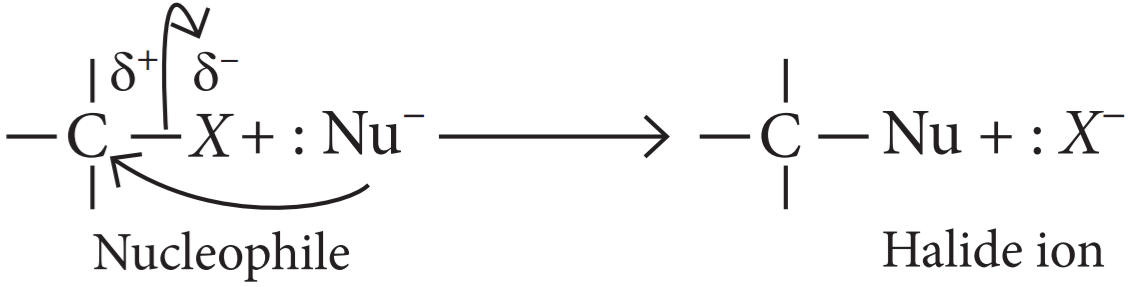
In haloalkanes, when a nucleophile stronger than the halide ion approaches the positively charged carbon atom of an alkyl halide, the halogen atom along with its bonding electron pair gets displaced and a new bond with the carbon and the nucleophile is formed. These reactions are called nucleophilic substitution reactions.
In these reactions the atom or group of atoms which loses its bond from carbon and takes on an additional pair of electrons is called leaving group. Halide ions are good leaving groups. Some important nucleophilic substitution reactions ofhaloalkanes with common nucleophiles are given in the table below.
 
Reagent
Nucleophile (Nu^-)
Substitution product R-Nu
Class of main product
1.
$NaOH$ or $KOH$ or moist $Ag_2O$
$^-OH$
$ROH$
Alcohol
2.
$H_2O$
$H^2O$
$ROH$
Alcohol
3.
$Nal$
$I^-$
$R – I$
Alkyl iodide
4.
$R'NH_2$
$\text{R'}\ddot{\text{N}}\text{H}_2$
$RNHR'$
Sec. amine
5.
$KCN$
$\overline{\text{C}}\equiv\text{N}:$
$RCN$
Nitrile (cyanide)
6.
$KNO_2$
$O = N – O^-$
$R – O – N = O$
Alkvl nitrite
In these questions (Q. No. i-iv), a statement of assertion followed by a statement ofreason is given. Choose the correct answer out of the following choices.
  1. Assertion and reason both are correct statements and reason is correct explanation for assertion.
  2. Assertion and reason both are correct statements but reason is not correct explanation for assertion.
  3. Assertion is correct statement but reason is wrong statement.
  4. Assertion is wrong statement but reason is correct statement.
  1. Assertion: Alkyl halides are hydrolysed to alcohols by moist silver oxide.
Reason: $RCI$ is hydrolysed to $ROH$ easily but reactions slow down on addition of KI.
  1. Assertion: Alkyl halides fonn alkenes when heated above $300^\circ C.$
Reason: $CH3CH21$ reacts slowly with strong base as compared to $CD_3CH_2I.$
  1. Assertion: RBr reacts with $AgNO_2$ to give nitroalkane.
Reason: Silver nitrite $(AgNO_2)$ is an ionic compound, therefore the negative charge on nitrogen is the attacking site.
  1. Assertion: The nucleophilic substitution of vinyl chloride is difficult than ethyl chloride.
Reason: Vinyl group is electron donating group.
  1. Assertion: $2-$Bromobutane on reaction with sodium ethoxide in ethanol gives 1-butene as the major product.
Reason: $1-$Butene is less stable than $2-$butene.
Answer
  1. (c) Assertion is correct statement but reason is wrong statement.
Explanation:
$KI$ reacts with $RCI$ to form RI. This RI molecule now hydrolysed easily to give $ROH$ because alkyl iodide are more reactive than alkyl chloride. Thus, reaction becomes faster on addition of $KI.$
  1. (c) Assertion is correct statement but reason is wrong statement.
​​​​​​​​​​​​​​​​​​​​​Explanation:
$CH_3CH_2I$ reacts more rapidly with strong base in comparison to $CD_3CH_2I.$ The elimination of $HI ($or $DI)$ in presence of strong base shows $E_2$ elimina-tion. The rate detennining step involves the breaking up of $C-H ($or $C–D)$ bond. The $C-D$ bond being stronger than $C- H$ bond is difficult to break.
  1. (c) Assertion is correct statement but reason is wrong statement.
​​​​​​​​​​​​​​​​​​​​​​​​​​​​​​​​​​​​​​​​​​Explanation:
Silver nitrite is a covalent compound and the bond between $Ag - O$ is covalent. Therefore, it does not have a negative charge on the oxygen atom. Hence, the nucleophillic attack occurs through the lone pair on nitrogen fanning nitroalkanes $(R - NO_2).$​​​​​​​
  1. (c) Assertion is correct statement but reason is wrong statement.
​​​​​​​​​​​​​​​​​​​​​​​​​​​​​​​​​​​​​​​​​​​​​​​​​Explanation:
The carbon-halogen bond in vinyl halides has some double bond character and hence little difficult to break.
  1. (d) Assertion is wrong statement but reason is correct statement.
​​​​​​​​​​​​​​​​​​​​​​​​​​​​​​​​​​​​​​​​​​​​​​​​​​​​​​​​Explanation:
$2$-Bromobutane on reaction with sodium ethoxide in ethanol gives $2-$butene as a major product.
View full question & answer
Question 84 Marks
Read the passage given below and answer the following questions:
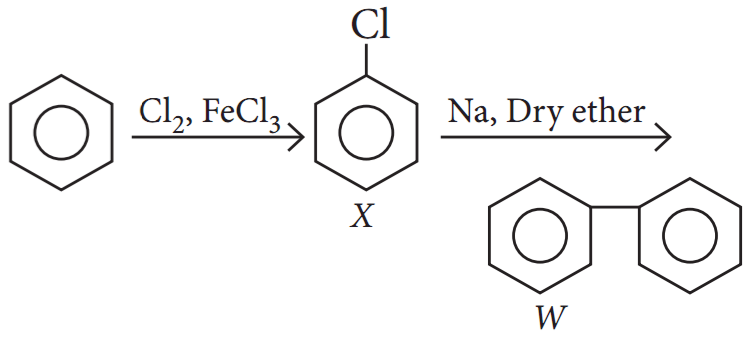
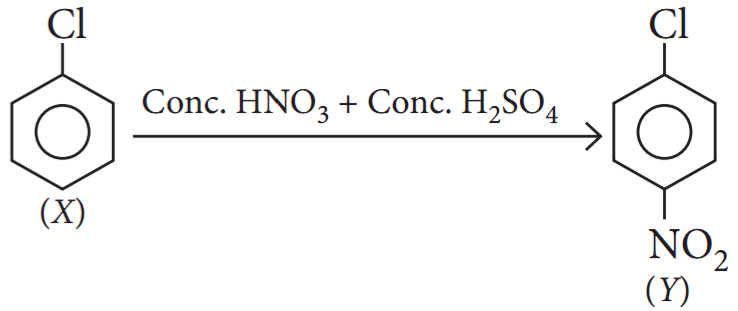
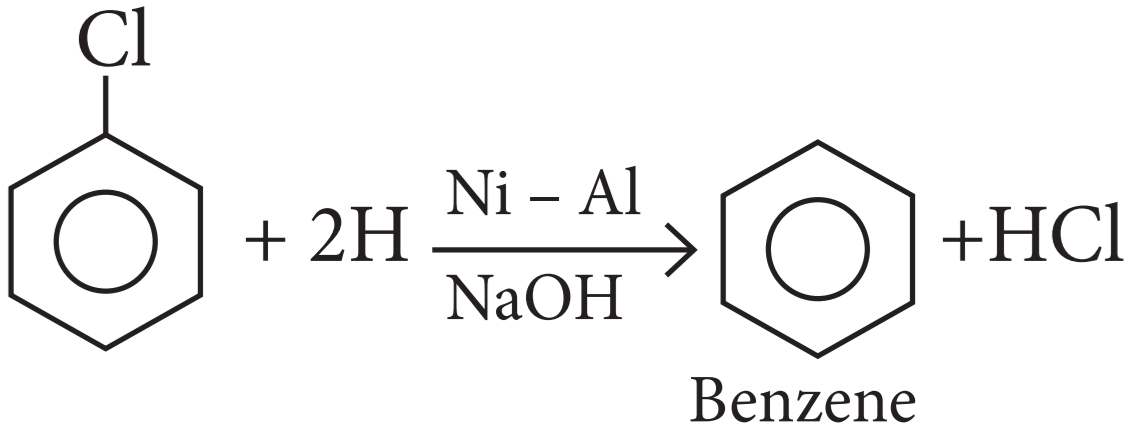
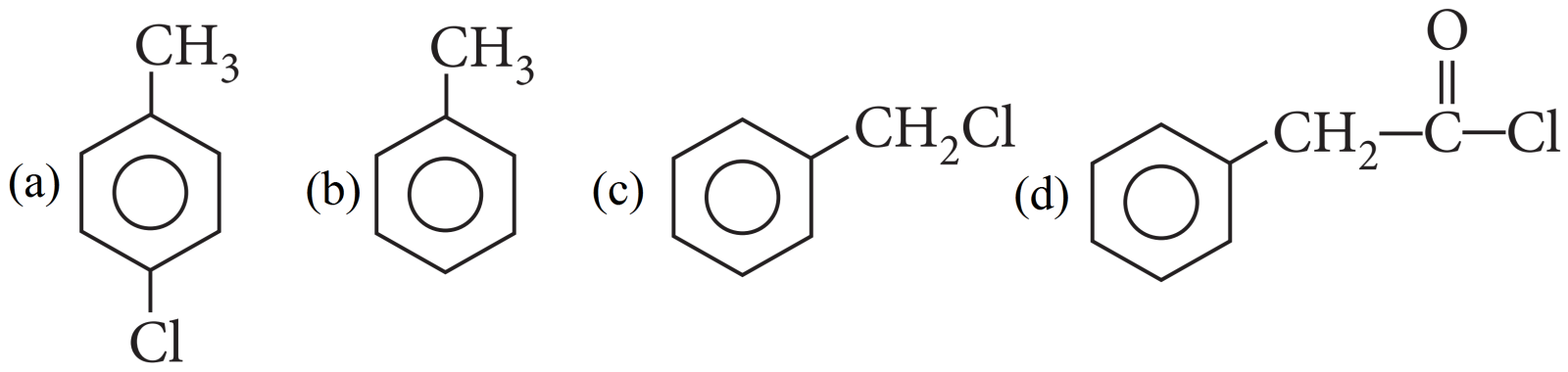
Consider the given sequence of reactions:

The following questions are multiple choice questions. Choose the most appropriate answer:
  1. Identify W.
  1. Compound Y is:
  1. When X reacts with $CH_3COCl$ in presence of anhy. $AlCl_3$, the reaction is known as:
  1. Fittig reaction.
  2. Ullmann reaction.
  3. Wurtz-Fittig reaction.
  4. Friedel-Crafts acylation reaction.
  1. When X is treated Ni-Al/ NaOH the product obtained is:
  1. Benzene.
  2. Phenol.
  3. P-chlorophenol.
  4. Triphenyl.
  1. Compound Z is:
  1. Phenol.
  2. P-chlorophenol.
  3. P-nitrophenol.
  4. Nitrobenzene.
Answer
  1. (c)

Explanation:
  1. (c)

​​​​​​​Explanation:
  1. (d) Friedel-Crafts acylation reaction.
  2. (a) Benzene.
​​​​​​​​​​​​​​Explanation:
  1. (c) P-nitrophenol.
View full question & answer
Question 94 Marks
Read the passage given below and answer the following questions:
Haloarenes are less reactive than haloalkanes. The low reactivity of haloarenes can be attributed to:
  • Resonance effect.
  • $sp^2$ hybridisation of C - X bond.
  • Polarity of C - X bond
  • Instability of phenyl cation (formed by self-ionisation of haloarene).
  • Repulsion between the electron rich attacking nucleophiles and electron rich arenes.
Reactivity of haloarenes can be increased or decreased by the presence of certain groups at certain positions for example, nitro ($-NO_{^2}$) group at o/ p positions increases the reactivity of haloarenes towards nucleophilc substitution reactions.
The following questions are multiple choice questions Choose the most appropriate answer:
  1. Aryl halides are less reactive towards nucleophilic substitution reaction as compared to alkyl halides due to
  1. The formation of less stable carbonium ion.
  2. Resonance stabilisation.
  3. Larger carbon-halogen bond.
  4. Inductive effect.
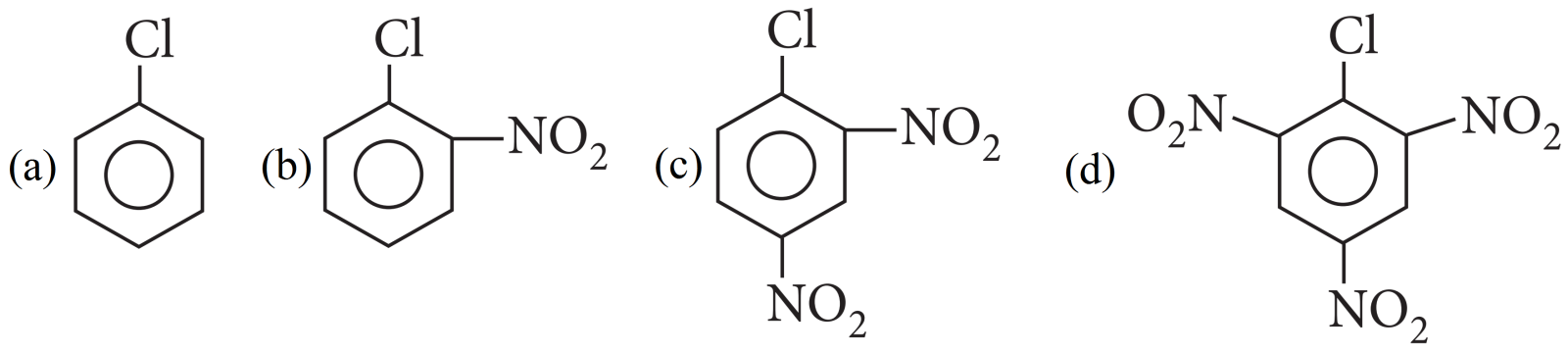
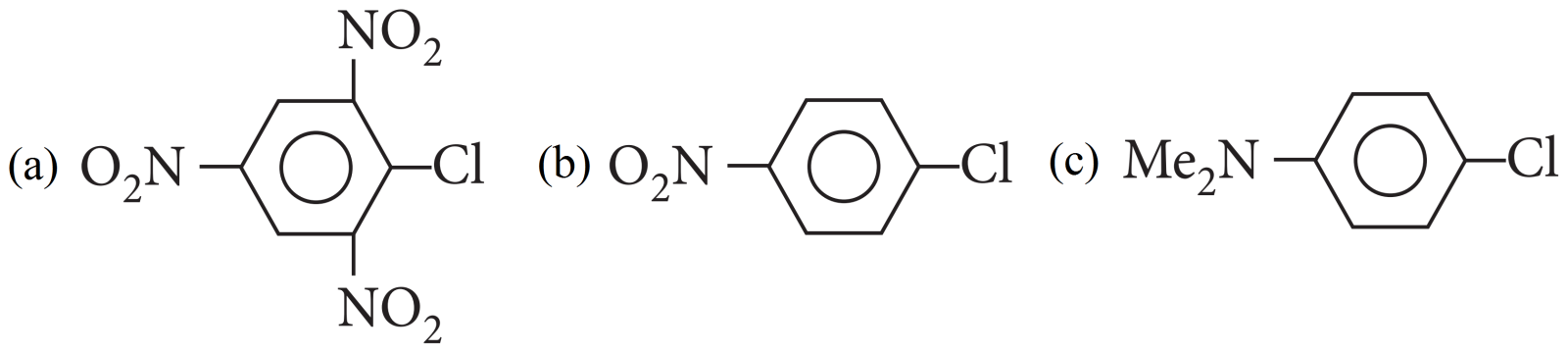
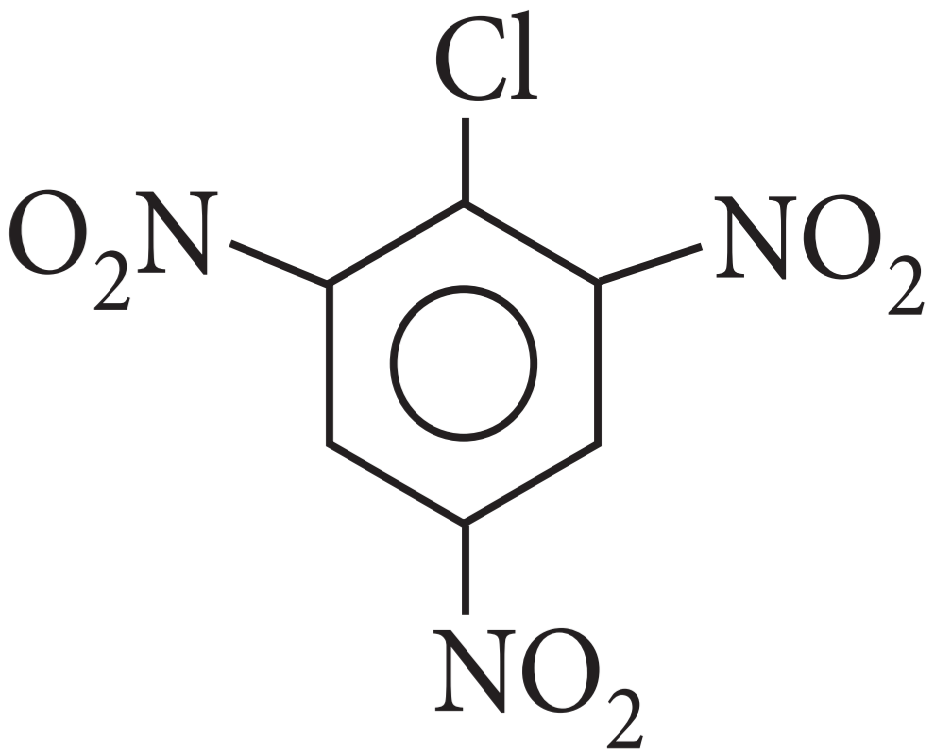
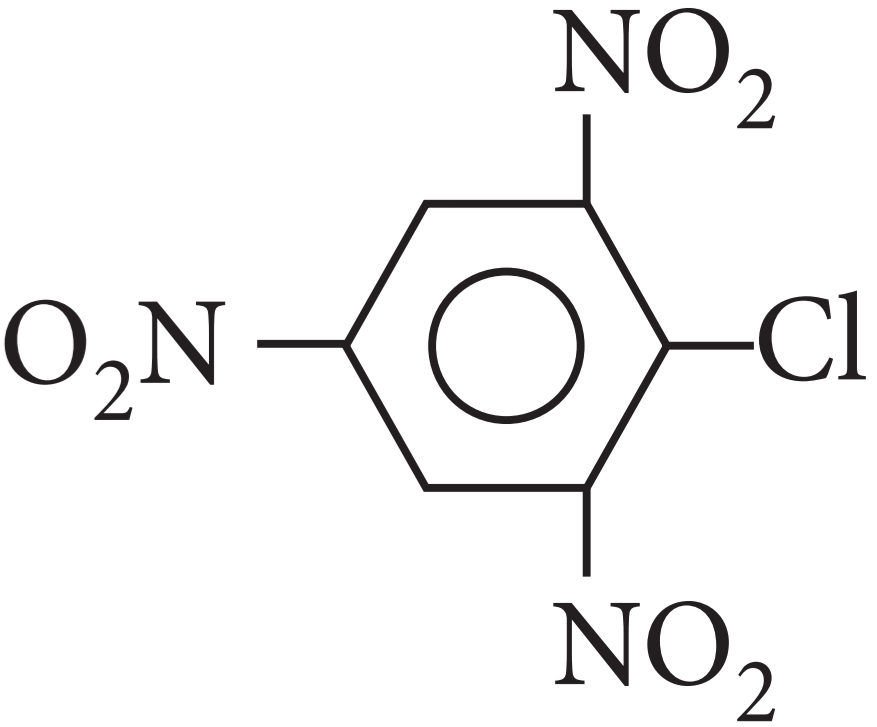
  1. Which of the following aryl halides is the most reactive towards nucleophilic substitution?
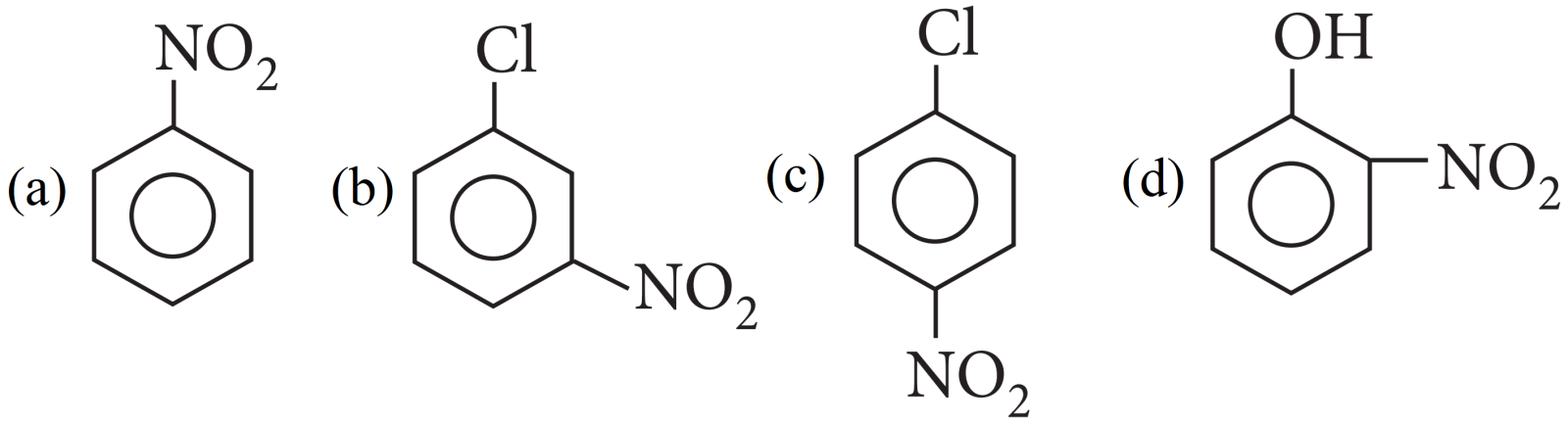
  1. Which one of the following will react fastest with aqueous $NaOH$?
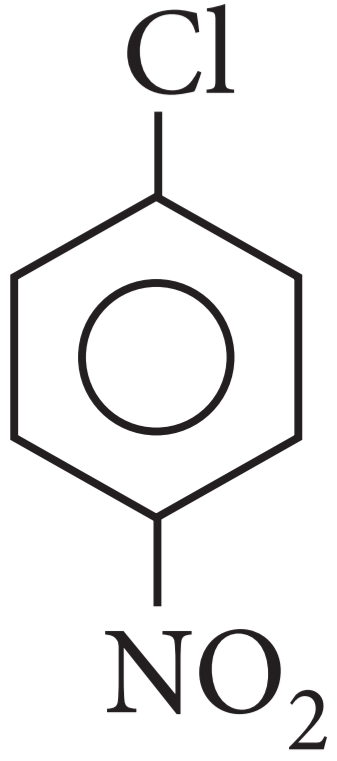
  1. Which chloro derivative of benzene among the followings would undergo hydrolysis most readily with aqueous sodium hydroxide to furnish the corresponding hydroxy derivative?
  1. $C_6H_5Cl$
  1. The reactivity of the compounds (i) $MeBr$, (ii) $PhCH_2Br$, (iii) $MeCI$, (iv) $p-MeOC_6H_4Br$ decreases as:
  1. (i) > (ii) > (iii) > (iv)
  2. (iv) > (ii) > (i) > (iii)
  3. (iv) > (iii) > (i) > (ii)
  4. (ii) > (i) > (iii) > (iv)
Answer
  1. (b) Resonance stabilisation.
  2. (d)

Explanation:
When in aryl halides the electron withdrawing groups are attached at ortho and para positions to the chlorine atom then the removal of chlorine atom as Cll- ion becomes easy, therefore, 2,4,6-trinitro chlorobenzene is the most reactive among given aryl halides.
  1. (d)

Explanation:
  1. (a)

Explanation:
Cl in 2,4,6-trinitrochlorobenzene is activated by three $NO_2$ groups at o, and p-positions and hence undergoes hydrolysis most readily.
  1. (d) (ii) > (i) > (iii) > (iv)
​​​​​​​​​​​​​​Explanation:
The order of reactivity follows the sequence: benzyl halides > alkyl halides> aryl halides. Out of chlorides and bromides, bromides are more reactive. Therefore, the correct order of reactivity is $PhCH_2Br$ (ii) $> MeBr$ (i) $> MeCl$ (iii) $> p - MeOC_6H_4Br$ (iv).
View full question & answer
Question 104 Marks
Read the passage given below and answer the following questions:
A primary alkyl halide (A) $C_4H_9Br$ reacted with akoholic KOH to give compound (B). Compound (B) is reacted with HBr to give compound (C) which is an isomer of (A). When (A) reacted with sodium metal, it gave a compound (D) $C_8H_{18}$ that is different than the compound obtained when n-butyl bromide reacted with sodium metal.
The following questions are multiple choice questions. Choose the most appropriate answer:
  1. Compound (A) is:
  1. $CH_3CH_2CH_2CH_2Br$
  2. $\text{CH}_3\text{CH}-\text{CH}_2\text{Br}\\\ \ \ \ \ \ \ \ \ |\\\ \ \ \ \ \ \ \ \text{CH}_3$
  3. $\ \ \ \ \ \ \ \ \ \ \ \ \ \ \text{CH}_3\\\ \ \ \ \ \ \ \ \ \ \ \ \ \ \ |\\\text{CH}_3-\text{C}-\text{Br} \\\ \ \ \ \ \ \ \ \ \ \ \ \ \ \ \ |\\\ \ \ \ \ \ \ \ \ \ \ \ \ \ \ \text{CH}_3$
  4. $CH_3CH_2CH_2Br$
  1. Which type of isomerism is present in compound (A) and (C)?
  1. Positional
  2. Functional
  3. Chain
  4. Both (a) and (c)
  1. Identify compound (B).
  1. $\text{CH}_3-\text{C}=\text{CH}_2 \ \ \\ \ \ \ \ \ \ \ \ \ \ \ \ \ \mid \\ \ \ \ \ \ \ \ \ \ \ \ \text{CH}_3$
  2. $CH_3– CH = CH – CH_3$
  3. $CH_3– CH_2 – CH = CH_2$
  4. None of these.
  1. IUPAC name of compound (D) is:
  1. N - octane
  2. 2, 5 - dimethylhexane
  3. 2 - methylheptane
  4. 3, 4 - dimethyl hexane.
  1. When compoound (C) is treated with ale. KOH and then treated with presence of peroxide, the compound obtained is:
  1. $\ \ \ \ \ \ \ \ \ \ \ \ \ \ \text{CH}_3\\\ \ \ \ \ \ \ \ \ \ \ \ \ \ \ |\\\text{CH}_3-\text{C}-\text{Br} \\\ \ \ \ \ \ \ \ \ \ \ \ \ \ \ \ |\\\ \ \ \ \ \ \ \ \ \ \ \ \ \ \ \text{CH}_3$
  2. $\ \ \ \ \ \ \ \ \ \ \ \ \ \ \text{CH}_3\\\ \ \ \ \ \ \ \ \ \ \ \ \ \ \ |\\\text{CH}_3-\text{CH}-\text{CH}_2-\text{Br}$
  3. $\text{CH}_3\text{CH}_2\text{CH}_2\text{CH}_2\text{Br}$
  4. $$$\text{CH}_3\text{CH}_2\text{CH}_2\text{CH}-\text{Br}\\\ \ \ \ \ \ \ \ \ \ \ \ \ \ \ \ \ \ \ \ \ \ \ \ \ |\\\ \ \ \ \ \ \ \ \ \ \ \ \ \ \ \ \ \ \ \ \ \ \ \ \text{CH}_3$
Answer
  1. (b) $\text{CH}_3\text{CH}-\text{CH}_2\text{Br}\\\ \ \ \ \ \ \ \ \ |\\\ \ \ \ \ \ \ \ \text{CH}_3$
Explanation:
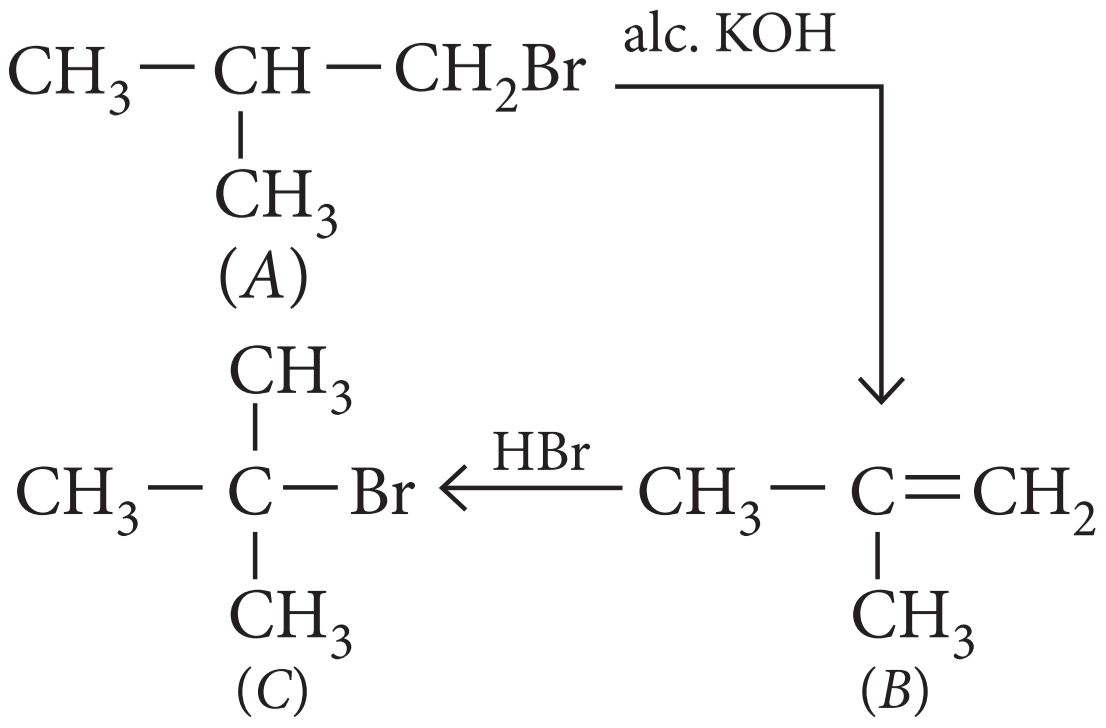
When compound (A) reacted with Na-metal, it gave a compound $D(C_8H_{18})$ which is different from the compound obtained when n-butyl bromide reacted with Na metal and hence the compound (A) must be isobutyl bromide.
$2\text{CH}_3\text{CH}_2\text{CH}_2\text{CH}_2\text{Br}+2\text{Na}\xrightarrow{\text{Wurtz reaction}}\text{CH}_3\text{CH}_2\text{CH}_2\text{CH}_2\text{CH}_2\text{CH}_2\text{CH}_2\text{CH}_3$
$2\text{CH}_3-\text{CH}-\text{CH}_2\text{Br}+2\text{Na}\xrightarrow{\text{Wurtz reaction}} \ \ \\ \ \ \ \ \ \ \ \ \ \ \ \ \ \ \mid \\ \ \ \ \ \ \ \ \ \ \ \ \ \ \text{CH}_3\ \ \ \ \ \ \\\ \ \ \ \ \ \ \ \ \ \ \ \ \text{(A)}$
$\text{CH}_3-\text{CH}-\text{CH}_2-\text{CH}_2-\text{CH}-\text{CH}_3\\\ \ \ \ \ \ \ \ \ \ \ \ \ \ |\ \ \ \ \ \ \ \ \ \ \ \ \ \ \ \ \ \ \ \ \ \ \ \ \ \ \ \ \ \ \ \ \ \ |\\\ \ \ \ \ \ \ \ \ \ \ \ \ \text{CH}_3\ \ \ \ \ \ \ \ \ \ \text{(D)} \ \ \ \ \ \ \ \ \ \ \ \text{CH}_3$
  1. (d) Both (a) and (c)
Explanation:
  1. (a) $\text{CH}_3-\text{C}=\text{CH}_2 \ \ \\ \ \ \ \ \ \ \ \ \ \ \ \ \ \mid \\ \ \ \ \ \ \ \ \ \ \ \ \text{CH}_3$
  2. (b) 2, 5 - dimethylhexane
Explanation:
$2\text{CH}_3-\text{CH}-\text{CH}_2\text{Br}+2\text{Na}\xrightarrow{\text{Wurtz reaction}} \ \ \\ \ \ \ \ \ \ \ \ \ \ \ \ \ \ \mid \\ \ \ \ \ \ \ \ \ \ \ \ \ \ \text{CH}_3$
$\text{CH}_3-\text{CH}-\text{CH}_2-\text{CH}_2-\text{CH}-\text{CH}_3\\\ \ \ \ \ \ \ \ \ \ \ \ \ \ |\ \ \ \ \ \ \ \ \ \ \ \ \ \ \ \ \ \ \ \ \ \ \ \ \ \ \ \ \ \ \ \ \ \ |\\\ \ \ \ \ \ \ \ \ \ \ \ \ \text{CH}_3\ \ \ \ \ \ \ \ \ \ \ \ \ \ \ \ \ \ \ \ \ \ \ \ \ \ \ \text{CH}_3\\\ \ \ \ \ \ \ \ \ \ \ \ \ \ \text{2,5 Di methylhexane }$
  1. (b) $\ \ \ \ \ \ \ \ \ \ \ \ \ \ \text{CH}_3\\\ \ \ \ \ \ \ \ \ \ \ \ \ \ \ |\\\text{CH}_3-\text{CH}-\text{CH}_2-\text{Br}$
​​​​​​​Explanation:
$\ \ \ \ \ \ \ \ \ \ \ \ \ \ \text{CH}_3\\\ \ \ \ \ \ \ \ \ \ \ \ \ \ \ |\\\text{CH}_3-\text{C}-\text{CH}_3\xrightarrow{\text{alc.KOH}} \\\ \ \ \ \ \ \ \ \ \ \ \ \ \ \ \ |\\\ \ \ \ \ \ \ \ \ \ \ \ \ \ \ \text{Br}$
$$$\ \ \ \ \ \ \ \ \ \ \ \ \ \ \text{CH}_3\ \ \ \ \ \ \ \ \ \ \ \ \ \ \ \ \ \ \ \ \ \ \ \ \ \ \ \ \ \ \ \ \ \text{CH}_3\\\ \ \ \ \ \ \ \ \ \ \ \ \ \ \ |\ \ \ \ \ \ \ \ \ \ \ \ \ \ \ \ \ \ \ \ \ \ \ \ \ \ \ \ \ \ \ \ \ \ \ \ \ \ \ \ |\\\text{CH}_3-\text{C}=\text{CH}_2\xrightarrow[\text{Peroxide}]{\text{HBr}}\text{CH}_3-\text{CH}=\text{CH}_2=\text{Br}$​​​​​​​
View full question & answer