Questions

2 Marks Questions

Take a timed test

6 questions · self-marked practice — reveal the answer and mark yourself.

Question 12 Marks
What is meant by the Ketal? Give an example.
Answer
Gem-Dialkoxyalkanes in which the two alkoxy groups are present on the same carbon within the chain are called ketals. These are produced when a ketone is heated with ethylene glycol in presence of dry HCl gas or p-toluenesulphonic acid (PTS).

Image
These are easily hydrolysed by dilute mineral acids to regenerate the original ketones. Therefore, ketals are used for protection of keto groups in organic synthesis.
View full question & answer
Question 22 Marks
Sodium chloride or calcium chloride is used to clear snow from the roads. Why?
Answer
Sodium chloride or calcium chloride depresses the freezing point of water to such extent that it cannot freeze to form ice. Hence it melts off easily at the prevailing temperature. As depression in freezing point is a colligative property which is directly related to number of solute particles. NaCl gives 2 ions in solution while CaCl₂ gives 3 ions in solution.
View full question & answer
Question 32 Marks
Answer the following:
$(a)$ Define rate of reaction?
$(b)$ For a reaction the rate law expression is represented as follows:
Rate $=k[A][B]^{\frac{1}{2}}$
$i$. Interpret whether the reaction is elementary or complex. Give reason to support your answer.
$ii.$ Write the unit of rate constant for this reaction if concentration of $A$ and $B$ is expressed in moles/L
Answer
Answer the following:
$(i)$ Rate of reaction is defined as change in concentration of reactants or products per unit time.
For example, the reaction $A \rightarrow B$ has the rate expressed as:
rate of reaction $=\frac{d x}{d t}=\frac{-[d A]}{d t}=\frac{[d B]}{d t}$
$(ii)\ i$. This is a complex reaction. Order of reaction is $1.5$ .
Molecularity cannot be $1.5 ,$ it has no meaning for this reaction.
The reaction occurs in steps, so it is a complex reaction.
$ii$. Rate $=k[A][B]^{\left[\frac{1}{2}\right]}$ Unit of Rate constant $(k)$
$=\frac{\text { Unit of rate }}{\text { Unit of }[A] \times \text { Unit of }[B] \frac{1}{2}}$
$=\frac{molL^{-1} s^{-1}}{\left(molL^{-1}\right)\left(molL^{-1}\right)^{\frac{1}{2}}}$
$=\text{mol}^{\frac{-1}{2}} L^{\frac{1}{2}} s^1$
View full question & answer
Question 42 Marks
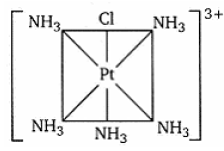
Write the $IUPAC$ name and draw the structure of coordination entities of $[PtCl(NH_3)_5]Cl_3.$
Answer
$IUPAC$ name. Pentaamminechlorido platinum $(IV)$ chloride.
It has octahedral structure
Image
View full question & answer
Question 52 Marks
Give an explanation for the catalytic properties shown by transition metals.
Answer
Transition metals show catalytic property because of their ability to adopt multiple oxidation states. Catalysts at a solid surface involve the formation of bond between reactant molecules and atoms of the surface of the catalyst. This has the effect of increasing the concentration of the reactants at the catalyst surface and also weakening of the bonds in the reacting molecules & the activation energy is lowered, moreover transition metals can change their oxidation state. Transition metals have tendency to form reaction intermediates with suitable reactants. The reaction intermediates decompose yielding products and regenerating the original substance. The transition metals form reaction intermediates due to the presence of vacant orbitals.
View full question & answer
Question 62 Marks
Define molal elevation constant or ebullioscopic constant.
Answer
Molal elevation constant is defined as increase in boiling point of the solvent, when one mole of solute is dissolved in $1000g$ of solvent. The elevation is proportional to the number of particles dissolved and given by $\Delta T_b= K _{ b }$ m,where m is the molal concentration of solute. The constant $K_b$ is the ebullioscopic constant of the solvent.
View full question & answer